Unattested originしゅつじふしょう
105 yokai rooted in Unattested origin. Explore the legends tied to this land.

神格 Mugidono Daimyōjin
MOO-gee-doh-noh dye-MYOH-jin
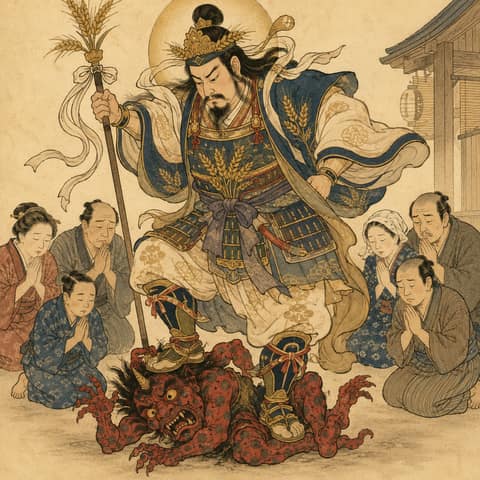
Measles Iconography: Demon-Trampling Aspect
Deities & Divine SpiritsEdo periodA canonical image of Muginodo Daimyojin found in measles prints. A formidable deity subdues a red-black oni under both feet while onlookers press their hands in prayer. Though the god’s origins are unclear, the image renders the disease visible and calms anxiety through the act of trampling. The accompanying text lists convalescent care, dietary restrictions, and prayers for recovery, blending devotion with practical guidance. The design reflects the plain sincerity of folk belief.

伝説 Datsue-ba
Datsueba
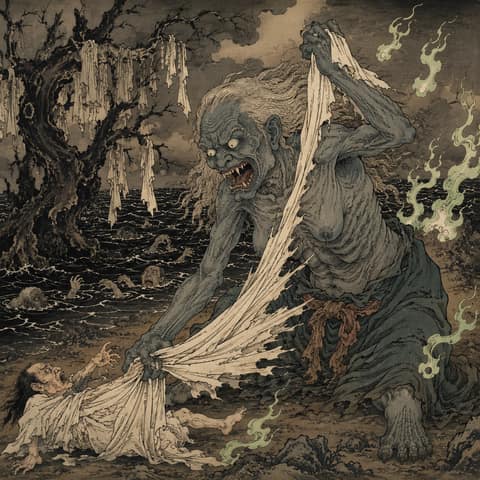
The Hag of the Sanzu River
霊・亡霊偽経発祥の三途の川の老婆、日本成立だが在地発祥地なしHer Place in Religious History as an Apocryphal Figure. The base description mentioned that the *Sutra of Jizo and the Ten Kings* marks Datsue-ba's first appearance; here, we delve into her status as an "apocryphal" figure. Though apocryphal sutras (gikyo) were not officially canonized in the Buddhist Tripitaka, they were mass-produced at the crossroads of folk religion, esoteric Buddhism, and Pure Land ideology. While the *Sutra of Jizo and the Ten Kings* was based on a Chinese Tang Dynasty text, it underwent meticulous Japanese localization by introducing Datsue-ba, Kenne-o, and the Eryoju tree. Apocryphal texts should not be dismissed merely as "fake sutras"; today, they are re-evaluated as vital religious resources that absorbed the masses' thirst for a comprehensible afterlife and salvation, significantly propelling the development of medieval Japanese Buddhism. The Technology of Visualizing Underworld Judgment. The entire apparatus—Datsue-ba, Kenne-o, the Eryoju tree, the six-mon toll, the Sanzu River—is a brilliant epistemological design by ancient Buddhism to materialize and translate the abstract concept of "karma." The three-stage translation—stripping the clothes → hanging them on a tree → weighing the sin by how much the branch bends—converted "invisible karma" into "the visible bending of a tree branch." This became an indispensable visual asset for medieval Buddhist monks when conducting *etoki* (picture explaining) with narrative scrolls. Preachers from the Pure Land, Ji, and Zen sects would point to these scrolls, explaining the mechanics of judgment to the common people. This historical practice forms the very core of Japan's collective view of life and death. A Comparison of East Asian River-Crossing Underworld Views. The structure of the Sanzu River and Datsue-ba is positioned as a variant of the East Asian "river-crossing" underworld motif. Stories of the dead crossing a river exist in China and Korea, but the Japanese trinity of Datsue-ba, Kenne-o, and the Eryoju tree exhibits extraordinary originality. It is fascinating to compare this with the River Styx and the ferryman Charon in Greek mythology, serving as material to explore the anthropological universality of river-crossing underworlds. The imagination that "the dead must cross a river" shares a common matrix in human societies built around large river basins, yet each culture carved out its own unique, localized judgment machinery. The Hayarigami Phenomenon at Shoju-in: A Social History of Urban Buddhism. The massive popularity of the Datsue-ba statue at Shoju-in (Naito Shinjuku) from 1849 through the Meiji era is a crucial case study for understanding the social history of urban Buddhism in the Edo period. Edo was a world-class metropolis with over a million residents; infectious diseases like tuberculosis and cholera were rampant, meaning the urban poor lived side-by-side with the fear of sudden death. The rumor that Datsue-ba possessed the miraculous power to "stop coughs" exploded as a folk remedy for respiratory illnesses, drawing endless lines of worshippers to her wooden statue. At the end of the Edo period, Datsue-ba was not the only figure to become a *hayarigami* (fad deity); O-Take Dainichi Nyorai and Mimeguri Shrine also experienced similar booms, serving as key phenomena for deciphering the collective psychology of the masses during times of political and social turmoil. The "Cotton Hag" and the Symbolism of Cloth. The Datsue-ba statue at Shoju-in was dubbed the "Cotton Hag" because worshippers draped cotton over her head and shoulders. This presents a fascinating inversion of the symbolism of cloth for a hag whose very name means "clothes-stripper." Datsue-ba is fundamentally a monster that *takes* clothes, yet the masses reversed this by *offering* her cotton (new cloth) in exchange for curing their coughs and ensuring good health. The binary opposition of "stripping clothes" versus "offering clothes" was masterfully reconciled in folk religion. If illness is something that "strips away health," then the folk logic dictates: "I offer you clothes, so please take my illness away." The statue brilliantly completed a flexible religious metamorphosis from a strict underworld judge in Buddhist scripture to a benevolent scapegoat deity in local folklore. Late Edo Woodblock Prints and Publishing Culture. Throughout the Kaei, Ansei, Man'en, and Bunkyu eras of the late Edo period, the Datsue-ba of Shoju-in was heavily depicted in nishiki-e (color woodblock prints). Edo's publishing culture swiftly commercialized the fad deity, building an industrial structure that tightly linked plebeian faith with consumer culture. The Datsue-ba prints functioned simultaneously as religious souvenirs, proof of pilgrimage, and media for spreading information, driving the gears of Edo's urban economy. At the intersection of Buddhist philosophy, folk religion, urban consumerism, and the publishing industry, Datsue-ba transcended the realm of a mere "underworld hag" to become a master key for decoding the collective mindset of Edo society. Datsue-ba's Rebirth in Modernity. In post-war yokai literature, horror, anime, and games, Datsue-ba has been repeatedly reshaped. The apocalyptic panics, pandemic fears, and confusion regarding life and death in the 21st century share a structural resonance with the anxieties of medieval and early modern people. The visceral imagery of Datsue-ba "stripping clothes to measure sins" retains a formidable evocative power. Resurrected in the modern weird fiction of authors like Natsuhiko Kyogoku, Baku Yumemakura, and Fuyumi Ono, as well as in subcultures like the game *Okami* and the *Touhou Project*, Datsue-ba continues to serve as a vital nexus connecting the religious imagination of the past with the pop culture of modern Japan.

伝説 Tsukumogami
tsoo-KOO-moh-gah-mee
Tsukumogami (Classical Depiction)
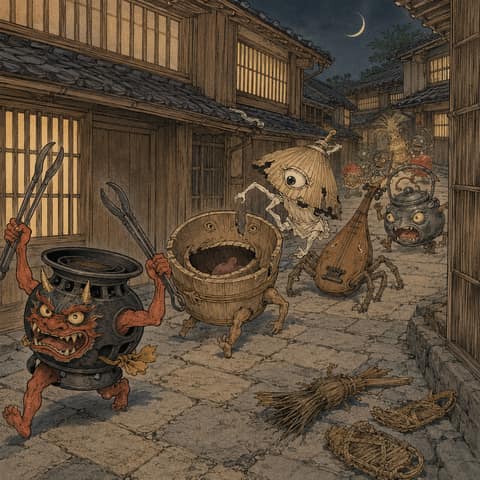
Household SpiritsMedieval Japan, chiefly the Kinai regionRooted in Muromachi-period picture scrolls, this portrayal centers on tools and household objects that gain spirit through long use. When discarded carelessly, they bear resentment and cause disturbances, yet they can be calmed by Buddhist rites, prayers, or renewed respectful use, and may act protectively thereafter. The number of one hundred years is symbolic, expressing the accumulated time that grants spiritual potency. Their forms vary widely—humanoid, demonic, bestial—with everyday implements such as braziers, washbasins, and sake pourers often depicted transforming. Although the name spread less in the early modern era, tool-spirits continued to appear in Night Parade of One Hundred Demons imagery, reflecting attitudes toward tools and impermanence. Local names are not fixed, and sources chiefly trace to the Tsukumogami picture scrolls and old glosses. The tales avoid fanciful additions, serving as moral lessons urging people to cherish and respect their tools.

名妖 Uwan
OO-wahn
Emaki Manifestation Type (Mansion Apparition)
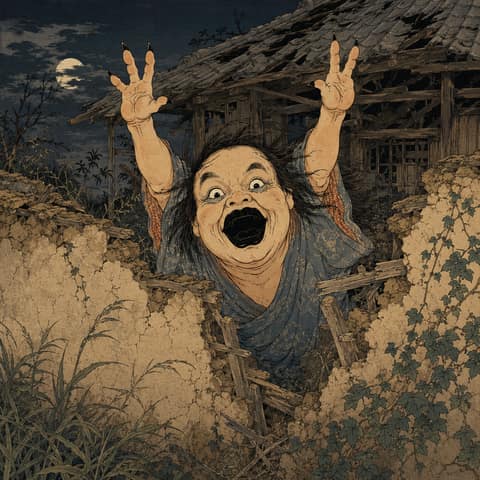
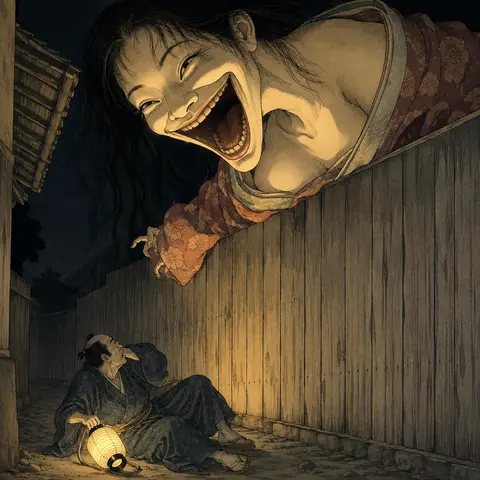
Household SpiritsJapanese folkloreA reconstruction based on Edo-period yokai picture scrolls. Depicted with a humanlike face marked by iron-blackened teeth, raising a three-fingered hand, appearing from behind fences or in ruined houses and shouting “uwan.” No early sources clearly state direct harm to people; its main behavior is appearing and intimidating. Because of similar regional names and frequent mansion backdrops, it is sometimes taken as a house-dwelling entity, but this is unproven and the portrayals are spare. Later creative tales—such as being driven off by a retort or killing victims—should be treated separately from the core record.

名妖 Otoroshi
oh-toh-ROH-shee
Iconography from Picture Scrolls (Early Modern Tradition)
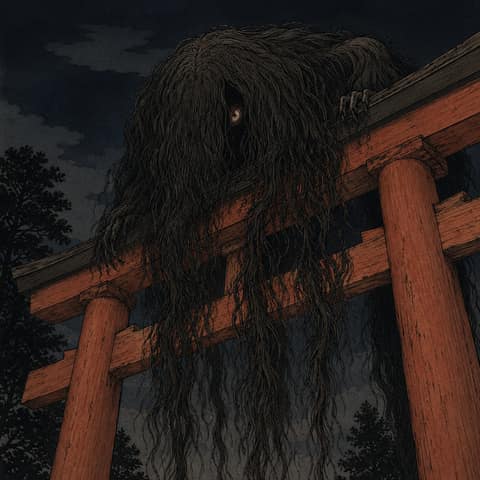
総称・汎称UnknownOrganized around forms depicted in Edo-period picture scrolls and picture sugoroku. Long hair covers the entire body, with bangs hanging down to obscure the face. In works like Hyakkai Zukan and Gazu Hyakki Yagyō it appears on the same page as Waira, suggesting a shared sound and sense of fear. Names such as Otoroshi, Odoro-odoro, and Keiippai are listed together, implying variation from differing readings of repeating marks. Specific locales, deeds, or omens cannot be inferred from the images; some show it atop a torii, but no sources conclusively assign it a punitive divine role. In folk thought, it is seen as a form shaped by the notion of odorogami (bristling hair) and the language of fear.

名妖 Shōkera
SHOH-keh-rah
Traditional Iconography Interpretation
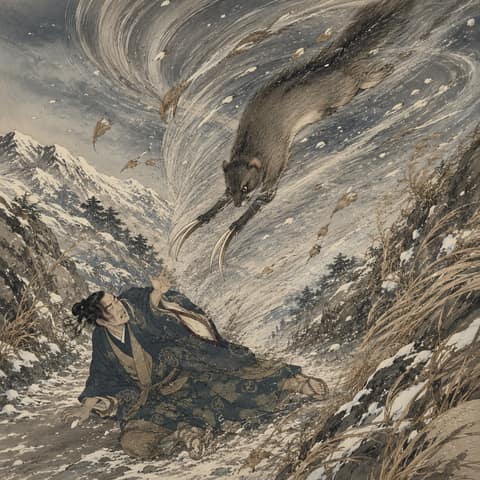
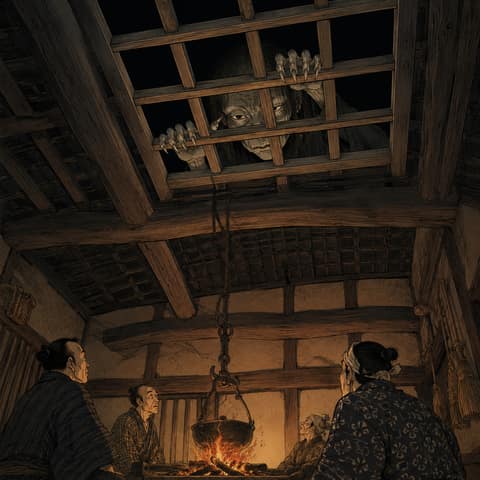
霊・亡霊Japanese folkloreBased on Toriyama Sekien’s depiction, this interpretation frames the yokai as a watchful presence peering through a skylight during Kōshin night. It is identified with the Sanshi or treated as a spiritual agent acting on their behalf, examining human sloth and broken vows and, upon transgression, bringing misfortune with sharp claws. The name also appears in historical kana as “Shaukerá” or “Seukerá,” and its concrete form varies by region and source, yet it is positioned as a yokai that visualizes the normative ethos of Kōshin belief. Early modern sources offer little explanatory text, with later folkloric readings filling the gaps.

名妖 Nuppefuhofu
NOOP-peh-FOH-hoh-foo
Traditional Image (E-maki Source Fidelity)
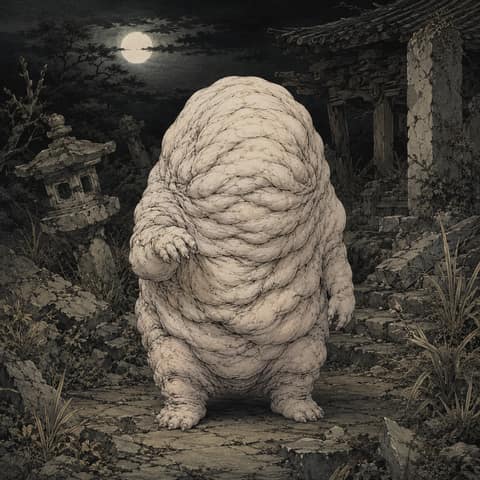
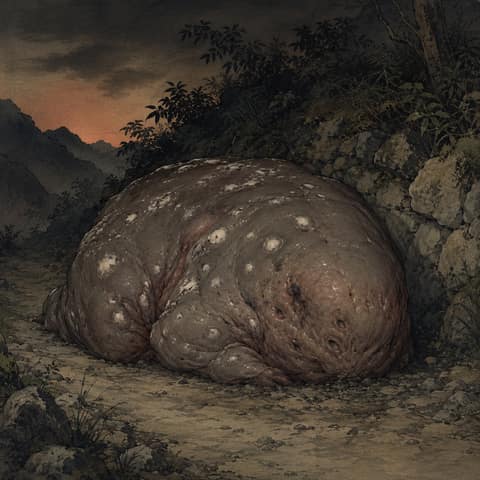
General ClassificationsJapanese folkloreA typical form based on Edo-period yokai picture scrolls. A one-head-tall, white, wrinkled mass stands upright with stumpy limbs and indistinct facial features. Only its name and image are preserved, so its behavior and intent are unsettled. In texts it is sometimes read as a prototypical faceless ghost (nopperabo), or noted as a transformation of an old toad or of foxes and raccoon dogs. Satirical books mention it “drinking the fat of the dead” or “disguising itself as a doctor,” but a broad regional tradition is hard to confirm. Claims of temple hauntings or a corpse-like stench likely stem from later interpretations, and firsthand accounts are limited. Its look is marked by powdery white skin and continuous folds of wrinkles.

名妖 Sazae-oni (Turban Shell Ogre)
sah-ZAH-eh OH-nee
Pictorial and Allegorical Representation (Sekien Edition)
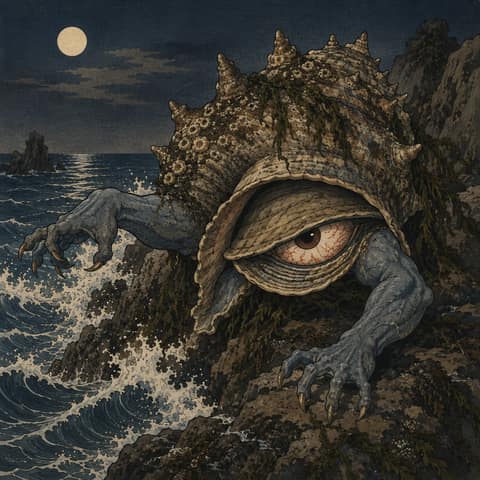
Animal ShapeshiftersJapanese folkloreA work by Toriyama Sekien that riffs on a transformation tale in the Book of Rites, caricaturing the principle by which a sea shell assumes a demonic aspect. Depicted as a turban shell with a human arm and an eye on its lid, it serves less as a harmful monster than as a visualization of ideas about metamorphosis and things-turned-spirits. It aligns with shell personifications in early modern Hyakki Yagyo paintings, conveying a sensibility that sees numinous presence in coastal nature. Later erotic ghost anecdotes are largely inventions and should be understood apart from this prototype.

名妖 Enenra
eh-NEHN-rah
Gossamer Smoke Sprite
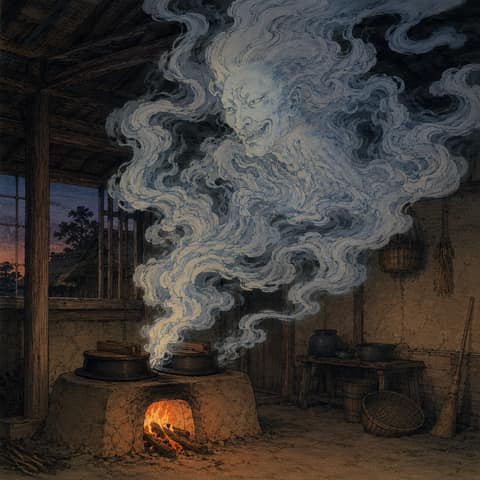
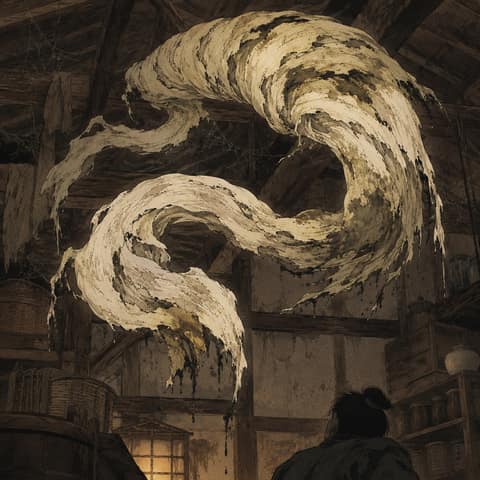
Household SpiritsJapanese folkloreBased on Sekien’s imagery, this interpretation highlights smoke layered like thin cloth coalescing into a human face. Rather than causing harm, it is better told as a sign pointing out imbalances in a household’s energy and as a warning about fire handling, which aligns with folk beliefs. It holds no fixed form, shifting with wind and temperature, with faces appearing and vanishing according to the viewer’s state of mind.

名妖 House Groans (Yanari)
yah-NAH-ree
Ienari (Traditional Depiction)
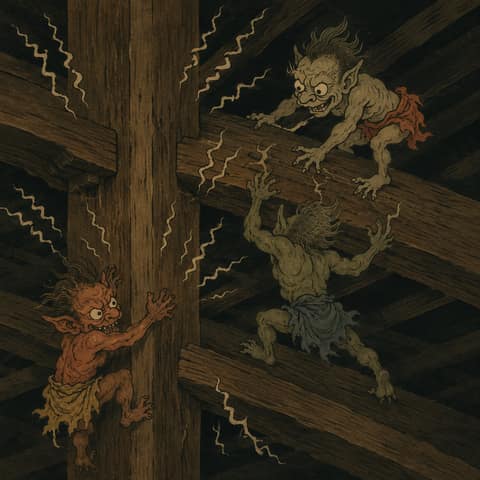
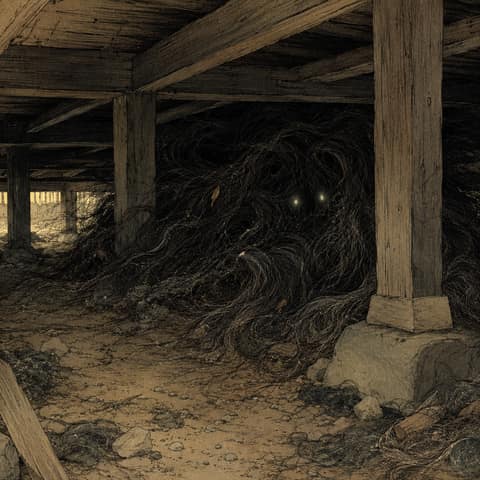
Household SpiritsVarious regions of JapanIn picture scrolls it appears as little goblins shaking beams and pillars, a visual rendering of the intangible phenomenon of creaks and tremors within a house. In actual lore it is often told as the house itself rumbling without a fixed cause, though in some regions it is tied to animal curses, the misdeeds of residents, or signs of spirits lingering on the estate. It is said to occur late at night, especially around the Dead of Night, and noises arising at vital spots such as the hearth, storehouse, or armory were feared as ominous. Quiet sitting or sutra chanting, checking and offering for the crawlspace, and purifying beams and pillars are said to calm it, but if it persists, moving house is sometimes recommended. Traditional advice warns against hasty causal claims, urging first a review of the property’s lineage and proper rites to ancestral and household deities.

名妖 Kyōkotsu (Mad Bone)
KYOH-koh-tsu
Sekien Zue Version
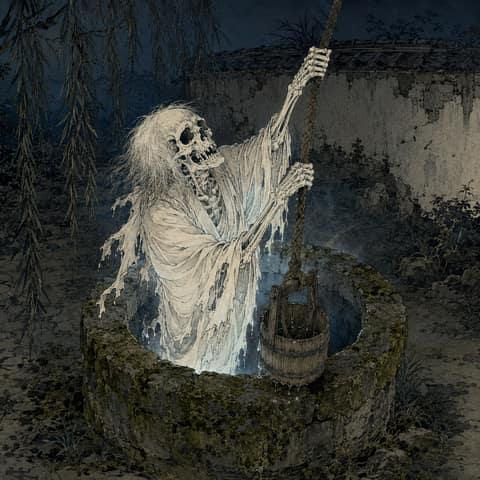
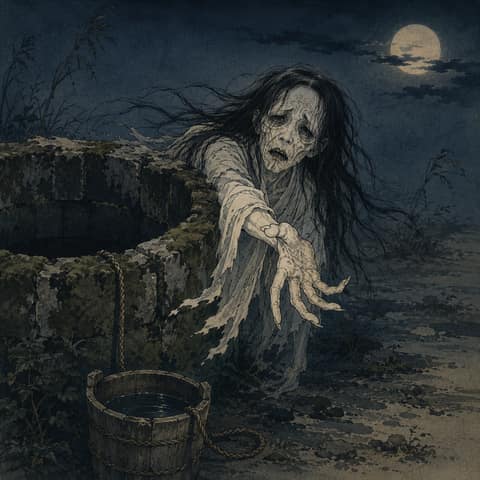
Animated Objects & UndeadEdo periodA form named and illustrated by the Edo-period artist Toriyama Sekien, who depicted white bones in a well as “Kyōkotsu.” The motif shows a skeleton in white garb linked to a bucket rope, rising from the well’s depths, often accompanied by phrases stressing violent grudge. Oral tradition for a proper name is sparse, and the figure likely arose from the linkage of image and words (dialect “kyōkotsu,” the term for bare bones “髑髏/白骨”). Later writers attached explanations such as “bones discarded in a well” or “spirits of the drowned or those who fell,” but primary sources do not fix its nature. Its eeriness as a skeletal image is emphasized, foregrounding symbolism over spiritual rank.

名妖 Kinrei (and Kintama)
kee-NREH
Kinrei • Kintama, Curated Tradition Edition
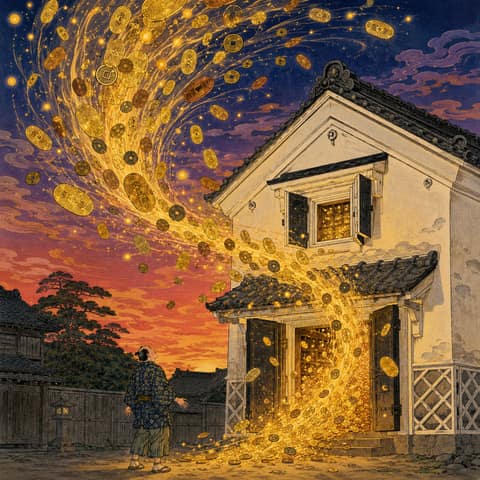
Ghosts & SpiritsAcross Japan (noted in Edo, the Kanto region, and Suruga)Kinrei appears in Edo-period art and commentary as a spiritual notion symbolizing the reward for moral practice, with household prosperity explained as part of a heaven-given order. Rather than a visitor like a tangible kami, it is understood as the auspicious aura born of selflessness and good deeds. Kintama, by contrast, is told across regions as a strange fire or orb-like visitant that brings luck to a home when respectfully enshrined, yet turns ominous if scraped or damaged, a taboo tied to its form. Early chapbooks and ghost collections depict swarms of coin-spirits drifting in the evening sky, or a roaring sphere flying in to enter the honest. Postwar retellings often link it to the rise and fall of household fortunes, but older records stress symbolic meaning and will-o’-wisp tales. Because names and traits overlap among regional traditions, sources differ in how they use “Kinrei” and “Kintama.”

名妖 Akaname
ah-kah-nah-meh
Bathhouse Grime-Goblin
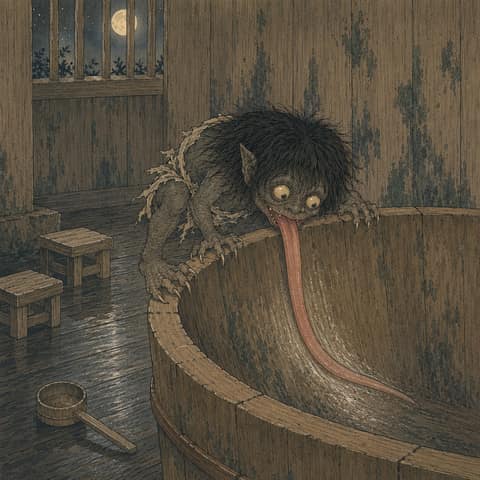
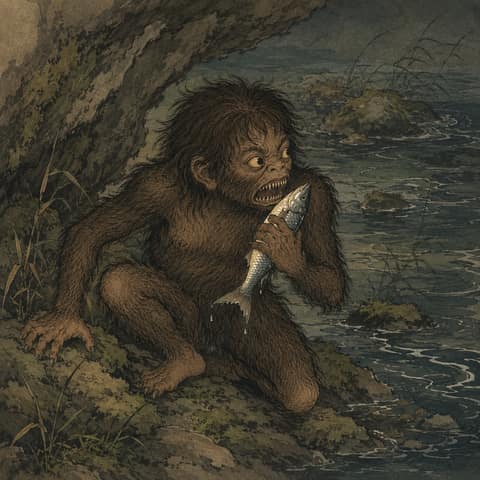
Household SpiritsVarious regions of Japan (especially Edo traditions)A canonical form based on Sekien’s imagery and Edo-period prints. Resembling a cropped-haired child, it has clawed feet and an unusually long tongue. It avoids people, appears on deserted nights, and laps up bath scum and mineral scale, leaving wet tongue trails and a strange odor as its trace. Direct harm is rare; it is often seen as a presence that urges residents to clean.

名妖 Tall Woman
tah-kah-OHN-nah
Iconography-True (Sekien-Based)
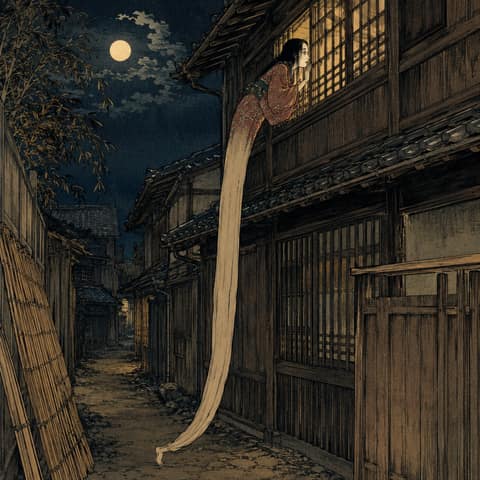
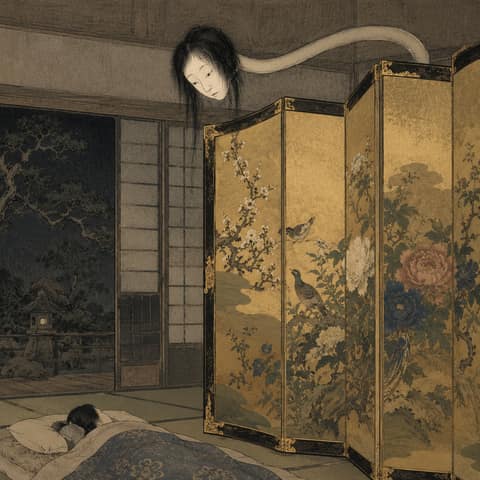
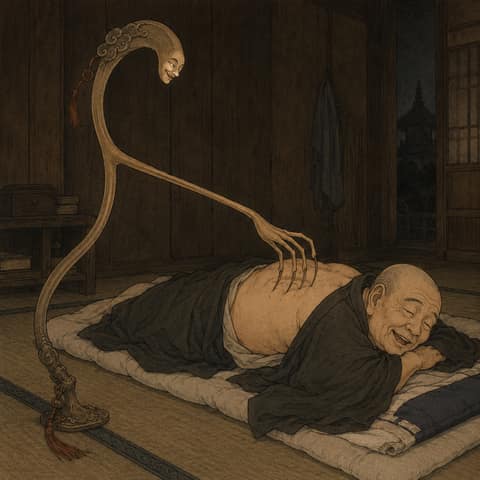
Household SpiritsJapanese folkloreReconstructed strictly from Sekien’s original image while preserving the absence of contemporaneous commentary. The figure is a gaunt woman whose body from the feet to the hips stretches like a serpent, extending from an alley up to the second-floor lattice of a townhouse to peer inside. Her actions are chiefly to startle, with no fixed malice. Regional proper names are uncertain, and later popular tales (brothels, satire, etc.) are treated as accretions. She is understood as a symbolic apparition that exploits nighttime quiet and architectural features, instilling unease in residents through her gaze.

名妖 Snake-Bone Hag
jah-KOHTS-bah-bah
Sekien Iconography Standard
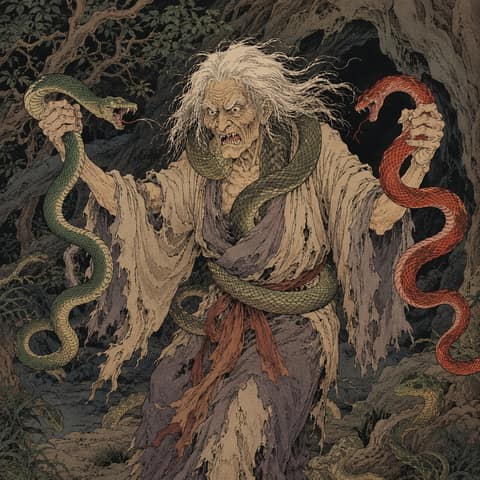
General ClassificationsJapanese folkloreJakotsubā is a name based on the image and brief note in Toriyama Sekien’s Konjaku Hyakki Shūi (late 18th century), without any specific oral tradition attached. The picture shows an old woman wreathed in snakes. The note mentions the Shanhai Jing’s account of the Wuxian people in the Overseas West Classic, citing those who hold a blue snake in the right hand and a red snake in the left, yet it stops short of directly identifying this old woman. The term itself appears in early modern chapbooks and theater as a derogatory label for an old woman, which Sekien likely molded into a yokai. Later encyclopedias claim she is the wife of “Snake Goemon,” that the blue snake freezes and the red snake burns, but these are embellishments inspired by Sekien’s wording, not grounded in cited tradition. Folklorically it visually aligns with the lineages of “oni-baba” and “snake bride,” but because no rites, taboos, or place-names unique to Jakotsubā are identified, academic treatments handle it as source-undetermined.

名妖 Red Tongue
AH-kah-shah
Iconographic Tradition: Akazashita (Toriyama Sekien lineage)
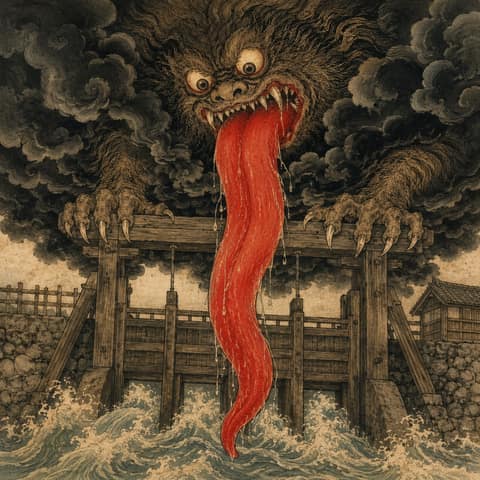
General ClassificationsVarious regions of Japan (sources uncertain)Akazashita is a rare case where imagery precedes textual records. Its core features are a colossal tongue thrusting from black clouds and a bestial face. Toriyama Sekien placed this figure over a sluice gate, and later scholars offered symbolic readings drawing on notions of filth such as scum and grime and on proverbs that cast the mouth and tongue as gates of calamity, but Sekien left no notes. In many early modern sources the sluice gate is absent, and the name wavers between Akazashita and Akakuchi. Links to the Onmyodo guardian name Akazashita-shin of the Grand Duke direction or to the Rokuyo day Akakuchi have been noted but cannot be firmly genealogized. Since the Showa era, fable-like explanations and local tales have spread, yet statements beyond the base sources should be avoided.

名妖 Great Zato (The Blind Masseur Yokai)
OH-zah-TOH
Sekien Zue Version
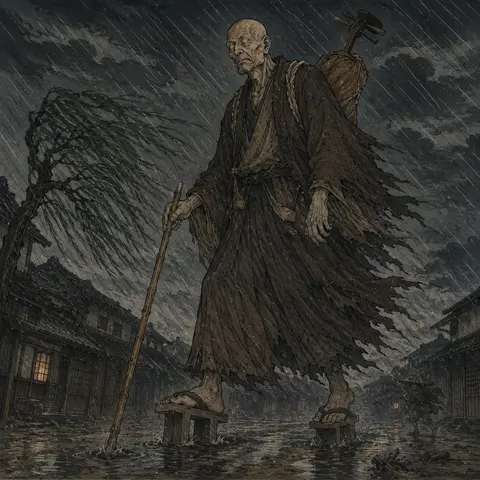
人妖・半人半妖Edo periodAn interpretive version based on one plate from Toriyama Sekien’s Konjaku Hyakki Shūi. It depicts a blind lute-priest in tattered hakama and wooden clogs, staff in hand, traveling the roads on stormy nights. A marginal note mentions plucking the shamisen in brothels, reflecting ties between early modern urban pleasure quarters and performing guilds. Folklorically, it blends visual othering with social satire, presenting a visage of the age more than a tale of uncanny powers. Kenji Murakami notes the othered image of the nocturnal zatō, while Katsumi Tada reads a “demonic” aura of enforcement from their shogunal protection and involvement in finance. Neither grants concrete supernatural powers, emphasizing a presence that appears on rainy nights and overawes the heart.

名妖 Great Head
OH-oh-KOO-bee
Hybrid Sources, Record-Grounded Version
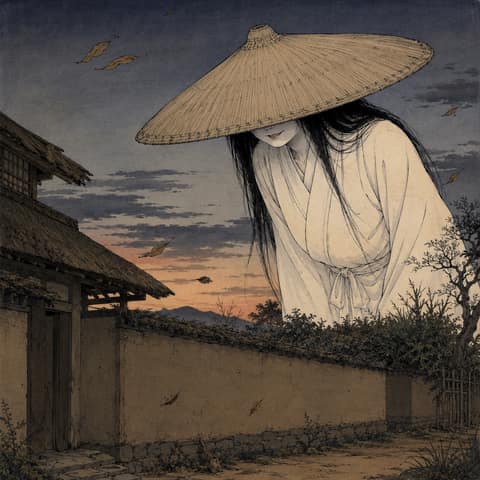
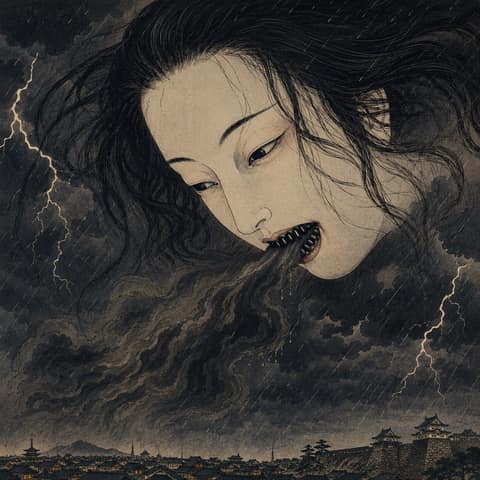
Ghosts & SpiritsVarious provinces (attested in Edo, Kaga, Nagato, and elsewhere)The Okubi is a type formed where images and records intersect. While Sekien’s depiction is noted for satire, Edo-period tales and essays contain many independent accounts of a gigantic woman’s head appearing. Common traits include manifesting during shifts in the heavens such as rainy nights, thunder, or moonrise, fixing itself to walls, doorways, or midair, the depiction of blackened teeth indicating a married woman, and a chill, stench, and dampness when approached. Its true nature is unsettled, described either as a spirit shaped by grudge or as fox or tanuki sorcery. Malice varies, from mockery, glaring, and breath that causes malaise to mere display before vanishing. Physical attacks rarely take effect, with reports of little resistance when stabbed. It is widespread in regions such as Chubu, Chugoku, and Kanto, without becoming a localized deity. The modern image of a “flying Okubi” owes much to Sekien, yet old texts also record appearances on the ground and indoors.

名妖 Great Spider
OHH-goo-moh
Great Spider of Mountain and Wilds
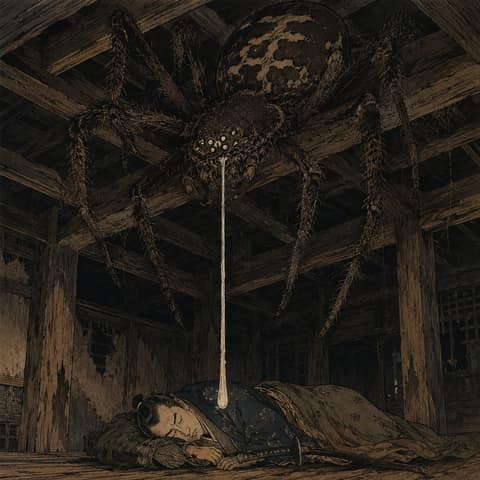
Animal ShapeshiftersVarious regions of Japan (mainly mountain areas and around temples and shrines)A tradition-grounded composite of spider apparitions said to gain occult power through great age, lurking in mountain passes, temple rafters, and caves. Appearances range from an ordinary spider grown enormous, to a hairy arm extending from the ceiling, to an old woman in human guise. Avoiding notice, it moves by night, saps vital energy, and binds victims with silk. In slaying tales it often retreats after its limbs are severed by blades, or reveals its true form and is later found as a corpse. Names and lairs vary; reports surface sporadically in local curiosities and essays. Though terms like yamagumo and tsuchigumo sometimes overlap, here it refers broadly to eldritch old spiders.

名妖 Ceiling Licker
TEN-joh-NAH-meh
Traditional Interpretation (after Sekien Toriyama)
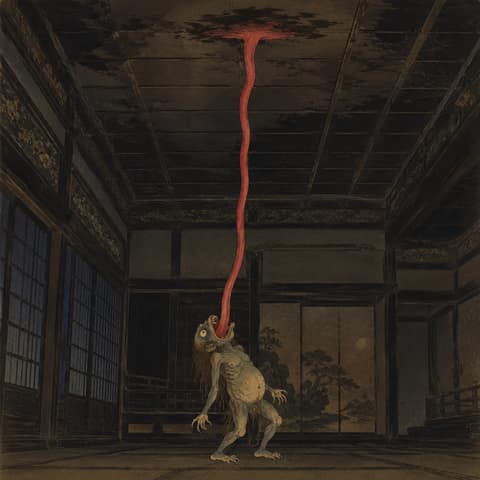
Household SpiritsEdo periodAn interpretation based on Toriyama Sekien’s picture book: a being that lets a long tongue hang down and roams old houses licking the ceiling. Rather than harming people directly, it is portrayed as bringing chill, gloom, and dampness into rooms. Its iconography is traced to a Muromachi-period Night Parade of One Hundred Demons scroll showing a creature extending its tongue upward, and later Edo-to-modern compendia ascribed to it the habit of licking away stains, soot, and cobwebs from ceilings. No proper name, lineage, or origin myth survives; it is taken as a symbol of household hauntings in general. Tradition places it in sparsely occupied buildings such as old temples and mansions, with wet streaks and speckles appearing on boards at night cited as its traces, though a firm regional folklore core is hard to confirm.

名妖 Painted Buddha
NOO-ree-boh-TOH-keh
Canonical Traditional Iconography
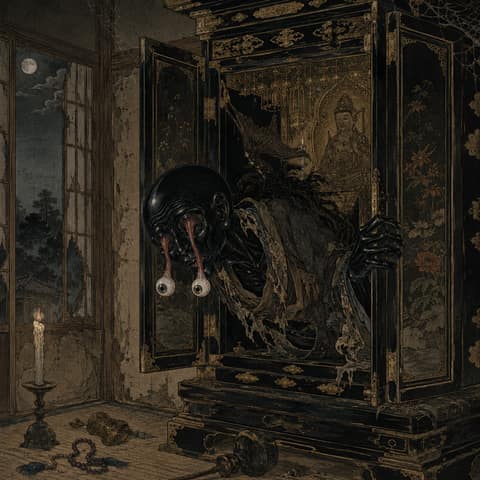
Household SpiritsJapanese folkloreBased on Edo-period yokai picture scrolls: a monk-like figure lacquer-black in color with protruding drooping eyes, accompanied behind by hairlike or fishtail-like elements. Most sources lack commentary, leaving its nature and origins unclear. In Sekien’s depiction it emerges from within a household Buddhist altar, which later encouraged reinterpretations as a possessed object or tool-spirit, though the original intent is uncertain. Accordingly, it is treated as an image embodying anxieties and awe surrounding domestic ritual spaces, with abilities limited to what the images suggest.

名妖 Shirōneri
shee-ROH-neh-ree
Based on Sekien’s Illustrations
Animated Objects & UndeadJapanese folkloreAnchored in Toriyama Sekien’s imagery, this version sees an aged dishcloth trailing long and fluttering in the wind, reimagined as a yokai. The original illustration offers little about harming humans, so it is understood as a symbol of attachment to old objects and the impermanence of things. Aggressive traits found in later ghost tales should be kept separate; here the focus is the eerie nature of a “moving old cloth” and the visual impression of it gliding between walls under a night lamp.

名妖 Biwa Bokuboku
BEE-wah BOH-koo-BOH-koo
Canonical Iconography
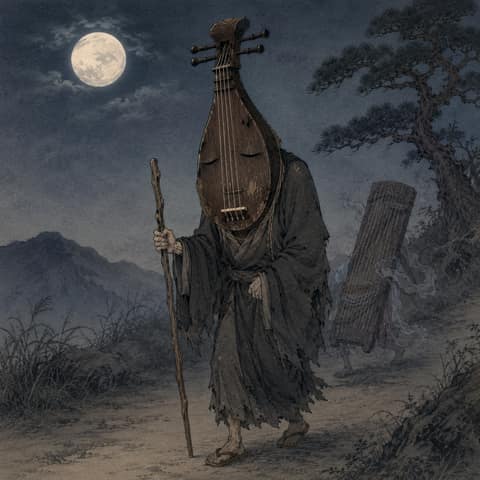
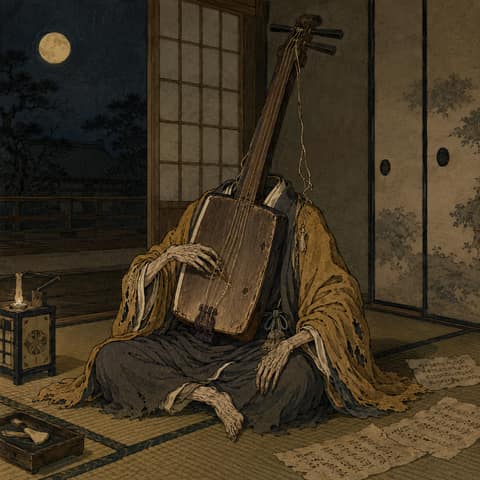
Animated Objects & UndeadJapanese folkloreA standard reading grounded in Sekien’s imagery and the lineage of Muromachi picture scrolls. A biwa long played and cherished attains spirit, joins the night parade clad like a blind lute priest. Its tone captivates the heart and carries an allegory urging awe and respect for venerable instruments. It does not hinge on particular biographies or local lore; praise of crafted objects and cautionary reverence are its themes. Tales tied to famed instruments such as Genjō and Makiba serve only to frame the tsukumogami worldview, while the conduct of the Biwa Moku-moku itself survives chiefly in pictorial form. In images it walks with eyes closed, leaning on a staff, sometimes paired on the same spread with a koto tsukumogami.

名妖 Menreiki
MEN-ray-kee
Classical Iconographic Interpretation
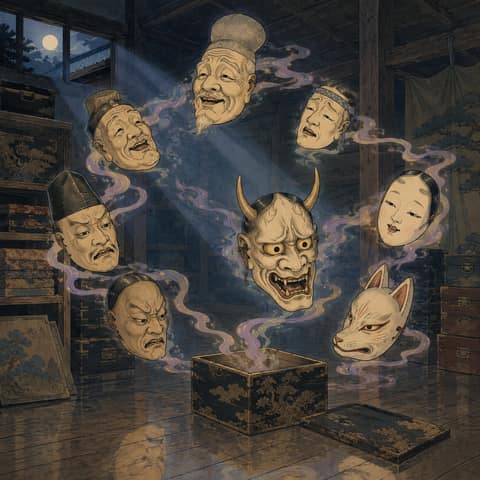
Animated Objects & UndeadJapanese folkloreBased on Toriyama Sekien’s illustration and notes, this version interprets Noh and Sarugaku masks as having accumulated vital aura over long years. The spiritual qi residing in the masks is said to rise at night, slip out from shelves and boxes, line up, and dance. They do not harm people without cause, showing resentment only when treated roughly, a later tsukumogami-like trait, yet at its core the phenomenon is an allegory for the living vitality born from the masks’ refinement. In households that revere the arts, they are enshrined and purified, with words of blessing offered during airing and maintenance to calm their numinous power.

名妖 Keukegen
KAY-oo-kay-gen
Kehakigen (Traditional Version)
General ClassificationsJapanese folkloreA hair-covered apparition of uncertain origin first depicted in Sekien’s illustrated compendium. Its name implies “seldom seen,” and this rarity is considered its defining trait. Later links to dampness or illness are editorial interpretations without firm oral tradition. Adhering to the original source, only its appearance and rarity are treated as certain.

名妖 Kejōrō (Hair Courtesan)
keh-JOH-roh
Printed Edition – Sekien School Variant
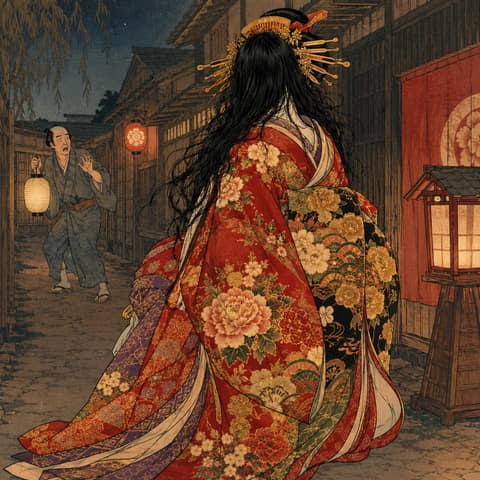
Household SpiritsEdo periodA canonical image based on Toriyama Sekien’s illustrations and Edo kibyoshi. Dressed like a courtesan of the pleasure quarters, its hair grows unnaturally long to shroud the body so the face cannot be discerned. Born from urban satire centered on Yoshiwara and a pun linking courtesans with shapeshifters, it appears as a literary construct with no proper name or origin tale. Sometimes read as a faceless yōkai, it serves as a symbol that reverses the viewer’s desires and assumptions. Sources are primarily printed editions, with scant oral tradition.

名妖 Mokumokuren
MOH-koo-moh-koo-REN
Toriyama Sekien Zue–Conformant Edition
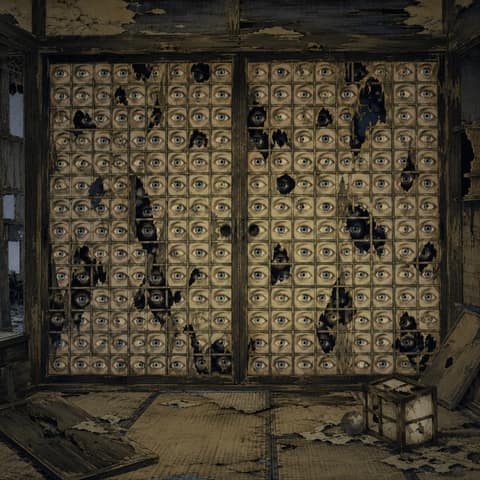
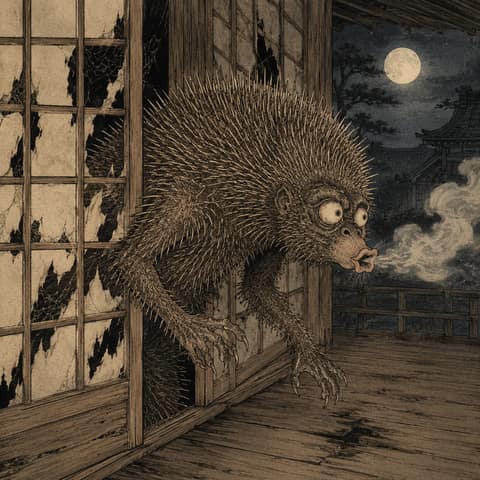
Household SpiritsJapanese folkloreReconstructed from Toriyama Sekien’s imagery and captions as a swarm of disembodied eyes gathering on the shoji of a ruined dwelling. Rather than inflicting direct harm, it unsettles by staring. It is mediated by domestic neglect and unappeased sentiments, yet belongs to a generalized lineage of house-haunts not tied to specific individuals or locales. This reading also aligns with later variations in collected names and with links to visual illusion phenomena.

稀少 Bake no Kawagoromo
ba-ke no ka-wa-go-ro-mo
The Dipper-Worshipping Fox of Transformation — Bake no Kawagoromo
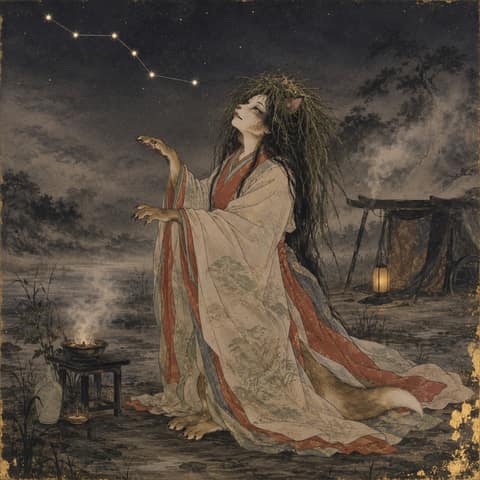
Animal ShapeshiftersUnknown (a fox-transformation figure recorded in Sekien’s Hyakki Tsurezure Bukuro)This version reads the Bake no Kawagoromo through a single point — the fox that transforms by worshipping the Dipper — and follows the rite of its making and the layers of wit folded into the picture. The passage in the Nuogaoji of the Youyang Zazu, the other source, speaks of more than a skull and the Dipper. There the wild fox is called the “purple fox,” and it is said that “when it strikes its tail at night, fire comes forth.” This stroke of fire from a fox’s tail runs continuous with the foxfire so familiar in Japan; behind the Bake no Kawagoromo, too, stands a fox that should by rights be eerie — kindling fire at its tail in the dark, a skull upon its head. When Sekien exchanged that skull for algae, the dread of the bones faded, and in its place came the comedy and pathos of a creature crowned with weed from the water’s floor. That the picture of transformation leans toward the droll rather than the uncanny is the effect of this single substitution. The word “kawagoromo” itself carries the literary turn Sekien favored. Speak of a kawagoromo, and the most famous in the classics is the “fire-rat’s robe” of the Tale of the Bamboo Cutter — that treasure which burns when set to flame and, if counterfeit, betrays the fraud. It and this fox, whose disguise is about to peel, answer one another twice over through the words “kawagoromo” and “bake no kawa.” There is no written proof that Sekien meant to invoke the allusion, but given how thoroughly his picture-books tread upon classical puns, it is hard to take for mere chance. The placement of the image, too, shows the author’s intent. In the first volume it sits between the “Kutsutsura” and the “Kinu-danuki.” Flanked on both sides by transforming beasts, this run forms a small province set within a book of tool-spirits, given over to the transformations of animals. A fox could crowd in among the spirits of old utensils only because “kawagoromo” could be read as a garment, a thing; and by closing with “mused within a dream,” Sekien made this forced pairing follow, naturally enough, the logic of dreams. Its powers and its failings, too, are all rooted in this one picture. The rite of transformation requires prayer toward the Dipper and a vessel borne on the head (a skull, or algae); should the vessel fall, the change does not take. Dressed though it is as a beautiful woman, it cannot quite clear away the beast in its tail, its paws, its attendants — and that “about to peel” is this fox’s appointed weakness. The lowly wild fox, striving three thousand years to reach the figure of a beautiful woman, bears in itself all the longing and all the shortfall of that road.

稀少 Furari-bi (Wandering Flame)
foo-RAH-ree-bee
Furari-bi
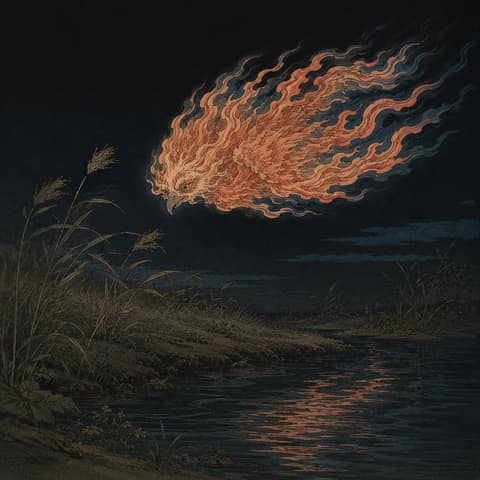
Natural Phenomena SpiritsJapanese folkloreBased on Edo-period picture scrolls, this version standardizes Furari-bi as a bird-shaped eerie flame wreathed in fire. It behaves more like a phenomenon than a corporeal being, with sightings reported from dusk through midnight. Confirmed cases of causing harm are scarce, and it shares common will-o’-the-wisp traits such as vanishing when approached and reappearing when one retreats. In Toyama it is called “Burari-bi,” often explained as a ghostly fire born from grudges or the unclaimed dead, though interpretations vary by region. The avian visage in the iconography is ambivalent, serving as a symbolic sign of the soul’s metamorphosis.

稀少 Saddle Fiend
KOO-rah-yah-ROH
Toriyama Sekien Plate Conformant
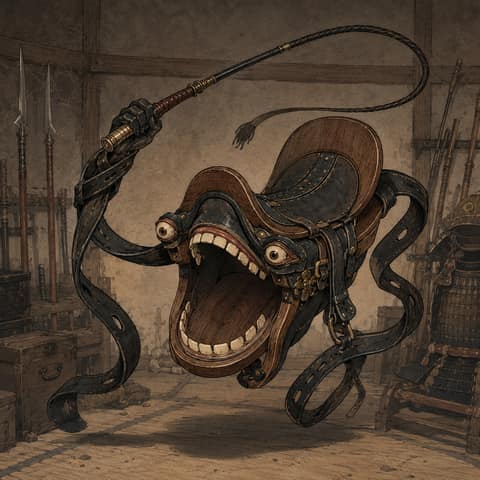
Animated Objects & UndeadJapanese folkloreAn image based on Toriyama Sekien’s Hyakki Tsurezurebukuro. The saddle itself forms the torso, accompanied by a caption indicating damage around the front bow. Eyes peer from the base of the stirrup leathers, and the mouth splits at the front bridge to reveal fangs. The hands are rendered as extended girth straps, grasping a whip at the tip. As a tsukumogami, it follows the early modern idea that old implements gain spirit through long use or resentment. The saddle, a nexus between lord and retainer and a vessel of battlefield memory, serves as a moral emblem warning against wrongful deaths and negligence. Paired with the stirrup mouth, it thematizes preparedness and care for one’s tack, with its monstrosity reflecting carelessness and impropriety like a mirror.

稀少 Himamushi Nyūdō
HEE-mah-moo-shee nyoo-DOH
Toriyama Sekien Iconography Reference
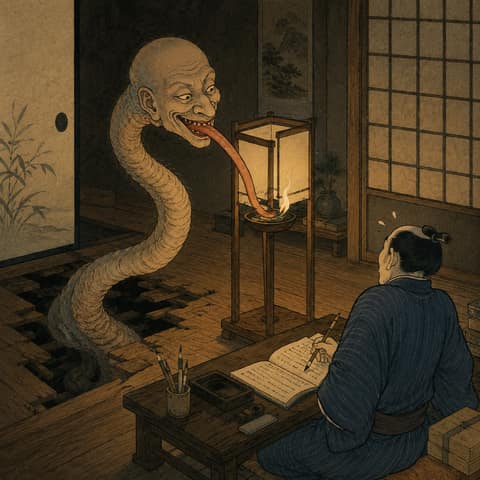
Household SpiritsEdo periodA reference edition compiled from the illustration and note in Toriyama Sekien’s Konjaku Hyakki Shūi. From beneath the floorboards extends the gaunt upper body of a nyūdō, lips slick, tongue reaching toward the saucer of an andon lamp. Its core origin is a didactic reading: the spirit of one who shirked labor appears nightly to lick the lamp oil, weakening the flame and hindering brushwork and needlework. The name connects to the letter-picture pun “Hemamushiyo Nyūdō,” suggesting a background in doodle play. In lived experience it overlaps with oil-loving bugs seen around hearths and kitchens, told as a being lured by darkness and the smell of oil. It causes no grave harm, preferring to make the flame waver, dampen the wick, and sap one’s focus. When spotted and scolded it shrinks back, a creature strongly inclined to hide in the shadows.

稀少 Fire-Quenching Crone
hee-KEH-shee-bah-bah
Sekien Iconography Edition
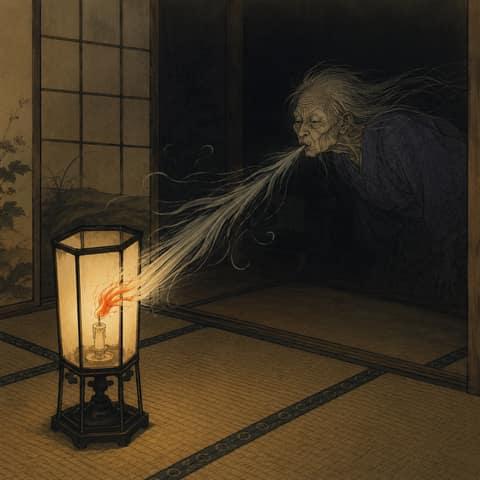
Half-Human BeingsEdoAnchored in Toriyama Sekien’s depiction of an old woman, this reading frames her as a being that bears Edo-period anxieties about fire use and the terrors of night. Fire was believed to purge impurity with a yang nature, yet accidental blazes became great calamities, so lamplight was strictly managed. The Fire-Dousing Crone personifies an “invisible hand” that presses upon daily vigilance. When a lamp at a banquet or in an inn’s parlor goes out, the event is narrated not as neglect or misfortune but as yokai intervention, symbolically restraining the vigor of flame. Sources vary on the name—“Fukkeshi,” “Fukikesh(i)”—all deriving from the act of blowing out a light. No tutelary deity or local origin tale is attached; references are mostly secondary, and in folklore taxonomy she sits as a variant of “lamp-light apparitions” or “parlor-room ghosts.”

稀少 Sea Zato (Blind Lute Priest of the Sea)
OO-mee-zah-TOH
Iconography-Based Tradition
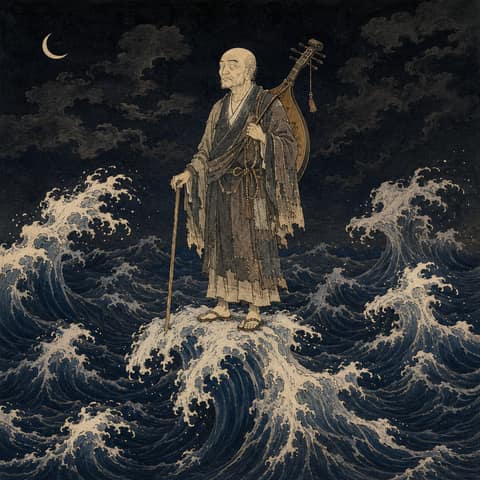
Aquatic SpiritsJapanese folkloreUmizatō survives only as an image in Edo-period picture scrolls and yokai paintings, with no transmitted nature or behavior. The motif shows a blind lute player standing upright amid waves, emphasizing the biwa and cane. From its visual traits, it is often read as representing the uncanny of encounters at sea and the absurdity of standing on unstable water. Kenji Murakami classifies it as a “yokai existing only in paintings,” noting possible overlap with sea-monk imagery. Accordingly, this entry is limited to iconographic details; concrete harms, benefits, rites, or banishment methods are not recorded.

稀少 Shell Child
KAI-chee-go
Iconographic and Encyclopedic Interpretation
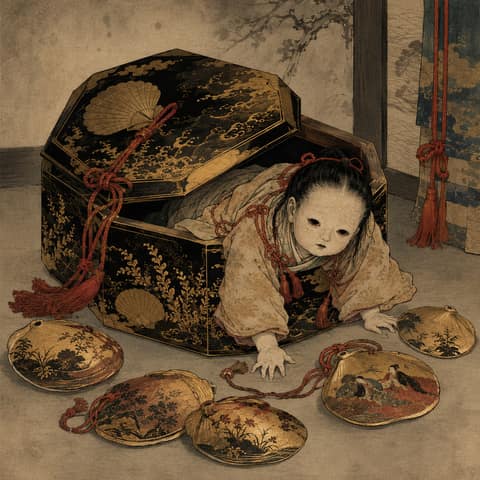
Household SpiritsJapanese folkloreRooted in Toriyama Sekien’s illustration and brief caption, this lineage reads the shell box through the history of kaiawase shells and bridal trousseau chests. Lacking firsthand anecdotes, it stays within the general tsukumogami frame, overlaying the folk view that long-serving objects acquire feeling. Its form is childlike, with a key association to crawling baby dolls. Late at night in a silent tatami room, the lid of the shell box is said to open slightly, and a small childlike figure peeks out. It causes little harm, and is said to vanish when household goods are treated carelessly.

稀少 Horned Washbasin Hanzō
TSOO-noh-HAHN-zoh
Gazu-tan, Sekien Edition
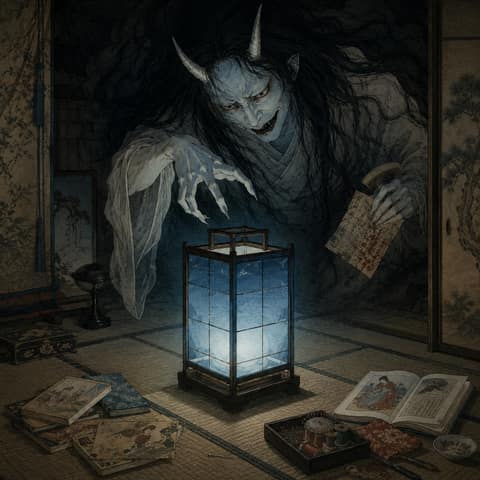
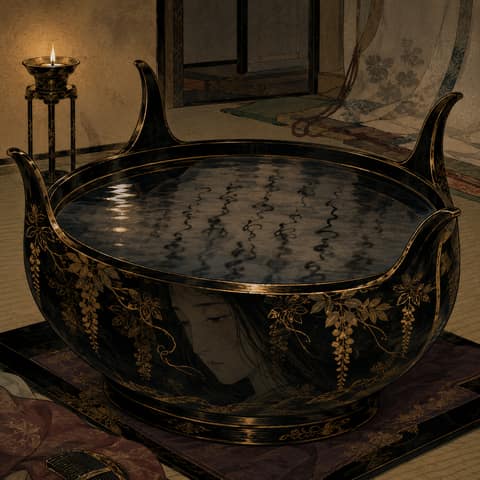
Animated Objects & UndeadKyoto Prefecture (associated tradition)An interpretation centered on Toriyama Sekien’s depiction of the horned washbasin figure. The rim of the jet-black basin rises like horns, and when lamplight is reflected on the clear surface, only deceitful characters added to a paper will blur and eventually dissolve away. As a tsukumogami of implements, it values human care and decorum, revealing its strange nature only when treated rudely. Rather than causing harm, it is said to expose hidden falsehoods. Echoing Noh and classical poetry, it is often shown alongside courtly cosmetics and writing instruments. Regional lore is scarce, with mentions largely confined to early modern picture compendia and encyclopedias.

稀少 Hatahiro
HAH-tah-HEE-roh
Emaki Source – Sekien Edition
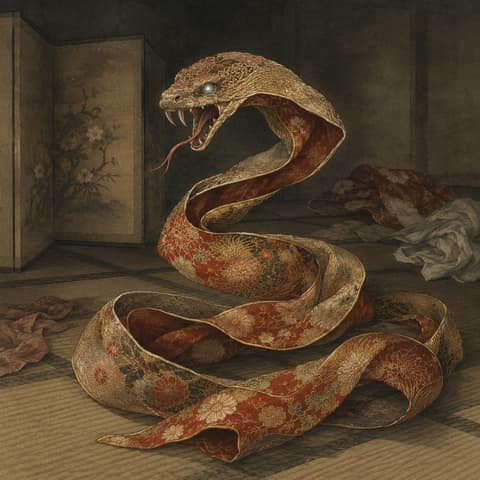
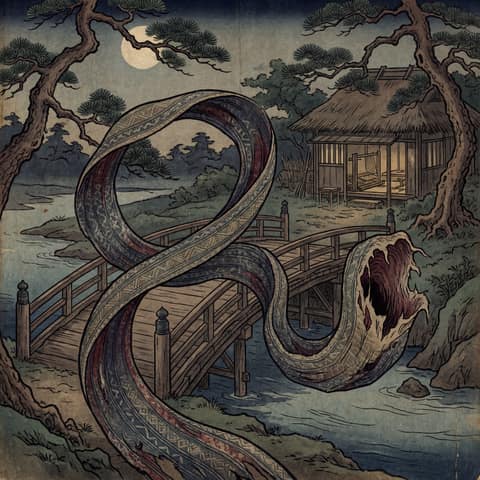
付喪神・骸怪Japanese folkloreA version based on the conceptual monster Toriyama Sekien presented through painting and notes. Resentment dwelling in a cloth takes serpentine form and wanders in search of its master, merging the symbolism of tool-spirits and snakes. As folklore data, independent oral accounts are scarce, so it remains a pictorial taxonomy that links tsukumogami tales with legends of loom sounds heard near water. Etymological notes mention associations with the performance term “nijūhiro” and wordplay, but firm sources are limited. Visually, a long bolt of cloth writhes into a snake shape, its tip commonly rendered like a tongue or a slit.

稀少 Kotofurunushi
koh-toh-koh-roo-NOO-shee
The Forgotten Tsukushi Koto, Kotofurunushi
Tsukumogami / MukurogaiFukuoka Prefecture (Former Tsukushi Province / Spirit of a forgotten Koto)This is the most orthodox and tragic interpretation of the Kotofurunushi, embodying the despair and sorrow of the "Tsukushi Koto" buried in the darkness of music history by the rise of the genius Yatsuhashi Kengyo. This Kotofurunushi is not a savage yokai that attacks and devours humans. Its true horror and melancholy unfold quietly deep within unvisited storehouses or ruined mansions late at night. In the darkness, the old koto—abandoned for years, cracked, and covered in dust—begins to tune itself without the help of any hands. Then, the countless snapped and frayed strings writhe like living creatures, or like the black hair of a vengeful female ghost, and begin to play the archaic, heavy, obsolete melodies of the "Tsukushi school" that modern humans can no longer comprehend. That tone, mixing the pride once loved by aristocrats and high priests with the raw despair of now being ignored by everyone, induces a heart-wrenching, intense nostalgia and psychological unease in anyone who hears it. The goal of the Kotofurunushi is not revenge, but the pure and maddening thirst of an instrument: "I just want someone to listen to my sound." Therefore, swords or talismans are not needed to appease this yokai. If someone who understands old music wipes the dust off this old koto, carefully restrings it, and affectionately plays its ancient tunes once more, its years of resentment will be sublimated as if it were an illusion, and the Kotofurunushi will revert to just being a masterpiece instrument. It is an entity that brilliantly expresses the cruel transitions of art and the uniquely Japanese affection for tools.

稀少 Raised-Collar Robe
eh-ree-TAH-teh-goh-ROH-moh
Ittan of Sekien Iconography
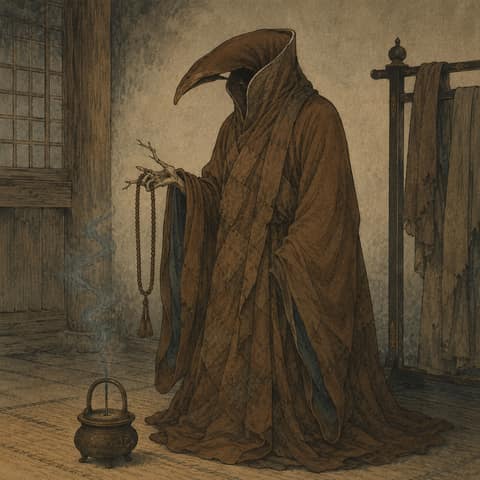
Household SpiritsJapanese folkloreA reconstruction based on the designs in Toriyama Sekien’s Hyakki Tsurezure Bukuro. The monk’s robes are a dull brown, layered thickly, with the collar hanging before the face to cast a beaklike shadow. Beads are held in one hand, a censer is set before it. Movements are unhurried; with each step the rustle of cloth sounds and a faint scent of incense drifts. Hints linking it to tengu remain only in the captions of the image, with no direct wings or long nose. It maintains autonomy as a tsukumogami, its tears and seams perceived as bearing will. It appears not where reverence for sacred implements is lacking, but shows signs near neglected robes and ritual tools, prompting awe rather than harm.

稀少 Kanazuchibō
kah-nah-ZOO-chee-boh
Iconographic Reconstruction (According to Tradition)
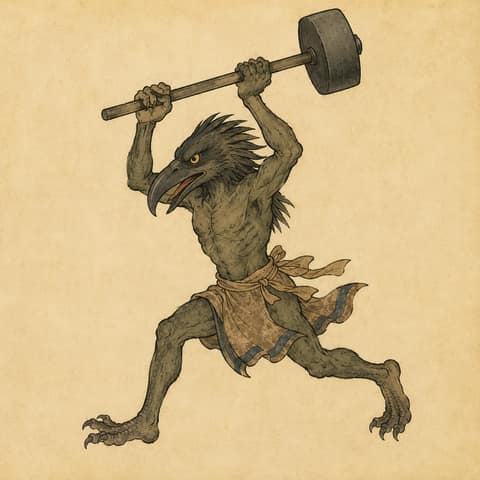
Household SpiritsJapanese folkloreReconstructed after the iconography seen in the Matsui Library Hyakki Yagyō handscroll and other monster scrolls held by institutions such as the National Museum of Japanese History: a bird-faced figure brandishing a raised hammer. Following the sources, its name is noted as Kanezuchibō, with a comment on its affinity to the cognate form Daichiuchi; its deeds and origins remain unknown. While the hammer suggests a tool-turned-tsukumogami reading, no explicit statement in the sources confirms this. It is most often depicted as a member of a procession, one of the recurring motifs in Hyakki Yagyō imagery. Later metaphorical readings (e.g., caution or self-effacement) are treated as secondary interpretations and not conflated with the original tradition.

稀少 Kutsutsura
koo-TSOO-TSOO-rah
Iconographic Critical Edition
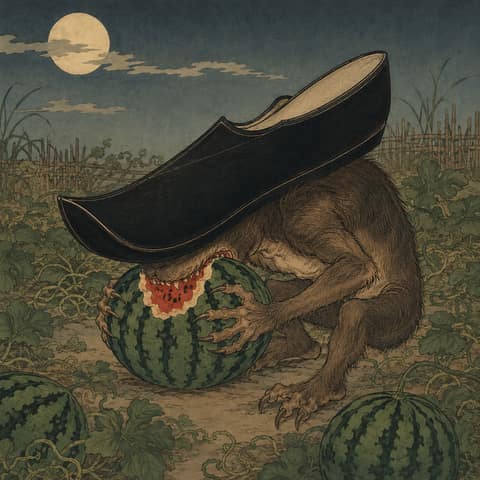
Animated Objects & UndeadJapanese folkloreA version organized from Toriyama Sekien’s anecdotes and imagery, presenting a beast-man figure bearing a symbolic clog (kutsu) to signify an animated implement. In Hyakki Tsurezure Bukuro, paired with the opposing page’s Long Crown, it allegorizes the proverb “Do not put on shoes in a melon patch, nor adjust your crown beneath a plum tree,” depicting caution against suspicion through a yokai image. No concrete sightings or harms are recorded; it is loosely linked to tales of creatures that eat melons in fields, and banishment is mentioned only via talismanic precedents. No firm association with specific Japanese locales is attested, and its design likely references Muromachi-period yokai scrolls featuring beast forms bearing shallow clogs.

稀少 Kinutanuki
kee-noo-tah-NOO-kee
Based on Sekien’s Illustrated Compendium
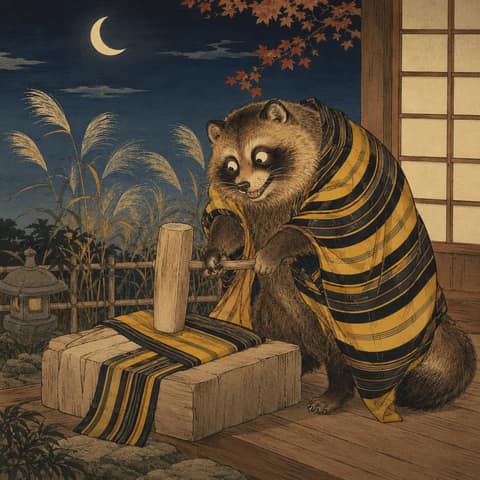
Animated Objects & UndeadEdo (place of publication)The Silk Tanuki is a yokai born from printed books, a visual conceit that overlays vocabulary from Hachijo silk (Kihachijo) with tales of shape-shifting tanuki. In Sekien’s example, a tanuki draped in silk patterns is paired with a caption that evokes both the name Hachijo and popular lore of trickster tanuki. Independent oral traditions are scarce; later readings add the sound of fulling blocks and cloth-beating gestures, but these remain reinterpretations of the image. Its nature aligns with object-spirits and a mitate-based tsukumogami, more a crystallization of wordplay and design in print culture than a field-reported apparition. It is described as wearing the yellow-striped Kihachijo motif and revealing itself less by appearance than by nocturnal cloth-beating sounds, yet such traits are interpretive and no fixed image is established.

稀少 Furu-Utsubo (Aged Quiver Spirit)
FOO-roo OOT-soh-boh
Toriyama Sekien Iconography Standard
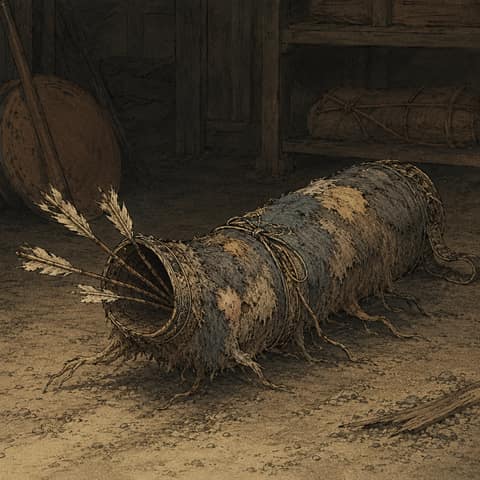
Animated Objects & UndeadJapanese folkloreGrounded in the classic image from Toriyama Sekien’s Hyakki Tsurezure Bukuro, it is understood as an aged leather or fur-covered utsubo quiver that raises its mouth and creeps along the ground. Its origin is not from a clear oral tale but from the tsukumogami belief that objects become ensouled with age. The accompanying text names the warrior who shot the field fox of Nasu no Hara (Tamamo-no-Mae), hinting that a quiver once emblematic of martial glory turns yokai after being forgotten. An earlier prototype is presumed in Muromachi-period Night Parade scrolls depicting object-spirits bearing bow and arrows, which Sekien reinterpreted and named. By night it slowly roams deserted roadsides and house shadows, said to make a sound like fletchings brushing. It is not strongly malicious, but when treated roughly it creaks and cries in warning, stirring memories of its former master.

稀少 Kokuri Baba (Temple Kitchen Hag)
KOH-koo-ree bah-BAH
Sekien Iconography Version
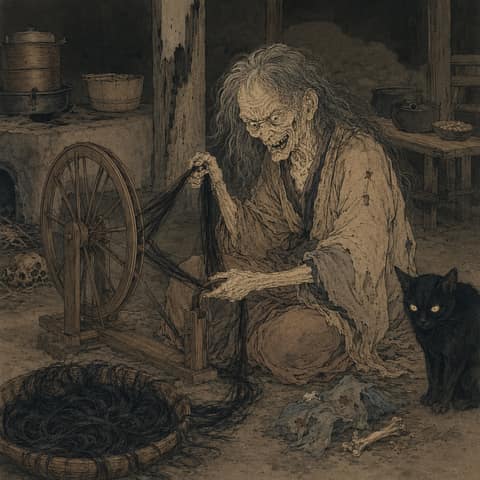
住居・器物Japanese folkloreAn interpretation grounded in Toriyama Sekien’s Konjaku Hyakki Shūi depiction. Said to be the transformed bōnsō of the seventh prior abbot haunting the temple kitchen quarters, it steals offerings and money, digs up graves to braid hair into garments, and eats human flesh. Artwork pairs an old woman twisting thread with a cat, suggesting satire of clerical corruption and monastic lapses. The name “Kokuri” may pun on a word for something terrifying. Lacking a fixed regional distribution, it is chiefly known as a bookborne pictorial yokai. Rather than field sightings, it likely served as a moral warning and social satire aimed at temple society.

稀少 Korōka (Ancient Lantern Fire)
koh-ROH-kah
Sekien’s Koro-bi (Ancient Lantern-Fire)
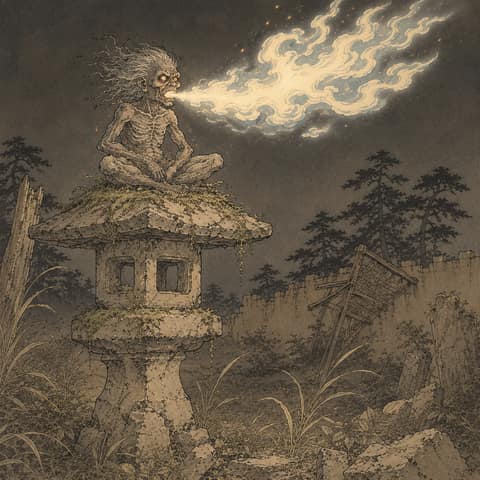
Household SpiritsJapanese folkloreA version reinterpreting Toriyama Sekien’s fusion of a stone lantern and will-o’-the-wisp, casting it as a fire spirit dwelling in the lantern. When old courtyard or temple lanterns go long unused, a thin flame is said to rise at night, flickering as if lingering over the places it once lit. Historically, Sekien’s illustration and note form the core record, with little tied to specific locales or figures. It influenced later ghostly retellings, but firsthand accounts are scarce, so it is treated as a symbolic yokai of “the memory of light.”

稀少 Koinryō
koh-EEN-ryoh
Edo Iconography Conformant
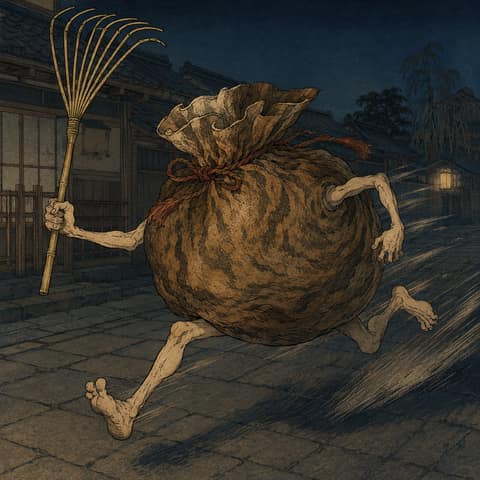
Animated Objects & UndeadJapanese folkloreA reconstructive reading based on Toriyama Sekien’s compositional layout and notes. The主体 is a leather coin pouch that, with age, has become a tsukumogami. Its rake-like implement echoes motifs from medieval picture scrolls and likely implies the act of sweeping up or gathering, though sources do not state this conclusively. It moves with great speed, dashing like a herald at the head of a procession, and is imagined merging with the motley ranks of the Night Parade of Haunted Tools. Its name suggests echoes of “tiger hide” and “inrō,” yet no citation is given and the origin remains unknown. No region-specific lore survives; from its placement alongside Yarikechō and Zenkamanasu within the work, it is understood as one among a group of antiquated implements. The entry avoids embellishment, limiting traits to Sekien’s notes and comparable iconography.

稀少 Five-Limbed Face
goh-tai-MEN
Iconographic Tradition Version
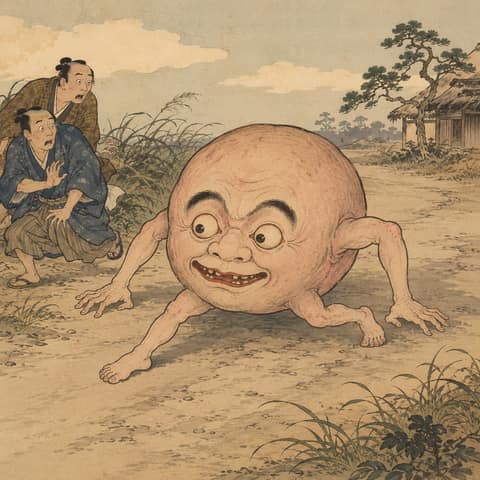
Mountain & Wilderness SpiritsJapanese folkloreA version based on the recurring grotesque motif in Edo-period yokai picture scrolls: a head with limbs attached directly to it. Many sources lack captions, and names vary, such as “Gotaimen” and “People of the Lower Country.” The figure often stands bowlegged and sidesteps, heightening visual dissonance and comic effect. Folklorists debate whether such visual oddities caricature social decorum and misalignment, yet no direct oral tradition is recorded. This version prioritizes the repetition of the image and the spread of names, avoids attaching behavior or powers, and limits the setting to generic outdoor scenes. Later studies and commentaries are consulted, but attributes beyond primary sources are not added.

稀少 Gotoku Neko (Trivet Cat)
GOH-toh-koo NEH-koh
Iconographic Tradition, Sekien-Centered Version
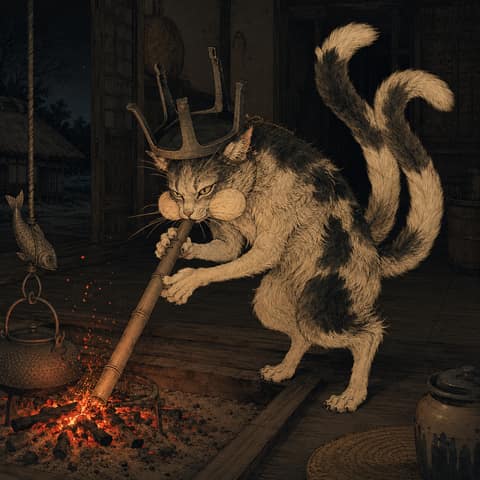
Animal ShapeshiftersJapanese folkloreThis version reconstructs the Gotoku-neko based on Toriyama Sekien’s original image and earlier iconography. An aged cat with a forked tail wears a trivet like a crown and lingers at the hearth’s edge. In Hyakki Tsurezure Bukuro, Sekien plays with the boundary between tool-spirits and animal-spirits, citing Tsurezuregusa’s “Crowned Trivet” and offering a punning interpretation. Thus the Gotoku-neko is not merely a monster cat but a symbolic being linking utensils and literary sources. The Muromachi-period Night Parade scrolls show a yokai bearing a trivet among figures balancing tools on their heads; Sekien follows that lineage while giving it a feline form. The postwar notion that it “kindles fire by itself” derives from later guesses about the depicted blowpipe; older records do not specify such acts. Accordingly, in this version it is restrainedly treated as an apparition seen by the hearth, attended by the presence of fire.

稀少 Ushirogami (The Back-Hair Spirit)
oo-SHEE-roh-gah-mee
Iconographic and Literary Tradition Type
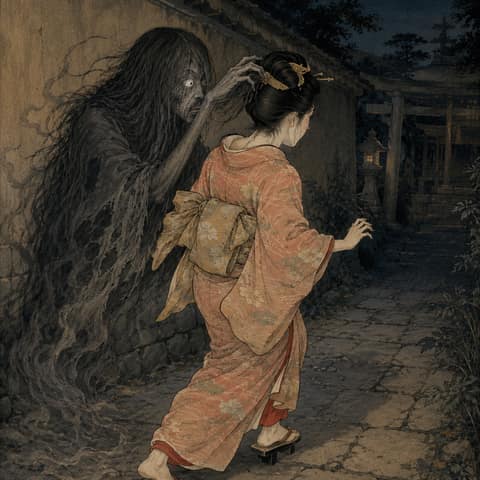
Ghosts & SpiritsAcross Japan (primarily Edo-period and Tsuyama traditions)A type shaped by Edo-period print culture, centered on Sekien’s imagery and the psychologized readings in kyoka verse. Rather than a concrete monster, it personifies the feeling of being held back by a tug at one’s trailing hair, dulling decisions through interference from behind. Mizuki Shigeru cites tales from the Tsuyama area that give it a corporeal aspect—ruffling a woman’s hair, breathing hot air—but in all cases it touches from behind and stirs hesitation. It is often grouped with hesitation-inducing yokai such as Okubyogami, Sodehiki-kozō, and Furifuri. Though there are notes of it being enshrined in Ise, specific rites are unknown, and it appears mainly in moral and didactic contexts. Stories survive in both urban and local settings, yet no clear lineage of deity name or object is shown, with wordplay and the concretization of psychology driving its transmission.

稀少 Elder Shamisen
SHAH-mee-CHOH-loh
Sekien Zue Version
Animated Objects & UndeadEdo periodAn interpretation grounded in the pictorial tradition of Toriyama Sekien’s Hyakki Tsurezure-bukuro. A shamisen that has gained a soul through long use is depicted like an aged monk, with robe-like garb and staff-like fittings. It plays on the proverb “a novice cannot leap straight to elder,” reinforcing the lesson that one must advance step by step in the arts, and it also cautions against mistreating tools. Similar images appear in Tsukioka Yoshitoshi’s prints, and later yokai encyclopedias introduce it as a representative tsukumogami. Lacking many named folktales, it spread chiefly through paintings and printed books.

稀少 Yamaoroshi
yah-mah-oh-ROH-shee
Based on Sekien Toriyama’s Iconography
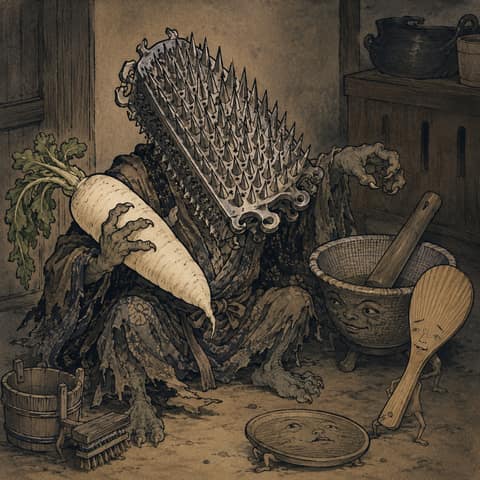
Animated Objects & UndeadJapanese folkloreA reconstruction guided by Sekien Toriyama’s image and notes. The head resembles a grater, its surface studs likened to porcupine quills. Though written as “Yamaoroshi,” its nature is not a mountain wind itself but an abstract monster born from combining a utensil (grater) with a bestial image. Daikon radishes and mortars placed nearby signal a tsukumogami-style scene, with no specific harm or blessing described. Rooted in Edo-period paintings, it lacks regional oral lore or cult, and later handbooks often present it as an example of utensil transformation and wordplay.

稀少 Snake-Obi
jah-TIE
Sekien Zukai Version
住居・器物Edo period; derived from painted sourcesA version based on Toriyama Sekien’s interpretation of the obi in Konjaku Hyakki Shūi. Though an everyday garment, the obi was said to turn into a serpent at the threshold of sleep and dream. This draws on the Natural History note that sleeping on a sash brings dreams of snakes, a belief also known in Japan. Sekien further composed that the triple sash of a jealous woman coils into a sevenfold venomous snake, punning on the kinship of malice and serpent-body, and presenting a visual reading in which emotion is projected onto objects. In folk terms, it warns that keeping a sash by the pillow invites ominous dreams, admonishes jealousy, and entwines concepts of sleep, dreams, and taboo. Rather than a literal attacker, the Snake-Obi is a symbolic specter that mirrors the viewer’s heart and reminds proper handling of sashes and bedding within the home.

稀少 Hand from a Kosode Sleeve
koh-SOH-deh no TEH
Iconographic Tradition, Based on Sekien Toriyama
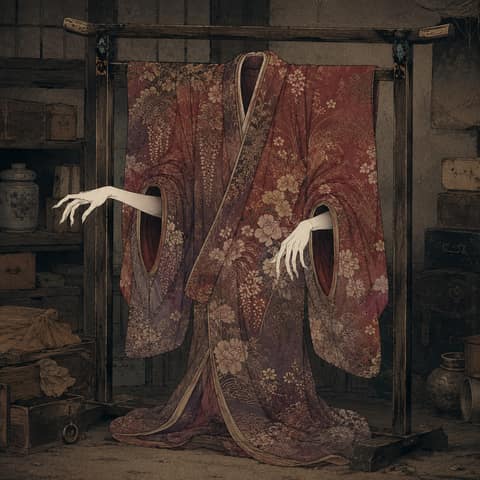
住居・器物Edo periodAn interpretation aligned with Toriyama Sekien’s imagery and accompanying text. Only a white feminine hand emerges from the sleeve opening, while the absent owner is signified by the garment itself as the main subject. The kosode was a fine everyday robe of the time; whether it became a keepsake, was dedicated to a temple, or sold marks the branching fate, with spiritual disturbance manifesting as attachment residing in the clothing. It layers commentary on courtesans’ circumstances and the irony of buyout money with an aesthetic for dress and a sense of impermanence, functioning less as a concrete monster than as a “visible metaphor.” In folktales, illness after acquiring secondhand clothes and nightly apparitions of a white hand often cease once the robe is offered to a temple and sutras are chanted. Situated at the crossroads of possessed objects and ghost lore, it can be read as tsukumogami, yet its focus remains the emotions of the garment’s former owner.

稀少 Shōgorō (the Gong Spirit)
SHOH-goh-ROH
Sekien Plate Edition (Toriyama Sekien-Inspired)
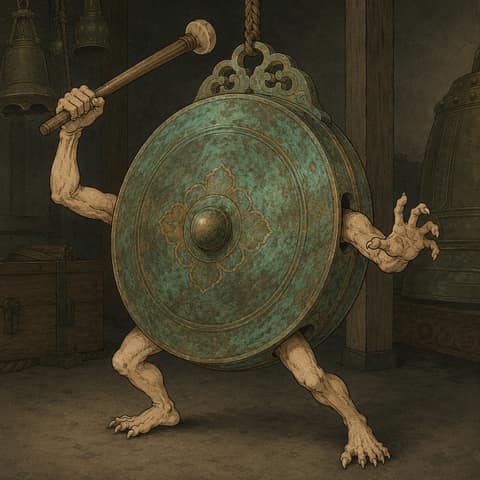
Animated Objects & UndeadEdo period, Kamigata tradition (Osaka)An interpretive reconstruction based on Shōgorō from Toriyama Sekien’s Hyakki Tsurezure Bukuro, linking the tsukumogami notion of spirits inhabiting tools with the muromachi-era Waniguchi bell monster seen in Night Parade picture scrolls. Because the name plays on words, it cannot be conclusively read as the vengeful spirit of any specific person. In the Kansai region it has been read against the Yodoya “Golden Rooster” legend, serving as an image that warns against the pursuit of wealth and fame. It is depicted as a round temple gong or waniguchi bell sprouting limbs, sounding of its own accord to give warning. No field sightings survive, and primary sources are picture scrolls, yokai paintings, and their notes.

稀少 Gooseflesh Specter
MEE-no-keh-DAH-chee
Emaki Iconographic Type: Hair-Raising Figure
Household SpiritsJapanese folkloreAn image-based yokai originating from picture scrolls without accompanying text, making its function and temperament hard to define. Its bristling, hair-standing posture suggests a visual motif of fear or dread, yet sources provide no explanation and no firm conclusion can be drawn. Names vary by source, and related figures may appear under different titles. Here, characterization is kept minimal, grounded only in the image’s form and the extant manuscripts.

稀少 Dust-Heap Demon King
chee-ree-ZOO-kah KAI-oh
Iconographic Origin – Sekien Edition
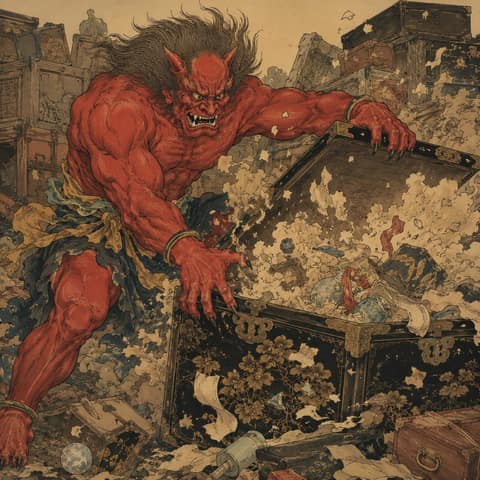
Animated Objects & UndeadJapanese folkloreIn literature, Chinzuka Kaiō is known chiefly from Toriyama Sekien’s Hyakki Tsurezurebukuro image, with no concrete deeds or sayings recorded. The painting shows a strongly muscled, red-hued oni prying open a kara-bitsu chest as dust and paper scraps swirl. Sekien appended a note calling it the “chief of the mountain hags formed from piled-up dust,” echoing the Noh play Yamanba’s line “clouds’ dust piles up and becomes a mountain hag.” However, no tradition directly links this yokai to Yamanba, leaving its placement ambiguous. Similar images appear in Meiji-era copies and anonymous picture scrolls, sometimes renamed as “kaiki” (monstrous oni). Since the Heisei era, some explain it as “king of dust and garbage tsukumogami,” but this is a later interpretation without proof in older sources. Iconographically, it is viewed as an early modern creation merging the “splitting the treasure chest” motif from Night Parade of One Hundred Demons scrolls with phrasing quoted from Essays in Idleness.

稀少 Seto General
SEH-toh TIE-shoh
Iconographic and Mitate-Derived Version
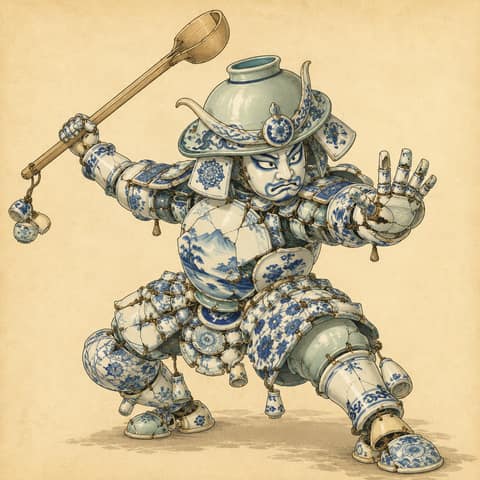
Animated Objects & UndeadUncertain (Edo-period pictorial works)Rooted in Sekien’s picture manuals, this tsukumogami-style portrayal recasts rivalry among ceramic centers like Seto and Karatsu into the guise of a warrior effigy. The body is a composite of cups, sake flasks, warming pans, and plates arranged as armor, while the accompanying text brims with wit, blending diction from Chinese classics and military tales. Rather than a field-sighted apparition, it crystallizes the idea of spirits inhabiting objects and the Edo-period literacy that likened trends and the prestige of named masterpieces to a “battle.” The motif continued into Meiji-era ukiyo-e and is viewed as a classic in the lineage of the Night Parade of One Hundred Demons.

稀少 Blue Lady-in-Waiting
AH-oh NYOH-boh
Emaki and Sekien Lineage Iconography
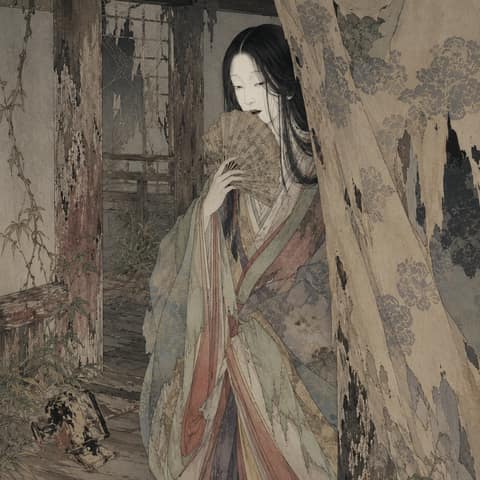
Half-Human BeingsJapanese folkloreAonyōbō here is less a creature of a fixed tale than a court lady’s image turned uncanny and circulated as iconography. Sekien paints her as a lady-in-waiting haunting a ruined old palace, exaggerating obsolete rites and cosmetics—ohaguro and painted brows—to give her a ghostly air. In Night Parade scrolls she often appears with ladies’ accoutrements such as curtains, mirrors, and fans, quietly following the procession. The name derives from the social title aonyo (young lady-in-waiting), making the yokai label largely retrospective. While a record of an “aonyo” exists in the Azuma Kagami, identification is cautious, sharing only the appearance of a young court woman. Local lore offers few concrete episodes, and the setting is typically a decayed palace or the parlor of an old house. Despite its creative coloring, this is a leading example of a pictorial yokai that renders the afterimage of court culture as the uncanny.

稀少 Zen-Gama-no-Shō (Zen Kettle Monk)
ZEN-gah-mah-noh SHOH
Iconographic Tradition: Tsukumogami Kettle
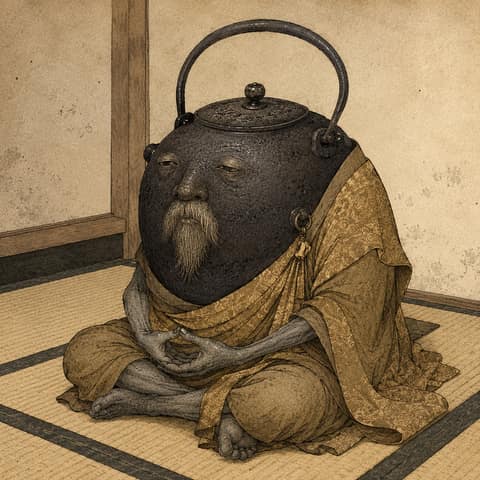
Animated Objects & UndeadJapanese folkloreBased on examples by Toriyama Sekien, this image depicts an aged tea kettle manifesting with spiritual authority. Its posture and arrangement inherit compositional methods akin to the Night Parade of One Hundred Demons scrolls, often shown marching alongside Torakakushi and Yarinaga. The name plays on the kinship between chanoyu and Zen, hinting at a caricature of a Buddhist priest. By the logic of mononari, tools long used or neglected accrue ki, appear before people, and inspire awe. Meiji painters continued this iconographic lineage, and yokai catalogues and dictionaries classify it as a type of tsukumogami, though specific local legends are scant. Later commentaries add anecdotes of startling humans, but early records offer little confirmation, so it is understood chiefly through its iconographic tradition.

稀少 Yarikechō (Spear Tuft Spirit)
yah-ree-keh-CHOH
Yarigechō (Iconographic Tradition)
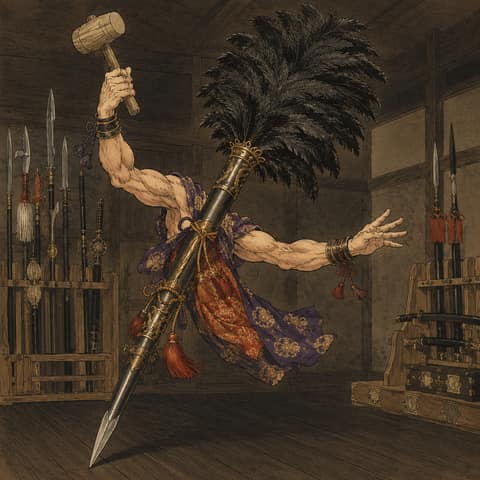
Animated Objects & UndeadEdo period, JapanA type of tsukumogami typical of early modern yokai art. The hair-spear used both as a practical weapon and as a symbol in processions was thought to accrue spiritual potency through associations with masters and tales of valor. In Hyakki Tsurezure Bukuro, Sekien depicted it wielding a wooden mallet, assigning it a specific object-name while drawing on older iconographic bones. The name Yarigechō likely arose where Night Parade motifs from the Muromachi era, Edo antiquarian taste, and the culture of famed implements converged. Modern print editions and nishiki-e varied the image, sometimes stressing the spear’s decorative plumes, yet it lacks distinctive oral lore and is known mainly through pictures and bibliographic notes.

稀少 Fukuro Mujina (Bag Badger)
FOO-koo-roh MOO-jee-nah
Annotated Iconography Edition (Seiyan-Toriyama Based)
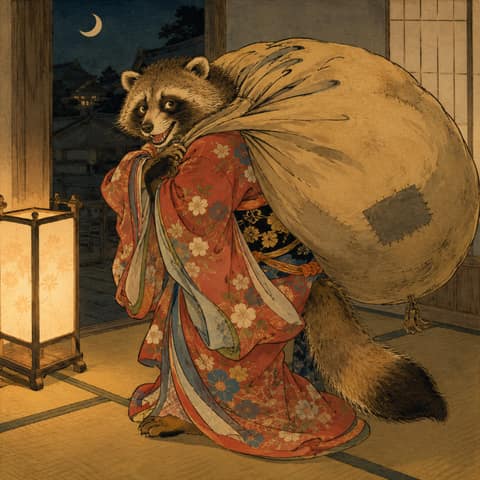
Animated Objects & UndeadEdo periodA version grounded in the image and brief annotation from Toriyama Sekien’s Hyakki Tsurezure Bukuro. It appears as a womanly mujina carrying a night-duty bag over her shoulder, yet from another angle the bag itself may be the yokai, with the porter’s pose serving as a metaphor. Its conduct lures people into rash judgments and lays bare the absurdity of empty speculation. Actual harm is slight, limited to confronting those who “rummage in the bag” of guesswork on night roads or in parlors and leaving them disgraced. True to picture-scroll lineage, no fixed era or locale is given, favoring witty identification and playful satire.

稀少 Great Tonsure
OH-kah-BOO-roh
Sekien Iconography Standard
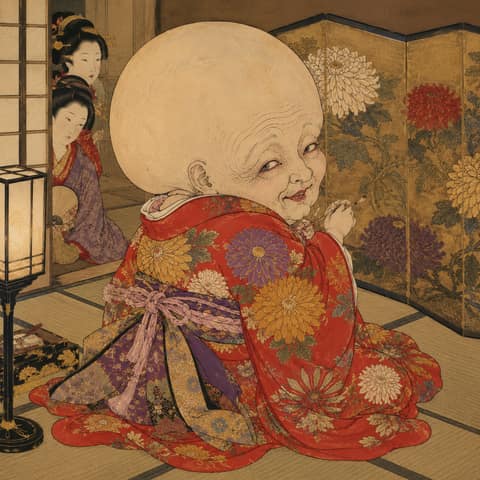
General ClassificationsEdo periodA Daikatsura interpreted strictly through Toriyama Sekien’s original imagery. Rather than a concrete monster, it functions as a satirical figure borrowing the iconography of brothel pages and the immortal youth Kikujidō. The chrysanthemum-patterned long-sleeved robe evokes tales of longevity and coded slang, while the shaved scalp suggests a paradox of childlike form and senescent decay. Mentions of Nachi and Kōya serve as metaphors for the contradiction between ascetic rule and transgression. The oversized childlike body in the picture imparts an uncanny yet comic effect. Historical sources list no specific powers or harms, and its appearances are confined to the pictorial frame. Despite the similar name, it is a different lineage from the later “Ōkamuro.”

稀少 Chokuboron
CHOH-koo-BOH-ron
Conforming to Traditional Iconography
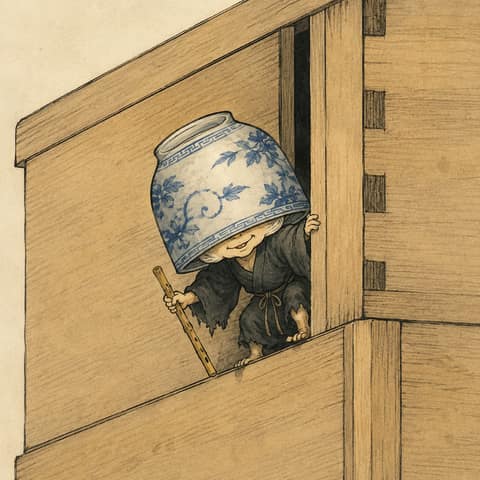
Animal ShapeshiftersEdo periodGuided by Sekien’s imagery and captions, this reading foregrounds its nature as a tsukumogami, a spirit of aged utensils. The little goblin, komusō-like with a sake cup as a hat, emerging from a box accords with the belief that long-used drinking vessels and tools gain spirit and appear at set times. The caption’s citation of Xuanzong and the Spirit of Ink bolsters the idea that spirits arise in objects such as calligraphy, painting tools, and sake ware, with Chokoburo composed pictorially as one of that kind. It does not point to a concrete religious entity of komusō or boro, but playfully borrows half-monk, half-lay visual cues, with a name born of puns and association. No locale of oral tradition is identifiable; its character is chiefly that of a visual怪 within Edo print culture.

稀少 Oni of Hemp Fiber (O-uni)
OH-oo-NEE
Iconographic Tradition, Sekien Lineage
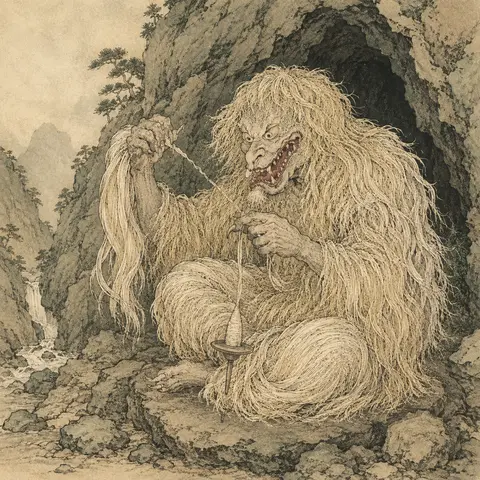
Mountain & Wilderness SpiritsUncertain (derived from an Edo-period picture scroll)Rather than arising chiefly from oral accounts, Ouni has been recognized through a lineage of images in picture scrolls. A precursor appears as the “Wau-wau” type in Sawaki Suushi’s Hyakkai Zukan (1737), and in the late Edo Hyakki Yagyō Emaki (Oda Gōchō, 1832) it is rendered as “Uwan-uwan.” Toriyama Sekien drew on this visual genealogy, exaggerating the hair and emphasizing a fiber-bundle texture suggestive of o, then named the figure accordingly. The term o denotes a tufted bundle of ramie or hemp fibers, serving as a visual sign tied to the creature’s mass of body hair. From the Heisei era onward, commentators increasingly connected Ouni with folktales of mountain hags who comb and spin fibers, treating it as a subtype of yama-uba. Yet Sekien gives no locality or deeds, and evidence for attaching it to specific place-based traditions is scant. It is safest to regard Ouni as a yokai defined by the iconographic core of a shaggy demon-woman appearing in the mountains, loosely linked to ideas surrounding women’s fiber work in upland communities.

稀少 Long Crown
oh-sah-KOH-buh-ree
Iconographic Tradition Version
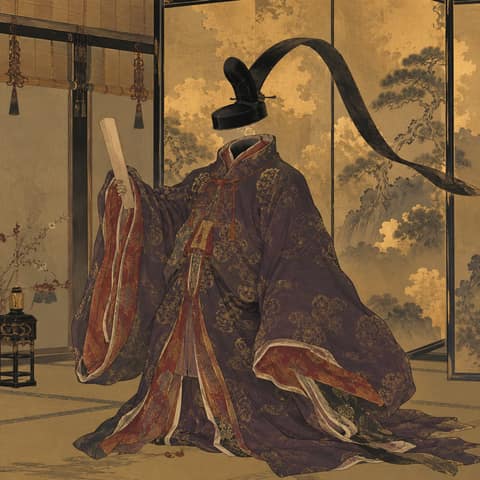
Household SpiritsJapanese folkloreBased on Sekien’s image and caption, the crown is shown as if it stands on its own and walks with proper manners, a satire aimed at minds fixated on authority. A crown should rightly regulate decorum and rank, yet when one refuses to remove it for selfish ends, the vessel is said to curse its master, gain form, and wander. Firsthand accounts are scarce; it appears mostly in paintings and texts as an unspoken warning, paired with Kutsuhō as a lesson in suspect behavior and knowing one’s proper place. Later artists like Yoshitoshi echoed this by adding a crown-spirit to Hyakki Yagyō processions. Among early modern aficionados, it was treated as an example of tsukumogami, in which ceremonial items like crowns and scepters acquire spirits as they age.

稀少 Doro-danbō (Mud Rice-Field Wraith)
DOH-roh-dahn-BOH
Sekien Iconography Conformant Edition
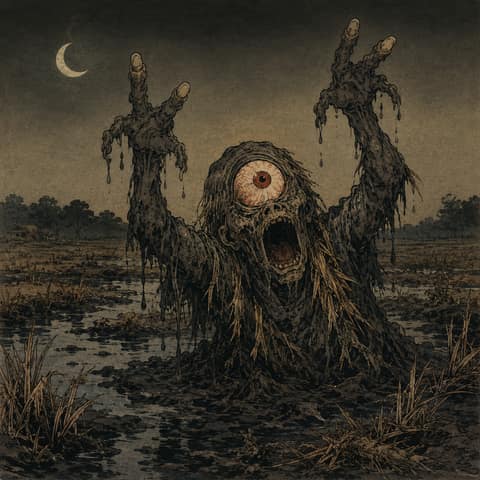
山野の怪Uncertain (Toriyama Sekien notes “the northern provinces”); otherwise Japanese folkloreThis version adheres to Toriyama Sekien’s image and brief note, centering on a one-eyed, three-fingered figure rising upper-body first from a muddy paddy. It avoids expanding later folkloric claims and emphasizes allegory. It appears as a voice rebuking impiety and neglect of farming after fields are sold off, standing by the paddy ridge at night and repeating in a low voice, “Return the fields.” Given the scant early modern corroboration, this is a reconstruction mindful that Sekien may have intended wordplay and social satire, without asserting ties to specific places or people. Visual traits include a mud-smeared monk-like upper body, a single eye, a wide mouth, and three-fingered hands.

稀少 Ceiling-Dropper
TEN-joh-KOO-dah-ree
Sekien Gazu Edition
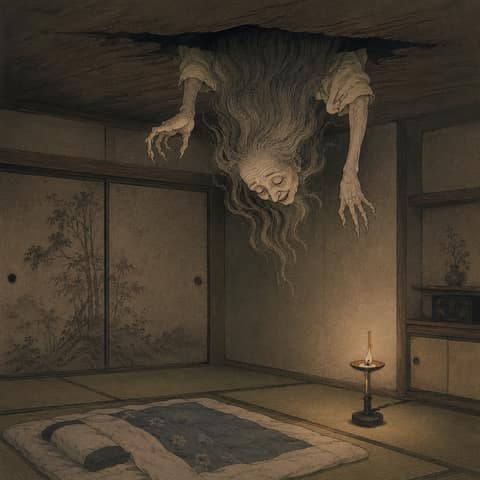
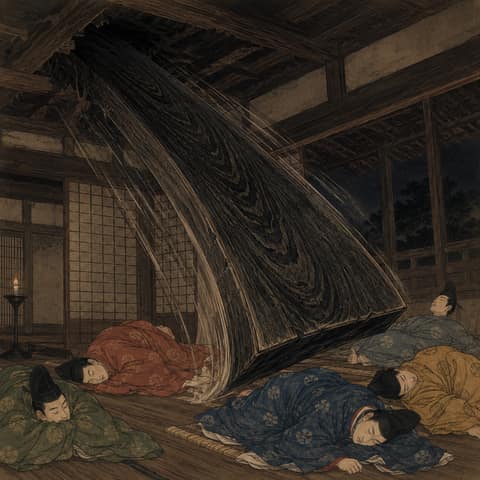
Household SpiritsEdo periodAn interpretation grounded in Toriyama Sekien’s iconic prototype. The house ceiling marks a boundary between inside and outside, the mundane and the otherworld; its upside‑down descent symbolizes an inversion of that threshold. It appears mostly at midnight when human activity has stilled, and is said to cause visual shock without actual harm. Early modern readers linked it to wordplay and household safety, reading it as an allegory that quietly warns of neglect, filth, and hazards in the crawlspace above. Later traditions reinterpreted creaks, drafts, and animal sounds in the ceiling as this apparition, placing it within the broader lineage of domestic yokai.

稀少 Abumikuchi
ah-BOO-mee-KOO-chee
Sekien Zue Conformant
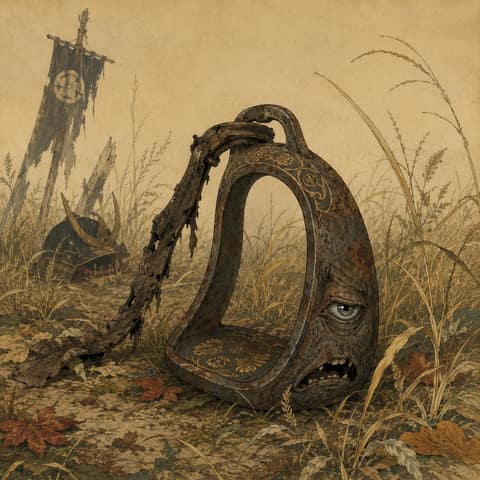
Animated Objects & UndeadJapanese folkloreAn abumiguchi depicted per Toriyama Sekien’s Illustrated Bag of a Hundred Tools. An ancient stirrup sprouts eyes and a mouth, shown lying on the ground or dragging its straps. A quoted line from the Noh play Tomonaga invites readings of battlefields and fallen warriors in the background, yet no concrete deeds or harms are recorded. Following tsukumogami conventions, it is the resentment and lingering attachment of a tool long used then discarded given form. This aligns with Edo-period essays that teach “cherish your implements,” and likely reflects the Tsurezuregusa passage warning about horse gear, echoed in its pairing with the Saddle Fellow. The modern retelling that it “awaits its master,” seen in Mizuki Shigeru’s notes, lacks support in older sources and is not adopted here. No verified field traditions are known, and no region is specified.

稀少 Nyūbachibō
nyoo-bah-chee-BOH
Emaki Seigan Iconography Version
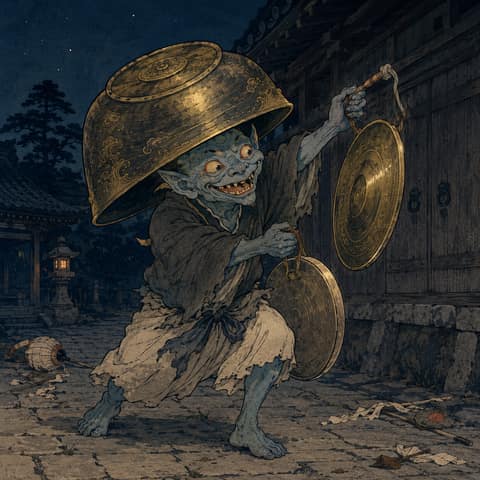
Household SpiritsJapanese folkloreTaking as precedent the disc-like apparition found in Muromachi-period Night Parade of One Hundred Demons scrolls, the Edo artist Toriyama Sekien shaped it in Hyakki Tsurezure Bukuro as a human figure bearing a bronze plate. Sekien frequently depicted utensils turned yokai, and Nyūchibō is one of these, yet the textual notes are brief and its conduct remains undefined. Amid overlapping names and forms—nao-bachi, dōbachi, and surigane used in temple rites and theater orchestration—later commentators supplied the trait of startling people by sounding. No specific regional lore is attached; it is recognized iconographically within the broader class of utensil-spirits. Its qualities today largely reflect fragments of folk materials and modern reinterpretations in yokai handbooks.

稀少 Hair Oni (Kamikki)
KAH-mee-oh-nee
Sekien Zukai Edition
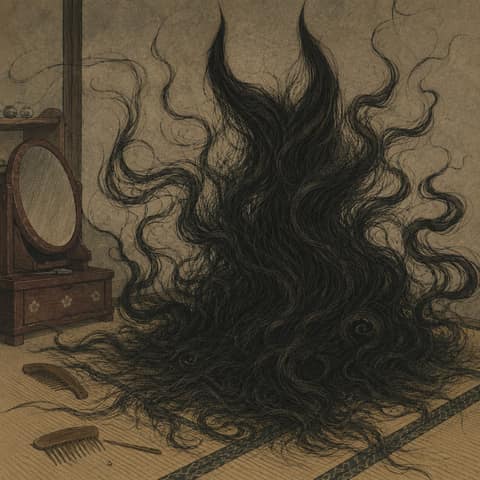
Animated Objects & UndeadJapanese folkloreAn iconographic reading of the Hair Demon as depicted in Toriyama Sekien’s Hyakki Tsurezure Bukuro. A woman’s hair, infused with its owner’s passions, becomes autonomous, standing on end at midnight as its locks extend and contract like living things. Cutting it offers only brief respite, for it regrows and multiplies at once. Rooted in a dual folk view that both sanctifies and shuns hair, it is shown as a being where tsukumogami traits cross with vengeful-spirit nature. Its body is a mass of hair without face or limbs, asserting menace through motion and shifting length. Memorial offerings and proper hair-cutting rites are said to calm it, yet no certain banishment method is recorded.

稀少 Iyaya (Negaya)
ee-YAH-yah
Sekien Iconography Standard
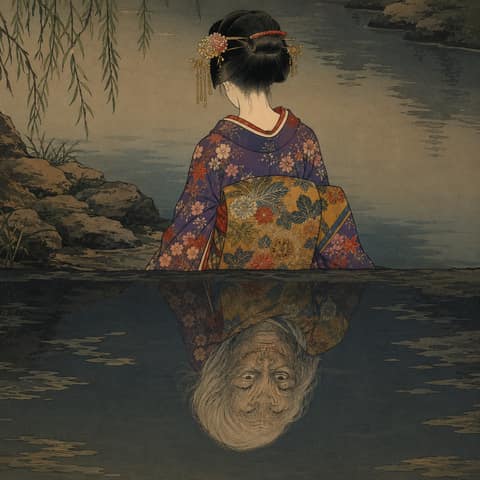
Household SpiritsUncertain; Japanese folkloreAdheres strictly to Toriyama Sekien’s image and notes, avoiding later embellishments. The yokai is shown as the back view of a young woman standing by water, while the surface reflects the visage of an old man. The name draws on Dongfang Shuo’s “kaizai” expressions of wonder, suggesting Sekien likely fashioned an allegory. Youth and age, beauty and ugliness, front and back are opposed within a single frame, read as a design warning against being deceived by appearances. Firm oral traditions are scarce, so its character is defined largely through image interpretation. The readings iyaya or iyami vary by source, possibly evoking refusal or repulsion akin to “no,” but the literature offers no certainty.

稀少 Momonji (the Hundred-Old Man)
MOH-mohn-jee
Iconographic and Textual Standard (Sekien Line)
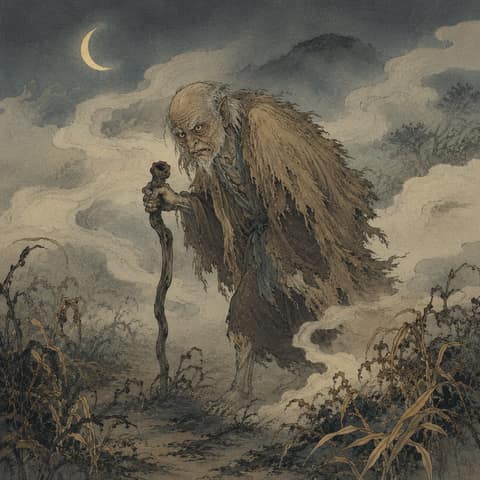
Mountain & Wilderness SpiritsUncertain; depicted in Edo-period picture scrollsBased on Toriyama Sekien’s image and notes, this version frames the entity as an old man–shaped specter appearing on open fields at midnight. Its name is taken as a blended form of child language like “momon-ga” and “gagoji,” embodying generalized fear of monsters. The belief that witnesses fall ill aligns with older notions that contact with the uncanny brings impurity and sickness, with no concrete acts of harm described. Early modern taboos against eating game and the euphemism “momonjii” may have encouraged its visualization through name association. Later readings place it as dwelling in mountains yet appearing at street corners to startle people, or as the city-going form of the nobusuma, but primary tradition is scant and no broad folktale type is attested. Accordingly, this version treats specifics as unclear, emphasizing its scenic traits—encounters on nighttime fields, fog, and wind—and its feared power to bring illness.

稀少 Hyōtan Kozō (Gourd Boy)
HYOH-tahn koh-ZOH
Iconographic Tradition–Tsukumogami Interpretation
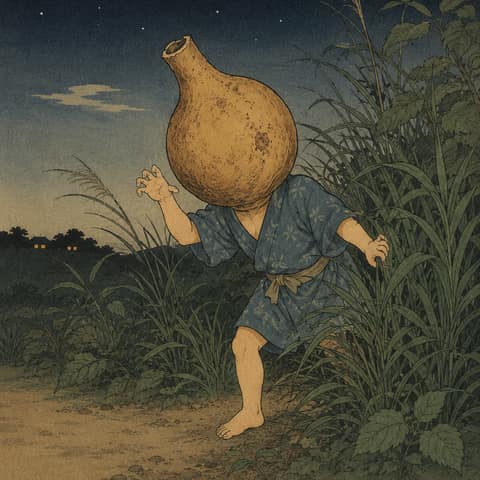
Animated Objects & UndeadJapanese folkloreAn interpretation based on Toriyama Sekien’s Hyakki Tsurezure Bukuro and related Hyakki Yagyō iconography. Gourds served as containers for water or sake and as percussion in festivals, and after long use were believed to acquire spirit in line with the tsukumogami view. The Gourd Boy appears as a human figure with a gourd for a head, briefly emerging from a night path or from grass to make passersby flinch, and little more. Its nature, name, and any definite harm are not fixed in sources, and alongside utensil-yokai like the Mortar Monk it is read as an allegorical old tool given life. Local oral lore is scant, with paintings and later commentaries as the main sources.

稀少 Kameosa
KAH-meh-OH-sah
Iseya Toriyama Plate Edition
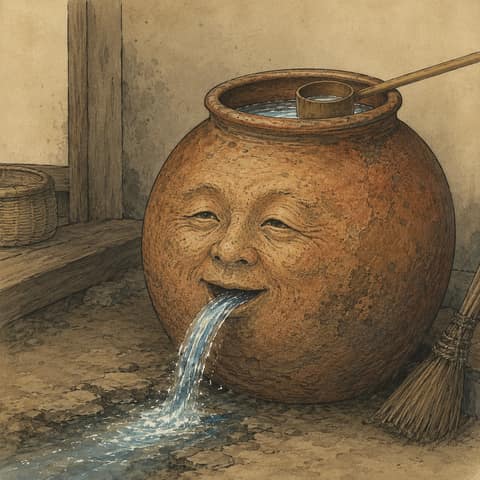
Animated Objects & UndeadEdo periodAn interpretation based on Toriyama Sekien’s Hyakki Tsurezurebukuro image and inscription. The water jar faces forward, its rim becomes the mouth, and patterns on the body are read as eyes and nose. The inscription pivots on the phrase “calamity turns to good fortune,” entrusting the vessel with the idea that blessings fill after adversity. Placed at the end of the volume to serve a congratulatory cadence, its nature is read as leaning more toward good than ill. Though grouped with tsukumogami familiar to early modern life, independent oral lore or怪談 are scarce. Later retellings expand the “inexhaustible when drawn” motif into control over water’s increase, decrease, and measured pouring, but the original is a symbolic painting with verse, and narrative deeds are limited.

稀少 Furaku-Furaku (The Dangling Lantern Spirit)
boo-RAH-boo-RAH
Sekien Plate Standard
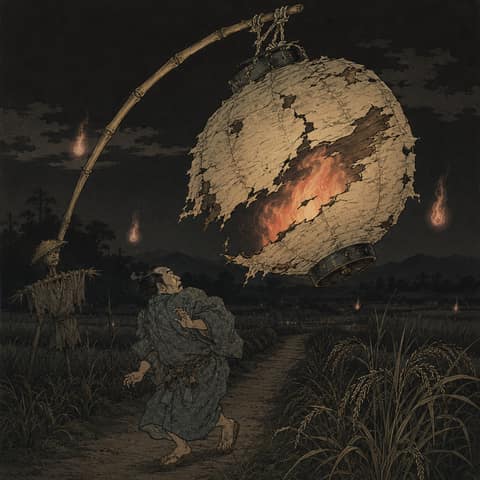
Animated Objects & UndeadJapanese folkloreAn arrangement of Furafurabu based on the depiction in Toriyama Sekien’s Hyakki Tsurezure Bukuro. The lantern is tied to bamboo, its torn paper resembling a mouth, tilting as it looms over the road. The scene evokes rice field ridges and scarecrows, and while the caption mentions “the lantern fire of Yamada,” it also muses that it might be foxfire. This yields competing readings—either a fox in disguise or a transformed implement—but since the volume files it among tool-spirits, understanding it as a tsukumogami is appropriate. The name varies between “Fufuraku” on the image and “Furakaku” in the catalog, though “Furafurabu” is generally accepted. No fixed local legends or concrete curse tales survive; it is received as a subtype of the generic lantern yōkai, a visual fright that startles travelers at night.

稀少 Nadezatō (the “Smoothing” Blind Monk)
NAH-deh-zah-TOH
Iconography-Based Version
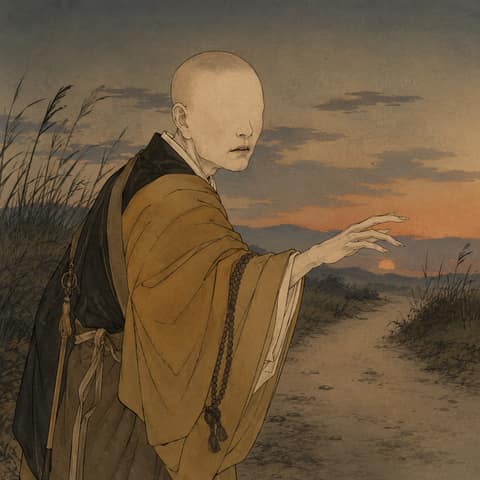
General ClassificationsYatsushiro, Kumamoto Prefecture (Matsui Collection)This version relies solely on images from picture scrolls with minimal notes. Nade-zato has a transmitted name and appearance, but the textual account is missing, so its nature and conduct cannot be fixed. The iconography shows a shaven-headed, blind masseur-like figure with eyes left undrawn; some depictions emphasize long fingers or claw-like hands. Related imagery includes an identical type titled “Mugan” (No-Eyes) in Edo-period Hyakki-zu, suggesting variant naming. Tada Katsumi notes that nade may connect to nademono, which transfers defilement by touch, and to an old byname for “cat,” hinting at a being that feigns meekness to hide its true nature; however, this is scholarly interpretation, not a firm local tradition. Accordingly, abilities, weaknesses, and habits are scarcely recorded and should be treated as unknown.

稀少 Hossumori, the Fly-Whisk Guardian
HOSS-soo-MOH-ree
Sekien Iconography Standard
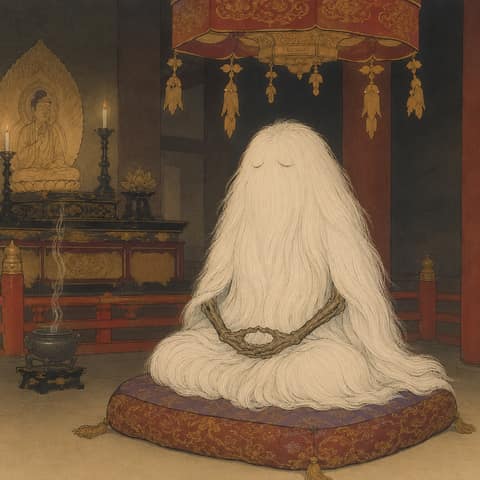
Animated Objects & UndeadEdo period; derived from picture scrollsBased on the tsukumogami of the fly-whisk as depicted in Toriyama Sekien’s Hyakki Tsurezure Bukuro. Seated cross-legged beneath a canopy, it embodies the purity of a ritual implement and the quietude of a spirit matured through long use. Strong Zen symbolism underlies it, with an allusion to “the Buddha-nature of the dog,” implying that Buddha-nature manifests beyond sentient and insentient distinctions. In China the fly-whisk was said to dispel demonic hindrances, leading to the idea of a tool-spirit that allows nothing to obstruct enlightenment. Though a tool-yokai, it is not told to cause disturbances like other Hyakki creatures; instead it sits in composure, contemplating its own nature. Its image is chiefly tied to places where ritual implements gather within temples—main halls, monks’ quarters, and storerooms—rather than to specific local legends.
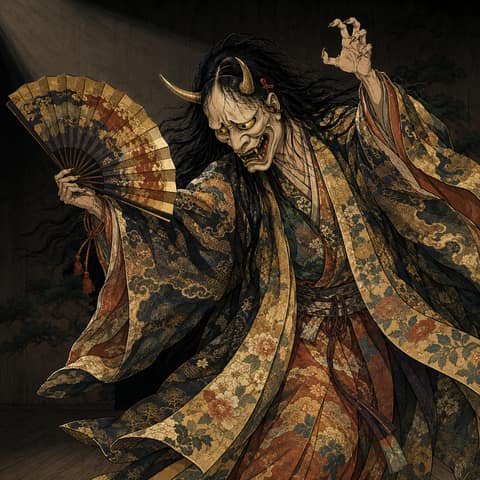
稀少 Fuguruma Yōhi (Letter-Carriage Enchantress)
FOO-goo-ROO-mah YOH-hee
Iconographic Edition, Sekien Toriyama Source
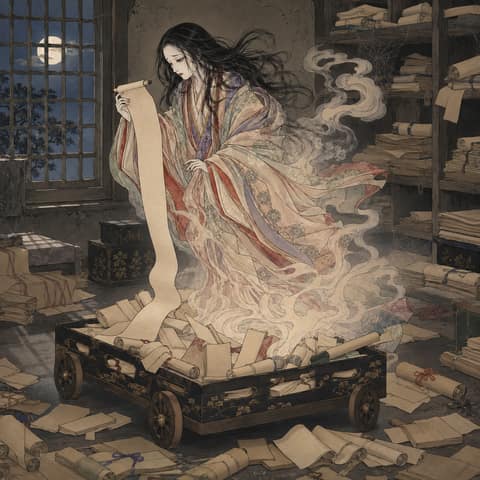
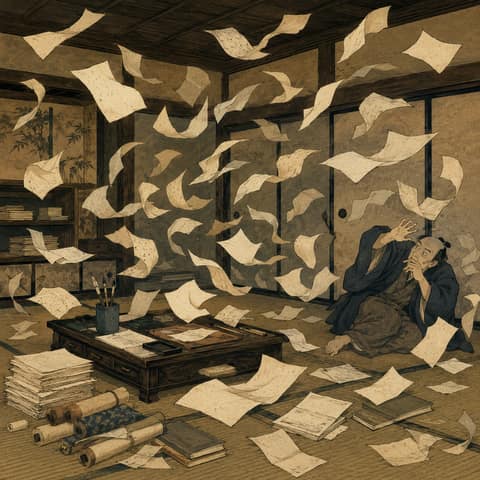
Animated Objects & UndeadEdo periodAn interpretation grounded in the imagery and captions of Toriyama Sekien’s Hyakki Tsurezure Bukuro. The document cart was a conveyance for papers in the imperial court, temples, and aristocratic residences, kept ready for emergencies. The accumulated sentiments within long-kept love letters are thought to congeal and manifest as a lady-in-waiting–like apparition. With little basis in oral tradition, this is a conceptual yokai born of early modern literature and painting, more often told as a presence that displays and summons remorse than as one causing concrete harm. The customary name is Fumikuruma Yohi, though later sources sometimes confuse it with Fumikuruma Yoki.

稀少 Heiroku
HAY-roh-koo
Iconography-Concordant Version
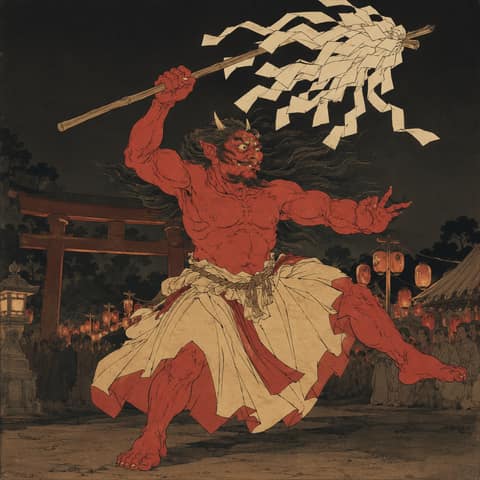
Animated Objects & UndeadJapanese folkloreAn interpretation grounded in Toriyama Sekien’s examples and Muromachi picture scrolls, taking the aberrant figure bearing a gohei as its standard. The paper-streamer wand signals ritual purity, yet Henroku brandishes it as an emblem of turmoil. It is not tied to any specific land or person, and is understood as an allegorical presence that appears where festivals or shrine order falter. Later traditions sometimes read it as a tsukumogami inhabiting the gohei, but firsthand accounts are scarce, and it is discussed chiefly within the lineage of visual iconography.

稀少 Grave Fire
HAH-kah-noh HEE
Traditional Iconography Edition
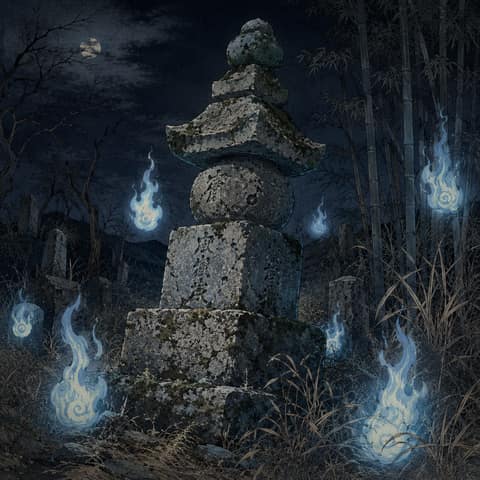
Natural Phenomena SpiritsGraveyards across Japan, notably Kyoto PrefectureA grave-fire image based on Sekien’s iconography. The pairing of a ruined graveyard, overgrown thickets, and a five-ring stupa with worn Sanskrit letters symbolizes the idea of fire dwelling in places without kin or proper memorials. Early modern tales describe it as a phosphorescent flame rising from human fat or grave soil, yet also tell of cases where chanting sutras or repairing the stupa makes it vanish, showing the overlap of religious practice and naturalistic views. The flame drifts as if following human silhouettes, but slips away when touched. Malice is rare, and it is rumored to light the path ahead like a guide.

稀少 Boroboroton
boh-roh-boh-roh-TOHN
Sekien Zufu Edition
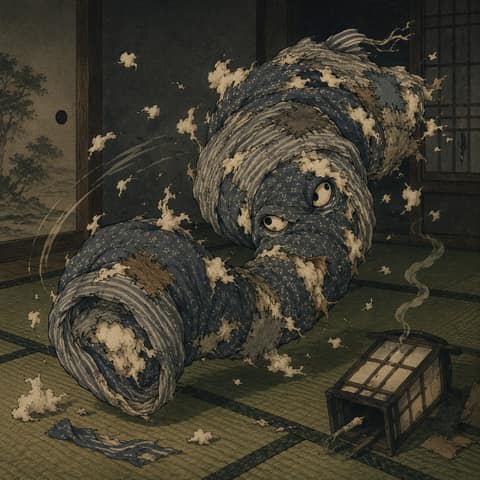
Animated Objects & UndeadEdo period, JapanAn image based on Toriyama Sekien’s Hyakki Tsurezure-bukuro. A futon long used and then cast aside rises at night, bounding about the room to startle its former owner. Its malice is mild, acting mainly as a chastening presence that creates a commotion to spur repentance. The name is often read as a play on the tattered fabric’s “boro-boro” and the term for Fuke Zen monks, intertwining beliefs about spirits inhabiting tools with literary wit. Though local folk attestations are scarce, iconographically it is treated as a link in the lineage of tsukumogami tales.
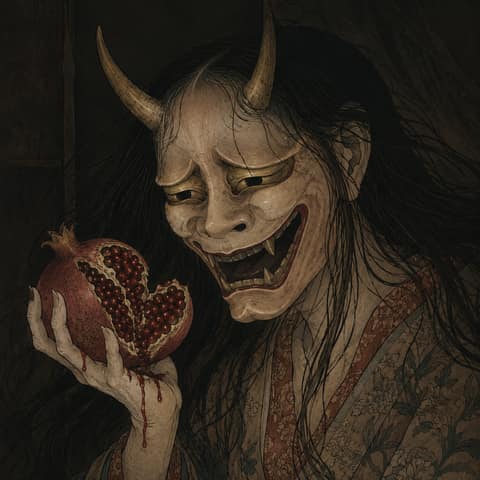
稀少 Straw-Raincoat Sandals
MEE-noh WAH-rah-jee
Iconographic Tradition Edition
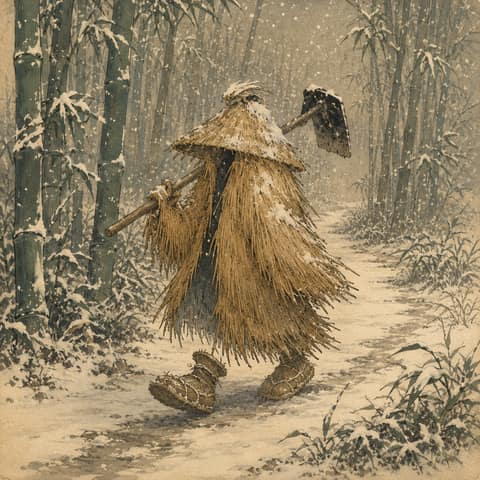
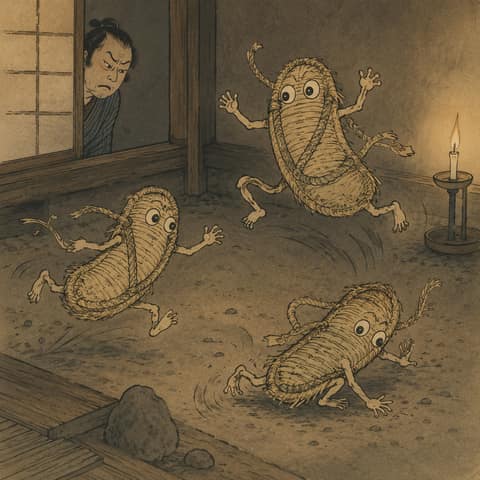
Animated Objects & UndeadJapanese folkloreA reimagining of the straw raincoat and straw sandals yokai based on Toriyama Sekien’s imagery. The straw raincoat serves as a protective emblem akin to visiting-deity garb, while the sandals take on the role of roadside boundary charms. Weathered by long use and harsh storms, they are believed to have gained spiritual potency and slipped into the human world. The act of shouldering a hoe evokes farm labor and service to local land deities, and the snowy bamboo grove setting suggests purity and deep quiet. Specific deeds go unrecorded, but it was likely feared as creaking sandal steps at midnight or a walking cloak’s silhouette in a blizzard, with little emphasis on malice. An emblematic member of the early modern tsukumogami ensemble, it reflects reverence for the lifespan and toil of tools.
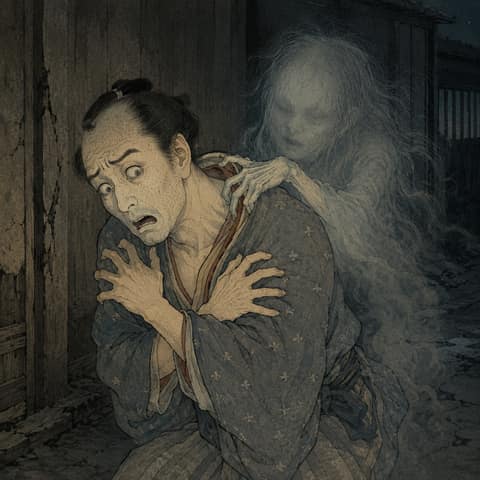
稀少 Net-Cutter
AH-mee-kee-ree
Iconographic Standard, Traditional Interpretation
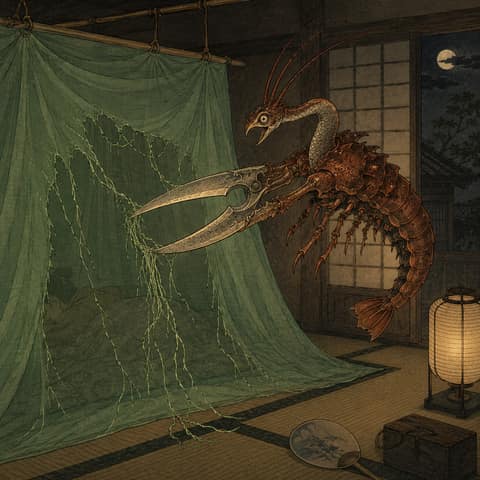
General ClassificationsJapanese folkloreAn interpretation grounded in Sekien’s depiction, tempered by later commentaries that popularized the trait of cutting nets and mosquito screens. Concrete behaviors are sparsely recorded in local sources, and it is often understood as a personification of wear, tear, and fraying. It appears with a carapace-like body and large pincers, shows up at night, and quietly severs its target, with no clear evidence of direct harm to people.

稀少 Mokugyo Daruma
MOH-koo-gyoh dah-ROO-mah
Iconographic Tradition, Sekien Lineage
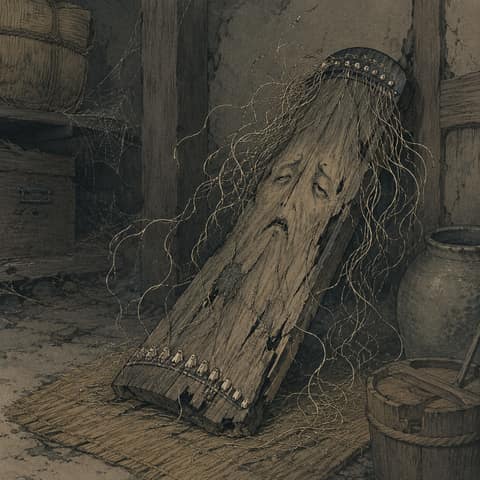
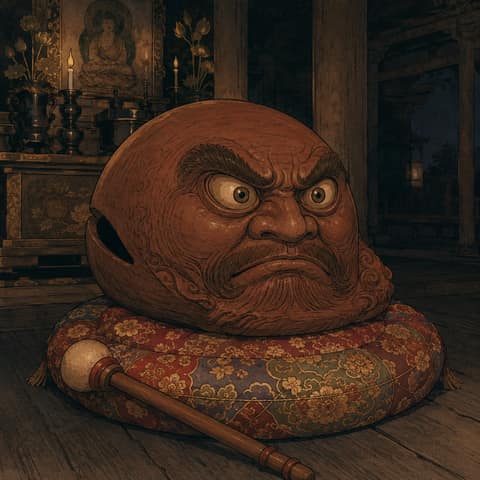
Animated Objects & UndeadJapanese folkloreAn interpretation of a tsukumogami rooted in Toriyama Sekien’s imagery, layering the sleepless symbolism of the wooden mokugyo with Daruma’s rigor of training. More often understood as a moral metaphor within temple culture than as a tale told to frighten. Some regions claim a mokugyo sounds on its own in the hall at night, but systematic oral tradition is scarce. Later artists such as Yoshitoshi followed the design, fixing the visage of a face upon a mokugyo seated on a round mat. It is positioned less as a source of terror than as a presence that sharpens the tension of practice.

稀少 Uyauyashi
oo-yah-oo-YAH-shee
Iconographic Tradition Edition
Mountain & Wilderness SpiritsJapanese folkloreA reconstruction based on imagery from picture scrolls. It kneels low to the ground, the body slack, skin ashen-brown mottled with pale spots. The face is indistinct, the line between mouth and nose blurred, with a damp sheen. In keeping with rare records that preserve little more than its name, no guiding motive is assigned. Said to be seen as a crouching lump by mountain paths or along thickets, it inspires awe and a sense of distance. If approached, it withdraws before its form can be fixed, making pursuit difficult. No confirmed harm is attributed to it, and encounter tales remain general.

稀少 Suzu-hiko-hime
SOO-zoo-HEE-koh-hee-meh
Based on Sekien Toriyama Plates
Household SpiritsJapanese folkloreA reconstruction grounded in Toriyama Sekien’s illustration and notes. Shown as a woman bearing a kagura suzu, she serves as a symbolic presence moving between summoning spirits and soothing souls. Rather than a concrete monster, she personifies the numinous power tied to the ritual bell, evoking the Ama-no-Iwato myth while remaining distinct from its deities. Edo painters placed her within the Night Parade lineage, and Tsukioka Yoshitoshi offered a comparable image to Suzuhiko-hime. No fixed haunt is recorded; she is thought to appear in the imagination at kagura offerings, festival floats, and shrine fairgrounds.

稀少 Kera-kera Woman
keh-rah KEH-rah OHN-nah
Sekien Illustrative Edition
Ghosts & SpiritsJapanese folkloreThis entry centers on Toriyama Sekien’s imagery, supplemented only minimally by the popular explanations found in modern yokai handbooks. Citing the anecdote of Song Yu of Chu, Sekien likened a woman laughing alluringly over a wall to the spirit of a wanton. The plate itself does not detail temperament, degree of harm, or methods of dispelling, offering only form and associative origin. Later commentators emphasize a dry laugh heard by one person alone on an empty road, framing it as a psychological apparition that provokes fear, shame, and unease. Tangible harm is rarely noted, sometimes limited to shock, freezing in place, or fainting. Its hauntings are not tied to a specific region, and are imagined wherever sightlines are blocked—along city walls, crossroads, or over hedges—though sources are not cited. Accordingly, this version keeps Sekien’s visual prompt at its core, treating confusion by laughter as an ancillary function.

稀少 Byōbu-Nozoki (Screen-Peeker)
BYOH-boo no-ZOH-kee
Iconographic Tradition–Conforming Version
Animated Objects & UndeadJapanese folkloreCentered on the commentary in Toriyama Sekien’s Konjaku Hyakki Shūi, this reading emphasizes the habit of peering in from beyond the folding screen. Rather than causing harm directly, it primarily spies on hidden affairs. Some note that the image of lofty screens in Chinese classics shaped its formation, while in Japan it became linked to the belief that bedroom furnishings can accrue spirit, with a folding screen that has long reflected human lives aging into a yokai. It is not a fixed local deity but is understood as a type of haunted implement tale (tsukumogami).

珍しい Rainfall Page-Boy
ah-meh-FOO-ree koh-ZOH
Rain-Attendant Page
Household SpiritsEdo periodBased on Toriyama Sekien’s imagery, this version foregrounds the character of a page serving the Rain Master. It appears with a Japanese umbrella stripped of its ribs worn like a hood and a lantern in hand. Its origins lie more in printed books than in oral folk tradition, and in yellow-covered comic books it shows up as a menial helper. The ideas of rain and service to nobility converge, shaping it as an attendant akin to small child-deity retainers. It does not wield an explicit divinity that summons rain, remaining subordinate to a being that governs rain’s power. Depictions vary—one eye, hat, lantern—depending on period and source, with no single fixed image. Lacking a known local provenance, it spread notably through Edo’s publishing culture.

珍しい Shadow Woman
KAH-geh-OHN-nah
Kage-onna (Traditional Depiction)
Half-Human BeingsUncertain (pictorial sources point to Edo–Kyoto area)The image of the Kage-onna traces back to Sekien’s prints and has been understood as a “woman of shadow alone,” appearing where houses meet moon-cast light. In early modern homes, shoji and wooden doors let light pass, creating a boundary between outside brightness and interior dimness where a woman’s outline emerges. Lore says her visit is fleeting, more a portent of household unrest than a threat. Whether she is the shadow of the living or a trace of the dead is uncertain, and she is sometimes linked to family misfortune or the mood of the local deity. Proper conduct is to refrain from pursuit, lower the fire, close the doors, and speak no words. The next day, households often cleanse the well, garden trees, and crawlspace, seeking rites to calm the omen. The shadow makes no footsteps and shifts its shape in the wind. Dogs and cats are said to react keenly, yet harm is rarely told, and she seldom lingers.

珍しい Bakezōri (Haunted Straw Sandal Tsukumogami)
bah-keh-ZOH-ree
Tsukumogami Sandal Spirit
Animated Objects & UndeadJapanese folkloreA reconstructed image based on medieval to early modern depictions of sandal tsukumogami. Straw sandals were everyday items that wore out quickly and were often discarded, so after a certain number of years they were thought to gain a resident spirit. It reveals itself with noisy nighttime footsteps and aimless hopping, yet causes little harm. The “singing footwear” anecdote found in modern yokai encyclopedias likely conflates a geta folktale and lacks firm evidence as a distinct tradition of the straw-sandal specter. In folklore studies it is understood as a visual emblem of the norm “do not treat tools carelessly,” and is classed as one type within the broader category of tsukumogami.

珍しい Gambari Nyūdō
GAHN-bah-ree nyoo-DOH
Tradition-Concordant Version
Aquatic SpiritsVarious regions (Edo, Kinai, Sanyōdō, etc.)A synthesis based on Toriyama Sekien’s imagery and regional taboos and chants tied to privies. Since antiquity, latrines were seen as thresholds where impurity and boundary meet, with apparitions said to appear at liminal times such as midnight and New Year’s Eve. Sekien depicts a monk-like figure vomiting a bird and notes a charm invoking “Gambari Nyūdō Cuckoo.” Folklore records chants that decide fortune or misfortune, tales of transmutation to gold or koban alongside ominous encounters marked by hearing the cuckoo. Scholars note punning links with the graph for cuckoo and Chinese toilet deities, and strong regional variation and name fluidity, including Wakayama’s “Setsuin-bō” and blending with Okayama’s Mikoshi-nyūdō. Practices on how and when to enter the privy, cautions on time, and children’s nerve-testing customs intertwine with taboos over what to say and tales of invited luck.

珍しい Garei (Spirit of the Painting)
GAH-ray
Garei (Ochikuri Monogatari Edition)
Animated Objects & UndeadKyoto (anecdote from the Kanjuji household)An image-spirit as portrayed in a late Edo essay. A woman steps forth from an old screen painting, and any treatment applied to the picture manifests as real-world phenomena—the core motif is the linkage between image and reality. Signs caused by the aging of the object are perceived as hauntings, yet they subside through repair and reverent care, fitting within tsukumogami tradition. The writer names specific places and households, but the entity’s purpose is unstated, its warnings and appearances are brief, and the events end once the piece is appraised and restored. Rather than the painter’s fame empowering a spirit, the tale chiefly cautions against mistreating fine works. Harm to people is rare; its hallmarks are visual manifestation and a return to its locus, vanishing before the screen. Later readings cite it as an exemplar underscoring the importance of memorial rites for objects.

珍しい Gangi Kozō
GAHN-ghee koh-ZOH
Archaic Illustration-Concordant Form
Aquatic SpiritsUncertain (appears in Edo-period picture books)A reconstruction based on Toriyama Sekien’s image and its brief note. It lurks along riverbanks and in shallow pools beneath cliffs, seizing fish when the moment is right. Its body is close to a small boy’s in build but covered in coarse hair, and its teeth are file-like, said to rasp flesh from its catch. While traits recalling the kappa (such as webbing and a waterside life) come to mind, definitive attributes like a carapace or head-dish are not attested and are therefore omitted. The “bank” and “cliff” elements in the name are read as descriptive of its haunt, not a regional or clan identifier. Modern commentary notes a cautious link to beings bearing “cliff” in mountain-怪 lexicon (e.g., Takiwaro), but stops short of identification. Extant primary sources are Sekien’s picture and text; no behavior, curse, or offering rites are transmitted. Here it is treated as a small waterside uncanny, silently stalking fish.

珍しい Paper Dance
KAH-mee-mai
Documentary Compilation Edition
Household SpiritsJapanese folkloreRather than an independent entity, Kamimai is a later整理 as a label for a household anomaly in which paper moves and scatters on its own. Fujisawa Eihiko is cited as authority and places its appearance in the tenth lunar month, yet his illustration reuses a scene from Ino Mononoke Roku, and the original source does not limit it to any particular month. Since the Showa era, folklore and ghost-story collections have introduced cases of contracts or manuscripts lifting and swirling, naming them “Kamimai,” but firsthand credibility and regional distribution remain unconfirmed. Accordingly, this entry treats Kamimai as a generic yokai image signifying inexplicable motions tied to dwellings and objects, specifically the self-propulsion or levitation of paper, with no fixed form or clear place of origin. In lore it rarely harms people or livestock, tending instead toward startling or teasing behavior.

珍しい Smiling Hannya
wah-RAH-ee HAHN-nyah
Edo Painting Traditions Edition
Demons & GiantsShinano Province (Higashichikuma District, Nagano Prefecture), and elsewhereAn edition distilled from late Edo-period ukiyo-e and comic prints depicting the smiling Hannya. Horns, fangs, bristling hair, wide staring eyes, and a strained grin form its core. Objects in its hands often allude to life and death, unsettling viewers with deliberate motifs. The demon-woman is understood to have once been human, transformed by accumulated jealousy, resentment, and attachment, aligning with the concept behind the Hannya mask. Specific local legends are sparse, yet it was treated in night-time tales and picture books as a symbol of fear and admonition, preserved as an image of the extreme of a woman’s grudge. In local oral tradition sometimes only the name remains, with the transmission of its form relying mainly on pictorial sources.

珍しい Shibiru-biru (Buru-buru) – The Quiver Spirit
boo-roo-BOO-roo
Shindanda (Tradition-Faithful)
Ghosts & SpiritsJapanese folkloreReconstructed around the conceptual yokai image based on Sekien’s illustration. Shindanda does not fix its form, appearing as a presence in lonely places or as something at one’s back. It brushes a person’s collar, sending a chill that freezes the heart and guts. Its alternate names, “Coward-Spirit” and “Zozogami,” personify the psychological and physiological reactions that arise on battlefields or night roads, reflecting a premodern view that treated the signs of fear themselves as a kind of possession. Specific methods of exorcism are not standardized; folk practice records distractions such as fire, light, or traveling with companions, but no systematic rite is known. Lacking a physical body, it is rarely a target for capture or slaying, and has been explained mainly as the cause of chills and gooseflesh that overtake the mind and body.

珍しい Water-Begging Ghost
MEE-zoo-koi YOO-ray
Testament Ghost and Water-Begging Ghost (Traditional)
Ghosts & SpiritsAcross Japan (tales circulated mainly in Edo)A traditional reading grounded in the side-by-side entries of the Testament Ghost and the Water-Begging Ghost in Ehon Hyaku Monogatari. The spirits of those who died with last words unspoken or burdened by thirst appear at night to plead for water. Individual names and deeds are seldom told; instead they serve as moral parables urging memorial offerings. When monks chant sutras, perform memorial services, feed hungry ghosts, or make alms to the dead, their thirst is said to be soothed with the symbolic “sweet dew” described in scripture. Told in both towns and villages, they appear where people and water meet—by wells, bridges, graves, and roadsides. They stir pity more than terror, and tales warn that rough treatment brings a curse, while respectful rites lay them to rest.

珍しい Snow Elder
YOO-kee-jee-jee
Elder of Snow Standing in the Mountains
Natural Phenomena SpiritsMountain regions of Tohoku, Hokuriku, and Koshin (uncertain)When the curtain of a blizzard falls, the Snow Elder appears as an old man in white robes, calling from afar to strip travelers of their sense of direction. He belongs to the lineage of snow-related apparitions, overlapping in role with Yuki-onna and Yuki-nyūdō, yet marked by his elder form. His figure is indistinct, fading the closer one approaches, while only his voice is said to echo from behind. In folklore he is understood as a symbolic warning against the perils of winter weather.

珍しい Nyoi Jizai (Will-at-Will Scepter Spirit)
NYOH-ee jee-ZAI
Emaki Edition
Animated Objects & UndeadJapanese folkloreA consolidation based on the nyoi monster depicted in Muromachi-period Night Parade of One Hundred Demons scrolls and on Toriyama Sekien’s Hyakki Tsurezure Bukuro images and captions. Following the tsukumogami belief that tools gain spirit with age, the nyoi’s original function of “reaching at will” is exaggerated as occult power. Two iconographic lines exist: one shows a humanoid with a tea-brown body and long claws that scratch a person’s back with extended arms, the other shows the nyoi itself sprouting wings and drifting in midair. Both appear late at night in bedrooms or Buddhist rooms, said to seek out itchy spots and places the hand cannot reach. Some readings hold that the morally wanting are left with claw marks, yet region-specific oral lore is scant, and the figure relies mainly on pictorial sources and later yokai commentaries.

珍しい Umashika (Horse-Deer Yokai)
oo-MAH-shee-kah
Emaki-Conforming
Animal ShapeshiftersUnknown; chiefly attested in Edo-period picture scrollsA version that preserves only the appearance seen in early modern picture scrolls. Key features are a horse-like face, cloven deer-like hooves, upturned eyeballs, clothing, and a stance with both forelegs braced. No behavior or abilities are recorded. The name is understood as a visual pun on the written word for “baka” (fool), and any allegory remains speculative. Later embellishments are avoided here; description is confined to the iconography.

珍しい Ita-oni (Board Demon)
EE-tah-oh-nee
Canon-Concordant (Based on Tradition)
Household SpiritsCourtly and aristocratic residences around Heian-kyō (Kyoto), JapanDrawing on the Konjaku Monogatari-shū, later scholarship calls it “Ita-oni” (Board Ogre). The entity is either a board itself or a phenomenon dwelling in a board, taking a plank-like form that juts from roof beams or lattices. Its motive and will are unstated, but its core act is crushing sleepers to death. In Heian court and aristocratic residences, night watch and gate duty were crucial, and tales of the uncanny often served to reinforce discipline. Here too, it bypasses two armed men and strikes a defenseless sleeping place, embodying the ethic that negligence invites death. While it aligns with the idea of spirits inhabiting objects, it lacks tales of aging into autonomy or growth, and is told as a transient manifestation of a specific board appearing to suit the scene. There are no records of pursuit or capture, and it appears and vanishes swiftly without leaving traces.

珍しい Muku-Mukabaki (Awakened Gaiters)
MOO-koo MOO-kah-bah-kee
Traditional Edition
Household SpiritsEdo periodAn edited version consolidating Edo-period pictorial sources of the “Inugake” apparition. Inugake are fur leggings worn from the waist to the legs for warmth and protection in hunting gear, placed within the lineage of tool-spirits that gain sentience after long use or separation from their owner. In Sekien’s illustration only the legs seem to walk independently, with the caption evoking the inugake of Kawazu Saburō in The Tale of the Soga. This is a literary hint by the artist rather than evidence of a specific vengeful-ghost tale. In early modern Night Parade of One Hundred Demons and tsukumogami scrolls, yokai wearing inugake appear, emphasizing the uncanny form of the gear. Its nature is generally to show up at night and startle people, with no clear record of harm or benefit. Localized traditions are scant, and most examples belong to urban pictorial culture. It is understood as a classic example of the idea that aged implements come to house spirits.

珍しい Metsuhō Shell (Metsuhō-gai)
MEH-tsu-hoh-gai
Emaki-Accurate Depiction
Aquatic SpiritsJapanese folkloreIn texts, the Metsuhō Shell appears solely as an image: an enigmatic shell-dwelling creature that emerges around rivers, marshes, and ponds. Eyes peer from the rim of its shell, and a tail-like appendage sways as if propelling it. Its behavior, malice, and omens are not recorded. Late Edo picture scrolls omit explanatory captions, inviting readers to infer origins from its name and form, and set it alongside other water spirits. The term metsuhō evokes a sense of lawlessness or being out of bounds, but no firm source, orthographic variants, or toponymic links are attested. Accordingly, this entry confines itself to minimal notes based on iconographic traits and extant sources.

珍しい Field Matchlock (Nodeppō)
noh-DEHP-poh
Canonical Folklore Version
Animal ShapeshiftersMountain forests of Japan’s northern provincesBased on images from illustrated Edo-period strange tales. It hides in northern mountains and fields and moves from twilight into early night. It appears as a small beast like a badger or a giant flying squirrel, and when attacking it blinds a person to sow confusion. Sources describe two modes: one covers the victim’s face with its whole body, the other spits a bat-like thing that clings to the face. Some accounts say it drinks blood, while later interpretations suggest it steals carried food while the victim’s sight is blocked. Historical conflation with badgers, tanuki, nobusuma, and bats led to shifting names and traits. A simple defense recorded is to keep rolled ear-shaped leaves in one’s bosom, though details vary by region and era. Avoids modern embellishment and follows classical picture compendia.

珍しい Fusuma
Fusuma
The White Cloth of the Night Road: Sado Fusuma
Dwelling / household objectSado Island, Niigata Prefecture (main form) / Tosa, Kōchi Prefecture (variant)This version focuses on the better-known white-cloth type from Sado, rather than the Tosa form. It centers on the circumstances in which Fusuma appears on night roads, the method of resisting it with ohaguro, and the legendary connection to the custom of men using kane tooth dye. In Sado, on night roads, snowy paths, or around inns, a white cloth about the size of a wrapping cloth is said to drift down without sound, as if floating in the moonlight, and cover a person from head to shoulders. Blades cannot cut it. Only when someone with ohaguro in their mouth bites through one edge does the apparition wither and fall away. It is true that some men on Sado used kane tooth dye into the Meiji period, and elders preserved the explanation that this was a remnant of measures against Fusuma. Yet the male ohaguro custom also has other possible motives, including festival dress and rites of adulthood. The claim that it existed specifically to defeat Fusuma should be read as partly containing later rationalization. In winter Sado, when wind rises over snowy fields, white cloth from eaves or drying racks can be swept up and blown across one's view. Such natural experiences may also have been retold locally under the name Fusuma.