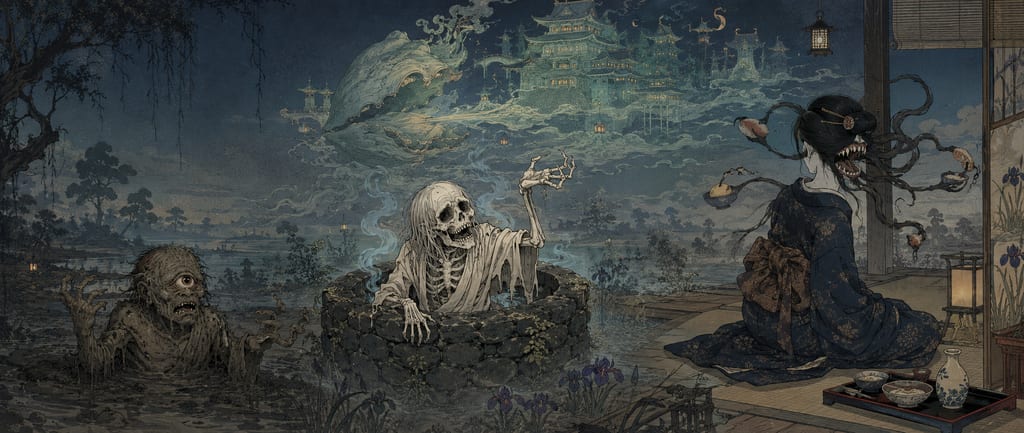
A yokai depicted by the Edo-period painter Toriyama Sekien in Konjaku Hyakki Shūi. Shown as a beauty from behind, yet the reflection on the water reveals a deeply wrinkled old face. Sekien notes he modeled its name “Iyaya” after the Chinese tale of the insect called “Guai zai” (“strange!”), rendering it as 否哉; no concrete traits are described. Later sources mention it under names like Iyami or Ijiami, but its existence in genuine tradition is doubtful.
Folklore & Legends
Beyond Sekien’s book, no reliable early traditions are known. Modern picture books and encyclopedias repeat the visual motif: a young woman seen from behind who turns out to be an old person, or whose reflection shows age. A Sendai setting is sometimes cited, but sources appear literary or embellished rather than oral tradition, and local, verifiable accounts are scarce. Name variants include 否哉, いやミ, and 異爺味.
Adheres strictly to Toriyama Sekien’s image and notes, avoiding later embellishments. The yokai is shown as the back view of a young woman standing by water, while the surface reflects the visage of an old man. The name draws on Dongfang Shuo’s “kaizai” expressions of wonder, suggesting Sekien likely fashioned an allegory. Youth and age, beauty and ugliness, front and back are opposed within a single frame, read as a design warning against being deceived by appearances. Firm oral traditions are scarce, so its character is defined largely through image interpretation. The readings iyaya or iyami vary by source, possibly evoking refusal or repulsion akin to “no,” but the literature offers no certainty.
Character Profile
This section is our own creative profile for storytelling. It is not historical fact or scholarship.
The diagram below is a diagnostic evaluation chart for Sekien Iconography Standard. The higher the value of each item, the stronger that characteristic is expressed.