YOKAI.JP

Yokai Encyclopedia

Encyclopedia of Japanese Yokai

560 Yokai|14 Category|Page 1 of 24
Localization in Progress - More content available in Japanese version
View Japanese
Sort by: NameAscending
  • Abe no Seimei

    Abe no Seimei

    Legendary

    AH-beh noh SAY-may

    Onmyoji Seimei

    Ghosts & SpiritsKyoto

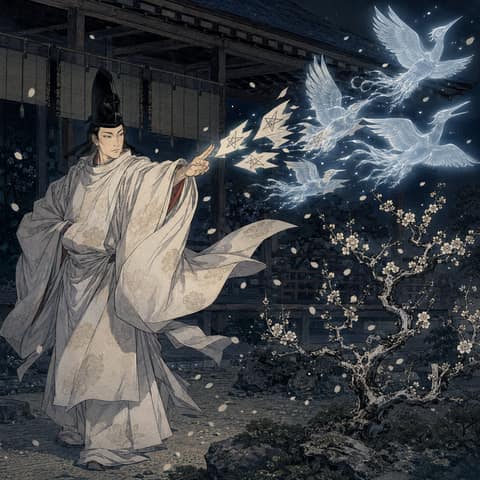
    A portrait of Abe no Seimei shaped around the historical court onmyoji, later embellished by folklore. He is chiefly depicted as a practitioner of astronomy, calendrics, divination, and purification, presiding over rites such as ritual stamping, ablution, and directional avoidance. Shikigami were originally discussed as doctrinal techniques of Onmyodo or auxiliary spirits, symbolized as secret transmissions within the family line. Prayers for rain and healing from epidemics functioned to stabilize society through knowledge of seasons, stars, and directions combined with public ritual. From early modern times onward, Seimei was elevated as the progenitor of the Tsuchimikado house, and miracle tales multiplied in temple-shrine origin stories and storytelling. Records of a real government official merged with the image of a thaumaturge in yokai tales, fixing his name as representative of Onmyodo.

  • Abumikuchi

    Abumikuchi

    Rare

    ah-BOO-mee-KOO-chee

    Sekien Zue Conformant

    Animated Objects & UndeadJapanese folklore

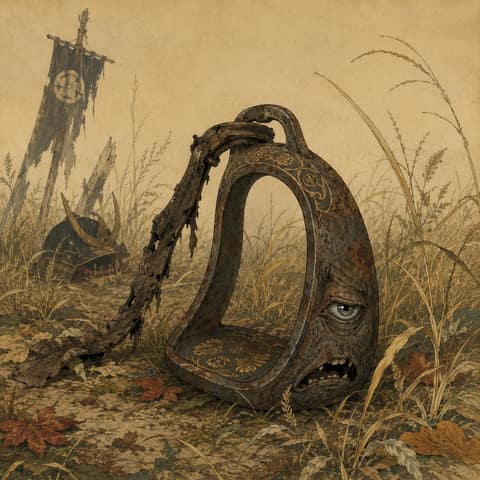
    An abumiguchi depicted per Toriyama Sekien’s Illustrated Bag of a Hundred Tools. An ancient stirrup sprouts eyes and a mouth, shown lying on the ground or dragging its straps. A quoted line from the Noh play Tomonaga invites readings of battlefields and fallen warriors in the background, yet no concrete deeds or harms are recorded. Following tsukumogami conventions, it is the resentment and lingering attachment of a tool long used then discarded given form. This aligns with Edo-period essays that teach “cherish your implements,” and likely reflects the Tsurezuregusa passage warning about horse gear, echoed in its pairing with the Saddle Fellow. The modern retelling that it “awaits its master,” seen in Mizuki Shigeru’s notes, lacks support in older sources and is not adopted here. No verified field traditions are known, and no region is specified.

  • Aburabō (Oil Wraith)

    Aburabō (Oil Wraith)

    Uncommon

    ah-boo-rah-BOH

    Abura-bō (Traditional Form)

    Half-Human BeingsShiga

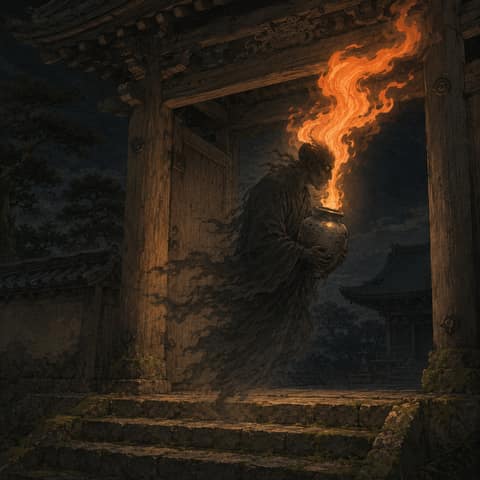
    At the core of Abura-bō is the guilt of misappropriating oil meant for temple and shrine lamps, manifesting as a spirit flame. Early modern records and local lore place its appearances around the foothills of Mount Hiei and temple precincts across Ōmi, most often from dusk to midnight in late spring through early summer. It takes the form of a small orange to yellow fireball, or the shadow of a monk cradling an oil jar, following a set course over gates, halls, and pond embankments before vanishing. Its voice is uncertain, though some regional tales mention indistinct murmurings. Names vary by area—“Abura-bō,” “Oil Thief,” “Oil Returned”—all carrying a folk warning about taboos surrounding oil and the need for proper rites. Specific individuals or temple names differ across sources, but the strict management of lamp oil in temple society likely fostered these tales. Methods to calm it include sutra chanting, burial of offerings, and restoring lamp offerings, though no fixed formula is known.

  • Aburahi-daimyojin

    Aburahi-daimyojin

    Divine

    あぶらひだいみょうじん

    The Tutelary Deity of Koka Descending with Fiery Light upon Mount Aburahi

    Divine Spirits / DeitiesShiga

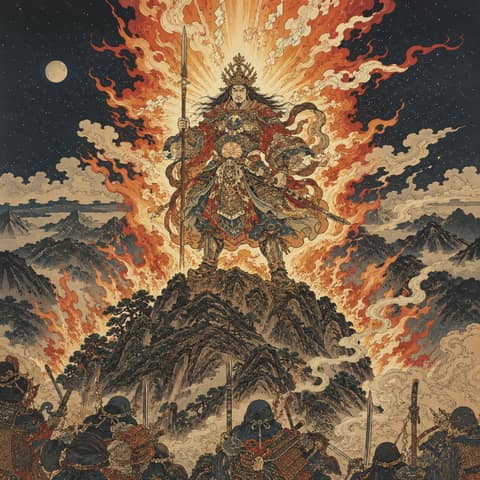
    Aburahi-daimyojin is a deity unique to Koka, intertwining nature spirits, Buddhism, and samurai worship. Its origins lie in ancient mountain worship directed at Mount Aburahi, a sacred peak whose summit shrine still venerates the water goddess Mitsuhanome-no-kami, preserving an older layer of belief. Overlaid onto this is the legend of the descent: "A god descended with a light like burning oil," which is told as the origin of the shrine's name. Furthermore, a Muromachi-period history connected the shrine's founding to Prince Shotoku (with Nyoirin Kannon as its original Buddhist manifestation, or *honji-butsu*), and in the Middle Ages, it evolved into the "Sosha of Koka," revered as a war god by the Koka samurai. Its mention in the oaths of the *Watanabe Family Documents* indicates that Aburahi-daimyojin was the deity before whom the shinobi of Koka swore their vows. Its multifaceted nature—encompassing fiery light, a sacred mountain, martial divinity, and the protection of fire and oil—mirrors the spiritual history of Koka, a land where espionage, fire arts, and Shugendo mountain asceticism intersected.

  • Aburasumashi

    Aburasumashi

    Rare

    あぶらすまし

    The Voice of Kusazumigoe: Aburasumashi

    Apparitions of Mountains and FieldsKumamoto

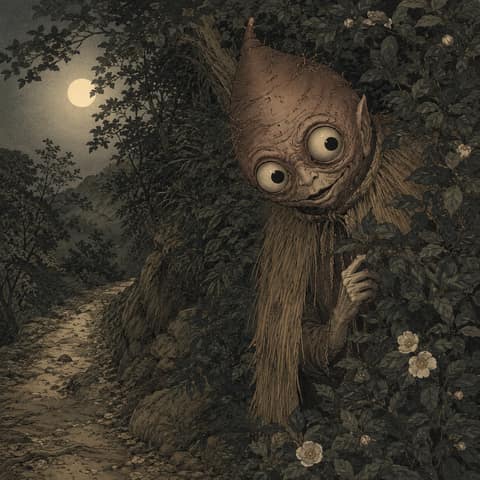
    The core of the aburasumashi is not its "appearance" but its "response." The moment someone mentions a rumor about it at the pass, it replies, "I still appear now" ── the very act of speaking becomes a summoning. It is a yokai that possesses words. The imagery of the straw raincoat, hat, and potato head was a later creation popularized by Shigeru Mizuki; the original Amakusa lore was purely about a voice and a presence. The backdrop to this legend is the local lifestyle of pressing "katashi oil" from the seeds of camellias and sasanquas in Amakusa. A leading theory suggests that the warning against those who stole or wasted the scarce oil crystallized into the shadow of a figure carrying an oil bottle in the darkness of the pass, sharing a lineage with oil-related apparitions like Aburabo and Aburabozu across Japan. While linking the nameless stone statue at Kusazumigoe in Sumoto to its "grave" is a modern reinterpretation, it serves as an excellent example of local memory coming to inhabit a physical object.

  • Accompanying Hyōshigi

    Accompanying Hyōshigi

    Uncommon

    oh-KOO-ree hyoh-SHEE-ghee

    Tradition-Faithful Version

    Household SpiritsTokyo

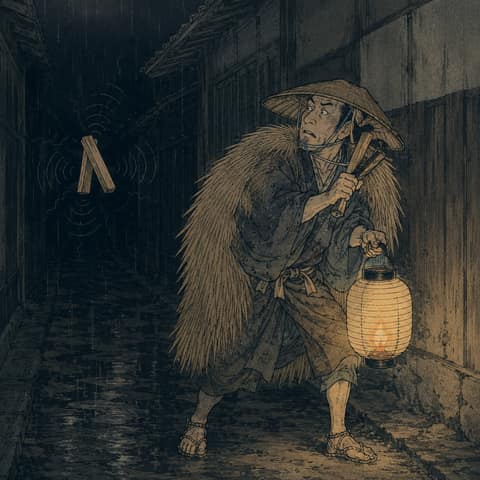
    Aligned with the clapper-wood anomaly counted among the Seven Wonders of Honjo. Understood less as a corporeal yokai and more as a name for an aural phenomenon. It appears in step with the steady rhythm of night-watch clappers, most notable at corners, near water, and in rain. Visual sightings are scarce, and turning back reveals only a lingering presence. An urban ghost tale tied to local customs of community patrols, paired with the kindred “Okuri Chochin.” The lore resists heavy anthropomorphism, and its hallmark is that sound itself becomes the act of “seeing-off.”

  • Ainu Kaisei

    Ainu Kaisei

    Uncommon

    EYE-noo KAI-say

    Oral Tradition Description Version

    Ghosts & SpiritsHokkaido

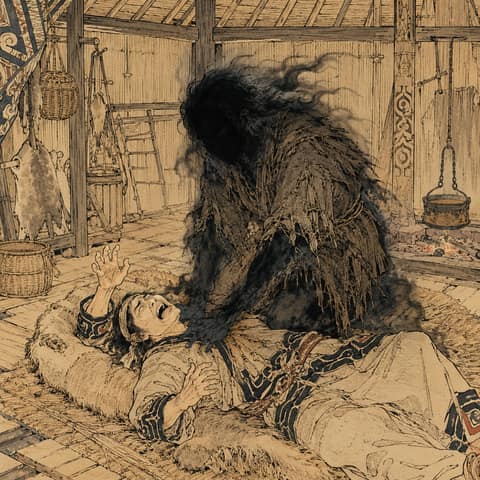
    A descriptive version organized from Ainu oral tradition. It wears attushi garments with frayed fibers and frequents human dwellings, especially vacant or old houses. It most often appears around midnight and is felt in bed as pressure on the chest or throat. Its true nature is interpreted as the presence of the dead or a death-tainted impurity, and it is sometimes linked to the general belief that neglecting household cleaning, fire tending, or prayer invites it. Its form is indistinct, spoken of as a shadow or presence, and it is said to withdraw if the light is strengthened or a voice is raised. Its relation to Tohoku’s zashiki-warashi is mentioned only by comparison as a similar “spirit that appears in the sitting room,” without any tales of bringing good fortune.

  • Aka Manto

    Aka Manto

    Epic

    Aka-manto

    Pre-War Red Caped Kidnapper / Post-War Red or Blue Paper

    霊・亡霊昭和10年代の流言·都市伝説、トイレ怪談へ派生

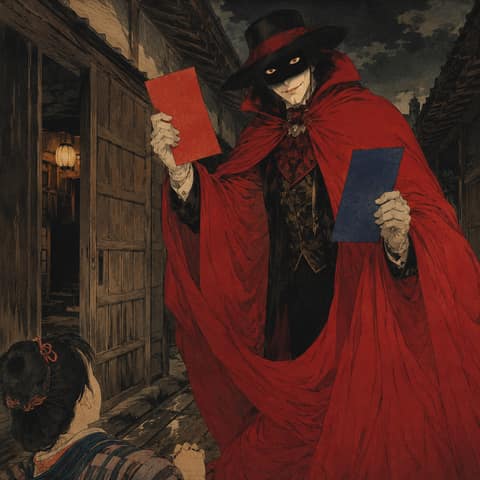
    Aka Manto as a Subject of Pre-War Rumor Studies. The base description outlined its evolution from pre-war to post-war; in this deep dive, we explore how the pre-war Aka Manto was positioned within Japanese sociological rumor studies. Soichi Oya (1900–1970), a prolific social critic from the pre-war to post-war eras, was a pioneer in journalism and rumor research. His essay, *The Sociology of Aka Manto*, published in the April 1939 issue of *Chuo Koron*, stands as a rare early example of academic analysis applied to a contemporary urban rumor. It utilized a single rumor to dissect wartime societal anxiety, the distortions caused by information control, and the collective psychology of urban residents. The pioneering nature of Oya's paper served as the starting point for later socio-psychological studies by scholars like Hiroshi Minami, Hideo Kishimoto, and Takeyoshi Kawashima, who systematized wartime and pre-war rumors. As the first urban legend to be comprehensively analyzed by Japanese sociology, Aka Manto holds immense significance in academic history. The Symbolic Weight of the Color "Red". The pre-war Aka Manto possessed a striking visual hook: "a running man in a red cape." In pre-war and wartime Japan, "red" carried heavy, complex connotations: (1) it was a symbol of blood, violence, and danger; (2) it was a metaphor for communism and anti-state ideology (within the context of wartime censorship); and (3) it represented the foreign otherness of Russia and the West (the Red Army, the "Red Devil"). The fact that Aka Manto proliferated during the war was no coincidence; it can be read as a socio-psychological event where the militaristic anxieties of urbanites coalesced and erupted around the color "red." Conversely, its post-war evolution into the "Red Paper, Blue Paper" schoolyard ghost story can be interpreted as the stripping away of its heavy pre-war symbolism, gamifying it into a simple "color-choice question" for children. The Continuity of Wartime Rumors and Children's Folklore. Aka Manto is a profoundly rare case of a pre-war urban rumor transitioning directly into a post-war school ghost story. This unbroken continuity is underpinned by three layers: (1) the generation who experienced their childhood in the 1930s became parents or teachers after the war, passing the story down to the next generation; (2) the chaos of the wartime metropolis and the rapid urban transformations of the post-war economic boom generated analogous psychological anxieties; and (3) the physical space of the school consistently functioned as the transmission apparatus for children's oral traditions across both eras. The Interrogative Structure of "Red Paper, Blue Paper". The core mechanic of the school ghost story version is the "color choice question." Answering "red" gets you dyed in blood; answering "blue" gets your blood drained. This "unsolvable dilemma"—where any answer results in death—shares structural similarities with classical Trickster myths (where every choice is a trap) and the psychoanalytic concept of the "forced choice." Folklorist Noboru Miyata theorized in *The Folklore of Yokai* (Iwanami Shoten, 1985) that the "unsolvable question structure" in post-war school ghost stories was a ritualized expression of childhood anxiety and powerlessness. Alongside Kokkuri-san's "answer-seeking summons" and Kashima-san's "Where are your legs?" interrogation, it is classified as one of the three major interrogative archetypes in children's oral horror. Convergence and Divergence with Hanako-san. In children's oral culture post-1980s, a strong trend emerged merging Aka Manto with "Hanako-san of the Toilet." Legends appeared featuring a Hanako wearing a red skirt or cape, narratives explaining that Hanako's true identity *was* Aka Manto, and storylines casting Aka Manto and a new "Ao (Blue) Manto" as a sibling duo or rival pair. This demonstrates that post-war school ghost stories did not exist in isolation; they evolved as a living ecosystem of interconnected myths. In modern urban legend studies, it has become standard practice to treat Aka Manto, Hanako-san, Kashima-san, Teketeke, and the Slit-Mouthed Woman collectively as an overarching "lineage of post-war Japanese horror intricately tied to women, the physical body, and the school space." The Nexus of Pre-War and Post-War Rumor History. Within Japanese urban legends, Aka Manto is an incredibly rare yokai that boasts explicit academic documentation across two distinct eras: pre-war (1935–1940) and post-war (1950–1990). It was recorded independently by two different academic fields—pre-war sociology/rumor studies (Soichi Oya, Hiroshi Minami) and post-war folklore/school ghost story research (Toru Tsunemitsu, Noboru Miyata). The mere fact that a 1939 academic paper in *Chuo Koron* and a 1990 children's book by Kodansha KK Bunko are discussing the exact same supernatural phenomenon, separated by half a century, serves as the most powerful testament to the enduring continuity of Japanese urban legend studies.

  • Aka-ashi (Red Foot)

    Aka-ashi (Red Foot)

    Uncommon

    AH-kah AH-shee

    Aka-ashi

    General ClassificationsVarious regions of Japan (Shiwaku Islands in Kagawa, Fukuoka Prefecture, Hachinohe in former Mutsu)

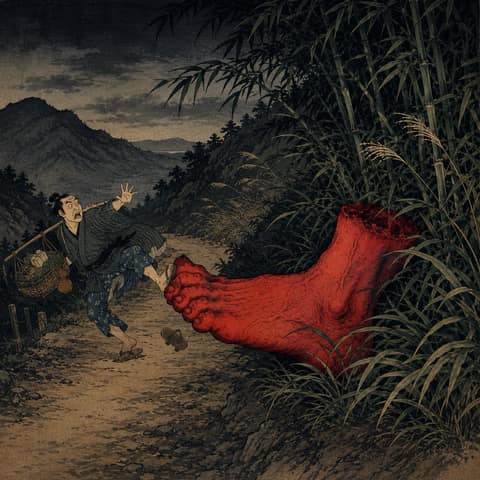
    Based on records from various regions, in places where it shows itself only a pair of red feet jut from the roadside, startling passersby and throwing off their pace. Where it remains unseen, a dry, cottony or cobweb-like touch clings to the shins, shortening strides and increasing fatigue. It is not lethal, yet it is feared for causing falls and leading people off the road. Its relation to the Red-Hand Child is noted in sources but not assumed to be identical. Encounters are told at crossroads, mountain paths, and brush edges in sparsely peopled spots, most often from dusk to midnight. As remedies, some regions pass down practical measures: breathe deeply and steady your steps, sit to retie sandal thongs, brush aside the roadside grass, though details vary locally and remain uncertain.

  • Akagi Daimyojin

    Akagi Daimyojin

    Divine

    Akagi Daimyojin

    Akagi Daimyojin, the Deity Ruling Mount Akagi

    Deity / Divine SpiritGunmaTochigi

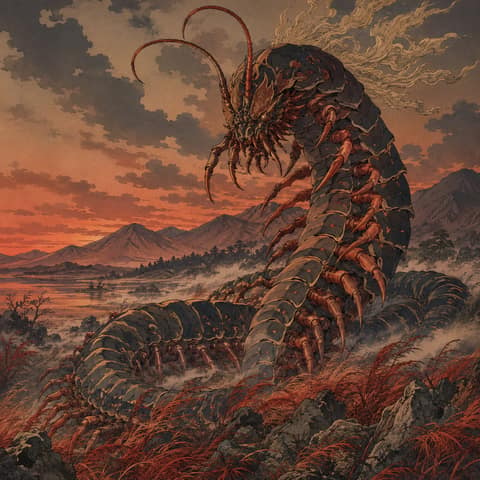
    Akagi Daimyojin is the deified embodiment of the entirety of Mount Akagi, which towers over the northern edge of the Kanto Plain. Rather than a singular anthropomorphic god, it strongly exhibits the nature of a "deity of place" that governs the mountains, swamps, forests, and springs. Consequently, it has been depicted in multifaceted ways over time—associated with Toyoki-irihiko-no-mikoto, Oanamuchi-no-mikoto, or even the goddess Akagi-hime. Its transformation into a giant centipede (or serpent) in the Battle of the Gods represents its fierce, combative aspect, forming a stark contrast to its gentle demeanor as a deity of agriculture and water during times of peace. The fact that real geographical locations like Senjogahara, Akanuma, and Oigami are all narrated as remnants of this divine battle suggests how deeply these legends are rooted in the local landscape. The cycle of tales featuring the Nikko deity as an adversary is essentially a mythologization of the border disputes between the former provinces of Kozuke and Shimotsuke. The variations in avatars and outcomes (whether Akagi is the centipede or the serpent, the victor or the vanquished) are direct reflections of the regional pride embedded in each area.

  • Akamata

    Akamata

    Rare

    あかまたー

    Night-Visiting Serpent Phantom Akamata

    Animal ShapeshifterOkinawa

    The Akamata is a serpent bridegroom that appears in the Okinawan night. It visits a young woman in the guise of a beautiful youth, but its true form is a massive reddish-brown snake. Suspicious, the young woman secretly pierces the hem of the young man's clothing with a threaded needle, and by following the thread at dawn, she is led to a snake's den—a classic spindle-motif tale passed down across the islands. A maiden visited by the Akamata conceives a serpent's child, but she purifies herself on the third day of the third lunar month by going down to the beach and stepping into the tidal waters to wash the unborn snake away. Fear and purification are intertwined in this single narrative, still recounted today as the origin of the Okinawan *Hamauri* festival.

  • Akamata Kuromata

    Akamata Kuromata

    Legendary

    Akamata Kuromata

    Akamata Kuromata, the Secret Deities of the Subterranean Otherworld

    Deity / Divine SpiritOkinawa

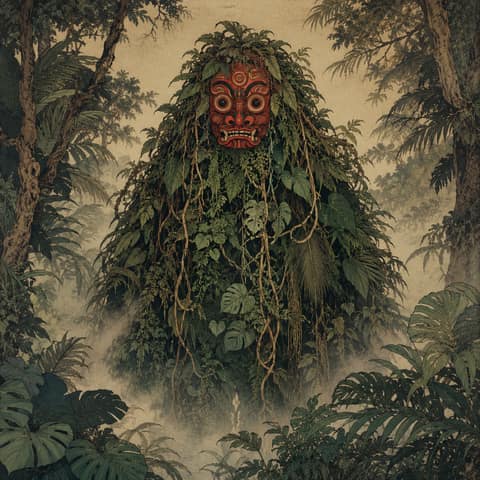
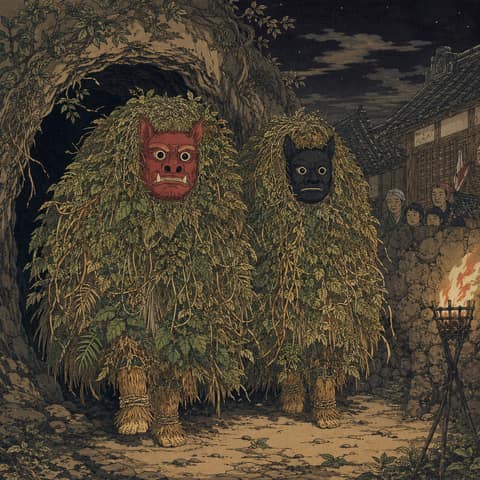
    This is a visiting deity clad in a stout, dumpling-like body wrapped in layers of vines, wearing a red or black mask. It is said that only once a year does it reveal itself from a bottomless subterranean cavern known as Niroo—an otherworld beyond the sea—to bestow bountiful harvests and fruitful yields upon the village. No one but the permitted local residents of the district may lay eyes on its form or hear its voice, and no photographs or spoken words of the ritual may ever leak to the outside world. It is an entirely different entity from the snake yokai Akamata, who shapeshifts into a handsome man to visit maidens. It is precisely by remaining unseen that its divine majesty is preserved, standing as the master of this silent, secretive festival.

  • Akaname

    Akaname

    Epic

    ah-kah-nah-meh

    Bathhouse Grime-Goblin

    Household SpiritsVarious regions of Japan (especially Edo traditions)

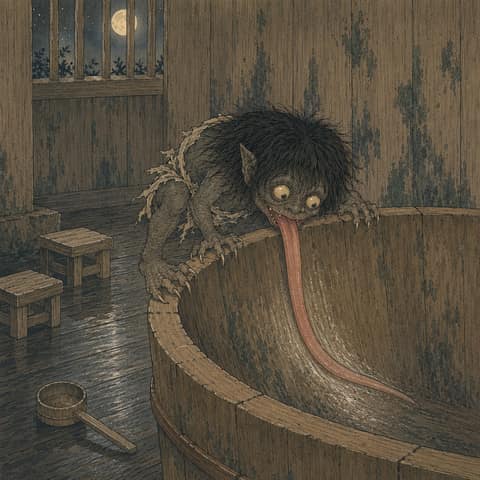
    A canonical form based on Sekien’s imagery and Edo-period prints. Resembling a cropped-haired child, it has clawed feet and an unusually long tongue. It avoids people, appears on deserted nights, and laps up bath scum and mineral scale, leaving wet tongue trails and a strange odor as its trace. Direct harm is rare; it is often seen as a presence that urges residents to clean.

  • Akashi-sama

    Akashi-sama

    Uncommon

    ah-KAH-shee-sah-mah

    Standard Folkloric Account

    Ghosts & SpiritsKanagawa

    A compiled standard telling of Akashi-sama from Hodogaya Ward. Its core traces to the late Edo period: a deranged lord craved bloodshed, cut down a hunter’s daughter, and was slain by the hunter. Thereafter the name was feared and spread as an oral warning against going out at night. Details like appearance, clothing, and the hour of manifestation are inconsistent; storytellers stress effects such as “it appears” or “it takes you away.” This is a scare-tale type of uncanny being tied to local norms, functioning practically in household discipline and communal safety. Identifying real persons or places requires caution; it is sometimes paired with the proper name “Akashi Gozen,” but lineage remains unclear.

  • Akki (Malevolent Oni)

    Akki (Malevolent Oni)

    Uncommon

    AHK-kee

    Akki (Traditional Image)

    General ClassificationsAcross Japan

    The traditional image of the akki is a collective notion of “oni” that personify external calamities such as epidemics and natural disasters, spoken of not as individuals but as targets to be subdued. After Buddhism took root, they were systematized as beings set against benevolent deities, often depicted as groveling demon figures trampled by the Four Heavenly Kings or Wisdom Kings to display divine might. Among commoners, practices like Setsubun bean-throwing and displaying foul-smelling or thorny materials expressed a shared intent to guard boundaries and repel misfortune at the threshold of the home. In texts they overlap with terms like akuma and jaki, and over time could also signify inner demons of desire and agitation, yet in daily practice they were treated chiefly as personifications of external threats.

  • Amabie

    Amabie

    Legendary

    ah-mah-BEE-eh

    Kawara

    Half-Human BeingsKumamoto

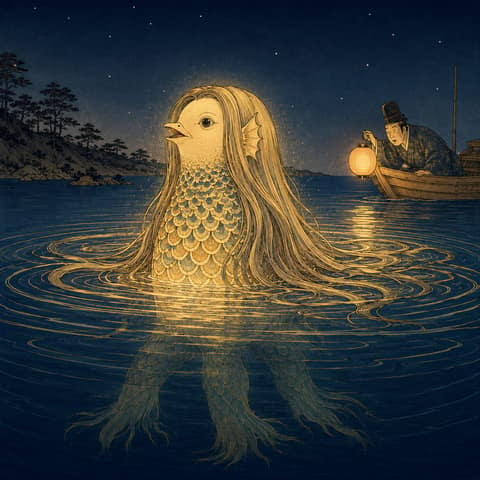
    Based on a broadsheet believed published in Koka 3 (1846), this version reconstructs a figure that appeared at sea, shone with light, and delivered prophecies to officials. Because the text states “as in the illustration,” appearance relies on the image; thus we avoid later Amabiko traits and confusions, noting only the referenced depiction such as a scaled body, long hair, a beaklike mouth, and three leglike appendages. The emphasis is on prophecy and dissemination of its image, with no explicit claim of directly suppressing epidemics. It foretells six years of abundant harvest alongside epidemic outbreaks, and presenting its portrait was accepted as a popular apotropaic act. Though said to originate in Higo Province, related tales appear nationwide with differing names and details.

  • Amamikiyo

    Amamikiyo

    Divine

    あまみきよ

    Amamikiyo, the Creation Deity of Ryukyu

    Deity / Divine SpiritOkinawa

    Amamikiyo is the creation deity believed to have journeyed from the otherworldly Nirai Kanai to form the Ryukyu Islands. It is said that they first descended on Kudaka Island, established seven sacred groves starting with Asumui Utaki, and settled people on the land. While the *Omoro Sōshi* sings of dual creation by Amamikiyo and Shinerikiyo, the *Chūzan Seikan* records Amamikiyo as a solitary creator. Diverging from mainland Japanese deities enshrined in main halls, Amamikiyo resides within the forest *utaki* and the sacred seas themselves. The *Agari-umāi* pilgrimage, in which kings toured eastern sites, traces this deity's arrival across the local geography—meaning that in Okinawa, myths can still be walked and experienced firsthand.

  • Amano-zako (Heaven-Contrary Deity)

    Amano-zako (Heaven-Contrary Deity)

    Epic

    ah-mah-noh-ZAH-koh

    Zukai-Conformant Demon-Deity Form

    Deities & Divine SpiritsUncertain (descriptions chiefly in Edo-period encyclopedias)

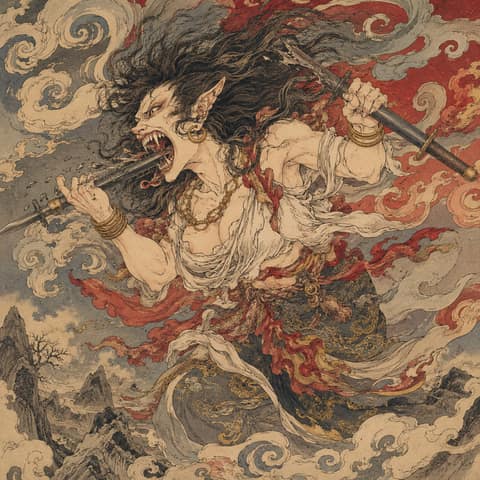
    This version follows the core account in Wakan Sansai Zue, depicting Amanozako as a ferocious demon-deity born from turbulent qi. Her appearance blends human and beast, with a high nose, long ears, and powerful fangs. Her temper is ever contrary, shunning proper procedure and delighting in reversals. She is said to wield overwhelming spiritual force, boasting the strength and presence to hurl even mighty gods afar. While conceptually akin to the Amanojaku, her lineage is unsettled, and claims that she is progenitor of the Tengu are limited. The note that she is mother of Tenma-no-O is confined to the Zue citation, with little broad support in oral tradition. Here the focus remains on her classical traits as a demon-deity—contrary speech, contrary action, and ferocious might—kept within the bounds of early-modern images and texts.

  • Amanojaku

    Amanojaku

    Epic

    ah-mah-noh-JAH-koo

    Traditional Iconography and Folktale

    Demons & GiantsOkayamaShizuoka

    Amanojaku is understood as a fusion of the trampled demon in Buddhist iconography and the folk image of a small imp fond of mimicry and speaking in reversals. Many temple and shrine statues of the Four Heavenly Kings or Shukongōshin place a small demon underfoot, signifying the subjugation of worldly desires and wicked intent. In stories, Amanojaku habitually reads people’s hidden thoughts, balks at requests, and does the opposite of commands to sow confusion. In mountain lore it is told as a being of tremendous strength, with unfinished stone piles, bridge piers, and toppled boulders on peaks attributed to its failed feats. Interpreting echoes as the voice of Amanojaku is a personification of natural phenomena, overlapping regionally with names like kodama and yamabiko. In fairy tales such as Uriko-hime, it serves as a touchstone-like adversary that preys on carelessness or greed, carrying a moral lesson. Overall, Amanojaku lives across iconography, folktales, and dialect traditions as a mirror of human contrariness and the gaps in the heart.

  • Amaterasu-Omikami

    Amaterasu-Omikami

    Legendary

    あまてらすおおみかみ

    Supreme Deity of Takamagahara

    Divine Spirit / DeityMie

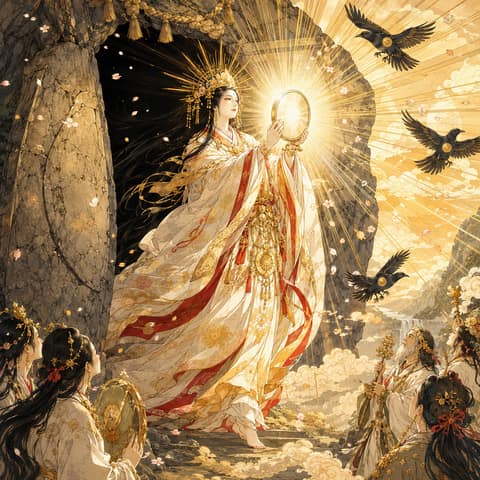
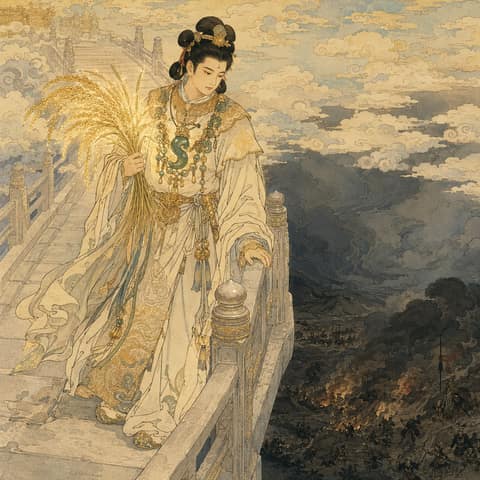
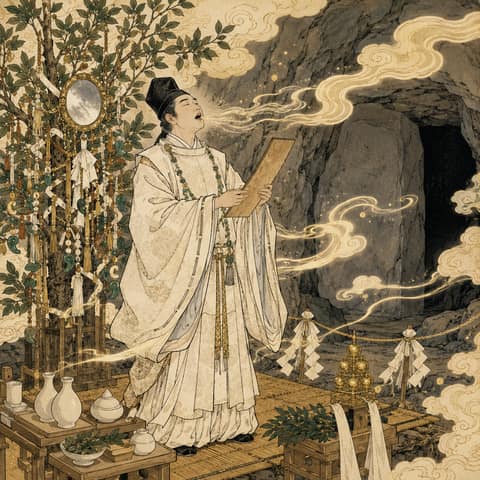
    The Peculiarity of Japanese Mythology: Sun God = Female. While the base description touched on the primary myths of Amaterasu-Omikami, this detailed explanation delves into the comparative religious peculiarity of Japanese mythology in making the sun god female. Sun deities in ancient world mythologies—such as Greece's Apollo, Egypt's Ra, India's Surya, Inca's Inti, and Babylonia's Shamash—are predominantly male. On the other hand, female sun deities like Japan's Amaterasu, Norse's Sól, Baltic's Saulė, and some in Eastern Europe are relatively rare. In post-war Japanese mythological studies, scholars like Takeshi Matsumae proposed the male deity theory, stating that "the archetype of Amaterasu was various male sun gods (Amateru deities) who were later feminized," which became a central controversy. If we adopt this theory, the feminization of the sun god can be read as a unique deification process that advanced within the kingship, religion, and agricultural rituals of ancient Japan. The "Hiding in the Rock Cave" Tale ── Comparative Religion of Sun Disappearance Myths. The "Hiding in the Rock Cave" tale, where Amaterasu-Omikami hides in a cave and plunges the world into darkness, is a prime example of "sun disappearance and rebirth" in world mythology. Myths recounting the disappearance and rebirth of the sun—such as the Aten faith of ancient Egypt, Surtr in Norse myth, the Hittite sun god disappearance myth, and the Baltic sun god rebirth myths—are widely distributed as religious responses to the winter solstice, solar eclipses, and agricultural cycles in ancient farming societies. Amaterasu's seclusion is interpreted as the origin myth of Shinto kagura and ritual ceremonies, where "ritual tools like Ame-no-Uzume's kagura dance, the Yata mirror, jewels, evergreen trees, and the eternal bird (announcing the eternal dawn)" summon the sun god from the cave. As the root myth of religious rituals like the ancient Japanese winter solstice festival, Niiname-no-Matsuri, and Kanname-no-Matsuri, it holds cosmological significance far beyond a simple heroic tale. The Three Sacred Treasures ── The Unity of Kingship and Religion. The Three Sacred Treasures (the Yata mirror, Yasakani jewel, and Kusanagi sword) that Amaterasu-Omikami bestowed upon Ninigi during the heavenly descent symbolize the unity of kingship, religion, and mythology in ancient Japan. The Yata mirror embodies sunlight and Amaterasu's spirit; the jewel is a symbol of spiritual power and prayer in ancient Japanese religion; and the Kusanagi sword is a symbol of martial power and rule obtained through Susanoo's slaying of the Eight-Headed Serpent. The Three Sacred Treasures became the core of ancient imperial enthronement rituals and continue to function as the central apparatus of imperial succession ceremonies to this day. They are devices embodying the unique continuity of myth and politics in ancient Japan, where mythological narratives exert a sustained influence on modern political systems and state rituals. Ise Jingu and the Shikinen Sengu ── Two Thousand Years of Succession. The Inner Shrine of Ise Jingu (Kotaijingu) is the sacred site enshrining Amaterasu-Omikami from ancient times to the present. Through the "Shikinen Sengu" (the ritual of completely rebuilding the shrine buildings every 20 years), which began in the 4th year of Empress Jito (690 CE), ancient architectural techniques, rituals, and Shinto culture have been passed down for over 1,300 years. This is a unique philosophy of succession that "embodies eternity through newness"—realizing an "eternity as constant rebirth" through periodic wooden reconstruction, in contrast to the "unchanging eternity" of ancient stone temples. The Shikinen Sengu continues in the 21st century, with the 62nd iteration conducted in 2013. It is a rare phenomenon in world religious history that embodies the essential views of time, eternity, and renewal in ancient Shinto. The Imperial Lineage and the Basis of Ancient State Legitimacy. As the ancestral deity of the ancient imperial lineage, Amaterasu-Omikami has been at the core of the basis of legitimacy for the Japanese state from ancient times to the present. The genealogy from Emperor Jimmu to successive emperors to the modern emperor was established through five generations from Amaterasu, functioning as an apparatus to guarantee the continuity between ancient myth and the ancient state. This is a prime example of establishing legitimacy through a founding myth of an ancient state, alongside China's Mandate of Heaven, Korea's Dangun myth, Rome's Aeneas myth, and Britain's Brutus myth. She has a complex religious and political history, having been emphasized and politically utilized as the core of State Shinto in pre-war Japan, and undergoing a history of re-evaluation and depoliticization under the post-war system of separation of church and state and popular sovereignty. Ise Shinto, Ryobu Shinto, and Yoshida Shinto ── History of Medieval Shinto Thought. In medieval Japan, faith in Amaterasu-Omikami gave rise to multiple ideological systems such as Ise Shinto, Ryobu Shinto, Yoshida Shinto, and Suika Shinto. Ise Shinto (Kamakura-Muromachi periods) was formed by Ise priesthood lineages like the Watarai and Arakida families, producing Shinto scriptures like the "Shinto Gobusho." Ryobu Shinto (Kamakura period) was a syncretism with Shingon Esoteric Buddhism, centered on the "Honji Suijaku" theory that identified Amaterasu with Mahavairocana (Dainichi Nyorai). Yoshida Shinto (Muromachi period) was a unique system formed by Kanetomo Yoshida (1435-1511), advocating "Yuiitsu Shinto," which positioned Shinto above Buddhism and Confucianism. Suika Shinto (Edo period) was a system integrating Confucianism, Neo-Confucianism, and Shinto by Ansai Yamazaki (1618-1682), emphasizing Shinto ethics centered on Amaterasu. These medieval and early modern Shinto thoughts evolved around Amaterasu-Omikami as their central axis, playing a decisive role in the formation of Japan's indigenous religious philosophy. Amaterasu-Omikami in the 21st Century ── From National Tutelary Deity to Individual Spirituality. Under the post-war constitutional system of separation of religion and state and popular sovereignty, Amaterasu-Omikami has been redefined from a political status as the "core of pre-war State Shinto" to a religious status as the "tutelary deity of the entire nation and the spiritual pillar of individuals." With over 8 million annual visitors to Ise Jingu, the nationwide distribution of Jingu Taima (amulets) centered on Ise Jingu, and the organizational structure of Shinto groups and the Association of Shinto Shrines, faith in Amaterasu remains at the foundation of Japanese daily religious life in the 21st century. At the same time, she has become a modern icon repeatedly reimagined in subcultures, games, and manga, making this a rare case where ancient myth and the spiritual culture of modern Japanese people maintain continuity across two millennia. Beyond merely a deity appearing in myths, she is a presence that holds sustained meaning as a core symbol running through the entirety of Japanese culture.
  • Amazake Hag

    Amazake Hag

    Epic

    ah-mah-ZAH-keh BAH-bah

    Traditional Folklore Aligned

    Half-Human BeingsNagano

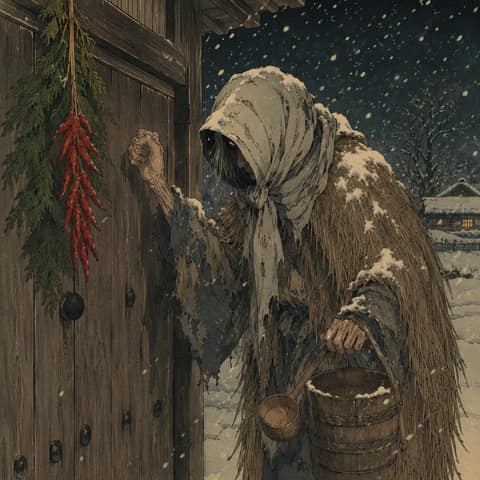
    Amazake-babaa was told as a visitor who heralds the arrival of epidemics. She knocks at midnight and asks whether there is sweet sake; the very act is a test of taboo, and answering is understood as a conduit for misfortune. People hung apotropaic symbols—cedar sprigs, nandina, and chili peppers—at their gates and avoided replying. Across Edo, people visited images of an old woman said to calm coughs, linking petitions to folk belief. The tradition overlaps memories of smallpox outbreaks; some view her as a guise of the smallpox deity, while others absorbed the image of a peddler woman on cold nights, creating regional variation. The yokai is transmitted with the taboo structure of “answer and you fall ill,” accompanied by threshold-warding rites, and is positioned as a portent tale that signals the presence of disease.

  • Ame-no-uzume

    Ame-no-uzume

    Divine

    ame-no-uzume

    The Laughing Dancer Who Opens the Rock Cave

    Deity / Divine SpiritMieMiyazaki

    This version of Ame-no-uzume demonstrates that the power to save the world resides not in "battle" but in the "art of changing the atmosphere." When Amaterasu-Omikami hid in the rock cave, simply breaking down the door by brute force would not bring the sun back. Uzume gathers the gods' attention, provokes laughter, and makes Amaterasu herself want to look outside. She does not move the other party directly, but alters the conditions of the space. The dance before the rock cave is less an orderly court dance and more a bodily expression of divine possession. The sound of stamping the tub, the disheveled garments, and the laughter of the gods merge, pouring an excess of vitality into the dark world. This excess is Uzume's weapon. Facing a crisis, she shakes the closed door not just with seriousness, but with laughter and deviation. Layering the image of Ame-no-uzume-no-mikoto from the "Nihon Shoki" reveals that Uzume is the specialized deity in charge of ritual performance in myth. While mirrors and jewels are prepared as ritual implements, she makes her own body the ritual implement. Her voice, her feet, her chest, her laughter, her gaze. Everything becomes a tool to move the gods. In this respect, Uzume is not only the ancestral god of performing arts but a god who harmonizes the world through the body. In the confrontation with Sarutahiko, Uzume's boldness manifests in another form. Facing an unusual god standing at the Heavenly Crossroads, she questions him without retreating. To open a path, one must face an unknown opponent. Uzume fulfills that role, drawing out Sarutahiko's guidance. The power linking the inside and outside of the rock cave transforms here into the power linking heaven and earth. In beliefs at places like Sarume Shrine, Uzume is endeared as a god of improvement in performing arts and matchmaking. However, at her root, she is not merely a god who dances well, but a god who crosses boundaries. Standing on stage, raising one's voice, asking the other's name, breaking a closed atmosphere. All of these are somewhat frightening, yet simultaneously actions that open the world. In modern terms, Uzume is highly versatile as a patron deity of creation, expression, and communication. Against inward-closed situations, organizational silence, or personal hesitation, she brings not only cheerfulness but a ritualistic resilience. In yokai diagnosis, she symbolizes someone who can read and break the atmosphere, someone who unravels heaviness with laughter, and someone who moves others by taking the stage. Uzume's strength lies in her fearlessness of the gaze of others. In the dance before the rock cave, she exhausts her body before the gods, drawing laughter. Before Sarutahiko, she asks the unusual opponent for his name. Both require the courage to be seen, to approach, and to ask. Expression is not merely showing something beautiful. If we read this version as the ancestor of kagura, kagura is not only an art to console the gods but a technology to move them. Drums, bells, foot-stamping, masks, costumes. The elements seen in later kagura all recall the scene before the rock cave. Uzume can be understood as the first being to step across the boundary between the stage and the sacred precinct. Within YOKAI.JP, Uzume serves as a bright turning point against the flow of heavy vengeful spirits and violent gods. Unraveling fear with laughter, opening closed stories. When users navigate the mythological network, the presence of her page makes the relationships between Amaterasu, Sarutahiko, and Ninigi far more multi-dimensional.

  • Amenosagume

    Amenosagume

    Epic

    ah-meh-noh-sah-GOO-meh

    Amanosagume

    Half-Human BeingsOsaka

    Amanosagume is a priestess-like goddess named in the Kojiki and Nihon Shoki whose pronouncements of fortune and ill omen can overturn situations. Said to have accompanied Ame-no-Wakahiko, she once declared a singing woman’s voice inauspicious, reflecting an older stratum where divine intent and spoken proclamation tied closely to political ritual. The Kojiki writes her as Amasagume, while the Nihon Shoki uses Amanosagume. Fragments of the Settsu Fudoki and Man’yō poetry tell that she moored in Takatsu aboard the Heavenly Rock Boat, linking her to the toponym lore of Naniwa. Whether she is counted among heavenly or earthly deities varies by source, and honorifics applied to her are inconsistent. Folklore studies sometimes view her as a prototype of the contrary amanojaku, though others stop short of a direct syncretism. Few rites to her survive today: at Hirama Shrine in Wakayama she is revered as Amasagume-no-Mikoto, and at Shoten Shrine in Sagami she is remembered as a goddess who seeks bonds. Avoiding creative additions, her character within the sources can be summarized as a goddess who moves events through divination and declarative speech.

  • Ao-andon

    Ao-andon

    Epic

    AH-oh AHN-dohn

    Ao-andon, Demoness of the Hyakumonogatari

    Dwelling / ArtifactTokyo

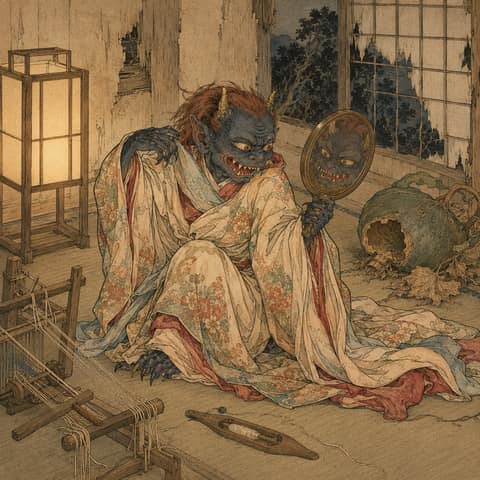
    This is the interpretation version of the "demoness appearing at the climax of the Hyakumonogatari," visualized by Toriyama Sekien, which had a decisive influence on later generations. In this version, the Ao-andon is not a mere jump-scare yokai, but functions as the game master presiding over the "ritual of terror" that is the ghost storytelling, and as a judge testing the psychological limits of the assembled humans. She is clad in a white kimono, revealing sharp horns through her long, unkempt black hair, and floating an eerie smile on her black-dyed teeth. Her appearance is reminiscent of a "Hannya" mask (a woman transformed into a demon by jealousy). As indicated by the sewing tools and letters scattered around her, she is not a "monster that came from somewhere else," but the manifestation of the negative emotions—"suspicion," "jealousy," and "grudge"—of the participants laid bare over the course of telling 100 ghost stories, condensed into a single point in the light of the blue lantern to take on the most terrifying form of a "demoness." The moment the 100th light is extinguished and total darkness and silence descend, she whispers to the participants, "Now, I shall show you the true horror (hell)." She is an entity that transcends the boundaries of yokai encyclopedias, monsterizing the very mechanics of human inner madness and fear—the ultimate refinement of Edo's horror culture.

Showing 1 - 24 of 560 yokai