YOKAI.JP
Tokyo The Folklore Spoken by the People and Carried by Print: An Encyclopedia of Tokyo's Yokai

Taira no Masakado, the Seven Wonders of Honjo, Yotsuya Kaidan, and Toriyama Sekien—The Genealogy of "Urban Legends" Born in Edo

The Folklore Spoken by the People and Carried by Print:
An Encyclopedia of Tokyo's Yokai

Tokyo · とうきょう

View on map

Taira no Masakado

Taira no Masakado

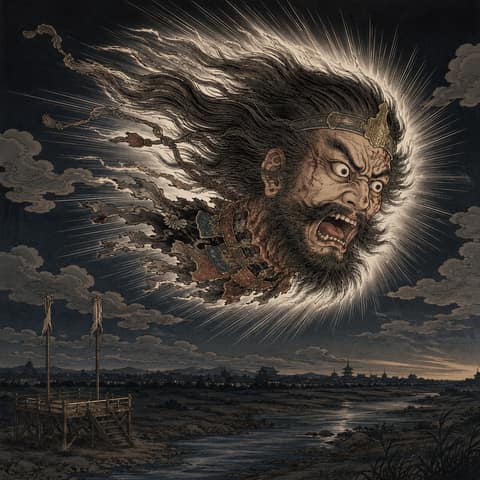
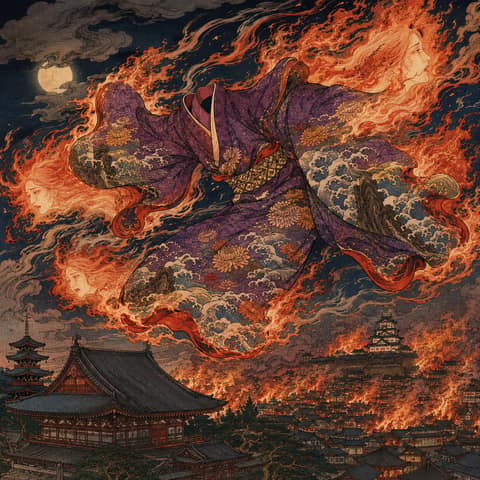
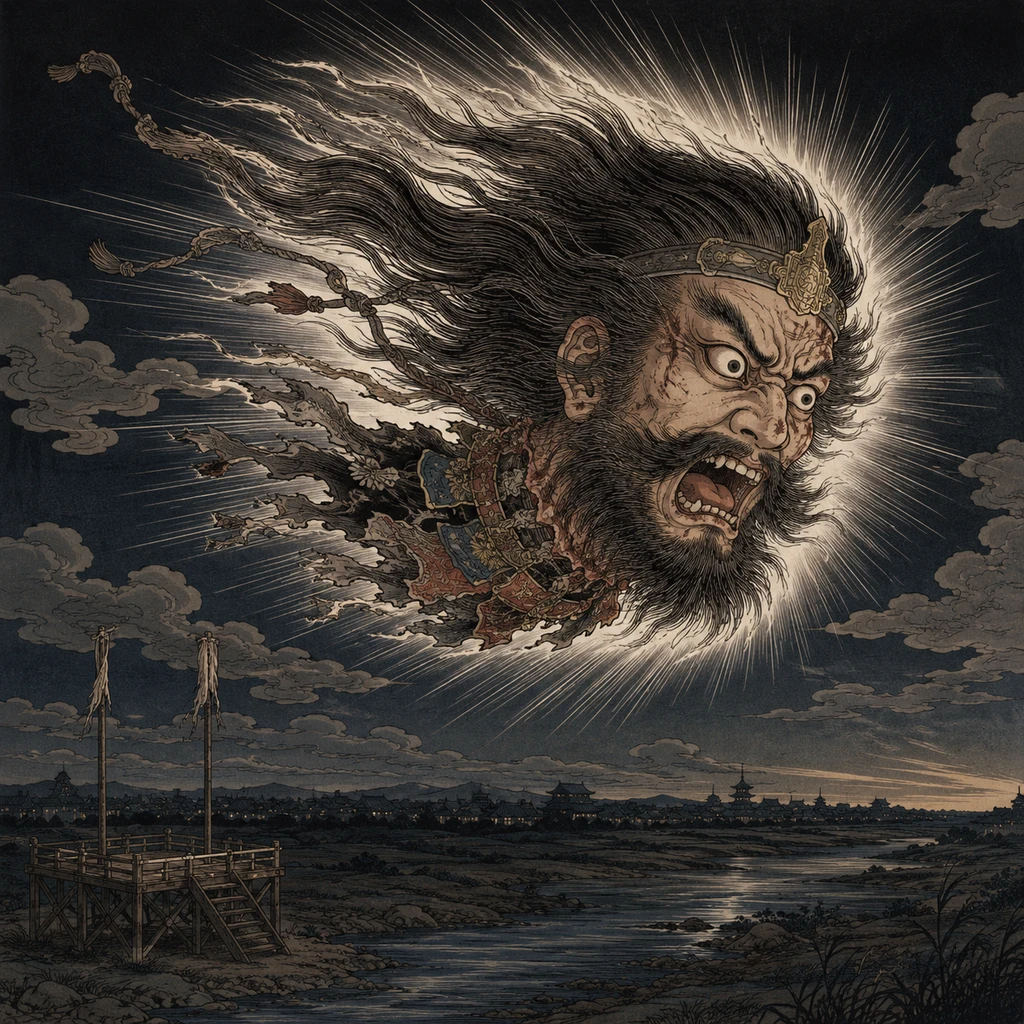
Taira no Masakado was a warrior of the Kanmu-Taira line who held sway over the Bandō region in the mid-Heian period, a man who raised the banner of revolt against the court, styled himself "New Emperor" (Shinnō), and was struck down. After his death, the uncanny tales surrounding his severed head made him one of the most dreaded vengeful spirits in Japan, and in time he was enshrined as a guardian deity of the Kantō and a goryō god at shrines such as Kanda Myōjin. In the Jōhei and Tengyō years, Masakado rose from private feuds within his own clan, and in the second year of Tengyō (939) he overran the provincial seats of Hitachi and other Kantō provinces to subjugate the eastern lands, proclaiming an oracle of Hachiman Daibosatsu and styling himself New Emperor . But the following year, the third of Tengyō (940), he was shot in the forehead and killed in battle by the punitive army of Taira no Sadamori and Fujiwara no Hidesato (Tawara Tōda). His life is recounted in detail in the contemporary war chronicle Shōmonki. What made Masakado a yokai and a vengeful spirit was less the historical revolt itself than the legend of the head, told in later ages. The story that his head, exposed in the capital, would not rot and cried out night after night before flying off to the east is bound up with the dread of the Masakado Grave-Mound (the "Head Mound") at Ōtemachi in Tokyo, and transmits to this day the belief that to move it brings a curse. At Kanda Myōjin, by contrast, he is fervently revered as the great tutelary of Edo and a god of martial fortune and thriving commerce—embodying the two faces of a goryō god: curse and protection.

Read more

While Kyoto developed as the capital of the imperial court and shrines, Edo grew as the city of townspeople and the samurai class. The center of gravity of yokai culture shifted in accordance with this difference. Whereas Kyoto's supernatural phenomena were narrated through aristocratic picture scrolls (*emaki*) and Goryo (vengeful spirit) worship, Edo's supernatural occurrences were disseminated through mass-produced media such as woodblock prints (*ihanbon*), *ukiyo-e*, kabuki, and *rakugo*. The moats of Honjo, the row houses (*nagaya*) of Yotsuya, the pleasure quarters of Yoshiwara, the ceilings of daimyo mansions, the late-night soba stalls, and the shores of the Izu Islands—places that from the perspective of the Kyoto court were mere "peripheries" became the main stages for the supernatural in Edo.

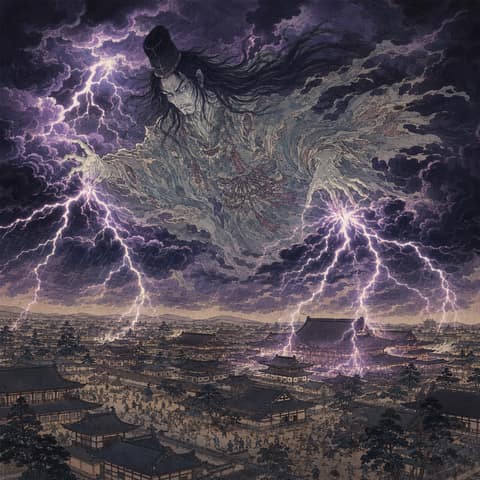
While Sugawara no Michizane and Emperor Sutoku—two of the "Three Great Vengeful Spirits of Japan"—were incorporated into Kyoto's spirit-pacification mechanisms, the third, Taira no Masakado, resides within the very structure of the city of Tokyo itself. Masakado's burial mound in Otemachi continues to resist relocation even today, and Kanda Myojin was positioned at the core of commoner festivals as a mechanism to seal the "demon gate" (kimon) of Edo Castle. If Kyoto "ends" a curse by enshrining it in a shrine, Edo keeps it "alive" through festivals. This article traces this unique supernatural culture of Tokyo through forty-five yokai deeply connected to the city.
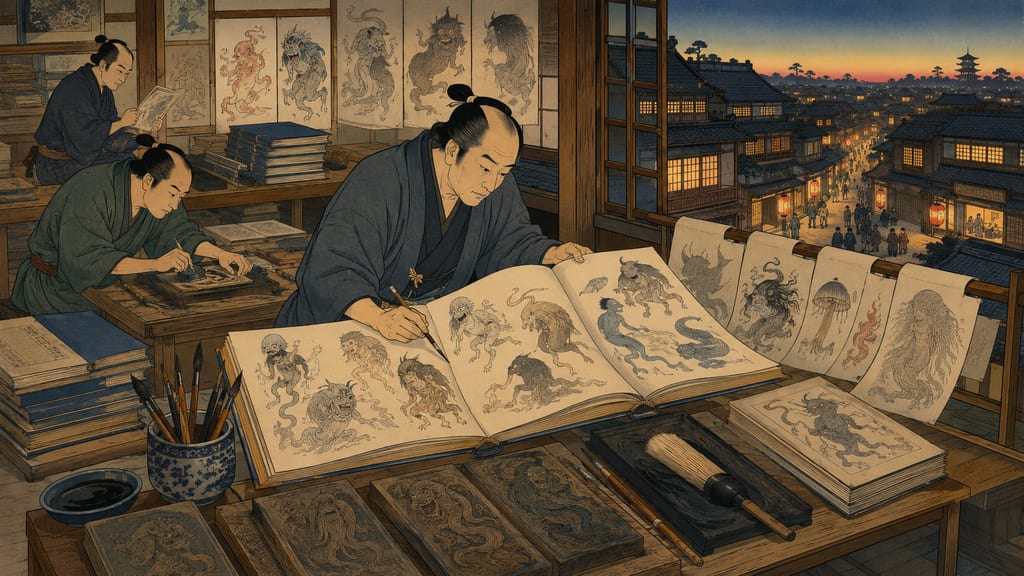
Edo's publishing culture restructured yokai from the parades of picture scrolls into one-entity-per-page illustrated encyclopedias.

From Kyoto to Edo:
The Shift in the Center of Yokai Culture

In the Middle Ages, yokai culture was concentrated in Kyoto. The *Hyakki Yagyo Emaki* (Night Parade of One Hundred Demons Picture Scroll) established in the late Muromachi period (kept at Shinjuan, Daitokuji Temple, attributed to Tosa Mitsunobu) was possessed by the nobility and temples; it was not a medium accessible to the common people. This changed after the publishing revolution of the Edo period. Woodblock publishing began in Kyoto during the Kan'ei era (1624–1644) but reached Edo by the Kanbun era (1661–1673), developing into an independent commercial publishing sphere. The last representative collection of ghost stories originating from Kyoto was Asai Ryoi's *Otogiboko* (Kanbun 6, 1666), and in the following decade, the Edo-published *Shokoku Hyakumonogatari* (A Hundred Tales from Various Provinces, Enpo 5, 1677, 5 volumes, 100 stories) was released. This was the moment the medium of ghost stories shifted from "picture scrolls" to "woodblock books," and its bearers shifted from "aristocrats" to "commoners."

The figure who brought this transformation to its completed form was Toriyama Sekien (1712–1788). An Edo-born painter, Sekien published the *Gazu Hyakki Yagyo* (The Illustrated Night Parade of a Hundred Demons) in An'ei 5 (1776). Along with its sequels, *Konjaku Gazu Zoku Hyakki* (An'ei 8, 1779), *Konjaku Hyakki Shui* (An'ei 10, 1781), and *Gazu Hyakki Tsurezure Bukuro* (Tenmei 4, 1784), he reorganized the "parading yokai" depicted in Kyoto's picture scrolls into an individual illustrated encyclopedia with one yokai and its name per page. The template followed by later yokai encyclopedias (leading all the way to Shigeru Mizuki) was determined here.
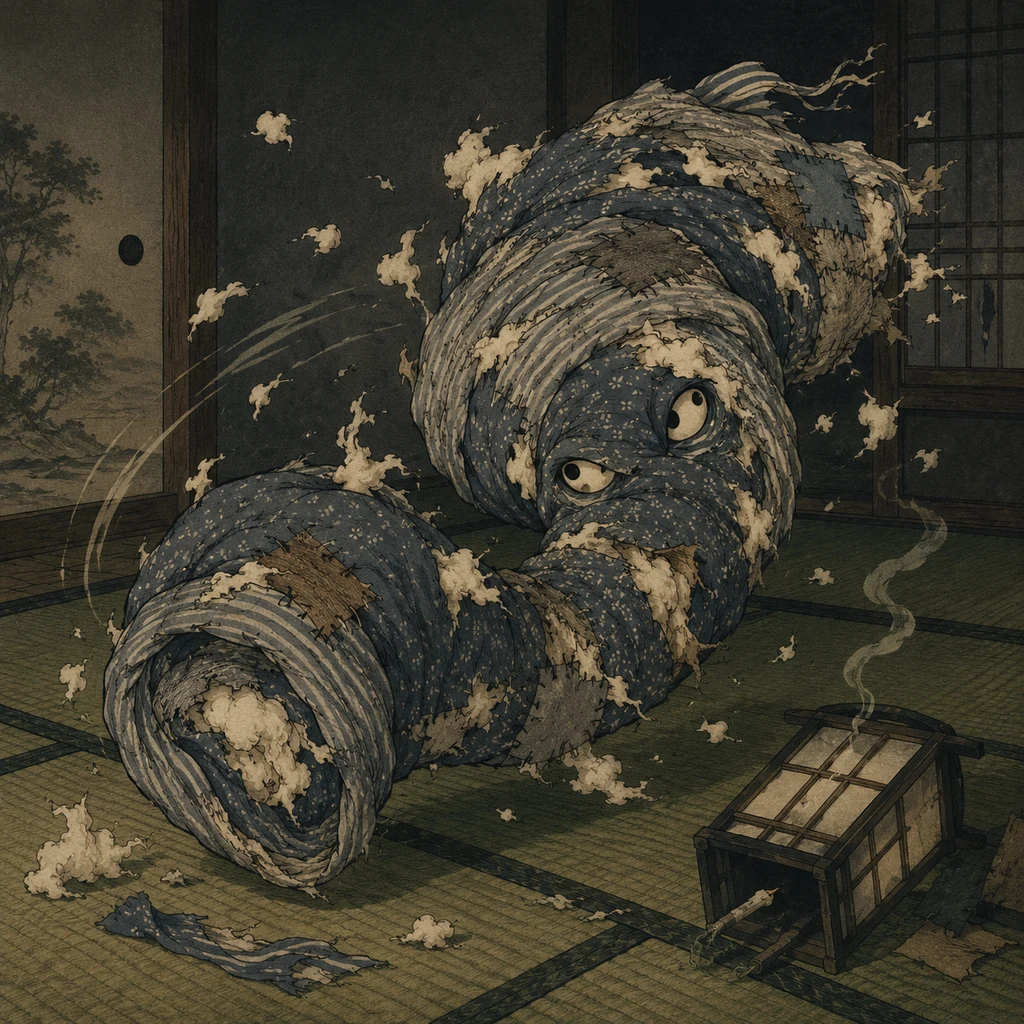
The Boroboroton and Kejorou are yokai strongly colored by Sekien's own creativity, newly drawn using wordplay and the customs of Edo as source material. On the other hand, Sekien indicates in his commentary that the Hone-onna (Bone Woman) is based on "Botan Doro" (The Peony Lantern) included in Asai Ryoi's *Otogiboko*, showing that the dual wheels of creation and reconstruction were moving simultaneously. The mischievous, tongue-sticking face of the Ungai-kyo is an excellent example of redrawing the tsukumogami of Muromachi picture scrolls with the sensibility of Edo gesaku (playful literature).

Taira no Masakado:
The Vengeful Spirit Protecting Edo Castle

During the Tengyo/Johei Rebellions (935–940), Taira no Masakado, who had built his power in the Bando region, raised a standard of revolt against the imperial court, declared himself the "New Emperor," and was ultimately struck down. Legend has it that his severed head, displayed in Kyoto, flew back to the Kanto region fueled by sheer resentment, and is now enshrined at the Masakado-zuka (Masakado's Mound) in Otemachi (Chiyoda Ward). What distinguishes Masakado from Kyoto's Michizane and Sutoku is that he is incorporated into the very core of the city of Edo itself.

Taira no Masakado

Taira no Masakado

Taira no Masakado was a warrior of the Kanmu-Taira line who held sway over the Bandō region in the mid-Heian period, a man who raised the banner of revolt against the court, styled himself "New Emperor" (Shinnō), and was struck down. After his death, the uncanny tales surrounding his severed head made him one of the most dreaded vengeful spirits in Japan, and in time he was enshrined as a guardian deity of the Kantō and a goryō god at shrines such as Kanda Myōjin. In the Jōhei and Tengyō years, Masakado rose from private feuds within his own clan, and in the second year of Tengyō (939) he overran the provincial seats of Hitachi and other Kantō provinces to subjugate the eastern lands, proclaiming an oracle of Hachiman Daibosatsu and styling himself New Emperor . But the following year, the third of Tengyō (940), he was shot in the forehead and killed in battle by the punitive army of Taira no Sadamori and Fujiwara no Hidesato (Tawara Tōda). His life is recounted in detail in the contemporary war chronicle Shōmonki. What made Masakado a yokai and a vengeful spirit was less the historical revolt itself than the legend of the head, told in later ages. The story that his head, exposed in the capital, would not rot and cried out night after night before flying off to the east is bound up with the dread of the Masakado Grave-Mound (the "Head Mound") at Ōtemachi in Tokyo, and transmits to this day the belief that to move it brings a curse. At Kanda Myōjin, by contrast, he is fervently revered as the great tutelary of Edo and a god of martial fortune and thriving commerce—embodying the two faces of a goryō god: curse and protection.

Read more

After Tokugawa Ieyasu established the shogunate in Edo (1603), when the high priest Tenkai designed the warding of Edo Castle's demon gate, he placed Kan'ei-ji Temple to the northeast and Kanda Myojin to the east. Kanda Myojin relocated to its current site (Sotokanda, Chiyoda Ward) in Genna 2 (1616) and welcomed Masakado as one of its main deities. The Kanda Festival, one of the three great festivals of Edo, continues to this day as an urban ritual where a portable shrine bearing Masakado parades through the neighborhoods once every two years. If Kyoto's Goryo-e (spirit pacification festivals) "seals" curses within shrines, Edo's Kanda Festival "celebrates" them through festivities. It is a reversal of the same grammar of Goryo worship, adapted to the character of the city.

In modern times, the curse of Masakado's Mound has been spoken of twice. After the Great Kanto Earthquake of Taisho 12 (1923), when the mound was temporarily removed for the construction of a temporary Ministry of Finance building, suspicious deaths occurred successively among ministry officials, including the Minister of Finance, Seiji Hayakawa. Consequently, the temporary building was demolished in Showa 3 (1928), and a monument for the repose of souls was erected. After the war, when bulldozers were brought in for zoning by the GHQ, an anecdote tells that a driver died in an accident and the plan was canceled. Whether these are facts or fabricated stories aside, the very fact that these anecdotes have been widely accepted demonstrates that the existence of Taira no Masakado is deeply ingrained in Tokyo's urban memory.
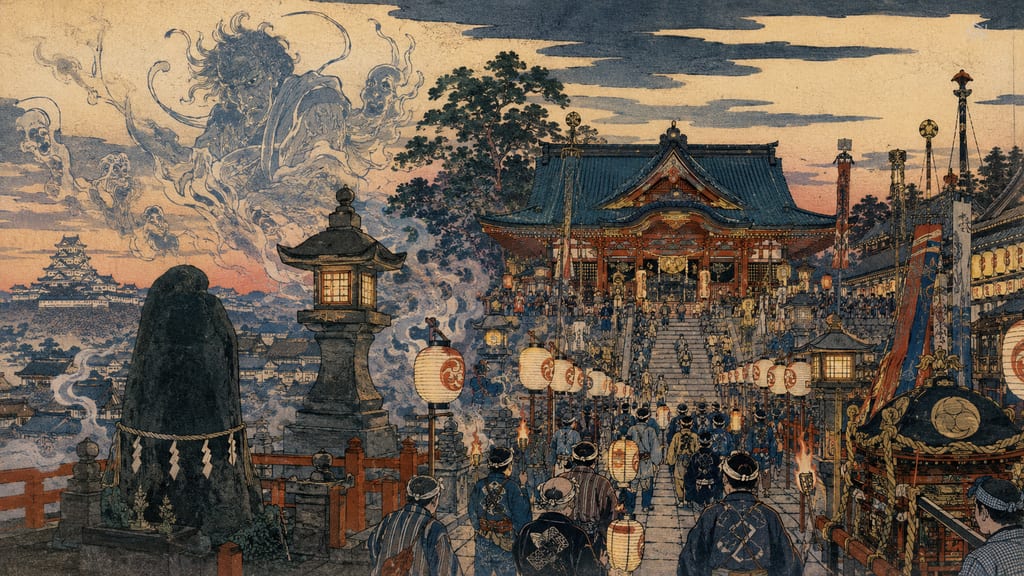
Kanda Myojin integrated Taira no Masakado into the center of Edo's urban protection and festivals.
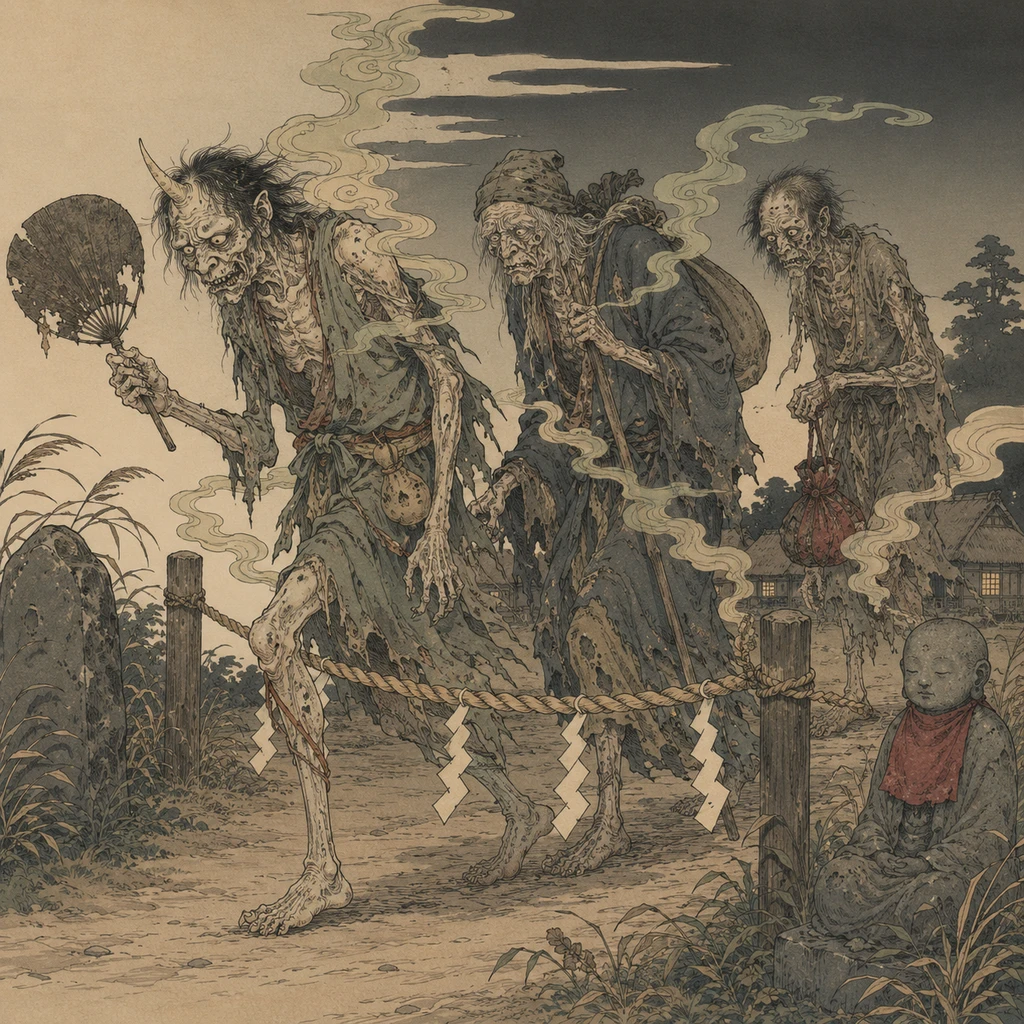
Epidemic Godyahk-BYOH-gah-mee

The Epidemic God is a feared malign deity believed to bring outbreaks and calamities. From the Heian period onward, noti

Feared alongside Masakado as urban spirits of Edo were the Yakubyogami (Gods of Plague). As one of the world's largest cities with a population exceeding one million, Edo repeatedly experienced epidemics of measles, smallpox, and cholera. Particularly during the massive outbreak of measles and cholera in Bunkyu 2 (1862), multi-colored woodblock prints called "Measles Pictures" (*Hashika-e*) depicting Mugidono Daimyojin, a guardian deity against measles, were published in large quantities and displayed in homes as talismans. The image of the deity trampling upon wheat ears and a demon is the crystallized product of early modern medicine, publishing, and folk belief in a single printed sheet.
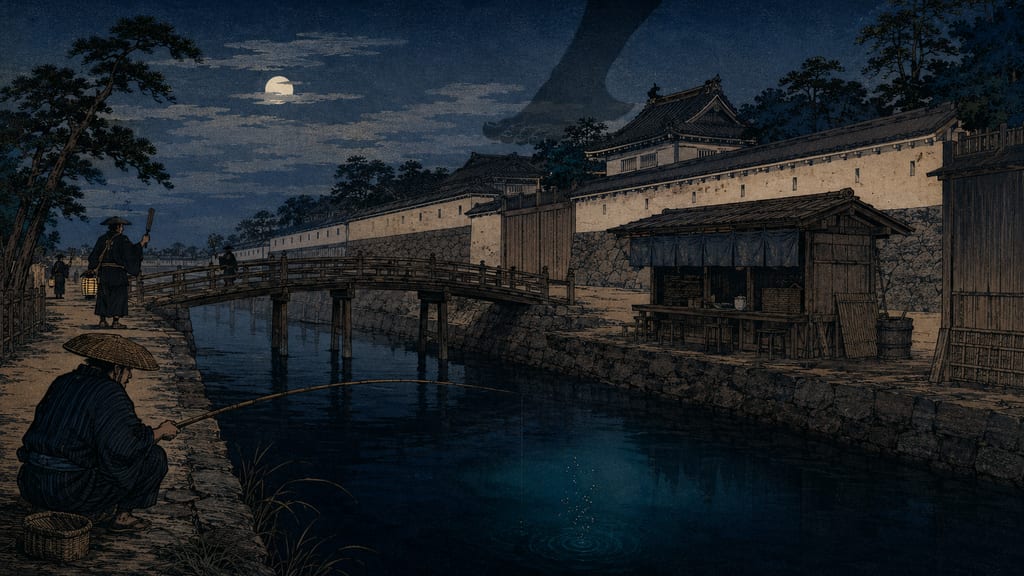
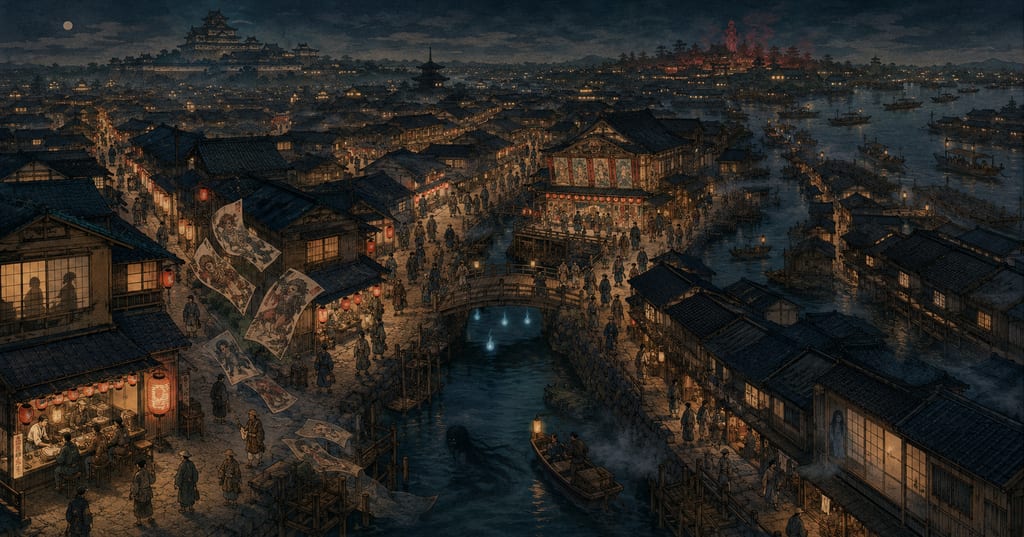
The Seven Wonders of Honjo were born from Edo's urban infrastructure: moats, bridges, stalls, and samurai mansions.

The Seven Wonders of Honjo:
The Invention of Urban Legends

The most original supernatural phenomena in Tokyo's yokai culture are concentrated in Honjo (present-day southern Sumida Ward). Honjo rapidly urbanized from farmlands to townhouses in the late Edo period, densely packed with new urban infrastructure such as moats, bridges, soba stalls, and daimyo mansions. The anomalies collectively known as the "Seven Wonders of Honjo" were born here. "Seven" is merely a nominal number, and depending on the version, the actual count fluctuates between eight and ten; this very fluctuation carries the message that "the city is always being retold."
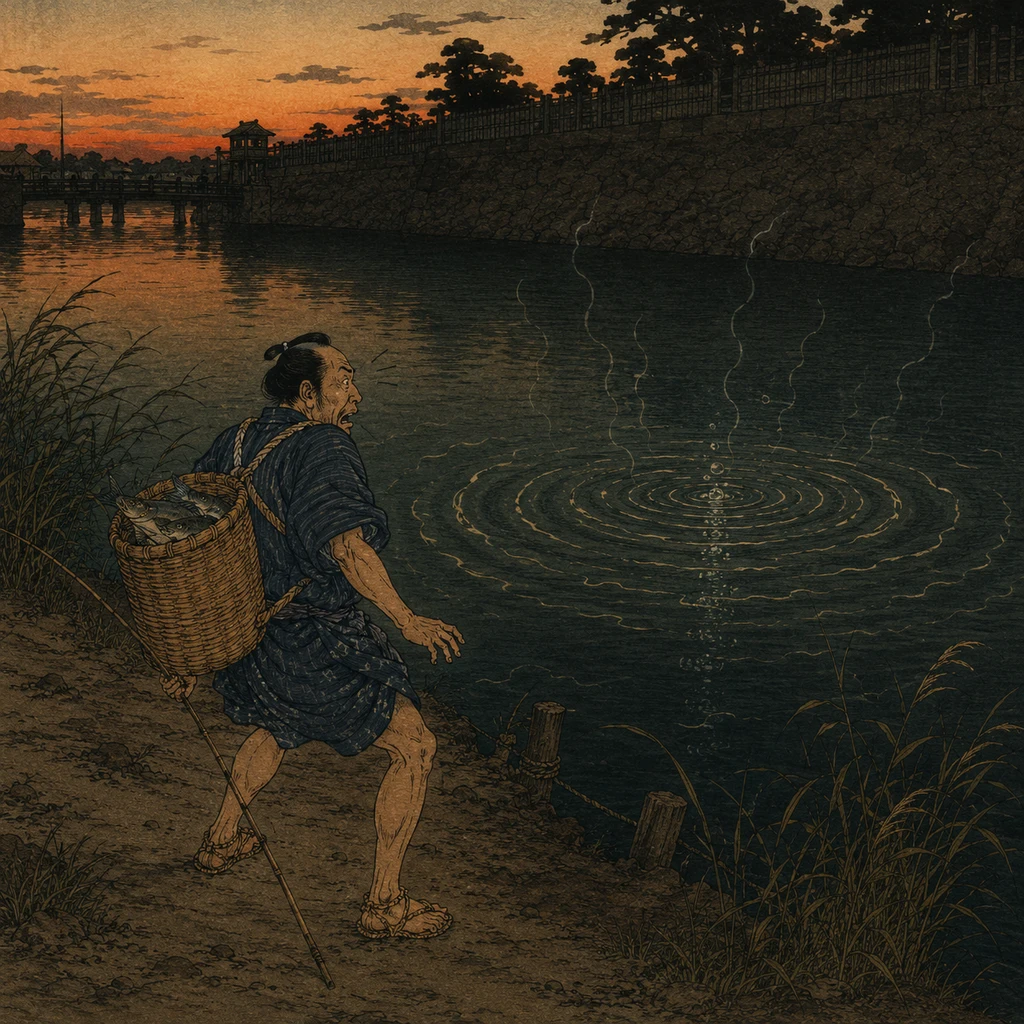
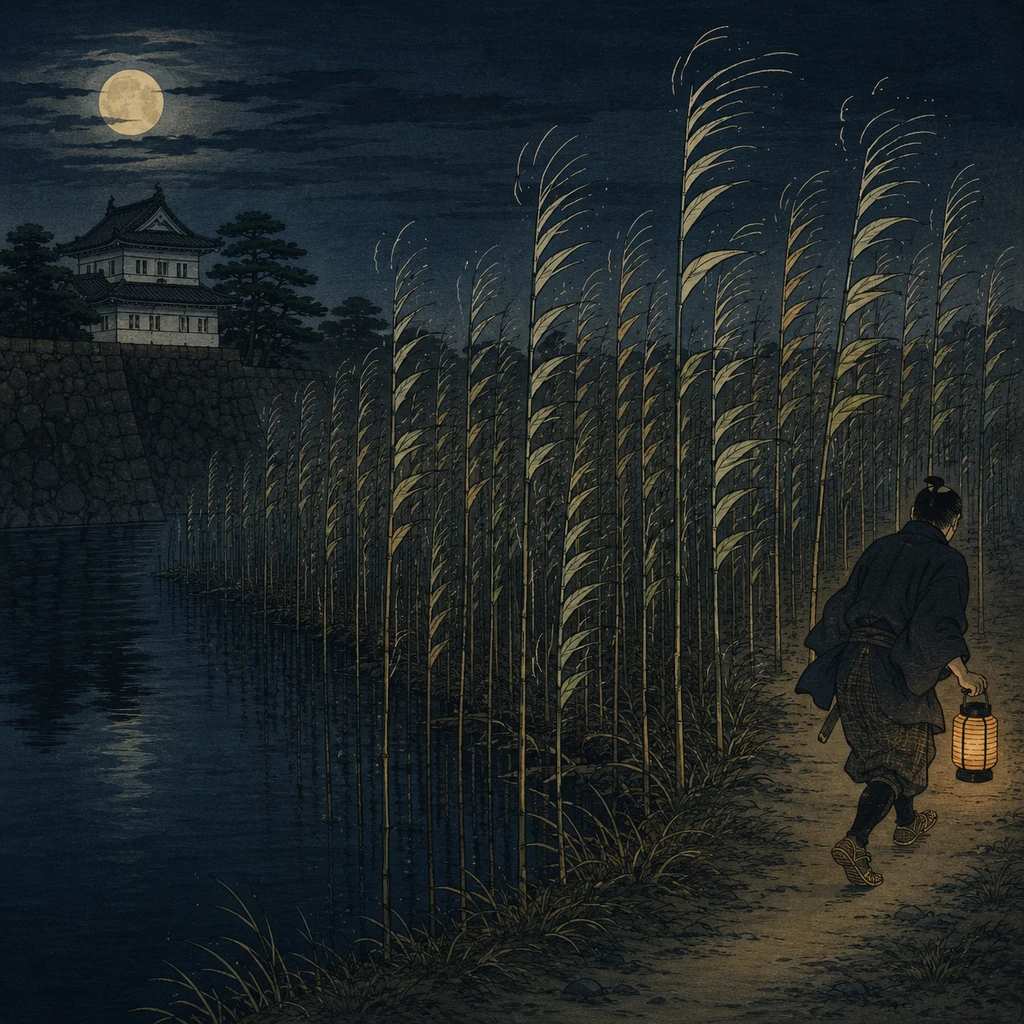
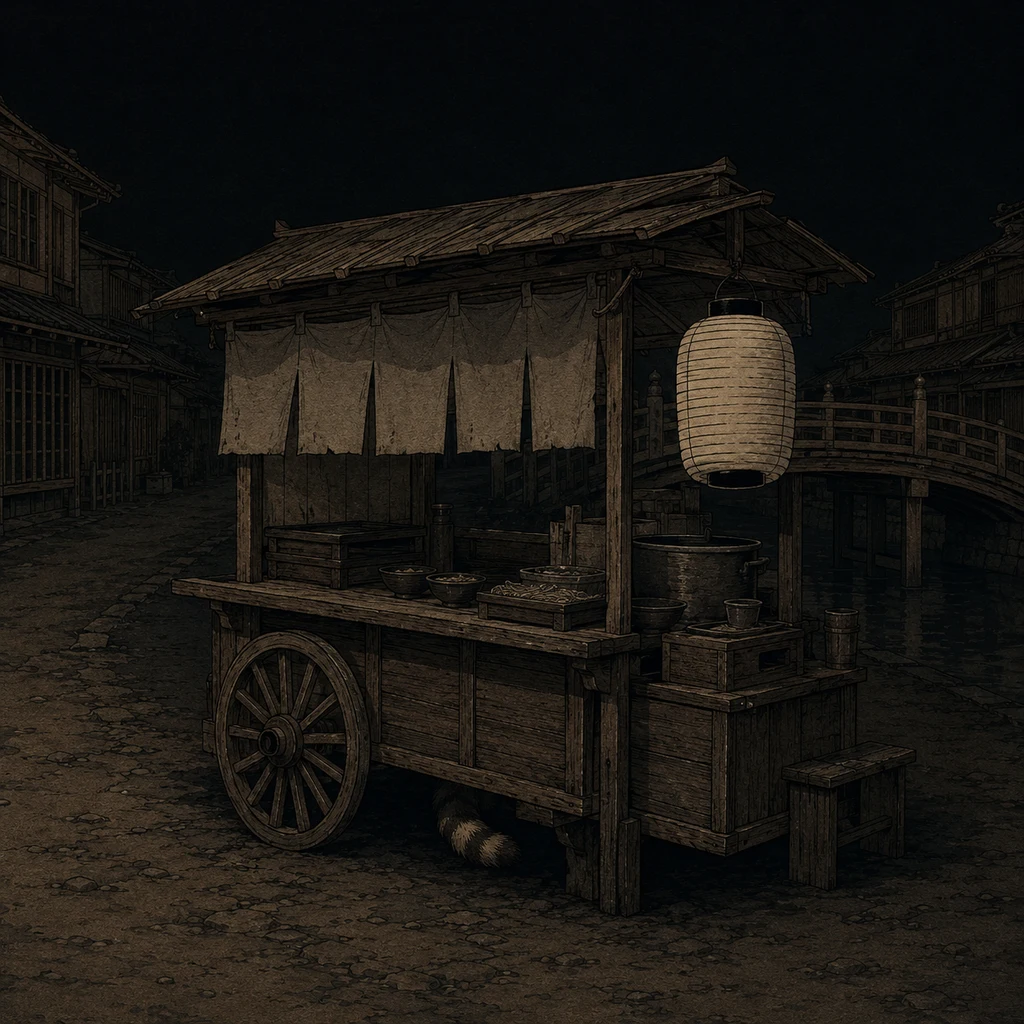
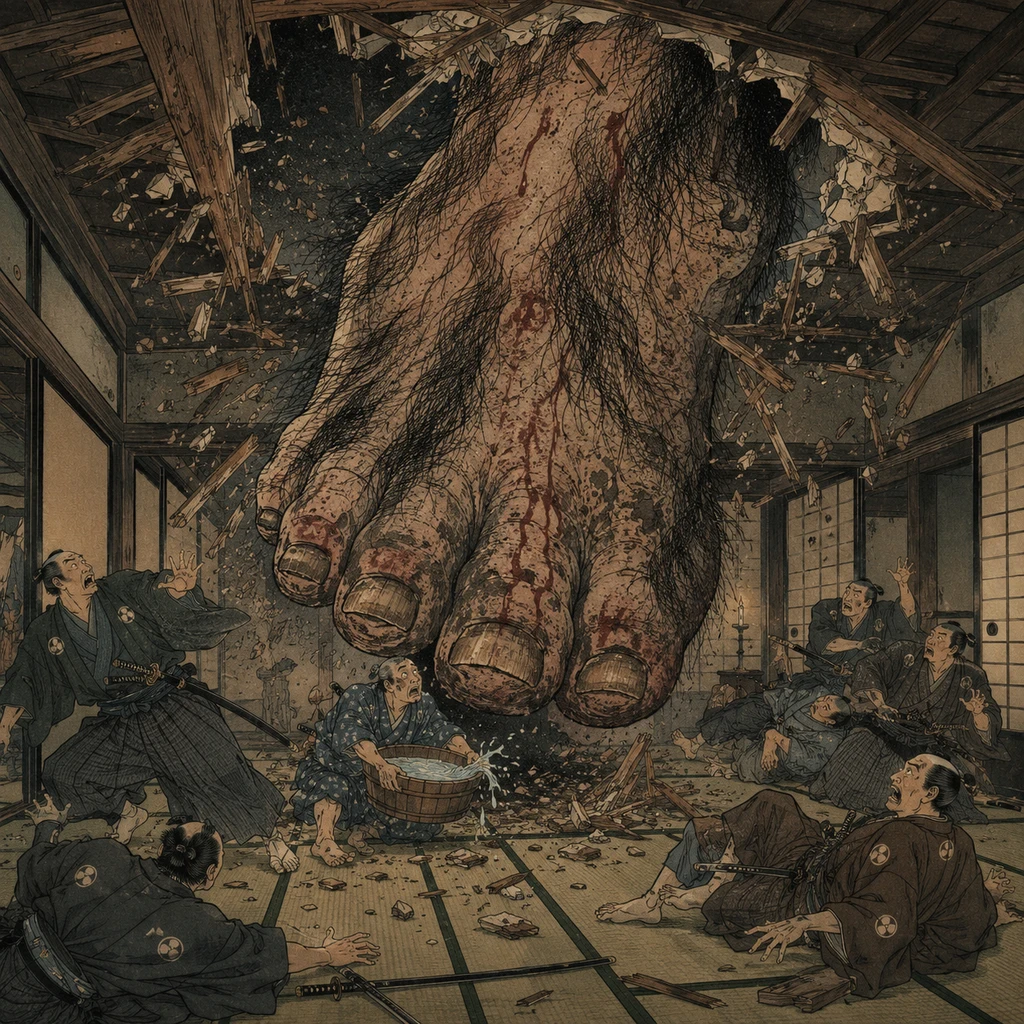
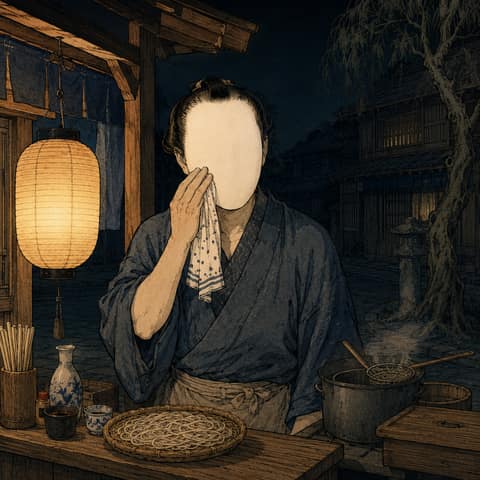
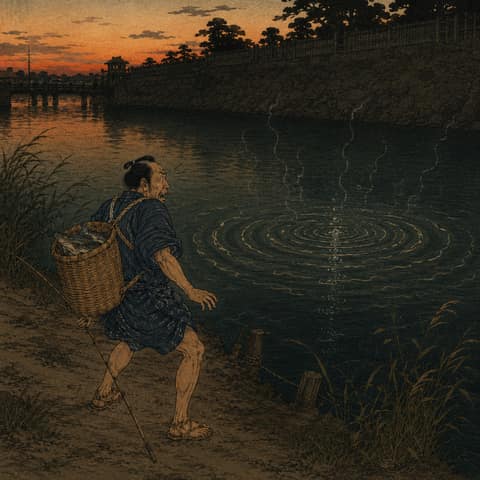
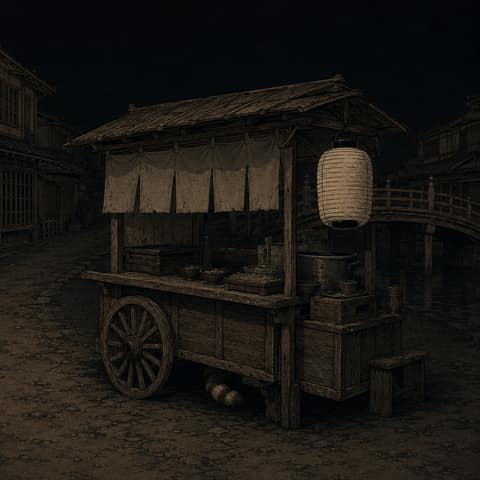
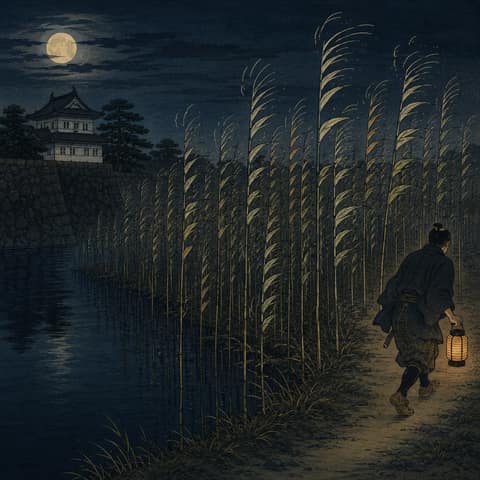
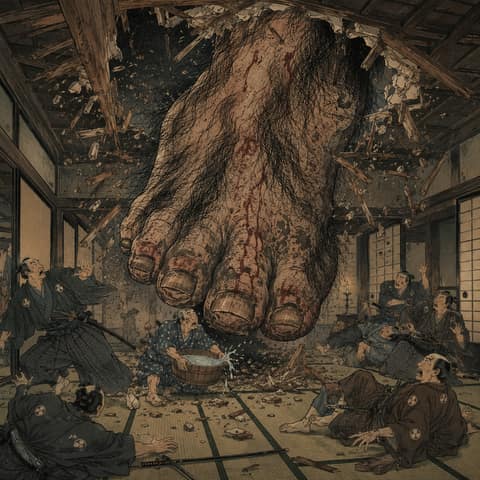
The Oitekebori (Leave It Behind Moat) is a phenomenon where, upon trying to take one's catch home from fishing in a Honjo moat, a voice from the water commands "Leave it behind." A monument passing down this legend remains near Kinshi Park in Kinshicho today. The Kataha no Ashi (One-sided Reed) refers to the reeds growing in clusters near Ryogoku Bridge that supposedly grow leaves on only one side; it is a silent anomaly that speaks of unexplained resentment through botanical abnormality. The Akarinashi Soba (Lightless Soba) is a tale of a soba stall along the Minamiwari sewer where the owner never shows their face, the paper lantern is always unlit, and misfortune visits anyone who lights a fire there. The Ashi-arai Yashiki (Foot-washing Mansion) involves a giant foot crashing through the ceiling of a hatamoto (direct shogun retainer) mansion demanding, "Wash my foot." It is uniquely Edo in that it takes the enclosed space of a samurai mansion's ceiling as its stage.
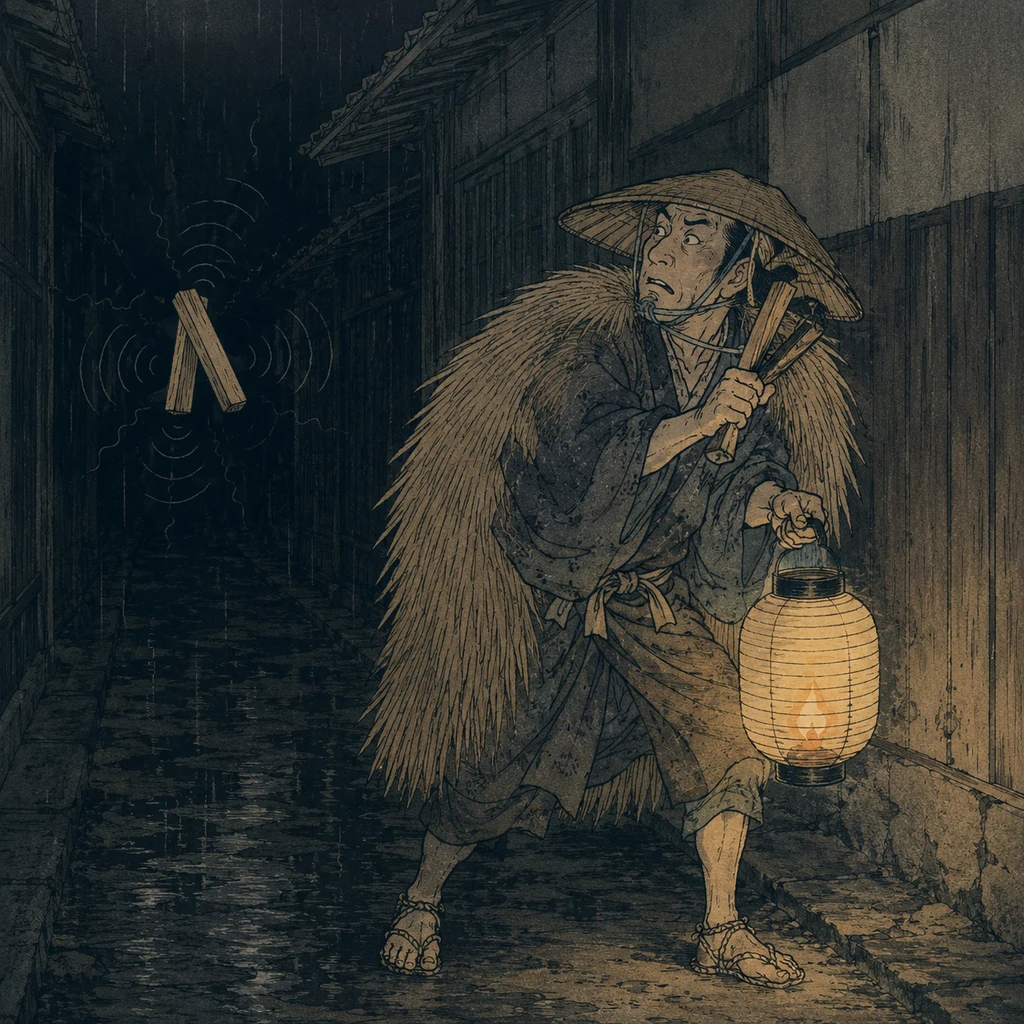
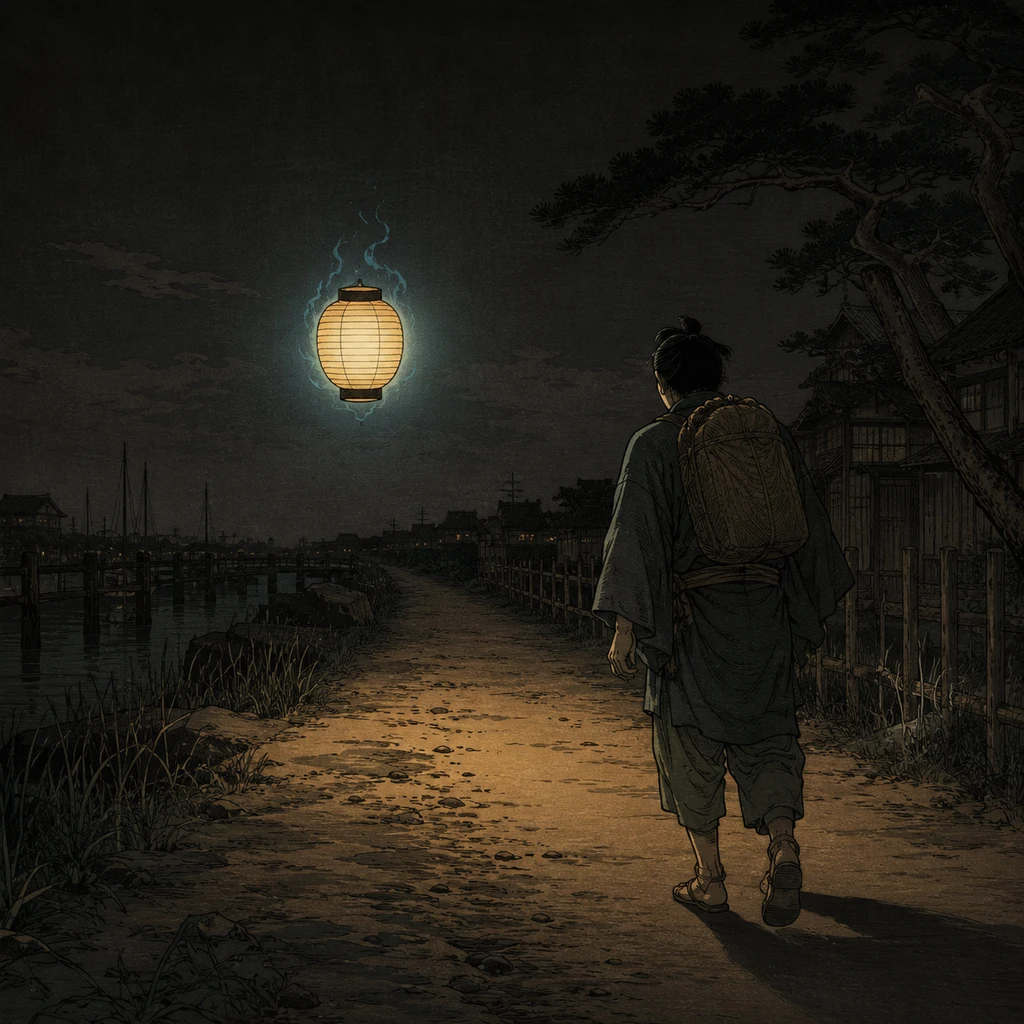
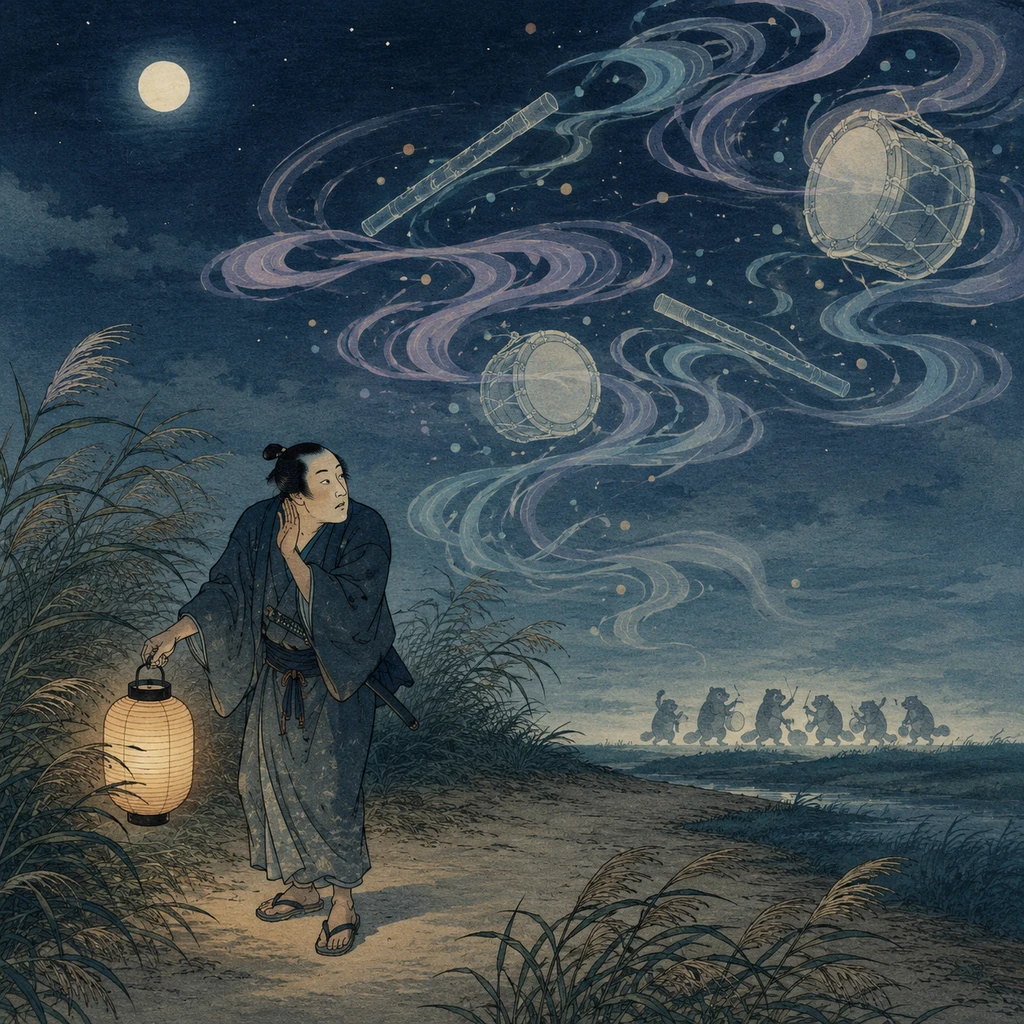
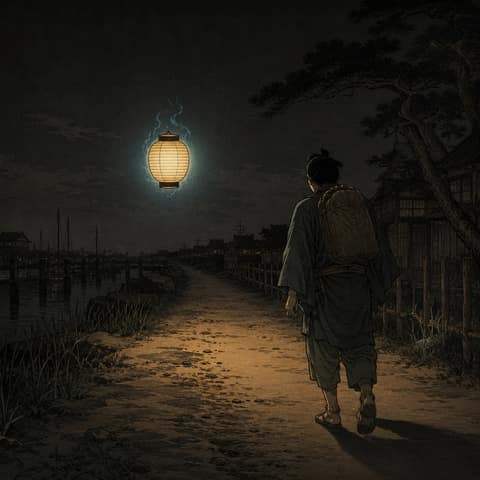
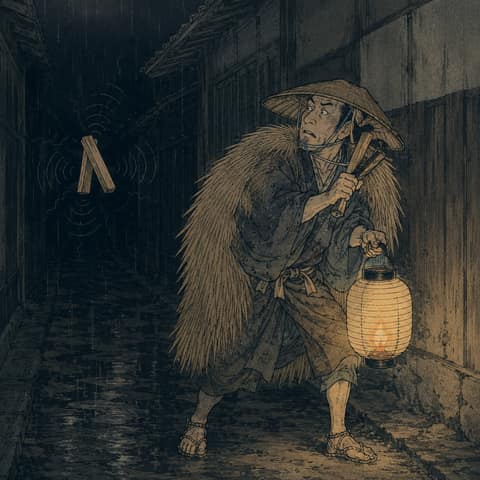
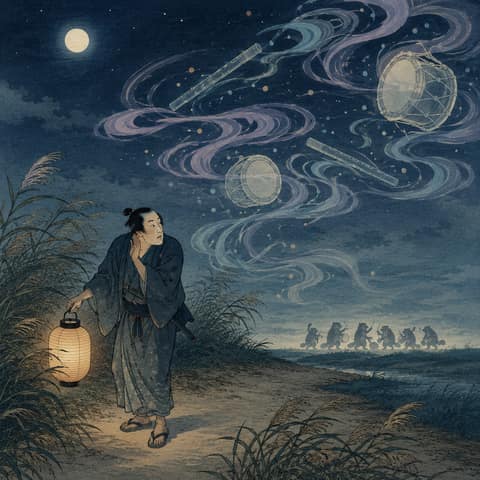
The Okuri-hyoshigi (Sending Wooden Clappers) and Okuri-chochin (Sending Lantern) are phenomena where "another person" seems to follow during a night patrol or night walk; they disappear when approached and reappear when distanced. The Tanuki-bayashi (Tanuki Musical Accompaniment) is the sound of flutes and drums heard from nowhere late at night, also recorded as "Baka-bayashi" (Fool's Music) in Honjo in the *Kasshi Yawa*. The Ochiba-naki Shii (Castanopsis Tree Without Fallen Leaves) is an old tree at the Matsura family's upper residence of the Hirado Shinden Domain; rumored that even though it was an evergreen, it never shed a single leaf throughout the four seasons.

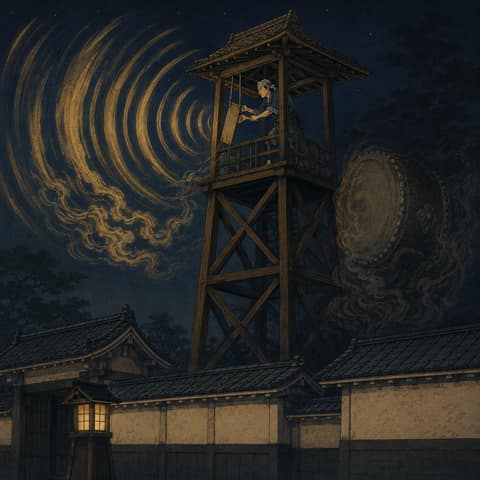
In addition to these, the Tsugaru no Taiko (Drum of Tsugaru) is also counted among the Seven Wonders of Honjo. At the fire watchtower of the Tsugaru family's upper residence of the Hirosaki Domain located in Honjo Midoricho, a drum was hung instead of the wooden board (*hangi*) usually used. The reason is unknown, and it is simply passed down as a "foreign object." It is likely the result of Tsugaru's unique drum culture clashing with the sensibilities of Edo's commoners, but the fact that this clash itself was preserved as an anomaly highlights the subtleties of Edo's urban folklore.

What the Seven Wonders demonstrate is a new type of anomaly distinct from natural yokai (like foxes, tanuki, or yamanba). They take the urban infrastructure itself—moats, bridges, stalls, daimyo mansions, night streets—as their stage, slipping as foreign objects into the everyday senses of the residents. The pattern followed by modern urban legends (the Slit-Mouthed Woman, Hanako-san of the Toilet, Hasshaku-sama) had already been perfected in Honjo.
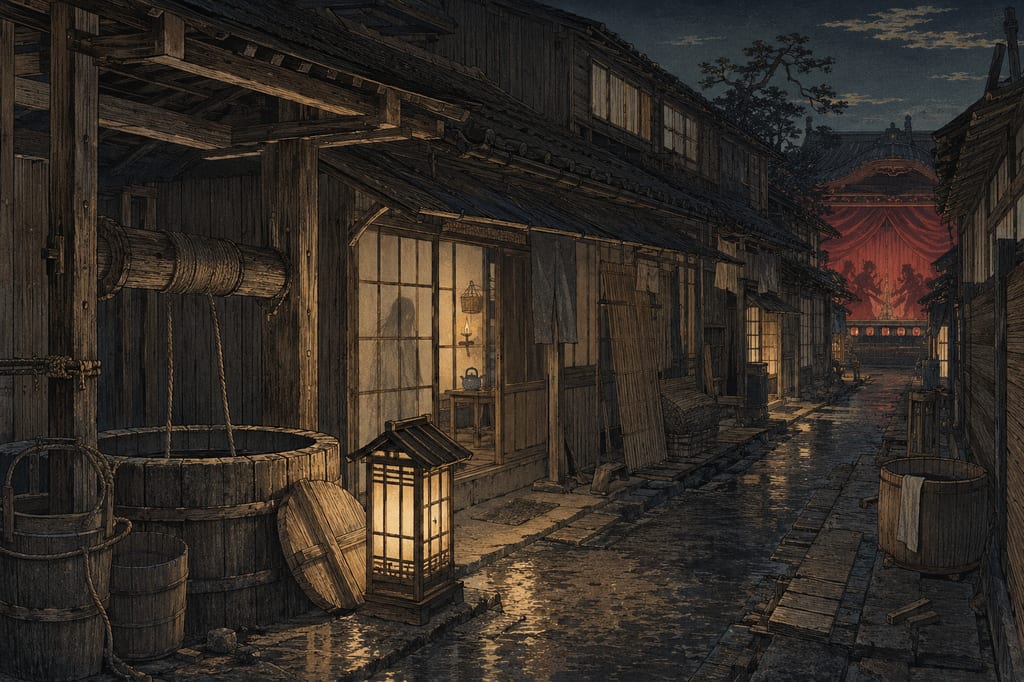
Yotsuya Kaidan transformed vengeful spirit tales into urban legends through the stage settings of Edo's row houses and kabuki.

Edo's Three Great "Bad Places" and Ghost Stories

The ghost stories of Edo commoners grew around three "bad places" (akusho): the pleasure quarters, execution grounds, and kabuki theaters. Yoshiwara, officially licensed in Fukiyacho, Nihonbashi in Genna 3 (1617), relocated behind Sensoji Temple (present-day Taito Ward) after the Great Fire of Meireki (1657) and became the New Yoshiwara. Ghost stories dealing with the deaths and reincarnations of courtesans were mass-produced here, and ghost story collections exclusively for Yoshiwara, such as *Seiro Kiji - Enka Seidan* published with the involvement of Tsutaya Juzaburo, were established. The legend of the Hinoenma (Flying Karma Demon)—a seemingly beautiful woman who is actually a female demon (yasha) bringing ruin to men—was repeatedly told within the pleasure quarter culture as a Buddhist admonition.
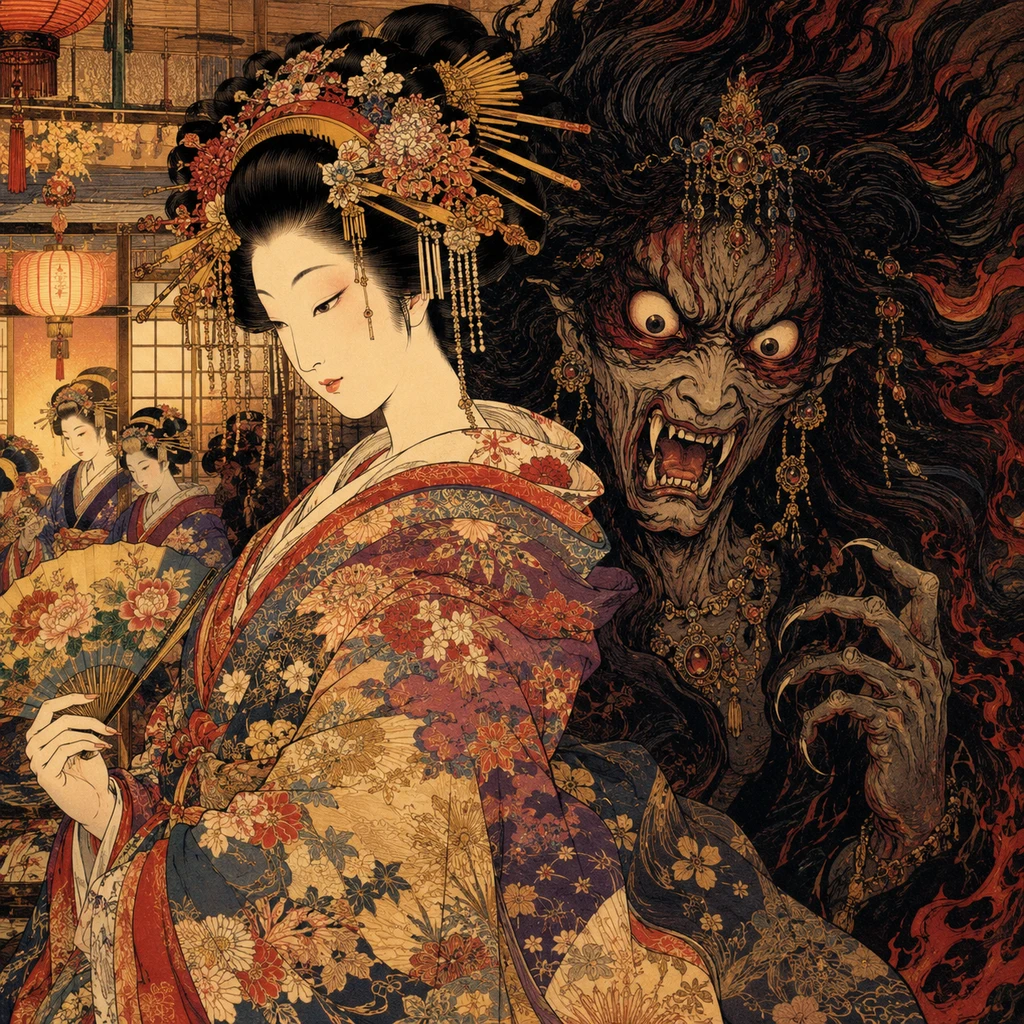
Hienma

hee-EN-mah

A yokai named in the Edo-period collection Ehon Hyaku Monogatari. Framed as a Buddhist admonition, it serves as a metaphor for the folly of being ensnared by a woman’s allure. Her outward beauty is likened to a bodhisattva, while her inner nature is as fearsome as a yaksha. Men whose hearts are unsettled by her are warned to lose their homes and ruin themselves. The name can be read as “calamity flying in on karmic ties,” and it has been linked to folk beliefs about women born in the year of Hinoe-uma (the fiery Horse).

Read more

The ghost stories originating from the row houses of Yotsuya represent the pinnacle of Edo kaidan. Tsuruya Nanboku's *Tokaido Yotsuya Kaidan* premiered at the Nakamura-za theater on July 26, Bunsei 8 (1825). Based on Oiwa, the daughter of Tamiya Matazaemon, an ashigaru (foot soldier) guarding Edo Castle, the play was structured as a side story to *Kanadehon Chushingura*. In this script, Onoe Kikugoro III played the three roles of Oiwa, Kobotoke Kohei, and Sato Yomoshichi. Oiwa, her face distorted by poison, turns into a vengeful ghost and destroys Tamiya Iemon. The cruel depictions that overturned the common sense of kabuki, and the pattern of a woman harboring a grudge returning as a ghost for revenge, have continued to flow as an undercurrent in Japanese horror ever since.

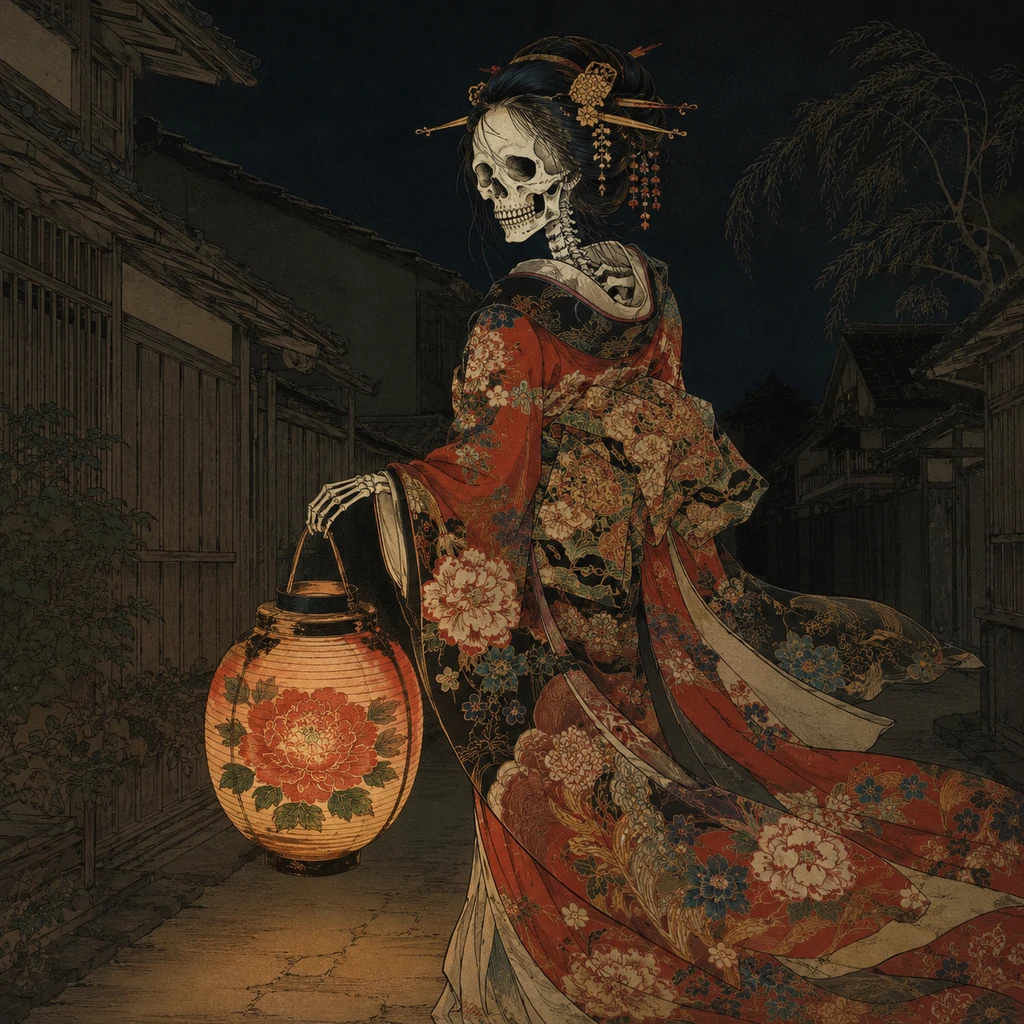
Alongside Yotsuya Kaidan, stories of the Hone-onna lineage also represent Edo ghost stories. The origin of the Hone-onna (Bone Woman) is "Botan Doro" (The Peony Lantern) in Asai Ryoi's *Otogiboko*, a tale where a woman visiting night after night carrying a lantern with a peony pattern is actually a skeleton. Sanyutei Encho performed this as a rakugo tale from around the Genji era (1864), restructuring it as the story of Otsuyu and Shinzaburo set in Nezu and Hongo as *Kaidan Botan Doro*. The shorthand book published in Meiji 17 (1884) became a linguistic milestone, pioneering the unification of spoken and written language (genbun itchi) prior to Futabatei Shimei's *Ukigumo*.

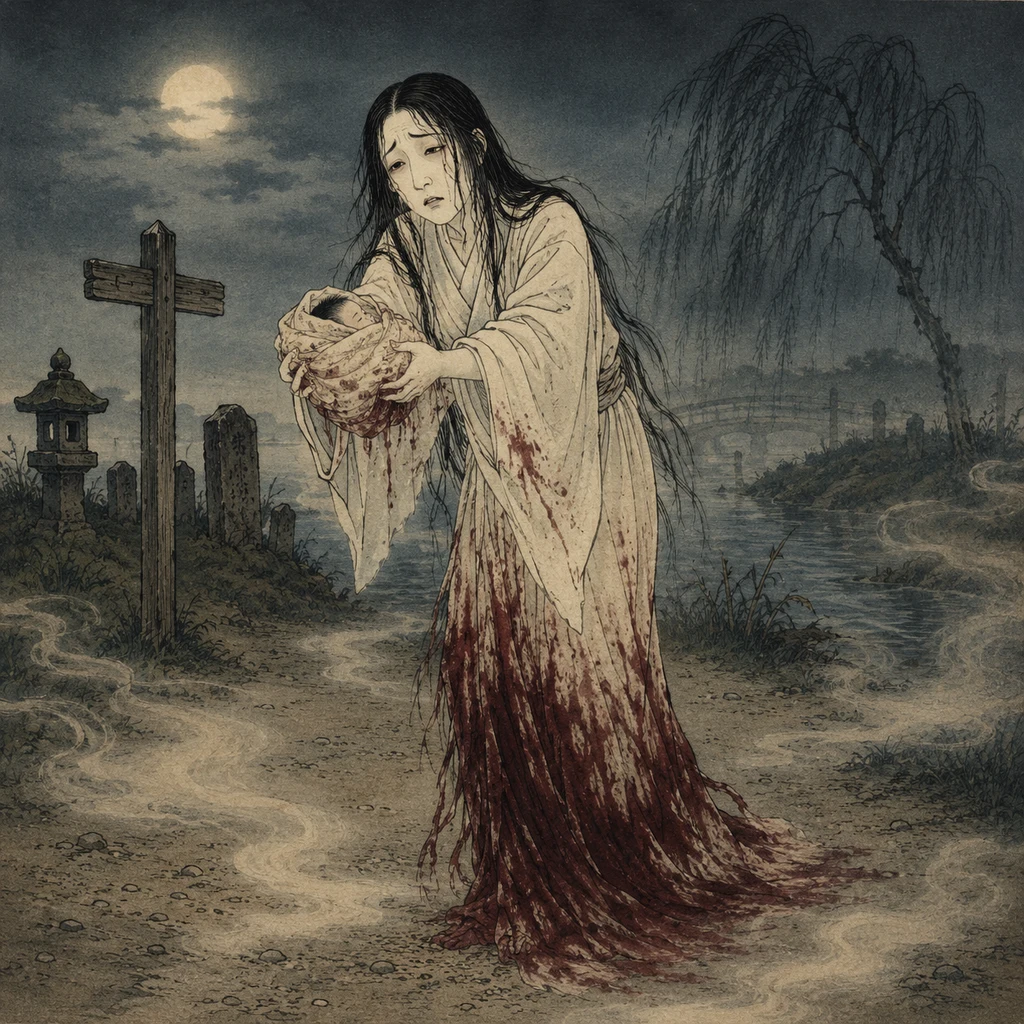
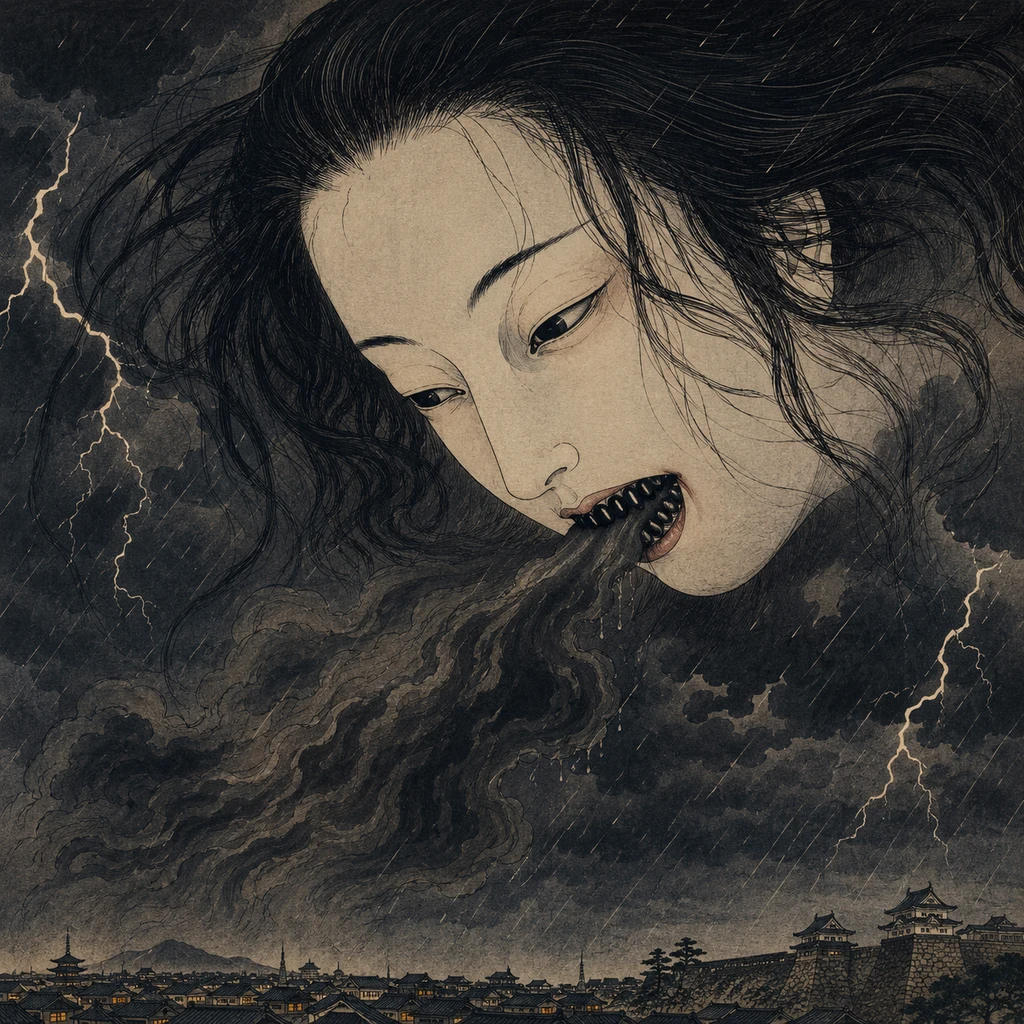
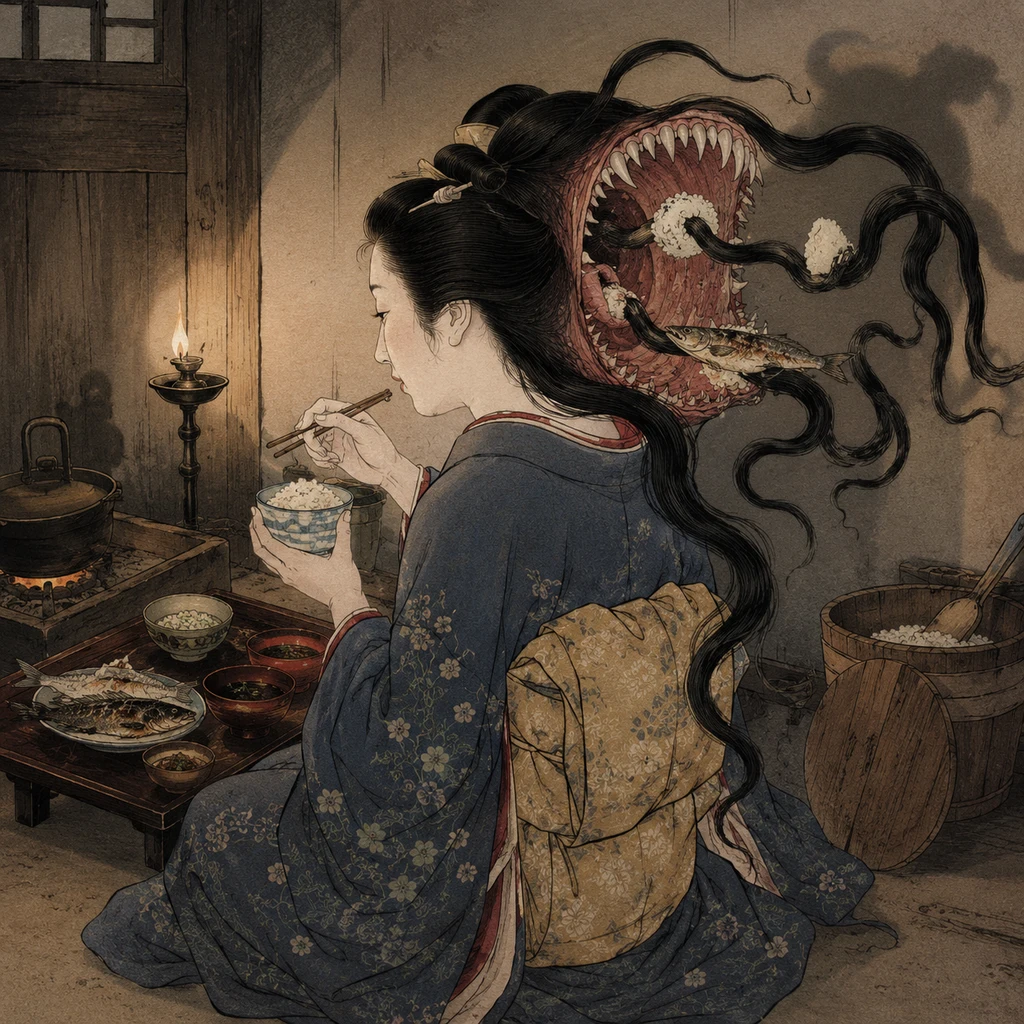
The Ubume is a woman who died in childbirth, appearing on dark roads holding a baby while wearing a blood-stained waistcloth; the Ookubi (Giant Head) is the enormous head of a married woman with blackened teeth drifting in the rainy night sky; the Futakuchi-onna (Two-Mouthed Woman) is a female yokai with a second mouth on the back of her neck. All of these depict the darkness of human relationships through the deaths or physical transformations of women.

The anomalies of execution grounds were concentrated in Suzugamori (Shinagawa) and Kozukappara (Arakawa Ward). At the Kozukappara execution grounds established in Keian 4 (1651), a total of 200,000 people were executed over 220 years, with crucifixions, burning at the stake, and decapitations conducted constantly. The Kubikiri Jizo (Beheading Jizo) of Enmei-ji Temple still preserves that memory. Ghost tales flowed outward from these places. Tales like the latrine anomaly of the Gambari-nyudo, the Dodomeki wandering through mansions, or the Oozato prowling on stormy nights to threaten passersby. These all demonstrate that the city of Edo lived side by side with executions and ghosts.

Toriyama Sekien's Yokai Encyclopedia:
The Pictorial Revolution of Edo

Boroboroton

boh-roh-boh-roh-TOHN

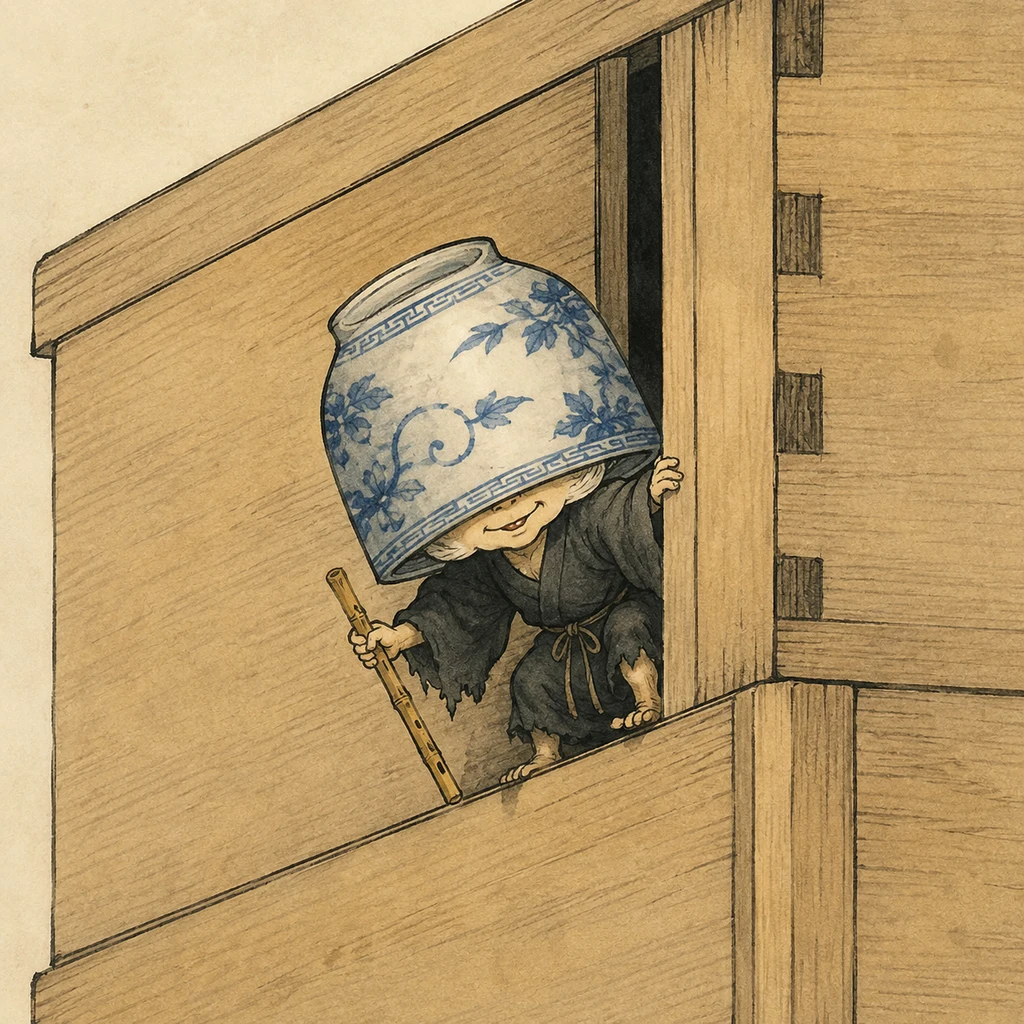
Boroboroton is a tsukumogami: an old, torn futon that gains a spirit after long years of use. It appears in Toriyama Sekien’s Edo-period Hyakki Tsurezurebukuro, where its name plays on boroboro (“tattered”) and possibly a term for mendicant monks. Lacking widespread oral lore, it is largely Sekien’s creation. At night the futon hops about and startles people, more prankster than menace.

Read more

Toriyama Sekien's four-part work was a decisive event in Edo yokai culture. Whereas the yokai picture scrolls since the Kan'ei era narrated through a succession of compositions, Sekien decomposed them into one entity per page, adding the name, its kanji notation, whether it had an authoritative source, and a brief explanation. It was the exact moment when the picture scroll culture of Kyoto was converted into the "illustrated encyclopedia" in Edo.

The Yarikecho, Chokuboron, Kinu-tanuki, and Fukuro-mujina included in the *Tsurezure Bukuro* are all *tsukumogami*—objects infused with souls. Sekien's playful spirit as a gesakusha is evident in his use of wordplay and historical allusions. The Shami-choro is the tsukumogami of an old, rotting shamisen, while the Fuguruma-yohi is an alluring figure combining a cart carrying old documents with the form of a woman.
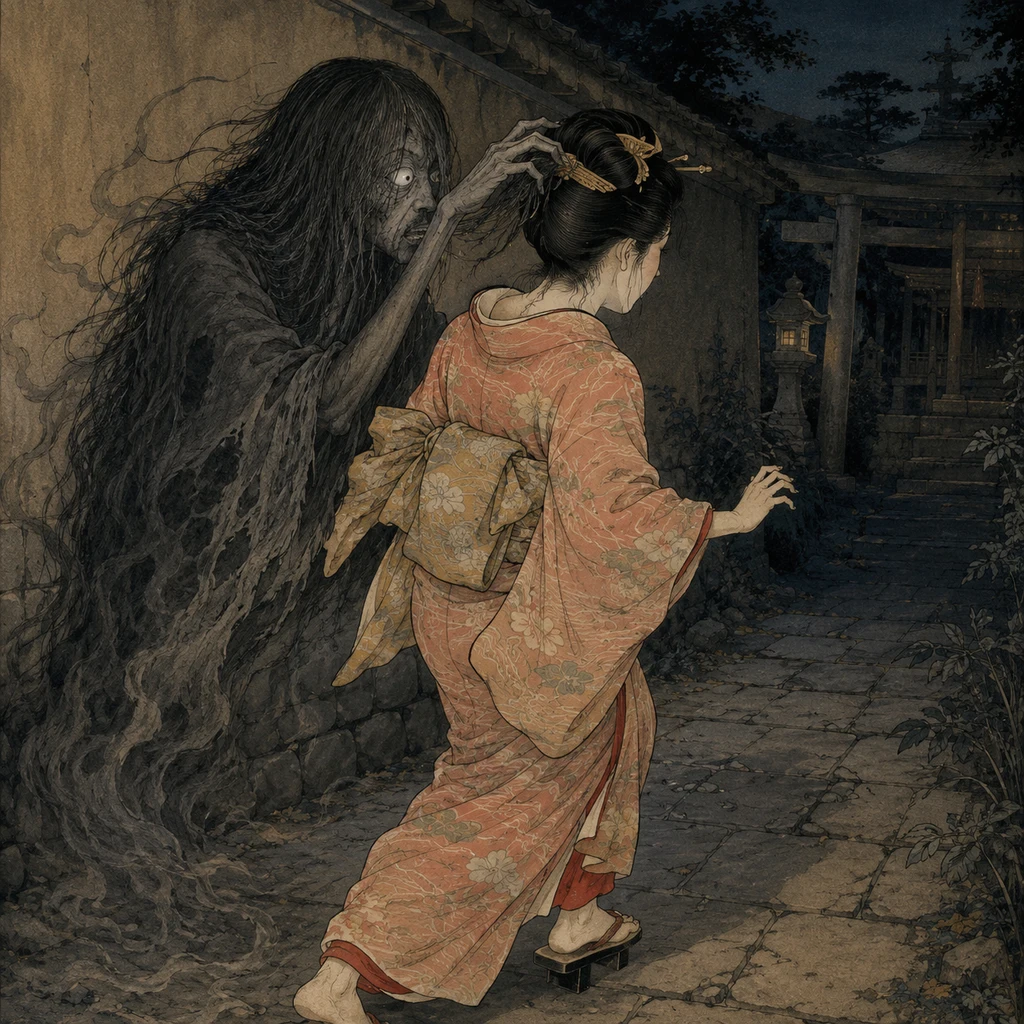
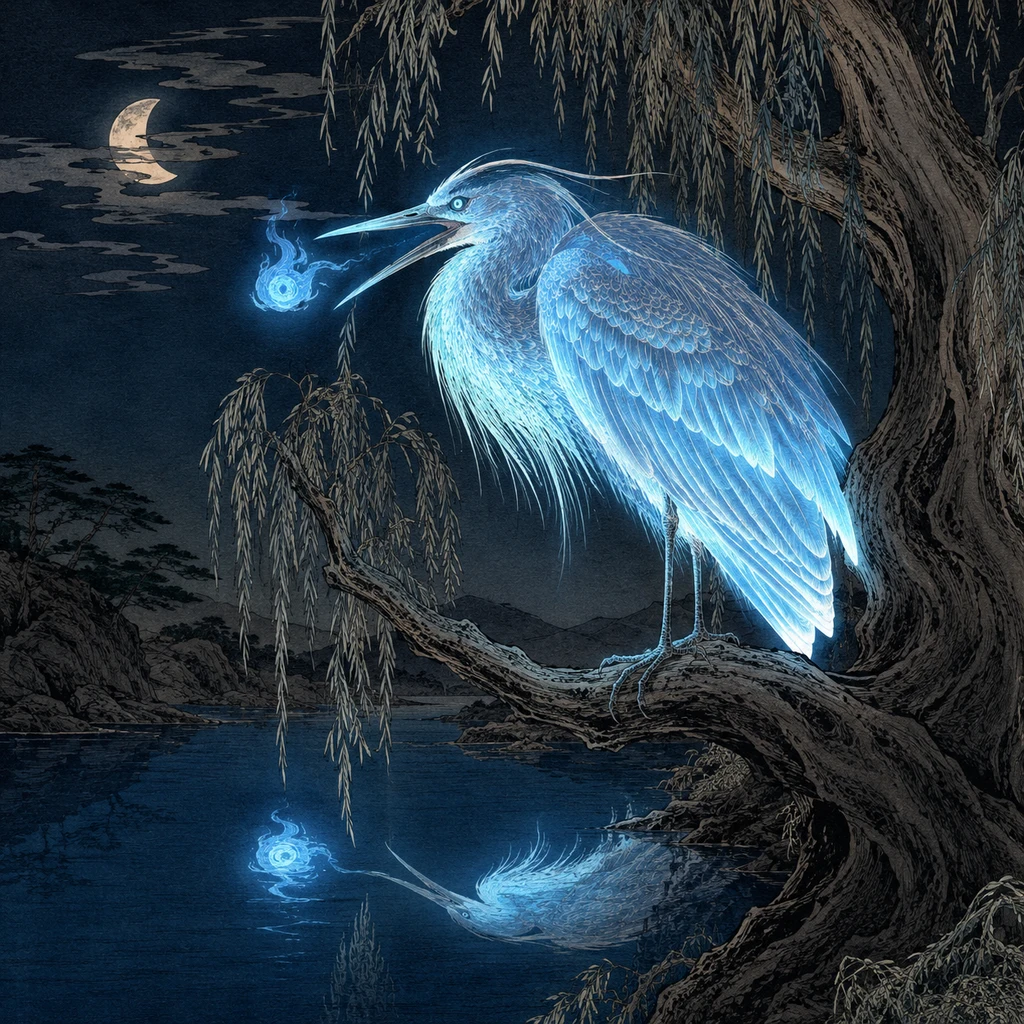
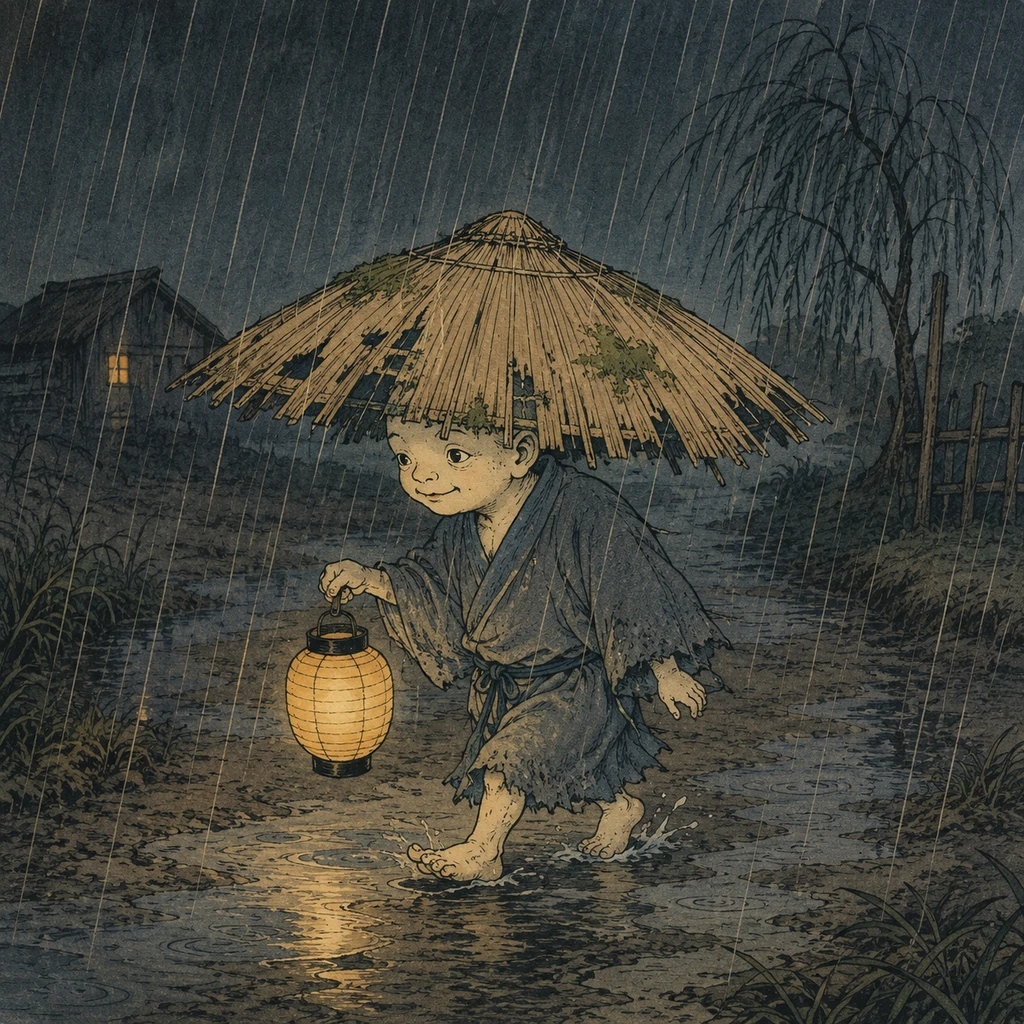
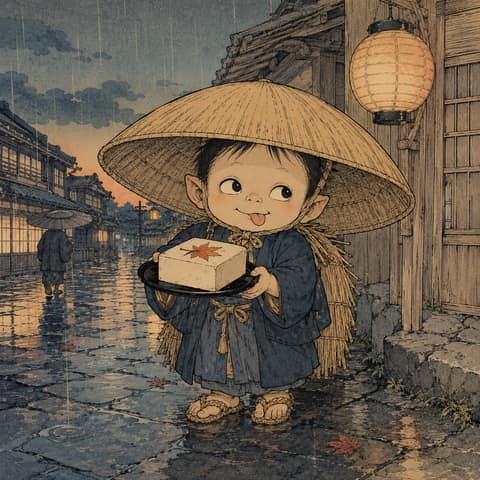
The Ushirogami is the personification of the vague sensation of someone sneaking up from behind; the Ao-andon (Blue Lantern) is the blue-faced woman appearing at the final flame of a Hyakumonogatari (One Hundred Ghost Stories) gathering; the Aosagibi (Blue Heron Fire) is a mysterious fire emitted by a blue heron at night, depicted as an intermediate existence between animal shapeshifting and a fire anomaly. The Amefuri-kozou (Rain-falling Boy) is depicted as a young boy holding a paper lantern and wearing a Japanese umbrella stripped of its middle ribs on his head, conceived by Sekien as an attendant serving the Rain God (Ushi).

Sekien's importance lies in his strict distinction between his own creations and traditional sources. For yokai like the Hone-onna and Gambari-nyudo, he explicitly cites Asai Ryoi and latrine superstitions; while for the Kejorou and Boroboroton, he adds them openly as original creations. The coexistence of scholarly temperament and playful writer spirit on the same page demonstrates Sekien's unique position as an intellectual in the late Edo period.

The Yokai of Ukiyo-e:
Hokusai,
Kuniyoshi,
Yoshitoshi

The "yokai as illustrated encyclopedia" established by Sekien rode the distribution network of ukiyo-e and sank deeply into the visual memory of the Edo commoners. Katsushika Hokusai began his *Hyakumonogatari* series around Tenpo 2 (1831). Though planned for 100 prints, only five survive today ("Oiwa-san", "Sarayashiki", "Warai Hannya", "Shunen", "Kohada Koheiji"). Each brought the question of "What does it mean to see a yokai?" into the picture, utilizing a unique style intertwining terror, humor, and sorrow.

Utagawa Kuniyoshi's *Soma no Furu-dairi* (The Old Imperial Palace at Soma, c. Koka 2-3, 1845-1846), based on Santo Kyoden's *Uto Yasukata Chugiden*, depicts Takiyasha-hime, the orphaned daughter of Taira no Masakado, using dark magic to summon a giant skeleton at the ruins of her father's mansion. Through the anatomical accuracy derived from Western anatomy and the compositional invention of unifying multiple skeletons into one giant entity, the prototype for the giant skeleton known in postwar yokai culture as the "Gashadokuro" was established. While the name "Gashadokuro" itself is a neologism born in postwar yokai books, the origin of its imagery undeniably rests in this single print by Kuniyoshi.
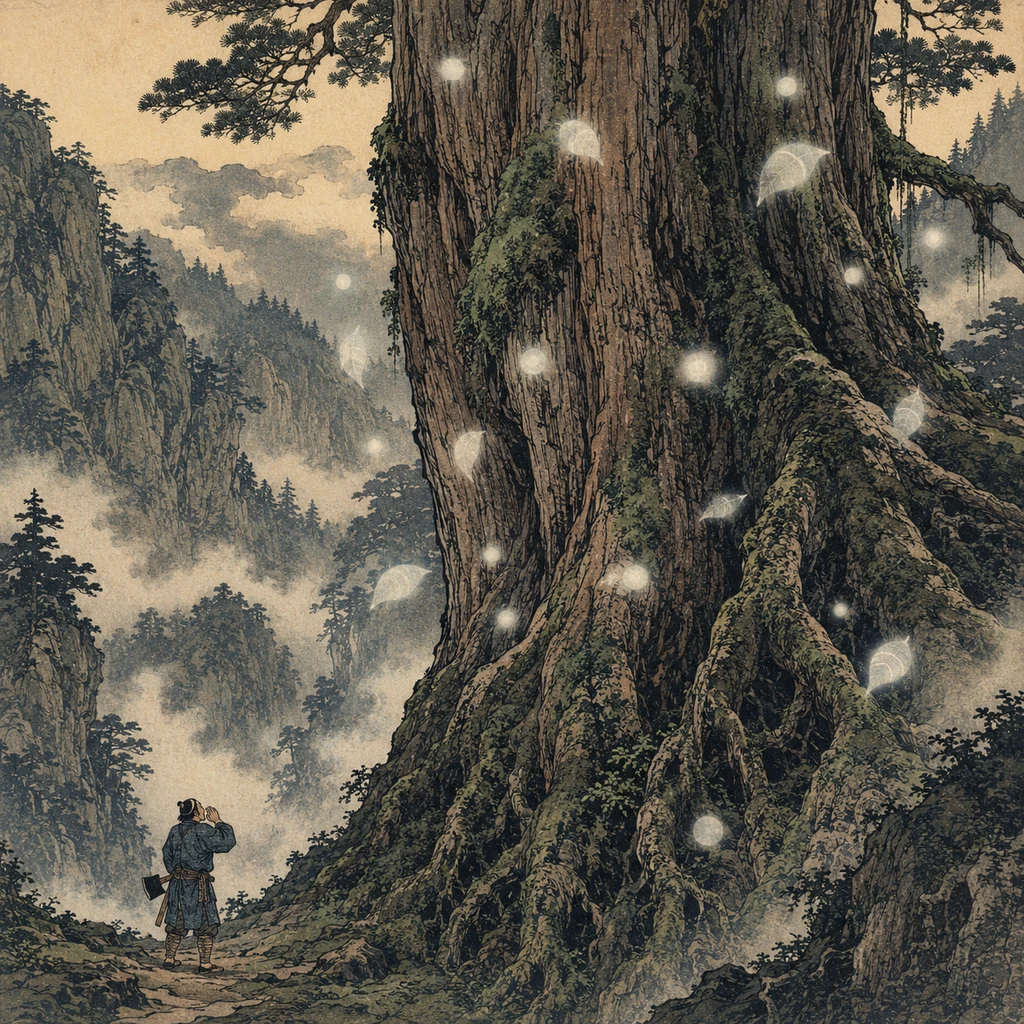
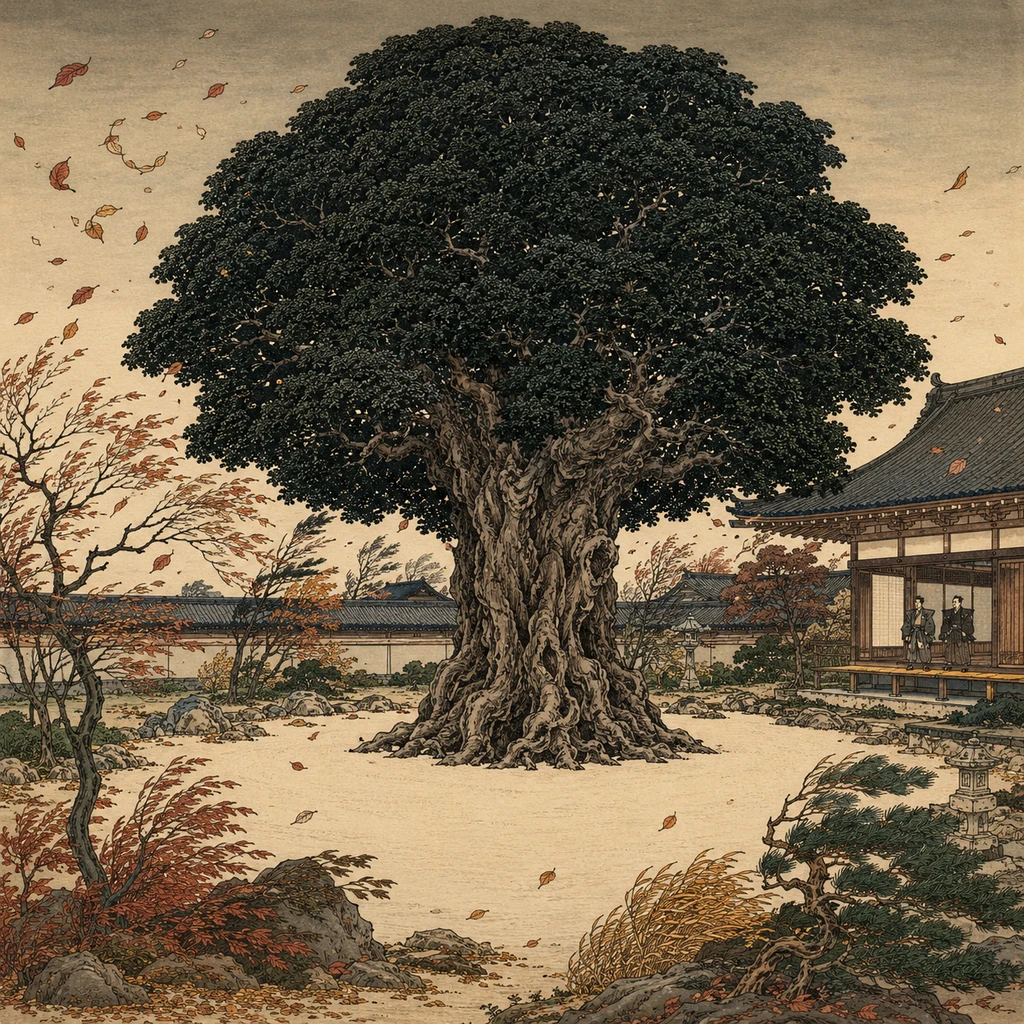
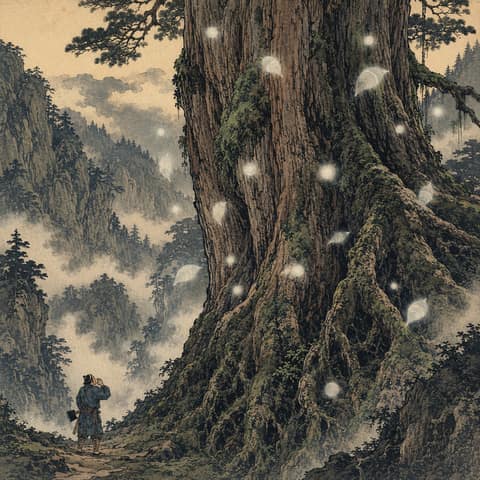
Kodama (Japanese Tree Spirit)kodama

Kodama, often searched in English as “kodamas,” are Japanese tree spirits: presences believed to dwell in old trees, or

Tsukioka Yoshitoshi, often called "the last ukiyo-e artist," completed the *Shinkei Sanjurokkaisen* (New Forms of Thirty-Six Ghosts) between Meiji 22 and 25 (1889–1892). The defining characteristic of these thirty-six prints is that the focal point is not the yokai itself, but the "human seeing the yokai." Yokai are depicted not as objective entities, but as products of human delusion and consciousness. The zeitgeist of redefining the supernatural within the scientific worldview following the Meiji Enlightenment crystallized here. Even nature-spirit yokai like the Kodama and Azuki-arai were brought into the psychological space of the urbanites by Yoshitoshi's hand.

Sanyutei Encho and Rakugo Ghost Stories:
The Bridge from Edo to Meiji

Born in Edo's Yushima in Tenpo 10 (1839), Sanyutei Encho is the most crucial figure in bridging Edo ghost stories to the new media of the Meiji era. He performed *Kaidan Botan Doro* from around the Genji era, and in *Shinkei Kasanegafuchi*, he reinterpreted the Kasane tragedy of Hanyu Village in Shimosa through a kanji pun on *shinkei* (meaning both "nerves/psychology" and "true view"), transforming it into a story of Meiji-era psychologism.

The shorthand transcriptions of Encho's performances are positioned as pioneers of the movement to unify the spoken and written language. The natural colloquial style of the shorthand book of *Kaidan Botan Doro* published in Meiji 17 (1884) paved the way for the innovation of modern Japanese prose ahead of Futabatei Shimei's *Ukigumo* (1887-1889). It is a rare example where the highly commoner-oriented space of Edo rakugo performances ended up shaping modern Japanese itself.
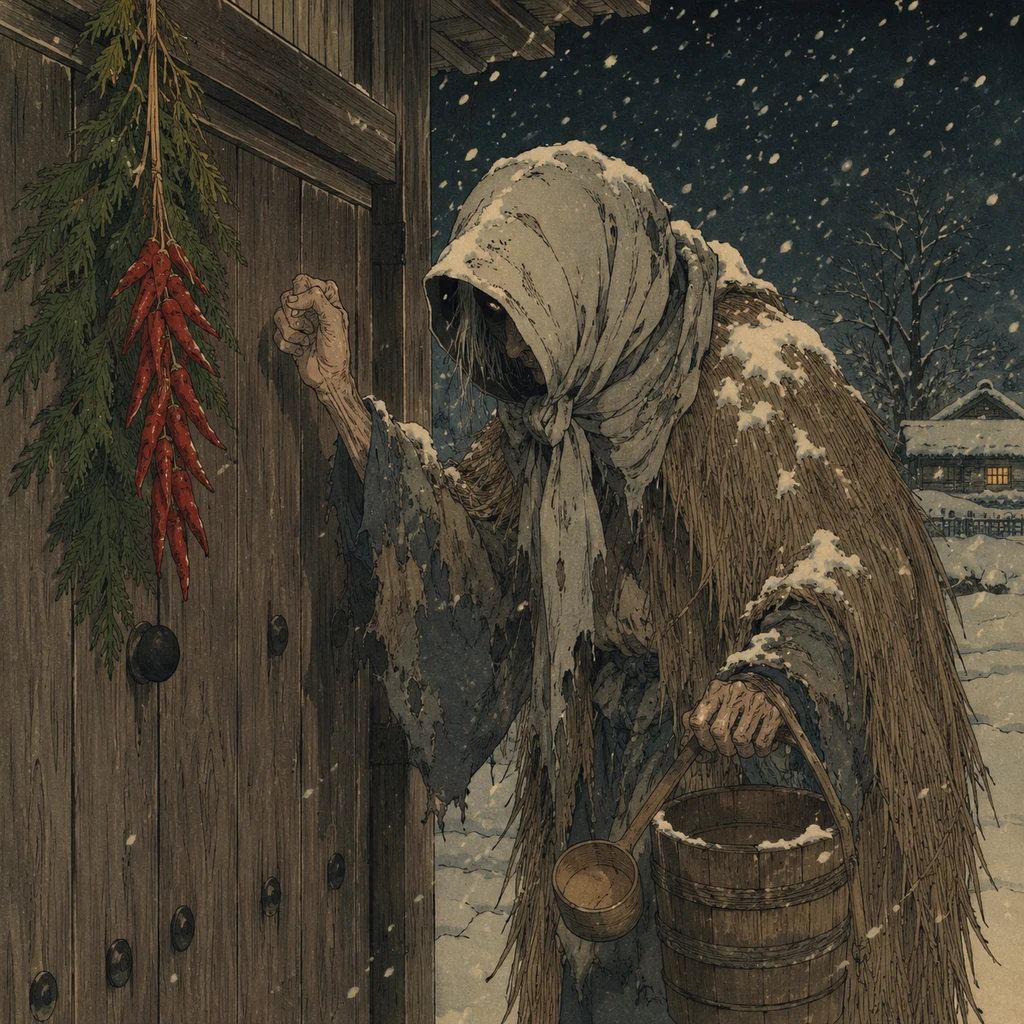
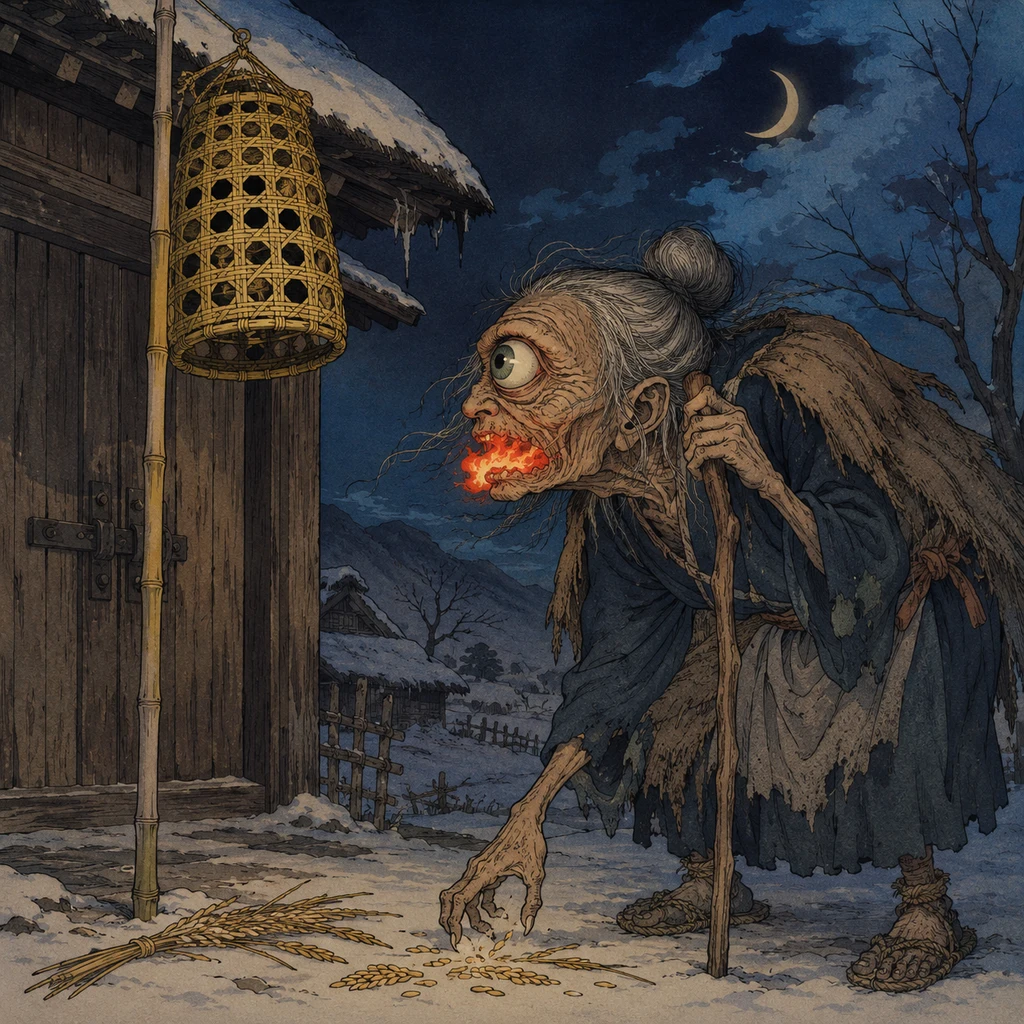
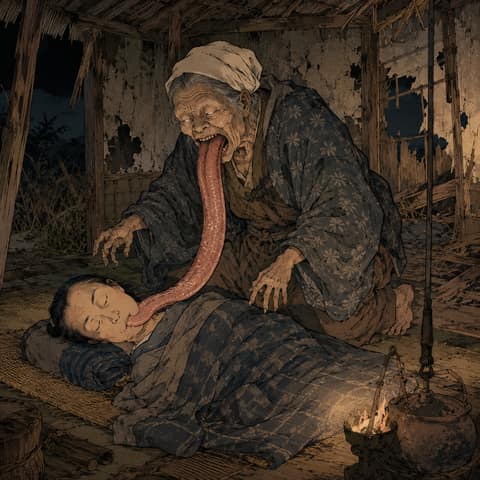
Amazake Hagah-mah-ZAH-keh BAH-bah

A yokai that appears as an old woman roaming late at night, knocking on doors and calling, “Any sweet sake?” Regardless

The withered old woman Amazake-baba who knocks on doors late at night bringing illness; the Ooatama-kozou (Large-headed Boy) who threatens a tofu seller in the guise of a child with an abnormally large head; the Kamikiri (Hair-cutter) secretly snipping off people's hair in the city. These characters appeared both in Sekien's illustrations and in rakugo performances, permeating every corner of Edo through the dual routes of text and speech.

Lafcadio Hearn's Kwaidan:
Edo Written in English

In Meiji 29 (1896), Lafcadio Hearn (who took the name Koizumi Yakumo after naturalization) arrived in Tokyo as a lecturer in English literature at Tokyo Imperial University. His predecessor was Toyama Masakazu, and his successor was Natsume Soseki—the central pillars of English literature in Japan. He reconstructed in English the ghost stories he had collected across Japan—specifically the tales orally transmitted by his wife, Koizumi Setsu, in Matsue, Kumamoto, and Tokyo. This book, *Kwaidan: Stories and Studies of Strange Things*, was published by Houghton, Mifflin in Boston in April of Meiji 37 (1904).

Yuki-onna, Hoichi the Earless, Mujina, Rokurokubi—when these anomalies submerged within the folk beliefs of Edo were transcribed into the international language of English, the "Japanese ghost story" opened its doors to the world as a universal genre. Masaki Kobayashi's 1965 film adaptation *Kwaidan* won the Special Jury Prize at the Cannes Film Festival, serving as the moment the regional cultures of Kyoto and Edo were formally placed into the history of world cinema. Hearn's primary base for writing was Tokyo Imperial University, and the site of his former residence in Nishi-Okubo is still remembered today as a literary landmark in Shinjuku.

The Woman of Ikebukuro and Edo's Consciousness of the Periphery
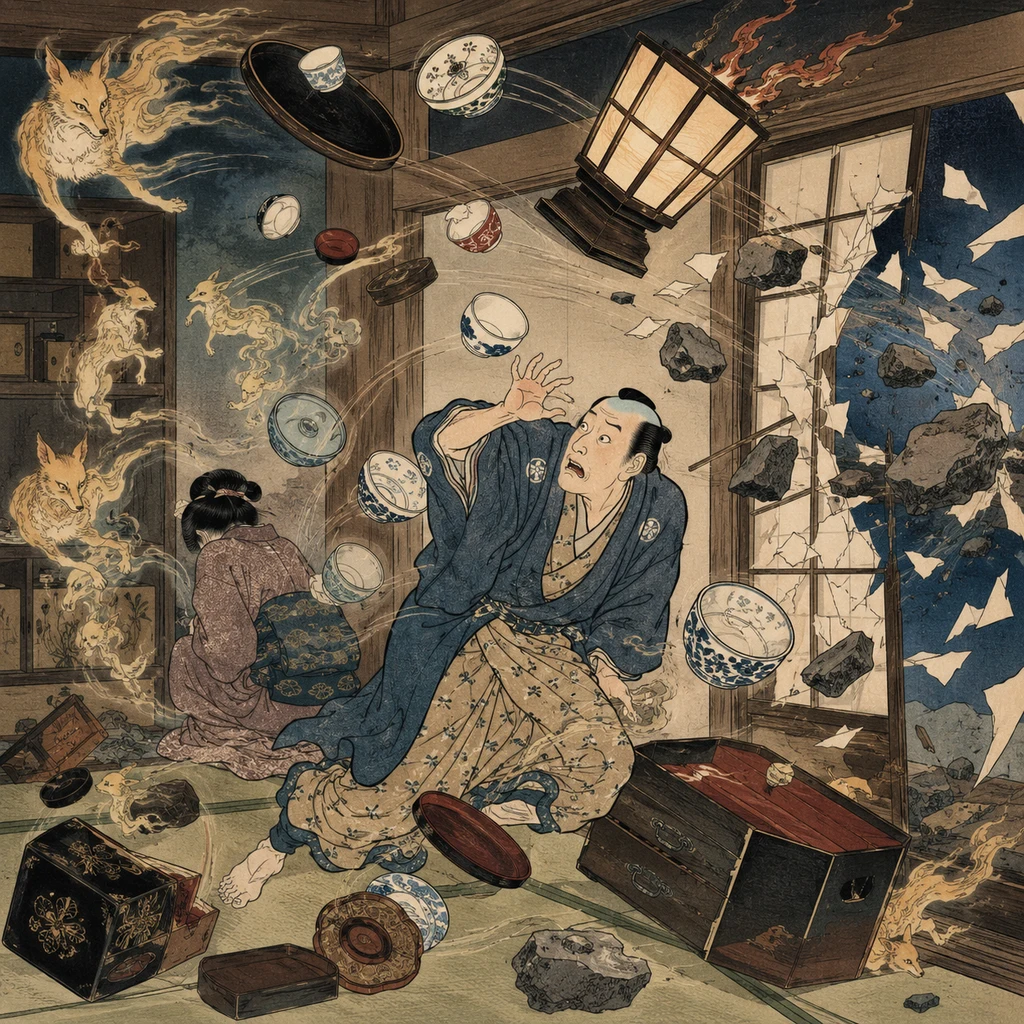
The Woman of Ikebukuro

ee-keh-BOO-kroh no OHN-nah

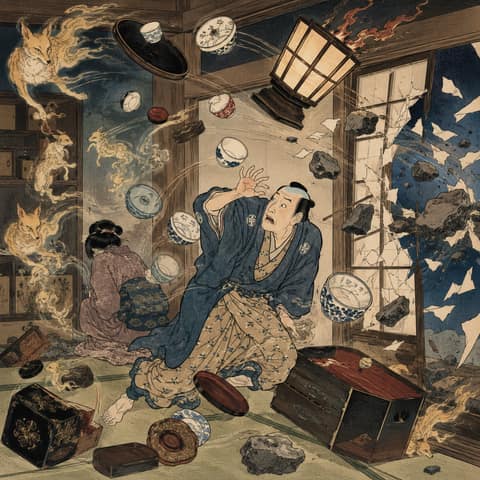
A late Edo-period folk belief: hiring a woman from Ikebukuro into another household would bring poltergeist-like disturbances—mysterious noises, thrown stones, and dishes or lanterns flying about. First recorded in Negishi Jin’e’s Mimibukuro (Kansei era), where hauntings followed a servant’s affair with a household member and ceased once she was dismissed. Similar tales are told of women from Ikejiri, Numabukuro, and Meguro, sometimes linked to the protection of their local tutelary deities or to the curse of osaki spirit-users.

Read more

In the *Mimi-bukuro* (Ear Sack) compiled by Negishi Shizumori during the Kansei era (1789-1801), an intriguing superstition is recorded. It was said that if an Edo mansion hired a woman from Ikebukuro as a maid, the house would experience *yanari* (creaking sounds), lanterns and mortars would dance around, and dishes would fly—frequent occurrences of what the West would call poltergeist phenomena. The story first appears indicating that this anomaly persisted after the maid had an illicit affair with someone in the household, and ceased once she was dismissed.

Similar tales are widely distributed across place names on the periphery or outskirts of Edo, such as Ikejiri (Setagaya), Numabukuro (Nakano), Meguro (Meguro Ward), Omiya (Saitama), and Chiba. The common structure is that "those from the periphery, viewed from the center (Edo Castle town), disturb the order of the center." This is a quintessential example where late Edo urban consciousness (the center is civilization, the periphery is strange) merged with regional discrimination and manifested as yokai, marking an important case study at the intersection of folklore and discrimination studies.

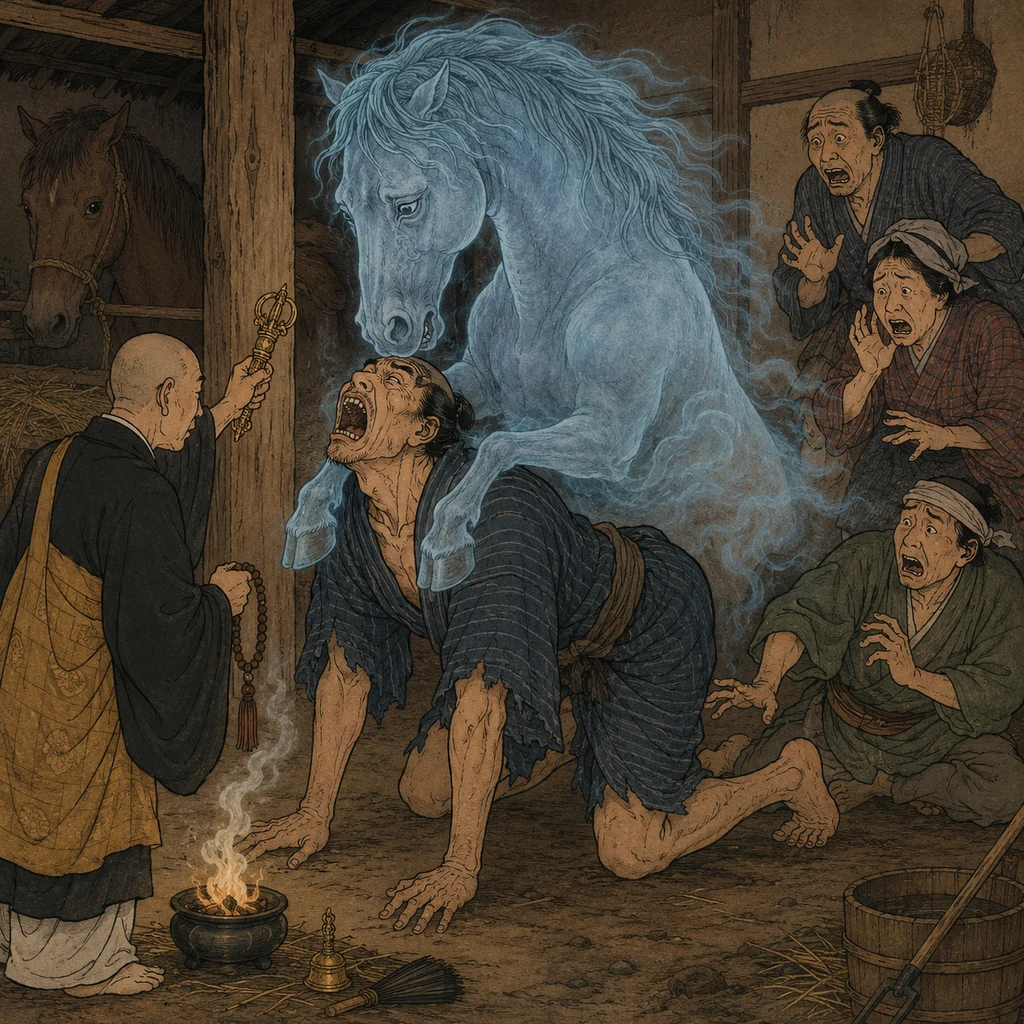
Alongside the Ikebukuro no Onna (Woman of Ikebukuro), another existence transformed into an anomaly by Edo's urban consciousness is the Uma-tsuki (Horse Possession). It was believed that the spirit of a dead horse would possess someone who had abused horses, causing them to neigh and rummage through dirty water in buckets with animalistic behavior. This was deeply feared by both samurai and commoners. The guilt toward the "horse"—an essential living infrastructure—returning in the form of a supernatural anomaly; this too is a sensibility unique to Edo.

Musashino and Tama:
The Anomalies of Tokyo's Western Suburbs

Tokyo's yokai culture is not confined to the 23 wards. The western suburbs, stretching from the Musashino Plateau to the Tama Hills, also nurtured their own unique anomalies. Mount Takao in Hachioji City is home to Yakuoin, a temple of the Chisan branch of Shingon Buddhism, which, combined with the worship of the main deity Izuna Daigongen, became a sacred site for tengu. Of the Eight Great Tengu listed in the *Tengu Sutra*, Izuna Saburo originally based himself on Mount Izuna in Shinshu, but after being invited to Mount Takao, he became the core of Kanto's tengu worship.

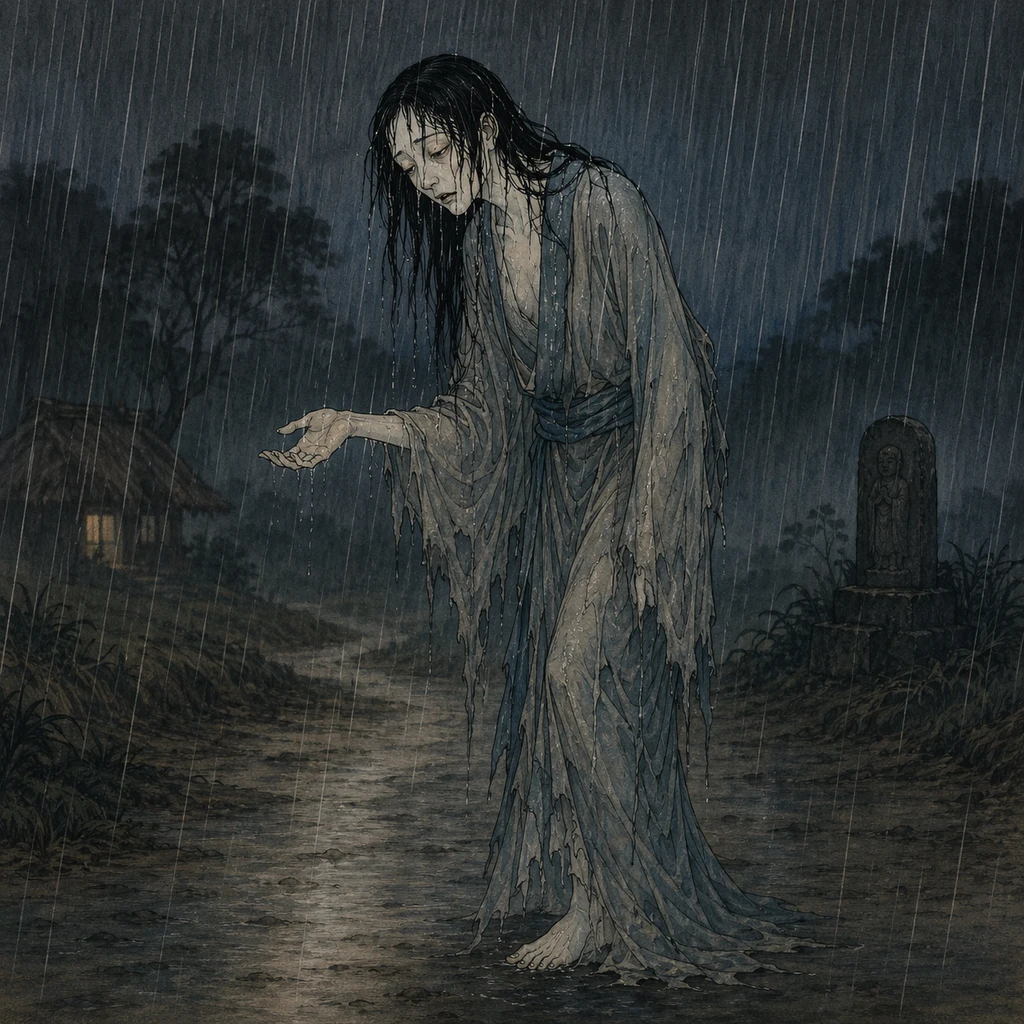
The Tengu-tsubute (Tengu's Thrown Stones) is an anomaly where pebbles from unknown origins fall like rain from the sky, frequently spoken of in the mountains of Takao and Okutama. The thrower is unseen, and no traces are left behind. It is a pattern where the boundary sensations of mountain worship are experienced as physical phenomena. The Mikari-baba is a one-eyed old woman passed down throughout the Kanto region, said to visit homes on the "Koto Yoka" (the 8th days of the 12th and 2nd lunar months) to borrow people's eyes or winnowing baskets (*mi*). Customs of placing bamboo baskets at doorways to ward off evil still remain in some areas. The Ame-onna (Rain Woman) is a female yokai that beckons rain, positioned on the ambiguous boundary between rainmaking prayers and natural disasters in agrarian society.
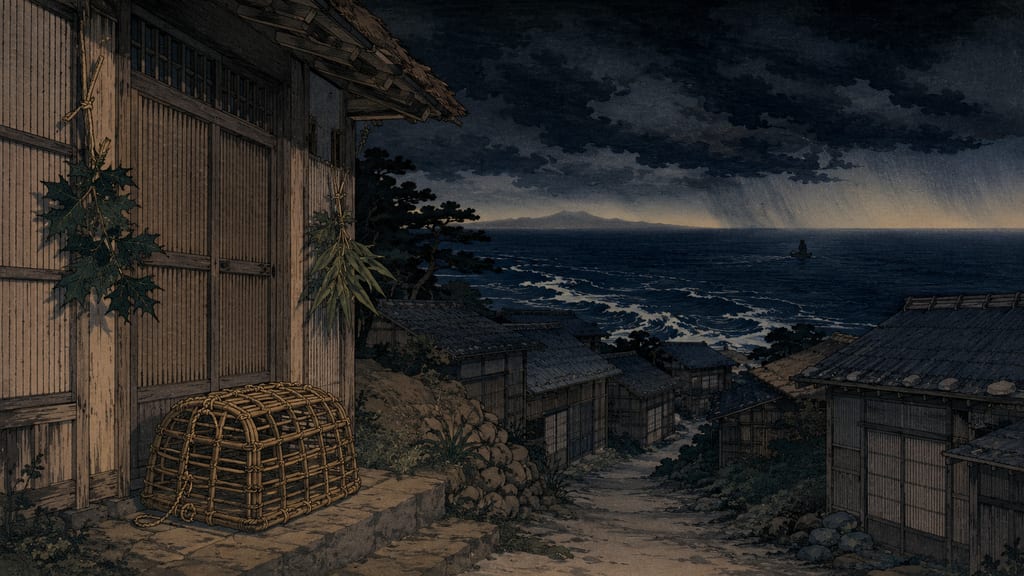
In the Izu Islands, taboos dictate shutting doors and using baskets and leaves to ward off evil on the night of the Kainan Hoshi.

The Yokai of the Izu Islands:
The Sea of Tokyo

As an administrative division, the Metropolis of Tokyo includes the Izu and Ogasawara Islands in addition to the 23 wards and the Tama region of inland Honshu. Anomalies stemming from a lineage entirely separate from Honshu's yokai system have been passed down here.
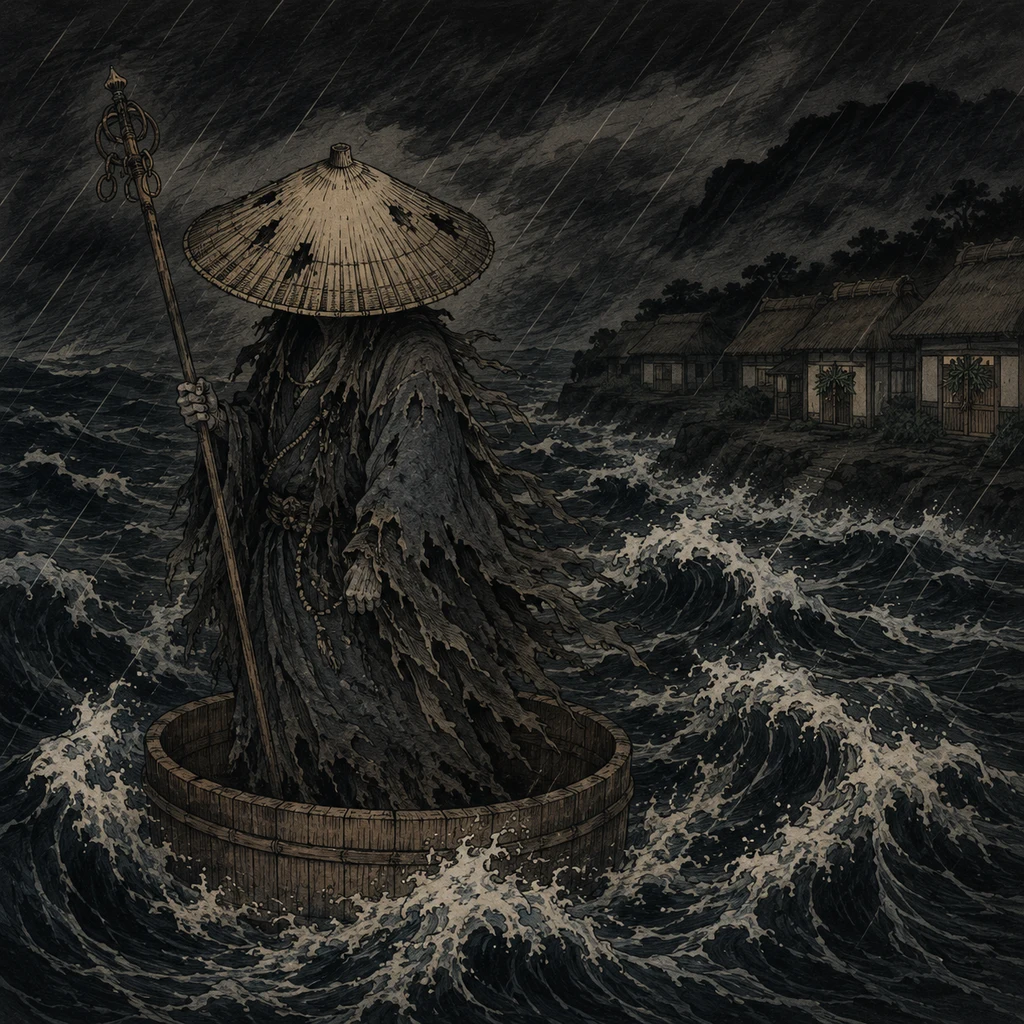
Kainan Hōshi

kainan hōshi

Kainan Hōshi is the vengeful spirit of people lost at sea in the Izu Islands, where it is also called Kannan-bōshi. On the night of the twenty-fourth day of the first lunar month, it is said to come from offshore in the form of a monk wearing a broad hat; anyone who sees it will go mad or meet the same kind of death. People therefore avoid going outside that night and observe a taboo that includes covering the entrance with a basket and placing branches of holly and tobira in the storm shutters. One origin story makes it the resentful ghost of an Edo-period island official, while some local rites treat the visitor from the sea more like an arriving deity.

Read more

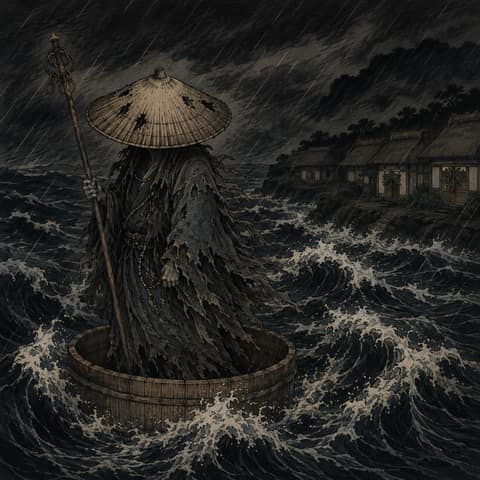
The Kainan Hoshi (Sea Disaster Monk, also pronounced "Kannan-boushi") is a taboo against going outside on the night of the 24th day of the first lunar month in the Izu Seven Islands. Around Kan'ei 5 (1628), the islanders sent the cruel local magistrate Toyoshima Tadamatsu, who had tormented them, out to a stormy sea to die. As revenge, it is said that his vengeful spirit roams the islands riding in a wooden tub on the night of the 24th. Because anyone who sees him will die the same death, on this night, households invert baskets at their gates as marks, and insert leaves of holly or Japanese cheesewood into shutters to ward off evil. Taking the day off work and secluding oneself at home is an ancient custom.

The name varies from island to island—"Yadaiji" on Toshima, "Nijugonichi-sama" on Kozushima, "Imi no Hi" on Miyakejima, and "Hiimi-sama" on Oshima. The very fact that the same anomaly is spoken of with different names on different islands indicates that the Izu Islands possess independent folkloric worlds of their own.

Kinutanukikee-noo-tah-NOO-kee

Kinutanuki is a yokai strongly shaped by the imagination of Edo-period artist Toriyama Sekien, who depicted it in his Hy

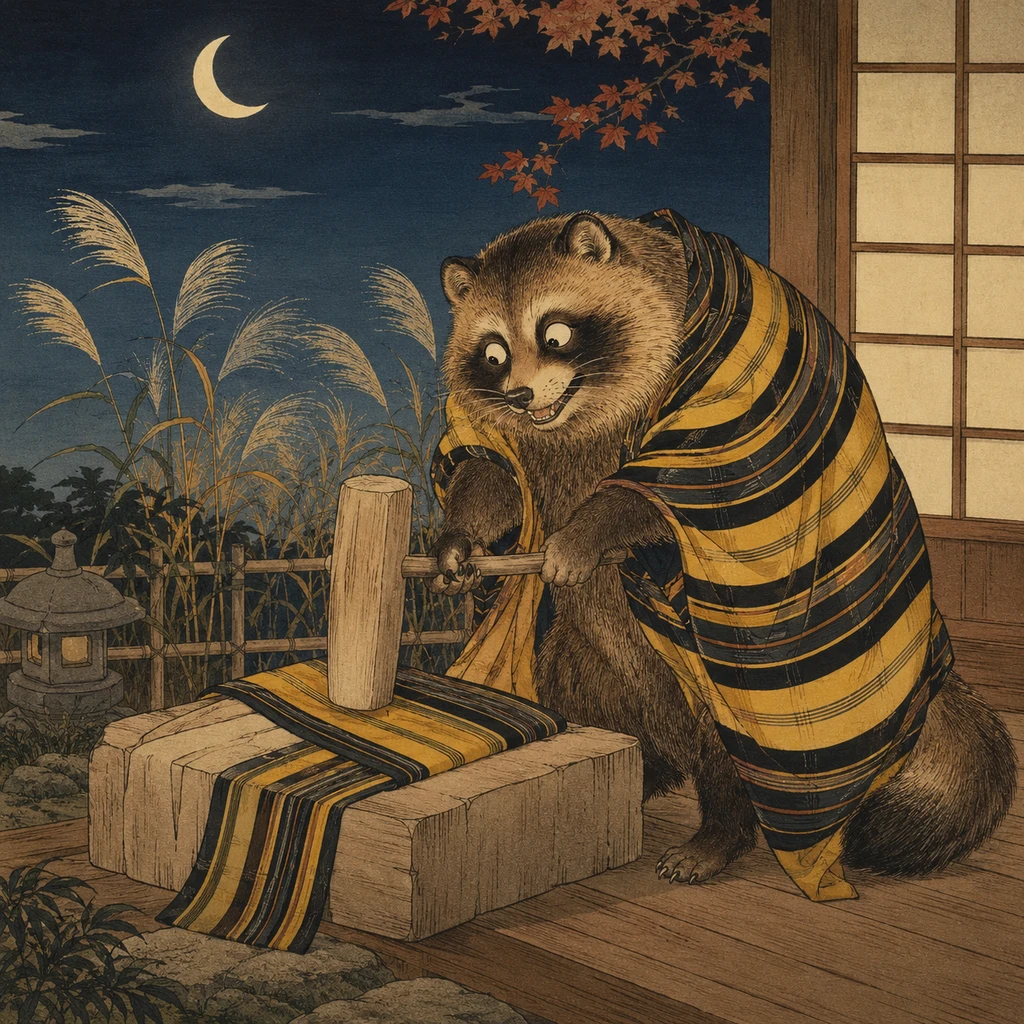
The Kinu-tanuki included in Sekien's *Tsurezure Bukuro* is an original yokai combining the local specialty of Hachijo-jima, Hachijo silk (*kinu*), with the superstition of the shapeshifting tanuki, depicted as a fusion of silk cloth and a tanuki. This is a wordplay based on the phonetic similarity between the fulling block (*kinuta*) and silk/tanuki (*kinu/tanuki*), demonstrating how the products of the Izu Islands were ingeniously cited in the playful works of an Edo painter.

Postwar and Modern Era:
Transplantation to Tokyo's Western Suburbs

Postwar Tokyo, while inheriting the context of Edo urban ghost stories, incorporated new geographies into the landscape of yokai culture. Manga artist Shigeru Mizuki (1922-2015), originally from Sakaiminato in Tottori Prefecture, moved to present-day Chofu City after his debut as a manga artist in 1959 and operated there until his death. In the Tenjin-dori shopping street in front of Chofu Station, yokai monuments were installed starting in 1991 based on Mizuki's proposal. Along with the Kitaro Chaya in front of Jindaiji Temple, Tokyo's western suburbs became the sacred ground of modern yokai culture. The lineage in which Mizuki inherited Toriyama Sekien's encyclopedia as the "modern yokai encyclopedia" draws a straight line connecting Kyoto's picture scrolls, Edo's illustrated books, and postwar manga.
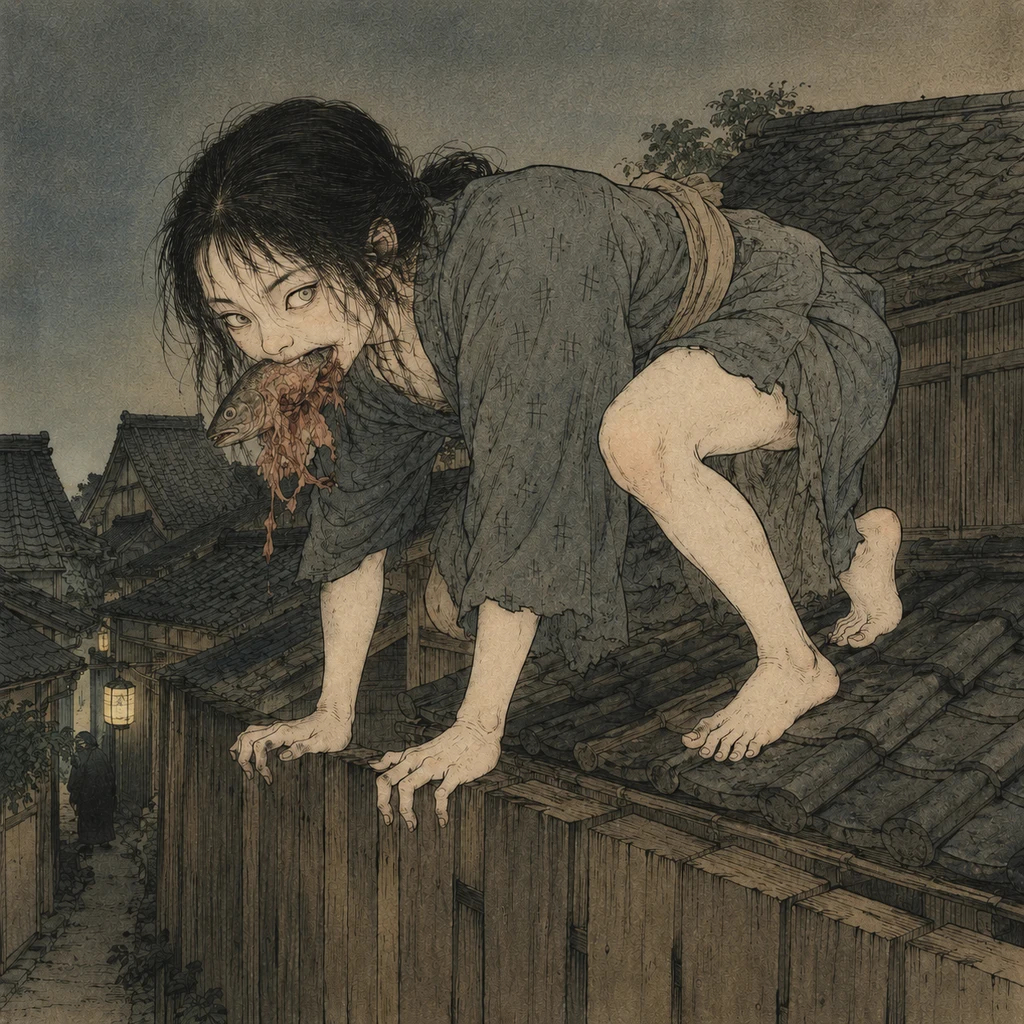
Cat MaidenNEH-koh-moo-SOO-meh

Cat Maiden is a label given to women who display feline habits or tastes, appearing in early modern eyewitness notes, si

Neko-musume (Cat Girl) was originally a colloquial term given to women exhibiting cat-like behaviors appearing in early modern sideshow records and *yomihon* (reading books). The moniker of a girl with bizarre habits performing in the sideshow tents of Edo or Kamigata was transformed into a nationally known character via Mizuki's *GeGeGe no Kitaro*. It is a prime example of Edo sideshow culture connecting directly to postwar animation.

Studio Ghibli's *Pom Poko* (1994, directed by Isao Takahata) is a story of tanuki resisting the development of Tama New Town (Tama City) and is the sharpest work overlaying the yokai of Tokyo's western suburbs with the history of urban development. Takahata's personal experiences working at Nippon Animation (Tama City) in the 1970s served as the origin for the film, which claimed the number one spot at the domestic box office and won the Best Feature award at the Annecy International Animated Film Festival (1995). Just as the Seven Wonders of Honjo were born in the corners of Edo's urbanization, the Pom Poko tanuki pack was born on the frontiers of postwar suburbanization. The theme of "yokai chased away by urbanization" should be interpreted as a postwar variation of Edo urban ghost stories.

The Hyakki Yagyo series beginning with Natsuhiko Kyogoku's *The Summer of the Ubume* (1994), as well as Daijiro Morohoshi's *Yokai Hunter* (1974-), also emanated from Tokyo's publishing culture sphere, pushing postwar Japan's yokai culture to new intellectual heights. Kyoto's picture scrolls, Edo's ukiyo-e, Meiji's rakugo and shorthand books, and postwar manga. The innovation of "how to present yokai" has been constantly occurring at the forefront of the newest media over a millennium.

Conclusion:
Anomalies Spoken by the People and Carried by Print

If the yokai of Kyoto lived within the picture scrolls of the nobility and the spirit-pacification rituals of shrines, the yokai of Tokyo (Edo) lived vividly in the woodblock prints, ukiyo-e, kabuki, and rakugo of the common people. The moats of Honjo, the row houses of Yotsuya, the pleasure quarters of Yoshiwara, the execution grounds of Suzugamori and Kozukappara, the festivals of Kanda Myojin, the yokai monuments of Chofu Station, the Kainan Hoshi of Izu Oshima. The birthplaces of these anomalies were all "urban mechanisms," and the storytellers were always townspeople, samurai, and wandering entertainers.

Even after being decapitated in Kyoto, Taira no Masakado's head flew back to the Kanto region, became a force sealing the demon gate of Edo Castle, and continues to dwell at the core of commoner festivals. Toriyama Sekien adapted Kyoto's picture scrolls into Edo's illustrated encyclopedias, writing the template for all subsequent yokai encyclopedias. Oiwa by Tsuruya Nanboku, Kasane and Otsuyu by Sanyutei Encho, Hokusai's Hyakumonogatari, Kuniyoshi's Gashadokuro, Yoshitoshi's yokai and humans, Lafcadio Hearn's Kwaidan, Mizuki Shigeru's Kitaro, and Takahata Isao's Pom Poko. Over a millennium, even as generations changed and media transformed, Tokyo has consistently continued to narrate yokai, inherit them, and put them out into the world. If Kyoto is a city that "enshrines and ends" curses through rituals, Tokyo is a city that "spreads and gives life" to curses through festivals and publishing. This is the unique landscape of Tokyo's yokai culture, witnessed in unison by the forty-five yokai told in this article.
Regional partners in Tokyo

Share work rooted in the yokai culture of Tokyo.

We welcome enquiries about crafts, cultural venues, yokai and folklore tours, accommodation and experiences, and local publications connected to Tokyo.

Partnership areas

  • Local crafts
  • Museums and cultural venues
  • Yokai and folklore tours
  • Stays and experiences
  • Local publishing
Discuss a regional partnership

Sponsored and advertising placements are clearly marked “PR” and kept distinct from editorial coverage.

All yokai of Tokyo42

Complete list of yokai linked to Tokyo, including those not featured in the article above.

Legendary places in this prefecture

Specific places within Tokyo — mountains, shrines, pools — where yokai are told. Visit each.

  • 高御産巣日神

    高御産巣日神

    Divine

    たかみむすびのかみ

    高木神として命を下す造化神・高御産巣日神

    神霊・神格高天原・天地初発神話 / 高木神社 (現·東京都墨田区押上)

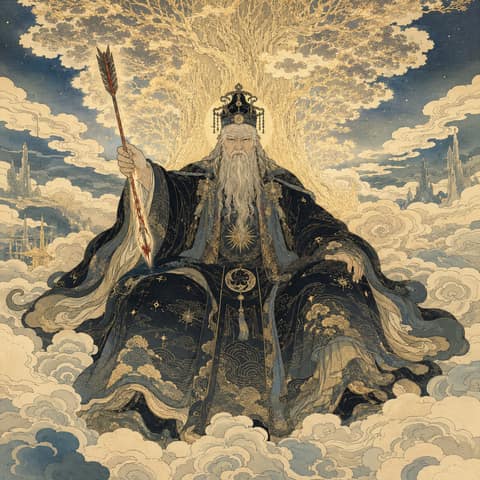
    Takamimusubi, who issues commands as Takagi-no-Kami, has his core in the transformation of an unseen creator god into a political decision-maker. At the beginning of the *Kojiki*, Takamimusubi appears as the second deity to come into being in Takamagahara when heaven and earth began, but immediately hides his form as a solitary deity. Here, the name is placed but the form is not depicted. The power supporting the beginning of the world is shown not as personal martial prowess or emotion, but as the root action that generates existence. However, entering the pacification of Ashihara-no-Nakatsukuni, this hidden deity emerges from silence. When Ame-no-Oshihomimi returns after seeing earthly turmoil, by the command of Takamimusubi and Amaterasu-Omikami, the myriad gods are gathered at Ame-no-Yasukawa. What is important here is that the command is issued not by Amaterasu alone, but jointly with Takamimusubi. If the sun goddess is the visible center, Takamimusubi is the unseen gravity that operates that center as a system. The name Takagi-no-Kami is another entry point for understanding this deity. The *Kojiki* (Ashihara-no-Nakatsukuni Pacification III) explains that Takagi-no-Kami is another name for Takamimusubi in the scene where the returned arrow reaches Amaterasu and Takagi-no-Kami. The official explanation of the enshrined deity at Takagi Shrine also lists the names Takamimusubi (Kojiki), Takamimusubi-no-Mikoto (Nihon Shoki), and Takagi-no-Kami, introducing the understanding that he is the deification of a tall tree. A tall tree stretches vertically from earth to heaven. As an impression of the name, Takagi-no-Kami can be read as an axis passing heavenly commands to the earth. In the story of the returning arrow, Takagi-no-Kami's judgment appears sharply. The arrow Ame-no-Wakahiko used to kill Nakime ascends back to heaven, reaching Takagi-no-Kami's hands stained with blood. Seeing it, Takagi-no-Kami declares that if Ame-no-Wakahiko has no evil heart, it shall not strike him, but if he does, it shall strike him, returning the arrow to earth. The arrow pierces Ame-no-Wakahiko. The fearsomeness of this scene lies in the fact that the deity does not punish out of anger, but reads the evidence, declares conditions, and reverses Ame-no-Wakahiko's own action into a judgment. In the scene of the Kuni-yuzuri, Takagi-no-Kami acts like a signature on a command. When Takemikazuchi descends to Izumo and thrusts the question upon Okuninushi, that authority is expressed as the command of Amaterasu-Omikami and Takagi-no-Kami. This shows that the transfer of rule over Ashihara-no-Nakatsukuni is told not as mere armed force or negotiation, but as a legitimate heavenly decision. Takagi-no-Kami is not a sword-wielding deity, but stands behind the sword-bearing envoy, turning the question into a "mandate of heaven." In the Tenson Korin, Takamimusubi's generative power also enters the lineage. Amaterasu and Takagi-no-Kami try to send Ame-no-Oshihomimi down to the pacified Ashihara-no-Nakatsukuni, but he suggests sending his newborn child, Ninigi-no-Mikoto. The text places Ninigi as the child born from Takagi-no-Kami's daughter, Yorozuhata-Toyoakitsushi-Hime. Takagi-no-Kami not only issues commands but is also involved in the maternal lineage of the heavenly grandson. Here, "generation" and "rule" are not separate. Being born itself creates the legitimacy to descend to earth. The divinity of Takamimusubi resonates well with Omoikane. In the pacification of Ashihara-no-Nakatsukuni, Omoikane confers with the gods and undertakes the judgment of selecting envoys. Takamimusubi calls upon that thinking and stands on the side of convening the heavenly council. The god of wisdom devises the strategy, and the god of creation establishes the space for council and command. Reading this relationship, the politics of Takamagahara appears not as the single shout of a hero god, but as a system where generation, light, wisdom, force, and negotiation overlap and operate. It is natural as a reading of the myth that Takagi-no-Kami is connected to the divine virtues of "creation of all things" and "successful consultations" in modern faith. The official divine virtues of Takagi Shrine list creation of all things, fulfillment of wishes, negotiations, and successful consultations for Takamimusubi. Looking at the generation at the beginning of heaven and earth, the council at Ame-no-Yasukawa, the dispatch of envoys, the Kuni-yuzuri, and the Tenson Korin as a single flow, this deity is not only a god who "births something" but a god who "places what is born into order." Takamimusubi is the generation before light, the consensus behind commands, and the deity who reties the story descending to earth from heaven.

  • Oguchi-no-magami

    Oguchi-no-magami

    Divine

    Oguchi-no-magami

    The Divine Messenger of Chichibu Mitsumine: Oinu-sama

    Divine Spirits / DeitiesMitsumine Shrine (Present-day Mitsumine, Chichibu City, Saitama Prefecture) / Musashi Province

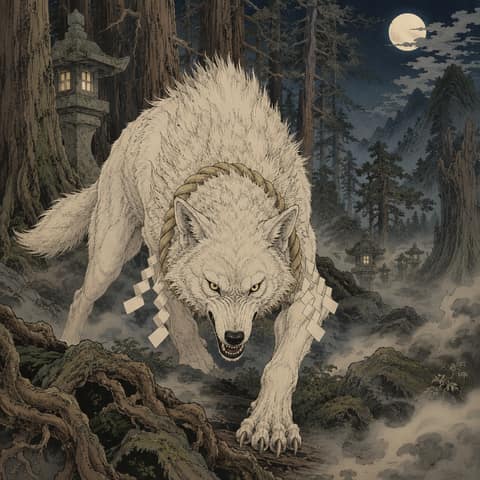
    Oguchi-no-magami is not merely a beastly yokai, but the crystallization of a faith that enshrined the Japanese wolf—a real, apex predator of the mountains—as a "True God." Centered around Mitsumine Shrine in Chichibu, Musashi Province, and extending to sanctuaries like Musashi Mitake Shrine and Hodosan Shrine, it is a guardian deity that permeates the wolf-worshipping sphere of the Kanto region. Its essence lies in "purification and exorcism." The fire that attacks a house, the thief that sneaks in, the evil spirits that possess people—the divine nature of a "watchdog" capable of sniffing out and driving away unseen disasters was strongly sought after by the commoners of the early modern period. The unique practice of *Gokensoku Haishaku* is an intense form of faith where the deity itself is welcomed into the home for a year. Through repeated cycles of returning and renewing the amulet, the bond between the deity and the household is maintained. The fact that an extinct beast is still treated as a god today demonstrates the deep-rooted strength of this faith.

  • Taira no Masakado

    Taira no Masakado

    Divine

    Taira no Masakado

    Masakado, Goryō God of the Kantō

    Divine Spirits & DeitiesThe Kantō region (the Masakado Grave-Mound at Chiyoda, Kanda Myōjin, and the old Bandō homelands)

    This edition follows in close detail—while fixing the boundary between history and legend—how a single Bandō warrior became the uncanny "flying head" and then turned into a god who guards Edo. First, history and the uncanny must be separated. The revolt itself is conveyed by the near-contemporary Shōmonki, which records in classical Chinese the private feud beginning in 935, the subjugation of the Kantō provincial seats, the proclamation as New Emperor, and the death in battle in 940. But here there is no marvel of a flying head. The supernatural story of a head that would not rot, cried out, and flew appears only centuries later, in the Nanboku-chō-period Taiheiki, with anecdotal relays such as the Konjaku Monogatari-shū in between. It is in this later stratum of legend that Masakado is told as a "yokai." The story of the curse around his head mound is newer still. The dread transmitted at the Masakado Grave-Mound at Ōtemachi—"move it and it curses"—is a modern urban legend, layered onto events that occurred in the heart of the city in the Taishō and Shōwa eras: the deaths of those involved in building the Ministry of Finance's temporary office after the Great Kantō Earthquake, and the bulldozer accident during the Occupation. The factual events and the interpretation that attributes them to Masakado's curse must be carefully separated. The path of deification, on the other hand, reaches back into the medieval age. In the second year of Enkyō (1309), the Ji-sect holy man Shinkyō Shōnin, who attributed a plague to Masakado's curse, pacified the spirit and added it to the enshrined deities of Kanda Myōjin. This, like Michizane, is the textbook goryō belief of enshrining a raging vengeful spirit and turning it into a protecting god. The ups and downs—drawing the reverence of the people as the great tutelary of Edo, being removed from the enshrined deities as a traitor in the Meiji era, and being restored at the end of Shōwa—also reflect well the duality of the image of Masakado as a hero who rebelled against the throne. In later ages, the story of his daughter Princess Takiyasha commanding a giant skeleton won popularity in kabuki and popular fiction and was depicted in Utagawa Kuniyoshi's "The Old Palace at Sōma"; it should be noted that this is a derivative starring the daughter, not Masakado himself.

  • Oiwa

    Oiwa

    Legendary

    Oiwa

    Oiwa of Yotsuya Kaidan

    Spirit / GhostOiwa Inari Tamiya Shrine (currently Samoncho, Yotsuya, Shinjuku-ku, Tokyo) — The setting of Tokaido Yotsuya Kaidan

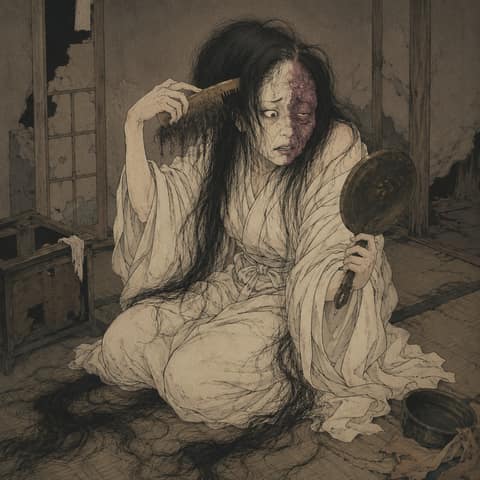
    Oiwa in the kabuki play "Tokaido Yotsuya Kaidan" debuted in July 1825 at the Edo Nakamura-za, staged as a mixed, two-day performance intertwined with "Kanadehon Chushingura". The ronin Kamiya Iemon of the Enya clan, despite having Oiwa as his wife, seeks to switch to a marriage proposal from a neighboring family for the sake of his career, feeding Oiwa a poisonous concoction. In the second act, the scene known as "Kamisuki" (hair-combing)—where Oiwa, half her face grotesquely swollen from the poison, dies in agony upon seeing her altered reflection while combing her falling hair—became the Kikugoro family's most polished and renowned spectacle. In the third act at Sunamura Onbobori, the corpses of Oiwa and Kobotoke Kohei wash ashore nailed to the front and back of a wooden door. The "Toitagaeshi" (door-flipping) scene, where the door turns over before Iemon's eyes—with a single actor playing both roles through lightning-fast costume changes—is the pinnacle of stage mechanism. In the final act at the Heikiyama hermitage, countless stage tricks (keren) are rapidly deployed, including the "Chochin Nuke" (lantern escape), where the ghost emerges from a burning lantern, and the "Butsudan Gaeshi" (altar flipping), where someone is pulled into a Buddhist altar. These bizarre phenomena are purely theatrical fiction with no connection to the historical virtuous wife Tamiya Iwa, yet their compelling realism led people to fear Oiwa as though she were an actual vengeful spirit. The story's framework hinges on the selfishness of a man who discards his wife for social advancement and the helpless desperation of a woman whose sincerity has been trampled. Oiwa is not an evil spirit cursing without reason; she is formulated as an existence whose lingering love for the husband who poisoned her has been violently inverted. Evoking both sympathy and terror in the audience simultaneously is the true essence of Nanboku's drama. A custom arose whereby the cast and crew, centered around the actor playing Oiwa, would visit Oiwa Inari in Yotsuya to pray for success and safety before the performance. This tradition continues to this day in modern kabuki, film, and theater (by ancient custom, the actor playing the betrayer Iemon does not visit, as doing so is said to anger the spirit instead). The very fact that accidents and injuries occurring on stage have often been passed down as "Oiwa's curse" stands as a rare case where a fabricated vengeful spirit attracted real-world religious belief. Ironically, the source of that belief, Oiwa Inari, was originally an auspicious shrine dedicated to the virtuous wife Oiwa who had restored her family's prosperity.
  • Okiku

    Okiku

    Legendary

    okiku

    Okiku of Sarayashiki

    Spirit / Vengeful GhostOkiku's Well, Himeji Castle (Current: Himeji, Hyogo) ── Banshu Sarayashiki, One of Japan's Three Great Ghost Stories

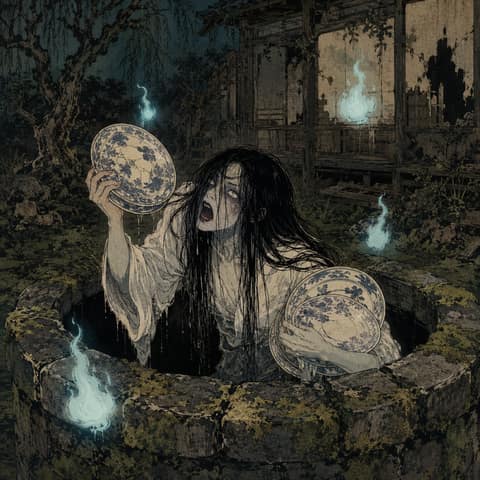
    "Okiku of Sarayashiki" is a vengeful spirit shaped as a creature of repetition, eternally counting her broken plates. Her terror lies primarily in her voice and numbers rather than her appearance—counting low in the darkness, "One... Two..." and unleashing a bloodcurdling scream upon reaching the ninth and missing the last. This structure of loss and repetition is the core of the Sarayashiki tales, causing the audience to cringe in anticipation of the inevitable dread of the "ninth." Okiku's grudge erupts from the absurdity inflicted upon the weak in early modern society: false accusations, class disparities, and the unreasonableness of masters. Here, the two major lineages must be strictly distinguished from their modern adaptations. First is the Banshu lineage—set in Himeji, where the maid Okiku is caught in Aoyama Tetsuzan's conspiracy to usurp the household. Tricked by Machitsubo Danshiro, she is framed for losing one heirloom plate, tortured to death, and sunk into a well. Second is the Bancho lineage—at the Edo Ushigome mansion of hatamoto Aoyama Shuzen, the maid Okiku is slain for breaking a plate (or for rejecting her master's unwanted affections), or throws herself into the well, becoming a well-dwelling haunt. Both are "Ghost Okiku," nurtured by early modern ghost stories, storytelling, and joruri. These must be sharply separated from the third layer—Kidō Okamoto's *Bancho Sarayashiki* (1916). Okamoto wrote this not as a ghost story but as a modern drama (New Kabuki), discarding the clan dispute plot and reimagining it as a tragic cross-class romance between the hatamoto Aoyama Harima and the maid Okiku. Okiku deliberately breaks the heirloom plate to test Harima's love; upon learning this, Harima, enraged that his true feelings were doubted, strikes her down—no ghost appears here, and the tale is elevated into a drama of tragic love and human psychology. In short, the "ghost Okiku counting from the well" is an image from early modern ghost stories, whereas Okamoto's Okiku is a distinct literary creation reinterpreted by a modern intellectual. The two must never be conflated.

  • Onryō (Vengeful Spirit)

    Onryō (Vengeful Spirit)

    Legendary

    ohn-RYOH

    Goryo Cult

    Ghosts & SpiritsAcross Japan

    A framework that enshrines vengeful spirits as goryo to pacify their curses and turn them into sources of blessing. Epidemics and natural disasters were seen as manifestations of resentment, and reconciliation was sought through founding shrines, conferring divinity, and institutionalizing festivals. Curse deities bear a dual aspect of fear and veneration, and their wild power was believed to transform into communal guardianship through proper requiem rites. Practices ranged from state rituals to village memorials, including era name changes, imperial envoys, Goryo-e, and Hojō-e. For individuals, memorial offerings, sutra copying, nenbutsu, and esoteric prayers were performed, while restoring honor and granting divine ranks were means to ease a spirit’s grievances. Narratives and origin legends explained why resentment arose, giving social memory to causes such as false accusation, untimely death, and broken lineages. A vengeful spirit’s power was not indiscriminate but signaled its intent according to causes, believed to speak through dreams, oracles, thunder and fire, and plague. Pacification was not a one-time act but continued through annual festivals and shrine upkeep, with warnings that neglect would invite resurgence.

  • Ushi-oni

    Ushi-oni

    Legendary

    ushi-oni

    Ushi-oni, the Bull-Headed Spider of the Deep

    Animal ShapeshifterCoasts from Shikoku and the Chūgoku region to Musashi, especially around the Seto Inland Sea

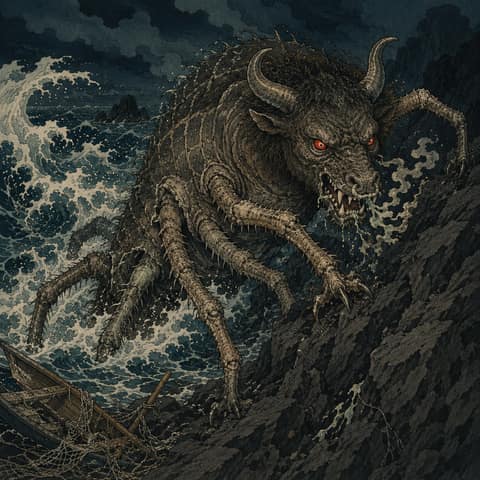
    Edo-period picture scrolls and modern yokai encyclopedias often give Ushi-oni its best-known form: a sea demon with the head of a bull and the body of a spider. The image joins a primal fear of dark, deep water to the spider's refusal to release anything caught in its web. Cattle were closely bound to farming and water control in older Japanese life, and could be revered as sacred animals, messengers of a water deity, or divine beings in their own right, as in the case of Gozu Tennō. One influential interpretation therefore sees the Ushi-oni lurking in a deep pool as the fallen form of a violent water deity—a power once worshiped and feared that became a yokai as its cult declined. This is no mindless beast. Ushi-oni can supposedly kill a person merely by licking their reflection, and it uses Nure-onna as bait before striking at a vulnerable victim. Such arbitrary, absolute power retains the character of a dangerous deity. Its resentment is strong enough to keep a severed body part moving, leaving an ordinary person almost no hope of resistance. People instead appealed to higher Buddhist powers such as Senju Kannon, or brought Ushi-oni itself into a festival at the head of the mikoshi procession. Properly received as an aramitama—a rough and violent divine spirit—its ferocity could be turned toward defending the town from other evils.

  • Shinigami

    Shinigami

    Legendary

    shinigami

    The Rakugo Guide Who Shows the Fire of Lifespan

    Spirit / GhostRakugo and modern ghost stories of the Edo-Meiji periods / Modern Japanese urban views on life and death

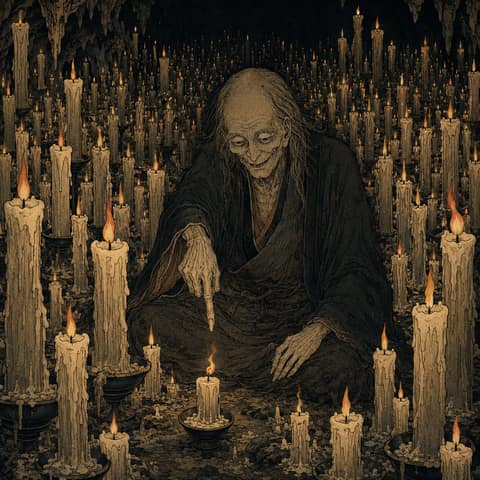
    This shinigami is not a monster that attacks with a scythe or as a skeleton, but a storytelling device that turns lifespan into something "visible." In the rakugo play "Shinigami," the most unforgettable scene is where countless candles burn. Human lives line up as individual fires; there are long fires, short fires, and fires about to go out. Because abstract lifespan is converted into the light and dark right before one's eyes, the listener accepts death not through logic, but visually. The core of this version lies in the fact that the shinigami tests human judgment rather than killing humans. The man is taught a technique by the shinigami, learning that if the shinigami is at the patient's feet, they can be saved. The ability itself seems like a gift, but it also means bearing the responsibility of "one who can see." The shinigami does not give many orders; it only hands over rules. It is always the human who breaks them, and the way they break them oozes with attachment to greed, fear, emotion, and fame. The shinigami in rakugo is also a being that converted an imported folktale into Japanese humor. While possessing a skeleton similar to the Grimm tale "Godfather Death," Encho's oral performances push the doctor's rise to success, the slice-of-life feel of the nagaya, and the comical struggle for money to the forefront. Therefore, the shinigami borrows Western allegorical imagery while wearing the breath of Edo-Tokyo's popular entertainment. The duality of it being both scary and funny, of being cornered by the shortness of lifespan while laughing, supports the Japanization of this anomaly. Compared to the kings of the underworld, this shinigami is a mediator, not an administrator. King Enma judges sins after death, and Datsueba strips clothes from the dead, whereas the shinigami enters a person's room while they are still alive. It is because it is before death that negotiations occur, and because negotiations occur, a story is born. Standing in a more ambiguous and precarious place before the system of the afterlife begins is what opened the shinigami up to urban legends and modern creations. The terror of this version lies in the fact that the shinigami does not seem to act solely out of malice. It looks like it is helping the man, and it also looks like it has been luring him to ruin from the start. The ambiguity of being readable both ways distances the shinigami from a simple villain. It is natural for humans to wish to avoid death, but the moment that wish turns toward another's life or a loophole in the rules, the shinigami transforms from a quiet guide into a mirror of judgment. If handling this shinigami on a modern page, it is best not to confine it solely to the image of black robes. The lighting of a hospital room, the remaining amount of fire, a shadow standing at the pillow, an invisible promise, the boundary between medicine and superstition—the essence of the shinigami lies in the combination of these "signs forecasting death." In cards or diagnoses, positioning it as a presence that reflects both the heart that fears the end and the heart that wants to know the end will bring out the depth of this anomaly. When turning the shinigami into a page, one should avoid simply placing a Western-style skeleton and calling it a day. The Japanese "Shinigami" was established by the overlapping of rakugo, adapted folktales, Buddhist views of the underworld, and modern medical anxiety. Therefore, the structure of the transaction surrounding death is more important than its appearance. The fire is short, the position of the sickbed is bad, breaking the rules comes with a price. The combination of such conditions calls the shinigami. This personality is also the reason why the shinigami is repeatedly remade in modern creations. Because it is not fixed to a single classical picture, it can be a young man in black robes, an old man in white, a kind guide, or a cold contractor. Yet at its core remains the human desire to escape death, and the moment that desire inevitably hits a wall. In YOKAI.JP, keeping this mutability while placing the rakugo candle as the central axis is the strongest approach.

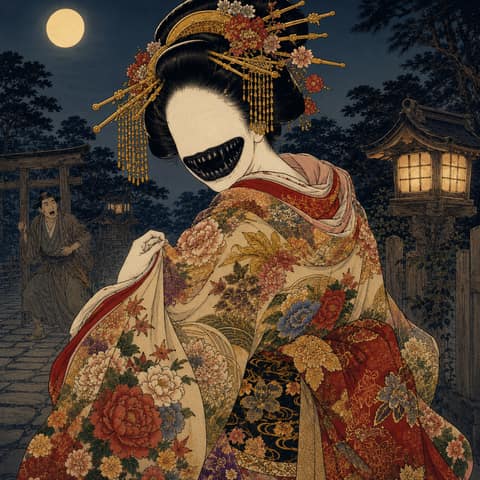
  • Noppera-bo

    Noppera-bo

    Epic

    nopperabo

    The Faceless Anomaly of Kii-no-kuni-zaka

    Humanoid/Half-Human YokaiKii-no-kuni-zaka in Akasaka, Edo (Present-day Moto-Akasaka area, Minato Ward, Tokyo) / Nationwide

    In this version, we interpret the Noppera-bo as a "mujina-type ghost story of facial erasure." The reason Lafcadio Hearn's "Mujina" is so powerful is that it doesn't end with merely showing the faceless woman; it has the man at the soba stand—the supposed sanctuary—perform the exact same action. The first encounter is an anomaly of the dark road; the second encounter is an anomaly where the very systems of everyday life collapse. Despite moving from the dark slope to the illuminated street stall, the horror draws closer, turning the very person one is conversing with into a blank void. The terror of this ghost story is rooted not in the physical design of the face, but in the "failure of confirmation." The man attempts to confirm that the crying woman is human, and fails. He then attempts to confirm that the soba stand is a safe human society, and fails again. The Noppera-bo does not physically attack, but it shatters the viewer's judgment process twice. The face is a screen for reading identity, emotion, and the presence or absence of hostility; when it vanishes completely, a person is left paralyzed, unable to know how to interact with the other. The connection to the "mujina" is the deep focus of this version. Hearn's title was "Mujina," and the name "Noppera-bo" was strongly foregrounded by later adaptations. In folklore, mujina, tanuki, and foxes are shape-shifting beasts that frequently interchange, frightening humans while keeping their true identities ambiguous. By maintaining this ambiguity, the Noppera-bo emerges not as a "person without a face," but as "something disguised as what appears to be a person." Precisely because its true identity remains unknown, the terror cannot be cleanly resolved through explanation. The illustrated Noppera-bo condensed the ambiguity of folklore into a single, powerful image. In Shigeru Mizuki's yokai encyclopedias, the outline of a faceless humanoid became so distinct that readers now immediately picture a smooth visage just by hearing the name. Yet behind this clear iconography lies an inherent obscurity: "we don't know whose face it is" and "we don't know what is shape-shifting." It is visually simple, but narratively, it is doubly unstable. While this version of the Noppera-bo lacks direct lethal force, it robs the victim of the ability to "read" the other. If fear arises from "finding a dangerous enemy," the Noppera-bo conversely creates a state where one "cannot even determine if it is an enemy." With a faceless entity, one cannot tell if it is angry or smiling, looking at them or turning away. The white blankness left behind is both the face of the anomaly and an empty canvas reflecting the viewer's own profound anxiety. What is crucial in this version is that the Noppera-bo performs an "erasure of identity," not just a "lack of expression." If it were an angry or smiling face, one could still read the emotion. But without eyes, nose, or mouth, the clues of age, gender, gaze, feeling, and even the possibility of speech are all eradicated. Because every cue for treating the entity as human vanishes, the viewer is stranded, unable to decide whether they are facing a person, an object, or a monster. Furthermore, by having the soba shopkeeper reveal the same face, the anomaly gains multiplicity. The victim doesn't feel they have escaped a single monster; instead, it feels as if the rules of the world itself have shifted to ones where faces can simply be erased. Herein lies the modern terror of the Noppera-bo tale. What has lost its face is not just the woman or the shopkeeper, but the very mechanism by which humans confirm one another's existence.
  • Mujina

    Mujina

    Epic

    MOO-jee-nah

    Traditional Tale Compliant – Trickster Mujina

    General ClassificationsAcross Japan (many tales in the eastern provinces)

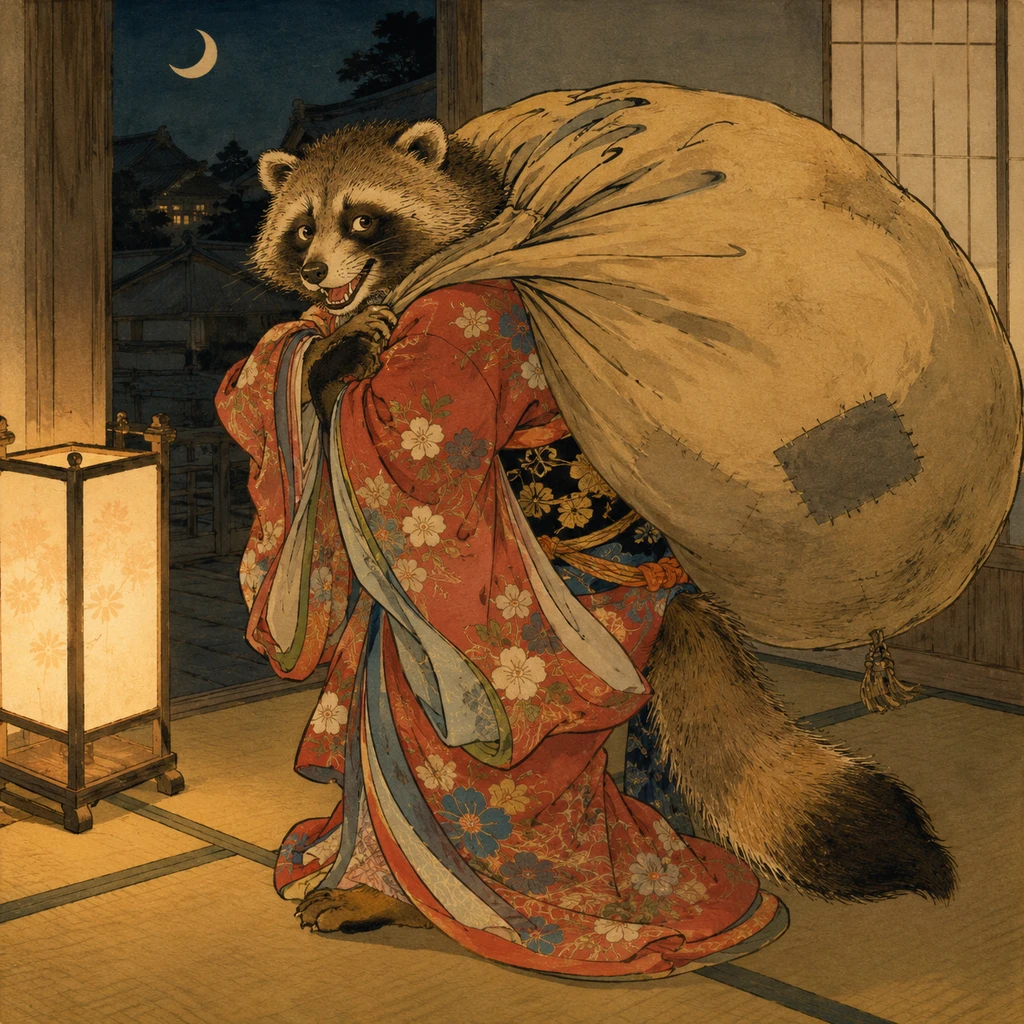
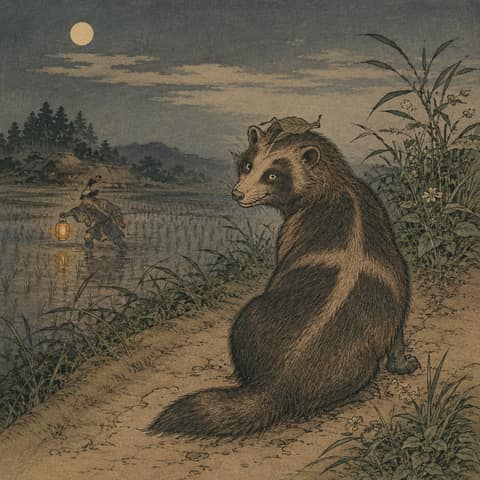
    A trickster figure based on mujina tales from across Japan. It appears as a beast about the size of a dog with slightly short forelegs; elders are said to show a cross-shaped patch of fur on the back. Skilled at disrupting attention and sense of direction, it makes travelers mistake fields for rivers, ridges for water surfaces, and straw stacks for human figures on night roads. Malicious ones disguise food and latrines as other things, causing shame or misfortune. When taking human form it favors inconspicuous looks such as a boy, a traveler, or a village woman, and may lure with voice alone. In many regions its lore blends with tanuki and fox tales, with the name “mujina” used regardless, but it broadly belongs to the class of beasts that bewitch. Rather than being repelled by martial arts or spells, most stories end with it vanishing once its true nature is seen through, after which it avoids the area. The proverb “mujina of the same hole” means birds of a feather, combining the observation that they share burrows with associations from trickster tales. Traditions are rich in eastern Japan, and Edo-period paintings depict it under the title “Mami” or “Badger.”

  • Epidemic God

    Epidemic God

    Epic

    yahk-BYOH-gah-mee

    Gyōekishin, Plague-Deity

    Deities & Divine SpiritsAcross Japan (many records from the Kinai/Kyōki region)

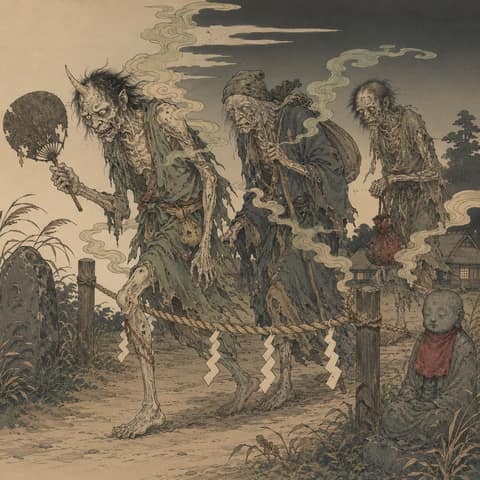
    An archaic image of the plague deity recognized in both court ritual and folk belief. Usually unseen, it gains force at seasonal turnings and when blossoms fall, entering through village bounds, crossroads, and riverbanks, spreading illness by seizing on household impurity and neglect. In paintings it appears as bands of oni-like or uncanny figures on the move, while tales say it stands at the door as a traveling old man or woman, disliking lapses in almsgiving or proper etiquette. Communal countermeasures include boundary festivals, rites of purification, offerings, displaying talismans, and sending off dolls, with porridge or other set foods prepared on fixed dates to ward it away. Its forms and names are not fixed, appearing in step with local customs and annual rites, so it varies by region, yet it is always told in connection with practices that “set the boundary and purge defilement.”

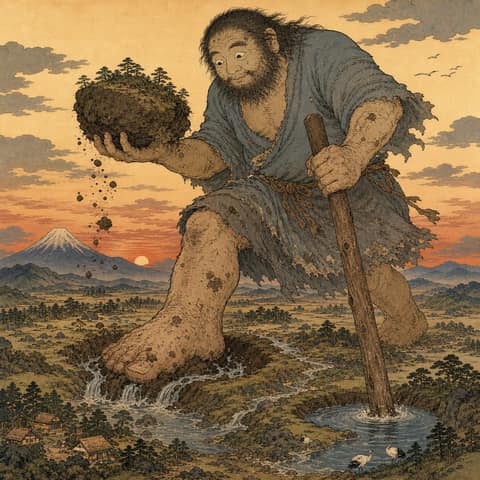
  • Mikoshi-nyūdō (Looming Priest)

    Mikoshi-nyūdō (Looming Priest)

    Epic

    mee-KOH-shee nyoo-DOH

    Mikoshi-nyūdō (Edo Kaidan Record Type)

    Demons & GiantsVarious regions of Japan (especially Kantō, Tōkai, Shinshū, and Chūgoku)

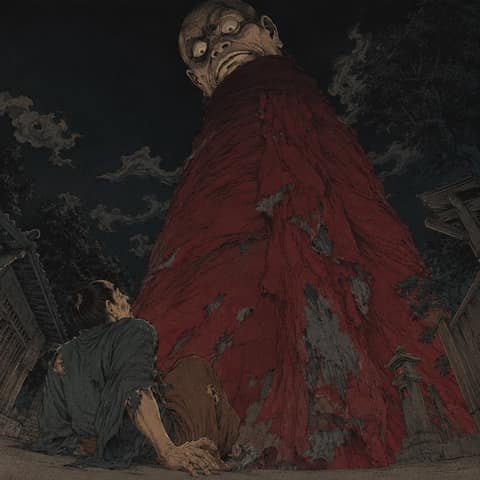
    An Edo-period anecdotal and ghost-story variant in which a giant priest-like figure blocks the night road, chilling the heart of anyone who looks up. In some regions it is treated as a plague-bringing deity that can cause fever or sudden death, and is taboo to step over. Its true nature is left unclear, sometimes taken as a disguise of a shape-shifting animal or a haunted object. Methods of banishment emphasize conduct unshaken by fear, such as calling it out by name, looking down on it, or pretending to measure its height.

  • Azuki-arai (Bean Washer)

    Azuki-arai (Bean Washer)

    Epic

    ah-ZOO-kee ah-RAH-ee

    Azukiarai of the Mountain Stream

    Ghosts & SpiritsVarious regions—especially mountain valleys in Kanto, Chubu, and Kinki

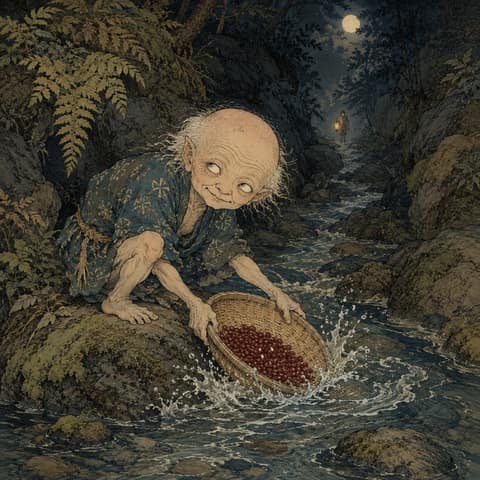
    Rooted in the classic image of the Azukiarai, it blends with the sounds of ravines and flumes, washing red beans through the midnight hours. It lures with sound and tests the curious who peer in. Drawing on early modern notes that it excels at counting and judges vessel measure and bean quantity at a glance, it is not wantonly harmful, but serves as a keeper of taboos along the water’s edge.

  • Ao-andon

    Ao-andon

    Epic

    AH-oh AHN-dohn

    Ao-andon, Demoness of the Hyakumonogatari

    Dwelling / ArtifactOriginates from Edo period Hyakumonogatari (100 Ghost Stories) gatherings and Toriyama Sekien's illustrations. A symbol of parlor hauntings.

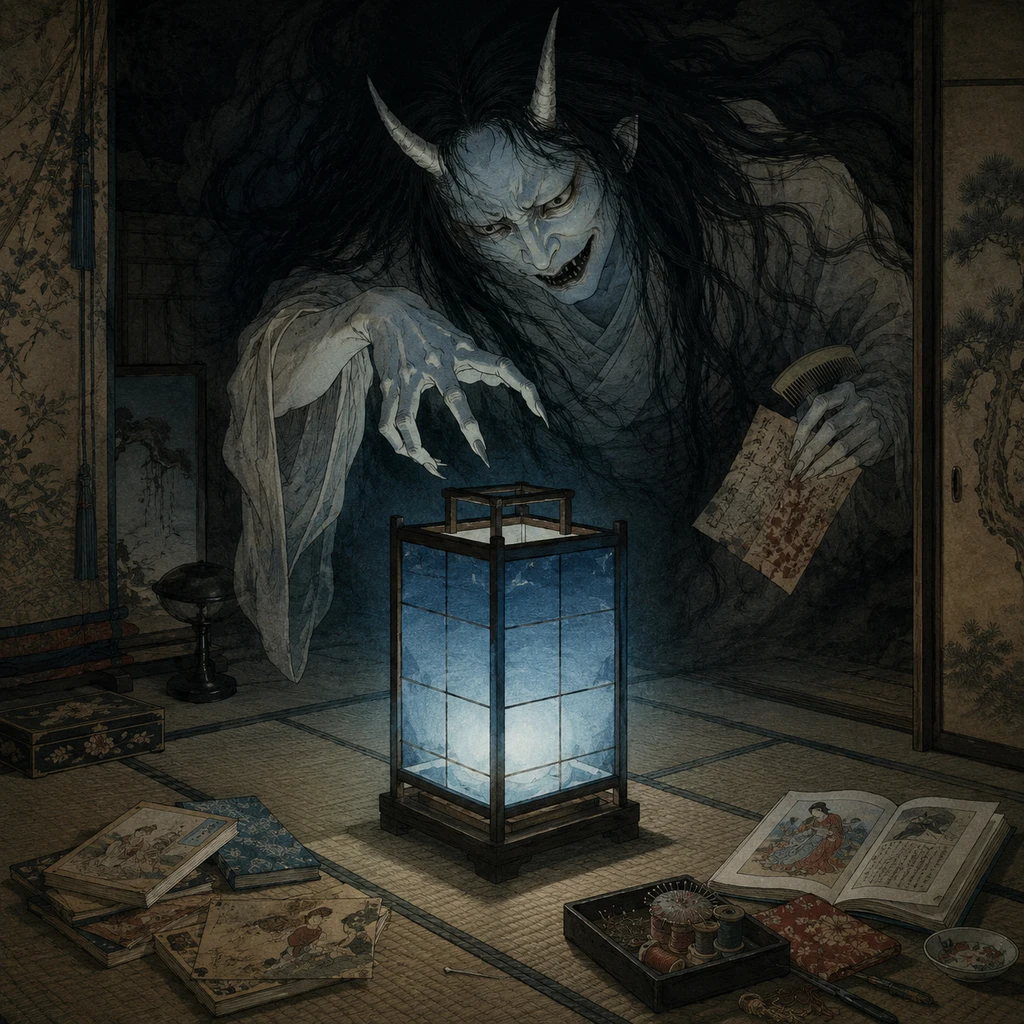
    This is the interpretation version of the "demoness appearing at the climax of the Hyakumonogatari," visualized by Toriyama Sekien, which had a decisive influence on later generations. In this version, the Ao-andon is not a mere jump-scare yokai, but functions as the game master presiding over the "ritual of terror" that is the ghost storytelling, and as a judge testing the psychological limits of the assembled humans. She is clad in a white kimono, revealing sharp horns through her long, unkempt black hair, and floating an eerie smile on her black-dyed teeth. Her appearance is reminiscent of a "Hannya" mask (a woman transformed into a demon by jealousy). As indicated by the sewing tools and letters scattered around her, she is not a "monster that came from somewhere else," but the manifestation of the negative emotions—"suspicion," "jealousy," and "grudge"—of the participants laid bare over the course of telling 100 ghost stories, condensed into a single point in the light of the blue lantern to take on the most terrifying form of a "demoness." The moment the 100th light is extinguished and total darkness and silence descend, she whispers to the participants, "Now, I shall show you the true horror (hell)." She is an entity that transcends the boundaries of yokai encyclopedias, monsterizing the very mechanics of human inner madness and fear—the ultimate refinement of Edo's horror culture.

  • Chochin-obake (Lantern Ghost)

    Chochin-obake (Lantern Ghost)

    Epic

    chochin-obake

    The Typical Lantern Ghost with a Long Tongue

    Artifact / TsukumogamiThroughout Japan (Primarily in Edo period Kusazōshi and Yokai Scrolls)

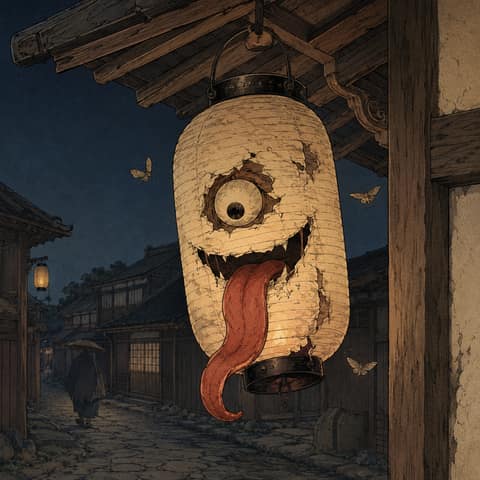
    This version focuses on the most classic image of the Chochin-obake, possessing large eyes and a long tongue, frightening humans with a humorous demeanor. It does not bring deep terror or disaster, but rather plays small pranks on humans after an everyday tool gains life. This casualness is precisely the charm of the Chochin-obake. Opening a large mouth where the lantern is torn and sticking out a red tongue is a pop design that symbolizes the visual culture of the Edo period. Lanterns were originally tools to illuminate the darkness and provide peace of mind. However, when it transforms into a yokai, the flame inside overlaps with the fire of life, flickering in the wind. Although there are no clear folktales stating that it harms humans, the sight of a lantern suddenly opening its eyes and sticking out its tongue on a dark night road undoubtedly brings a sense of surprise, allowing one to intuitively realize that the tool they thought was under their control actually possesses its own will. This is a small but tangible anomaly. This version of the Chochin-obake can be seen as a guiding light connecting humans and the world of yokai. It does not carry a tragic grudge like the Oiwa-chochin. It merely emerges in the darkness of the night, using pranks to make humans aware of the existence of the otherworld. In YOKAI.JP, it is highly appropriate to treat it as such an iconic existence representing the unique humor and approachability of Tsukumogami. If made into a card, the background should depict a dim Edo period night road or a dilapidated temple, with the Chochin-obake's own flame flickering in the wind and its long tongue exaggeratedly extended. Rather than horror, the comicality that makes one want to laugh should be emphasized. It will teach people that not all yokai are terrifying enemies, and that there are yokai like this that just play with humans in the night.

  • Futakuchi-onna (Two-Mouthed Woman)

    Futakuchi-onna (Two-Mouthed Woman)

    Epic

    foo-tah-KOO-chee OHN-nah

    Futakuchi-onna

    Half-Human BeingsEdo period

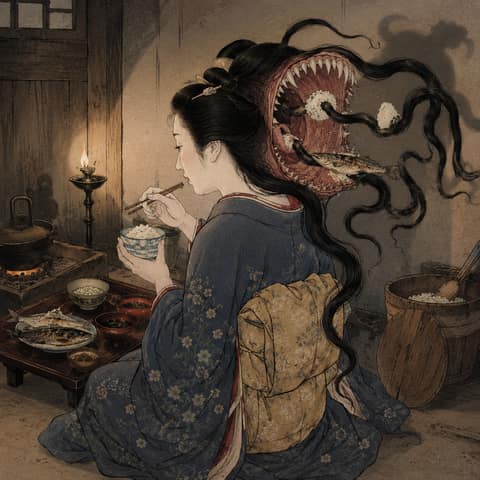
    Aligned with Edo-period strange tales, this type’s true hunger is amplified by a mouth on the back of the head. The front mouth feigns daintiness, while the rear mouth manipulates the hair to pull dishes close. It secretly devours nearby food, sowing domestic discord and appearing in stories about household budgets and shame. In art, a fanged mouth peeks from between coiffed hair. Said to be keen to sounds and smells, it hides its nature deftly in public.

  • Dodomeki

    Dodomeki

    Epic

    DOH-doh-MEH-kee

    Sekien Iconography Standard

    Half-Human BeingsEdo period

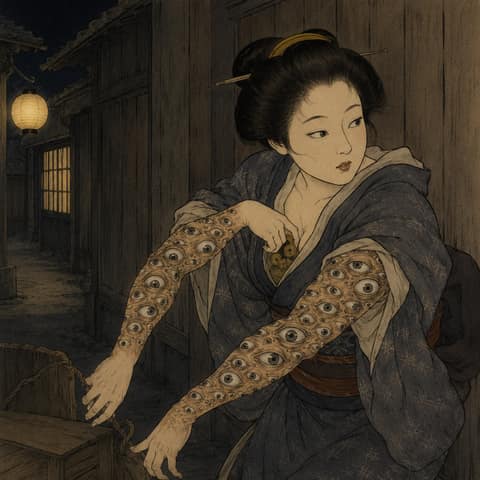
    Following Toriyama Sekien’s note, this version centers on a moralizing motif warning against theft. The many eyes along the arm relate to a pun likening the holes of copper coins to birds’ eyes, externalizing the habit of hands reaching to steal. The source Sekien cites, “Kankangai-shi,” is of uncertain reality; his wordplay on Hakone as a boundary and his own remark calling it a curious book suggest the citation itself is part of the artistic conceit. The Dodomeki’s image concentrates on a female form, yet no concrete personal names, family lines, or local legends are preserved, pointing to an urban allegory where image and wordplay outweigh regional lore. Postwar explanations vary in reading and interpretation, but the archetype is traced to Sekien’s original.

  • Kodama (Japanese Tree Spirit)

    Kodama (Japanese Tree Spirit)

    Epic

    kodama

    Kodama (Ancient Tree and Echo Spirit)

    Mountain and Forest SpiritsOld forests and sacred trees across Japan; Aogashima and Okinawa preserve local tree-spirit traditions

    This is the classical kodama: not a mascot-like creature, but the unseen presence of an old tree and the voice that seems to answer from the mountain. It draws on older ideas of tree divinity, on the belief that ancient trunks hold spiritual force, and on the folk reading of yamabiko, the returning mountain echo. The kodama may remain invisible, showing itself only through sound, silence, unease, or the taboo surrounding a tree that should not be cut without ceremony. This version emphasizes the traditional boundary: kodama can be described as a tree spirit, a forest yokai, or a lingering kami-like presence, but its power lies precisely in not fitting only one category.

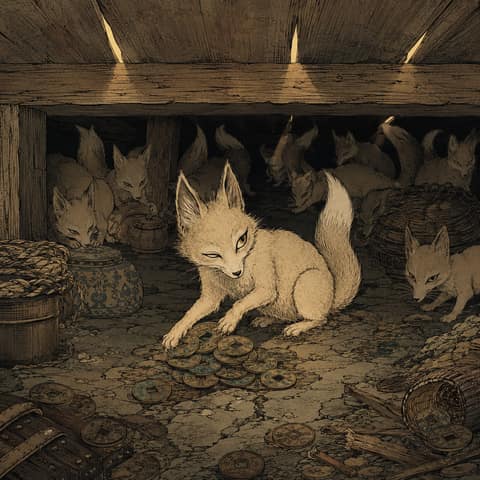
  • Osaki-gitsune

    Osaki-gitsune

    Rare

    osaki-gitsune

    The Small Fox Clinging to Family Lineages: Osaki-gitsune

    Animal YokaiChichibu, Musashi Province (Present-day Chichibu region, Saitama Prefecture) / Kōzuke Province and Kōshinetsu region

    In this version, we read the Osaki-gitsune as the "small fox clinging to family lineages." The terror of the Osaki-gitsune is not that it suddenly jumps out on a mountain path. Its terror lies in the fact that by being spoken of as possessing a house for generations—that the family is an "Osaki holder"—it completely alters the reputation of the entire family. The yokai does not appear before the individual; it rides upon the family name. The Osaki-gitsune functioned as an explanation for wealth. In village societies, when only a specific family became wealthy, the reason was sometimes spoken of not merely as effort or luck, but as the invisible power of a fox. This narrative contains both envy and fear. A wealthy family has power, but whether that power is legitimate is doubted. The Osaki-gitsune is an entity that translates economic imbalance into the form of a yokai. As an explanation for illness or possession, the Osaki-gitsune also played a major role. Unexplained ailments, sudden madness, and abnormal appetites were spoken of as fox possession, becoming subjects for prayers and exorcisms. Here, the fox does not just enter the sick person's body; it spreads the suspicion of "Who sent it?" and "Which family has it?" The belief in spirit possession expands bodily issues into issues of the family and the community. The proximity to the Kuda-gitsune enriches the reading of this version. Both are small fox spirits that possess houses and are tied to wealth and disease. However, while the Kuda-gitsune easily takes on the sorcerous image of bamboo tubes or Izuna magic, the Osaki-gitsune functions more strongly as a family's reputation. Whether they actually keep a fox cannot be confirmed. Even so, simply being said to "have it" sways marriage prospects and social interactions. The invisible fox has visible effects socially. The Osaki-gitsune in this version is less a yokai with the appearance of a small animal, and more a suspicion dwelling in a house. While the shape of its tail or the size of its body changes depending on the teller, the feeling that "there is something in that house" never disappears. The outline of the Osaki-gitsune is clearest when we shift our eyes from searching for yokai in the fields and mountains, to looking at family reputations. The power of the Osaki-gitsune lies not in visible possessions, but in the suspicion of invisible possession. Even without evidence of actually keeping a fox, if it is said that "that house has Osaki," the attitudes of those around them change. Before showing its form, the yokai begins to operate as a reputation. In this version, we read the Osaki-gitsune as a memory device of the village. A certain family has been rich since the old days, produces sick people, or is avoided in marriage. Such memories are bundled under the name of the fox. The Osaki-gitsune has the function of transforming individual incidents into the narrative of a single family lineage. Therefore, the cute image of a fox is insufficient for the Osaki-gitsune. Even though it is small, it sways the evaluation and future of a family. Though it is a fox yokai, what it truly bites into are human relationships. The small fox lurking in the house becomes largest in the eyes of the community. Precisely because it is invisible, this fox enters deep into the house. The fewer people who have seen its form, the harder it is to deny. Something no one can verify sways the judgments of marriage and association. The Osaki-gitsune demonstrates very sharply the process by which a yokai becomes a social fact. That slight invisibility is what makes the Osaki-gitsune remain for a long time.

  • Ohaguro-bettari

    Ohaguro-bettari

    Rare

    ohaguro-bettari

    Ohaguro-bettari, the black-toothed bridal face

    Humanlike and hybrid yokaiEdo (present-day Tokyo), in the late-Edo illustrated kaidan tradition

    The Ohaguro-bettari, taking the form of a bride's mask with blackened teeth, is a yokai whose encounter always begins with the gesture of hiding its face. The target first sees the figure of a beautiful woman, or perhaps someone who looks like a bride. The kimono, the downcast posture, the hidden visage. Natural human curiosity kicks in, a desire to verify the face lying beneath the formal attire. But that curiosity itself becomes the trap. As is often the case with the cluster of yokai in the "Ehon Hyakumonogatari", this monster establishes its terror not through lengthy explanations, but through the psychological drop between the moment before looking and the moment after. When the face is raised, the expected beautiful features are absent. There are no eyes, no nose—only a mouth. And within that mouth, the historical bodily adornment known as ohaguro manifests so thickly and darkly that it practically dominates the entire face. Tooth-blackening was originally a custom tied to beauty, maturity, and marriage, varying by era and social class. The Ohaguro-bettari does not erase these social meanings; rather, it amplifies them to an excess. That is why it is terrifying. The black teeth are not a "makeup failure"; they are a grotesque form where the makeup alone has consumed the face. The structure of this yokai is close to the Noppera-bo, yet distinct. A Noppera-bo renders the entire face blank. The Ohaguro-bettari leaves only a mouth within that blankness. The viewer searches for the other's eyes, but there are none. They search for the source of a voice, but there is only a mouth. The center of the face presses forward not as a place to read expressions, but as a black fissure. The tools humans use to comprehend a face are stripped away one by one, leaving only the "mouth" in grotesque excess. Its relationship with bridal attire is also vital. A bride's dress symbolizes blessing, family, union, and social approval. Yet when it appears as a yokai, that blessing becomes a trap of encounter. The gesture of hiding the face looks like modesty, but it is actually a curtain to draw the victim closer. Calling out, trying to see the face, stepping near. Once that sequence of actions is complete, the gaping maw of black teeth is revealed. In other words, the Ohaguro-bettari is not simply an ugly monster; it is a yokai that inverts etiquette and aesthetic consciousness itself. Late Edo-period ghost story picture books handled this inversion masterfully on the page. "Ehon Hyakumonogatari: Momoyanjin Yawa" combines text and illustration to give the reader both the "imagination before looking" and the "shock after seeing." The Ohaguro-bettari's strength lies precisely in this medium. One glance at the picture and it is understood immediately, but in the instant of understanding, the viewer is sharply reminded of why they tried to look at the face in the first place. The resonance of the word "bettari" (thickly plastered/smeared) in the Ohaguro-bettari's name also aids in reading the iconography. If the black teeth were merely dyed neatly, it would just be makeup. However, when called "bettari," the blackness takes on a density that sticks to the mouth, as if staining the entire face. Edo ghost stories conjure anomalies out of everyday language through such phonetic nuances. Just by attaching a word indicating excess to the name of a custom, the reader already begins to imagine something that is no ordinary bride. In the context of modern yokai relations, the Ohaguro-bettari stands alongside the Noppera-bo, Shirime, Kejoro, and Hone-onna as a "monster of face and attire." People judge others by looking at their face, and understand the situation by looking at their attire. Yet this yokai uses attire to provide false comfort, uses the face to betray expectations, and abnormally amplifies only the mouth. It uses the collapse of perception, not physical attack power, as its weapon. Because of this, it is not a grand boss to be exterminated, but remains as an unforgettable, single image of abnormality. The black-toothed bride's mask is a quiet, sharp mockery born when Edo aesthetics are flipped inside out in the dark. For this reason, when drawing this creature, simply making a scary face dilutes its essence. What is crucial is that it first succeeds as a beautiful figure in formal dress; next, there must be the tense pause of the hidden face; and finally, the sudden, explosive reveal of the missing eyes/nose and the gaping black-toothed mouth. The Ohaguro-bettari is a yokai that builds expectation before it builds terror, and possesses its greatest power only in the instant it betrays that expectation.

  • Daidarabotchi

    Daidarabotchi

    Rare

    Daidarabotchi

    The Terrain-Shaping Giant Who Trampled the Lands of Musashi

    Oni / Giant MonstersOotakubo (Present-day Minami Ward, Saitama City, Saitama Prefecture) / Musashi Province / Omi Province (Lake Biwa Creation Myth)

    Daidarabotchi is not so much a terrifying monster as a giant whose existence serves to explain the origins of the land. He has been debated both as a degraded folk version of the nation-building deities from the *Kojiki* and *Nihon Shoki* myths, and as a product of ancient peoples' imagination trying to explain Jomon period shell mounds or natural terrain features. Musashi Province is one of the areas where these legends are particularly strong, dotted with origin stories of place names—such as "Ootakubo" in Saitama City—where his footprints turned into depressions, marshes, and wells. Even massive geographical features like Mount Fuji, Lake Biwa, and Lake Haruna are attributed to this giant's deeds, operating on a scale far exceeding a single prefecture. Ever since Kunio Yanagita compiled the footprint legends from across the country, Daidarabotchi has become a "giant bearing the memory of place names and terrain," blending seamlessly into the very landscape of Japan.

  • Furisode-no-kai

    Furisode-no-kai

    Rare

    furisode-no-kai

    The Furisode That Burned Edo: The Furisode Fire

    Dwelling / ObjectHonmyoji Temple in Hongo Maruyama (Present-day Sugamo, Toshima Ward, Tokyo) / Edo City (Present-day Tokyo Wards)

    The *Furisode-no-kai* is characterized by the fact that it is an "anomaly where an object and a disaster become one," lacking the form of a specific yokai. Its core consists of a dual structure: on the inside, there is the curse of an object where a *furisode* imbued with the thoughts of the dead takes the life of its new owner (a passion akin to a *tsukumogami*); on the outside, there is the great disaster where the fire burning the *furisode* loses control and burns down the entire city. The former is a typical example of the many "cursed garments and mementos" tales in Edo, while the latter is the real historical tragedy of the Great Fire of Meireki. The originality of this ghost story lies in stitching the two together. For the residents of Edo, fires were the greatest terror. While praised as "Fires and brawls are the flowers of Edo," once a fire spread, the wooden cityscape easily turned to ashes. The *Furisode-no-kai* can be said to be a product of imagination unique to urban ghost stories, translating that terror into an easily digestible tale of a single garment's fate, giving a face and a reason to an indiscriminate disaster.

  • Atakemaru

    Atakemaru

    Uncommon

    ah-TAH-keh-mah-roo

    Atakemaru (Possessed Vessel Tale)

    Household SpiritsSaid to originate from Izu Province (Itō)

    A folkloric image of Atakemaru, the famed shogun’s flagship, remembered as a presence imbued with lingering spiritual power after dismantling and reuse. The ship’s splendor and public reverence fused with the belief that soul can dwell in objects, becoming a warning that rough treatment of its timbers invites strange happenings. Its manifestations are indirect—unsettling noises, revelatory dreams, possession of household members—with details varying by place and storyteller. Because historical service records blend with oral tradition, the tale functions as a symbolic, cautionary yokai story.

  • Kainan Hōshi

    Kainan Hōshi

    Uncommon

    kainan hōshi

    Kainan Hōshi, Visitor of the Twenty-Fourth Night

    Aquatic SpiritsSenzu on Izu Ōshima, now part of Ōshima, Tokyo, where a Kainan Hōshi shrine survives and the spirit is worshiped as Hiimi-sama

    Kainan Hōshi is inseparable from the taboos observed in the Izu Islands on the twenty-fourth day of the first lunar month. It is described as the vengeful dead of maritime disasters. Some origin stories point to a hated island official; others tell of a group of young people killed together in a storm. The resentful spirits cross from offshore in washbasins or small boats, and anyone who sees them may suffer calamity. That night, households cover their entrances with baskets, place branches of holly and tobira—Japanese cheesewood—in the storm shutters, close themselves indoors, and avoid even outdoor trips to the privy. The next day, the tobira is burned and the crop forecast from its cracking sounds and the way the branches swell. Customs differ considerably from island to island. At Senzu on Izu Ōshima, the visitor is called Hiimi-sama and remains the object of shrine rites; one account assigns a particular family to wait beside the shore through the night. On Kōzushima, shrine priests preserve a solemn nocturnal reception that gives the vengeful spirit the character of a visiting deity. On Miyakejima, plates and earthenware are placed at doorways and small children are put to bed early. Over time, these practices became a shared rule for guarding the boundary between sea and community. Stories warn that anyone who mocks Kainan Hōshi or breaks the taboo may encounter strange events or fall ill. Researchers have also noted that related traditions are scarce in the southern islands, so the distribution is uneven. Kainan Hōshi is not a general name for every maritime ghost. It belongs to the calendar, ritual life, and one recurring night of the Izu Islands.

  • Phantom Locomotive

    Phantom Locomotive

    Uncommon

    nee-SEH-kee-shah

    False Locomotive (Traditional Type)

    General ClassificationsAcross Japan (especially along railway lines)

    Accounts of the False Locomotive cluster around the era when the alien sounds and sights of steam engines entered rural life, understood through beliefs in beastly transformations and mimicry. Across regions the plot is similar: at night a whistle and pounding wheels approach from ahead, even lights are seen, but everything vanishes just before impact. Soon after, a dead tanuki or badger is found and given memorial rites. Folklorists place it alongside beings like Azukiarai and Sand-Throwers, extending the idea that uncanny noises are the work of animals. Rumors spread not only by word of mouth but also via newspapers, producing uniform distribution and content. Even when tied to specific locales or temples, the core remains threefold: the match of sound and phantasm, and the tangible animal corpse. It declined as modern transport expanded, yet survives in trackside ghost tales.

  • Female Tengu

    Female Tengu

    Uncommon

    OHN-nah TEN-goo

    Annotated Tradition Edition: Female Tengu

    Mountain & Wilderness SpiritsSacred mountains and river valleys across Japan

    The Female Tengu is a strand within the broader image of tengu sporadically referenced in texts and oral lore. She is depicted in women’s attire such as kosode, light robes, or scarlet hakama, yet her back-borne wings and supernatural power mark her as a tengu. In The Tale of the Heike and its offshoots, the nun-tengu appears as a metamorphosis born from religious decline, providing a female counterpart to the monk-tengu. Edo-period mountain-encounter tales often stress prohibitions against women, noting the absence of female tengu, while river-tengu lore sporadically mentions married pairs or feminine features. Claims tracing their lineage to the goddess Amanozakoyahime appear in early modern natural-history writings but remain interpretive rather than doctrinal. Regional variation is great and no single image dominates, yet they share the general tengu attributes of might, illusion, and flight. Stripped of creative exaggeration, the Female Tengu is best seen as a projection of womanhood within the tengu world, with specific names and genealogies largely unknown.

  • 舌長姥

    舌長姥

    Uncommon

    したながうば

    荒野の破屋に舌を伸ばす姥・舌長姥

    人妖・半人半妖越後国から江戸への道中 / 出自不詳

    When viewed as a hag extending her tongue in a ruined shack in the wilderness, the terror of the Shitanaga-uba lies less in the monster's appearance itself and more in the moment hospitality flips into predation. The travelers, conditioned by nightfall, getting lost, and fatigue, search for a house and believe they are saved by the old woman's invitation. However, the night's lodging is not a safe zone of the human community, but a trap waiting in a closed room for them to fall asleep. In the scene where the tongue extends to the sleeper, the everyday and soft action of "licking"—rather than the use of blades or claws—transforms into the violence of obliterating the flesh, producing a tactile terror much closer than the red face of Shu-no-banbo. This hag monster's outline becomes clearest when working as a pair with Shu-no-banbo. In the setting of the journey from Echigo to Edo, the Shitanaga-uba is placed inside the house, while Shu-no-banbo acts as a voice from the outside. It is the Shitanaga-uba whose name is called first, and Shu-no-banbo appears saying, "Shall I help?" In other words, the Shitanaga-uba is not a mere servant, but one of the principal culprits moving in front of the prey. If Shu-no-banbo is a yokai of sight, the Shitanaga-uba is a yokai of touch, and the two terrors mesh seamlessly within the same night. While the story connects Echigo Province and Edo on the map, pinning the Shitanaga-uba down solely as a "yokai of Niigata Prefecture" misses the core of the tale. What is important is that an unnamed wasteland opens its jaws halfway between a known land and a known city. The ending, where the house vanishes, suggests the possibility that the anomaly's dwelling was not permanently there, but rose up for just one night to absorb the travelers. Thus, on this page, Echigo Province is listed as the story's starting point, Edo as the destination, and "Unknown" side-by-side as the limit of her origin. In later yokai culture, while Shu-no-banbo stands out by gaining the iconography of a red face and large mouth, the Shitanaga-uba is easily compressed into the short name "the old woman with the long tongue." Yet, that very compression is the strength of this yokai. The moment you hear her name, you know her shape, and the moment you know her shape, you know what she will do. She is not a flashy protagonist, but an anomaly that lingers in the reader's bodily senses through the minimal elements of an inn, sleep, and a tongue.

  • Guiding Lantern (Okuri-chōchin)

    Guiding Lantern (Okuri-chōchin)

    Uncommon

    oh-KOO-ree CHOH-cheen

    Honjo Seven Wonders Tale: Okuri-Chochin (Guiding Lantern)

    Mountain & Wilderness SpiritsHonjo, Musashi Province (modern Sumida, Tokyo)

    Passed down around Edo’s Honjo district, the Okuri-Chochin is understood as a strange guiding fire that appears between safety and dread on night roads. Its light sways with a person’s steps and breath, keeps its distance while leading ahead, yet never allows touch. At times it slips to one’s rear or flank to upset direction, and when accompanied by a clapper-like sound it is recorded under the alias “Okuri Hyojiki.” The “Lantern Boy” of Ishihara Warigesui is a formless Odawara-lantern flame that circles on all sides and vanishes when approached, regarded as the same phenomenon as the Okuri-Chochin. In Mukojima it is called the “Okuri-Chochin Fire,” believed to light one’s footing and ensure safe passage, with cases linked to offerings at Ushijima Myojin. Though it rarely causes direct harm, it can lead travelers astray, so locals advise not to chase it, to keep a set distance and pass it by, or to bow at a shrine or temple to seek protection.

  • Accompanying Hyōshigi

    Accompanying Hyōshigi

    Uncommon

    oh-KOO-ree hyoh-SHEE-ghee

    Tradition-Faithful Version

    Household SpiritsHonjo, Musashi Province (modern Sumida, Tokyo)

    Aligned with the clapper-wood anomaly counted among the Seven Wonders of Honjo. Understood less as a corporeal yokai and more as a name for an aural phenomenon. It appears in step with the steady rhythm of night-watch clappers, most notable at corners, near water, and in rain. Visual sightings are scarce, and turning back reveals only a lingering presence. An urban ghost tale tied to local customs of community patrols, paired with the kindred “Okuri Chochin.” The lore resists heavy anthropomorphism, and its hallmark is that sound itself becomes the act of “seeing-off.”

  • Foot-Washing Manor

    Foot-Washing Manor

    Uncommon

    ah-shee-AH-rah-ee yah-SHEE-kee

    Ashiarai Mansion (Edo Odd Tale Traditional Type)

    Household SpiritsHonjo, Musashi Province (modern Sumida, Tokyo)

    In Honjo, Edo, this house-bound tsukumogami-like apparition manifests as a single gigantic foot descending from the ceiling to demand washing. It speaks human words and subsides when the ritual act of washing is performed, aligning with household notions of purification. Its true identity is left undefined and has been variously told as demon, monster, beastly shapeshifter, or a transformed house deity. Though threatening, some variants include a protective role that crushes thieves, and tales warn that forced exorcism angers it, reflecting urban ghost lore that prizes proper response over rash banishment. Regional lore varies—ending after a house change, or requiring a woman to do the washing—but the core remains: only the foot appears, and washing makes it withdraw.

  • Tanuki Bayashi (Raccoon Dog Festival Drums)

    Tanuki Bayashi (Raccoon Dog Festival Drums)

    Uncommon

    tah-NOO-kee bah-YAH-shee

    Honjo Baka-bayashi (Edo Tradition)

    Mountain & Wilderness SpiritsKantō region (especially Edo/Honjo), Bōsō (Kisarazu), and various locales

    A classic case of tanuki-bayashi reported around Honjo in Edo. The sound layers like flute, drum, and shamisen, seeming to recede as you approach and shifting direction when you turn a corner. It often cuts off abruptly near waterways and moat edges. While common folk sometimes explained it as refraction and echoes caused by wind and terrain, people of the time also took it as the work of tanuki. Counted among the Seven Wonders of Honjo, it was frequently mentioned in sideshows and popular literature, with the names “Baka-bayashi” and “Tanuki-bayashi” used interchangeably. Notably, there are no accompanying sightings of a physical form, making it a sound-only apparition of high record value. Folklore warns that chasing it can leave you lost and wandering into the outskirts by dawn, so one should stop midway and cover the ears.

  • The Woman of Ikebukuro

    The Woman of Ikebukuro

    Uncommon

    ee-keh-BOO-kroh no OHN-nah

    Edo Folk Belief: The Woman from Ikebukuro

    General ClassificationsIkebukuro, Toshima District, Musashi Province (modern Toshima, Tokyo)

    A late Edo period folk belief recounts that households employing a woman from Ikebukuro would suffer a barrage of noisy disturbances: sounds of thrown stones, damaged shutters, flying utensils and lanterns, and small fires flitting into the tatami room. Many versions begin with an affair between the master and a maid, and the phenomena cease once the maid is dismissed. Explanations vary, including obligations to the local tutelary deity, links to Osaki-possession tales from the Chichibu area, or simple human contrivance such as hoaxes and harassment. Rather than a single yokai individual, the term serves as a catch-all for disturbances tied to hiring women from certain locales, with parallel cases recorded for places like Ikejiri, Numabukuro, and Meguro.

  • Oitekebori

    Oitekebori

    Uncommon

    oh-EE-teh-keh-BOH-ree

    Ochikohori (Curated Traditional Tales Version)

    Aquatic SpiritsHonjo, Musashi Province (modern Sumida, Tokyo)

    Spoken of as a haunting tied to canals and irrigation ditches in Edo’s low wetlands, it functioned as both a warning against greedy overfishing and a folkloric device marking taboos on the water. The entity has no fixed form and is often only a voice, though in some regions it is identified with known shapeshifters like kappa or tanuki. Its stage centers on Honjo’s Kinshi-bori and Sendai-bori and along the Sumida River, with variants in Kameido, Horikiri, and Kawagoe. A typical pattern is the three-step “big catch—departing voice—loss of fish,” accompanied by etiquette tales that aver misfortune can be avoided by sharing the catch or releasing a few fish. It appears in curious tale collections and local lore around the Kansei era and later took root through rakugo storytelling. Natural sounds and animal behavior became the raw material of the uncanny, and the tale served to symbolize rules for ditch maintenance and norms for shared resources.

  • The Tsugaru Drum of Honjo

    The Tsugaru Drum of Honjo

    Uncommon

    tsu-GAH-roo no TIE-koh

    Bansho Seven Wonders – Traditional Lore Version

    Household SpiritsEdo, Honjo (present-day Sumida, Tokyo)

    Told as an urban-legend-style ghost tale from Edo’s Honjo district, this curiosity lies in the pairing of objects and institutions rather than vivid supernatural feats. The phenomenon itself is scarcely described; the very adoption of a drum for duty is treated as uncanny. Shaped by the locale, samurai compound regulations, and a city prone to fires, the oddity of sound lingered in memory and became a tale. A variant recounts that striking a wooden clapper produced a drum’s sound, hinting at auditory error or transmission drift. Sources appear in local topographies and essays, and typically lack specific origins or named figures. Later creative retellings add ghosts of fire brigades or watchmen, but older lore is restrained, focusing on the strange pairing of residence and watchtower.

  • Lamp-less Soba Stall

    Lamp-less Soba Stall

    Uncommon

    ah-kah-ree NAH-shee SOH-bah

    Honjo Seven Wonders Type

    General ClassificationsEdo, Honjo (present-day Sumida Ward, Tokyo)

    A stall-based apparition type rumored in the town quarters of Edo’s Honjo. It does not attack directly but carries a taboo-like dread in which misfortune befalls those who touch it after a delay. Two variants are told side by side: one where the lantern stays extinguished, and one where the oil never runs out and the flame keeps burning. Both are marked by lights that stray from the ordinary. The absence of a stall keeper echoes empty-mansion ghost tales; though often explained as a tanuki trick, local lore commonly avoids naming a definite identity. It appears near watersides at night when foot traffic thins, drawing no customers and inspiring fear simply by existing. Records appear in local folktale collections and oral traditions, with details varying by storyteller.

  • Tofu-kozo

    Tofu-kozo

    Uncommon

    tofu-kozo

    The Edo Clown Yokai Born from Kibyoshi: Tofu-kozo

    Humanoid Yokai / Half-human Half-yokaiEdo (Present-day Tokyo Wards) – The publishing world of Kibyoshi and Kusazoshi

    The Tofu-kozo is a character that embodies the sensibility of the late Edo period, which shifted *yokai* from 'objects of fear' to 'objects of affection and laughter'. While ancient Japanese and Chinese *yokai* were feared in dark tales and picture scrolls, the Tofu-kozo was born from the start as a character in printed entertainment books, intended not to frighten readers but to amuse them. The core of its form lies in the fixed iconography of 'hat, tofu, tray, and stuck-out tongue'. Rather than the invention of a single author, this became standardized as it was repeated and shared across printed books. Its very powerlessness—having no real abilities, causing no harm, and simply standing with tofu—ironically generated strong semiotic power. Visual traits such as the white of the tofu against the red of the maple stamp, and the disproportion between the child's body and the large hat, provided the foundation for its spin-off into toys and kite paintings. The Tofu-kozo is an entity that demonstrated early on that *yokai* could be detached from local beliefs and circulated as urban products and brands, and can be read as a distant archetype of modern mascots (*yuru-chara*) and the character business.

  • Cat Maiden

    Cat Maiden

    Uncommon

    NEH-koh-moo-SOO-meh

    Cat-Girl of Early Modern Sideshow and Eyewitness Reports

    Half-Human BeingsEdo, Kamigata (Kyoto–Osaka), Awa Province (modern Tokushima)

    The cat-girl refers to accounts of human oddities in early modern urban sideshows and reportage, describing feline tastes (fondness for fish entrails, chasing rats), movements (traversing walls and rooftops), and mannerisms (likened to a rough, tongue-like texture). In the Horyaku and Meiwa eras, she was occasionally billed in Asakusa and similar venues, but her fame was short-lived, and even amid the An’ei and Tenmei vogue she never became a major headline act. In yomihon and kyoka collections she appears as a curiosity under labels like “cat-girl” or “licking woman,” not as a transforming yokai. Late Edo miscellanies include an anecdote of a girl near Ushigome praised for catching rats, material that reflects community responses to rodent damage, a taste for spectacle, and the gaze cast upon the strange.

  • Hair-Cutter

    Hair-Cutter

    Uncommon

    KAH-mee-KEE-ree

    The Hair-Cutter of Edo Streets

    Mountain and wilderness yokaiEdo and urban areas such as Ise Province

    An amalgam of hair-cutting incidents reported from Edo and other early modern towns. At night, in the street or at the threshold of an indoor privy, there is a sudden brush of contact, and moments later the victim’s hair falls away still neatly tied, without their noticing. Witnesses describe a figure black from head to toe, catlike, or with the feel of velvet, yet its true form remains uncertain. Servant girls and maids were often noted as victims, with rumor-mongering and official crackdowns recorded side by side. Folklorically, taboos surrounding hair as part of the body overlap with notions of impurity tied to night roads and privies, casting an unseen assailant as a yokai. Its method and motive are never stated in tradition, placing it among urban horrors shaped by fear and unease.

  • The One-Leaved Reed

    The One-Leaved Reed

    Uncommon

    kah-tah-HAH no AH-shee

    Honjo Seven Wonders – Traditional Tale

    Weather & Calamity SpiritsHonjo, Musashi Province (modern Sumida, Tokyo)

    A classic Edo urban apparition that finds sacred presence in familiar natural anomalies. The single-bladed reed form signals a communal storytelling device that shares unease without fixing a cause. The anomaly is sensed less as a property of the plant than as an atmosphere of place, told alongside night silence and the sound of water. Memorial rites, posted placards, and small shrines are often noted as local pacification practices, and like other Seven Wonders (such as the ginkgo that never sheds its leaves), the tale pointedly withholds rational explanation and leaves the strangeness intact. Later embellishments personify people and incidents, but older accounts remain origin-unknown and phenomenon-focused.

  • Nodera-bō

    Nodera-bō

    Uncommon

    nodera-bō

    Nodera-bō, keeper of the abandoned temple bell

    Humanlike and hybrid yokaiEdo (present-day Tokyo); no earlier provenance securely identified

    When viewed as the bell-keeper of a ruined temple, the Nodera-bo is a yokai that dwells in a "place where sound should not ring." The temple bell was a voice that carved out the time of the community and announced Buddhist services and mourning. However, in Sekien's illustration, the bell tower is covered in grass and ivy, and the temple has slipped from human hands. The monk-like figure standing there is neither striking the bell nor chanting sutras. He simply exists beside the bell. In a place that has lost its function, it looks as if only the duty remains. This stillness is the terror of the Nodera-bo. The "Nodera-bo" in the "Yō" section of the first volume of "Gazu Hyakki Yagyo" does not close its meaning with an explanatory text. Sekien combined the thin monk shape, torn robes, the bell tower, ivy, and wild grass, leaving just enough clues for the reader to intuit, "This is something that appears in a ruined temple." As a yokai illustration, it boasts an extremely strong composition, with most of the frame approaching negative space. Rather than the true identity of the anomaly, the wind blowing at the temple's edge, the untended woodwork, and the time of the plants entwining the bell linger in the eye. The Nodera-bo preserves the sensation of having "seen something" before the yokai is explained away in words. It is easy to conclude that this yokai is the ghost of a monk, but such a reading is too narrow. The Nodera-bo does not possess a clear name from its lifetime like the vengeful monk spirits Tesso or Raigo. Nor does it have an origin story of destroying Buddhist law like the Teratsutsuki. While possessing the eeriness of a monk-like form akin to the Aobozo or Nurobotoke, the Nodera-bo leans even closer to its location. In other words, the subject of the anomaly is not just the "monk" but also the "wild temple." A temple without people still requires the shadow of a monk. Read in this way, the Nodera-bo approaches the personification of the ruined temple itself. As Kenji Murakami's "Yokai Jiten" indicates, the Nodera-bo is not a dense folk tale told in a specific region, but a yokai whose later explanations were constructed from Sekien's imagery. With this type of yokai, it is necessary not to hide the scarcity of source material as a weakness, but to look at what that scarcity birthed. Because there is only a name and a picture, the reader imagines the sound of the bell. Why is the monk there? For whom is he guarding the bell? Why did the temple fall into ruin? The lack of answers overlaps with the negative space of the ruined temple. Yokai encyclopedias post-Shigeru Mizuki bridged this negative space to modern readers. By entering the Mizuki-lineage yokai directories, the Nodera-bo became a name known not only to those who read Sekien, but to readers flipping through yokai encyclopedias. However, even with modern characterization, the core of the Nodera-bo is not flashy abilities. The ruined temple, the bell, the black robes, the grass, the silence. When these five are present, the yokai rises up even without a story. The Nodera-bo is a yokai for reading the unseen presence left in a space of faith abandoned by people. When a temple is alive, the bell makes a sound. When a temple falls into ruin, the bell falls silent. Yet, if a thin monk were standing beside the silent bell, that place would no longer be a complete ruin. Someone is still keeping watch. Or perhaps, only the thing keeping watch remains. The Nodera-bo is a yokai that locked that sense of unease into a single illustration.

  • Nobusuma

    Nobusuma

    Uncommon

    nobusuma

    Nobusuma, the Gliding Beast That Covers the Face

    Animal transformationEdo publishing culture / mountains and woodlands across Japan

    This Nobusuma is a small animal that slips from the treetops and presses a cloth-like gliding membrane across a traveler's face. Its terror lies less in teeth or claws than in the instant loss of sight and breath. Something falls from above on a mountain path; a damp membrane clings to the skin; eyes and nose are covered, and direction disappears. That chain of bodily sensations is what turns an ordinary flying squirrel into a yōkai. Sekien's image does not make the creature enormous. Nobusuma is frightening precisely because it is small, agile, and hard to distinguish in the dark. Rather than confronting a victim like a serpent or oni, it drops from branches, eaves, or the shadow of a cliff at an angle the traveler has not considered. Its spread membrane resembles cloth, but is not cloth. That is the decisive difference from Fusuma: the white-cloth yōkai begins with an ownerless textile, whereas Nobusuma is born in the instant when an animal's body is mistaken for one. Understanding its attack as “covering the face” also reveals its closeness to the Nodeppō. Nodeppō is said to spit out something bat-like that covers a person's face and shuts their eyes. Nobusuma is variously linked to that projectile or described as the transformation of an old bat. Either way, the sequence is similar: first vision is taken, then breathing and orientation are disturbed, and finally blood or vitality may be drained. A moment of losing one's bearings on a mountain road has been rearranged into the behavior of a monster. Nor can Nobusuma be dismissed simply by saying that a real flying squirrel explains everything. The animal exists, but a person who sees a shadow glide overhead at night may not be able to identify it. In the mountains, bird and beast, cloth and shadow, wind-shaken branch and living body can collapse into one impression. Nobusuma inhabits that interval of uncertainty. Natural histories supplied the animal name, Sekien converted it into an image, and strange tales added blood drinking and the smothered face: knowledge did not erase the uncanny, but furnished it with material. This version preserves Nobusuma's position between a small mountain animal and a cloth tsukumogami. Its body is beast, its appearance cloth, and its conduct yōkai. The traveler has almost no time to decide which is which; fear arrives before the name. Nobusuma is therefore most vivid not as the hero of a grand legend, but as an apparition compressed into a single second on a dark road. Keeping it small makes the attack feel closer: it seems near enough to brush away by hand, yet cannot be shaken loose. Geographically, Nobusuma does not belong neatly to one prefecture. The cloth Fusuma can be tied to traditions in Sado and Tosa, but Nobusuma bears the stronger imprint of Edo publishing, which reworked a nocturnal mountain animal into a yōkai. This version begins from that print culture while placing the creature in forests, ravines, and wooded edges near settlements. What waits there is not a giant monster displaying itself in full, but a small patch of darkness already against the face by the time it has been noticed.

  • The Oak That Never Shed Its Leaves

    The Oak That Never Shed Its Leaves

    Uncommon

    oh-chee-bah-NAH-kee SHEE-ee

    Honjo Seven Mysteries – Traditional Lore Version

    Natural Phenomena SpiritsHonjo, Musashi Province (modern Sumida, Tokyo)

    A recorded marvel revered and feared as the very phenomenon of an ancient chinkapin that shed no leaves. Understood less as a personified will and more as the ambience of the land or the work of a tree spirit, it is told alongside other Honjo Seven Mysteries such as Okehazubori and the Foot-Washing Mansion as an enigma that reveals no cause. Named in Mimibukuro and in local gazetteers and collections of strange tales, it is not remembered for direct harm but for an uncanny presence that keeps people away. It aligns with tree veneration and the notion of household guardian trees, with hyperbole like needing no sweeping of fallen leaves to emphasize the marvel. The identification of the actual tree is debated and unconfirmed.

Read on ── other regions