Oiwa
Oiwa
Oiwa of Yotsuya Kaidan
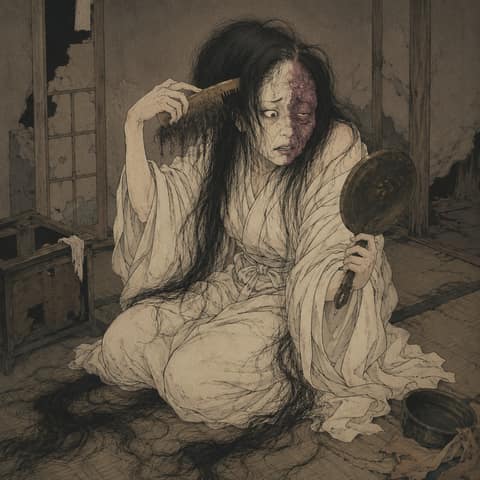
Oiwa in the kabuki play "Tokaido Yotsuya Kaidan" debuted in July 1825 at the Edo Nakamura-za, staged as a mixed, two-day performance intertwined with "Kanadehon Chushingura". The ronin Kamiya Iemon of the Enya clan, despite having Oiwa as his wife, seeks to switch to a marriage proposal from a neighboring family for the sake of his career, feeding Oiwa a poisonous concoction. In the second act, the scene known as "Kamisuki" (hair-combing)—where Oiwa, half her face grotesquely swollen from the poison, dies in agony upon seeing her altered reflection while combing her falling hair—became the Kikugoro family's most polished and renowned spectacle. In the third act at Sunamura Onbobori, the corpses of Oiwa and Kobotoke Kohei wash ashore nailed to the front and back of a wooden door. The "Toitagaeshi" (door-flipping) scene, where the door turns over before Iemon's eyes—with a single actor playing both roles through lightning-fast costume changes—is the pinnacle of stage mechanism. In the final act at the Heikiyama hermitage, countless stage tricks (keren) are rapidly deployed, including the "Chochin Nuke" (lantern escape), where the ghost emerges from a burning lantern, and the "Butsudan Gaeshi" (altar flipping), where someone is pulled into a Buddhist altar. These bizarre phenomena are purely theatrical fiction with no connection to the historical virtuous wife Tamiya Iwa, yet their compelling realism led people to fear Oiwa as though she were an actual vengeful spirit. The story's framework hinges on the selfishness of a man who discards his wife for social advancement and the helpless desperation of a woman whose sincerity has been trampled. Oiwa is not an evil spirit cursing without reason; she is formulated as an existence whose lingering love for the husband who poisoned her has been violently inverted. Evoking both sympathy and terror in the audience simultaneously is the true essence of Nanboku's drama. A custom arose whereby the cast and crew, centered around the actor playing Oiwa, would visit Oiwa Inari in Yotsuya to pray for success and safety before the performance. This tradition continues to this day in modern kabuki, film, and theater (by ancient custom, the actor playing the betrayer Iemon does not visit, as doing so is said to anger the spirit instead). The very fact that accidents and injuries occurring on stage have often been passed down as "Oiwa's curse" stands as a rare case where a fabricated vengeful spirit attracted real-world religious belief. Ironically, the source of that belief, Oiwa Inari, was originally an auspicious shrine dedicated to the virtuous wife Oiwa who had restored her family's prosperity.