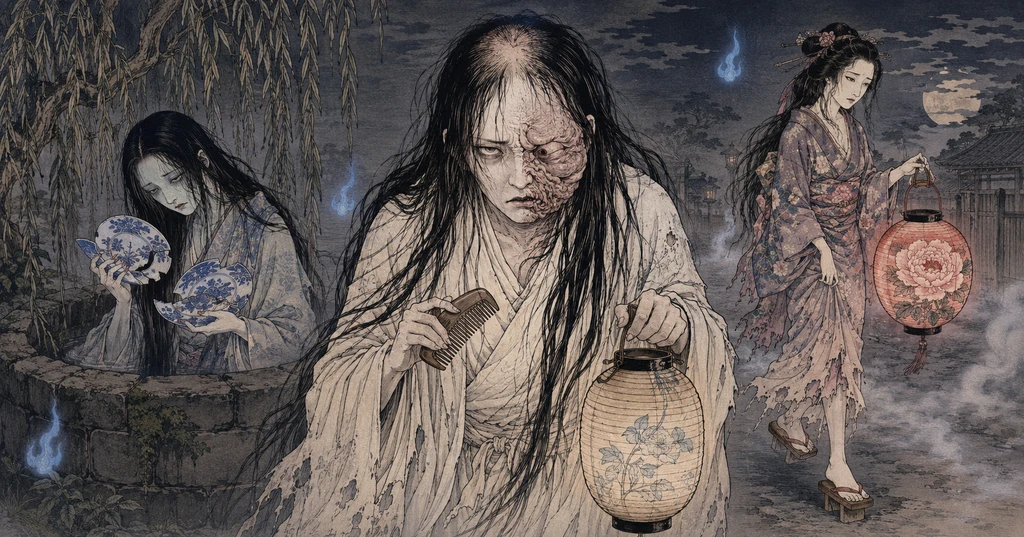
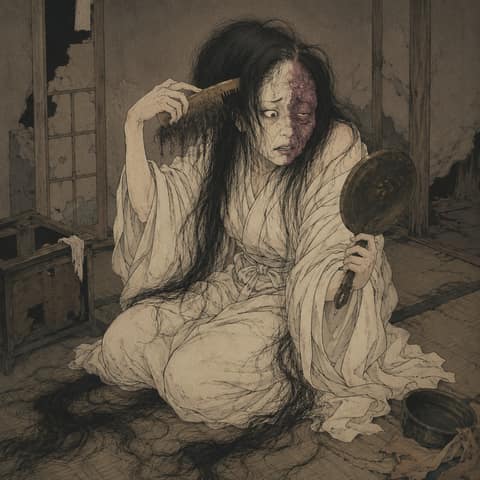
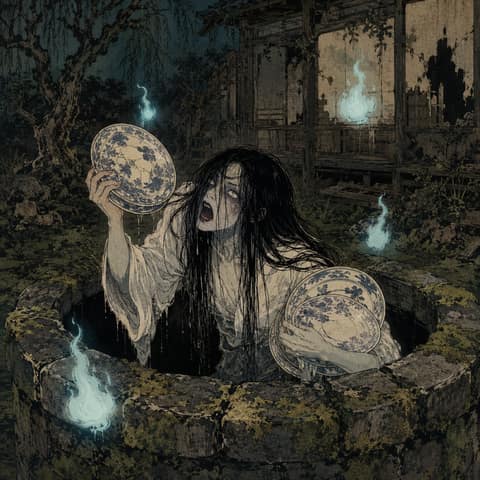
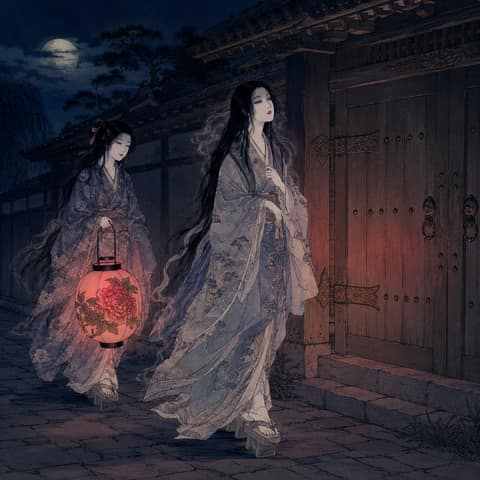
Oiwa is the protagonist of Japan's most widely known ghost story, renowned as a female ghost who was betrayed and poisoned by her husband, dying with a disfigured face and returning as a terrifying, vengeful spirit. However, this image is almost entirely a theatrical fabrication. In the kabuki play "Tokaido Yotsuya Kaidan"[1] (written by Tsuruya Nanboku IV and premiered at the Edo Nakamura-za in 1825), the role of Oiwa was played by Onoe Kikugoro III. The iconic scenes—where she dies while combing her hair with half her face terribly swollen and decaying, washes ashore nailed to a wooden door, and later emerges from a burning lantern to torment her husband—established the archetype of the vengeful ghost Oiwa. Importantly, the real woman behind the legend was said to be the exact opposite. Oiwa (Tamiya Iwa), the wife of the Tamiya samurai family living in Samoncho, Yotsuya, was known as a devoted and faithful wife with a deeply loving marriage. She devoutly worshipped the family's Inari shrine and successfully restored her family's declining fortunes, making her an auspicious figure. The Oiwa Inari (Tamiya Inari)[2] shrine dedicated to her was originally visited as a "god of luck that brings family prosperity." The name Oiwa stands upon the immense contrast between the historical virtuous wife and the vengeful spirit crafted by Nanboku two centuries later.
Folklore & Legends
The basic historical document regarding the real-life Tamiya Iwa is the "Oiwa Inari Yuraisho"[3], submitted to the shogunate by the Oiwa Inari Tamiya Shrine in 1827. According to this record, Oiwa, the daughter of the Tamiya family, married Iemon, who was adopted into the family. They devotedly worshipped the family's Inari shrine, which consequently led to the restoration of the Tamiya family's fortunes. People revered this shrine as "Oiwa-san's Inari," and Oiwa was remembered as a virtuous wife who passed away during the Kan'ei era (reportedly in 1636). The plot of her being poisoned by her husband is a later fabrication that the shrine explicitly denies. On the other hand, the literary core of "Yotsuya Kaidan" as a ghost story can be found in the "Yotsuya Zoudanshu"[4], which bears a postscript dated 1727. It tells a tale of a curse where Tamiya Iemon alienated his wife Oiwa to carry on an affair with another woman; after the maddened Oiwa disappeared, Iemon's relatives suffered unnatural deaths one after another, ultimately wiping out eighteen people. Based on the same folklore, storybooks such as Kyokutei Bakin's "Kanzen Tokoyo Monogatari"[4] (1806) and Ryutei Tanehiko's "Kinsei Kaidan Shimoyaboshi"[4] (1808) amplified the narrative. In 1825, Tsuruya Nanboku IV synthesized this material with the world of "Kanadehon Chushingura"[1] to create the kabuki play "Tokaido Yotsuya Kaidan." In the Meiji era, Sanyutei Encho adapted it into the rakugo "Yotsuya Kaidan," adding a modern interpretation that rationalized Oiwa's curse as "shudoku" (alcohol-induced hallucinations). Although Oiwa is often grouped with other female vengeful spirits like the legend of Kasane or Okiku of Sarayashiki, these are inherently separate lineages of ghost stories. What firmly established Oiwa as the protagonist of Yotsuya Kaidan was Nanboku's dramatic composition and the enduring performance legacy of the Onoe Kikugoro family (Otowaya).
Oiwa in the kabuki play "Tokaido Yotsuya Kaidan"[1] debuted in July 1825 at the Edo Nakamura-za, staged as a mixed, two-day performance intertwined with "Kanadehon Chushingura"[1]. The ronin Kamiya Iemon of the Enya clan, despite having Oiwa as his wife, seeks to switch to a marriage proposal from a neighboring family for the sake of his career, feeding Oiwa a poisonous concoction. In the second act, the scene known as "Kamisuki" (hair-combing)—where Oiwa, half her face grotesquely swollen from the poison, dies in agony upon seeing her altered reflection while combing her falling hair—became the Kikugoro family's most polished and renowned spectacle. In the third act at Sunamura Onbobori, the corpses of Oiwa and Kobotoke Kohei wash ashore nailed to the front and back of a wooden door. The "Toitagaeshi" (door-flipping) scene, where the door turns over before Iemon's eyes—with a single actor playing both roles through lightning-fast costume changes—is the pinnacle of stage mechanism. In the final act at the Heikiyama hermitage, countless stage tricks (keren) are rapidly deployed, including the "Chochin Nuke" (lantern escape), where the ghost emerges from a burning lantern, and the "Butsudan Gaeshi" (altar flipping), where someone is pulled into a Buddhist altar. These bizarre phenomena are purely theatrical fiction with no connection to the historical virtuous wife Tamiya Iwa, yet their compelling realism led people to fear Oiwa as though she were an actual vengeful spirit. The story's framework hinges on the selfishness of a man who discards his wife for social advancement and the helpless desperation of a woman whose sincerity has been trampled. Oiwa is not an evil spirit cursing without reason; she is formulated as an existence whose lingering love for the husband who poisoned her has been violently inverted. Evoking both sympathy and terror in the audience simultaneously is the true essence of Nanboku's drama. A custom arose whereby the cast and crew, centered around the actor playing Oiwa, would visit Oiwa Inari[2] in Yotsuya to pray for success and safety before the performance. This tradition continues to this day in modern kabuki, film, and theater (by ancient custom, the actor playing the betrayer Iemon does not visit, as doing so is said to anger the spirit instead). The very fact that accidents and injuries occurring on stage have often been passed down as "Oiwa's curse" stands as a rare case where a fabricated vengeful spirit attracted real-world religious belief. Ironically, the source of that belief, Oiwa Inari, was originally an auspicious shrine dedicated to the virtuous wife Oiwa who had restored her family's prosperity.
Character Profile
This section is our own creative profile for storytelling. It is not historical fact or scholarship.
Originally a modest and deeply religious woman who supported her husband. In the play, even after being betrayed and poisoned, she still longs for her husband; however, this affection inverts into a relentless and unforgiving curse. Her depiction is less about pure hatred and more about the manifestation of trampled sincerity that has nowhere else to go, ultimately turning into a vengeful grudge.
Compatibility
She forms deep bonds with those who are sincere and devoted, but correspondingly, she never forgets to exact retribution for betrayal and deceit. She stands like a guardian deity by those who keep their promises, but leaves no route of escape for those who lie.
Abilities
Inducing terror with a face disfigured by poisonManifesting unpredictably, such as flipping doors and emerging from lanternsA chain curse that brings unnatural death to the relatives of betrayers one after anotherDivine protection as a virtuous wife for those who keep their faith and promises
Weaknesses
She does not curse those who mourn her sincerely and keep their promises. It is believed that through deep devotion and sincere memorial services at Oiwa Inari, her grudge is pacified, and she reverts to her original nature as a compassionate and virtuous wife.
Habitat
The former site of the Tamiya family residence in Samoncho, Yotsuya, Edo, and the Oiwa Inari shrine. Within the stages of kabuki, rakugo, and film.
The diagram below is a diagnostic evaluation chart for Oiwa of Yotsuya Kaidan. The higher the value of each item, the stronger that characteristic is expressed.