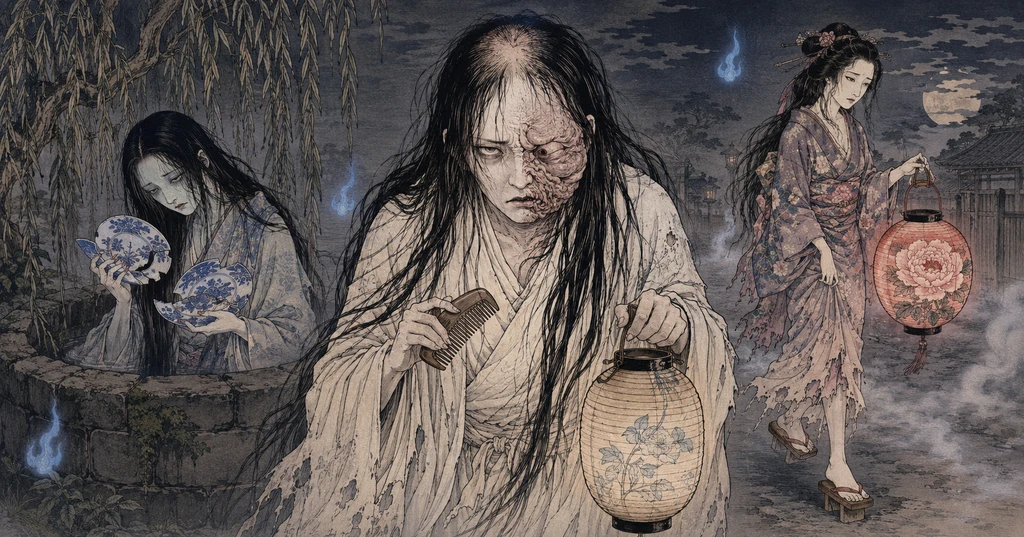
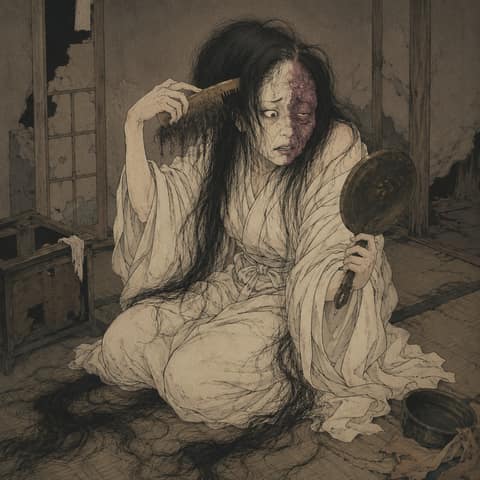
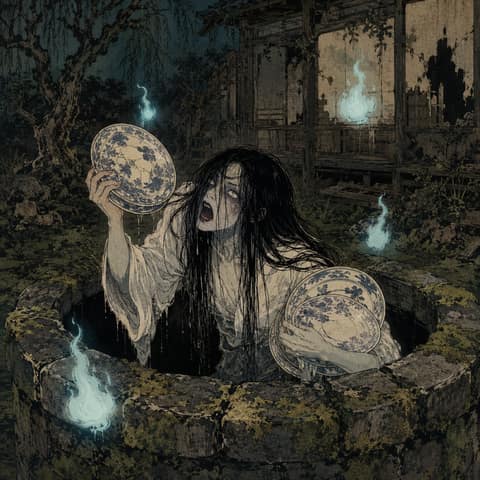
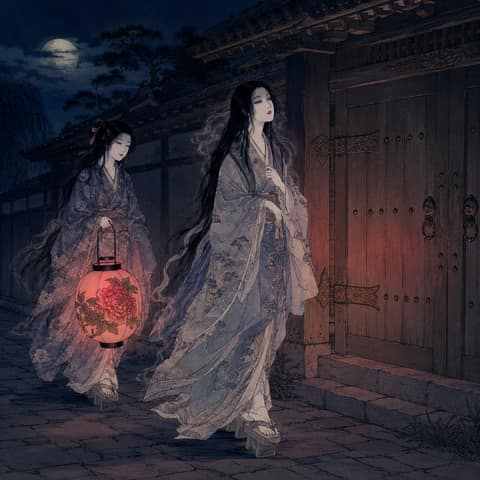
Okiku is the vengeful ghost of a woman who was drowned in a well over the suspected loss of a single heirloom plate, returning every night to the bottom of the well to count plates: "One... Two..." She features in two major lineages of legends: the *Banshu Sarayashiki*[1] tradition set in Harima (Himeji), and the *Bancho Sarayashiki*[2] tradition set in Bancho, Edo. Alongside Kasane and Oiwa, she is considered one of the most representative female vengeful spirits of early modern Japanese ghost stories. In the Banshu lineage, amid Aoyama Tetsuzan's conspiracy to usurp the Kodera (Hosokawa) clan during the Muromachi period, his retainer Machitsubo Danshiro hides one of ten heirloom Chinese plates, pins the blame on the maid Okiku, tortures her to death, and throws her into a well[1]. In the Bancho lineage, Okiku is a maid in the mansion of the hatamoto Aoyama Shuzen who breaks a plate—or refuses her master's unwanted advances—and is slain and cast into a well[2]. Both versions share the core motif of a cyclical haunting where she counts the incomplete set of plates, climaxing in an agonizing shriek when she reaches the missing piece. The Okiku Well still exists beneath the main keep of Himeji Castle, and the legend has taken deep root even in local place names, shrines, and the names of insects[3].
Folklore & Legends
The oldest surviving comprehensive literature is the storyteller Baba Bunko's *Sarayashiki Bengiroku* (1758)[2], which conveys the framework of the Bancho lineage. Set at the mansion of hatamoto Aoyama Shuzen near the Ushigome Gate in Edo, it tells of the maid Okiku who breaks a plate, is tortured, throws herself into a well, and emerges nightly to count plates. However, the title of "Hitsuki Tozoku Aratame" (Arson and Theft Control) contradicts Aoyama Shuzen's lifetime, suggesting the tale is a stylized ghost story born of storytelling rather than historical fact[2]. Meanwhile, the Banshu lineage was established as a joruri puppet play, *Banshu Sarayashiki* (1741, premiered at Osaka Toyotake-za, written by Tamenaga Tarobei and Asada Itcho)[1], which set the stage in the Muromachi period and linked the tale to Aoyama Tetsuzan's scheme to take over the clan. In Himeji, there is a shrine dedicated to Okiku within the grounds of the Junisho Shrine, believed to date back to around the time this joruri was popular[3]. The well inside Himeji Castle was originally called the "Tsurubetori Well" but came to be known as the "Okiku Well" from the Taisho period onward[3]. In 1795, a massive outbreak of pupae occurred in the area; because they resembled a woman bound with her hands behind her back, they were dubbed "Okiku Bugs" (Okikumushi), now believed to be the pupae of the Byasa alcinous butterfly[3]. In folkloristics, Kunio Yanagita[4] pointed out that the Obata clan at the foot of Mount Myogi in Joshu had possessed a similar oral tradition since the Ashikaga period (the cause being a needle in a rice bowl rather than a plate, leading to a ban on growing chrysanthemums due to fear of a curse), and noted that descendants of this clan were employed by the Matsudaira lords of Himeji Castle in 1640. He argued that the Sarayashiki narrative is not a localized incident but a widespread legend type distributed across the country[4]. Similar tales span various regions, with one theory claiming as many as forty-eight locations[5]. Furthermore, in the rakugo story "Sarayashiki," the tale shifts into a comedic piece where crowds flock to watch Okiku count plates, reflecting the gradual transformation of ghost stories into popular entertainment during the late Edo period.
"Okiku of Sarayashiki" is a vengeful spirit shaped as a creature of repetition, eternally counting her broken plates. Her terror lies primarily in her voice and numbers rather than her appearance—counting low in the darkness, "One... Two..." and unleashing a bloodcurdling scream upon reaching the ninth and missing the last. This structure of loss and repetition is the core of the Sarayashiki tales, causing the audience to cringe in anticipation of the inevitable dread of the "ninth." Okiku's grudge erupts from the absurdity inflicted upon the weak in early modern society: false accusations, class disparities, and the unreasonableness of masters.
Here, the two major lineages must be strictly distinguished from their modern adaptations. First is the Banshu lineage[1]—set in Himeji, where the maid Okiku is caught in Aoyama Tetsuzan's conspiracy to usurp the household. Tricked by Machitsubo Danshiro, she is framed for losing one heirloom plate, tortured to death, and sunk into a well. Second is the Bancho lineage[2]—at the Edo Ushigome mansion of hatamoto Aoyama Shuzen, the maid Okiku is slain for breaking a plate (or for rejecting her master's unwanted affections), or throws herself into the well, becoming a well-dwelling haunt. Both are "Ghost Okiku," nurtured by early modern ghost stories, storytelling, and joruri.
These must be sharply separated from the third layer—Kidō Okamoto's *Bancho Sarayashiki* (1916)[6]. Okamoto wrote this not as a ghost story but as a modern drama (New Kabuki), discarding the clan dispute plot and reimagining it as a tragic cross-class romance between the hatamoto Aoyama Harima and the maid Okiku. Okiku deliberately breaks the heirloom plate to test Harima's love; upon learning this, Harima, enraged that his true feelings were doubted, strikes her down—no ghost appears here, and the tale is elevated into a drama of tragic love and human psychology[6]. In short, the "ghost Okiku counting from the well" is an image from early modern ghost stories, whereas Okamoto's Okiku is a distinct literary creation reinterpreted by a modern intellectual. The two must never be conflated.
Character Profile
This section is our own creative profile for storytelling. It is not historical fact or scholarship.
The deep, quiet grudge of someone wrongfully accused and senselessly drowned. Said to have been a cheerful and loyal servant in life, her very purity fueled an obsession with the stigma forced upon her, coalescing into the endless, repetitive counting of plates.
Compatibility
Resonates with the aura of wells, watersides, and old mansions. Shares the same circumstances as other female vengeful spirits born of false accusations or violent deaths (Oiwa, Kasane), and harmonizes with souls trapped by feelings of loss and compulsive counting.
Abilities
Echoes the sound of counting plates from the bottom of the well every night, unleashing a horrific scream upon reaching the missing ninth plate.A monster of loss and repetition—binds the space simply through the act of continuous counting, corroding the minds of those who hear it.Uses the memory of her false accusation as a medium to summon the aura of torture, water, and wells.
Weaknesses
The restoration of the missing single plate (or proof of her innocence). It is said that her grudge can be pacified through memorial services, sutra chanting, and enshrinement, such as at the Junisho Shrine.
Habitat
The wells of old mansions. Places steeped in the memory of water and torment, such as the Okiku Well beneath Himeji Castle's main keep and the hatamoto mansions in Edo's Ushigome and Bancho districts.
The diagram below is a diagnostic evaluation chart for Okiku of Sarayashiki. The higher the value of each item, the stronger that characteristic is expressed.