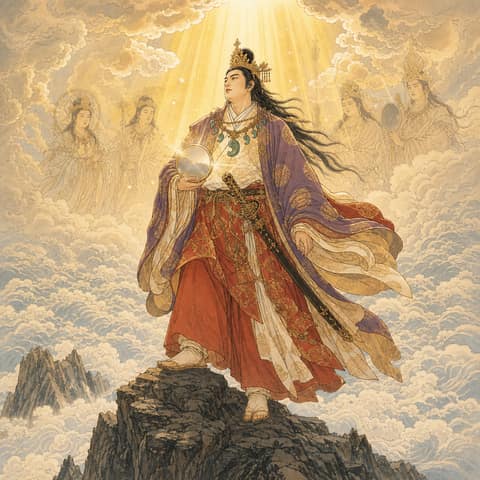
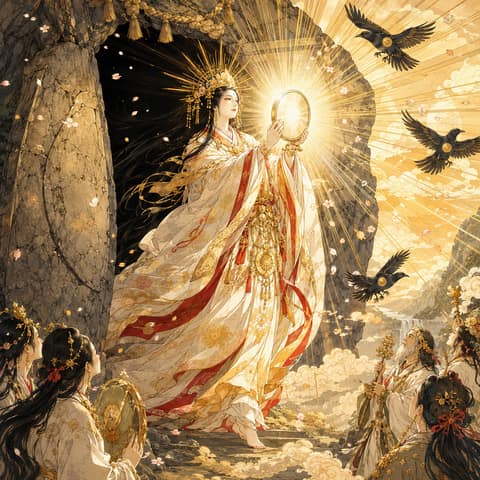
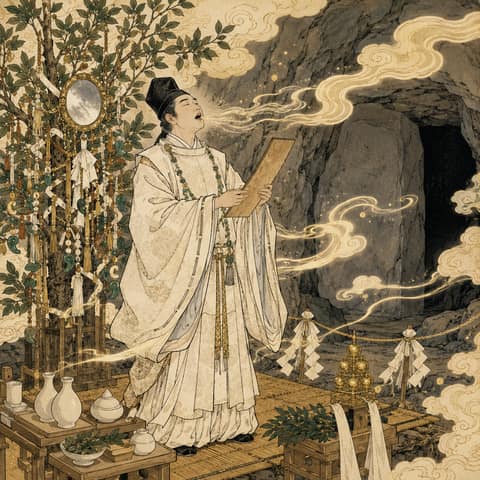
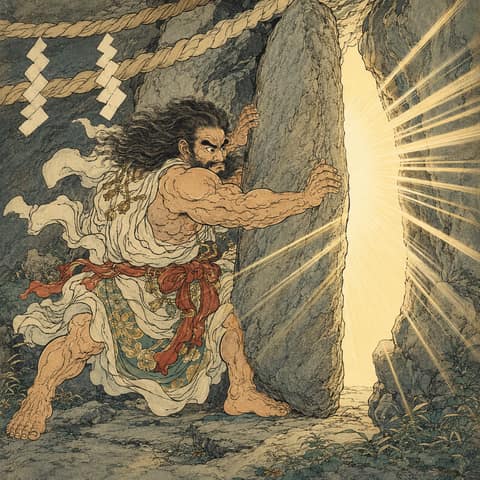
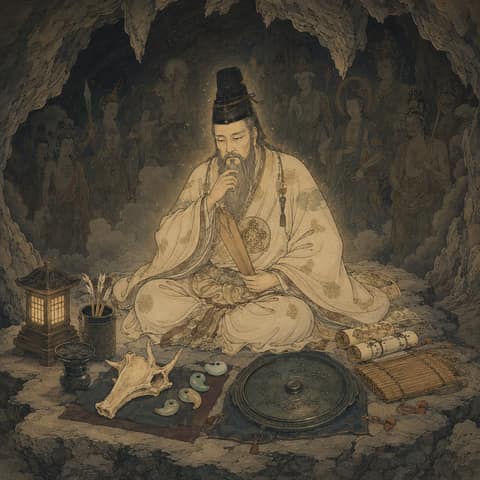
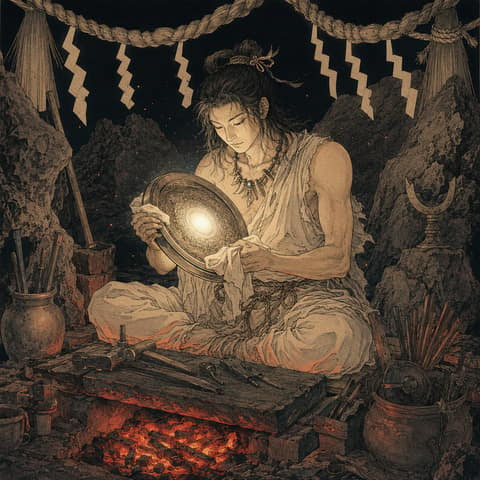
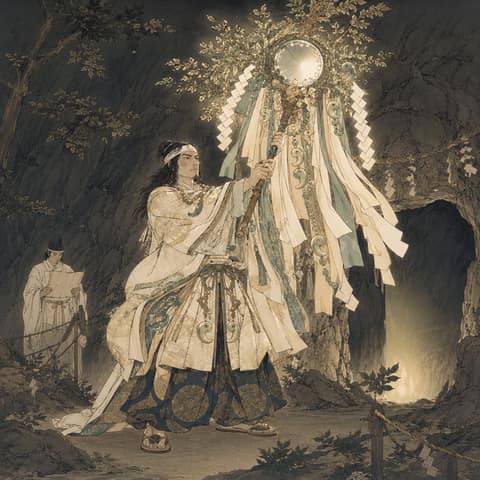
This version of Ame-no-uzume demonstrates that the power to save the world resides not in "battle" but in the "art of changing the atmosphere." When Amaterasu-Omikami hid in the rock cave, simply breaking down the door by brute force would not bring the sun back. Uzume gathers the gods' attention, provokes laughter, and makes Amaterasu herself want to look outside[1]. She does not move the other party directly, but alters the conditions of the space.
The dance before the rock cave is less an orderly court dance and more a bodily expression of divine possession. The sound of stamping the tub, the disheveled garments, and the laughter of the gods merge, pouring an excess of vitality into the dark world. This excess is Uzume's weapon. Facing a crisis, she shakes the closed door not just with seriousness, but with laughter and deviation.
Layering the image of Ame-no-uzume-no-mikoto from the "Nihon Shoki" reveals that Uzume is the specialized deity in charge of ritual performance in myth[2]. While mirrors and jewels are prepared as ritual implements, she makes her own body the ritual implement. Her voice, her feet, her chest, her laughter, her gaze. Everything becomes a tool to move the gods. In this respect, Uzume is not only the ancestral god of performing arts but a god who harmonizes the world through the body.
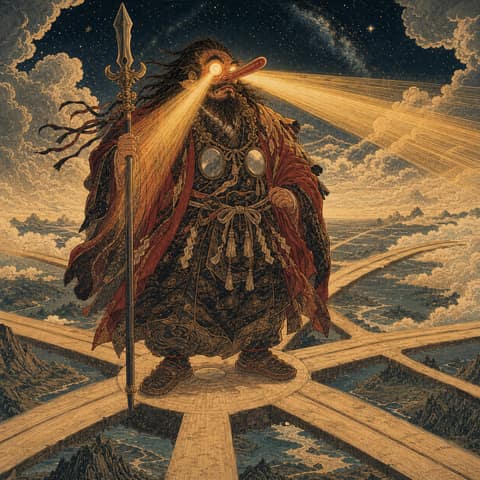
In the confrontation with Sarutahiko, Uzume's boldness manifests in another form. Facing an unusual god standing at the Heavenly Crossroads, she questions him without retreating[1]. To open a path, one must face an unknown opponent. Uzume fulfills that role, drawing out Sarutahiko's guidance. The power linking the inside and outside of the rock cave transforms here into the power linking heaven and earth.
In beliefs at places like Sarume Shrine, Uzume is endeared as a god of improvement in performing arts and matchmaking[3]. However, at her root, she is not merely a god who dances well, but a god who crosses boundaries. Standing on stage, raising one's voice, asking the other's name, breaking a closed atmosphere. All of these are somewhat frightening, yet simultaneously actions that open the world.
In modern terms, Uzume is highly versatile as a patron deity of creation, expression, and communication. Against inward-closed situations, organizational silence, or personal hesitation, she brings not only cheerfulness but a ritualistic resilience. In yokai diagnosis, she symbolizes someone who can read and break the atmosphere, someone who unravels heaviness with laughter, and someone who moves others by taking the stage.
Uzume's strength lies in her fearlessness of the gaze of others. In the dance before the rock cave, she exhausts her body before the gods, drawing laughter. Before Sarutahiko, she asks the unusual opponent for his name. Both require the courage to be seen, to approach, and to ask. Expression is not merely showing something beautiful.
If we read this version as the ancestor of kagura, kagura is not only an art to console the gods but a technology to move them. Drums, bells, foot-stamping, masks, costumes. The elements seen in later kagura all recall the scene before the rock cave. Uzume can be understood as the first being to step across the boundary between the stage and the sacred precinct.
Within YOKAI.JP, Uzume serves as a bright turning point against the flow of heavy vengeful spirits and violent gods. Unraveling fear with laughter, opening closed stories. When users navigate the mythological network, the presence of her page makes the relationships between Amaterasu, Sarutahiko, and Ninigi far more multi-dimensional.
Character Profile
This section is our own creative profile for storytelling. It is not historical fact or scholarship.
Yokai Type - Kami
Category - Deities & Divine Spirits
Rarity - Divine
Personality - Bold and highly adept at reading the atmosphere. Even in a crisis, she can reverse the situation with laughter and gestures.
Compatibility - 表現する勇気を持つ人、閉塞を破りたい人と強く響き合う。沈黙を絶対視する相手にはまぶしすぎる。
Abilities - Dancing the dance that opens the rock caveProvoking the laughter of the godsReversing closed situationsAsking the names of unknown godsProtecting performing arts and kaguraTying the knot that opens paths
Weaknesses - Cannot immediately reach a completely closed heart, and struggles to exert her power if there is no audience or responsive atmosphere in the space.
Habitat - Before the Amano-Iwato, kagura halls, Sarutahiko Shrine & Sarume Shrine, stages, festival circles, crossroads.