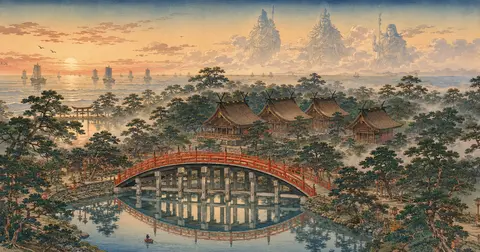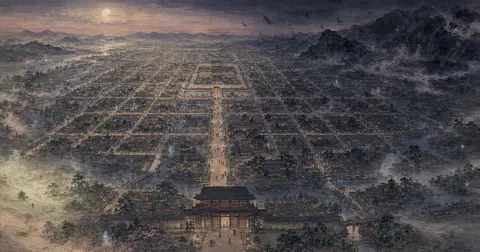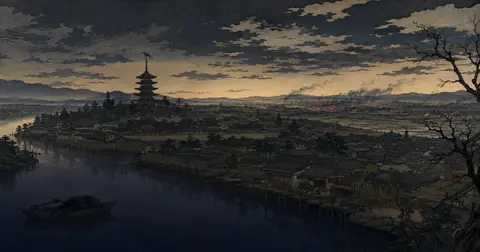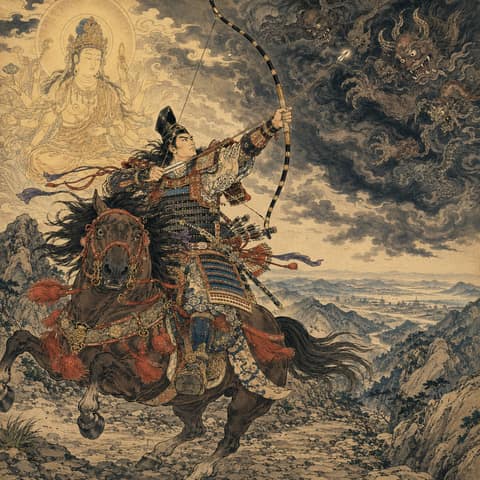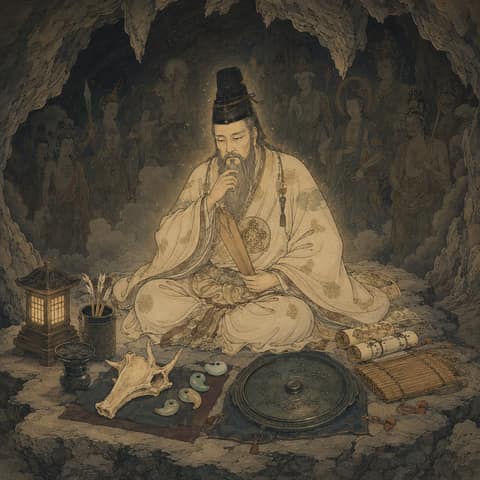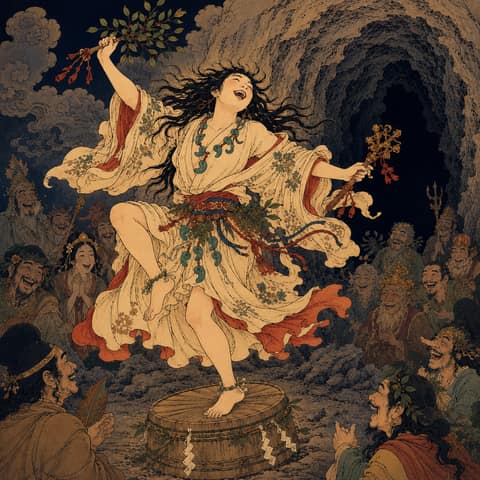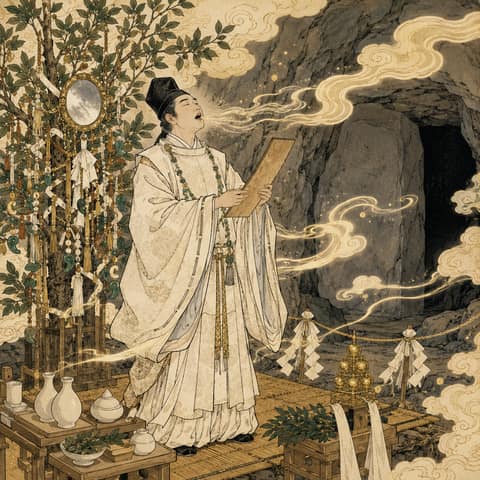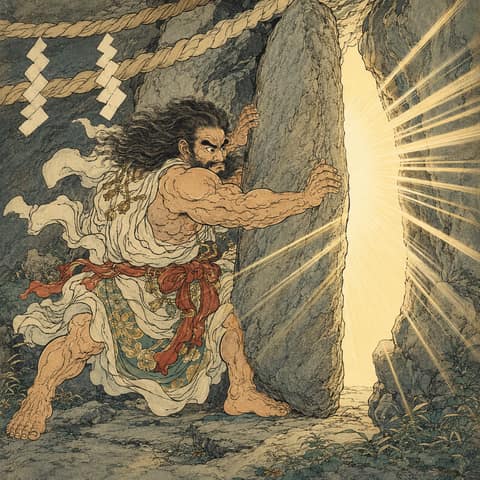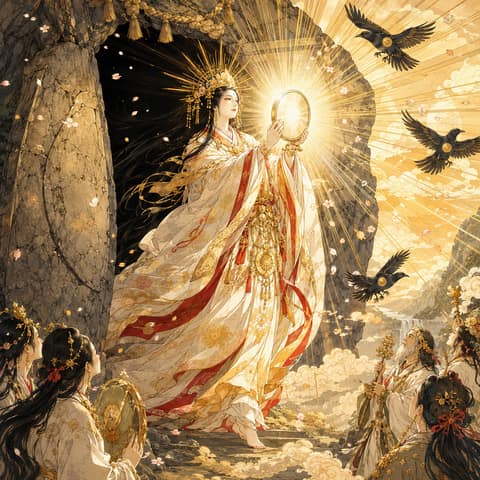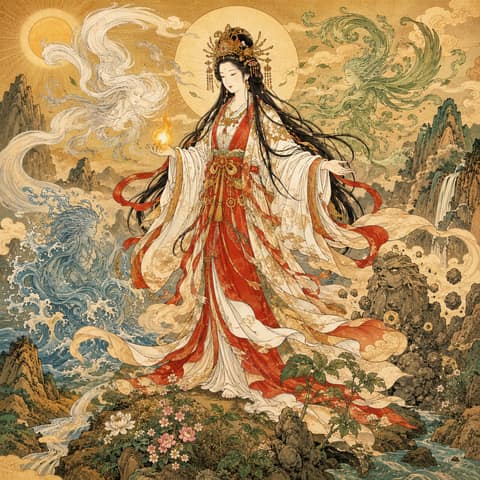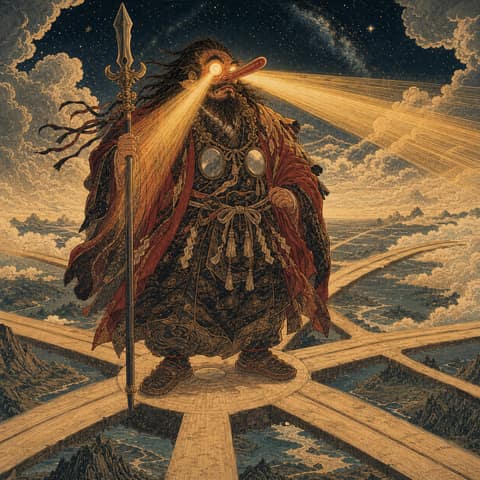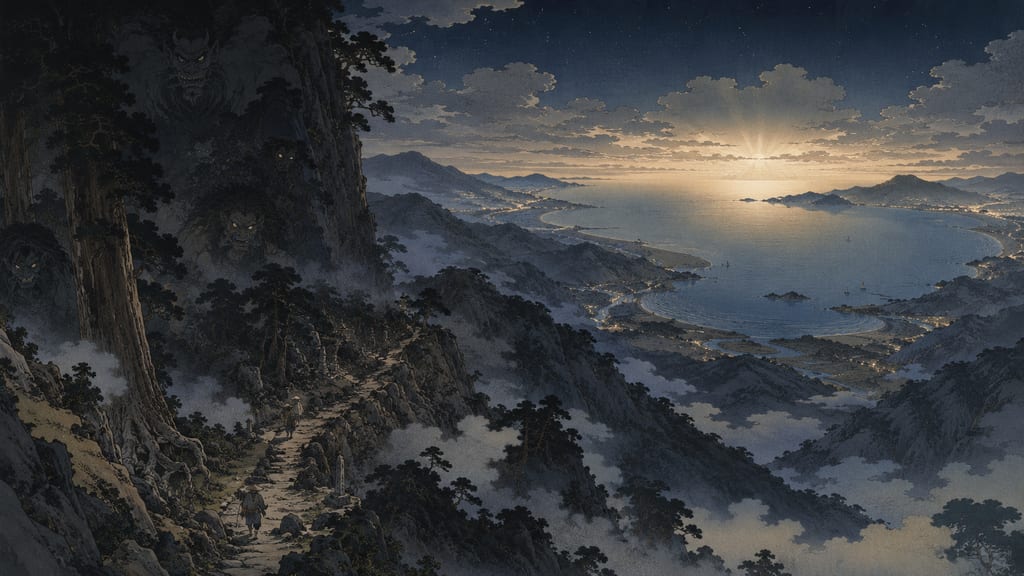
Mie's supernatural phenomena do not emerge from a single epicenter, but rather rise from a multitude of "passageways." Journeying up the Isuzu River from Ise Bay leads to the Inner Shrine (Kotai Jingu), where the sun goddess Amaterasu is enshrined, while at the foot of the Suzuka Mountains, the pathfinding god Sarutahiko-no-mikoto opens the way. Heading south, Hananoiwaya Shrine facing the Kumano Sea holds the memories of Izanami's death and the underworld, and the pilgrimage routes of the Kii Mountains continue into a sacred mountain culture where Shinto, Buddhism, and Shugendo blend seamlessly[1][2][3].
Meanwhile, Suzuka Pass serves as a boundary dividing the capital from the eastern provinces, giving rise to the tales of Otakemaru and Suzuka Gozen in the space between Ise and Omi. In Iga, the four demons of Fujiwara no Chikata rebel against the imperial court in military chronicles, while at Onigajo in Kumano, Konheika connects to the legends of Sakanoue no Tamuramaro as a seaside demon. In the waters of Shima, the Tomokadzuki—a doppelgänger of the *ama* divers—lurks in the depths, and on rainy nights in Ise, the spectral fire of Akurojin drifts. In Yokkaichi, a giant O-nyudo appears as a mechanical festival float, while in Matsusaka, the Kamikiri was recorded as an urban ghost story. The yokai culture of Mie is simultaneously the mythological center and a map of the anxieties generated by boundaries, mountain passes, sea routes, and port towns. Let us trace these passageways, traveling from Ise in the north over the Suzuka Pass, and down through Iga, Kumano, and Shima.
Ise and Kumano — Where Mythology Touches the Ground
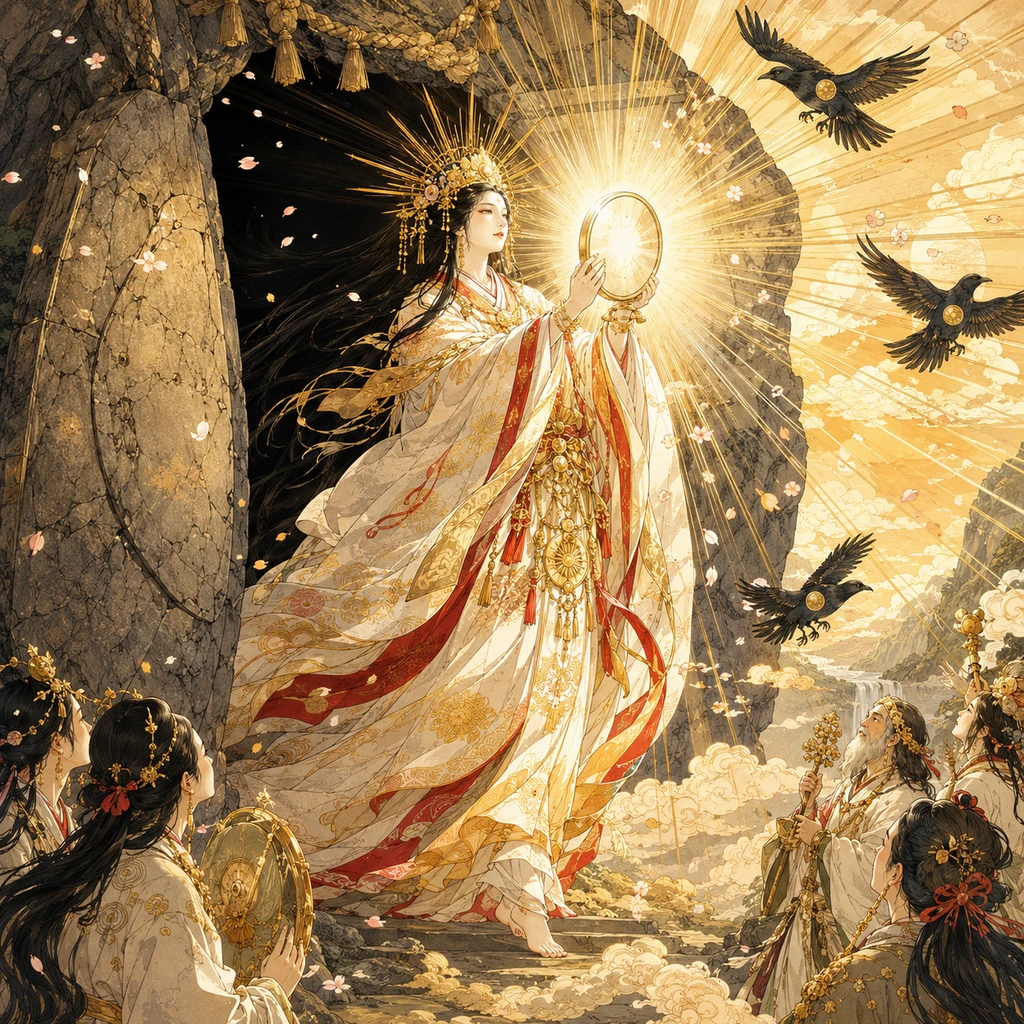
When reading Mie as a map of yokai, the first thing that becomes clear is how myth survives as tangible "places" today. The Inner Shrine of Ise Jingu rests peacefully by the Isuzu River, serving as one of Japan's foremost sacred sites dedicated to Amaterasu[1]. It is said that when Yamatohime-no-mikoto traveled through various provinces seeking a place to enshrine Amaterasu, she was guided along the way by Sarutahiko-no-mikoto. Yamatohime departed Yamato, journeying through Iga, Omi, and Mino, until finally deciding "this is the place"—the banks of the Isuzu River. The Shikinen Sengu, the ritual rebuilding of the shrine pavilions every twenty years, has been repeated on these grounds for thirteen centuries. It is a place where mythological time is still alive and moving. Interestingly, there are almost no legends of demons or yokai at the Inner Shrine of Ise Jingu itself. The supernatural does not approach the purest sanctuaries; instead, anomalies gather at their peripheries—the approach paths, outside the torii gates, mountain passes, and seashores. The stronger the sanctity, the thicker the anxiety at its borders. This may be why Mie's yokai map can be read like concentric circles centered around the grand shrine.
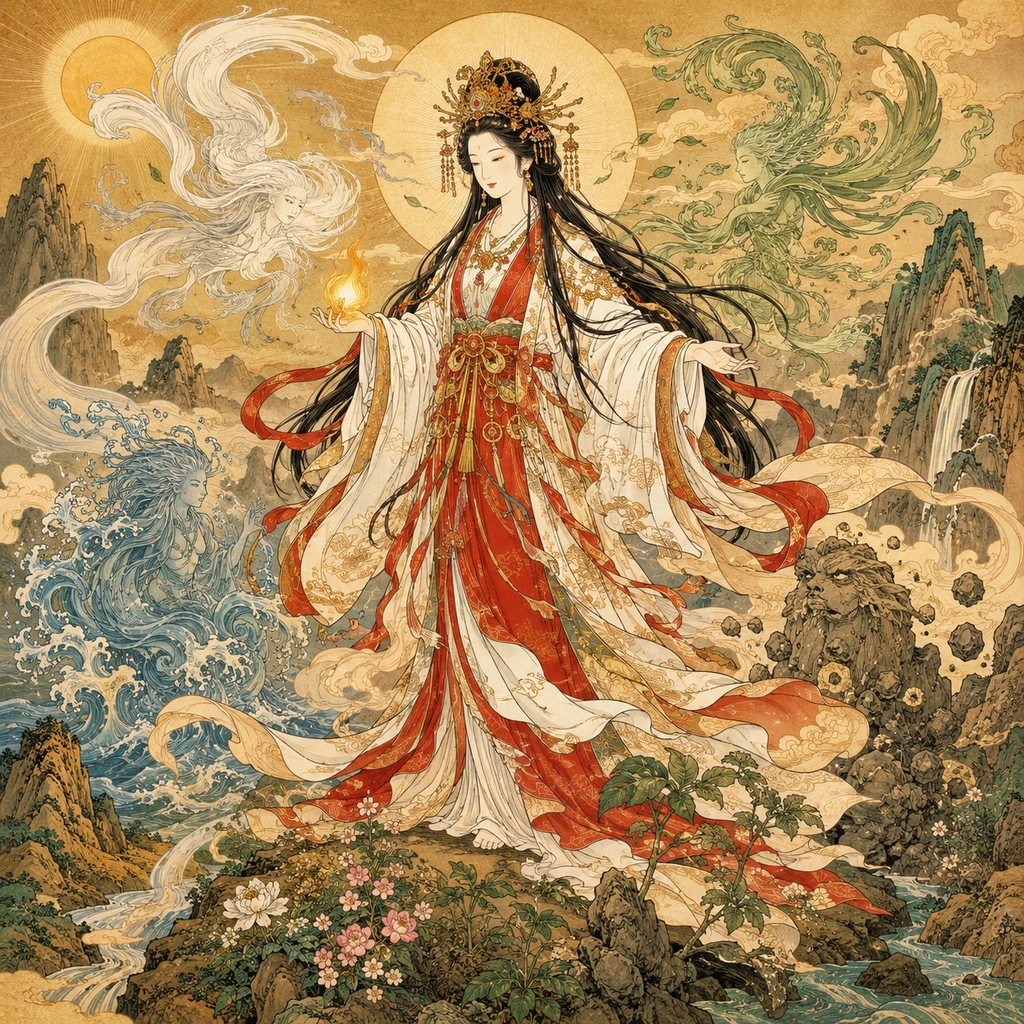
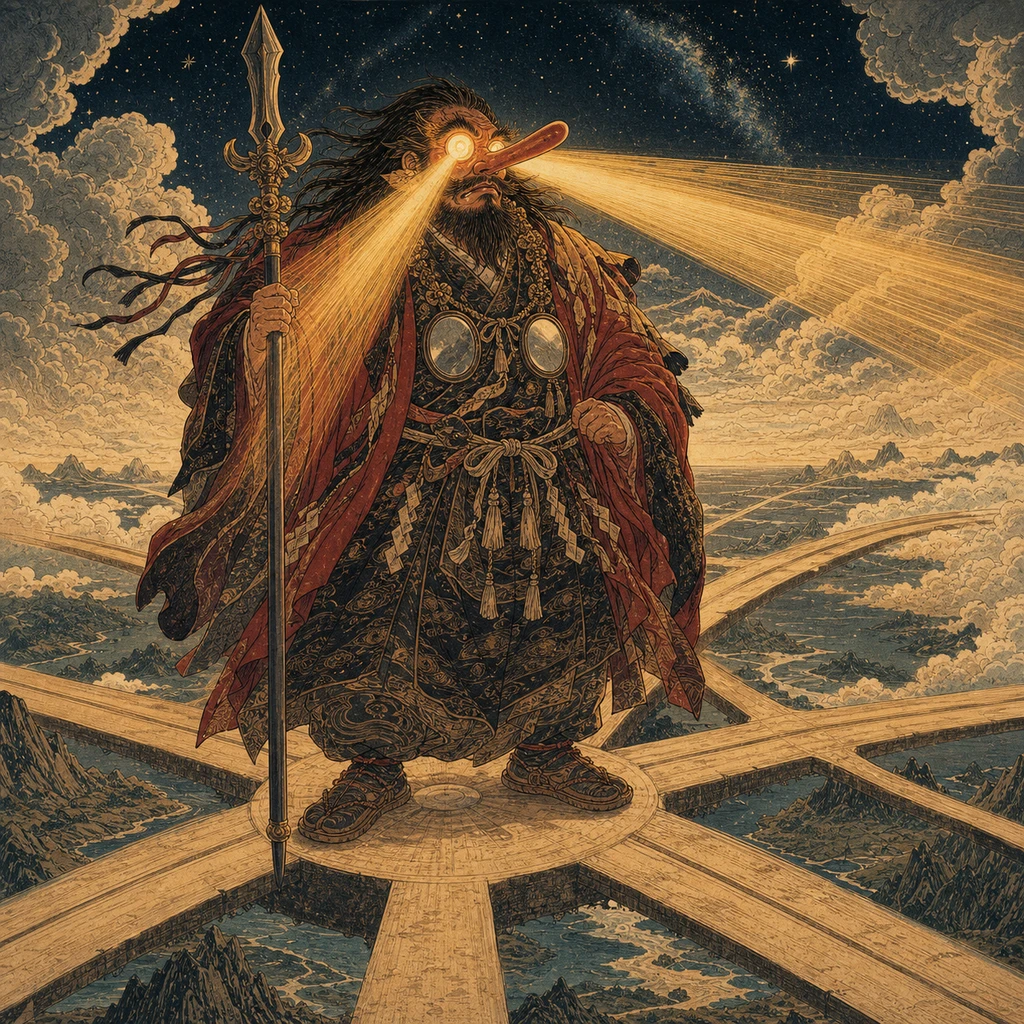
Sarutahiko-no-mikoto is no mere guide. While he is the god of "pathfinding" who stood at the heavenly crossroads to guide the divine grandchild's descent, the *Nihon Shoki* depicts him as a grotesque figure: a nose seven hand-spans long, a back measuring seven shaku, and eyes shining like eight-span mirrors—the god who opened the way was himself something other than human. According to the *Kojiki*, while fishing in the sea of Azaka in Ise (present-day Matsusaka), Sarutahiko's hand was caught in a giant clam and he drowned; from his sinking, the rising bubbles, and the bursting bubbles, three deities were born. Tsubaki Grand Shrine in Suzuka City is the head shrine nationwide dedicated to Sarutahiko Okami[4], and at Futami Okitama Shrine in Ise, "Futami Frogs"—considered the messengers of Sarutahiko—line up before the torii gate of the Meoto Iwa (Married Couple Rocks) facing the offshore Okitama Shinseki, praying for people to "return safely" (a pun on *kaeru*, meaning both frog and return). Pilgrims to Ise would first purify themselves at this Futami-ga-ura beach before heading to the shrine. It is entirely fitting that the frogs, messengers of the pathfinding god, reside on that beach where purification takes place at the boundary between the sea and the sacred precinct.
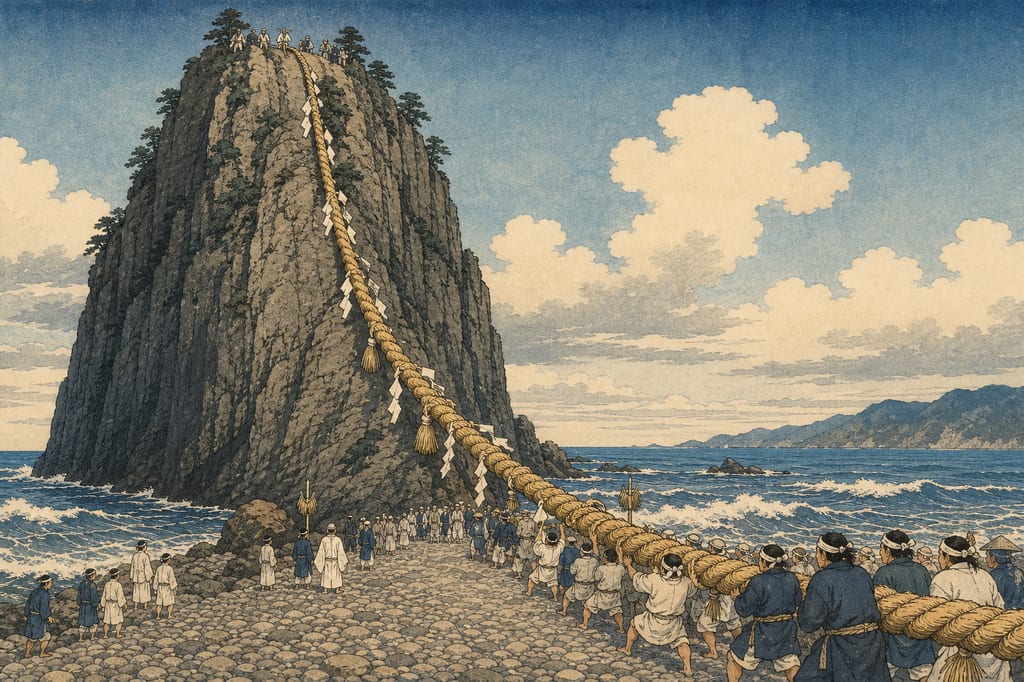
Heading down to Kumano, myth touches the ground even more vividly. Hananoiwaya Shrine in Arima, Kumano City, is considered "Japan's oldest shrine," noted in the *Nihon Shoki* as the burial place of Izanami. It has no main hall; the 45-meter-tall massive rock itself serves as the object of worship[2]. It is the tomb of the goddess who gave birth to the fire god Kagutsuchi, was burned, and died. Twice a year, parishioners conduct the "Otsunakake" ritual, stretching a massive rope 170 meters from the top of the rock to the shore of Shichiri Mihama—a rope interwoven with the seven nature deities of wind, sea, tree, grass, fire, earth, and water, tying the rock to the sea. Myth continues to descend to the earth today in the form of a single rope. Izanami died burning because she gave birth to the fire god, departing for the underworld—it is no coincidence that the story of her death is tied specifically to the rocks of Kumano. Since ancient times, Kumano has been perceived as the "root country where the dead go," a land on the boundary between life and death.
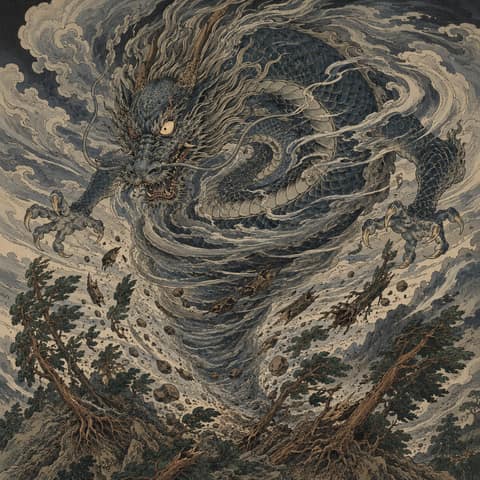
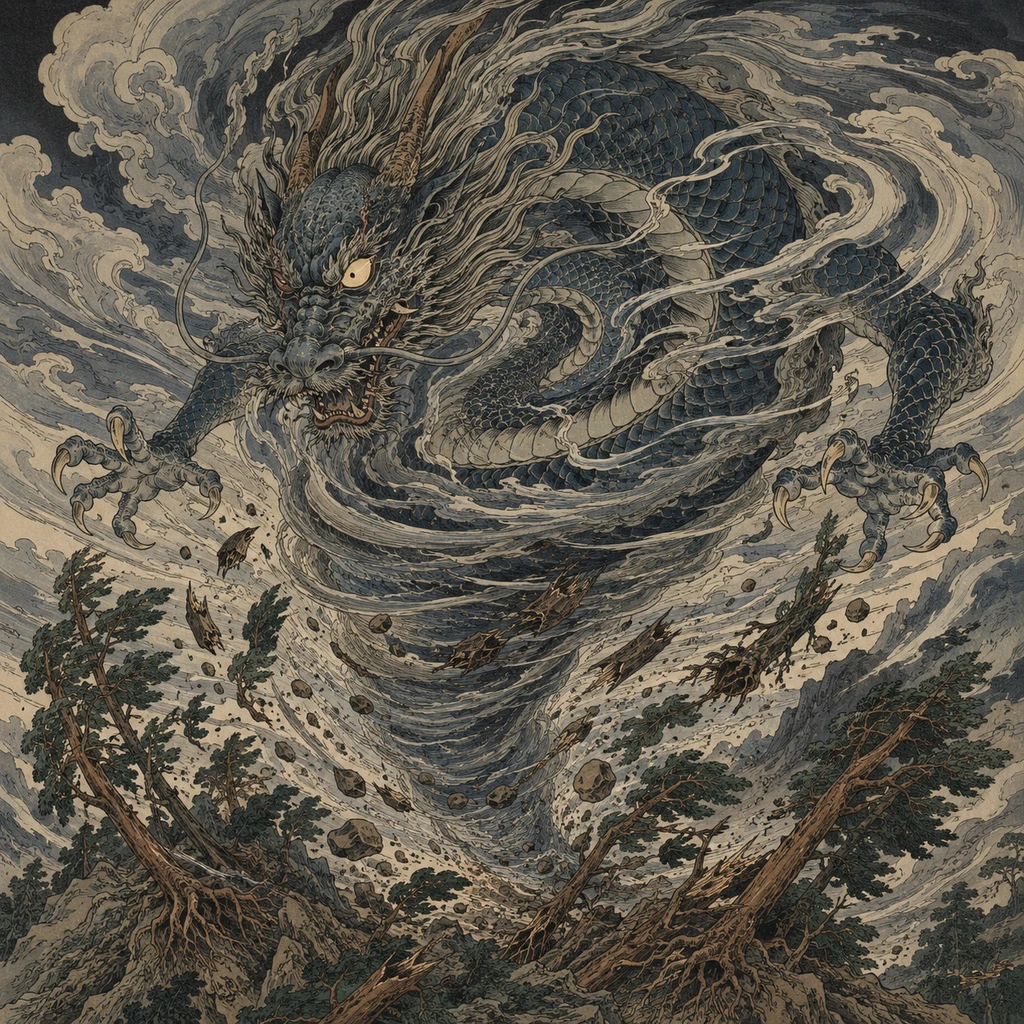
Ichimokuren is another fierce god rooted in Mie's nature. Ichimokuren Shrine, an auxiliary shrine of Tado Taisha in Kuwana, enshrines Amenomahitotsu-no-mikoto, the god of blacksmithing. Ichimokuren is a one-eyed dragon god and a wind deity, feared as a violent spirit capable of summoning torrential rains and storms. His shrine building has no doors—so that when the god unleashes his divine power, he can soar freely into the sky[5]. It is also said that his single eye reflects the image of a blacksmith closing one eye to assess the heat color of iron. Fishermen of Ise Bay have prayed to this one-eyed dragon god for rain, clear weather, and protection from maritime disasters. At Tado Taisha, the heroic "Ageuma" (horse-raising) ritual—where youths race horses up a steep slope in a single breath—has been held since ancient times to divine the year's harvest; horses and humans attempt to run up to the heavens before the god of wind and rain. Kuwana is a town of water where the Three Kiso Rivers flow into Ise Bay, constantly exposed to floods and storm surges. Enshrining the violent god of wind and rain in a doorless shrine to appease him—this reflects the earnest prayers of people living alongside water. Amaterasu stands at the center of light and order, Izanami marks the boundary of death and the underworld, Sarutahiko opens the path, and Ichimokuren governs the peril of wind, rain, and sea. In Mie, the gods have not descended far off into the sky, but onto riverbanks, rock caves, mountain passes, and sea breezes. Thus, if one separates myth and folklore, the supernatural occurrences in this prefecture immediately fade.
Suzuka Pass,
Iga,
and Kumano — Boundaries that Give Birth to Demons
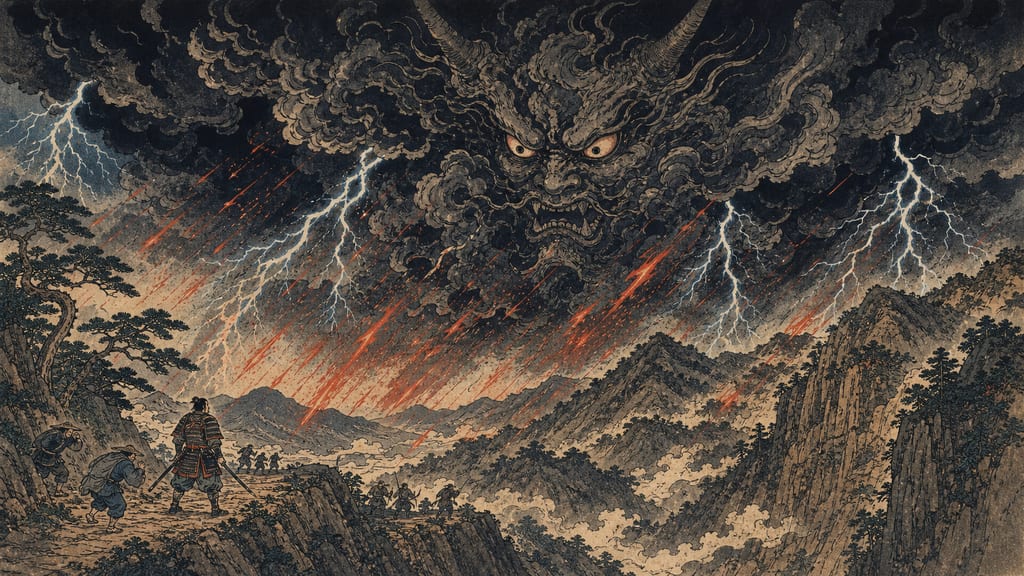
If one were to choose a single protagonist from Mie's yokai, it would be Otakemaru. Suzuka Pass separated Ise and Omi provinces, serving as a vital transportation hub from the capital to the eastern provinces. Yuji Yamada's research contextualizes the Tamuramaro legends passed down at this pass as being formed through the intersection of transportation routes, local bandit lore, and the origin stories of shrines and temples[6]. Here, Otakemaru rises not as a monster lurking deep in the mountains, but as a "demon god of the boundary" who shakes the order of the capital from the outside. From the ancient official roads to the modern Tokaido highway, Suzuka Pass was a treacherous point travelers inevitably had to cross, while simultaneously being a terrifying place haunted by bandits. It is likely that this real-world anxiety summoned the tales of a demon god dwelling in the pass.
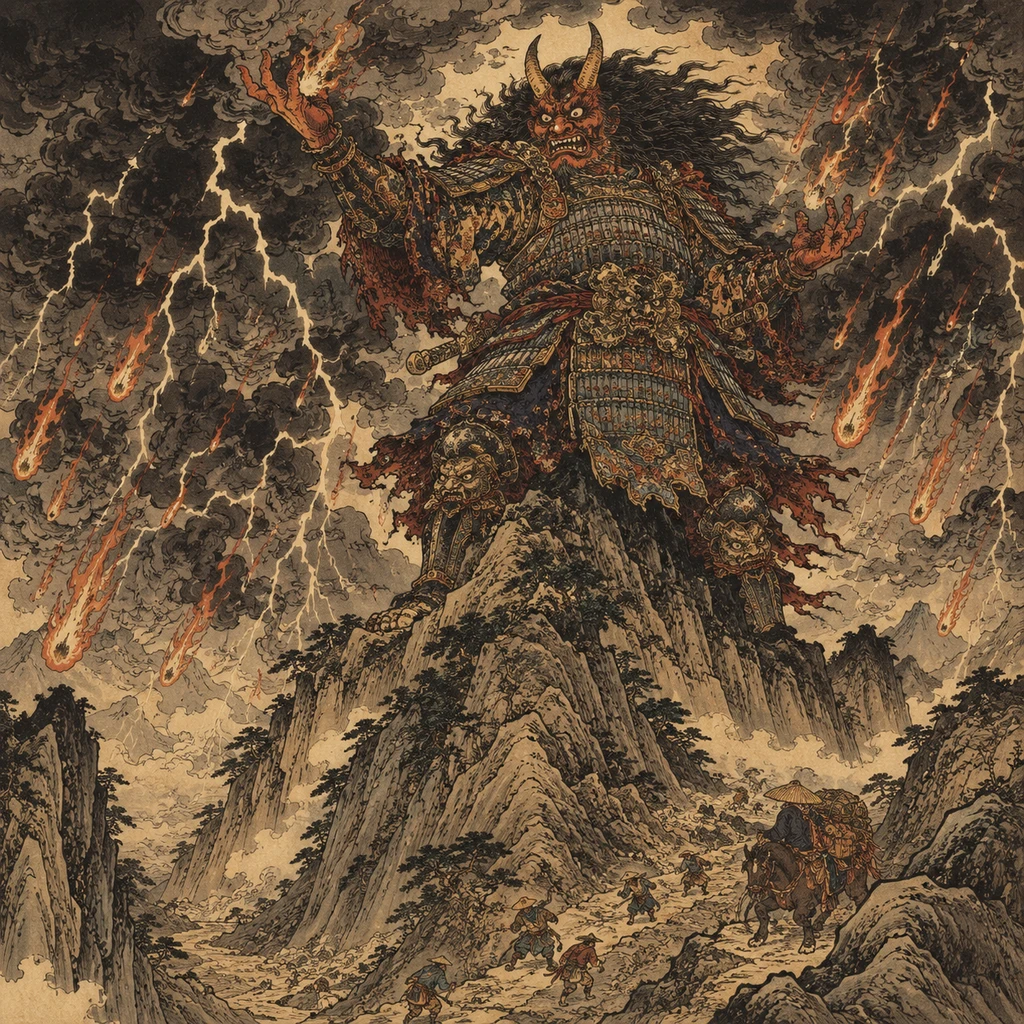
Ootakemaru
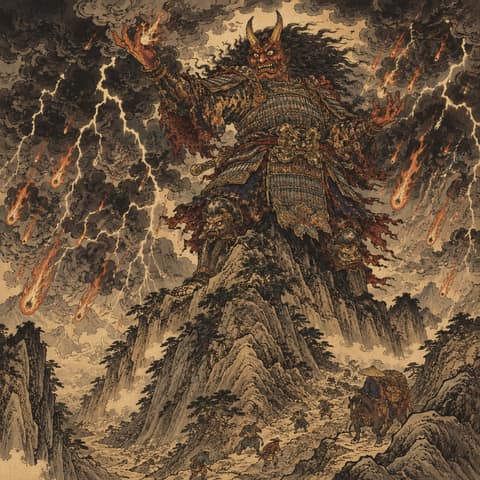
Ootakemaru is a demon god said to have made his stronghold at Mount Suzuka and the Suzuka Pass, located on the border between Ise and Omi provinces. In Otogizoshi and the Tamura stories, he appears as a Great Demon King who steals tributes meant for the capital and repels armies with black clouds, lightning, and rain of fire, only to be slain by Tamuramaru (modeled after Sakanoue no Tamuramaro) and Suzuka Gozen. The Tamuramaru of the story is not the historical Shogun himself, but a heroic figure born from the overlapping of medieval Kiyomizu Kannon worship, boundary beliefs of the Suzuka Pass, and Tamura legends from the Tohoku region. Ootakemaru is also sometimes cited as one of the "Three Great Yokai" alongside Shuten-doji and Tamamo-no-Mae. The fact that his severed head and remains are later incorporated into tales of treasures, temple origins (engi), and burial mounds reflects the medieval significance of a "slain great enemy".
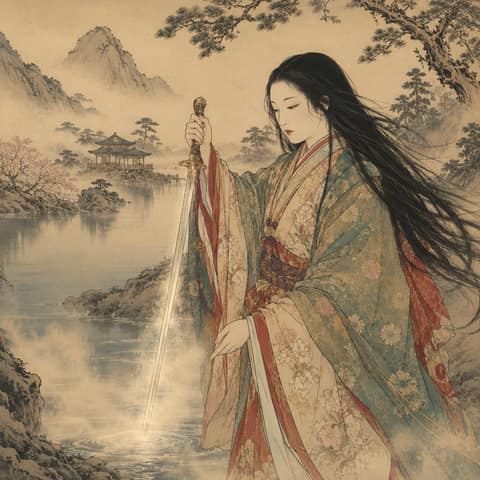
Read moreOtakemaru was a great demon god who covered Mount Suzuka in black clouds, rained down thunder and fire, and could shape-shift into a beautiful child or a noble. He wielded the three Sanmyo swords: Daitsuren, Shotsuren, and Kenmyoren. The key to defeating him was Suzuka Gozen, said to be either a heavenly maiden or a female bandit named "Tate-eboshi." She was a female chieftain who lived on Mount Suzuka and attacked travelers, yet she was also a descended goddess, and even harbored romantic feelings for the demon Otakemaru—Suzuka Gozen possessed an elusive charm, swaying between the sacred and the demonic, goddess and bandit. In narratives like the *Otogizoshi* tale *Tamura no Soshi*, Suzuka Gozen uses her charms to steal two of the swords from Otakemaru, joining forces with Tamuramaro to defeat the demon[7]. The spirit of a woman who knew the inside of the pass guided the hero who came from the outside—the story of Suzuka is less a male heroic epic and more a tale of aligning the power of the pass itself on one's side. The Sanmyo swords were said to be demonic blades originally forged by an Asura in India, and Kenmyoren in particular had the power to resurrect its owner. With grandiose origin stories identifying Suzuka Gozen as the "Daughter of the Demon King of the Sixth Heaven" and the divine protection of the Senju Kannon of Kiyomizu-dera depicted in the Noh play *Tamura*, the Tamura narratives grew increasingly embellished over time, refined within religion and performing arts. The fact that the *Tamura Sandaiki* claims to cover "three generations" (Toshijin, Toshimune, and Tamuramaro) shows how the deeds of the historical Sakanoue no Tamuramaro expanded into a saga spanning multiple generations of heroes.
Furthermore, Otakemaru does not end after being defeated once. In narratives like the Oku-joruri *Tamura Sandaiki*, the soul of the slain Otakemaru returns to India, resurrects through the power of the un-stolen Kenmyoren, and hides in Mount Kiri in Mutsu to be defeated a second time[8]. It is also told that when Suzuka Gozen passed away by heavenly decree, Tamuramaro negotiated directly with Enma, the King of Hell, to win back his wife. Katayama Shrine at the foot of Suzuka Pass in Kameyama City still enshrines Suzuka Gozen as Suzuka Daimyojin today. The Muromachi-period travelogue *Koun Kiko* (1418) already notes that "Tamuramaro defeated the princess deity of Suzuka, built a shrine at the foot of the mountain, and a shrine maiden worships her," indicating that the demon god lore of this pass had been established by the Middle Ages. In popular versions of the story, the severed head of Otakemaru was stored in the treasure house of Uji, while in the *Tamura Sandaiki*, it soared high into the sky and fell on the border of Ou, naming the land "Onikobe" (Demon's Head). Even after being slain, the demon continues to live on by carving its name into the land.
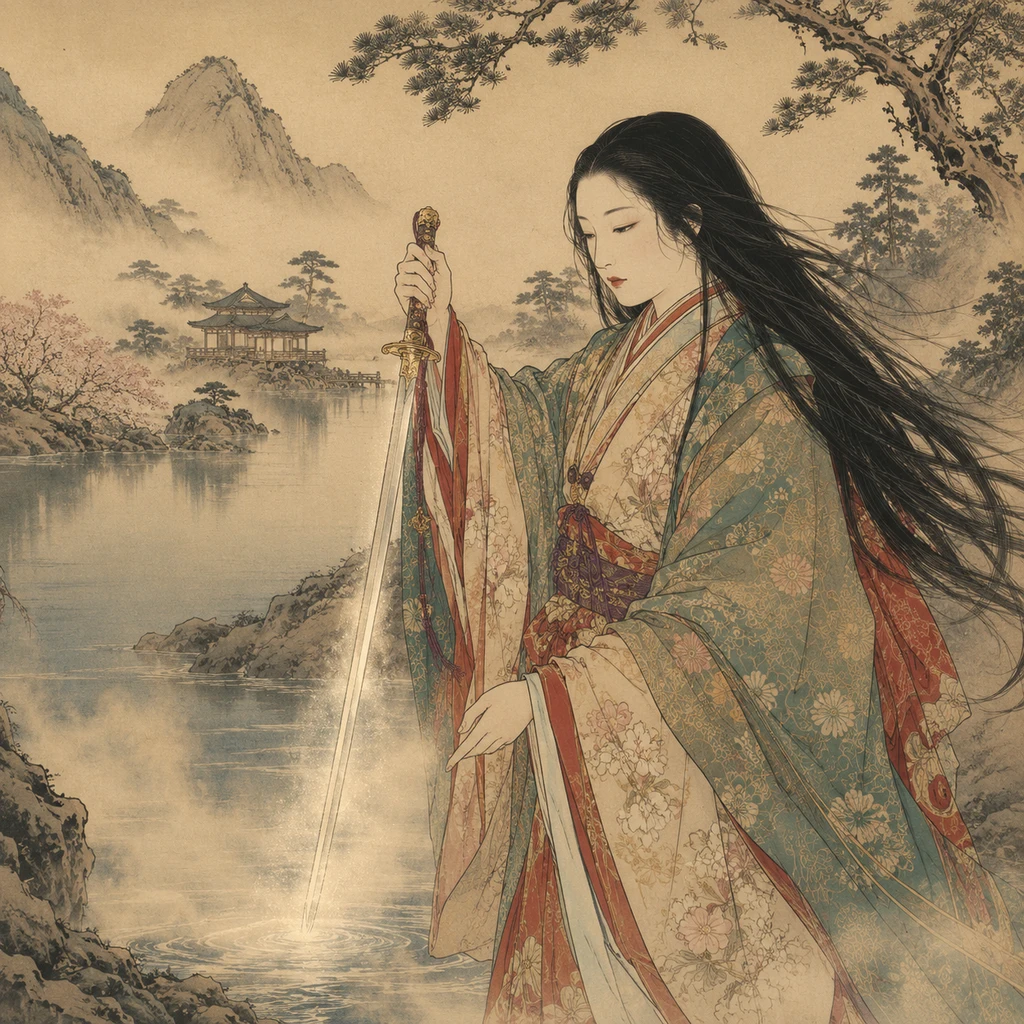 Suzuka Gozenすずかごぜん
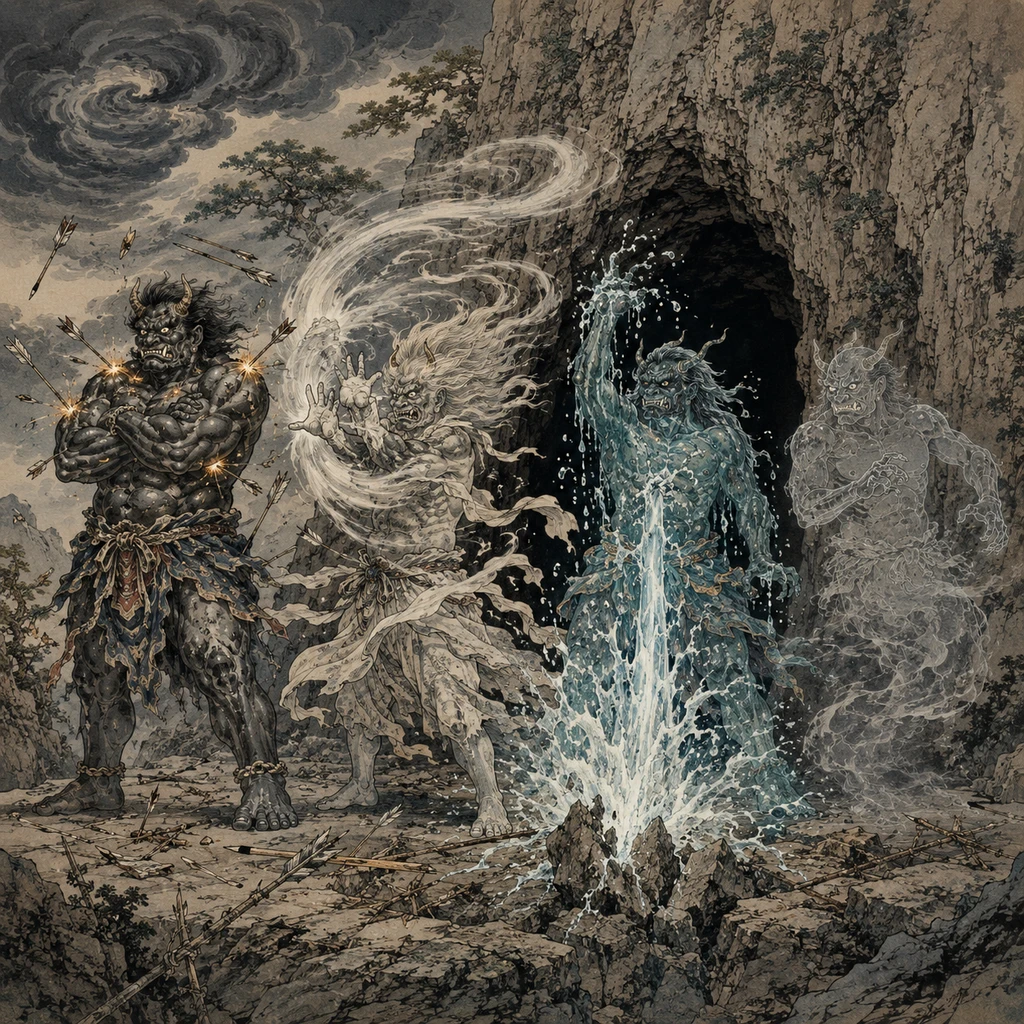 Fujiwara no Chikata’s Four Onifooj-ee-WAH-rah no chee-KAH-tah no yohn-kee
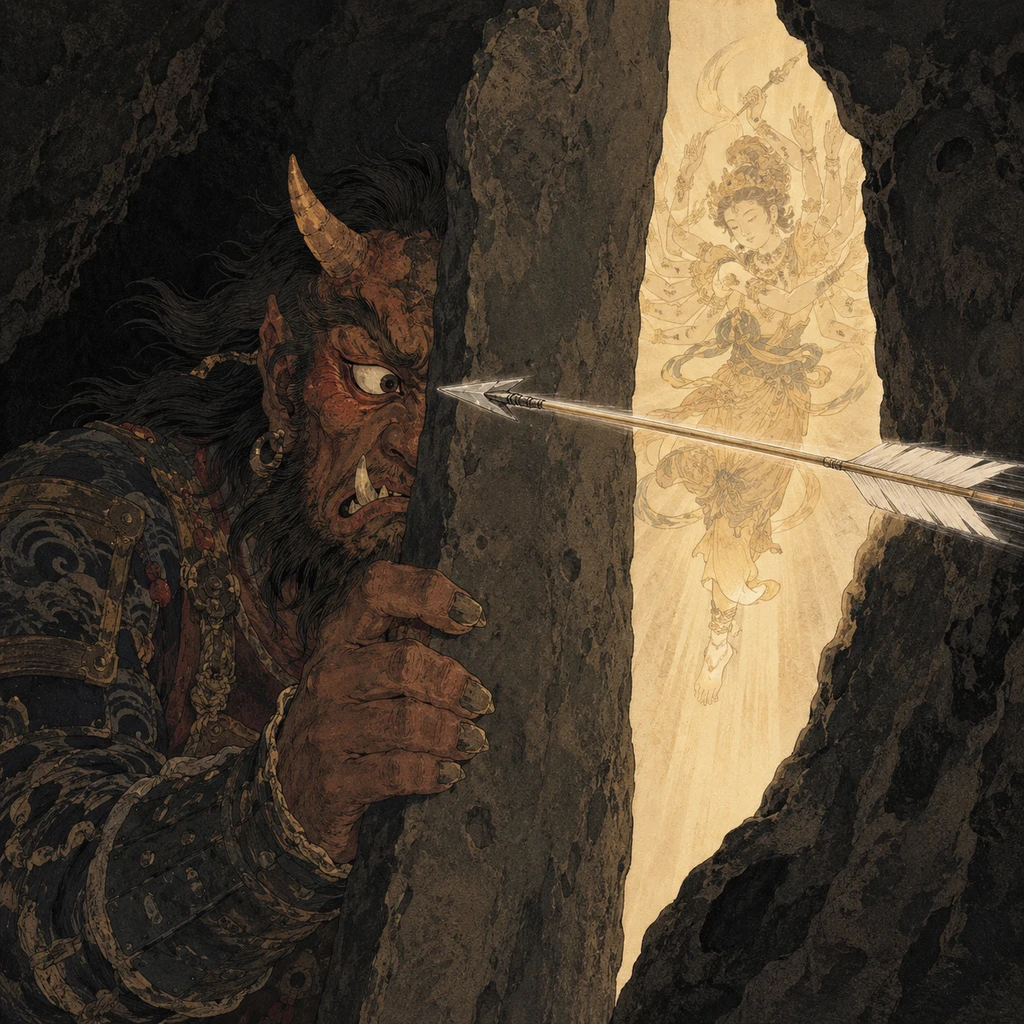 Konpeika, the Golden Ogre of Kumanokohn-PAY-kah
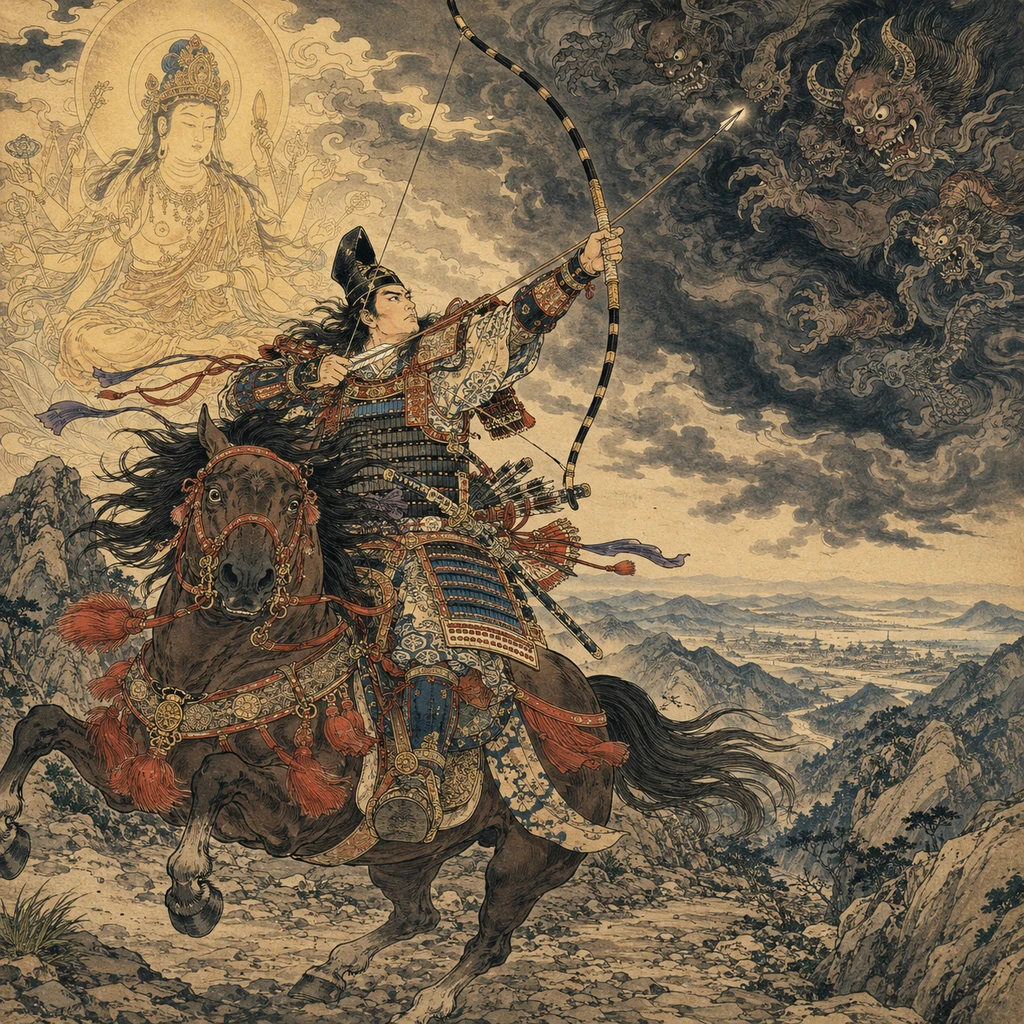 Sakanoue no Tamuramaroさかのうえのたむらまろ
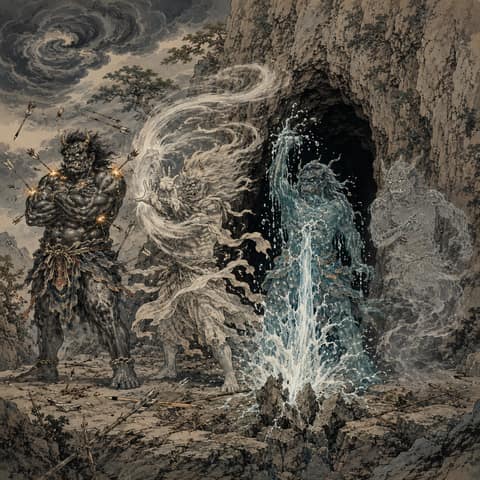
Crossing the pass into Iga, another group of demons appears: the Four Demons of Fujiwara no Chikata. The *Taiheiki* Volume 16, "Matters of the Emperor's Enemies in Japan," lists Chikata alongside Tsuchigumo and Taira no Masakado, stating he rebelled against the imperial court commanding the Gold Demon (Kinki), Wind Demon (Fuki), Water Demon (Suiki), and Invisible Demon (Ongyoki). They were demons truly worth an entire army—the Gold Demon with a hard body that repelled weapons, the Wind Demon who conjured gales, the Water Demon who summoned floods, and the Invisible Demon who hid his presence. However, when Ki no Tomoo composed and sent a poem reading, "Since even the grass and trees are the realm of our great lord, where could a demon find a place to dwell?", the demons yielded to the power of the word spirit (kotodama) and scattered in all directions, causing the ruin of Chikata who lost his backing[9]. Gold, wind, water, and the invisibility that erased presence—the powers of the four demons were personifications of magical forces controlling nature itself (some variants add the Fire Demon and Earth Demon, suggesting a connection to the Five Elements philosophy). Chikata himself is a legendary figure described as an onmyoji or a general, and his actual existence remains uncertain. At Tensho-ji in Kiryu, Iga City, a five-tiered stupa said to be Chikata's burial mound still remains. It is a conclusion fitting of the land of words, where a single waka poem, rather than military force, repels demons.
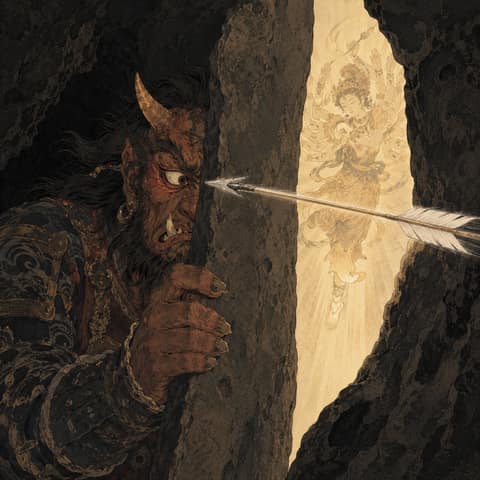
By the sea in Kumano, there is yet another demon: Konheika, who entrenched himself at Onigajo. In the early Heian period, Sakanoue no Tamuramaro, under the orders of Emperor Kanmu, slew this demon chieftain who had ravaged the Kumano Sea. However, struggling to attack the steep sea cliffs, a child (an incarnation of Kannon) appeared on an offshore island and danced. When Tamuramaro's forces joined the dance, the suspicious demon slightly opened the rock door to peek out—and Tamuramaro's arrow pierced through that gap. The official history of Onigajo calls this chieftain Tagamaru, and the name Konheika was layered on by secondary materials in later generations, but both refer to the same Kumano demon[10]. Onigajo is a magnificent sea cliff carved by the rough waves of the Kumano Sea over 1.2 kilometers; it is now part of the World Heritage site "Sacred Sites and Pilgrimage Routes in the Kii Mountain Range" and designated a National Place of Scenic Beauty and Natural Monument. The passage about the child dancing on the offshore island resonates with the origin stories of demon festivals and lion dances passed down throughout Kumano. Eiichiro Kirimura, who studied the Kumano demon legends, views the archetype of these demon-slaying tales as memories of subduing local powers that resisted central authority—the defeated are called "demons," and the victors are recounted as "Tamuramaro." Looking at Suzuka, Iga, and Kumano in a single line, Mie's demons do not stay in one point but emerge as a single epic moving across passes, mountain paths, and coasts. What is fascinating is that the protagonist of this epic is always Sakanoue no Tamuramaro. Slaying Otakemaru at Suzuka Pass, and Konheika in Kumano—from the northern passes to the southern seas, the single hero Tamuramaro travels around unifying all the demons of Mie. A prefecture of boundaries that gives birth to demons was simultaneously a prefecture that required a hero to slay them.
The Ama Divers' Sea,
Port Towns,
and Roads on Rainy Nights
Mie's supernatural encounters do not end with mountains and passes.
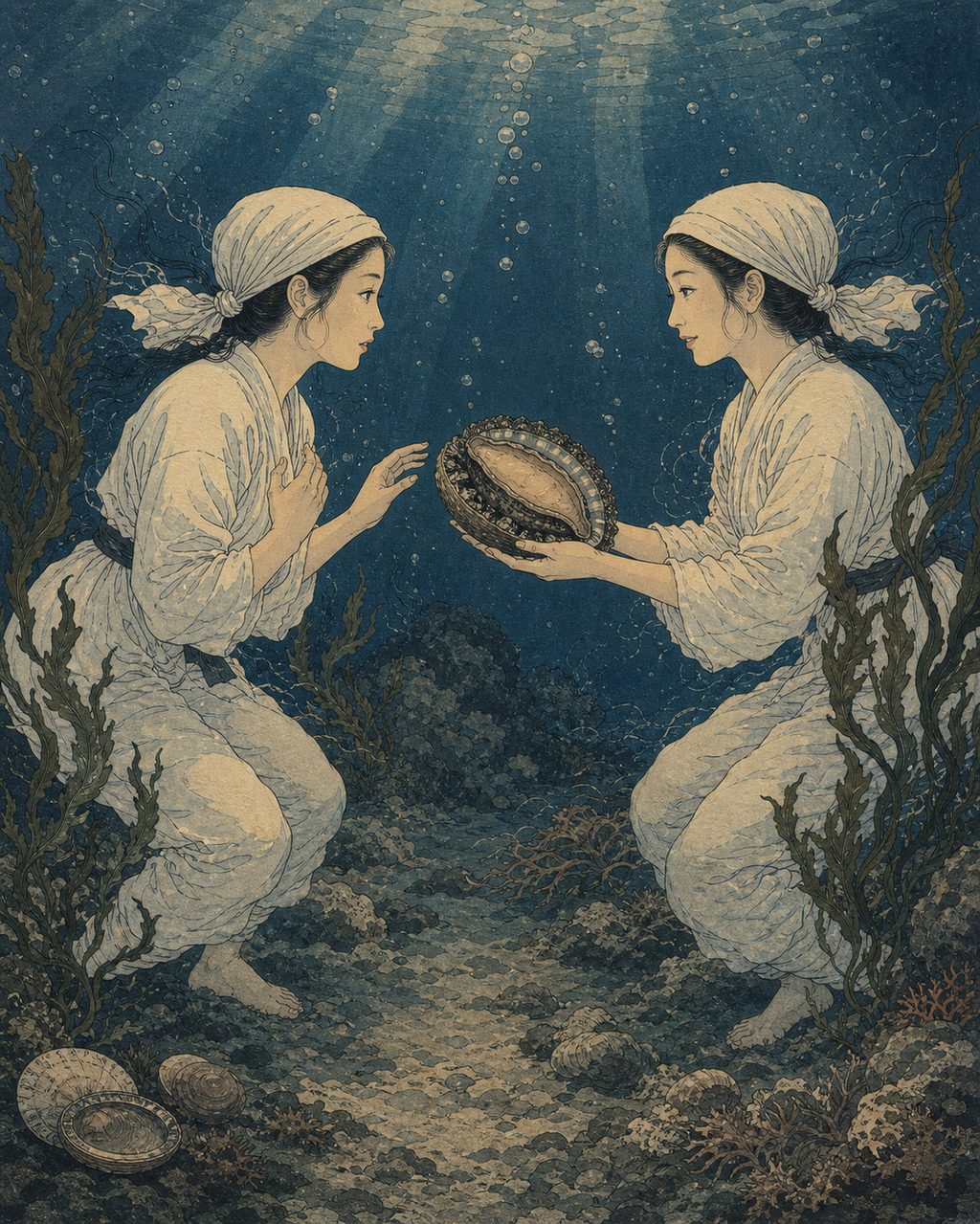
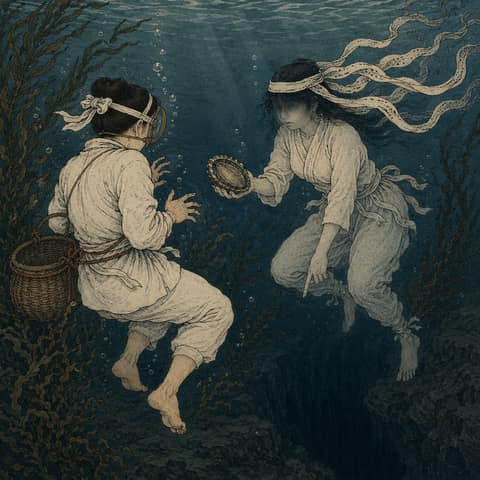
In the sea of Shima, there is an entity that the *ama* divers fear the most: the Tomokadzuki. While diving at the bottom of the sea where no one else should be, another diver who is the spitting image of yourself suddenly appears and smiles, offering an abalone. If you accept it, your life is taken, and you are dragged into the depths of the sea—a yokai that gives form to the unfathomable terror of an *ama* diver encountering herself underwater[11]. This word is also recorded in the *Comprehensive Glossary of Japanese Folklore* supervised by Kunio Yanagita[12]. It is sometimes explained as the confusion of consciousness caused by long periods of diving, but the *ama* divers feared this as a visceral reality. The *ama* of Toba and Shima draw the star-shaped "Seiman" and the lattice "Doman" symbols on their bandanas and tools to protect themselves—the star shape, which can be drawn in a single stroke and always returns to its origin, is said to be a sign of "returning alive safely"—an earnest prayer of those who dive into the otherworld of the sea every day. The *ama* fishing in Toba and Shima is a free-diving culture rarely seen in the world, one that is still actively practiced today. Diving into the deep sea in a single breath, and rising again—in the space between those breaths stands another version of oneself at the bottom of the sea. The Tomokadzuki may be the face that the *ama*, who commute between life and death daily, saw in the sea itself. Shima is also the "Miketsukuni" (Land of Royal Provisions) that has offered seafood to the imperial court since ancient times, and abalone is still presented to Ise Jingu today. The rich blessings of the sea and the death it threatens have always stood side by side. The reason an *ama* must never accept the offered abalone is because she knew firsthand the precarious balance between what the sea gives and what it takes.
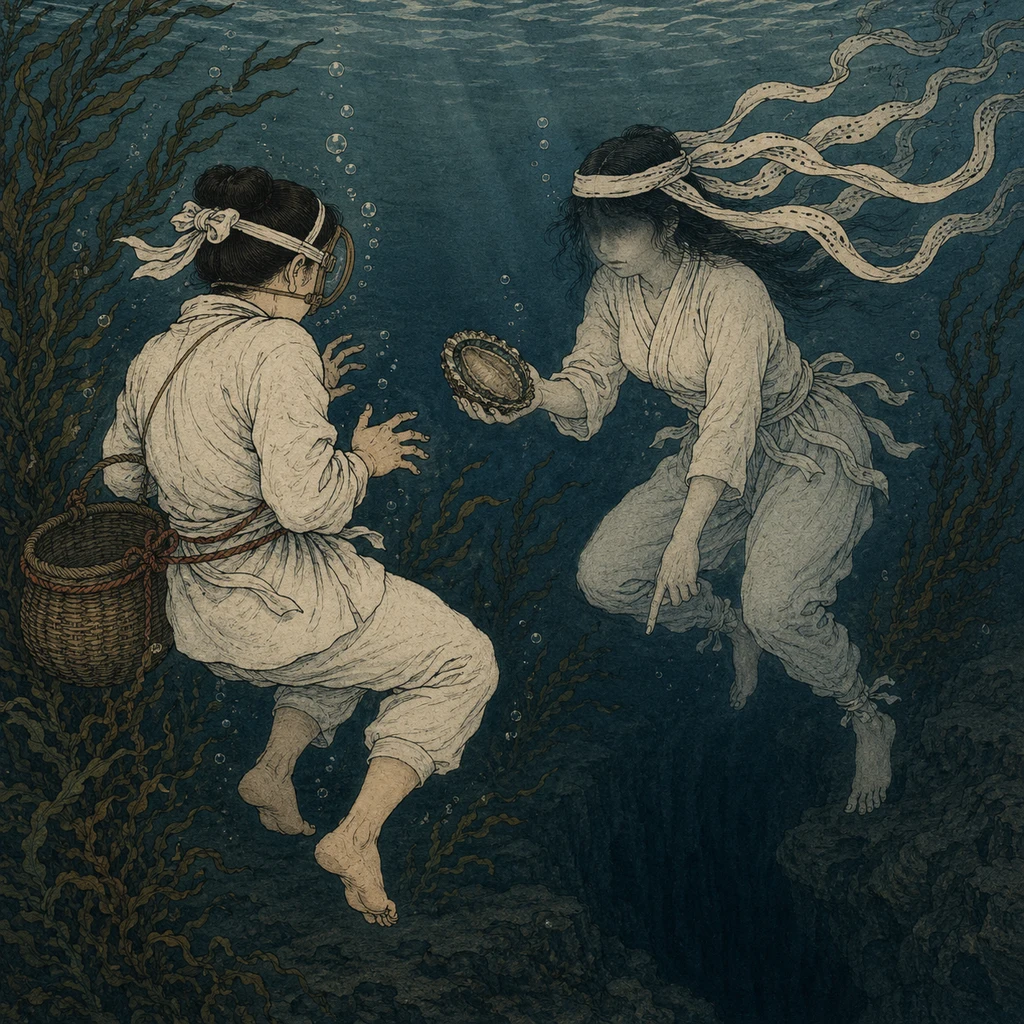 Tomokadzukitomokadzuki
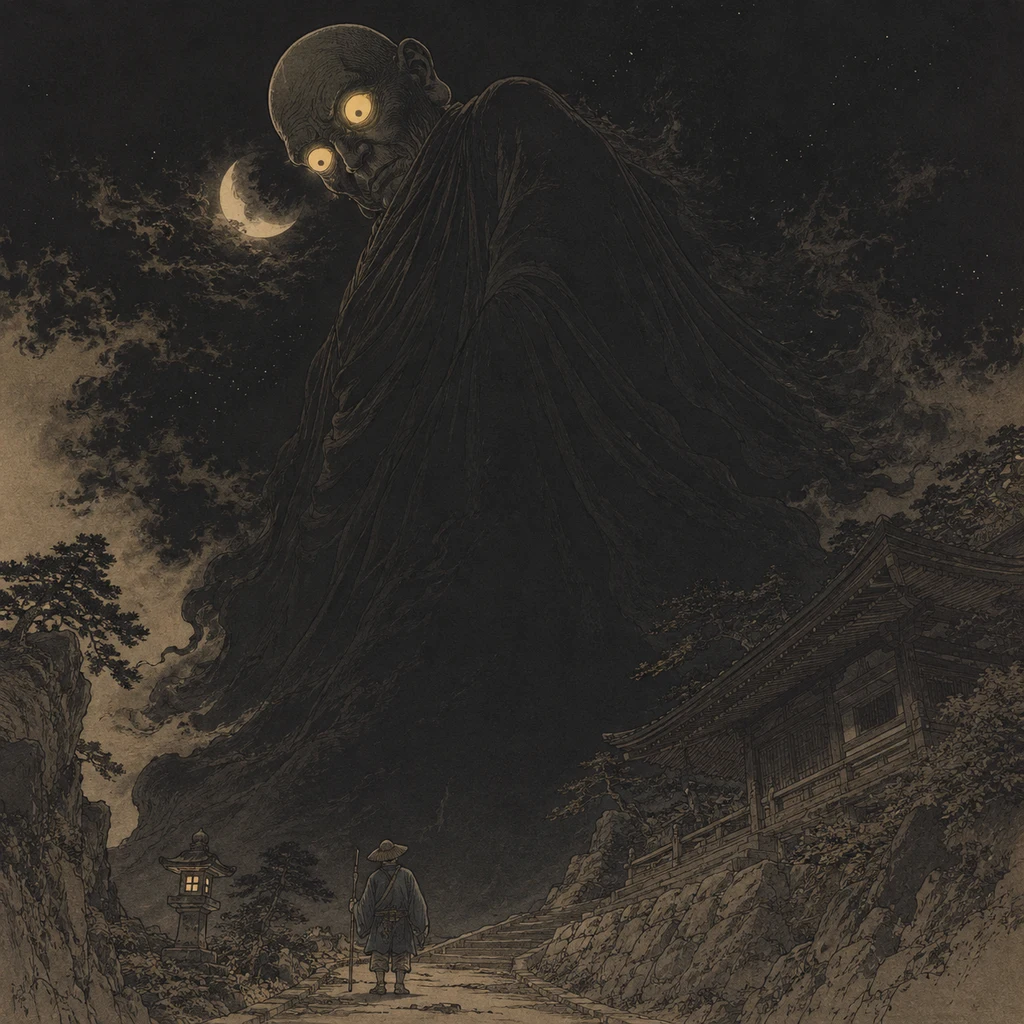 Great Nyūdō (Giant Priest Apparition)oh-oh-nyoo-DOH
 Hair-CutterKAH-mee-KEE-ree
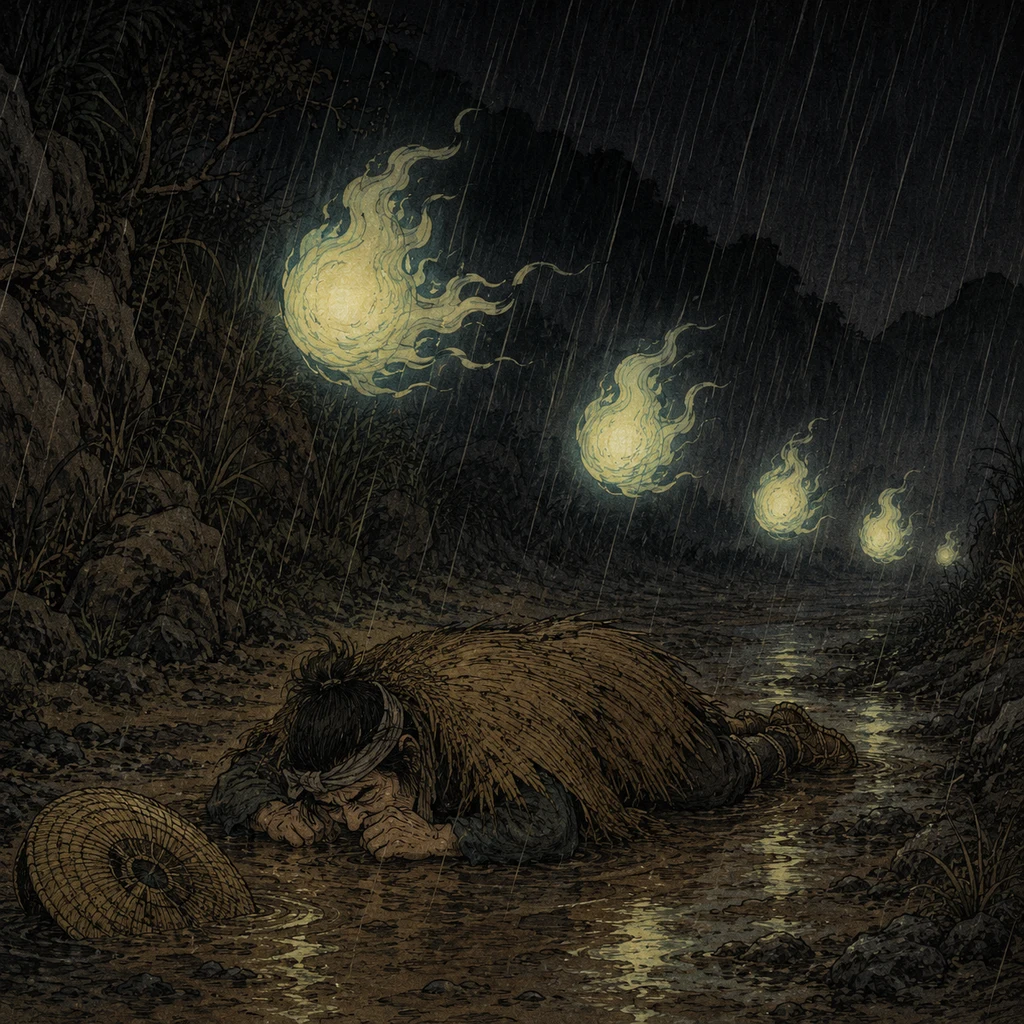 Fire of the Akuro-gamiAH-koo-roh-gah-mee no HEE
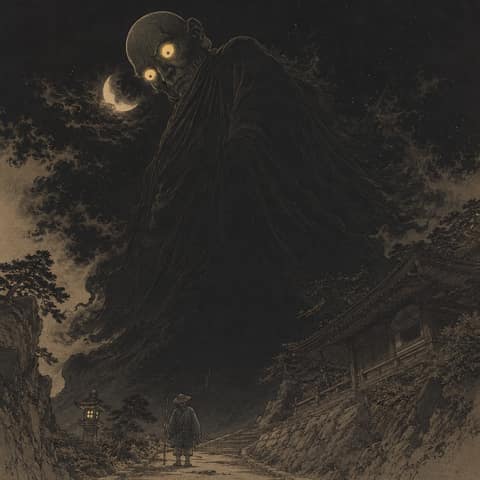
In the port towns along Ise Bay, anomalies take the form of festivals and rumors. The O-nyudo of Yokkaichi is a giant *karakuri* festival float with a neck that stretches eerily. The figure is about 4.5 meters tall, the extending neck is 2.7 meters, and including the float base, it reaches a total length of approximately 9 meters, earning it the title of "Japan's largest karakuri figure." The mechanism, incorporating whale baleen, is operated by six people inside. It is said to have originated as a way to scare back a shape-shifting tanuki that appeared in the seaside Okeno-cho district during the festival of Suwa Shrine in Yokkaichi[13], and it is now beloved as the star attraction of the Yokkaichi Festival. Handcrafted by a *karakuri* master from Nagoya during the Bunka era (1804–1818), the current O-nyudo is designated as a Tangible Folk Cultural Property of Mie Prefecture. A giant figure born to counter a monster tanuki has, over two centuries, become the town's proud treasure. Here, the yokai is not vanquished and erased; it has become the face of the town's festival.
During the Edo period, fervent mass pilgrimages known as "Okage Mairi" swept the nation every few decades, heading toward Ise Jingu. Millions of people traveled the highways to Ise, and along the way, rumors of foxes and badgers shape-shifting into traveling companions, or tales of the spirits of those who collapsed on the road, followed them constantly. The road to the sacred site was itself a passageway for the supernatural.
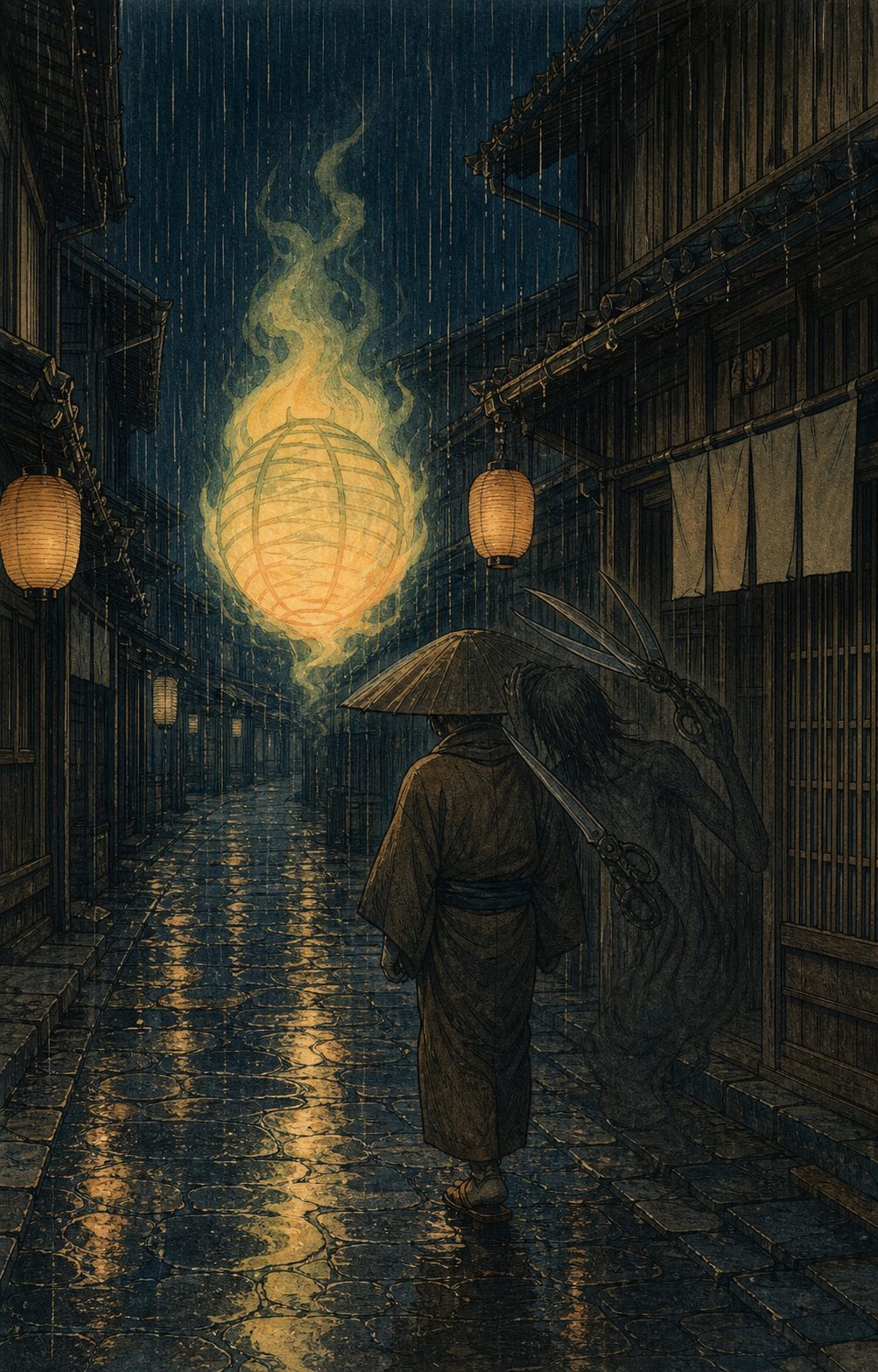
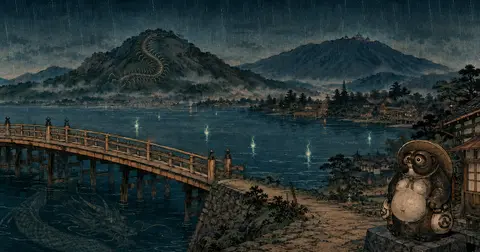
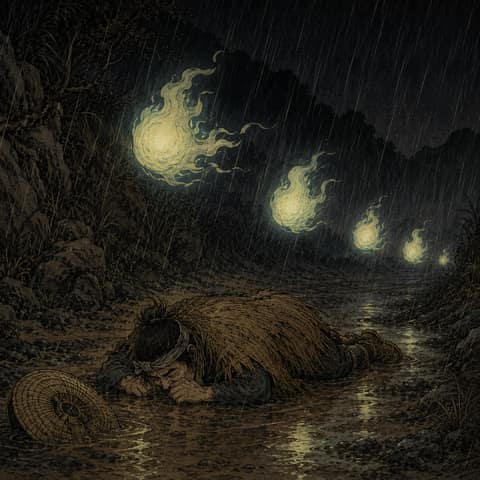
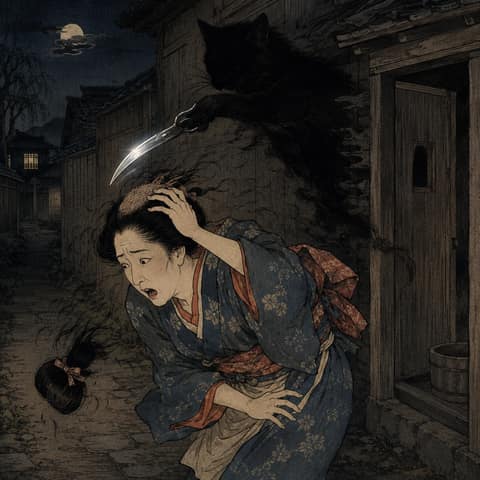
In Matsusaka, an anomaly was recorded as an urban ghost story of the early modern period: the Kamikiri (Hair Cutter). Senryo Kikuoka's *Shokoku Rijindan* (1743) records that in the early Genroku era, on the night roads of Matsusaka in Ise and Konyacho in Edo, the hair of those walking at night would be cut from the roots without them even noticing, leaving their still-tied hair fallen on the street[14]. Rumored to be the work of foxes or a Kamikiri insect, "hair-cutting incidents" occurred repeatedly in Edo, causing public unrest. The artist Sekien Toriyama also depicted this Kamikiri as a yokai with scissor-like claws. The fact that one's hair was cut off without any memory of being touched—it was this incomprehensibility that fueled people's anxiety. Matsusaka was a prosperous merchant city that produced many Ise merchants who set up large shops in Edo. Precisely because it was a bustling town with people constantly coming and going, the rumors of hair-cutting on night roads circulated all the more vividly. And on rainy nights in Ise, the fire of the Akurojin drifts. The essay *Kanso Sadan* by Shunsui Tamenaga notes that at Igusa-ga-fuchi in Mayumi Village within the Tamaru domain (present-day Tamaki Town), mysterious fires resembling lit lanterns pass back and forth on rainy nights; encountering them brings illness, so it is best to quickly lie face down on the ground and let them pass[15]. Due to the name "Akurojin" (Evil Road God), some theories associate it with Akuro-o (Aterui), the Emishi leader slain by Sakanoue no Tamuramaro, but there is no solid evidence for this. Regardless, in this land of Mie steeped in Tamuramaro's demon-slaying legends, the fact that the spectral fire of a rainy night is crowned with the name "Akuro" is a fascinating coincidence. The *ama* divers' sea, port town festivals, the night streets of Matsusaka, and the rain of Ise—in Mie, it is not just the demons of the mountains, but these small anomalies that quietly breathe right next to everyday life.
Mie is a Prefecture Where "Sacred Sites" and "Boundaries" Coexist
If we view Mie solely as a prefecture of myth, the majesty of Ise Jingu and Kumano comes to the forefront. Conversely, if we view it solely as a prefecture of yokai, the stories of Otakemaru and Suzuka Gozen appear isolated. In reality, however, sacred sites and boundaries overlap on the very same map. The light of Amaterasu is what makes the death of Izanami so dark. Sarutahiko opens the path, which is precisely why the demons of Suzuka Pass block it. Ichimokuren of Tado controls the wind and rain, which is why the *ama* divers of Shima fear the anomaly resembling themselves at the bottom of the sea.
This is likely because the land of Mie is built upon numerous "boundaries." Suzuka Pass separating Ise and Omi, the cliffs of Kumano and shores of Shima where sea and land meet, the rock of Hananoiwaya where life and death touch, the pilgrimage route to Ise connecting the human world and the otherworld—the forests of the Grand Shrine, the passes of Suzuka, the mountain roads of Iga, the rocky caves of Kumano, the seas of Shima, the festivals of Yokkaichi, and the night streets of Matsusaka. All of these exist on the border between "here" and "there," and Mie's supernatural phenomena emerge at the precise moment someone attempts to cross that boundary. In this prefecture where gods open paths and demons block them, the sacred and the strange have been back-to-back from the beginning. The pilgrimage route to the Grand Shrine, the mountain pass leading to the eastern provinces, the ocean paths where *ama* divers sink—Mie's yokai are the very memories of the land where people traverse these passageways. Beside the footsteps seeking sacred ground, demons, dragons, and sea shadows quietly linger to this day. To walk this prefecture, where gods and yokai align on the same map, is to feel with the soles of your feet how the Japanese people have divided and connected the sacred and the strange.