YOKAI.JP

Izanami

Izanami

Izanami

Izanami

Their soul is listening — speak, and they will answer.

Basic Description

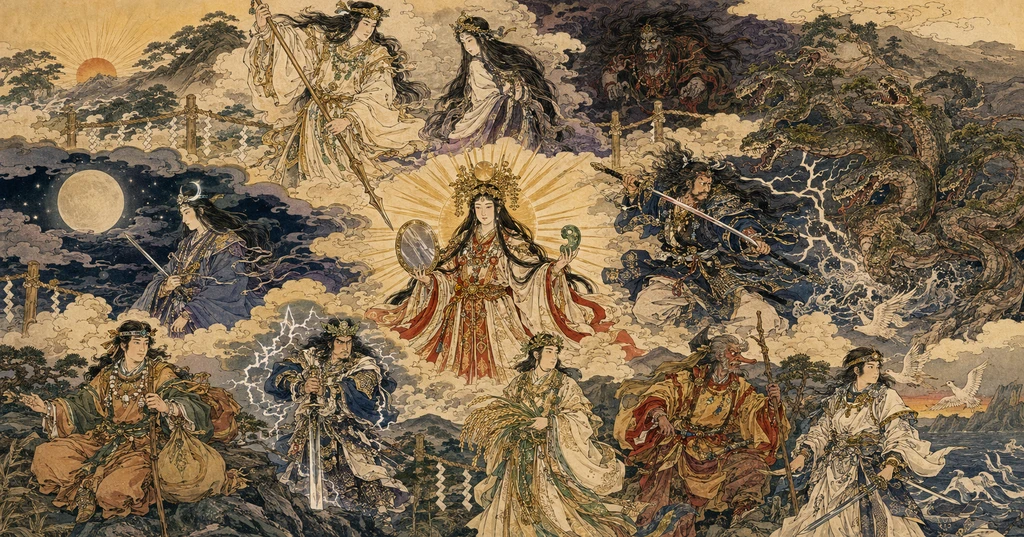
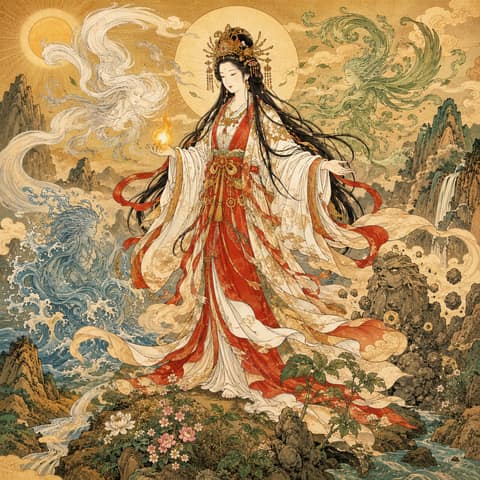
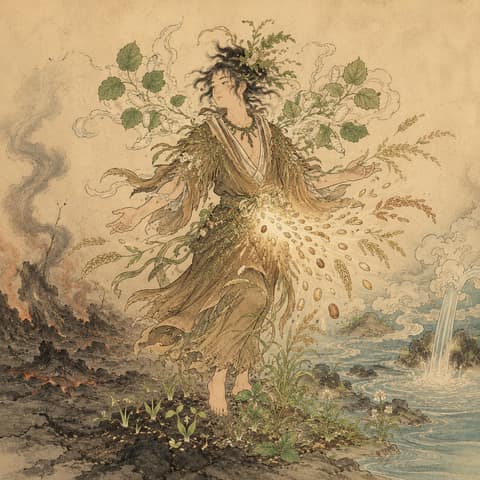
Izanami is the primordial goddess of creation in the Kojiki (712) and Nihon Shoki (720). Together with her husband Izanagi, she gives birth to Oyashima, the islands of Japan, and to many deities; she is the central female power of the myths of land-birth and god-birth[1][2]. In the Kojiki her name appears as Izanami no Mikoto and Izanami no Kami, while the Nihon Shoki writes it with the forms Izanami no Mikoto and Izanami no Kami using different characters. She appears with Izanagi as the final paired deity of the Seven Generations of the Age of the Gods. At the last stage of giving birth to lands and gods, she bears Kagutsuchi, the fire god, and dies after being burned in her genitals, becoming the first dead being in Japanese myth. After death she becomes queen of Yomi no Kuni, the land of the dead. When Izanagi comes to Yomi to retrieve her and sees her decaying body, she erupts in shame and rage, sending the Yomotsu-shikome, the eight thunder gods, and the armies of Yomi after him. At Yomotsu Hirasaka she curses him, declaring that she will kill one thousand people each day; Izanagi answers that he will cause fifteen hundred to be born each day. In this exchange, the order of life and death is fixed. Her burial places are variously identified with Mount Hiba between Izumo and Hoki, Hana no Iwaya in Kumano, Mie, and Ifuyazaka in eastern Izumo, Matsue. Hana no Iwaya Shrine in Kumano is especially famous: linked in the Nihon Shoki to Izanami's burial and the mythic stage of creation, it is counted among Japan's oldest shrines and forms part of the UNESCO World Heritage Site Sacred Sites and Pilgrimage Routes in the Kii Mountain Range.

Folklore & Legends

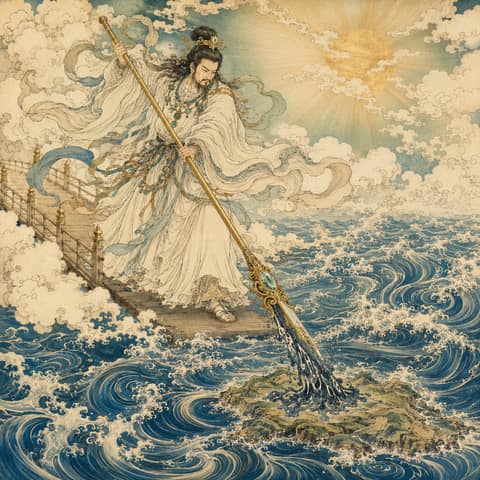
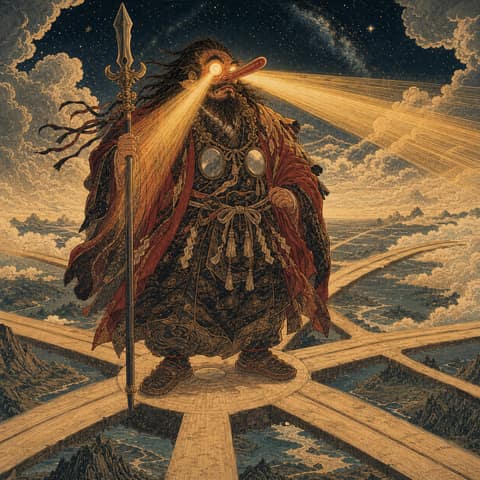
Goddess of land-birth and god-birth. According to the opening volume of the Kojiki, Izanami no Mikoto is born with her husband Izanagi no Mikoto as the final paired deity of the Seven Generations of the Age of the Gods. The heavenly gods command the two to solidify the drifting land. Standing on the Floating Bridge of Heaven, they stir the blue sea with the heavenly jeweled spear; the drops that fall from the spear harden into Onogoro Island. There the two descend, marry, and begin the births of land and gods. They give birth to the Oyashima islands, Awaji, Iyo, Oki, Tsukushi, Iki, Tsushima, Sado, and Honshu, and then to thirty-five deities of mountains, rivers, seas, wind, trees, and fields. Izanami is not a passive consort in this scene. She is the body through which lands and gods are born, an image of feminine principle and earth-mother power in ancient Japanese cosmology.

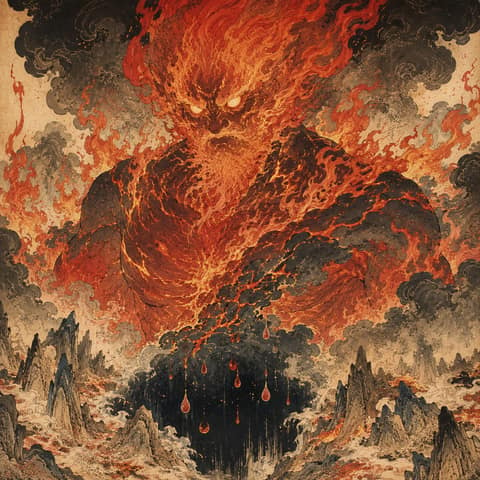
Kagutsuchi's birth and the first death in Japanese myth. At the final stage of land-birth and god-birth, Izanami gives birth to Kagutsuchi, the fire god. Burned by his fire, she falls ill and dies. The Kojiki says that even from her vomit, urine, and excrement as she suffers on her deathbed, deities of mines, earth, and grain are born, including Kanayamahiko, Kanayamahime, Haniyasuhiko, Haniyasuhime, and Wakumusubi. This is not merely a death scene, but a dense ancient image of death and new birth circling into one another. Izanami's death is the first death in Japanese mythology and becomes the tragic point from which later myths unfold: the birth and division of the Three Precious Children, the descent of the heavenly grandson, and the eastward expedition of Jinmu.

Burial places and the queen of Yomi. The Kojiki says that Izanami was buried on Mount Hiba, on the border of Izumo and Hoki, while one variant in the Nihon Shoki says she was buried in Kumano in Kii. These traditions create two major sacred geographies. The Izumo line includes Mount Hiba in Shobara, Hiroshima, Hiba-yama Kume Shrine in Yasugi, Shimane, and the Iwasaka imperial tomb reference site in Higashi-Izumo, Matsue. The Kumano line includes Hana no Iwaya Shrine in Kumano, Mie, and Kumano Hayatama Taisha in Shingu, Wakayama. The coexistence of Izumo and Kumano burial traditions forms one of the central debates in ancient Shinto geography. After burial, Izanami reigns in Yomi no Kuni, the land of the dead. Having eaten the food of Yomi, she can no longer return to Ashihara no Nakatsukuni, the world of the living.

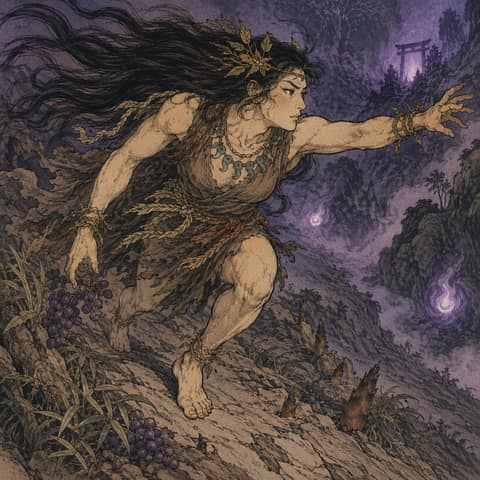
A broken taboo and the pursuit by the women of Yomi. Izanagi descends to Yomi to bring his wife back. Izanami tells him not to look at her while she consults with the gods of Yomi, but he loses patience, breaks a tooth from his comb, lights it, and sees her rotting body: maggots swarm, and the eight thunder gods cling to her flesh. Enraged that her shame has been seen, Izanami sends the Yomotsu-shikome, the eight thunder gods, and the armies of Yomi in pursuit of Izanagi. He flees, turning his black vine headband into grapes, his comb into bamboo shoots, and finally hurling three peaches to drive back the pursuers. At Yomotsu Hirasaka he sets down the great Chibiki rock and separates the world of the living from the world of the dead. There the two deities divorce. Izanami declares that she will kill one thousand people each day; Izanagi replies that he will cause fifteen hundred to be born. The order of life and death is born from this separation.

Hana no Iwaya Shrine, one of Japan's oldest sacred places. Hana no Iwaya Shrine in Kumano, Mie Prefecture, is explicitly linked in the Nihon Shoki to Izanami's burial and to the mythic stage of creation, and is counted among Japan's oldest shrines. It has no main sanctuary building; its sacred body is a forty-five-meter rock face looking toward the Kumano Sea. The enshrined deities are Izanami and Kagutsuchi, worshipped together as mother and child, a ritual form rooted in the myth of her death after giving birth to the fire god. During the great festivals on February 2 and October 2, local people hang a rope of about 170 meters from the top of the sacred rock to the southern corner of the precincts in the Otsunakage rite, designated an intangible folk cultural property of Mie Prefecture. The shrine is regarded as an origin point of Kumano faith, the "Kumano of the cavern," and remains a major ancient Shinto sacred site.

Rebirth in modern culture. Izanami's myth was studied philologically in the Edo period by Motoori Norinaga in his Kojiki-den, completed in 1798, and it became a central text for kokugaku and Japanese thought. In modern culture, motifs of Izanami, Yomi no Kuni, and the Yomotsu-shikome recur in works such as Shin Megami Tensei, Okami, Demon Slayer, and Record of Ragnarok. Her name has even been reused in the economic term "Izanami boom" for the 2002-2008 expansion. As queen of Yomi, mother, wife, and the divine subject of both birth and death, Izanami offers a layered image that remains important in twenty-first-century feminist myth studies and cultural criticism.

Related Yokai

Yokai deeply tied to this one in legend.

Detailed Analysis

The cycle of birth and death: the nature of an ancient mother goddess. The basic profile described Izanami's mythic role; the deeper issue is that she embodies birth and death in a single archaic mother figure. Izanami gives birth to the Oyashima islands and thirty-five nature deities, and even on her deathbed continues to produce gods of mines, earth, and grain from her vomit, urine, and excrement. This resembles the ambivalence of mother goddesses across the ancient world, such as Gaia in Greece, Inanna in Sumer, or Kali in India: the one who gives life also contains death. Izanami is more than a creator deity. She joins birth and death, the living world and the underworld, purity and pollution into one Japanese variation of the archaic mother goddess.

Kagutsuchi's birth and the symbolism of fire. Izanami dies because she gives birth to the fire god Kagutsuchi, an event of major symbolic force in ancient Japanese cosmology. Fire begins civilization: forging, pottery, cooking. Yet fire also brings destruction and death. In ancient societies, childbirth itself could threaten a woman's life, and the myth binds those dangers together. Kagutsuchi is born, Izanami dies, and from her dead or dying body arise deities of mines, earth, and grain. This chain makes the material foundations of civilization, metallurgy, agriculture, land-making, emerge from the sacrifice of the mother goddess. The myth gives a stark expression to an ancient worldview: civilization stands on the body of the mother.

Yomi no Kuni and the queen of the dead. After burial, Izanami reigns as queen of Yomi no Kuni. This is an unusual structure in ancient myth. Chinese underworlds are often ruled by male figures such as Fengdu or the Lord of Mount Tai; India has Yama, and Greece has Hades. In Japanese myth, however, the realm of the dead is ruled by the former creation goddess. Izanami's rule over Yomi shows the close ancient Japanese linkage of woman, death, and underworld. Later images of Enma, Jizo, and the Sanzu River grow in soil prepared by this imagination of the dead. The idea of death as a feminine principle is one of the most striking points for comparative religion.

The burial debate: Izumo and Kumano. The Kojiki names Mount Hiba, on the Izumo-Hoki border, as Izanami's burial place, while a variant in the Nihon Shoki names Kumano in Kii. The two traditions map onto two religious geographies. The Izumo line, Shobara in Hiroshima, Yasugi in Shimane, and Higashi-Izumo in Matsue, connects with Izumo ritual lineages and faith in Ne no Katasukuni. The Kumano line, Hana no Iwaya in Mie and Kumano Hayatama Taisha in Wakayama, connects with Kumano Sanzan worship, Fudaraku sea-crossing beliefs, and Pure Land imagination. Izumo lies to the north, facing the Sea of Japan; Kumano lies to the south, facing the Pacific. Together the two burial traditions form a core problem in the religious geography of ancient Japan.

Hana no Iwaya Shrine and ancient iwakura worship. Hana no Iwaya Shrine in Kumano, Mie, is named in the Nihon Shoki as Izanami's burial place and is one of Japan's oldest shrines; it has no shrine hall and worships a forty-five-meter sacred rock as its divine body. Iwakura worship is an old Japanese mode of nature veneration in which trees, boulders, waterfalls, and mountain peaks are treated as places where divine spirits dwell. Later shrine architecture grew out of such natural sacred places, and Hana no Iwaya preserves an especially ancient layer by having no main building. The Otsunakage rite, held on February 2 and October 2, hangs a rope about 170 meters long from the sacred rock to the precincts; it is a rare living folk practice that carries ancient rock worship into the present.

"One thousand a day, fifteen hundred a day": the cosmology of life and death. The exchange at Yomotsu Hirasaka is the moment when Japanese myth fixes the order of life and death. Izanami says she will kill one thousand people a day; Izanagi answers that he will cause fifteen hundred to be born. The scene is grief after marital separation, but also a cosmic declaration that death and life, underworld and this world, feminine and masculine principles will stand in permanent tension. Death counts one thousand; birth counts fifteen hundred. Life exceeds death. That inequality becomes a religious expression of life's continuation. Japanese myth does not remain a simple tragedy; it turns the dialectic of life and death into cosmology.

Izanami reevaluated in the twenty-first century. Postwar feminist myth studies and cultural criticism have moved beyond reading Izanami only as a victim of patriarchal myth. They also understand her as an embodiment of the ancient mother goddess who unites birth, death, and the underworld. Motoori Norinaga's Kojiki-den, completed in 1798, laid the philological foundation; later comparative mythologists such as Orikuchi Shinobu, Obayashi Taryo, and Yoshida Atsuhiko added new interpretive layers. In the twenty-first century, Izanami is no longer merely a mythic character. She has become an image of the feminine root of Japanese myth and of cosmic order as mother, continuing to shape religion, scholarship, and cultural imagination.

Character Profile

This section is our own creative profile for storytelling. It is not historical fact or scholarship.

Yokai Type
Kami
Rarity
Legendary
Personality
An ambivalent deity who unites creative maternity as the mother of lands and gods with the fierce power of the queen of Yomi. Through the pain of giving birth to Kagutsuchi, rage at Izanagi's broken taboo, grief of separation, and the curse that follows, she takes on the cosmic role of fixing the order of life and death.
Compatibility
Close to those drawn to land-birth, safe childbirth, bonds, Kumano faith, and feminine spirituality; to pilgrims of Hana no Iwaya, the Kumano Sanzan, Mount Hiba, and Izanagi Shrine; and to readers who approach ancient myth through the feminine principle.
Abilities
Gives birth to the land, creating the Oyashima islandsGives birth to gods, including thirty-five nature deities and posthumous gods of mines, earth, and grainBecomes the first dead being in Japanese myth through the birth of KagutsuchiRules Yomi no Kuni, the land of the dead, as its queenSends the Yomotsu-shikome, eight thunder gods, and armies of Yomi after IzanagiFixes the order of life and death with the curse to kill one thousand people a dayManifests local sacred power as Kumano Fusumi and Hiba-related deities
Weaknesses
Mortally wounded while giving birth to Kagutsuchi; shamed when Izanagi breaks the taboo and sees her decaying body; unable to return to the living world after eating the food of Yomi; blocked from the world of the living by the Chibiki rock at Yomotsu Hirasaka and by the apotropaic power of peaches.
Habitat
Yomi no Kuni; Yomotsu Hirasaka, traditionally linked to Iya in Higashi-Izumo, Matsue; Hana no Iwaya Shrine in Kumano, Mie; Kumano Hayatama Taisha in Shingu, Wakayama; Mount Hiba in Shobara, Hiroshima; Hiba-yama Kume Shrine in Yasugi, Shimane; Izanami-line shrines throughout Japan; and the wider Kumano Sanzan faith sphere.
🔮Yokai Compatibility Test

For more detailed information and diagnosis results about Izanami no Mikoto, Ancient Mother Goddess of Birth and Death, please click here.

Sources & References

4
  1. 古事記太安万侶((現存最古の日本神話典籍), 和銅 5 年 (712)) [古典文献] Reference和銅 5 年 (712) 太安万侶が献上した日本最古の神話典籍。上巻にヤマタノオロチ退治譚を収め、形態描写・八塩折之酒の罠・天叢雲剣出現・須佐之男とクシナダの結婚・須賀の歌等を具体的に記す。國學院大學古事記学センターによる校訂本文・現代語訳が公開されている。
  2. 日本書紀舎人親王ら((養老4年成立の正史), 720) [古典文献] Reference推古天皇三十五年二月条に、陸奥国の狢が人に化けて歌ったという記事を含む。狸・狢系の獣変化を考える際の古い記録。
  3. 花の窟神社 (世界遺産「紀伊山地の霊場と参詣道」)三重県熊野市·花の窟神社(三重県熊野市井戸町, 『日本書紀』 (720 年) に「国生みの舞台」 として明記·世界遺産登録 2004 年) [世界遺産·無形民俗文化財]三重県熊野市の花の窟神社は『日本書紀』 神代第一に「イザナミの葬地·国生みの舞台」 として明記される日本最古の神社の一つで、 熊野灘に面した高さ 45m の巨大磐座を御神体とする社殿無き古社。 祭神はイザナミとカグツチ (母子神祭祀)。 毎年 2 月 2 日·10 月 2 日の例大祭で奉される「お綱掛け神事」 (磐座上から境内南隅に約 170m の大綱を掛ける儀礼) は三重県無形民俗文化財に指定。 熊野三山信仰の元宮·「窟の熊野」 として 2004 年に世界遺産「紀伊山地の霊場と参詣道」 に登録された。
  4. 古事記伝 (全 44 巻)本居宣長((江戸期国学の代表的注釈書、 没後 1822-1825 年に整版刊行), 1798 (寛政 10 年完成)) [学術注釈書] Reference江戸期国学の大成者·本居宣長 (1730-1801) が 35 年の歳月をかけて完成させた『古事記』 注釈書。 全 44 巻。 古代日本語の音韻·語彙·神名·神話譚を文献学的·言語学的に厳密に注釈し、 国学の中核として近世·近代日本思想を駆動した不朽の名著。 イザナギ·イザナミ·三貴子等の創世神話を含む古事記全文を解読する基礎文献。

Interested in this type of yokai?

Discover the yokai most similar to your personality with our yokai diagnosis

Start Yokai Diagnosis

Meet your guardian yokai at the shrine

Draw an omikuji fortune and discover the yokai watching over you today.