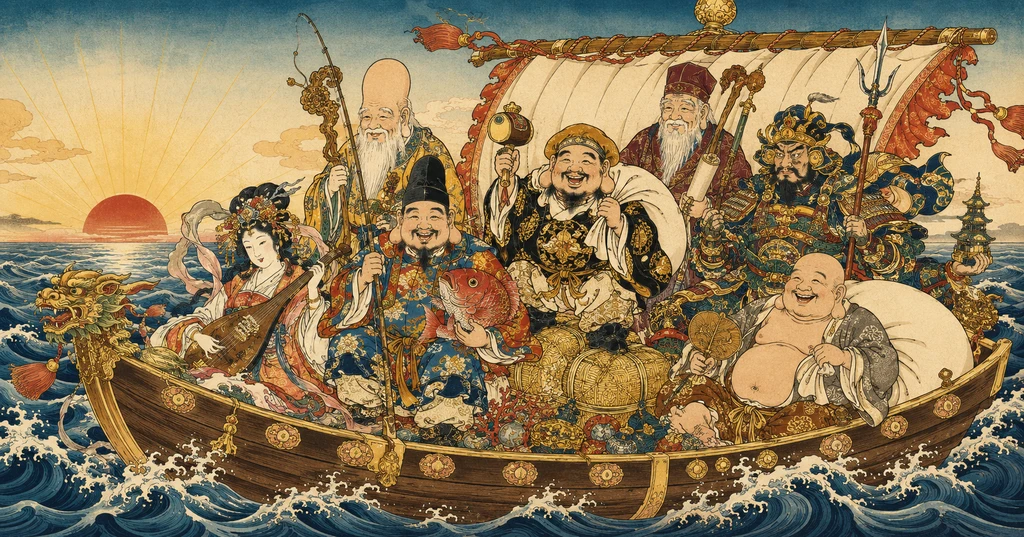
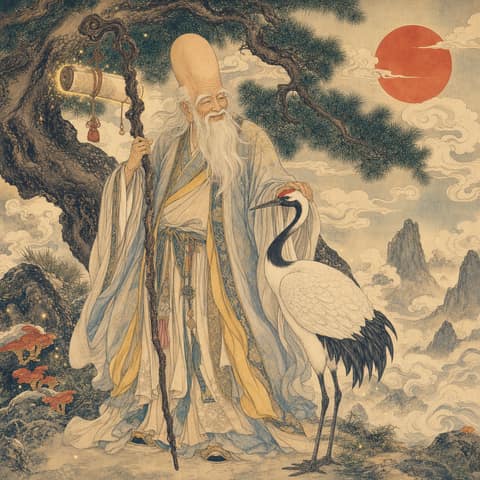
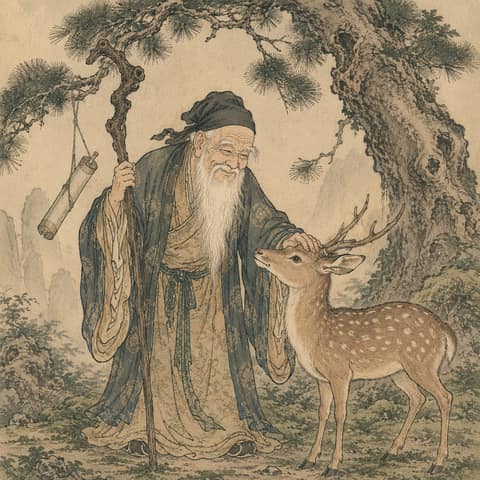
Fukurokuju is the anthropomorphic deity that integrates the three Daoist stars of China (the Gods of Fortune, Wealth, and Longevity) into a single body[1]. Among the three, the Star of Longevity (the Old Man of the South Pole = Canopus[2]) is an ancient astronomical deity recorded in the astronomical chapters of the "Records of the Grand Historian" and the "Book of Jin," and a year in which it could be seen was said to augur world peace. The Star of Fortune was associated with Jupiter, and the Star of Wealth with the Wenchang star of the Big Dipper. Although each initially had its own independent following, the "Sanxingtu" (Three Stars Image), depicting them together, was established in the Song dynasty and popularized as New Year decorations for the masses throughout the Ming and Qing dynasties. The singular deity Fukurokuju is the anthropomorphized amalgamation of these three stars. Multiple origin tales coexist, including the theory that he is the incarnation of the Song Daoist Tiannanxing[3], and the theory that he is the incarnation of the Old Man of the South Pole himself. His iconography depicts him as short in stature with an unusually elongated head, bearing a long white beard, attaching a scroll to the head of his staff, and accompanied by a crane or turtle. This is the epitome of Daoist iconography: the "short body and long head" are physical auspices of long life, the scroll signifies the mastery of the Dao, and the crane and turtle represent auspicious beasts of longevity. Introduced to Japan in the late Muromachi period (15th century) likely through Zen monks' travels to China and imported Daoist-Buddhist paintings, the Zen and painter-monk circles of the Higashiyama culture period[5] reorganized him into the "Seven Gods of Fortune and Virtue." By combining the already indigenized Ebisu, Daikokuten, Bishamonten, and Benzaiten with the fellow imported deities Hotei and Jurojin, they grouped them as the seven fortune deities styled after the Seven Sages of the Bamboo Grove—the prototype of the current Seven Lucky Gods. Fukurokuju's inherent dilemma lies in the problem of being the same entity under a different name as Jurojin; since both are incarnations of the Old Man of the South Pole, theories considering them the same deity have existed since ancient times. Although early modern popular encyclopedias like Kaibara Ekken's "Yamato Koto Hajime" list them as distinct entities, irregular Seven Lucky Gods variations replacing Jurojin with Kisshoten, Fukusuke, or Inari also circulated in Edo period Takarabune paintings. Because Fukurokuju simultaneously presides over three virtues (descendants, wealth, and longevity), he was favored for family celebrations by merchants and samurai. For longevity prayers by the clergy, however, Jurojin was often chosen. Their division of roles loosely converged in the late early-modern period as "the comprehensive fortune deity of the secular world (Fukurokuju)" and "the ascetic deity of longevity (Jurojin)."
Character Profile
This section is our own creative profile for storytelling. It is not historical fact or scholarship.
Yokai Type - Kami
Category - Deities & Divine Spirits
Rarity - Legendary
Personality - A serene, silent old man who watches over others with a smiling face. Showing no intense emotions, he possesses the disposition of a grandfather looking after his descendants.
Compatibility - Highly compatible with those praying for family harmony and the prosperity of their descendants, as well as those seeking both longevity and financial fortune. Because he and Jurojin share the same origin, enshrining them side-by-side causes their energies to overlap; traditional etiquette dictates choosing one or enshrining them with distinct roles.
Abilities - Bestowal of Three Virtues (Simultaneously blessing with descendants, wealth, and longevity)Resonance with the Old Man of the South Pole (Calling forth signs of world peace)Guidance of Crane and Turtle (Accompanied by auspicious beasts symbolizing longevity)Chanting of the Scroll (Warding off disasters with the scroll tied to his staff)
Weaknesses - The issue of sharing an identity with Jurojin (enshrining them together is said to make it difficult for either's virtues to manifest). It is also said that prayers greedily demanding too much of all three virtues are ironically less likely to be answered.
Habitat - Zen and Obaku sect temples, Seven Lucky Gods Takarabune paintings, the bedside on New Year's Day, and various Seven Lucky Gods pilgrimage sites in the Kanto and Kinki regions.