From Kubera to Vaiśravaṇa: Over a Millennium of Cultural Evolution. While the basic description touches upon Bishamonten's primary attributes, this comprehensive exposition delves into the thousand-year cultural evolution from the ancient Indian Kubera to the modern Japanese Bishamonten. Kubera was an important deity in ancient Indian mythology, serving as the Hindu god of wealth, guardian of the north, and lord of the Yakshas[1]. After being adopted into Buddhism, he became the Dharma protector Vaiśravaṇa and spread to Central Asia, China, and Japan. In each cultural sphere, he underwent unique semantic transformations. In Japan, this produced a multifaceted lineage of faith: the Shigisan Engi involving Prince Shotoku, national protection during the Heian period, victory prayers of Sengoku warlords, and his inclusion among the Seven Lucky Gods in the Edo period. He is a quintessential example of a single deity evolving across centuries and multiple cultural spheres.
The Privileged Position of Tamonten in the Four Heavenly Kings System. In Buddhist cosmology, the Four Heavenly Kings—Jikokuten (East), Zochoten (South), Komokuten (West), and Tamonten (North)—guard the four directions on the slopes of Mount Sumeru. Bishamonten, equivalent to Tamonten, is the only one among them to be worshipped independently as the most highly revered figure. This is the result of Kubera's original high status (as god of wealth and northern guardian) in ancient India being preserved even after his adoption into Buddhism. While Shitenno-ji (established by Prince Shotoku in 593) served as the fundamental training ground for Buddhist state religion enshrining all four kings, Bishamonten (Tamonten) independently developed his own following, leading to the formation of temple networks centered around Shigisan, Kurama, and Todai-ji. This dual nature of being both "one of the Four Heavenly Kings" and an "independent deity" is the defining characteristic of Bishamonten worship.
The Shigisan Engi and Prince Shotoku: The Origin Myth of Japanese Buddhist State Religion. The founding legend of Shigisan Chogosonshi-ji—where Prince Shotoku received a secret treasure of victory from Bishamonten on the year, day, and hour of the Tiger during his campaign against Mononobe no Moriya—is a representative example of the origin myth of Japan's Buddhist state religion[2]. The Battle of Shigisan in 587 was Japan's first religious war over the acceptance of Buddhism, pitting Soga no Umako and Prince Shotoku (pro-Buddhism) against Mononobe no Moriya (Shinto/anti-Buddhism). The victory of the Soga faction solidified the acceptance of Buddhism in Japan. The legend of Bishamonten appearing as the guardian of victory at this historical juncture acts as a religious narrative device that grounds the origin of Japan's Buddhist state religion in Bishamonten worship. The association between the tiger and Bishamonten developed uniquely in Japan stemming from this very legend.
Kurama-dera and the Legend of Minamoto no Yoshitsune: The Evolution of Heian Faith. Kurama-dera in Sakyo Ward, Kyoto, is an ancient temple founded in the early Heian period (traditionally in 770 by Gantei) with Bishamonten as its principal deity, tasked with protecting the north of Heian-kyo and defending the nation. The National Treasure standing statue of Bishamonten (early Heian period) is one of the pinnacle works of Japanese Bishamonten sculpture and a vital cultural asset in ancient sculptural history. Kurama-dera later became the stage for hero legends, such as Minamoto no Yoshitsune (Ushiwakamaru) learning swordsmanship on Mount Kurama from Tengu (considered familiars of Bishamonten), establishing it as a crucial sacred site for samurai faith and heroic lore from the late Heian to early Kamakura periods. This is a prime example of Bishamonten worship expanding from ancient state religion to medieval samurai culture.
Uesugi Kenshin: The "Bi" Banner and the God of War. The apex of Bishamonten worship in Sengoku Japan was Uesugi Kenshin (1530-1578), the powerful daimyo of Echigo. Born in the Year of the Tiger and named "Torachiyo," Kenshin believed he was the reincarnation of Bishamonten, riding into battle under a banner bearing the single character "Bi" (毘). The Bishamon Hall at Kasugayama Castle (present-day Joetsu City, Niigata) formed Kenshin's religious core, where he held prayers during crucial moments before deployments, after victories, and during peace treaties. This stands as a representative example of the trinity of religion, military might, and politics in the Sengoku period, showcasing the typical religious individuality of warlords, comparable to Takeda Shingen's devotion to Fudo Myoo or Oda Nobunaga's reverence for a syncretic Namban deity.
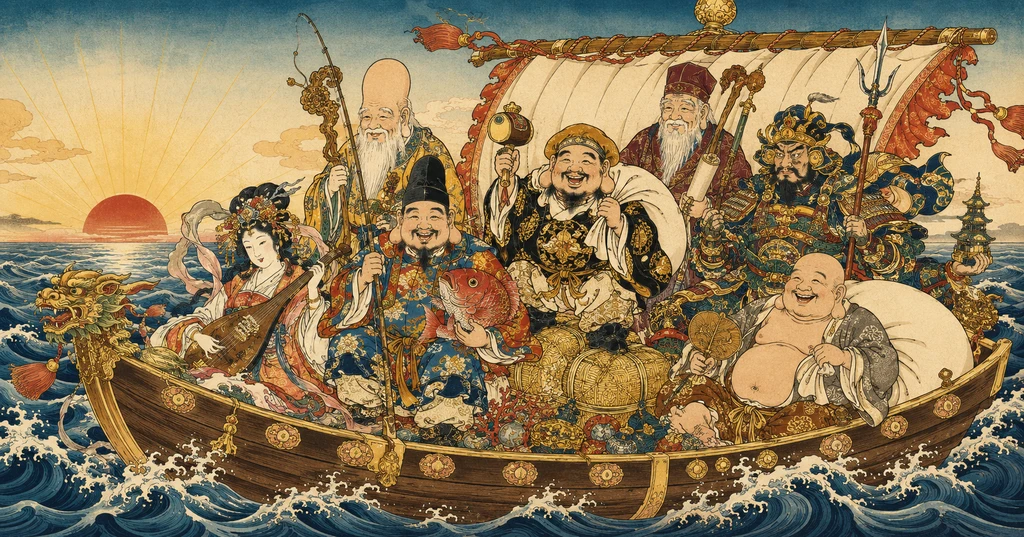
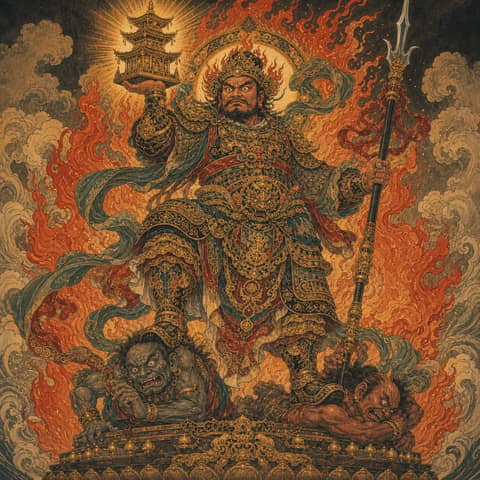
Incorporation into the Seven Lucky Gods and Edo Popular Faith. In the late Muromachi period, the worship of the Seven Lucky Gods was established, and Bishamonten was included as the armed deity of fortune presiding over "martial luck, victory, and wealth." While the other members of the Seven Lucky Gods are depicted with gentle appearances, Bishamonten is the only one who retains his fully armed guise (armor, pagoda, baton, trampling a demon), giving him a unique presence within this belief system. In the Edo period, Bishamonten played an important role in Takarabune (treasure ship) paintings, New Year's Seven Lucky Gods pilgrimages, and prayers for business prosperity and academic success. He became the core of popular religious culture that aggregated multiple layers of heritage: the ancient Indian wealth god Kubera, the protector of the Heian state, the victory deity of Sengoku warlords, and the popular lucky god of the Edo period.
Bishamonten in the 21st Century: Modern Continuity of Multifaceted Faith. Today in the 21st century, Bishamonten is a rare deity that bears a six-stage multifaceted heritage: (1) wealth and northern guardian from ancient India, (2) Tamonten of the Buddhist Four Heavenly Kings, (3) victory guardian of Prince Shotoku and the Shigisan Engi, (4) the faith of Sengoku warlords like Uesugi Kenshin, (5) the armed lucky god of the Edo Seven Lucky Gods, and (6) the modern deity answering prayers for business, exams, and sports victories. He is devoutly worshipped at Shigisan Chogosonshi-ji, Kurama-dera, Todai-ji, and Bishamonten temples and shrines nationwide. Furthermore, he is continuously reimagined in subculture works (such as the games "Nobunaga's Ambition," "Sengoku BASARA," "Megami Tensei," and the manga "Demon Slayer: Kimetsu no Yaiba"). He remains a symbolic figure of Japanese Buddhism, religion, and samurai culture, embodying the unbroken continuity of cultural heritage from antiquity to the present day.
Character Profile
This section is our own creative profile for storytelling. It is not historical fact or scholarship.
Yokai Type - Kami
Category - Deities & Divine Spirits
Rarity - Legendary
Personality - A multifaceted divine persona spanning over a millennium, integrating the fierce protectiveness embodied in his majestic armed guise (wearing armor, holding a pagoda and baton, trampling a demon), the reliable martial guardianship fervently trusted by historical heroes like Prince Shotoku and Uesugi Kenshin, and the compassionate benevolence that brings fortune, wealth, and prosperity as one of the Seven Lucky Gods.
Compatibility - Deeply compatible with those seeking martial fortune, victory, business prosperity, academic success, athletic triumphs, new business ventures, family safety, and longevity. Also resonates with those who visit Shigisan Chogosonshi-ji, Kurama-dera, Todai-ji, and Bishamonten temples nationwide; those who revere tigers; those who inherit the faith of Sengoku warlords; and those who appreciate his cultural evolution from ancient India to the modern era.
Abilities - The power of wealth and northern guardianship derived from ancient India's KuberaWorld protection as the northern Tamonten in the Buddhist Four Heavenly Kings systemWarding off evil and granting victory by trampling demons and wielding the treasure pagoda and batonBestowal of secret victory treasures as seen in the legend of Prince Shotoku and Shigisan EngiVictory guardianship for Sengoku warlords like Uesugi Kenshin, Takeda Shingen, and Toyotomi HideyoshiUnique animal faith employing the tiger (Tora) as a messenger and familiarMartial and victory-granting divinity through his unique armed appearance among the Seven Lucky GodsIntervention in heroic lore, such as the legends of Kurama-dera and Minamoto no Yoshitsune
Weaknesses - The end of warlord faith (the dilution of samurai devotion after the Edo period), the simplification of his divinity due to the complete disappearance of the true nature of Kubera as an ancient Indian wealth god, the reduction of his sanctity through post-war secularization and commercialization, and the trivialization of his godhood through subcultural adaptations.
Habitat - Shigisan Chogosonshi-ji in Heguri, Nara Prefecture; Kurama-dera in Sakyo Ward, Kyoto; Todai-ji (Great Buddha Hall) in Nara City; Shitenno-ji in Tennoji Ward, Osaka; the ruins of Kasugayama Castle in Joetsu City, Niigata (Uesugi Kenshin's Bishamon Hall); Bishamonten temples and shrines nationwide; Seven Lucky Gods pilgrimages; New Year's Takarabune paintings; academic success prayer sites; household altars in merchant businesses and corporations; and modern subcultural spaces.