"Ebisu" as an Ancient Japanese Belief in the Sea and the Otherworld. While the basic description touches upon the two major origin theories of Ebisu, a thorough analysis reveals the deep layers of "Ebisu" as an indigenous ancient Japanese belief in the sea and the otherworld. The fact that "ebisu" and "emishi" share the same etymology indicates that ancient Japanese collectively referred to beings arriving from "beyond, the otherworld, or boundaries" as "ebisu," finding abundance, fortune, and auspiciousness in them[1]. As a representative example of the "visiting deity (Marebito)" belief systematized by Shinobu Orikuchi, it forms the core of widespread otherworldly and abundance beliefs in ancient Japan.
The Hiruko Myth ── The Narrative Archetype of Deformity, Exile, and Rebirth. The Hiruko myth passed down in the *Kojiki* and *Nihon Shoki*[1] (a deformed child set adrift in a reed boat who is reborn as a deity of abundance in a foreign land) is a representative example of the narrative archetype of "deformity, boundaries, and rebirth" in ancient Japan. The process by which Hiruko washed ashore in Nishinomiya and gained the reverence of fishermen to become Ebisu is the result of this universal religious motif uniquely developing in connection with Japan's indigenous marine and fishing culture.
The Kotoshironushi Myth ── The Origin of Ebisu in the Land Transfer Myth. Kotoshironushi, the eldest son of Okuninushi, is a crucial deity who negotiated with Takemikazuchi on his father's behalf in the land transfer myth[2]. The process of Kotoshironushi, who was fishing at Mihogasaki, hearing of the messenger's arrival and advising his father to accept the transfer is a religious expression of the political integration of the center (Amatsukami) and the regions (Kunitsukami) in ancient Japan. The concrete image of a fishing deity flowed directly into the later iconography of Ebisu holding a sea bream and a fishing rod.
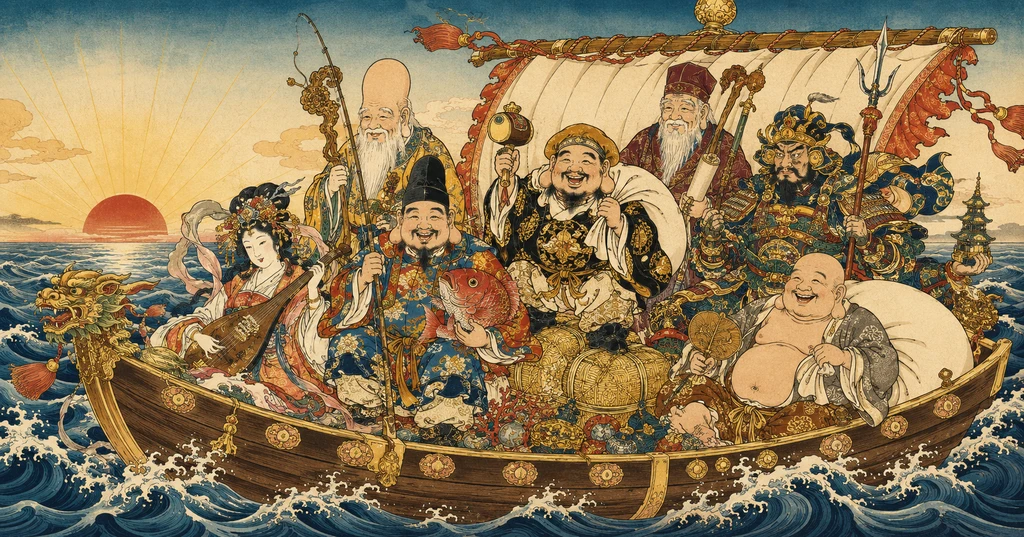
Coexistence of Two Major Origin Theories ── Hiruko and Kotoshironushi Lineages. The fact that the two major origin theories—Hiruko (Nishinomiya Shrine lineage) and Kotoshironushi (Miho Shrine lineage)—coexist and have been passed down without being completely unified demonstrates the flexibility and plurality of Japanese religious culture. The Edo period Seven Lucky Gods faith integrated both lineages under the common name "Ebisu-sama," and the common people affectionately embraced him as the "god who brings business prosperity and fortune" without strictly distinguishing between the two.
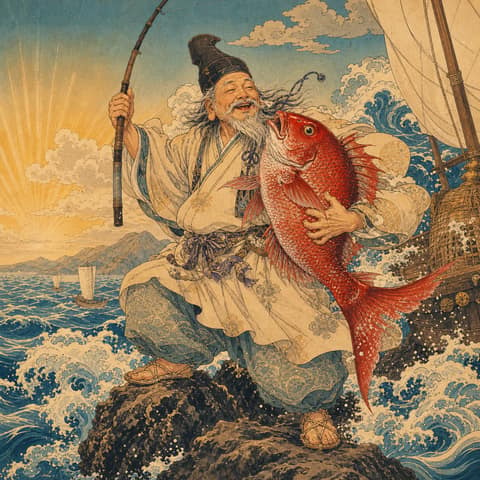
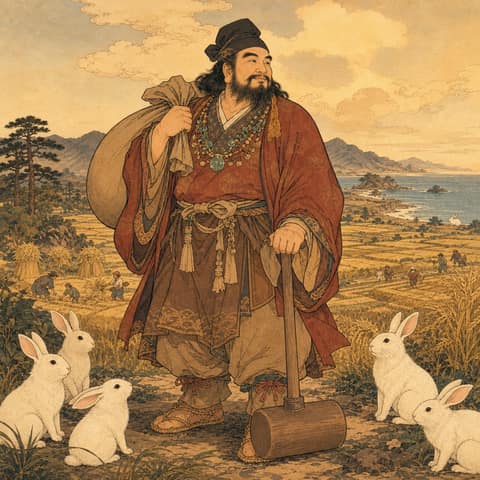
Sea Bream, Fishing Rod, Smile ── Medieval and Early Modern Iconography. The modern image of Ebisu (sea bream, fishing rod, smile, ori-eboshi, kariginu) is a culmination of unique designs established in medieval and early modern Japan. (1) The sea bream is a symbol of ancient Japanese fishing, commerce, auspiciousness, and the color red. (2) The fishing rod is a symbol of ancient fishing, rituals, and the Kotoshironushi myth. (3) The smile (Ebisu face) is an expression of gentleness common to gods of fortune since the Middle Ages. (4) The ori-eboshi and kariginu visually emphasize Ebisu's uniqueness as a "fortune god unique to Japan."
Toka Ebisu ── The Festival Culture of Edo Period Commoner Faith. The Toka Ebisu in Kansai (January 9-11) is a representative Ebisu festival established in the Edo period, held on a large scale at places like Imamiya Ebisu, Nishinomiya Shrine, and Kyoto Ebisu Shrine[3]. The accompanying chant "Bring a bamboo branch for business prosperity" and the conferment of lucky charms like the fuku-zasa support the collective prosperity prayers of merchants, restaurants, and individual worshipers.
Ebisu in the 21st Century ── Urban Culture and Modern Prosperity Prayers. Today, Ebisu is widely embraced as the principal deity for Japanese commerce, dining, fishing, navigation, and new business prayers. The place name "Ebisu" around Ebisu Station in Shibuya, Tokyo, originated from the YEBISU Beer factory in the Meiji era and enjoys nationwide fame as a symbolic name for modern urban culture and commercial districts. Repeatedly reshaped in subculture works, he represents a prime example of ancient marine and otherworldly beliefs transforming into a modern Japanese pop icon.
Character Profile
This section is our own creative profile for storytelling. It is not historical fact or scholarship.
Yokai Type - Kami
Category - Deities & Divine Spirits
Rarity - Legendary
Personality - Gentle, Prosperous, Business Prosperity, Abundance Prayer, Rebirth in a Foreign Land
Compatibility - Those praying for business prosperity, fishing, navigation, new ventures, the restaurant industry, merchants, and store openings; those who visit Nishinomiya Shrine, Miho Shrine, Imamiya Ebisu Shrine, and Kyoto Ebisu Shrine; those who inherit the Toka Ebisu, treasure ship paintings, and Seven Lucky Gods pilgrimages; and those who resonate with ancient beliefs in the sea, the otherworld, and visiting deities.
Abilities - Arrival from the sea, the otherworld, and boundaries bringing abundanceConnection with the sea bream (ancient Japanese symbol of auspiciousness, red, and high-class fish)Dominion over the sea via the fishing rod (ancient fishing, Kotoshironushi myth)Guardianship of business prosperity, restaurants, and merchantsProtection of fishing, navigation, and maritime safetyWisdom and political judgment of Kotoshironushi in the land transfer myth (Kotoshironushi lineage)Power of rebirth in a foreign land in the Hiruko myth (Hiruko lineage)Core of collective prosperity prayers as the central figure of Toka Ebisu, treasure ship paintings, and the Seven Lucky Gods
Weaknesses - Dilution of singular divine identity due to the coexistence of two major origin theories (confusion between Hiruko
- Kotoshironushi lineages), dilution of indigenous pre-medieval beliefs due to incorporation into the Seven Lucky Gods in the Edo period, reduction of sacredness due to post-war secularization and commercialization
Habitat - Nishinomiya Shrine in Nishinomiya, Hyogo (Head of the Hiruko lineage); Miho Shrine in Matsue, Shimane (Head of the Kotoshironushi lineage); Imamiya Ebisu Shrine in Naniwa, Osaka; Kyoto Ebisu Shrine in Higashiyama, Kyoto; Ebisu Shrine in Shibuya, Tokyo; over 3,500 Ebisu shrines nationwide, Seven Lucky Gods pilgrimages, merchant altars, restaurants, and modern urban cultural spaces