Ao-andon
Ao-andon in Toriyama Sekien’s Hyakki Yagyō Shūi
Dwelling / ArtifactEdo-period Hyakumonogatari literature and the printed imagery of Toriyama Sekien’s Konjaku Hyakki Shūi
Ao-andon is a yokai of the printed page, formed where the blue-paper lantern used in Hyakumonogatari gatherings meets the strange figure Toriyama Sekien drew in his early modern collection of yokai images. Its earliest documented named appearance is in the middle volume, "Mist," of Hyakki Yagyō Shūi, prefaced in 1781. The title slip calls the work Konjaku Hyakki Shūi, while its preface title gives Hyakki Shūi; the same work has come down under more than one title. Ao-andon occupies the right-hand page of a double-page spread and is an independent entry, with its own heading and explanatory note, separate from the Ameonna on the left.
The device of telling ghost stories beside a lantern covered in blue paper appears in literature before Sekien. Asai Ryōi’s Otogibōko, book 13, "To Tell of the Strange Is to Invite the Strange," was first published in 1666. In the text of an edition published in 1699, a single lantern is covered in blue paper and fitted with one hundred wicks; one wick is removed after each tale. Yet that gathering is interrupted by a strange occurrence before it reaches a hundred stories, and it features neither a horned figure nor the yokai name Ao-andon. It is prehistory for the apparatus of Hyakumonogatari, not the first appearance of Ao-andon itself.
Sekien’s note relates that when a lamp seems about to go out, then brightens again, and its shadows tremble and darken, something called Ao-andon may appear. It goes on to explain that people who hold Hyakumonogatari gatherings have long covered their lanterns in blue paper, and cautions that telling of demons in the night invites the strange. It says nothing of a hundredth tale, a final wick, total darkness, or an appearance that is inevitable. Accounts of Hyakumonogatari include strange events around the ninety-ninth tale, events after all one hundred tales have been told, and even stories that turn to laughter when a supposed monster proves to be a dog’s or a person’s leg. Nor is there evidence of a universal rule requiring participants to stop at ninety-nine.
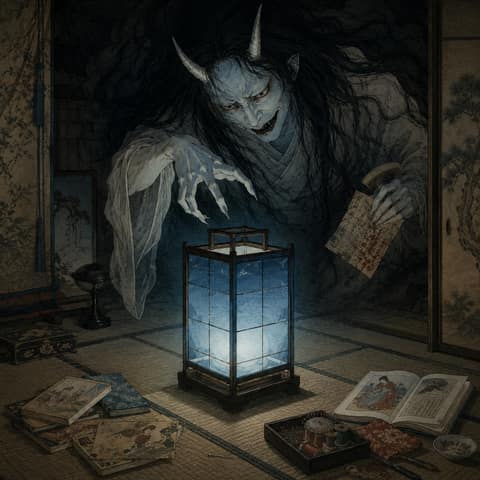
The figure in the illustration has long hair, two hornlike projections on its head, and darkly rendered teeth. Inside the lantern, whose front frame has been removed, are an oil dish and wicks; on the floor lie a box, papers, and slender objects that may suggest combs or hairpins. Sekien’s note does not identify them as love letters or sewing tools, however, and it tells no story of a jealous wife, a husband’s betrayal, or a vengeful grudge. Its personality, purpose, victims, attacks, speech, weaknesses, and means of exorcism are unknown.
Later yokai dictionaries and creative works have portrayed Ao-andon as a demon woman who stands at the culmination of Hyakumonogatari, gathers fear, or judges ghost stories. Those images are a rich reception history generated by Sekien’s spare single page, but they must be read apart from the Edo-period note itself. The repeated incorporation of early modern yokai imagery into modern creative work is one reason Ao-andon has acquired further layers in each era. The historical record does not identify a specific place of origin, sighting, shrine, or rite, and Edo is not treated as the location of a regional tradition.