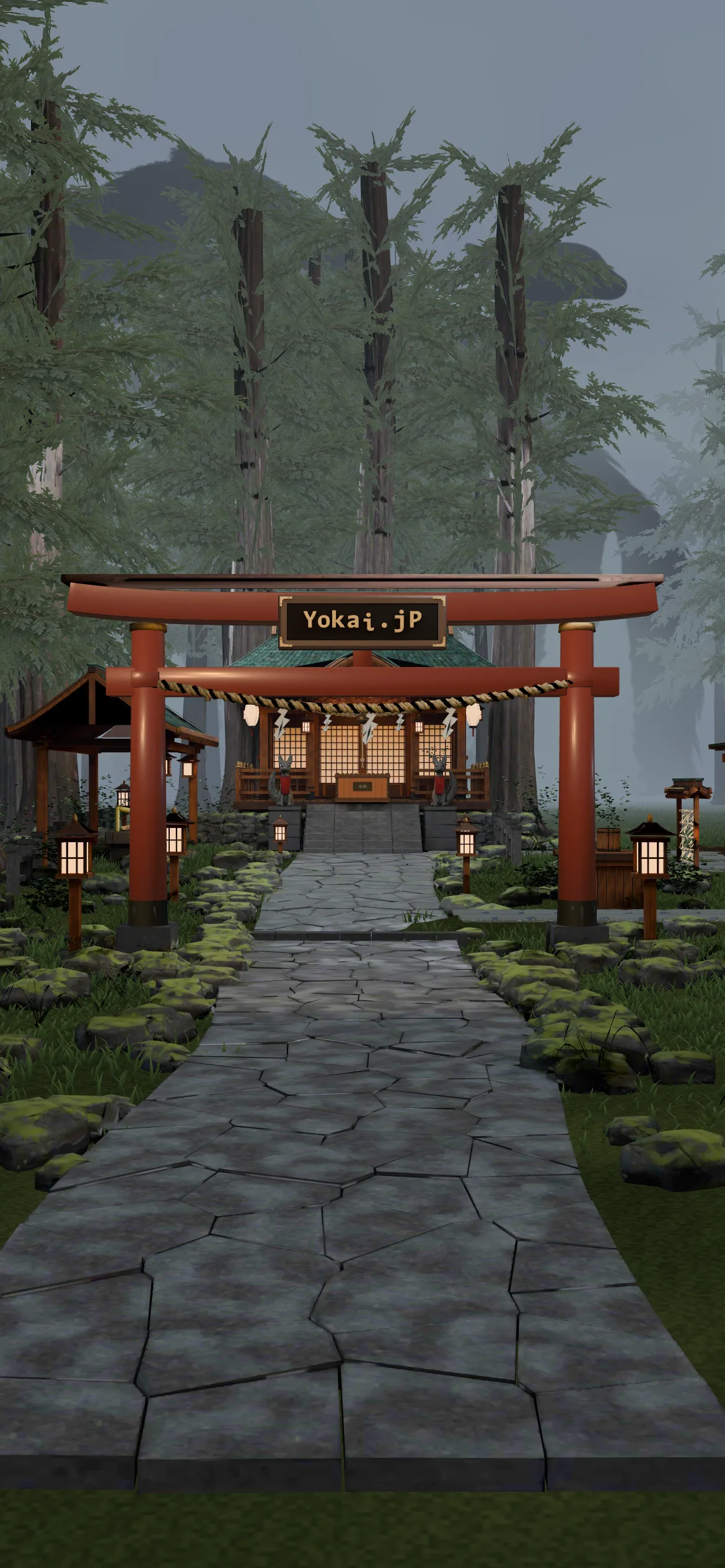
At a Japanese shrine you first purify your hands and mouth at the basin, then go to the worship hall. Yokai Shrine's basin and hall walk you through the same steps, one at a time.
Purifying at the basin
- Take the ladle in your right hand and scoop up water.
- Pour water over your left hand.
- Move the ladle to your left hand and pour water over your right.
- Take it in your right hand again, pour water into your cupped left palm and rinse your mouth. Never touch the ladle with your lips.
- Rinse your left hand once more.
- Tilt the ladle upright so the last of the water runs down the handle, then put it back.
The water is poured away beside the basin, never back into it. Doing everything with the first ladleful is considered the graceful way.
At the worship hall (two bows, two claps, one bow)
- Bow lightly before the hall and make your offering.
- Ring the bell.
- Bow deeply twice.
- Put your hands together at your chest and clap twice.
- Keeping your hands together, pray silently.
- Finish with one deep bow.
Two bows, two claps and a bow is the most common form, but some shrines differ: at Izumo Taisha, for example, you clap four times.
Praying at Yokai Shrine
At the hall you choose an offering of 5, 15 or 50 mon in Yosen and what you pray for: a wish fulfilled, good relationships, work, prosperity, health or studies. In Japanese, five (go-en) sounds like 'a bond', and the 15 and 50 offerings play on the same old pun. Once you have prayed, you can draw an omikuji and write an ema that day.
Questions
- How much should I offer?
- There is no set amount. Many people offer a 5-yen coin because go-en also means a bond or connection, and Yokai Shrine's 5 mon follow the same play on words. What matters is the gratitude and the wish, not the sum.
- Why not walk in the middle of the approach?
- The centre of the approach, called seichū, is said to be the path of the kami. Visitors traditionally keep to one side.
- Why rinse the mouth at the basin?
- It is a simplified form of misogi, the purification once done by bathing in a river or the sea.
- Can I visit at any time?
- Yokai Shrine never closes. The grounds follow Japan time through morning, day, evening and night, and the medallion at the top right lets you change the hour yourself.