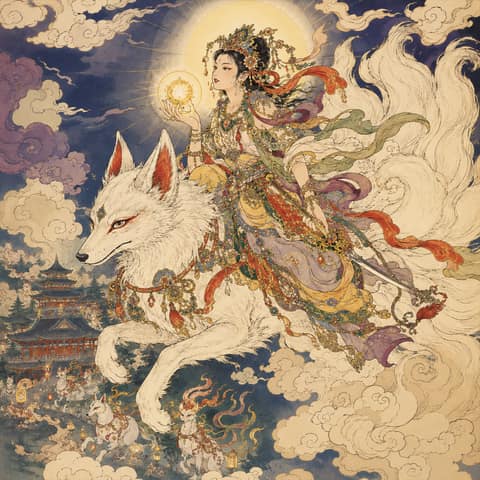
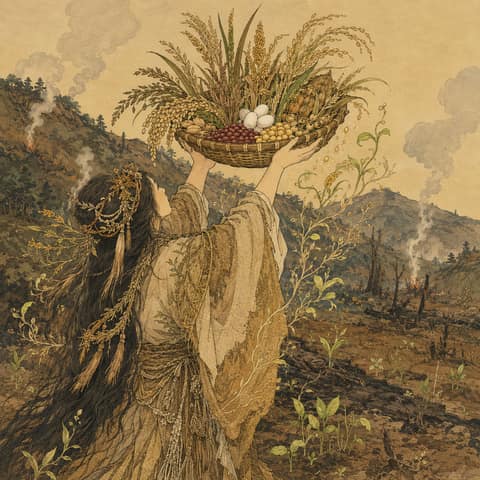

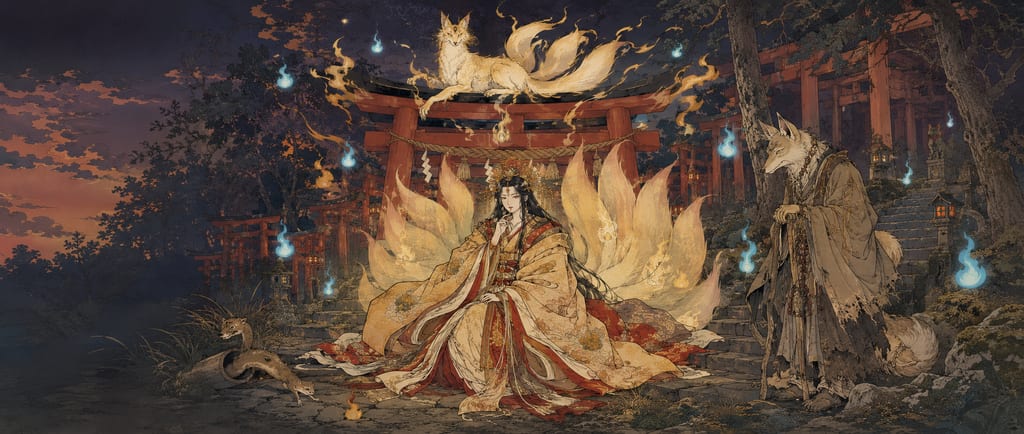
The principal deity of Inari, Ukanomitama-no-Kami (also known as Ukanomitama-no-Mikoto)[1], is a goddess of grain and food appearing in the first volume of the "Kojiki" (712). The name combines "Uka" (ancient word for food) and "Mitama" (spirit), preserving its simple folk origin as the "personification of spiritual power dwelling in grains." The head shrine, Fushimi Inari Taisha[2] (Mount Inari, Kii County, Yamashiro Province; present-day Fushimi Ward, Kyoto), originated on the first Day of the Horse in February 711. It was founded when Hata-no-Irogu, head of the Hata clan (an immigrant clan who pioneered the Kyoto basin and Fushimi area)[5], shot an arrow at a target made of mochi (rice cake). In a miraculous event, the mochi transformed into a white swan, flew away, and sprouted rice plants where it landed on the mountain peak, prompting the enshrinement of three deities (according to a lost text of the "Yamashiro no Kuni Fudoki"). The three deities were Ukanomitama-no-Okami (the main deity), Satahikoo-no-Okami, and Omiyanome-no-Okami; later, Tanaka-no-Okami and Shi-no-Okami were added to collectively form the five Inari Okami. For its rapid expansion in faith after the Heian period, its connection with To-ji Temple, the head temple of Shingon Esoteric Buddhism, played a decisive role. Starting with the legend of Kukai seeking Inari's cooperation when constructing To-ji, Shingon Buddhism and the Inari faith became deeply intertwined, leading to a syncretism with the Indian esoteric female demon Dakini-ten (Ḍākinī)[4]. Originally a "man-eating female yaksha," Dakini-ten softened as she passed through Tibet and China to Japan, becoming depicted as a "celestial maiden riding a white fox," and was eventually identified with Inari. This established a unique lineage of Buddhist Inari (Toyokawa Inari/Myogon-ji founded in Aichi in 1441, Saijo Inari/Myokyo-ji founded in Okayama in the 1300s, etc.), coexisting with the Shinto Inari (Fushimi lineage). During the Edo period, a massive boom occurred where people of all classes—samurai, townspeople, and farmers—enshrined Inari in small shrines on their properties as household deities. It became so widespread that a famous senryu poem listed "Iseya, Inari, and dog poop" as the most commonly seen things in Edo. Modern Inari shrines are estimated at about 32,000[3] (2,900 head shrines + branch shrines + household shrines), making it Japan's largest belief system by number of shrines. The relationship with foxes requires careful attention. While Fushimi Inari Taisha officially clarifies that "the fox is a divine messenger (familiar) of the Inari deity, not the deity itself," in folklore, many regions treat the fox itself as the Inari deity. This "fox deity faith" from the Edo period onward remains the mainstream of folk belief today. The messenger foxes are called "Byakko" (white foxes) and are traditionally depicted holding one of four items in their mouths: a jewel, a key, a rice sheaf, or a scroll. The jewel represents divine virtue, the key opens the spiritual granary, the rice sheaf represents grain, and the scroll signifies Buddhist scriptures. The main prayers are for bountiful harvests, prosperous business, family safety, fire prevention, and warding off epidemics. Especially since the Edo period, as it became a merchant household deity, prosperous business and financial fortune have become the primary focus. Today, this practice has spread to corporate and storefront altars (even small shrines on commercial building rooftops) and roadside shrines, embedding itself deeply in Japanese society across the four tiers of shrines, temples, residences, and corporations. The annual Hatsu-uma Matsuri (Festival of the First Day of the Horse)[6] in February marks the descent of the Inari deity and is celebrated grandly at Inari shrines nationwide.
Character Profile
This section is our own creative profile for storytelling. It is not historical fact or scholarship.
Yokai Type - Kami
Category - Deities & Divine Spirits
Rarity - Legendary
Personality - A serene, maternal deity governing prosperity. Rather than being strict, she possesses a temperament that stays close to the daily lives of the common people.
Compatibility - Highly compatible with those praying for prosperous business and financial fortune, those seeking family safety and household protection, and those desiring the blessings of grains and agriculture.
Abilities - Bountiful harvests and agricultural blessingsProsperous business and financial fortuneHousehold protection and family safetyFox familiars (sensing fortune and misfortune through divine messengers)Esoteric Buddhist blessings via Dakini-ten syncretism
Weaknesses - Folk beliefs warn of curses if an "O-Inari-san" is treated disrespectfully; neglecting or removing a household Inari shrine is said to result in continuous misfortune. Prayers solely for commercial gain are also popularly believed to result in being "bewitched by foxes."
Habitat - Over 30,000 Inari shrines, branch shrines, household shrines, roadside shrines, and merchant altars nationwide.