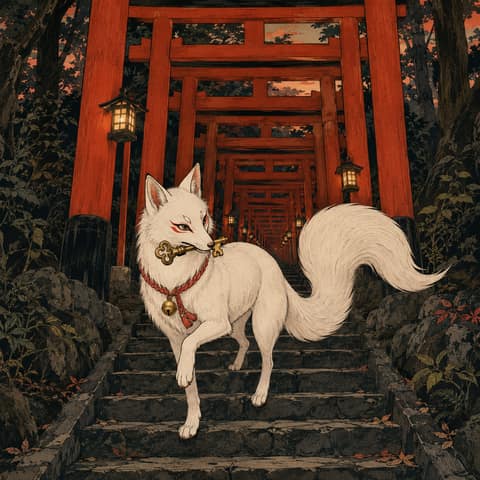
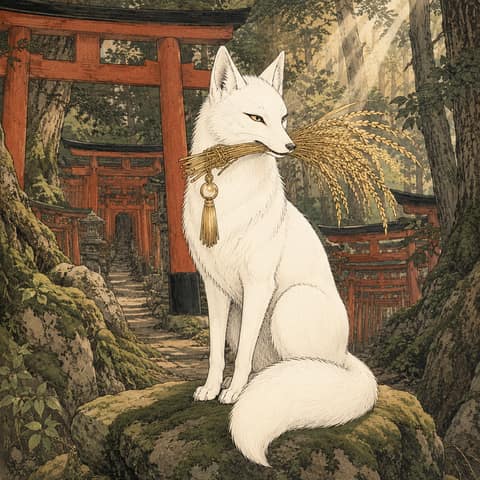
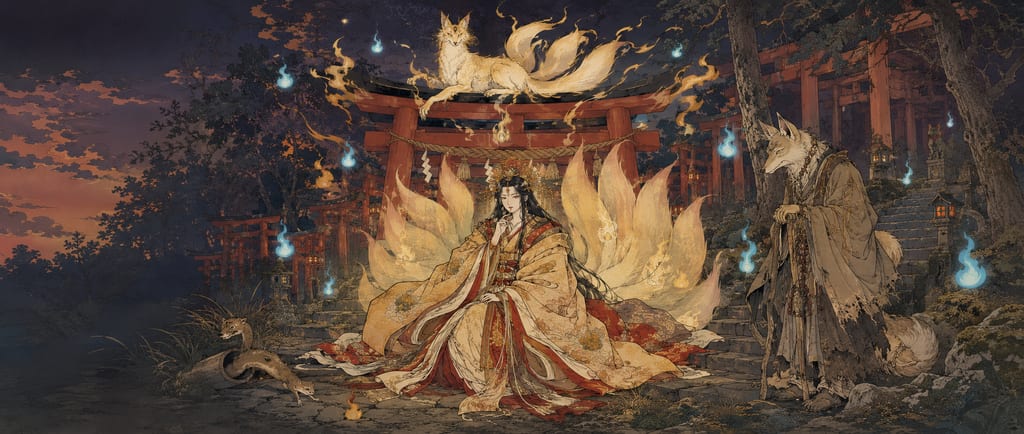
Dakiniten is a Buddhist deity of the Tenbu (Deva) realm derived from the Sanskrit word "Ḍākinī." Depicted as a celestial maiden riding a white fox, she has been worshipped as the "Buddhist Inari"[1][2]. She syncretized with the Shinto Inari Okami and became the principal image of temple-based Inari shrines such as Toyokawa Inari (Myogon-ji) and Saijo Inari (Myokyo-ji).
Tracing her origins back to Indian Esoteric Buddhism, the Dakini was originally a female demon-goddess who flew through the sky, foresaw human deaths, and devoured their hearts (human flesh and life force)[2]. In middle-period Esoteric Buddhism, she was subjugated by Mahakala (Daikokuten) and was positioned as an entity permitted to eat the hearts of the dead. She was introduced to Japan in the early Heian period by Kukai along with Shingon Esoteric Buddhism, and was depicted in the Womb Realm (Garbhakosa) Mandala as a life-force-stealing demon belonging to the retinue of Enmaten (Yama)[2].
Eventually, the ancient Indian concept of foxes as animals that foresee death and steal life force combined with the Japanese Inari faith, which viewed foxes as divine messengers. Dakiniten thus transformed into the figure of a female deity riding a white fox. Statues of a celestial maiden holding a wish-fulfilling jewel (cintamani) and riding a white fox were enshrined in temples and shrines across the country. As "Dakiniten = Inari-san," she became beloved by the common people alongside Ukanomitama-no-Kami[1].
Folklore & Legends
The name Dakiniten is said to mean "one who flies in the sky" and is believed to have been incorporated into Buddhism from the indigenous beliefs of the Bengal region[2]. In Indian Hinduism, she was considered a member of the goddess Kali's retinue, possessing the characteristics of a female demon (Yaksha) who killed enemies and devoured their flesh and blood. She was subjugated by Mahakala in middle-period Esoteric Buddhism, and in the later period, influenced by Shakti (divine feminine energy) worship, she also became a female consort deity for practitioners[2].
In Japan, Kukai brought her teachings along with Shingon Esoteric Buddhism. Initially, she was depicted in the Outer Vajra section of the Womb Realm Mandala as a life-force-stealing demon under Enmaten. Her image was that of a half-naked figure holding a blood vessel, a short sword, and a corpse, but over time, it transformed into a celestial maiden riding a white fox, and she came to be called Dakiniten, crowned with the title "Ten" (Deva)[2].
The syncretism with Inari progressed rapidly due to the common denominator of the fox. The ancient Indian concept of foxes inhabiting tombs and mounds to devour corpses overlapped with the Shinto tradition of foxes as the divine messengers of the Inari god. The image of "Dakiniten riding a white fox" merged with the existing Inari faith, establishing the syncretism of "Inari = Dakiniten"[1]. During the Sengoku period, warlords enshrined Dakiniten as Inari for the protection of their castles, and from the Kamakura to Muromachi periods, temple-based Inari such as Toyokawa Inari (Myogon-ji) and Saijo Inari (Myokyo-ji) were established. Believed to possess immense divine power to grant wishes, she was widely worshipped by the common people in the Edo period alongside Ukanomitama-no-Kami as "Inari-san," and is still enshrined in temples today as a deity of business prosperity and successful careers[1].
Dakiniten is a phonetic translation of the Sanskrit word "Ḍākinī." She is a Buddhist deity of the Tenbu realm, worshipped as the "Buddhist Inari" due to her appearance as a celestial maiden riding a white fox. She syncretized with the Shinto Inari Okami and became the principal image of temple-based Inari shrines such as Toyokawa Inari and Saijo Inari.
In India, she was originally a female demon-goddess who flew through the sky and devoured human life force and hearts, but was subjugated by Mahakala in middle-period Esoteric Buddhism. Introduced to Japan by Kukai in the early Heian period, she was depicted in the Womb Realm Mandala as a life-force-stealing demon in the retinue of Enmaten. However, through the medium of the fox, she became tied to the Inari faith, transforming into the figure of a female deity holding a wish-fulfilling jewel and riding a white fox. Due to her immense divine power to grant wishes, she was deeply revered by warlords and commoners alike, and has been passed down to the present day as a deity of business prosperity and successful careers. She is an ambivalent deity, possessing both the ferocity of a demon-goddess and the mercy to fulfill desires.
Character Profile
This section is our own creative profile for storytelling. It is not historical fact or scholarship.
Both fierce and deeply compassionate. An ambivalent deity possessing immense divine power that unfailingly grants wishes.
Compatibility
稲荷大神·宇迦之御魂神と習合。大黒天 (調伏者) と縁を持つ
Abilities
Granting wishes (fulfilling desires with immense divine power)Commanding and riding white foxesBlessings of business prosperity and career successWarding off evil and subjugating enemies
Weaknesses
Due to her fierce demonic nature, she carries a terrifying duality where neglecting her worship is feared to result in curses.
Habitat
Temple-based Inari such as Toyokawa Inari and Saijo Inari, as well as Esoteric Buddhist temples.
The diagram below is a diagnostic evaluation chart for The Buddhist Inari Riding a White Fox, Dakiniten. The higher the value of each item, the stronger that characteristic is expressed.