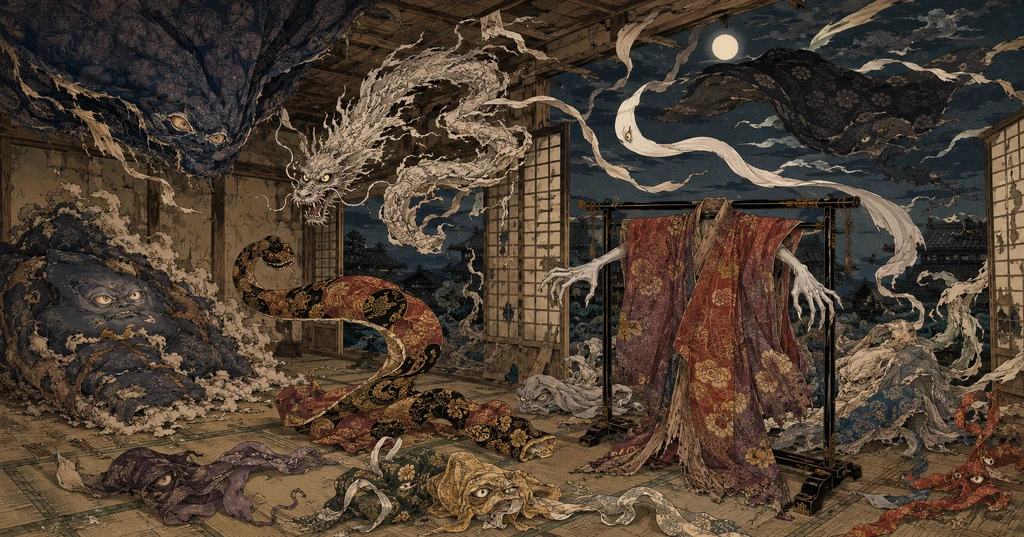
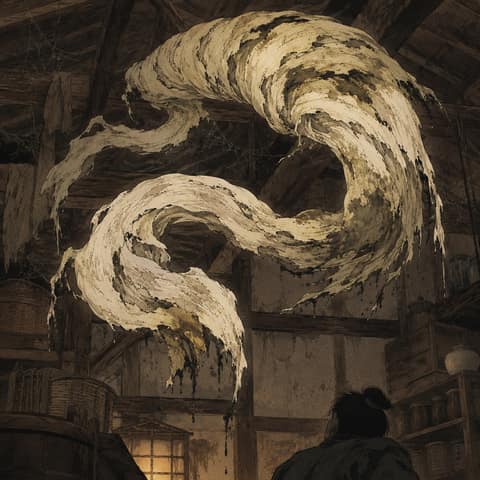
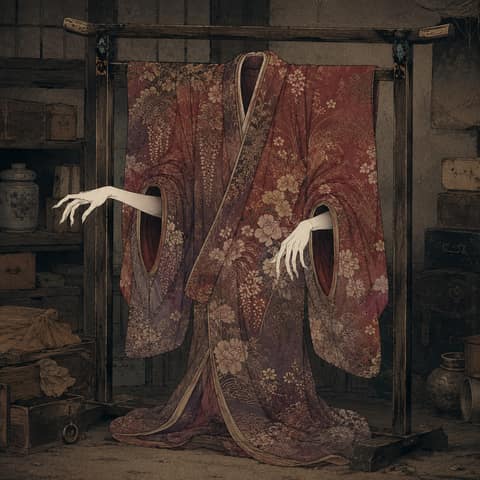
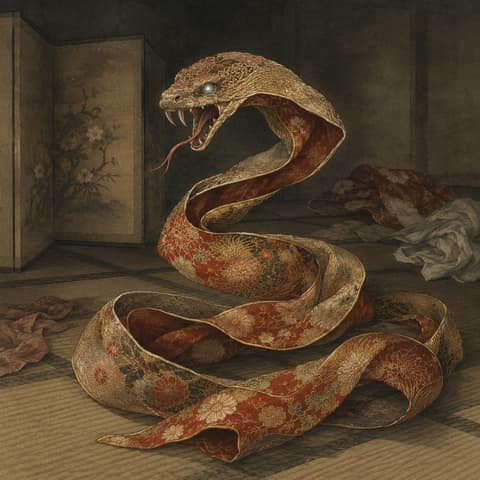
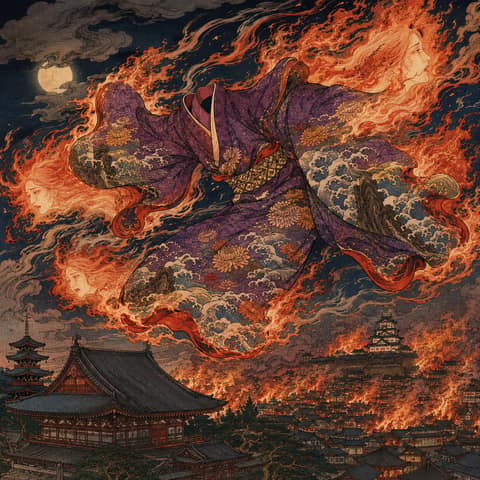
The *Furisode-no-kai* (Apparition of the Furisode / Furisode Fire) is an urban ghost story of Edo surrounding a single *furisode* (long-sleeved kimono) that is said to have successively claimed the lives of young girls. It is told that three girls who wore the same *furisode* died one after another on the exact same month and day of their respective years. When a temple tried to burn it to hold a memorial service, the burning *furisode* flew up in the violent wind, caught fire to the temple halls, and caused a massive conflagration that burned down most of Edo. This great fire is none other than the Great Fire of Meireki[1], which occurred in the first month of Meireki 3 (1657), burning most of the Edo cityscape, many daimyo mansions, and even the main keep of Edo Castle, resulting in an estimated 30,000 to 100,000 deaths; its popular name is the "Furisode Fire". The source of the fire is said to be Honmyoji Temple[2] in Hongo Maruyama, and the tale of the *furisode*'s curse is inextricably linked to this legend of the fire's origin. It is simultaneously an apparition of an object that curses people, and an anomaly that condenses the memory of the disaster that burned the mega-city of Edo into a single garment.
Folklore & Legends
Regarding the great fire itself, Asai Ryoi's *kanazoushi* (kana-script booklet) *Musashi Abumi* (1661)[3] is famous as a near-contemporary record that vividly depicts the tragic state of the destruction with illustrations. On the other hand, the plot of the *furisode*'s curse is considered a popular myth spread by the people of Edo, who intensely feared fires, by linking the unprecedented disaster to a story of karmic retribution, and is hard to accept as historical fact [1]. In the widely circulated storyline, the daughter of a pawnbroker in Azabu fell sick and died of unrequited love for a temple page, and the purple crepe *furisode* with a pattern of rough shores and chrysanthemums that she had loved was draped over her coffin. The subsequent girls who acquired this *furisode*, resold as second-hand clothing, died of illness on the exact same day of the same year. When the chief priest of Honmyoji Temple, fearing the bad omen, tried to burn it in a *goma* (holy fire) ritual, the fire was fanned by the north wind and spread, causing the great fire on the 18th day of the first month of Meireki 3. Regarding the fire's source, there are theories that the adjacent mansion of a *Roju* (senior councilor) was the true source, and that Honmyoji Temple took the stigma to save the shogunate's face [2], and even a popular theory that the shogunate intentionally set the fire for the urban remodeling of overcrowded Edo; all lack solid proof. In modern times, writers like So'un Yada and Lafcadio Hearn polished the story of the *furisode* as literature, establishing it as a typical Edo ghost story that bundles mysterious fires and the curses of objects.
The *Furisode-no-kai* is characterized by the fact that it is an "anomaly where an object and a disaster become one," lacking the form of a specific yokai. Its core consists of a dual structure: on the inside, there is the curse of an object where a *furisode* imbued with the thoughts of the dead takes the life of its new owner (a passion akin to a *tsukumogami*); on the outside, there is the great disaster where the fire burning the *furisode* loses control and burns down the entire city. The former is a typical example of the many "cursed garments and mementos" tales in Edo, while the latter is the real historical tragedy of the Great Fire of Meireki. The originality of this ghost story lies in stitching the two together. For the residents of Edo, fires were the greatest terror. While praised as "Fires and brawls are the flowers of Edo," once a fire spread, the wooden cityscape easily turned to ashes. The *Furisode-no-kai* can be said to be a product of imagination unique to urban ghost stories, translating that terror into an easily digestible tale of a single garment's fate, giving a face and a reason to an indiscriminate disaster.
Character Profile
This section is our own creative profile for storytelling. It is not historical fact or scholarship.
Takes the lives of young girls who wear it on the same day and at the same ageTurns into dancing flames when burned, causing the fire to spreadBecomes the core of a disaster that causes a city-wide great fire
Weaknesses
Repose of souls through respectful memorial services and sutra chanting. Fire prevention and destructive firefighting to prevent spreading (the establishment of firebreaks and broad streets (*hiroke*) were lessons learned from this great fire).
Habitat
Circulates through the city via Edo pawnbrokers and second-hand clothing stores, spreading with the main hall of a temple as the source of the fire.
The diagram below is a diagnostic evaluation chart for The Furisode That Burned Edo: The Furisode Fire. The higher the value of each item, the stronger that characteristic is expressed.