YOKAI.JP

Modern Kaii Encyclopedia

Post-war school folklore and Heisei-era urban legends

15 Yokai|9 Category|Page 1 of 1
Localization in Progress - More content available in Japanese version
View Japanese
Sort by: NameAscending
Aka Manto

Aka Manto

Epic

Aka-manto

Pre-War Red Caped Kidnapper / Post-War Red or Blue Paper

霊・亡霊昭和10年代の流言·都市伝説、トイレ怪談へ派生

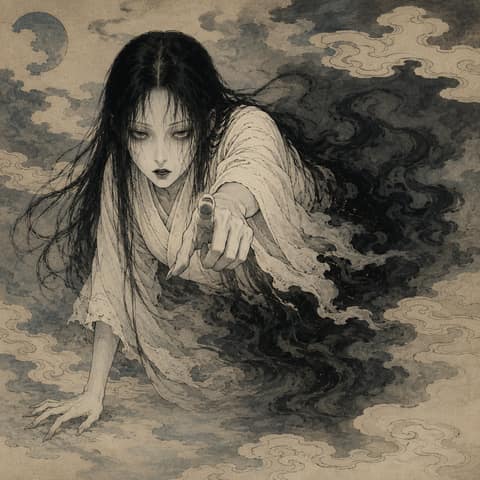
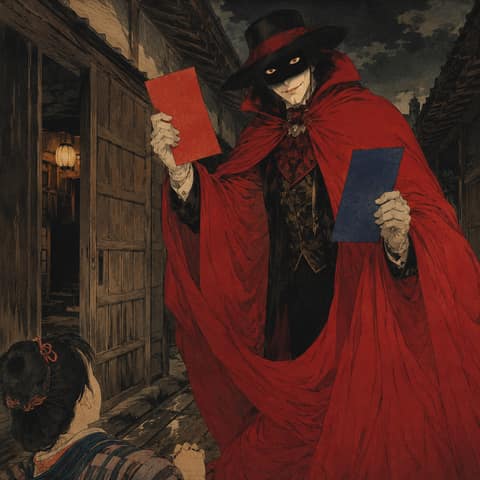
Aka Manto as a Subject of Pre-War Rumor Studies. The base description outlined its evolution from pre-war to post-war; in this deep dive, we explore how the pre-war Aka Manto was positioned within Japanese sociological rumor studies. Soichi Oya (1900–1970), a prolific social critic from the pre-war to post-war eras, was a pioneer in journalism and rumor research. His essay, *The Sociology of Aka Manto*, published in the April 1939 issue of *Chuo Koron*, stands as a rare early example of academic analysis applied to a contemporary urban rumor. It utilized a single rumor to dissect wartime societal anxiety, the distortions caused by information control, and the collective psychology of urban residents. The pioneering nature of Oya's paper served as the starting point for later socio-psychological studies by scholars like Hiroshi Minami, Hideo Kishimoto, and Takeyoshi Kawashima, who systematized wartime and pre-war rumors. As the first urban legend to be comprehensively analyzed by Japanese sociology, Aka Manto holds immense significance in academic history. The Symbolic Weight of the Color "Red". The pre-war Aka Manto possessed a striking visual hook: "a running man in a red cape." In pre-war and wartime Japan, "red" carried heavy, complex connotations: (1) it was a symbol of blood, violence, and danger; (2) it was a metaphor for communism and anti-state ideology (within the context of wartime censorship); and (3) it represented the foreign otherness of Russia and the West (the Red Army, the "Red Devil"). The fact that Aka Manto proliferated during the war was no coincidence; it can be read as a socio-psychological event where the militaristic anxieties of urbanites coalesced and erupted around the color "red." Conversely, its post-war evolution into the "Red Paper, Blue Paper" schoolyard ghost story can be interpreted as the stripping away of its heavy pre-war symbolism, gamifying it into a simple "color-choice question" for children. The Continuity of Wartime Rumors and Children's Folklore. Aka Manto is a profoundly rare case of a pre-war urban rumor transitioning directly into a post-war school ghost story. This unbroken continuity is underpinned by three layers: (1) the generation who experienced their childhood in the 1930s became parents or teachers after the war, passing the story down to the next generation; (2) the chaos of the wartime metropolis and the rapid urban transformations of the post-war economic boom generated analogous psychological anxieties; and (3) the physical space of the school consistently functioned as the transmission apparatus for children's oral traditions across both eras. The Interrogative Structure of "Red Paper, Blue Paper". The core mechanic of the school ghost story version is the "color choice question." Answering "red" gets you dyed in blood; answering "blue" gets your blood drained. This "unsolvable dilemma"—where any answer results in death—shares structural similarities with classical Trickster myths (where every choice is a trap) and the psychoanalytic concept of the "forced choice." Folklorist Noboru Miyata theorized in *The Folklore of Yokai* (Iwanami Shoten, 1985) that the "unsolvable question structure" in post-war school ghost stories was a ritualized expression of childhood anxiety and powerlessness. Alongside Kokkuri-san's "answer-seeking summons" and Kashima-san's "Where are your legs?" interrogation, it is classified as one of the three major interrogative archetypes in children's oral horror. Convergence and Divergence with Hanako-san. In children's oral culture post-1980s, a strong trend emerged merging Aka Manto with "Hanako-san of the Toilet." Legends appeared featuring a Hanako wearing a red skirt or cape, narratives explaining that Hanako's true identity *was* Aka Manto, and storylines casting Aka Manto and a new "Ao (Blue) Manto" as a sibling duo or rival pair. This demonstrates that post-war school ghost stories did not exist in isolation; they evolved as a living ecosystem of interconnected myths. In modern urban legend studies, it has become standard practice to treat Aka Manto, Hanako-san, Kashima-san, Teketeke, and the Slit-Mouthed Woman collectively as an overarching "lineage of post-war Japanese horror intricately tied to women, the physical body, and the school space." The Nexus of Pre-War and Post-War Rumor History. Within Japanese urban legends, Aka Manto is an incredibly rare yokai that boasts explicit academic documentation across two distinct eras: pre-war (1935–1940) and post-war (1950–1990). It was recorded independently by two different academic fields—pre-war sociology/rumor studies (Soichi Oya, Hiroshi Minami) and post-war folklore/school ghost story research (Toru Tsunemitsu, Noboru Miyata). The mere fact that a 1939 academic paper in *Chuo Koron* and a 1990 children's book by Kodansha KK Bunko are discussing the exact same supernatural phenomenon, separated by half a century, serves as the most powerful testament to the enduring continuity of Japanese urban legend studies.

Cow Head

Cow Head

Legendary

ushi-no-kubi

The Forbidden Ghost Story from which Tellings Offer No Return

Generic / GeneralAn urban legend forbidding its telling / Reception through the works of Sakyo Komatsu

This version of Cow Head is a form where the untold text itself has been yokai-fied. Ghost stories usually have an introduction, development, turn, and conclusion. It is told where, who, saw what, and what happened. Cow Head extracts that center. All that remains is the title, the taboo, the anomaly in those who heard it, and the silence of the teller. And yet, it is terrifying. Rather, precisely because nothing is shown, readers arbitrarily paint the most unbearable pictures within themselves. The strength of Sakyo Komatsu's "Cow Head" lies in the fact that it consciously treated the mechanism of this blank space as a story. Readers want to read the contents of the terrifying story. However, the work stares back at that very desire. Terror does not lie in the object, but dwells in the posture of the reader seeking the object. Cow Head is also a ghost story that punishes the heart wanting to consume ghost stories. The word "Cow" also works to prevent a concrete monster image from being established. Gozu Tenno, Ushi-oni, Kudan, Ox-Head and Horse-Face—Japanese anomaly culture has many strong images surrounding the heads of cows. But Cow Head does not connect directly to any of them. Rather, it merely lets the existing ox-head images resonate from afar, making the reader feel that "there is something old and heavy." The absence of content is supported by cultural associations. As an urban legend, Cow Head is highly compatible with the hearsay format. Someone heard it, it used to be told, only a certain teacher knew it, the student who heard it met a terrible fate. These prefaces are frames designed to compensate for the lack of text. The telling styles of the school and urban ghost stories collected by Hiroshi Matsuyama also have many techniques for amplifying terror through the distance of hearsay. In Cow Head, the fact that the distance is too far to see the center becomes the terror itself. Viewed as a taboo ghost story, Cow Head carries the command "Do not know." Just as "Purple Mirror" forbids remembering the word, and "Kokkuri-san" forbids summoning with a light heart, Cow Head forbids approaching the content. When forbidden, people want to know. Here lies the trap of the ghost story. Does the text not exist, or did it exist but was lost, or is someone hiding it? That inability to judge prevents the reader from stepping outside the story. On YOKAI.JP, we do not treat Cow Head as a specific ox-headed yokai, but as a modern anomaly protecting the blank space of ghost stories. If one were to depict its figure, it would not be a giant cow's head, but a mouth stopping just as it begins to tell, a blank manuscript, the dead silence inside a bus. Cow Head does not appear. By not appearing, it enters deeper into the reader's imagination than any yokai. Placing this anomaly in the modern information environment reveals yet another face. In an era where searching should bring up anything, there is a story whose true contents do not appear no matter how much you search. Summary articles, analyses, and creative versions can be found, but the definitive text cannot be grasped. In an age of information overload, absence itself holds a rare value. Cow Head is a yokai in the format of a secret, remaining in an era where secrets have vanished. And that secret is not protected as long as someone does not tell it, but continues to be protected by everyone believing it cannot be told.

Hachishakusama

Hachishakusama

Legendary

Hasshakusama

2.4-Meter White Woman - Hachishakusama

Spirit / GhostInternet urban legend originating from 2ch in 2008

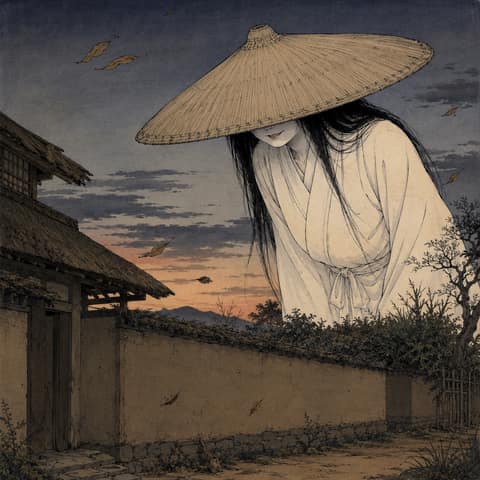
Sharekowa Thread Culture and "Forum-Born Horror". While the basic overview traces her origins, a deeper dive reveals why Hachishakusama could only be born on 2ch in 2008. In the late 2000s, the 2ch Occult board hosted a long-running thread series titled "Let's gather stories so scary you'll die," fostering a unique culture where users anonymously posted original or secondhand ghost stories. In this space, dubbed "Sharekowa," stories were judged not just on scariness, but on narrative pacing, folkloric foreshadowing, and overall structural completion. Hachishakusama was posted as a "series," split across multiple posts, captivating readers with its concise yet meticulously crafted narrative. This became the quintessential "literary horror of the internet age," setting it apart from traditional oral ghost stories. Intentional Appropriation of Folklore. The Hachishakusama legend incorporates four distinct folkloric elements: (1) Jizo as a boundary guardian, (2) warding via salt piles in the four corners of a room, (3) barricading until 7:00 AM (the passing of the demonic hour between the Ox and Tiger hours), and (4) protective amulets and Buddhist prayers. These are classic motifs found in folk magic texts (purification, pacification, warding) since the Edo period. The author didn't just write a scary story; they intentionally synthesized folklore to manufacture authenticity. Whereas traditional legends inherit folklore unconsciously, Hachishakusama treats folklore as an intellectual "resource," marking a turning point in how internet-era legends are generated. The Phonetics of the "Po... Po..." Laugh. While her height is her primary visual marker, her auditory signature is the bizarre onomatopoeic laugh, "Po... po... po... po...". This sound consists of bilabial plosives (the 'p' sound) repeated four times. Unlike the fricative sounds of normal human laughter ("ha ha", "fu fu"), it sounds mechanical or toy-like. Though the author never explained this choice, dehumanizing her laugh creates an uncanny "looks human but isn't" effect. In fan culture, this rhythm is frequently parodied in sound MADs and song covers, turning it into a unique cultural icon that straddles the line between terror and comedy. The Structure of the "Targeting" Curse. Hachishakusama does not attack immediately upon encounter; instead, she uses a delayed curse mechanic: "being targeted" leads to "death within days." This parallels the ancient Japanese Goryo (vengeful spirit) beliefs and the medieval Mononoke tradition of stealing souls or essence over time. Her terror stems from prolonged psychological pressure rather than immediate physical violence. The original narrative's focus on a "seven-day barricade" effectively dramatizes this delayed curse structure. Global Spread and "J-Horror Folklore". Since the late 2010s, Hachishakusama has been translated and shared on Reddit's r/nosleep, English horror blogs, and SCP Foundation spin-offs, becoming shared knowledge in the English horror community. She is frequently listed alongside Sadako (*Ring*, 1991) and Kayako (*Ju-On*, 2002) as Japan's premier "tall female horror icon," proving that the terrifying frontiers opened by post-war Japanese cinema are now being inherited by internet urban legends. Visual Adaptations and Modern Legacy. Early visual adaptations appeared in the 2010s as web dramas and short films. This escalated to full theatrical and streaming releases with Jiro Nagae's 2023 film *Resort Baito* (adapting another 2009 Sharekowa legend with Hachishakusama elements) and Ryujin Onizuka's 2024 *Sealed Video 16: The Curse of Hachishakusama*. Nagae's specialization in adapting 2000s 2ch legends (e.g., *Kisaragi Station* in 2022, *The True Samejima Incident* in 2020) cements Hachishakusama's firm position within the contemporary genre of "internet legend cinema."

Hanako-san of the Toilet

Hanako-san of the Toilet

Legendary

といれのはなこさん

The Girl in the Third Stall of the Third-Floor Girls' Bathroom, Hanako-san

Spirit / Ghost1980s school ghost stories, popularized nationwide by Toru Tsunemitsu's "School Ghost Stories" in 1990

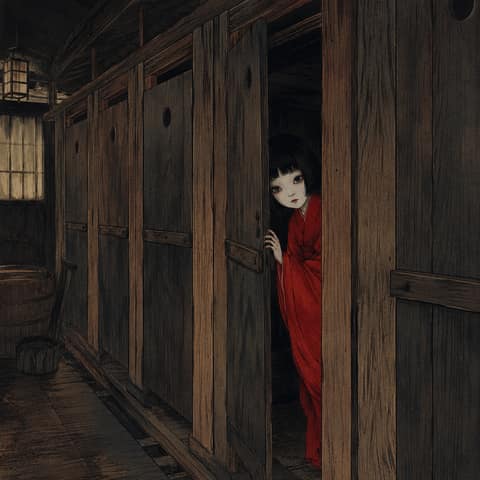
Post-war School Architecture and the "Closed Water Space". While the basic description traced literary first appearances and nationwide distribution, this deep dive explores why the combination of "school, bathroom, and young girl" became the core of modern ghost stories. Post-war Japanese elementary school architecture standardized around three-story reinforced concrete buildings starting in the 1950s. The fixed layout placed the staff room on the first floor, upper-grade classrooms on the third floor, and bathrooms at the ends of each floor. The third-floor bathroom is furthest from the teachers' watchful eyes, easily becoming an empty space outside of recess. Here, the boundary between the ordinary and the extraordinary runs deep. For children (especially girls), the bathroom is a place where physical vulnerability is exposed, and simultaneously a place to be alone within a communal space. Toru Tsunemitsu positioned this "periphery of school space" as the geographical foundation of the Hanako-san ghost story. The Code of the Number "Three". The triple "three"—the third floor, the third door, and three knocks—is not a coincidence. It can be read as a carryover into modern ghost stories of the "threshold number three" common in Japanese folkloric summoning rituals (e.g., seven days of the ox-hour visit, three calls, walking around a grave three times). Children unconsciously reenact this traditional summoning structure within the school. This is why playing Hanako-san functions not just as "mere play" but as a pseudo-summoning ritual. It has also been pointed out that the ritualistic format of the Kokkuri-san (ouija board) game, popular in elementary schools in the 1970s, was continuously inherited by the Hanako-san game in the 1980s. The Color Red and the Lineage of "Red Mantle". Hanako-san is often depicted wearing a red skirt or red overalls. In post-war Japanese depictions of young girls, the color red has three layers of meaning: (1) physical realities like blood or menarche; (2) a sense of foreignness that deviates from standard school uniform colors; and (3) a blending with the pre-war ghost story "Red Mantle" (a voice asking whether you want blue or red paper). The Red Mantle ghost story, said to have originated in Kobe in 1939—a voice in the bathroom asking if you want red or blue paper—has a sisterly relationship with Hanako-san, showing the continuity of ghost story lineages from pre-war to post-war eras. The fact that the Red Mantle elements are strongly mixed into Hanako-san variations in Hokkaido and Tohoku is also evidence that the echoes of pre-war ghost stories transitioned into post-war school buildings. The Anonymity of the Name "Hanako". Hanako-san bears one of the most common Japanese female names from the Showa era, but her specific life history is never told—this allows her to function as a collective pronoun for "countless nameless schoolgirls." Theories of her death by war, earthquake, or murder all lack a specific individual identity, and can even be read as a personification of "the very history of the school space swallowing up young girls." Folklorist Noboru Miyata argued in "Folklore of Yokai" (Iwanami Shoten, 1985) that post-war school ghost stories serve the function of "the community re-enshrining the nameless dead after the fact." Details of Media Expansion in 1994-95. In the 1994 Kansai TV omnibus "School Ghost Stories," "Hanako-san" was produced as a single episode, and it was also included in the August Pony Canyon VHS "School Ghost Stories: Truly Happened!!". Shochiku's "Hanako-san of the Toilet" (directed by Joji Matsuoka, starring Etsushi Toyokawa), released on July 1, 1995, was a mystery-horror film combining a serial murder case with the Hanako-san legend. In contrast, Toho's "School Ghost Stories" (directed by Hideyuki Hirayama), released on July 8, was a juvenile adventure horror film. The styles of these two films, running side-by-side that summer, stood in sharp contrast. Toho's version went on to produce sequels in 1996, 1997, and 1999, grossing over 3 billion yen in total box office revenue across the 4-part series. Modern Toilet-Bound Youth and the Layering of Secondary Works. AidaIro's "Toilet-Bound Hanako-kun" (serialized from 2014) has surpassed 20 million copies, receiving a TV anime adaptation in 2020 and a stage play in 2022. The "Hanako-kun" here is a cheerful, caring, blonde earthbound spirit, completely detached from the original image of the girl ghost. For Generation Z, "Hanako" is primarily recognized as a cute male character rather than a scary ghost girl—an excellent example of the modern phenomenon where a ghost story's secondary creation overwrites the primary legend itself.

Jinmenken (Human-Faced Dog)

Jinmenken (Human-Faced Dog)

Epic

jinmenken

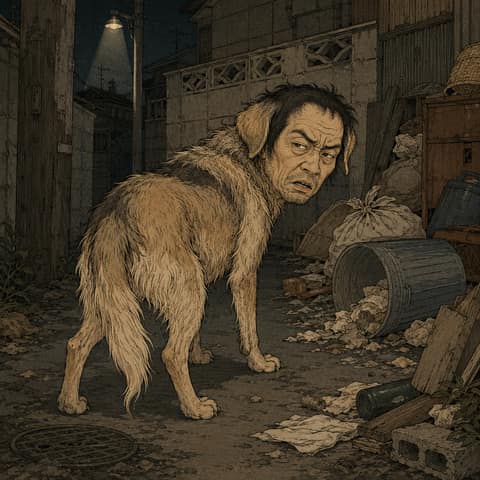
Late Showa Era Urban Legend: Jinmenken

Animal TransformationLate Showa Era Urban Legend (Spread nationwide from the Tokyo metropolitan area)

In this version, we read the Jinmenken as a "road urban legend" born from the city during the late Showa era. The Jinmenken is not a yokai that appears fully formed in classical texts; rather, it is an entity where the rumor ran ahead, and magazines and television later gave it a contour. Because of this, its details are never fixed. Where it was seen, what it said, and whose face it resembled shift depending on the teller, and this malleability served as the fuel for its popularity. The stage of the "road" underpins the eeriness of the Jinmenken. On a night road, animal carcasses, lost dogs, the optical illusions of headlights, and suddenly crossing shadows are everyday occurrences. When an easily recognizable component like a "human face" is mixed in, the witness feels that "perhaps it wasn't a dog." The speed of vehicular society robs people of the time to verify. Passing by without being able to confirm whether it was a misperception or an anomaly strengthens the rumor. The Jinmenken's dialogue elevates this anomaly from a mere composite animal to an urban legend. Words like "Leave me alone" or "What are you looking at?" are closer to rejection than horror. The monster is not attacking; it hates your gaze. This sensation closely resembles the awkwardness of witnessing someone's bizarre behavior on a city street. The one who sees the yokai is slightly blamed as the rude interloper. In the realm of modern folktales handled by Miyoko Matsutani, modern vehicles and urban infrastructure become the sources of new ghost stories. The Jinmenken is positioned perfectly within this current. Instead of emerging from the old natural environment like fox-fire or a mountain witch, it appears from late-night stores, national highways, housing complexes, and the roads home from school. This dog clearly demonstrates how the stage of yokai has shifted in accordance with changes in lifestyle. This version of the Jinmenken is a yokai of incomplete transformation. The dog did not turn into a person; it remains a dog but merely possesses a human face. That incompleteness becomes both a joke and a nightmare. Children found it amusing as a rumor, and adults consumed it as a media phenomenon, but at the bottom of it all lies the lingering anxiety that "somewhere in the city, you might encounter something that cannot be classified." The Jinmenken is the form of that anxiety running at its lightest and fastest. Through the media, this version of the Jinmenken became a monster that "everyone knows, even though no one has seen it." Most people have never actually encountered it. Even so, anyone can instantly imagine the scene of a dog with a human face speaking. The rumor distributes the image before the sighting, and that image in turn generates new eyewitness accounts. The choice of a "dog" is also sharp. A dog is close to the human sphere of living, considered a loyal and familiar animal. When a human face is pasted onto it, that familiarity is shattered instantly. If it were a complete monster, you could keep your distance; but because it is a dog, you momentarily approach it. That delay establishes the ghost story of the Jinmenken. The Jinmenken also carries the burden of urban loneliness. Even though it can speak human language, it doesn't seek conversation; instead, it rejects it with "Leave me alone." This is remarkably similar to the sensation of city life, where people are densely packed yet do not interact with one another. The anomaly doesn't attack humans, but finds the very gaze of humans to be a nuisance. Within that lies its coldness as a modern yokai.

Kashima Reiko

Kashima Reiko

Epic

Kashima Reiko

The Woman Who Asks from the Other End of the Phone: Kashima Reiko

Spirit / ghostUrban legend that emerged in the 1970s, often told around Kakogawa and Takasago in Hyōgo Prefecture

The telephone as postwar infrastructure and kaidan device. The basic entry covers the contagious structure of Kashima Reiko's curse; this fuller explanation looks more closely at the medium that carries it: the telephone. In Japan, the spread of black rotary phones into ordinary households rose sharply in the postwar decades, from about 8 percent in 1965 to about 80 percent in 1975. It is unlikely to be a coincidence that a legend emerging in the 1970s chose the device of "a question coming by telephone." The anxiety of a new infrastructure entering the home became part of the legend's core machinery. Where prewar Aka Manto belongs to alleys and night roads, and Hanako-san of the 1980s belongs to the school toilet, Kashima Reiko is distinctive because she violates the postwar private space of the household telephone. From the 1990s onward, the setting expanded into text media such as email and LINE, keeping pace with the evolution of postwar communication infrastructure. The structure of the "Where are your legs?" question. At the center of the Kashima Reiko legend is a question: "Does Kashima-san have legs?" "Where are her legs?" and similar variants. A wrong answer is fatal, but correct replies such as "Kamashi," "Kashima Reiko," "above the waist," or "from above the waist downward" are said to save the listener. Like Aka Manto's "red paper or blue paper" and Kokkuri-san's yes-or-no exchanges, this is a no-win question structure common in children's oral ghost stories. At the same time, it offers an escape route: correct knowledge can save you. Folklorist Noboru Miyata, in Yōkai no minzokugaku (Iwanami Shoten, 1985), argued that question-based children's kaidan satisfy a childhood desire for intellectual advantage, the feeling that those who know the answer survive. The transformation of postwar social memory into ghost story. The theory that Kashima Reiko began with the "1948 Kakogawa American-soldier incident" has not been historically confirmed. Even so, it preserves in ghost-story form a social memory of sexual violence suffered by Japanese women under the U.S. occupation. Postwar U.S.-Japan relations, defeat, occupation, and the security order, left many experiences insufficiently spoken in official discourse. Such unspoken harm can settle into the underground layer of urban legend and surface in the 1970s as a supernatural presence. Folklorist Norio Murakami has discussed this mechanism of social memory turning into kaii, noting that experiences excluded from public memory can remain in the form of ghost stories and spirit possession. Kashima Reiko is a representative example. Contagious curses in the internet age. Kashima Reiko's structure, in which hearing the story makes one part of the curse, became a foundation for the chain-mail culture, internet curses, and creepypasta of the 2000s and beyond. "Forward this email to X people or you will be cursed," "anyone who sees this URL will be cursed": these online curse formulas have their prototype in Kashima Reiko's instantly contagious oral kaidan. Internet-era kaidan such as Kunekune (2003) and Hasshaku-sama (2008) inherit the same device, turning the reader into a participant in the curse. Kashima Reiko therefore played an important mediating role between 1970s oral kaidan and 2000s internet horror. The ecology of Teketeke and Kuchisake-onna. Postwar Japanese children's oral kaidan do not exist as isolated beings. They form an ecology of mutual reference, merger, and branching. Kuchisake-onna (1978), Kashima Reiko (late 1970s), and Teketeke (1980s) follow one another chronologically and share motifs: a damaged female body, a question structure, and a curse aimed at children. In Tōru Tsunemitsu's Gakkō no kaidan (Kodansha KK Bunko, 1990), these stories were gathered under the category of "school kaidan," helping establish them as a single folkloric genre worthy of study. Dandadan and modern transmission. In Yukinobu Tatsu's Dandadan, serialized in Shueisha's Shonen Jump+ from 2021 and adapted for television anime in 2024, Kashima Reiko was reshaped as a major supernatural figure and became familiar again to Generation Z. The adaptation keeps the key elements of the source tradition, the missing lower body, the telephone, and the contagion of the curse, while recasting them in the character language of contemporary shonen manga. From children's oral legend in the postwar 1970s to manga and anime of the 2020s, Kashima Reiko has become a rare urban kaidan transmitted across nearly half a century.

Kisaragi Station

Kisaragi Station

Legendary

kisaragi-eki

The Unmanned Station Slipping into the Otherworld

Dwelling / ObjectShizuoka

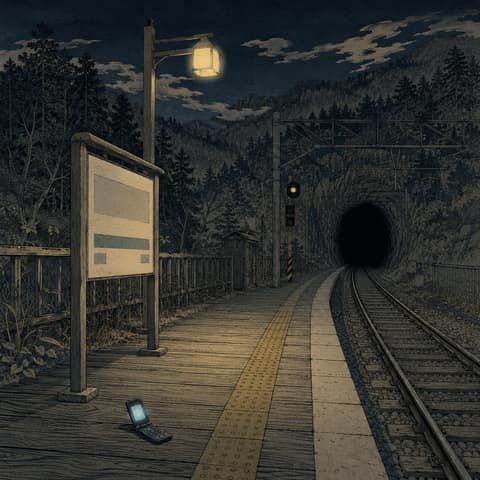
This version of Kisaragi Station is a form for reading the station itself as a yokai. Instead of depicting a monster with a physical shape, it combines elements like platforms, tracks, tunnels, in-train announcements, and mobile phone signals to capture the moment everyday space changes slightly into different rules. The otherworld is not in the deep mountains far away. When you think you've slept past one station on your usual way home, the train has already entered an unknown order. The initial terror begins with the breakdown of the sense of time. The distance between stations is too long, the train passes stations it should stop at, the scenery out the window changes to something unfamiliar. At this stage, it can still be explained as "got on the wrong train" or "half asleep." But as explainability is crushed one by one, the reader is placed in the same closed train car as the poster. The message board format plays a major role here. Because a third party is advising but cannot save her, the voice of reason itself is incorporated into part of the anomaly. The hiragana notation of the station name is also important. If written in kanji as "如月駅," it leans toward an elegant place name or month name, but writing it as "きさらぎ駅" (Kisaragi) makes it an inorganic symbol printed on a station nameplate. A softness that even a child can read and a blankness that doesn't belong to any municipality stand simultaneously. According to Asazato Itsuki's organization of modern anomalies, there is a naming power here that pierces memory with just short words, the same as "Red Paper, Blue Paper" in school ghost stories or "Mary-san" in phone ghost stories. If Kisaragi Station were to be connected to the lineage of classical yokai, it would be spiriting away (kamikakushi) and road anomalies. Tengu taking people to the mountains, travelers bewitched by foxes walking in circles in the same place, festival music heard at crossroads. They have all spoken of the moment a road leaves human control. In Kisaragi Station, that road became a railway track. Tracks are originally a modern promise guaranteeing destination and time, but in this ghost story, the very strength of the guarantee flips. You can't go back even if you get off, and you won't reach your destination even if you stay on. The reason there are so many subsequent derivatives is that the stage setting is very easy to expand. Change the station name, change the route, add a smartphone or map app, and another Kisaragi Station is immediately born. As the urban legend theory compiled by ASIOS shows, modern ghost stories circulate by not only preserving fixed original texts but including verification, denial, and reenactment. Kisaragi Station is an anomaly including its circulation format, and even the reader's act of searching becomes an extension of the story. Therefore, the most sincere attitude toward this unmanned station is not to determine a real station. There is an outline that looks like western Shizuoka Prefecture. But the moment you crush the outline into a real station name, the essence of Kisaragi Station is lost. On YOKAI.JP, we treat it as an otherworld originating from a creation, while simultaneously leaving the realistic texture of the railway network. A station not on the map is not scary because it's off the map. It's scary because the more people believe in maps, the more they arrive there. Another point of interest is that advice does not become salvation. The message board residents think rationally and propose realistic means like the police, station staff, family, and confirming the current location. But once she enters the otherworld, all that rationality arrives slightly too late. Kisaragi Station does not deny modern safety devices, but lets them idle while making them look like they're functioning. Therein lies a coldness typical of Heisei internet ghost stories.

Kokkuri-san

Kokkuri-san

Epic

こっくりさん

Composite Deity of Fox, Dog, Raccoon Dog: Kokkuri-san

Spirits / GhostsDerived from Western table-turning; became popular starting from Shimoda, Izu in 1884.

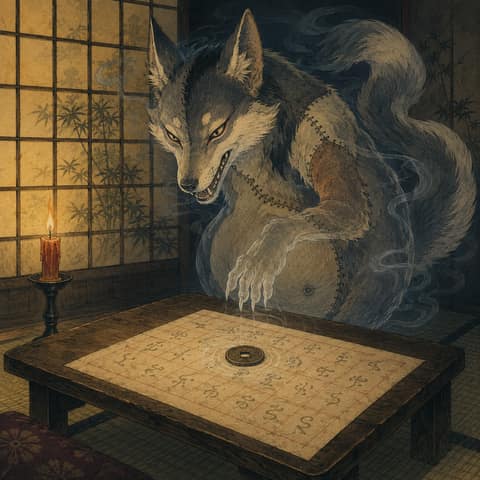
The Ideomotor Effect and the Significance of 'False Wonder'. While the basic explanation touched upon Enryo Inoue's classification, the detailed explanation delves deeper into the significance of its scientific demystification. The ideomotor effect is a phenomenon named by British physiologist William Carpenter in 1852, referring to involuntary micro-movements of muscles without human awareness. Table-turning, dowsing, Ouija boards, and Kokkuri-san—these all share the exact same principle for moving a coin or pointer. Inoue independently verified this latest Western theory in Meiji-era Japan, demonstrating that 'yokai can be explained by science,' making it a representative case of pre-war Japanese enlightening rationalism. Kokkuri-san's mystery shifted from a 'physical mystery' to a 'psychological mystery triggered by the unconscious.' Selection of the Three Beasts 'Kokkuri'. Choosing which kanji to assign to the sound 'kokkuri' was arbitrary, but the selection of 'fox, dog, raccoon dog' (狐·狗·狸) had roots in the lineage of Japanese animal spirit beliefs. Foxes represent the ability to bewitch humans, as seen in Inari worship and Tamamo-no-Mae; raccoon dogs are equally famous shape-shifters known for belly-drumming (haratsuzumi) and Bunbuku Chagama; dogs are known as mediums for spirit possession in local beliefs like inugami (dog gods). Combining the three beasts was an intellectual invention that summoned the three major representatives of Edo-period animal shape-shifter tales at once, wrapping the alien nature of the 1884 Shimoda origin (Western table-turning) in traditional Japanese spiritual concepts. Inheritance of Summoning Rituals in School Spaces. Since the 1970s boom, Kokkuri-san has become a significant game played during recesses and after school in elementary and junior high schools. Folklorist Noboru Miyata pointed out in *The Folklore of Yokai* (Iwanami Shoten, 1985) that post-war Japanese schools became new 'sites for summoning rituals.' Kokkuri-san (1970s-) → Hanako-san (1980s-) → Hasshaku-sama (2008-). All these share the common structure of 'summoning/sealing spirits in school spaces,' reading as modernized, secularized, and gamified versions of magical rituals from the Heian period (such as Ushi-no-koku Mairi and chanting the Sonsho Dharani). Bans and the Tradition of the 'Correct Ending'. From the late 1970s to the 80s, many schools issued bans on Kokkuri-san. This responded to the frequent occurrence of abnormal behavior among children (mass hysteria, hyperventilation, trance states), demonstrating the effect when the ideomotor effect combines with group psychology. Concurrently, the tradition of the 'correct ending method' became refined among children—chanting 'thank you' together, returning the coin to the torii, tearing up and throwing away or burning the paper, etc. These ritualistic steps are structurally similar to medieval curse-breaking practices (henbai, scattering rice, scattering salt), drawing folkloric attention as a case where modern children unwittingly reenact classical magical rituals. Re-creation in Manga and Anime. Following Jiro Tsunoda's *Ushiro no Hyakutaro* (1973-1980), Kokkuri-san became a staple motif appearing repeatedly in manga and anime. It was a key element in the 1995 Toho film *School Ghost Stories 2* (directed by Hideyuki Hirayama), and in the 2012 TV anime *Inu x Boku SS*, Kokkuri-san was incorporated into the protagonist's bloodline. Recently, comedy manga personifying Kokkuri-san, like *Gugure! Kokkuri-san* (by Midori Endo, serialized in Square Enix's *Monthly G Fantasy* 2011-2016, animated in 2014), have also become massive hits. It is a rare case where Meiji scientific demystification and modern subculture reception intersect through the same apparition. 2010s Modern Kokkuri-san. Around 2015, a modern version of Kokkuri-san resurged among junior high and high school students. This involved displaying the syllabary on a smartphone app, with friends placing multiple fingers on the screen to move it. Some schools again reported students yelling and making strange noises, prompting faculty intervention. A table-turning trick shown by shipwrecked sailors in Izu Shimoda 140 years ago has continuously changed form while being passed down through modern Japanese youth culture—this is Kokkuri-san's most peculiar trait.

Kunekune

Kunekune

Epic

くねくね

The White Silhouette Standing in the Rural Distance: Kunekune

Spirit / GhostModern internet ghost story originating around 2000

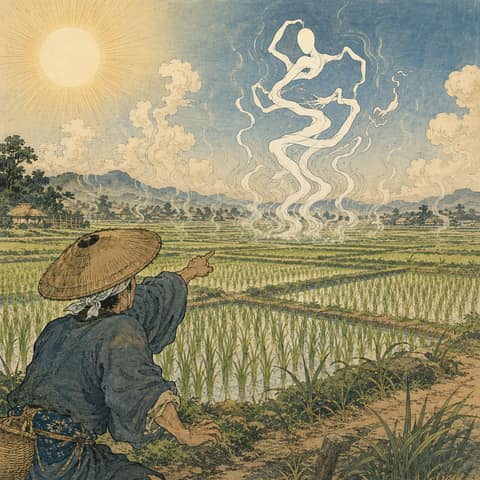
The epistemological horror of "looking itself is a curse". The basic description touched upon the narrative structure and visual elements, but this thorough breakdown dives into Kunekune's greatest uniqueness—the punishment for cognition itself. Many traditional Japanese ghost stories inflict harm through physical contact (having legs cut off, being decapitated, being severed at the waist) or by approaching a specific location (abandoned houses, mountain passes, tunnels). Kunekune is different. Standing in the distance, it causes no harm, but the moment an observer uses binoculars or strains their eyes to "see its true identity"—attempting to complete their cognition—they go insane. This structure, which punishes the observer's subjectivity (understanding, interpretation, verbalization) itself, is unique for bringing a philosophical dimension to the ghost story. Undercurrents with Lovecraftian cosmic horror. In the 1920s and 30s, H.P. Lovecraft (1890-1937) established the concept of cosmic horror: "attempting to understand an existence beyond human cognitive abilities results in the loss of sanity." Representative works include "The Call of Cthulhu" (1928) and "At the Mountains of Madness" (1936). Kunekune can be read as an entity that reconstructs this structure within the Japanese rural landscape. While it is unclear if the Japanese internet writers directly referenced Lovecraft, the idea of a "punishment for cognition" parallels the central theme of American weird fiction, demonstrating the intellectual depth of post-war Japanese horror culture. The significance of selecting "rural landscapes" as the space. Kunekune always appears in open rural spaces such as "rice paddies, riverbanks, and beaches." In contrast to many urban legends set in "enclosed spaces" (abandoned houses, schools, bathrooms, train stations), Kunekune appears in the distant, unobstructed view. This is not unrelated to the increase in urban-born populations during the post-war rapid economic growth period, where urban youths' opportunities to experience "rural life" were limited to vacations, returning to hometowns, or summer camps. For an urban youth visiting their grandparents during summer vacation, the distant view of a rice paddy is the epitome of "non-ordinary scenery" disconnected from daily life. Placing Kunekune there gives form to the "vague anxiety towards the countryside" felt by urban residents. The cultural background of the 2003 2channel Occult board. The 2ch Occult board in 2003 supported the golden age of internet forum-posted ghost stories, alongside Hachishakusama in 2008 and Kisaragi Station in 2004. 2ch's anonymity, the blurred boundary between fiction and reality, and its copy-paste virality served as the incubator for ghost stories like Kunekune, where "fiction disclaimers are dropped, making them real." Folklorist Ryuhei Hirota (ASIOS) terms this "internet folklore," categorizing it as a new ghost story generation mechanism distinct from the oral tradition of urban legends. The difficulty of visual adaptation. The 2010 film adaptation "Kunekune" (directed by Hisataka Yoshikawa) highlighted the difficulty of visually reproducing the original's "looking itself is a curse" structure. Because film is a visual medium, depicting something that "should not be looked at" creates a self-contradiction. The same issue applies to SCP Foundation entities that "punish visual contact," which are similarly difficult to adapt for the screen. Kunekune is rather a rare ghost story that maintains its vitality in "media that leave room for imagination," such as text, illustrations, and dramatic readings. As one of the "Three Major 2ch Forum Ghost Stories". Kunekune (2000/2003), Kisaragi Station (2004), and Hachishakusama (2008) are representative forum-posted ghost stories born on the 2ch Occult board between the early and late 2000s, often grouped together in later years as the "Three Major Forum Ghost Stories." Kunekune presents epistemological horror, Kisaragi Station the eeriness of traveling to the otherworld, and Hachishakusama the structuralization of folkloric wards—each offering unique narrative mechanisms. Repeatedly reproduced on TikTok and YouTube horror channels in the 2020s, they have become a pathway for Gen Z to rediscover "2000s Japanese internet ghost stories."

Mary-san's Phone Call

Mary-san's Phone Call

Legendary

めりーさんのでんわ

Call from a Discarded Doll / The Girl Spirit Behind You

Dwellings & ObjectsLate 1990s modern urban legend, phone-based ghost story

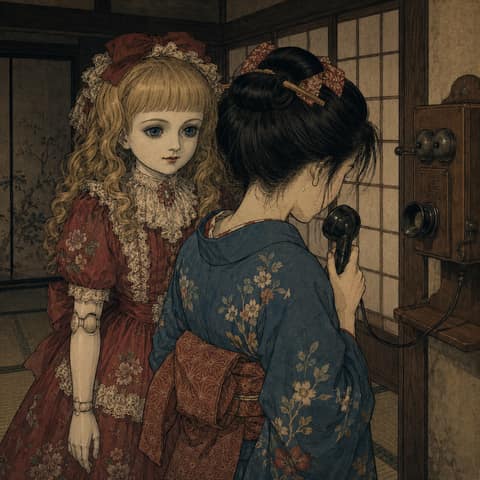
The Representative Phone-Medium Urban Legend. Mary-san's Phone Call is regarded as the ultimate realization of post-war Japanese urban legends, perfectly embodying the three characteristics of "object possession," "phone medium," and "distance compression." Alongside Hanako-san of the Toilet (debuted 1948, fixed-location type) and Hachishaku-sama (Eight-Feet Tall) (originated online 2008, humanoid pursuit type), it stands as one of the three major pillars of post-war urban folklore. Notably, by using the telephone—the newest communication medium of its time—as the conduit for the supernatural, it marks a stark departure from pre-war oral traditions or shrine-based ghost stories, instead presupposing a modern industrial society and mass-produced toy culture. The Foreign Doll as a Cultural "Other". The specific designation of the Mary doll as "foreign-made" is a crucial folkloric detail. During Japan's post-war period of rapid economic growth, mass-produced foreign dolls (like Barbie and Blythe, the precursors to Licca-chan) entered Japanese households via the occupying forces, acquiring a dual nature of aspiration and eeriness in girls' culture. The narrative structure of "a discarded foreign doll seeking revenge" in Mary-san's Phone Call aligns seamlessly with Hiroshi Matsuyama's interpretation that the legend crystallizes post-war Japan's complex emotional distance and tension toward foreign toys and the artifacts of victorious nations. The cultural friction is also evident in how the Licca-chan doll was marketed by heavily emphasizing its "Japanese-ness." The Historicity of the "Telephone" Medium. The late 1970s marked an era when landline telephone penetration in regular households reached 90%, making it commonplace for children to answer the phone at home. Concurrently, services like the Licca-chan Phone (1968-) and various telephone services (time, weather, fortunes) fostered children's imagination that a distinct personality might exist on the other end of the line. The core eeriness of Mary-san's Phone Call—the sensation that "someone is peeking into my house from the other end of the phone"—is inherently tied to the landline culture of that era. In the age of mobile phones and smartphones, where the connection between a phone number and a physical location is diluted, similar ghost stories have evolved into mobile ringtone or voicemail variants like *One Missed Call*. The Vocal Training Function of Repetitive Phrasing. Mary-san's Phone Call also serves as a classic example of an oral ghost story memorized and passed down by children. The repetitive phrase "I am Mary-san, I am currently at [Location]" is easy to memorize and possesses an open-ended structure where the story works simply by swapping out the location. In storytelling settings like school lunch breaks, field trips, sleepovers, and tests of courage, narrators infinitely spawn local variations by inserting their own neighborhood or specific landmarks. This is a prime example of the "recursive oral generation" structure of urban legends pointed out in *Toshi no Ana*. Re-systematization in the 1990s "School Ghost Stories" Boom. During the 1990s, amidst the "School Ghost Stories" boom sparked by Toru Tsunemitsu's *Gakkou no Kaidan* (1990) and fueled by children's books and TV shows, Mary-san's Phone Call became a standard repertoire piece. It frequently appeared in Toho's 1995 *School Ghost Stories* film series and various ghost story variety shows. Through this process, what was originally an oral tradition originating in the Kanto region was consolidated into a nationwide urban legend. Alongside contemporaries like "Kashima Reiko," "Teketeke," and "Aka Manto" (Red Cape), it forms a core component of post-war school ghost stories. The Dramatic Structure of "Right Behind You". The story's final phrase, "I am Mary-san, I am right behind you," serves as a classic example of dramatic reversal (peripeteia) in urban legends and has been the subject of both literary criticism and folklore studies. Because the physical act of holding a phone receiver to one's ear implies that "the field of vision is diverted from behind," the moment the voice on the phone finishes speaking, the physical action of turning around is inherently delayed. Incorporating this physical time lag into the horror structure is the unique genius of Mary-san's Phone Call. The 2011 film adaptation similarly anchors its narrative around this climactic final line.

Murasaki-kagami

Murasaki-kagami

Epic

murasaki-kagami

The Word Curse Engraved with an Age Limit

Spirit / GhostA curse of words / Memory infection with an age limit

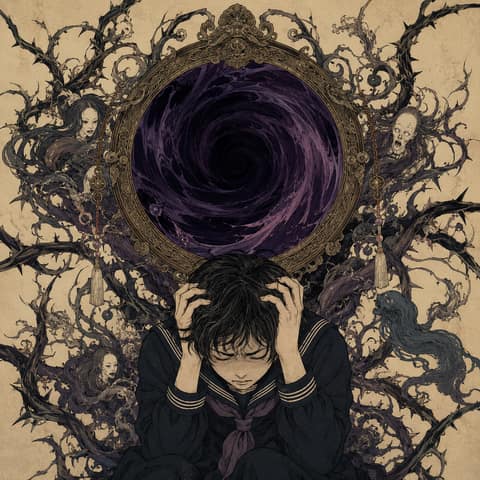
This version of Murasaki-kagami does not appear as a tangible yokai. Its true form is the word "Murasaki-kagami" itself, and the memory of the person who received it. Because the anomaly resides within the brain, locking doors or fleeing far away is meaningless. The moment you hear "you will die if you remember," the contract of the curse is unilaterally established. This unreasonableness is the very characteristic of an anomaly parasitic on words. The curse being set to the deadline of "age twenty" is by no means accidental. It is not just a legal boundary, but a symbol of the end of childhood. In the process of becoming an adult, people discard and forget many things. Murasaki-kagami acts as a ritual testing "whether you can forget the ominous superstitions of childhood as mere superstitions." Dying if you do not forget by twenty implies that if you fail to complete this rite of passage, the shadows of childhood will consume you. This ghost story paradoxically increases its survivability by attaching counter-curse words like "White Crystal" or "Light Blue Mirror." If there were no way to break the curse, people would try to erase it from their memory; however, by teaching them that they must remember another word to break it, the foundational word "Murasaki-kagami" becomes even harder to forget. This is a highly calculated structure parasitic on the human memory mechanism, multiplying like a virus in the manner of urban legend transmission mechanics organized by ASIOS. A purple mirror is an uncommon object in reality. In Japanese color psychology, purple is often viewed as noble but also carrying a sickly or unsettling tone. Combining this color with a "mirror" that reflects one's face creates a word that evokes an eerie visual image. Even without knowing the backstory of the burned girl, the mere sound of "Murasaki-kagami" radiates an unforgettable eeriness. Murasaki-kagami does not seek physical harm. Its purpose is to remain dormant in a corner of memory for the years until the person turns twenty. It suddenly awakens when you casually see the color purple or look in a mirror, bringing small anxieties until age twenty arrives. Rather than appearing like a ghost, it exists as unerasable data in the brain. It continues to spread via text on the internet, surviving as a modern word curse that uses human memory as its incubator.

Saruyume

Saruyume

Epic

saruyume

The Nightmare Train with No Stopovers

Spirit / GhostA dream ghost story originating on anonymous message boards / No specific location

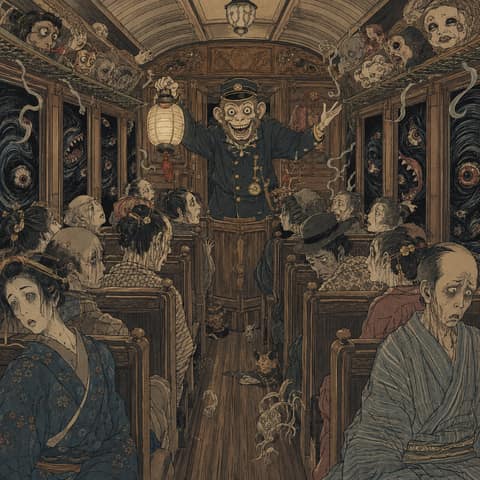
This version of Saruyume is read as a single railway line laid out inside a dream. The train is a means of transportation, but simultaneously a device for determining order. Passengers are made to sit in seats, listen to announcements, and wait until their turn comes. The terror is not just what will happen. Because events are announced methodically like station names or sequences, the absurdity of the dream approaches wearing the face of a system, and that is what makes it terrifying. The "monkey" in Saruyume is more of an MC's mask than the true form of the yokai. Monkeys resemble humans, but deviate slightly from human ethics. Thus, when a monkey-like entity laughs in a dream, the comicality of an amusement park and the coldness of an execution ground rise simultaneously. In old monkey god folklore, monkeys stand at the boundary between mountain and village, but in Saruyume, they stand at the boundary between sleep and wakefulness. They are not messengers of mountain gods, but petty attendants advancing a dream's performance. The reason this ghost story is strongly remembered on the internet is that the telling is short and the structure is clear. You board a train, there are previews, passengers decrease, you wake up halfway, you become afraid of falling asleep next. This framework is concise, and even if readers forget the details, they do not forget the structure. Like many of the modern anomalies compiled by Itsuki Asazato, Saruyume is both a single completed story and a template re-enacted within the reader's brain. Viewed as a dream ghost story, Saruyume modernizes the custom of "telling others the dreams you had." Superstitions like "bad dreams fade when told to others" or conversely "telling them makes them real" exist everywhere. In Saruyume, posting on a message board does not fade the dream; it duplicates it. Readers read someone else's dream and take home material similar to their own dreams. Here, the internet is a dream archive and simultaneously a medium that infects dreams. The lack of place names in Saruyume's stage is not a weakness, but a strength. Kisaragi Station has an outline reminiscent of western Shizuoka Prefecture, but Saruyume does not even have that. Thus, readers can move the stage to any sleeping location: a futon at home, a nap at school, a seat on a night bus, a hospital bed. The feeling that "it could happen to me," which ASIOS emphasizes in the circulation of urban legends, is established with minimal conditions in Saruyume. Getting off this train midway is made possible only once by waking up. However, the story does not treat waking up as an exit. Rather, waking up is an interruption, a preview of resumption. It does not allow the terror to be consumed in one night, but carries it over to the next sleep. This time design is the very anomaly of Saruyume, and the reason it encroaches on real-life rhythms despite using a dream as its stage. If Saruyume were posited as a single yokai, its body would be the entire train, the voice, the sequence chart. Hands and feet directly chasing passengers cannot be seen. Instead, the voice announcing the next station name dominates the progression. This is the sense of security of a modern transportation system turned inside out into nightmare procedures within a dream. You don't know where you are heading, but the next stop is certain to come. That certainty elevates Saruyume from a mere nightmare to a memorable modern anomaly.

Satoru-kun

Satoru-kun

Epic

satoru-kun

The Telephone Prophet Approaching from Behind

Spirit / GhostA telephone-ritual urban legend / The threshold between public and mobile phones

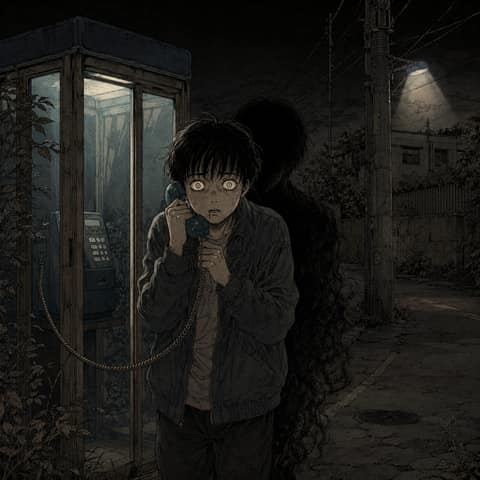
This version of Satoru-kun appears as a prophet coming from the other end of the phone. He is not merely an anomaly of pure malice. He has a clear function: answering the caller's question. That is precisely why he is dangerous. If it were only terror, people could avoid it, but thinking they might get an answer draws them to the dangerous steps. Satoru-kun sees through that curiosity. The medium of the telephone allows only the voice to arrive first. An entity with no face or body announces its location right in your ear. When that distance shortens to "I'm at the station now," "I'm in front of your house now," "I'm right behind you now," the phone changes from a communication device to a summoning path. Like the cluster of telephone urban legends collected by Hiroshi Matsuyama, Satoru-kun's terror is born the moment remoteness reverses into proximity. A comparison with Kokkuri-san illuminates this anomaly's personality well. Because Kokkuri-san involves multiple people surrounding the paper, responsibility is dispersed among the group. Because Satoru-kun requires calling alone, responsibility returns entirely to the individual. There is no escape route of "Didn't someone else move the coin?" Call histories, ringtones, and your own voice become the only evidence. The feeling of wanting to know becomes the very signature for the summoning. The endpoint of standing behind the caller is also important. Because he is behind rather than in front, the desire to confirm is born. But the moment you confirm, you break the taboo. This is an old ghost story structure: the other world is exposed when prohibitions like "do not look," "do not open," or "do not turn around" are broken. Despite being a telephone ghost story, Satoru-kun is an entity that has transferred the "must not look" archetype—shared by the Crane Wife, Urashima, and Yomotsu Hirasaka—to modern devices. Following Itsuki Asazato's categorization of modern anomalies, Satoru-kun is strong as a "ghost story with a method". Rather than just listening to a scary story, the steps are written out. When there are steps, people are forced to choose whether to try it or not. That choice is already a participation in the story. Even readers who do not execute it will mentally lift the receiver of a public phone, press the numbers, and hear the ringtone. Because public payphones themselves have decreased in modern times, Satoru-kun may look like an antiquated ritual. But the decrease does not weaken the anomaly; it concentrates it. The phone booth left in the corner of the station, the green phone in the hospital corridor, the fogged glass on a rainy day. Unused communication devices look like ritual tools left solely to connect this side and the other side. Satoru-kun stands in the place where a tool that has lost its convenience regains a magical nature. The final remaining question is what to do after getting the answer. Satoru-kun answers the question, but he will not necessarily save your life. Far from erasing anxiety, knowledge confirms the fact that something is behind you. This anomaly shows the paradox often found in divination ghost stories—the moment when the wish "knowing brings peace of mind" flips to "I can't escape because I know"—through the distance of a single phone call. Therefore, he is a prophet, and simultaneously a punishment for knowledge.

Teke Teke

Teke Teke

Epic

てけてけ

Teke Teke, the Crawling Half-Woman

Spirit / GhostModern urban legend of the 1990s-2000s, based on train accident motifs

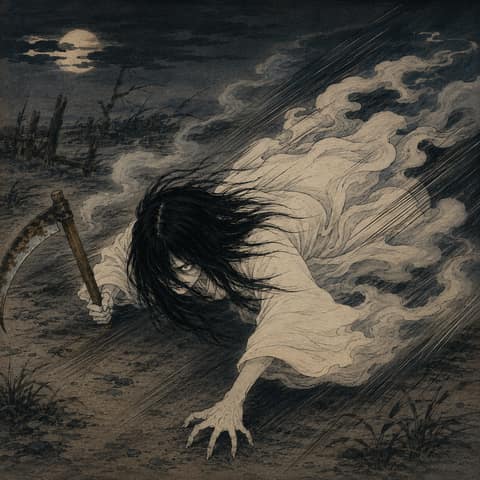
The "Woman Missing Her Lower Half" as a Post-War Japanese Horror Motif. While the basic description traces her origins and spread, a deeper analysis repositions Teke Teke within a broader cultural sphere: the motif of the "physically mutilated female ghost" in post-war Japan. The "female ghost lacking a complete body" is a recurring archetype in Japanese horror. From Oiwa (facial disfigurement, Nanboku Tsuruya's "Tokaido Yotsuya Kaidan," 1825) and Kasane (facial and bodily disfigurement, Encho Sanyutei's "Shinkei Kasanegafuchi"), to post-war entities like the Slit-Mouthed Woman (mouth disfigurement, first appeared in Gifu in 1979), Teke Teke (missing lower half), Kashima-san (missing lower half), and Hachishakusama (abnormal height), there is a common thread of "the loss of female physical integrity." Within this lineage, Teke Teke is unique for her connection to the "railway," a piece of post-war Japanese infrastructure. The Linguistic Choice of the Onomatopoeia "Teke Teke". The name "Teke Teke" mimics the sound of crawling on both arms, and this specific onomatopoeia is the result of several linguistic choices. First, the combination of the plosives 't' and 'k' suggests the hard, striking sound against a wooden floor or concrete. Second, the repetition (teke-teke) creates an eerie sense of a "slow, continuous pursuit." Third, it rolls easily off the tongue, making it easy for children to reenact. Derivative names like "Patapata," "Kotokoto," and "Katakata" have all undergone similar phonological selections, demonstrating a folk-acoustic pattern of "expressing the sound of movement with a two-syllable onomatopoeia." The Genealogy of Railway Accident Urban Legends. Japan's railways during the post-war period of rapid economic growth were the site of numerous fatal accidents, becoming a hotbed for ghost stories. Alongside Teke Teke, various railway and crossing-related legends have been recorded nationwide since the 1970s, such as "a woman standing behind you when you look back at a crossing," "a figure missing its lower half at the edge of a platform," or "being spoken to by a woman waiting for a train along the tracks." In "The Folklore of Yokai" (Iwanami Shoten, 1985), folklorist Noboru Miyata argued that post-war urban infrastructures (railways, tunnels, housing complexes) function as new spaces for generating ghost stories, replacing traditional locations like bodies of water, crossroads, and mountain passes. Teke Teke is perhaps the most successful entity born of these "infrastructure ghost stories." Cross-referencing with Kashima-san and the Structure of the "Answer". The method to survive Teke Teke—"answering 'Kashima-san'"—spread widely as a derivative rule. This follows the same pattern as answering "pomade" or "bekko ame" (tortoiseshell candy) to the Slit-Mouthed Woman, actively engaging children's imaginations by embedding a "correct answer" within the story. The countermeasures for Kashima-san herself are diverse, such as "answering 'Kamashi'" or "chanting the full name 'Reiko Kashima'," turning the countermeasures themselves into a trend among children. This can be read as a secularized form of the spells and mantra beliefs that have existed since the Heian period, now taking place within the school environment. Interpretation of the 2009 Film Adaptation. Director Koji Shiraishi's film "Teke Teke" (2009) adopted the Kakogawa, Hyogo origin theory, depicting the monster as a woman (real name "Reiko Kashima" = Kashima Reiko) whose lower body was severed in a post-war railway suicide. The film reconstructed the oral cross-referencing between Teke Teke and Kashima-san as "two sides of the same person." Bolstered by its connection to the idol culture of the time—starring AKB48's Yuko Oshima—Teke Teke served as a prime example of how post-war children's oral ghost stories were mediated into mainstream Heisei-era cinematic horror. Reproduction in the Internet Age. Since the 2010s, Teke Teke has been repeatedly reproduced through ghost story reading channels on YouTube, paranormal content on Niconico, and horror shorts on TikTok. In the 2020s, she has been embraced anew by Generation Z as a "scary story told at school during childhood," making her a rare case of an 80s-90s children's oral tradition successfully passing down through generations. Teke Teke is perhaps the clearest example of how the lifeline of a ghost story can endure while adapting its medium from "oral tradition → children's magazines → movies → the internet."

Yamanoke

Yamanoke

Epic

Yamanoke

The Headless One-Legged Entity Possessing Women

山野の怪2007年2ちゃんねる発祥の創作怪談

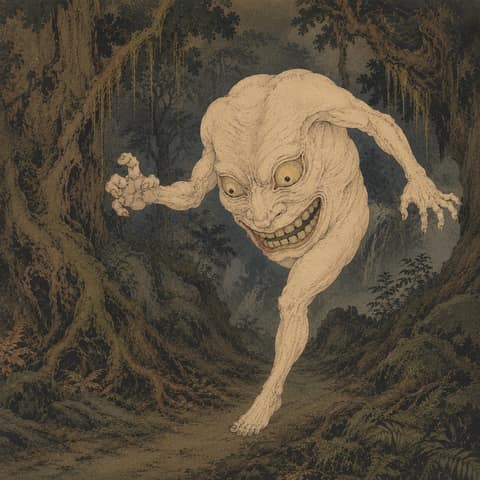
The Literary Prowess of the "ShareKowa" Golden Age. As mentioned in the base description, Yamanoke is a masterpiece from the golden age of 2channel's occult board. In this deep dive, we will explore the specific literary mechanisms that make this story so effective. The 'ShareKowa' (Scary Stories You Can't Laugh At) thread produced numerous internet legends, but Yamano Keita's Yamanoke stands out for its exceptional narrative pacing. The story transitions seamlessly from a mundane, slightly mischievous act by a father (driving down an unpaved mountain road to scare his daughter) into a sudden encounter with the incomprehensible. The pacing of the escape, the creeping realization of the daughter's abnormal behavior, and the dramatic diagnosis by a temple priest are woven together with the precision of a professional horror short story, elevating it far beyond a simple forum post. The Psychological Horror of Possession. Unlike monsters that simply attack or kill, Yamanoke's terror lies in "possession." When the daughter is afflicted, she loses her sanity and begins mimicking the monster's eerie "Ten-sou-metsu" chant. The horror is twofold: the physical danger of the encounter, and the psychological devastation of watching a loved one's mind be erased and replaced by something alien. The ticking clock element introduced by the priest—"if not exorcised within 49 days, she will never recover"—adds a desperate, suspenseful tension to the narrative that mirrors classical demonic possession tropes while rooting them firmly in Japanese folk Buddhism. The Resonance with Classical Mythology: Xing Tian. The morphological similarity between Yamanoke and the Chinese mythological figure Xing Tian (from the *Classic of Mountains and Seas*) is a subject of endless fascination among folklore enthusiasts. Xing Tian, the headless giant who fought the Yellow Emperor using his chest as a face, represents relentless, unyielding willpower in Chinese mythology. Whether Yamano Keita intentionally borrowed this imagery or arrived at it independently, transplanting this bizarre, ancient anatomy onto a modern Japanese mountain spirit creates a visual that is both absurd and deeply unsettling. The juxtaposition of a mythological warrior's body with the behavior of a grinning, muttering stalker is a masterclass in character design. The Linguistic Genius of "Ten-sou-metsu". The phrase "Ten-sou-metsu" is a brilliant piece of horror writing. In Japanese, the syllables "ten," "sou," and "metsu" evoke kanji related to heaven (天), sending/transferring (送), and destruction/annihilation (滅). It sounds like a fragmented Buddhist incantation or a curse. Because the author never provided a canonical kanji spelling or translation, readers are forced to imagine what this entity is trying to convey. Is it a threat? A countdown? A prayer? This linguistic ambiguity forces the reader's imagination to do the heavy lifting, ensuring the monster remains truly incomprehensible and, therefore, terrifying. The 2025 Resurgence and Sequel. The landscape of internet horror was shaken in late 2024 when Yamano Keita, the original author, re-emerged on social media after nearly two decades. The release of the sequel, *Zange* (Confession), in March 2025 proved that the author's ability to craft atmospheric dread remained entirely intact. The fact that an internet legend born in 2007 could receive a direct, canonical continuation 18 years later—and that the internet community reacted with such fervor—demonstrates that entities like Yamanoke are not just disposable forum posts, but enduring pieces of modern digital folklore that command genuine cultural legacy.

Showing 1 - 15 of 15 yokai