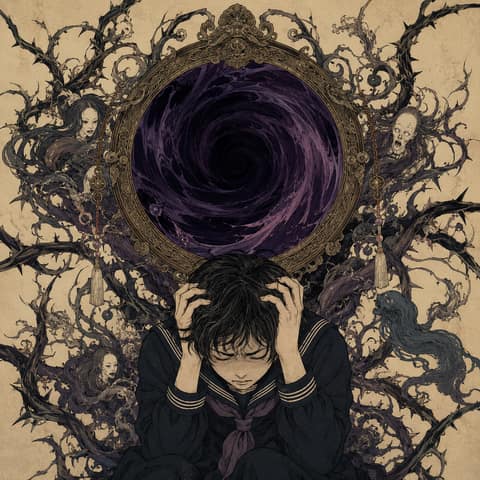
Murasaki-kagami (Purple Mirror) is a modern ghost story stating that "if you remember the word 'Murasaki-kagami' until you are twenty years old (or until coming of age), you will face misfortune or die." Unlike ordinary ghost stories, there is no specific yokai that appears or ghost that attacks people; the "memory of the word" itself becomes the curse. As pointed out in Itsuki Asazato's "Encyclopedia of Modern Japanese Anomalies," the characteristic of this anomaly is that the moment the reader hears the story, they are drawn into it, forced to bear the shackles of that memory until they reach the specified age[1].
There is no physical refuge in this ghost story. Because the curse is active as long as it is remembered in the brain, what is required is not escape, but "forgetting." However, psychologically, this invokes the ironic process theory known as the white bear problem—"the harder you try to forget, the stronger it remains in your memory." The condition of "must not remember until twenty" brilliantly utilizes adolescent psychology. Twenty is the boundary between childhood and adulthood. The anxiety and fear of the future experienced during the process of growing up are projected onto the four characters of "purple mirror" (Murasaki-kagami).
Regarding its origin, there is a widely circulated rumor about a burned girl who received a purple mirror, acting as the "story component" forming the core of the ghost story. However, this backstory was arguably added later to provide rationale for the unreasonable rule of "being cursed just by remembering." The primary force in this ghost story is not the mirror's origin, but the anxiety generated within the listener who hears the word "Murasaki-kagami."
To counter this curse, methods to break it were born, such as remembering words like "White Crystal" (Shiro-zuishou), "Light Blue Mirror" (Mizu-iro-kagami), or "Pink Mirror." This is a phenomenon unique to oral traditions, much like creating talismanic spells to counter spreading diseases. Murasaki-kagami moved from late 20th-century schools to anonymous message boards and social media, and while changing form, it continues to exist as an anomaly that treats memory itself as a dangerous object.
Folklore & Legends
Murasaki-kagami is often told not with a detailed plot, but as a short proposition: "If you remember the word 'Murasaki-kagami' until you are twenty, you will die." As analyzed in "Solving 'Urban Legends'" compiled by ASIOS, the power of this phrase lies in its extreme brevity and memorability. While many oral ghost stories blur in detail as they lengthen, Murasaki-kagami became a powerful meme simply by having a short word and an age limit.
There are several variations of the backstory accompanying it. For example, "A girl cherished a purple mirror, but the mirror broke before her twentieth birthday, and she died," or "A girl suffered burns, saw her ugly face in a purple mirror, and committed suicide." These stories give visual depth to the word-only curse, but they are not the essence of the anomaly. The essence lies in what the "I" who received the story should do. The listener is placed in a position of battling their memory until their twentieth birthday arrives.
The age limit of twenty (or coming of age) carries the meaning of a rite of passage. In his study of school ghost stories, Toru Tsunemitsu points out that ghost stories act as devices for children to process stress within the closed space of a school[3]. Murasaki-kagami lifts its curse at the timing of leaving school and becoming an adult. It converts the instability on the ladder from childhood to adulthood into the suspense of a ghost story. Being safe once you turn twenty means it is a ghost story exclusively for children.
To break the curse, countermeasures like "You must remember White Crystal (or White Mirror, Pink Mirror, etc.)" circulate alongside it. While the curse is "must not remember," the countermeasure "must remember" is also a binding of memory, but it alleviates anxiety by providing an active means of defense. The fact that the curse and its cure circulate as a pair is arguably due to children's need for a means to control the anomaly themselves.
Even after the popularization of the internet, Murasaki-kagami regained power as an "anomaly of words" easily spread on social media. Even if not whispered in a classroom, the curse is established just by seeing the words flow on a timeline. The ominousness of a purple mirror—an item rarely found in reality—combined with the clear deadline of age twenty and the formless fear of "what if I remember," constructs this modern anomaly. It is not the terror of being chased by something, but the terror of being bound by an unerasable memory within one's own brain.
This version of Murasaki-kagami does not appear as a tangible yokai. Its true form is the word "Murasaki-kagami" itself, and the memory of the person who received it. Because the anomaly resides within the brain, locking doors or fleeing far away is meaningless. The moment you hear "you will die if you remember," the contract of the curse is unilaterally established. This unreasonableness is the very characteristic of an anomaly parasitic on words.
The curse being set to the deadline of "age twenty" is by no means accidental. It is not just a legal boundary, but a symbol of the end of childhood. In the process of becoming an adult, people discard and forget many things. Murasaki-kagami acts as a ritual testing "whether you can forget the ominous superstitions of childhood as mere superstitions." Dying if you do not forget by twenty implies that if you fail to complete this rite of passage, the shadows of childhood will consume you.
This ghost story paradoxically increases its survivability by attaching counter-curse words like "White Crystal" or "Light Blue Mirror." If there were no way to break the curse, people would try to erase it from their memory; however, by teaching them that they must remember another word to break it, the foundational word "Murasaki-kagami" becomes even harder to forget. This is a highly calculated structure parasitic on the human memory mechanism, multiplying like a virus in the manner of urban legend transmission mechanics organized by ASIOS.
A purple mirror is an uncommon object in reality. In Japanese color psychology, purple is often viewed as noble but also carrying a sickly or unsettling tone. Combining this color with a "mirror" that reflects one's face creates a word that evokes an eerie visual image. Even without knowing the backstory of the burned girl, the mere sound of "Murasaki-kagami" radiates an unforgettable eeriness.
Murasaki-kagami does not seek physical harm. Its purpose is to remain dormant in a corner of memory for the years until the person turns twenty. It suddenly awakens when you casually see the color purple or look in a mirror, bringing small anxieties until age twenty arrives. Rather than appearing like a ghost, it exists as unerasable data in the brain. It continues to spread via text on the internet, surviving as a modern word curse that uses human memory as its incubator.
Character Profile
This section is our own creative profile for storytelling. It is not historical fact or scholarship.
Possesses no will of its own; it merely parasitizes the human brain as words and memories. Uses the backlash of trying to forget and the milestone of age twenty to stir anxiety.
Memory parasitismAge limit settingAnxiety inductionReversal of defense instincts (White bear effect)Paired propagation with counter-curses
Weaknesses
Completely loses its power upon turning twenty-one. Furthermore, because it is a curse dependent on age awareness, it is difficult to take effect on those who are unconcerned with their age or have forgotten it.
Habitat
The memories of primary and middle school students, classroom rumors, anonymous message board posts, a corner of the mind when welcoming one's twentieth birthday.
The diagram below is a diagnostic evaluation chart for The Word Curse Engraved with an Age Limit. The higher the value of each item, the stronger that characteristic is expressed.