Yokai Encyclopedia

Encyclopedia of Japanese Yokai

121 Yokai|14 Category|Page 1 of 6
Localization in Progress - More content available in Japanese version
View Japanese
Sort by: NameAscending
Epic
  • Aka Manto

    Aka Manto

    Epic

    Aka-manto

    Pre-War Red Caped Kidnapper / Post-War Red or Blue Paper

    霊・亡霊昭和10年代の流言·都市伝説、トイレ怪談へ派生

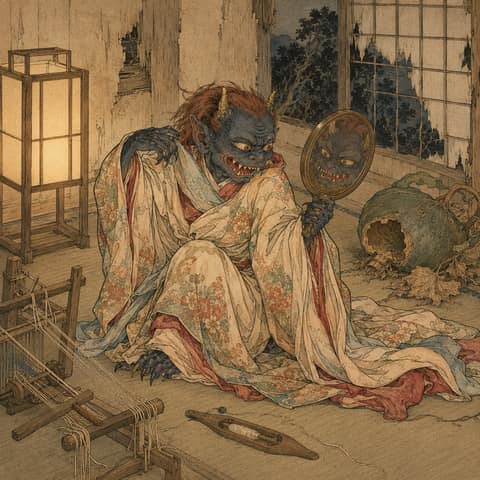
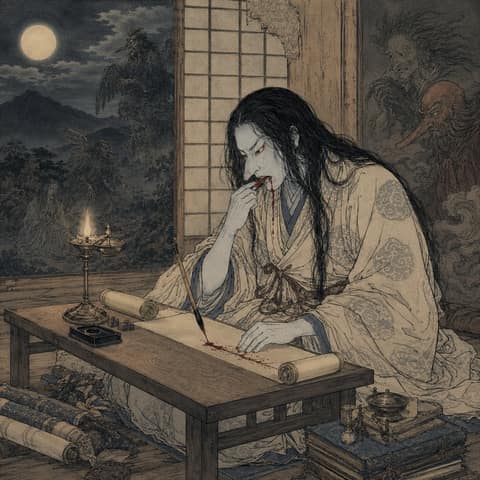
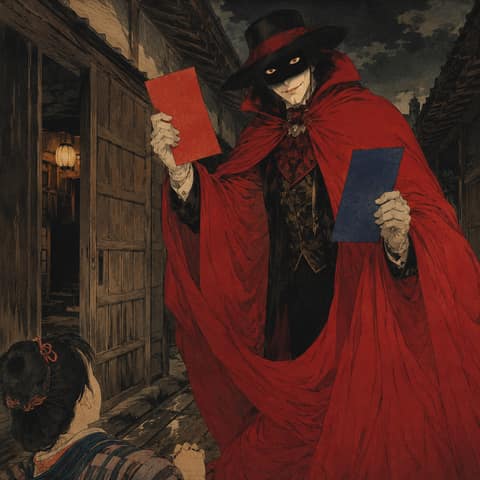
    Aka Manto as a Subject of Pre-War Rumor Studies. The base description outlined its evolution from pre-war to post-war; in this deep dive, we explore how the pre-war Aka Manto was positioned within Japanese sociological rumor studies. Soichi Oya (1900–1970), a prolific social critic from the pre-war to post-war eras, was a pioneer in journalism and rumor research. His essay, *The Sociology of Aka Manto*, published in the April 1939 issue of *Chuo Koron*, stands as a rare early example of academic analysis applied to a contemporary urban rumor. It utilized a single rumor to dissect wartime societal anxiety, the distortions caused by information control, and the collective psychology of urban residents. The pioneering nature of Oya's paper served as the starting point for later socio-psychological studies by scholars like Hiroshi Minami, Hideo Kishimoto, and Takeyoshi Kawashima, who systematized wartime and pre-war rumors. As the first urban legend to be comprehensively analyzed by Japanese sociology, Aka Manto holds immense significance in academic history. The Symbolic Weight of the Color "Red". The pre-war Aka Manto possessed a striking visual hook: "a running man in a red cape." In pre-war and wartime Japan, "red" carried heavy, complex connotations: (1) it was a symbol of blood, violence, and danger; (2) it was a metaphor for communism and anti-state ideology (within the context of wartime censorship); and (3) it represented the foreign otherness of Russia and the West (the Red Army, the "Red Devil"). The fact that Aka Manto proliferated during the war was no coincidence; it can be read as a socio-psychological event where the militaristic anxieties of urbanites coalesced and erupted around the color "red." Conversely, its post-war evolution into the "Red Paper, Blue Paper" schoolyard ghost story can be interpreted as the stripping away of its heavy pre-war symbolism, gamifying it into a simple "color-choice question" for children. The Continuity of Wartime Rumors and Children's Folklore. Aka Manto is a profoundly rare case of a pre-war urban rumor transitioning directly into a post-war school ghost story. This unbroken continuity is underpinned by three layers: (1) the generation who experienced their childhood in the 1930s became parents or teachers after the war, passing the story down to the next generation; (2) the chaos of the wartime metropolis and the rapid urban transformations of the post-war economic boom generated analogous psychological anxieties; and (3) the physical space of the school consistently functioned as the transmission apparatus for children's oral traditions across both eras. The Interrogative Structure of "Red Paper, Blue Paper". The core mechanic of the school ghost story version is the "color choice question." Answering "red" gets you dyed in blood; answering "blue" gets your blood drained. This "unsolvable dilemma"—where any answer results in death—shares structural similarities with classical Trickster myths (where every choice is a trap) and the psychoanalytic concept of the "forced choice." Folklorist Noboru Miyata theorized in *The Folklore of Yokai* (Iwanami Shoten, 1985) that the "unsolvable question structure" in post-war school ghost stories was a ritualized expression of childhood anxiety and powerlessness. Alongside Kokkuri-san's "answer-seeking summons" and Kashima-san's "Where are your legs?" interrogation, it is classified as one of the three major interrogative archetypes in children's oral horror. Convergence and Divergence with Hanako-san. In children's oral culture post-1980s, a strong trend emerged merging Aka Manto with "Hanako-san of the Toilet." Legends appeared featuring a Hanako wearing a red skirt or cape, narratives explaining that Hanako's true identity *was* Aka Manto, and storylines casting Aka Manto and a new "Ao (Blue) Manto" as a sibling duo or rival pair. This demonstrates that post-war school ghost stories did not exist in isolation; they evolved as a living ecosystem of interconnected myths. In modern urban legend studies, it has become standard practice to treat Aka Manto, Hanako-san, Kashima-san, Teketeke, and the Slit-Mouthed Woman collectively as an overarching "lineage of post-war Japanese horror intricately tied to women, the physical body, and the school space." The Nexus of Pre-War and Post-War Rumor History. Within Japanese urban legends, Aka Manto is an incredibly rare yokai that boasts explicit academic documentation across two distinct eras: pre-war (1935–1940) and post-war (1950–1990). It was recorded independently by two different academic fields—pre-war sociology/rumor studies (Soichi Oya, Hiroshi Minami) and post-war folklore/school ghost story research (Toru Tsunemitsu, Noboru Miyata). The mere fact that a 1939 academic paper in *Chuo Koron* and a 1990 children's book by Kodansha KK Bunko are discussing the exact same supernatural phenomenon, separated by half a century, serves as the most powerful testament to the enduring continuity of Japanese urban legend studies.
  • Akaname

    Akaname

    Epic

    ah-kah-nah-meh

    Bathhouse Grime-Goblin

    Household SpiritsVarious regions of Japan (especially Edo traditions)

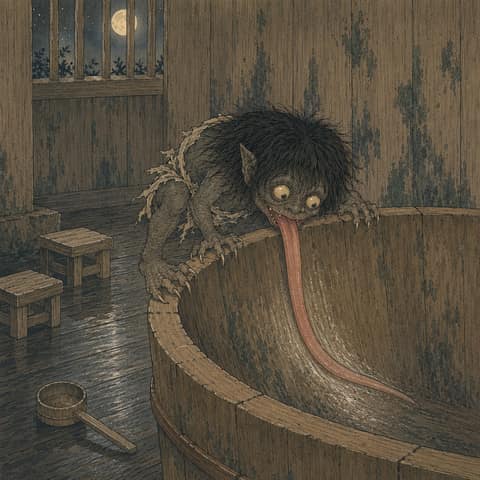
    A canonical form based on Sekien’s imagery and Edo-period prints. Resembling a cropped-haired child, it has clawed feet and an unusually long tongue. It avoids people, appears on deserted nights, and laps up bath scum and mineral scale, leaving wet tongue trails and a strange odor as its trace. Direct harm is rare; it is often seen as a presence that urges residents to clean.

  • Amano-zako (Heaven-Contrary Deity)

    Amano-zako (Heaven-Contrary Deity)

    Epic

    ah-mah-noh-ZAH-koh

    Zukai-Conformant Demon-Deity Form

    Deities & Divine SpiritsUncertain (descriptions chiefly in Edo-period encyclopedias)

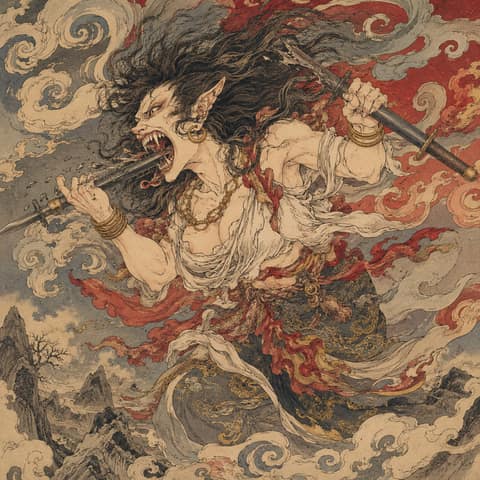
    This version follows the core account in Wakan Sansai Zue, depicting Amanozako as a ferocious demon-deity born from turbulent qi. Her appearance blends human and beast, with a high nose, long ears, and powerful fangs. Her temper is ever contrary, shunning proper procedure and delighting in reversals. She is said to wield overwhelming spiritual force, boasting the strength and presence to hurl even mighty gods afar. While conceptually akin to the Amanojaku, her lineage is unsettled, and claims that she is progenitor of the Tengu are limited. The note that she is mother of Tenma-no-O is confined to the Zue citation, with little broad support in oral tradition. Here the focus remains on her classical traits as a demon-deity—contrary speech, contrary action, and ferocious might—kept within the bounds of early-modern images and texts.

  • Amanojaku

    Amanojaku

    Epic

    ah-mah-noh-JAH-koo

    Traditional Iconography and Folktale

    Demons & GiantsOkayamaShizuoka

    Amanojaku is understood as a fusion of the trampled demon in Buddhist iconography and the folk image of a small imp fond of mimicry and speaking in reversals. Many temple and shrine statues of the Four Heavenly Kings or Shukongōshin place a small demon underfoot, signifying the subjugation of worldly desires and wicked intent. In stories, Amanojaku habitually reads people’s hidden thoughts, balks at requests, and does the opposite of commands to sow confusion. In mountain lore it is told as a being of tremendous strength, with unfinished stone piles, bridge piers, and toppled boulders on peaks attributed to its failed feats. Interpreting echoes as the voice of Amanojaku is a personification of natural phenomena, overlapping regionally with names like kodama and yamabiko. In fairy tales such as Uriko-hime, it serves as a touchstone-like adversary that preys on carelessness or greed, carrying a moral lesson. Overall, Amanojaku lives across iconography, folktales, and dialect traditions as a mirror of human contrariness and the gaps in the heart.

  • Amazake Hag

    Amazake Hag

    Epic

    ah-mah-ZAH-keh BAH-bah

    Traditional Folklore Aligned

    Half-Human BeingsNagano

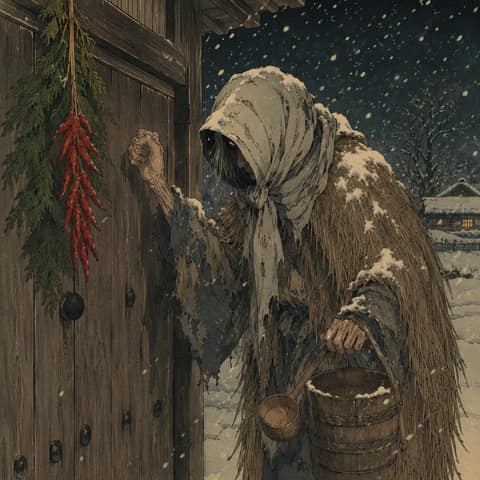
    Amazake-babaa was told as a visitor who heralds the arrival of epidemics. She knocks at midnight and asks whether there is sweet sake; the very act is a test of taboo, and answering is understood as a conduit for misfortune. People hung apotropaic symbols—cedar sprigs, nandina, and chili peppers—at their gates and avoided replying. Across Edo, people visited images of an old woman said to calm coughs, linking petitions to folk belief. The tradition overlaps memories of smallpox outbreaks; some view her as a guise of the smallpox deity, while others absorbed the image of a peddler woman on cold nights, creating regional variation. The yokai is transmitted with the taboo structure of “answer and you fall ill,” accompanied by threshold-warding rites, and is positioned as a portent tale that signals the presence of disease.

  • Amenosagume

    Amenosagume

    Epic

    ah-meh-noh-sah-GOO-meh

    Amanosagume

    Half-Human BeingsOsaka

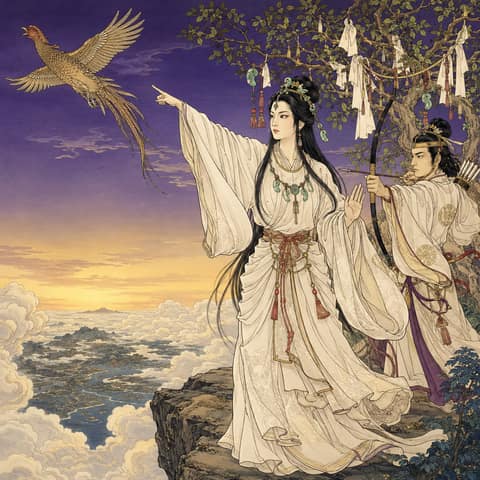
    Amanosagume is a priestess-like goddess named in the Kojiki and Nihon Shoki whose pronouncements of fortune and ill omen can overturn situations. Said to have accompanied Ame-no-Wakahiko, she once declared a singing woman’s voice inauspicious, reflecting an older stratum where divine intent and spoken proclamation tied closely to political ritual. The Kojiki writes her as Amasagume, while the Nihon Shoki uses Amanosagume. Fragments of the Settsu Fudoki and Man’yō poetry tell that she moored in Takatsu aboard the Heavenly Rock Boat, linking her to the toponym lore of Naniwa. Whether she is counted among heavenly or earthly deities varies by source, and honorifics applied to her are inconsistent. Folklore studies sometimes view her as a prototype of the contrary amanojaku, though others stop short of a direct syncretism. Few rites to her survive today: at Hirama Shrine in Wakayama she is revered as Amasagume-no-Mikoto, and at Shoten Shrine in Sagami she is remembered as a goddess who seeks bonds. Avoiding creative additions, her character within the sources can be summarized as a goddess who moves events through divination and declarative speech.

  • Ao-andon

    Ao-andon

    Epic

    AH-oh AHN-dohn

    Ao-andon, Demoness of the Hyakumonogatari

    Dwelling / ArtifactTokyo

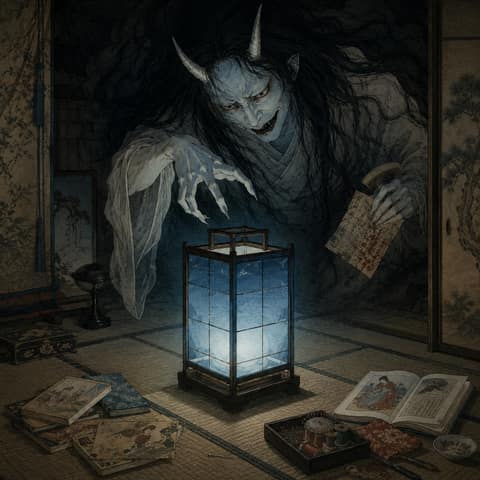
    This is the interpretation version of the "demoness appearing at the climax of the Hyakumonogatari," visualized by Toriyama Sekien, which had a decisive influence on later generations. In this version, the Ao-andon is not a mere jump-scare yokai, but functions as the game master presiding over the "ritual of terror" that is the ghost storytelling, and as a judge testing the psychological limits of the assembled humans. She is clad in a white kimono, revealing sharp horns through her long, unkempt black hair, and floating an eerie smile on her black-dyed teeth. Her appearance is reminiscent of a "Hannya" mask (a woman transformed into a demon by jealousy). As indicated by the sewing tools and letters scattered around her, she is not a "monster that came from somewhere else," but the manifestation of the negative emotions—"suspicion," "jealousy," and "grudge"—of the participants laid bare over the course of telling 100 ghost stories, condensed into a single point in the light of the blue lantern to take on the most terrifying form of a "demoness." The moment the 100th light is extinguished and total darkness and silence descend, she whispers to the participants, "Now, I shall show you the true horror (hell)." She is an entity that transcends the boundaries of yokai encyclopedias, monsterizing the very mechanics of human inner madness and fear—the ultimate refinement of Edo's horror culture.

  • Ayakashi

    Ayakashi

    Epic

    ah-yah-KAH-shee

    Maritime Ayakashi

    General ClassificationsCoastal regions across Japan, especially Western Japan

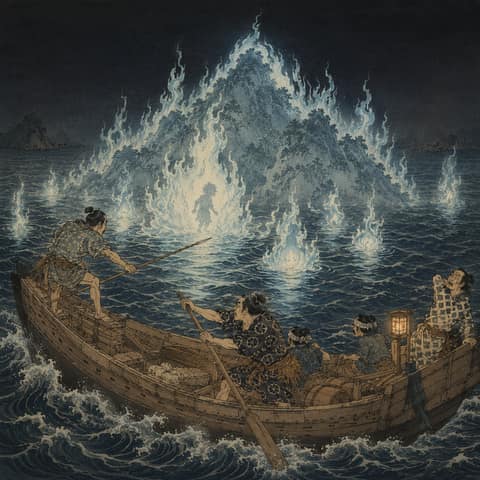
    A consolidated image of ayakashi used as a catchall name for sea-borne anomalies tied to maritime disasters across Japan. Forms vary widely—ghostly fires, phantasms, phantom women, sea serpents—but share behaviors such as leading ships astray, blocking courses, distracting crews, and luring the thirsty. In Tsushima, will-o’-wisps are said to become mountains, and local lore advises boldly pressing ahead to disperse them. In Nagasaki they drift as ghostly lights at sea, in Yamaguchi and Saga they are feared as funayurei, and off Bōsō they are recorded as a well-woman specter. The name is also shared with the real remora in folk belief that it slows a vessel, functioning as a folk explanation for natural phenomena and seafaring anxiety. Toriyama Sekien’s imagery shows a giant sea serpent, tying the idea to ancient notions of sea monsters.

  • Azuki-arai (Bean Washer)

    Azuki-arai (Bean Washer)

    Epic

    ah-ZOO-kee ah-RAH-ee

    Azukiarai of the Mountain Stream

    Ghosts & SpiritsTokyoIbaraki

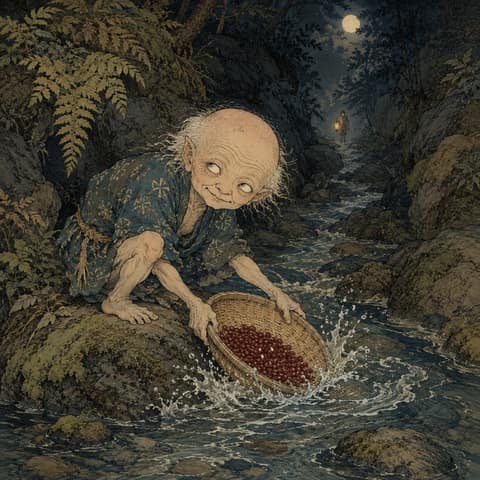
    Rooted in the classic image of the Azukiarai, it blends with the sounds of ravines and flumes, washing red beans through the midnight hours. It lures with sound and tests the curious who peer in. Drawing on early modern notes that it excels at counting and judges vessel measure and bean quantity at a glance, it is not wantonly harmful, but serves as a keeper of taboos along the water’s edge.

  • Basan

    Basan

    Epic

    BAH-sahn

    Tradition-Faithful Iyo Type

    Animal ShapeshiftersEhime

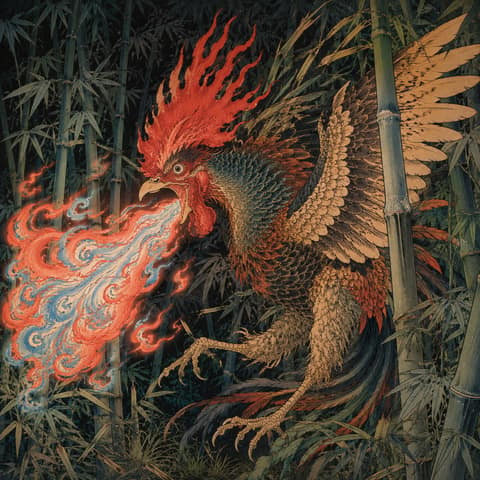
    This version follows accounts from Iyo, portraying it as a monstrous bird lurking in mountain bamboo thickets. It resembles a chicken with a striking red comb, and in the dark only the comb and the fire it exhales are visible. Its expelled fire is a will-o’-the-wisp without heat that does not ignite objects, said to flicker suddenly along night roads and village borders, leaving a strong memory of beating wings. Nocturnal in habit, it reacts sharply to signs of doors opening or moving lights such as torches, and retreats into the thicket at once. Reports of harming people are scarce, with encounters mostly limited to startling passersby, and villages regarded it as an ambiguous sign of the mountain’s presence—neither auspicious nor ill-omened. Early modern sources also note views likening it to a fire-eating bird and names derived from its wingbeat, blending natural-history notes with tales of the uncanny. In folk belief it is placed among boundary spirits marking the divide between mountain and settlement, a gentle anomaly linked to both ghost-light lore and bird-yokai traditions.

  • Batsu (Hiderigami)

    Batsu (Hiderigami)

    Epic

    BAHT-soo (hee-DEH-ree-gah-mee)

    Bibliographic Transmission Batsu (Hiderigami) of the Wakan Zukai Lineage

    Deities & Divine SpiritsChinese tradition (transmitted to Japan through texts)

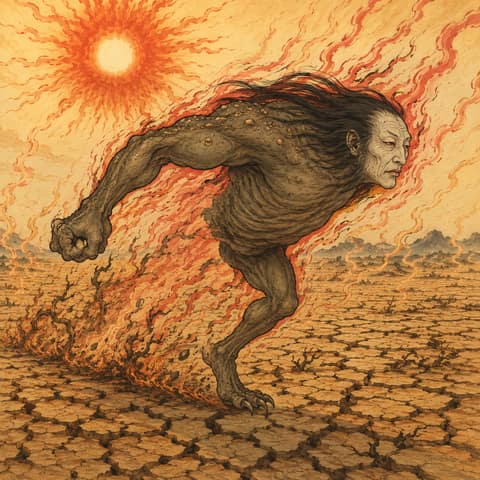
    In Japan, images of the batsu (Hiderigami) were received mainly through later Chinese writings and bibliographic transmission. The Wakan Sansai Zue cites Sancai Tuhui, Bencao Gangmu, and Shenyijing, explaining that the batsu, called the “drought god,” has a human face and beastly body with a single hand and a single foot, runs like the wind, and wherever it dwells no rain will fall. Toriyama Sekien’s Konjaku Gazu Zoku Hyakki visualizes this composite form and notes the alias “Hanmu.” Rather than native Japanese yokai lore, these accounts reflect learned reception of Chinese views on calamities and calendrical omens, treating the batsu as an ideational symbol of drought more than an eyewitnessed apparition. Its form is not fixed, with a goddess aspect (Bo) and a beast-shaped aspect coexisting, though Japanese sources tend to emphasize the latter. Religious responses align with general drought countermeasures such as rain prayers and water-deity rites, and clear cases of direct worship of the batsu itself are not well attested. As a calamity deity, its approach was thought to wither plants and exhaust human spirits.

  • Biwa Bokuboku

    Biwa Bokuboku

    Epic

    BEE-wah BOH-koo-BOH-koo

    Canonical Iconography

    Animated Objects & UndeadJapanese folklore

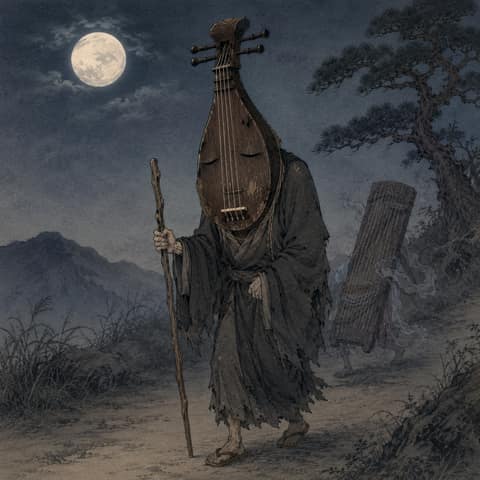
    A standard reading grounded in Sekien’s imagery and the lineage of Muromachi picture scrolls. A biwa long played and cherished attains spirit, joins the night parade clad like a blind lute priest. Its tone captivates the heart and carries an allegory urging awe and respect for venerable instruments. It does not hinge on particular biographies or local lore; praise of crafted objects and cautionary reverence are its themes. Tales tied to famed instruments such as Genjō and Makiba serve only to frame the tsukumogami worldview, while the conduct of the Biwa Moku-moku itself survives chiefly in pictorial form. In images it walks with eyes closed, leaning on a staff, sometimes paired on the same spread with a koto tsukumogami.

  • Blue Heron Fire

    Blue Heron Fire

    Epic

    ah-oh-SAH-gee-bee

    Canonical Folklore Version

    Animal ShapeshiftersNaraNiigata

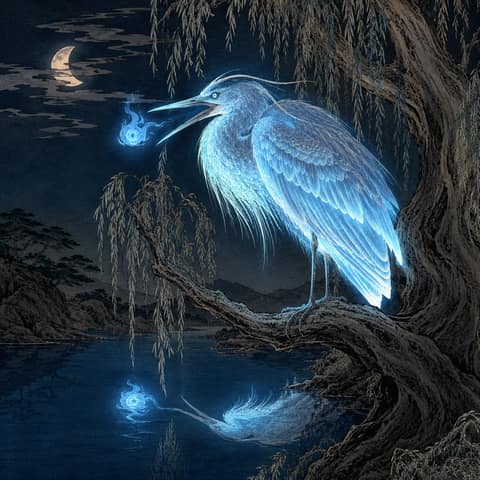
    Aosagibi is told as the pale blue glow seen around night‑active herons such as the black‑crowned night heron, appearing above water or against the night sky. In the Edo period it was depicted by Sekien and recorded widely in essays. Willows and ancient plum trees, river mouths and inlets, and shrine and temple precincts—places where “ki gathers”—were feared as haunts where mysterious fires would linger, and cases are told where a shot “ghost light” proved to be a heron. Explanations noted since early modern times include moonlight and water reflections, the sheen of wet feathers, the glare from white breast plumage, or microorganisms at the waterside, showing how people moved between natural causes and yokai tales. Other strands say old night herons faintly glow by season, turn into fireballs, or breathe fire, letting tales of ghost lights, strange birds, and dragon lamps intersect. Though eerie, many stories end with the creature merely being a bird once brought down, emphasizing its nature as a misperceived apparition.

  • Broom Spirit (Hōkigami)

    Broom Spirit (Hōkigami)

    Epic

    HOH-kee-gah-mee

    Folk Belief Version – Broom Deity

    Deities & Divine SpiritsVarious regions across Japan

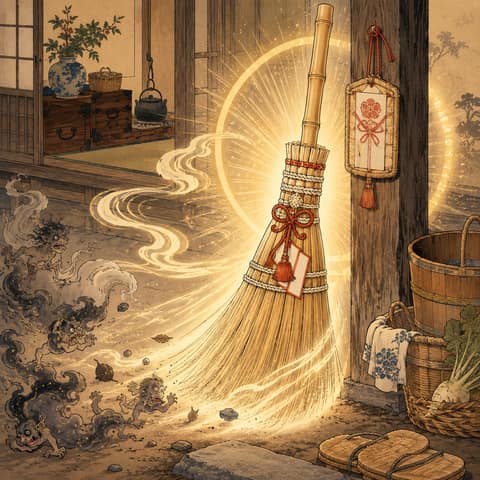
    Emphasizing the household cult image of the broom deity, this spirit uses the broom as a sacred vessel to govern domestic purity and the safety of childbirth. Sweeping is seen as a rite of purification that orders boundaries and drives out misfortune and impurity, while the power to gather scattered things back together also symbolizes recalling souls and inviting good fortune. At life’s turning points—New Year, moving house, pregnancy and postpartum—people renew the broom and dispose of the old one with thanks. Mistreating a broom is taboo, and stepping over it, treading on it, or leaving it upside down is inauspicious. Yet the upside-down broom can be used deliberately as a charm to gently send lingering guests home. In art, Toriyama Sekien depicts it as a tsukumogami in Hyakki Tsurezure Bukuro, but in folk practice it is revered as a divine presence dwelling in the tool, a household deity, both practical implement and object of faith. Regional details vary, but it is understood as a local guardian of cleansing and boundaries.

  • Ceiling Licker

    Ceiling Licker

    Epic

    TEN-joh-NAH-meh

    Traditional Interpretation (after Sekien Toriyama)

    Household SpiritsEdo period

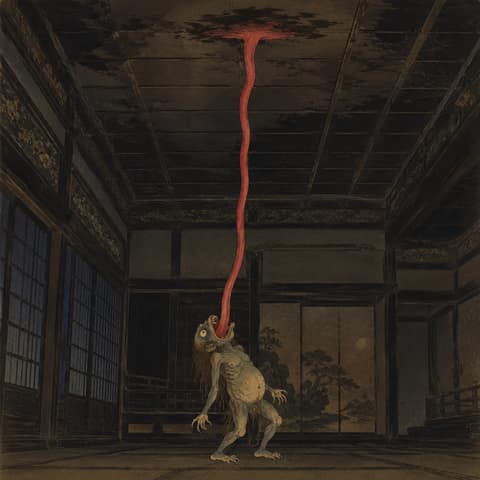
    An interpretation based on Toriyama Sekien’s picture book: a being that lets a long tongue hang down and roams old houses licking the ceiling. Rather than harming people directly, it is portrayed as bringing chill, gloom, and dampness into rooms. Its iconography is traced to a Muromachi-period Night Parade of One Hundred Demons scroll showing a creature extending its tongue upward, and later Edo-to-modern compendia ascribed to it the habit of licking away stains, soot, and cobwebs from ceilings. No proper name, lineage, or origin myth survives; it is taken as a symbol of household hauntings in general. Tradition places it in sparsely occupied buildings such as old temples and mansions, with wet streaks and speckles appearing on boards at night cited as its traces, though a firm regional folklore core is hard to confirm.

  • Crab Monk

    Crab Monk

    Epic

    KAH-nee-BOH-zoo

    Crab Monk (Chogenji Tradition, Classical Version)

    Half-Human BeingsYamanashi

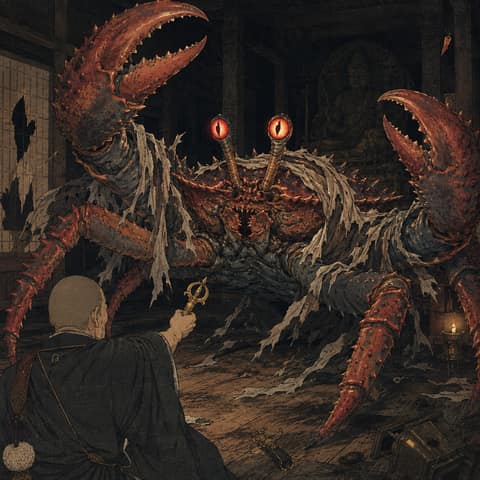
    A figure centered on the monstrous crab legend of Chogenji at Manriki in Kai Province. Disguised as an itinerant monk, it comes to the temple at midnight and borrows Zen phrases, tossing hints like “freely side-walking” and “two legs eight legs” to suggest a crab while testing its counterpart’s wit. It retains human form until its identity is pierced, but when pressed with ritual implements or mantras it reveals its carapace and flees, said to span a two-ken square or reach four meters across. Local lore preserves place names like Crab-Chasing Slope and Crab Marsh, a holed “claw-mark” stone, and tales of thrown stones. Across regions the same tale type shares an empty temple, late night, Q and A, exposure of the true form, and retreat or slaying, with the kyogen play “Crab Yamabushi” often cited as an influence. Devotional aftertales may stress the ritual implements used in subduing it—vajra pestles or iron fans—and devotion to Kannon, though details vary. The version told from the Kyoho era onward forms today’s backbone, and a Meiji hanging scroll attests to the tale’s settlement. Stripped of later embellishment, it is a moral tale of a shape-shifting crab that tests a monk and yields to sacred power.

  • Daija

    Daija

    Epic

    だいじゃ

    The Water God Disputing Lake Chuzenji: Daija of Senjogahara

    Divine SpiritTochigi

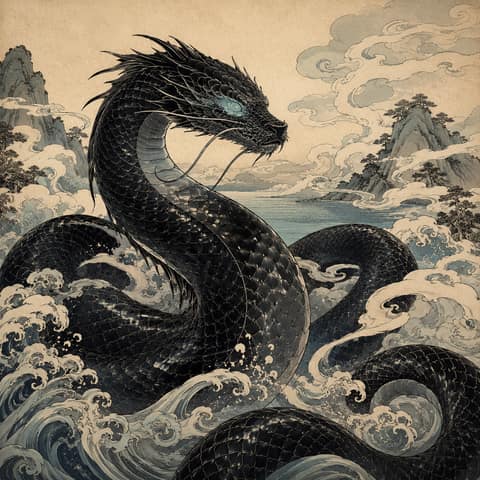
    The Daija of Senjogahara is the avatar taken by the god of Mount Nantai (Futarasan) to fight for dominion over the lake. When uncoiled, it is long and massive enough to cover half of Lake Chuzenji. Its scales shine like wet obsidian, and its eyes harbor the phosphorescent glow of the lake bottom. It summons water, raises fog, and stirs waves upon the lake's surface to hinder its foes. Initially pressed hard by the giant centipede of Mount Akagi, it is said to have turned the tide by borrowing an arrow from a human master archer—preserving a form of worship where mountain and village intersect, showing a god winning through human assistance. The traces of this victory and defeat became the place names Akanuma, Shobugahama, and Senjogahara, which are etched into the landscape of Oku-Nikko to this day.

  • Dancing Heads

    Dancing Heads

    Epic

    MAI-koo-bee

    Canonical Folklore Standard

    Ghosts & SpiritsKanagawa

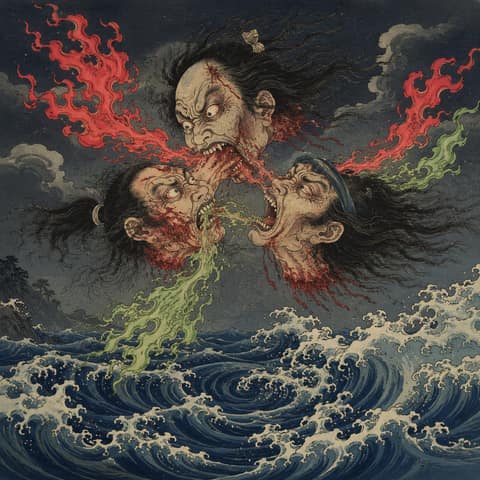
    A standard interpretation based on the vengeful spirit of Manazuru’s sea as recorded in Picture Book of One Hundred Ghost Stories (Ehon Hyaku Monogatari). The severed heads of fallen warriors refuse to relinquish their grudges and are told to bite one another while spewing fire. Two origins are given in parallel: a sword fight born from a quarrel during a festival, or execution for gambling crimes. In either case, the heads move on their own, dance, raise whirlpools and ghostly flames above the sea, and link to local place-name lore. Artwork depicts three heads joined and dancing, a motif echoed in later kibyōshi and yomihon. Framed as a sea-deep and rocky-shore apparition, the tale warns of fear toward severed heads, the curses of war and private duels, and the perils of watersides.

  • Dodomeki

    Dodomeki

    Epic

    DOH-doh-MEH-kee

    Sekien Iconography Standard

    Half-Human BeingsTokyoTochigi

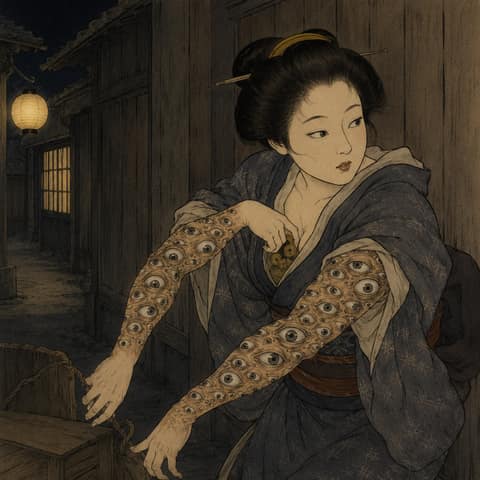
    Following Toriyama Sekien’s note, this version centers on a moralizing motif warning against theft. The many eyes along the arm relate to a pun likening the holes of copper coins to birds’ eyes, externalizing the habit of hands reaching to steal. The source Sekien cites, “Kankangai-shi,” is of uncertain reality; his wordplay on Hakone as a boundary and his own remark calling it a curious book suggest the citation itself is part of the artistic conceit. The Dodomeki’s image concentrates on a female form, yet no concrete personal names, family lines, or local legends are preserved, pointing to an urban allegory where image and wordplay outweigh regional lore. Postwar explanations vary in reading and interpretation, but the archetype is traced to Sekien’s original.

  • Emperor Sutoku

    Emperor Sutoku

    Epic

    Emperor Sutoku

    Emperor Sutoku, the Vengeful Spirit Exiled to Sanuki

    Spirits & GhostsKagawa

    This edition follows in close detail—discerning the boundary between history and the legend that runs from the Hōgen Monogatari onward—how a single deposed emperor turned into the Great Tengu and Great Demon-Bond called the greatest in Japanese history. First, the history must be grasped. Sutoku's misfortune lay in the political exclusion of being shunned by the cloistered emperor Toba as an "uncle-child" and being made to abdicate without ever holding the power of cloistered rule. After the early death of Emperor Konoe, that his younger brother Go-Shirakawa, rather than his own son Prince Shigehito, was set up became the trigger for the Hōgen Rebellion (1156). On the defeated Sutoku's side, Minamoto no Tameyoshi and Taira no Tadamasa were put to public execution for the first time in roughly four hundred years, and Sutoku himself was exiled to Sanuki. Up to here it is history grounded in records. The uncanny is born beyond that, in the stratum of legend. Both the curse said to have been written in blood—"I shall become the Great Demon-Bond"—after biting off his tongue, and the figure of him turning into a tengu with nails and hair grown long, are stories transmitted not by contemporary records but by the Kamakura-period Hōgen Monogatari. Yet this legend spread with great persuasive force, and the great fires, forceful appeals, and upheavals that struck the capital from the Angen years onward—indeed, the Jishō-Juei War leading to the fall of the Taira—came to be read as Sutoku's curse. The events themselves are history; the interpretation that ascribes them to Sutoku's rancor is goryō belief—the two must be seen as sharply distinct. What fixed Sutoku's tengu image was literature. "Unkei Miraiki," book twenty-seven of the Taiheiki, depicts Sutoku as a demon-king ruling the throngs of tengu and demon-bonds, and in the early-modern era "Shiramine" in Ueda Akinari's Ugetsu Monogatari gave vivid form to Sutoku's vengeful spirit confronting Saigyō—not as a long-nosed tengu but as a golden kite. The image of Sutoku told of as "the foremost Great Tengu of Japan" and "the greatest vengeful spirit in Japanese history" stands upon this accumulation of literature. What deserves attention is that his pacification reached even into the modern era. In the first year of Meiji (1868), the Meiji government welcomed Sutoku's divine spirit, resting in Sanuki, to the capital and enshrined it at Shiramine Jingū. That at the outset of a new reign they still feared the curse of a deposed emperor seven hundred years past tells how deep-rooted the dread of Sutoku's vengeful spirit was. A poet who left a famous verse in the Hyakunin Isshu, and a great demon-king who curses the throne—this very gulf is what pushed Retired Emperor Sutoku to the apex of goryō belief.

  • Enenra

    Enenra

    Epic

    eh-NEHN-rah

    Gossamer Smoke Sprite

    Household SpiritsJapanese folklore

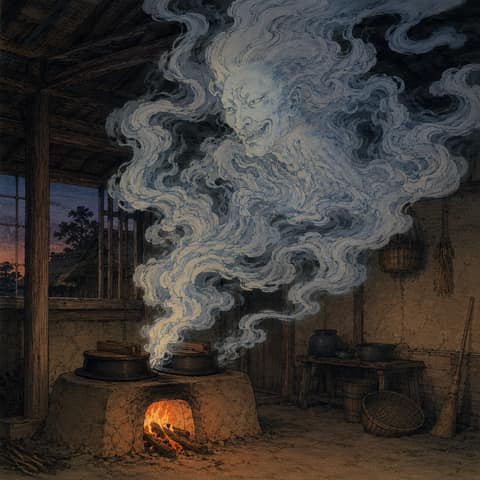
    Based on Sekien’s imagery, this interpretation highlights smoke layered like thin cloth coalescing into a human face. Rather than causing harm, it is better told as a sign pointing out imbalances in a household’s energy and as a warning about fire handling, which aligns with folk beliefs. It holds no fixed form, shifting with wind and temperature, with faces appearing and vanishing according to the viewer’s state of mind.

  • Epidemic God

    Epidemic God

    Epic

    yahk-BYOH-gah-mee

    Gyōekishin, Plague-Deity

    Deities & Divine SpiritsHiroshimaKyoto

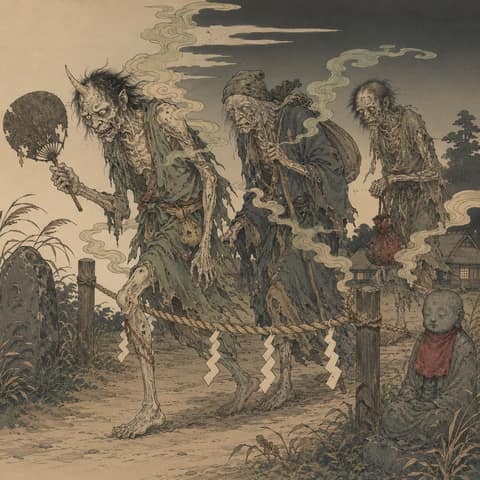
    An archaic image of the plague deity recognized in both court ritual and folk belief. Usually unseen, it gains force at seasonal turnings and when blossoms fall, entering through village bounds, crossroads, and riverbanks, spreading illness by seizing on household impurity and neglect. In paintings it appears as bands of oni-like or uncanny figures on the move, while tales say it stands at the door as a traveling old man or woman, disliking lapses in almsgiving or proper etiquette. Communal countermeasures include boundary festivals, rites of purification, offerings, displaying talismans, and sending off dolls, with porridge or other set foods prepared on fixed dates to ward it away. Its forms and names are not fixed, appearing in step with local customs and annual rites, so it varies by region, yet it is always told in connection with practices that “set the boundary and purge defilement.”

  • Funayūrei (Boat Ghosts)

    Funayūrei (Boat Ghosts)

    Epic

    foo-nah-YOO-ray

    Beggar of Teigo at Dan-no-ura

    Aquatic SpiritsYamaguchiFukushima

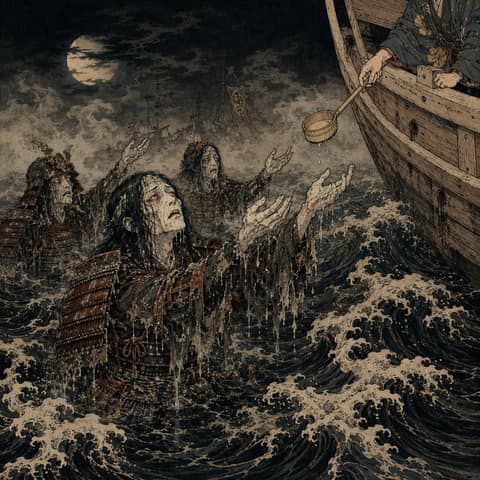
    An uncanny variant of the funayurei said to be the ruined shades of the Taira clan sunk at the Battle of Dan-no-ura. On nights of shifting tides and sea mist in the western straits, they draw alongside a boat, armor dripping, and beg, “Give us a teigo ladle.” Their faces are pale, eyes reddened by salt, voices hoarse yet mannered with samurai courtesy. Keeping the discipline of their former camp, they form ranks even at sea, a herald calls out, and many hands clutch the gunwale. If given a ladle with an intact bottom, they silently bail seawater into the boat until it founders. Those who know the old ways cross the sea with bowls and ladles whose bottoms are pierced, tied ready at the rail. When the ghosts accept them, water runs through and does not stay aboard, and only the weight of their rancor scatters on the tide. Priests sometimes hold services, and then the shadow of war hats melts into the mist, chains of armor return to the sound of waves. They do not drown people at random but approach those ignorant of sea rites or proud souls who scorn the ocean, marking their own downfall upon the world. On the sixteenth of Obon, on equinoctial days, and on battle anniversaries, their tread comes nearest when the sea is unnaturally still, and ghostly fires line the surface like beacons, mirroring the fleets of old. Offerings of ash, rice cakes, incense and flowers, and dumplings soothe their fixation; cast them from the bow and a wave like a shirabyōshi’s sleeve returns once and pushes the boat onward. A hard stare may make them withdraw, not by force of gaze but because the living truly behold the dead and the knotted ki loosens. As Yamaoka Genrin told, their true form is congealed rancor, soot-like grudge given shape upon the current; when winds shift, sutras resound, and offerings sink, the loosened ki disperses into the sea. Thus this version of funayurei can be stilled not only by fear but by memorial rites. Sometimes the outline of a child appears among their ranks, its voice thinner still, never asking for “water,” only hooking small fingers over the rail. If you hear the faint chime of armor bells, correct your helm, take the Hayatomo Rapids on the slant, and let a murmured nembutsu ride the wind. The slayers’ spirits drifting in the western dark yield only to proper forms and compassion.

  • Funayūrei (Boat Ghosts)

    Funayūrei (Boat Ghosts)

    Epic

    foo-nah-YOO-ray

    Inada-Kase Boat Ghost

    Aquatic SpiritsYamaguchiFukushima

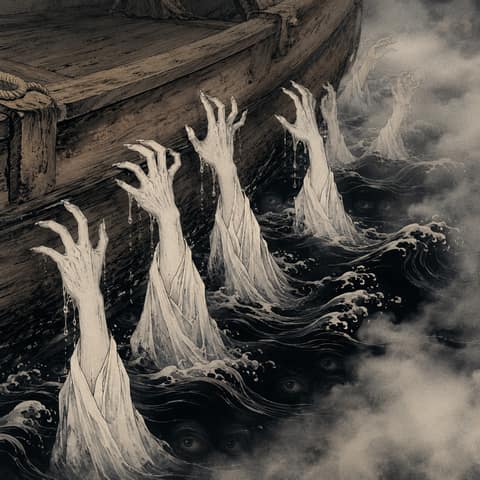
    A variant of the boat ghost that appears with the call of “Inada-kase” along the Fukushima coast. On calm nights, in drifting fog, or before a squall, pale hands and wet sleeves line the gunwale, and a chill voice repeats “lend the inada” from the waves. The inada is a bailer ladle for scooping water from a boat; once lent, the spirit pours seawater back into the craft to sink it. It rarely shows its face head-on, the visage veiled in sea mist, only dripping cuffs and black eyes glinting in the lamp’s edge. Reasonable at heart yet tasked with judging neglect and breaches of maritime order, it favors the sixteenth day of Obon, the dark of the moon, and fishing grounds where memorial rites have lapsed. Traditional countermeasures say to hand over a ladle with its bottom removed; the spirit accepts out of courtesy, but the water spills back to the sea. A pinch of rice ball, hearth ash, or salt-purified rice cake cast with the words “this is an offering” also satisfies its claim. If met with turmoil or shouting, it flies into a rage, unseen hands weighing the oars, dimming the compass, and warping the tide lines. They are a host of the drowned, a balance of the sea, and a mirror of neglected tools and unkept rites. Thus fishers notch their bailer, tie a sprig of shiso or a straw, purify it, and bow to the boat spirit before setting out. Because the ghost returns borrowed tools to the sea, the ladle may wash ashore by morning crusted with salt flowers. On windless nights when the helm grows heavy and water sounds along the side, add no lights, raise no voice, and quietly offer the inada; then the spirit cannot fulfill its debt and slips away in shame.

Showing 1 - 24 of 121 yokai