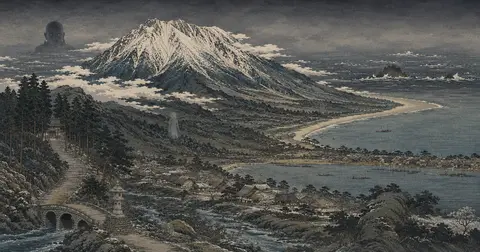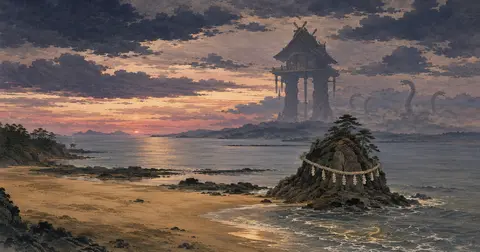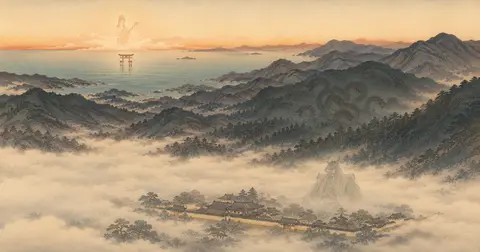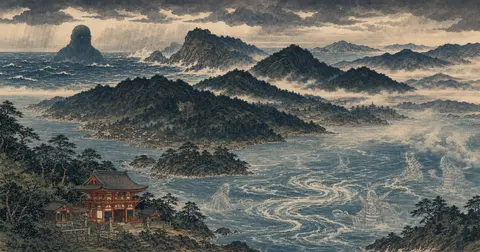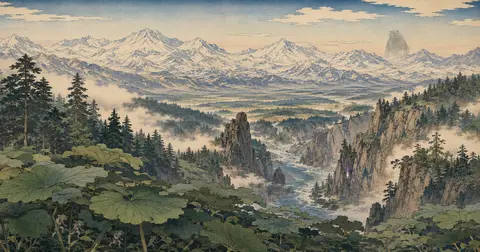
Situated in the southern part of the Chugoku region and facing the Seto Inland Sea, Okayama Prefecture is the site of a major ancient power known as Kibi Province. It later split into Bizen, Bitchu, and Bingo, while the northern mountainous area became independent as Mimasaka Province. If one were to thread the yokai culture of this land with a single string, it would be the "supernatural of boundaries"—the Kibi plains where the Yamato court clashed with local forces, the sea of the Bisan Seto separating Honshu and Shikoku, and the deep mountains of Mimasaka where human settlements and sacred realms meet on a razor's edge. The supernatural phenomena of Okayama constantly rise from the seams of these dual worlds.
A prime symbol of this is that the area is the home of the folktale "Momotaro." The story of Momotaro crossing over to Onigashima to slay demons is said to have originated from the legend of Ura at Kibitsu Shrine[1], where Kibitsuhiko-no-Mikoto defeated the demon god Ura. The slain demon did not disappear; its severed head continued to roar, and was eventually laid to rest beneath a cauldron, becoming a god that prophesies good and bad fortune. The conquered turning into supernatural beings that continue to speak—this motif of reversal is the key to deciphering Okayama's yokai. In this article, starting with the roaring cauldron of Kibi, we will trace the supernatural entities nurtured by the land of Okayama, including the sacrifices swallowed by the mountains of Mimasaka, the mysterious shadows floating in the Seto Inland Sea, and the small specters lurking in the villages.
The Cauldron of Kibitsu and Ura:
What Roars in Momotaro's Homeland
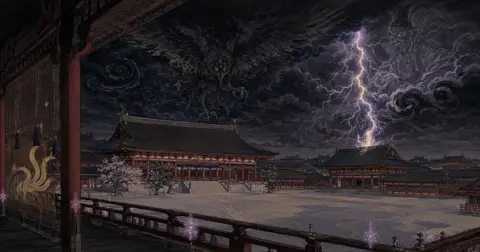
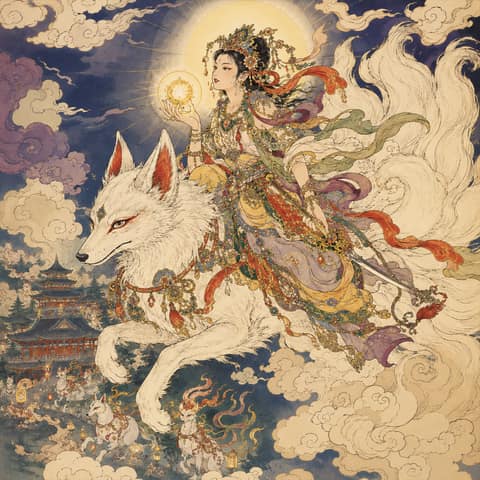
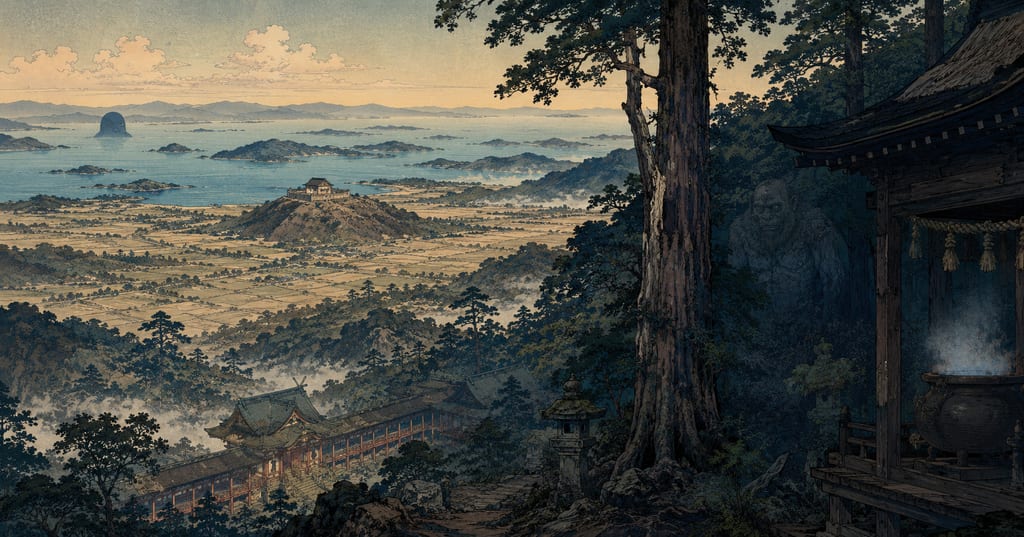
Situated at the foot of Mount Nakayama in the west of Okayama City, Kibitsu Shrine is one of the oldest shrines in Okayama Prefecture, enshrining Okibitsuhiko-no-Mikoto as its main deity. According to the *Kojiki* and *Nihon Shoki*, this deity, sent to the western regions as one of the four legendary generals, defeated the demon god Ura here. According to the shrine's legend of Ura[1], Ura came from a foreign land, built the Demon's Castle (Kinojo) on Mount Shin, flew through the sky, changed his shape, and tormented the people of Kibi. The Mikoto set up his camp at Nakayama and fired arrows at Ura's castle, but his arrows collided mid-air with rocks thrown by Ura and all fell to the ground. Therefore, the Mikoto nocked two arrows at once; while one hit a rock, the other finally pierced Ura's left eye. It is said that blood flowed like a river from Ura's wounded eye.
What is noteworthy is that this story goes beyond mere folktale and is etched into the very place names of the Kibi plains. The place where the Mikoto's arrows and Ura's rocks fell is enshrined as Yagui-no-Miya. The river dyed red with the blood Ura shed is called the Chisuigawa (Blood-Sucking River). Shot in the eye, Ura transformed into a pheasant and fled into the mountains, and when the Mikoto pursued as a hawk, Ura turned into a carp and jumped into the Chisuigawa. The Mikoto immediately became a cormorant and devoured the carp—the site of this capture is Koikui Shrine. This battle of transformations between god and demon remains in the fields of Kibi as a series of sacred sites that can still be traced on foot today.
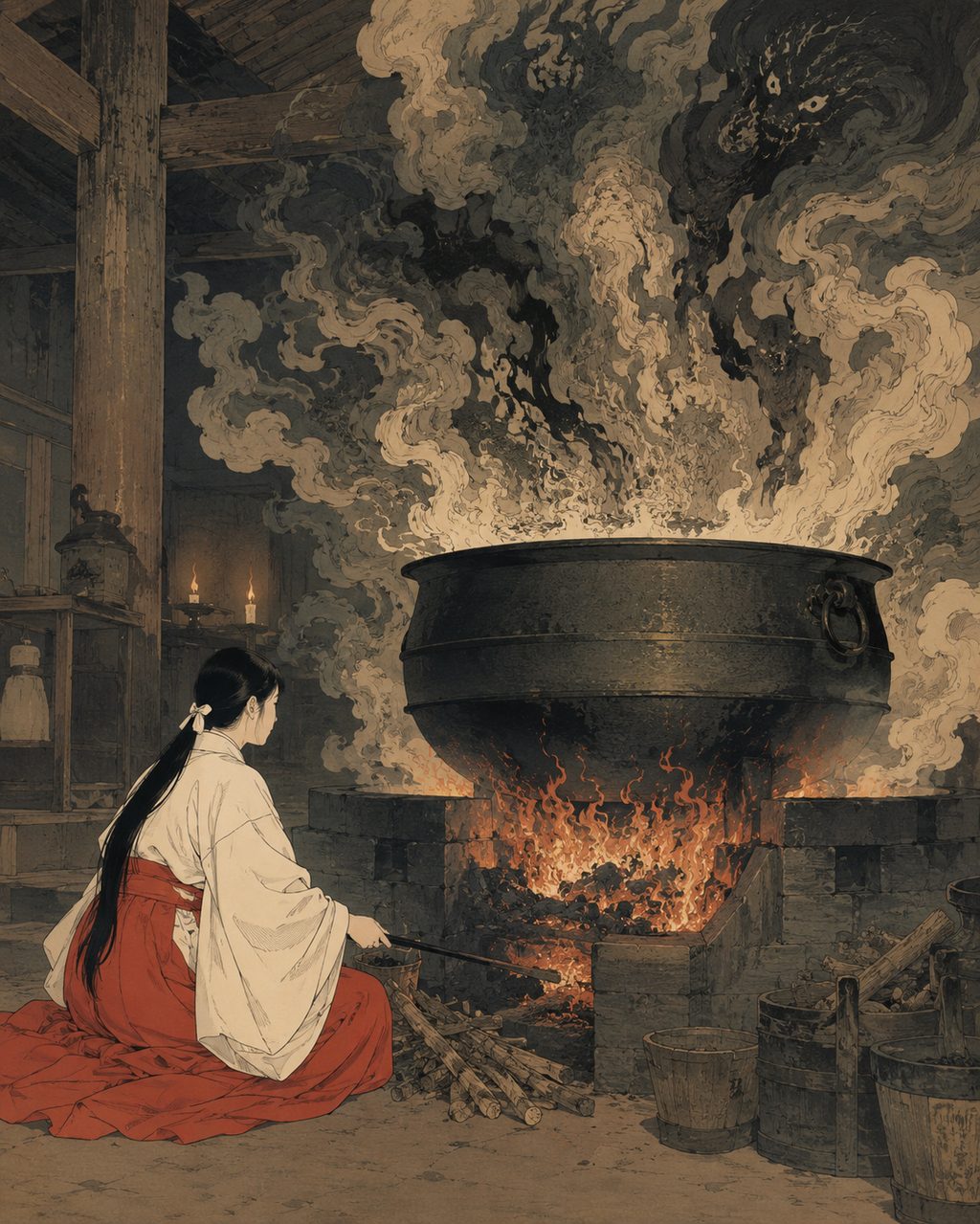
The story does not end here. The Mikoto beheaded Ura, but the head continued to roar loudly for years even as it was exposed on a prison gate. Even when the Mikoto had a dog eat the head until only the skull remained, the roaring did not stop. At his wit's end, the spirit of Ura appeared to the Mikoto in a dream and told him, "Have my wife, Aso-hime, cook divine offerings in the cauldron hall. Then I will foretell the good and bad fortune of the world through the sound of the cauldron." When he did as instructed, the roaring subsided, and from then on, a ritual of divination based on the sound of the cauldron was born—this is said to be the origin of the Narigama Shinji (Roaring Cauldron Ritual) still performed at Kibitsu Shrine today.
There are also grounds in the correspondence of characters as to why this tale of slaying Ura is considered the prototype of the folktale "Momotaro." The three retainers who fought alongside the Mikoto—Inukai Takeru, Sasamorihiko, and Tometamaomi—are said to be the models for Momotaro's retainers: the dog, the monkey, and the pheasant, respectively. The millet dumplings (kibi dango) given to the retainers are a play on words with Kibi Dango, a famous local product of Kibi Province. The fact that such a concrete geography of conquest and ritual lies beneath a bright folktale is precisely the starting point of Okayama's yokai culture.
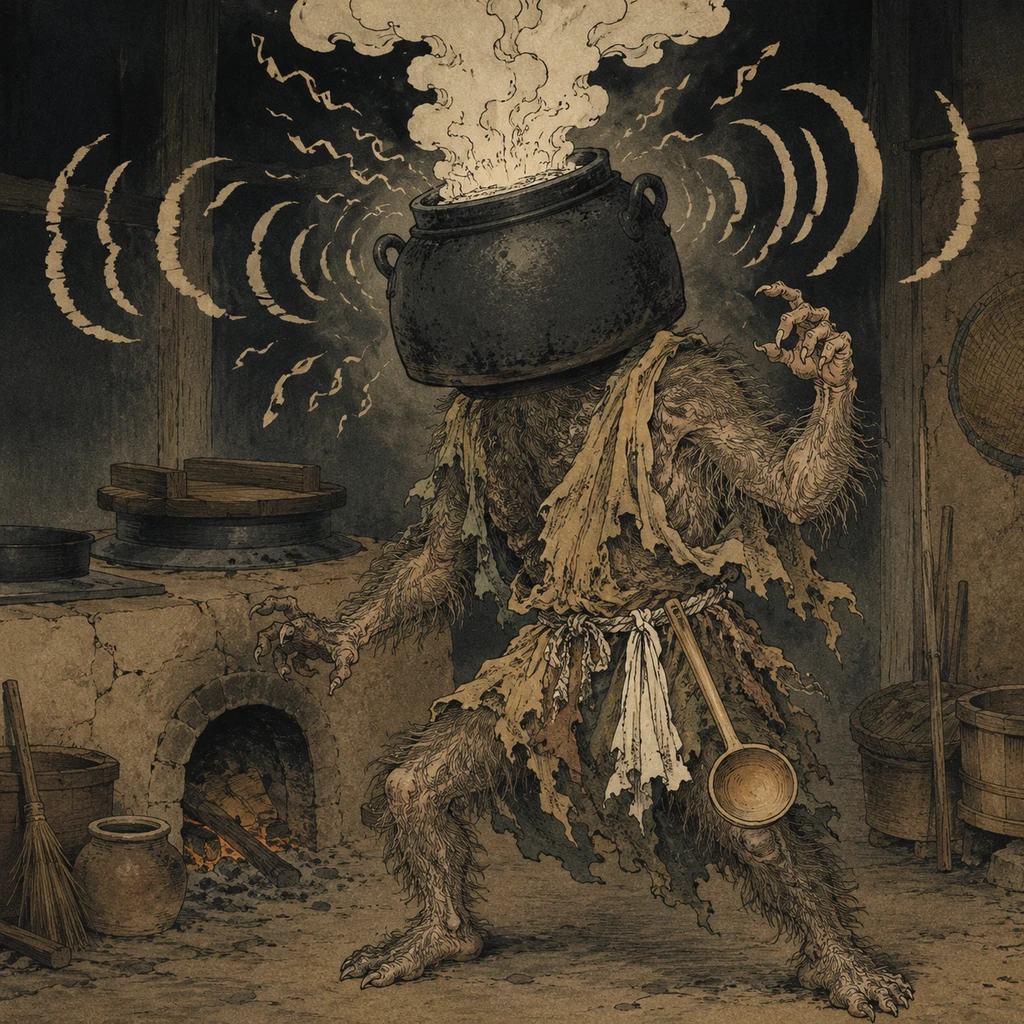
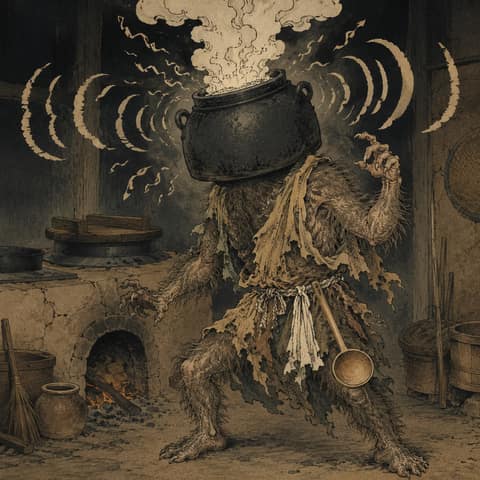
Roaring Cauldron (Narigama)
A tsukumogami said to arise when an iron cooking cauldron, used for many years, gains a spirit and takes on a humanlike form. The name ties to old beliefs that the rumbling or moaning a kettle makes during cooking could foretell good or bad fortune, with its tones read as omens. In paintings it appears with a cauldron for a head, emerging late at night to make ringing sounds and test people’s hearts.
Read moreNarigama is the very cauldron enshrined in this ritual that has become a supernatural entity. When a shrine maiden called an Azo-me cooks rice in the cauldron hall, a heavy sound rises from the bottom of the cauldron, like a roaring cow or a swarm of bees. Worshippers read the good and bad fortune of their wishes by the volume and length of that sound. If it rings loudly, long, and richly, it is a good omen; if it does not ring, it is a bad omen. There is also a tradition that Ura's head is buried under the floor of the cauldron hall, and what resounds has been thought to be Ura's own roaring voice. A conquered deformed king sinks his head beneath the cauldron to become a god of oracle—this layering of a subjugation tale turning into belief, and belief into divination, is the depth of Kibi's yokai culture. While being in the lineage of Tsukumogami (tools acquiring a spirit), Narigama is not merely a haunted old tool, but a ritual vessel possessed by the spirit of the defeated. The very act of "listening" to the sound of the cauldron is also a gesture of requiem, straining one's ears to the voice of the slain, giving this ritual its profound significance.
The sound of this roaring cauldron also cast a deep shadow on literature. Ueda Akinari, a Yomihon author of the late Edo period, included "The Cauldron of Kibitsu" as the sixth tale in his masterpiece collection of supernatural stories, *Ugetsu Monogatari*[2], published in 1776. When Isora, the daughter of Kasada Miki, a Shinto priest of Kibitsu Shrine, is to marry the prodigal Izawa Shotaro, the Kasada family divines the fortune of the marriage with the sacred cauldron ritual. However, the cauldron did not make a sound like a roaring cow, and ultimately did not ring—a bad omen. Nevertheless, the marriage proceeded, and Isora devoted herself to Shotaro even after marrying, but Shotaro extorted money from Isora under the pretense of making clothes for his mistress, and eventually absconded with her.
Betrayed and weakened by illness, Isora first becomes a living spirit and curses the mistress to death, and eventually dies herself, turning into a vengeful ghost. The fleeing Shotaro asks an Onmyoji (yin-yang diviner) for a prayer, and is told that he will be saved if he endures a forty-two-day period of abstinence. However, thinking the period of vows was over, Shotaro opened the door on the final night, and Isora's spirit dragged him into the darkness. The gruesome ending where only the man's topknot—his tied hair dripping with blood—was left hanging from the eaves the next morning is known as one of the most famous scenes in early modern ghost stories. Akinari brilliantly wove the oracle nature of the Narigama ritual into the narrative, in that the silence of the cauldron that did not ring prophesied all the tragedy. By depicting the fate of one who made light of a divine oracle, this single story made the Cauldron of Kibitsu known to readers nationwide. The core of the ritual—rewards and punishments delivered by a demon—was thus passed down even more widely through literature.
The Sarugami of Mimasaka:
The Sacrifice Swallowed by the Mountain
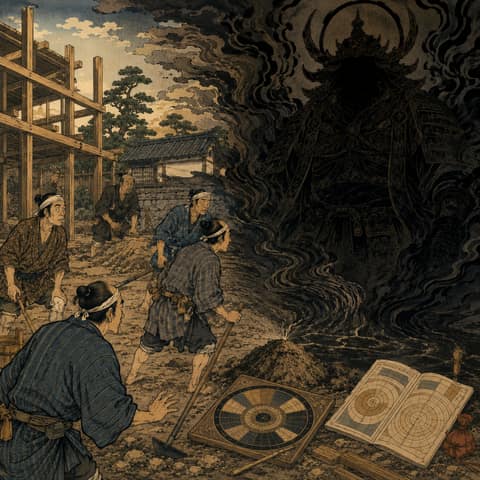
If the south of Kibi is the boundary between sea and plain, the northern Mimasaka Province is the boundary between mountain and sacred realm. Nakayama Shrine, the Ichinomiya (highest-ranking shrine) of this old province embracing the Tsuyama basin, became the setting for one of the most famous tales among Japanese yokai folklore. It is a tale of slaying a Sarugami sacrifice conveyed in "How a Hunter from the East Stopped the Sacrifice of a Maiden to the God of Mimasaka," the seventh tale in volume 26 of the *Konjaku Monogatarishu*[3], a collection of tales from the late Heian period.
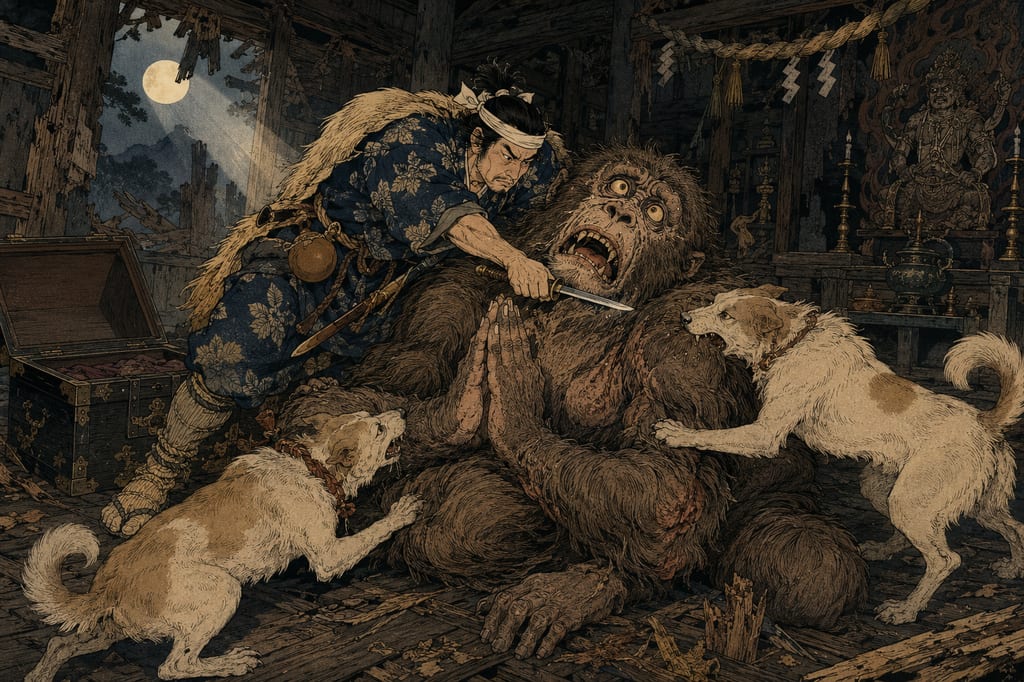
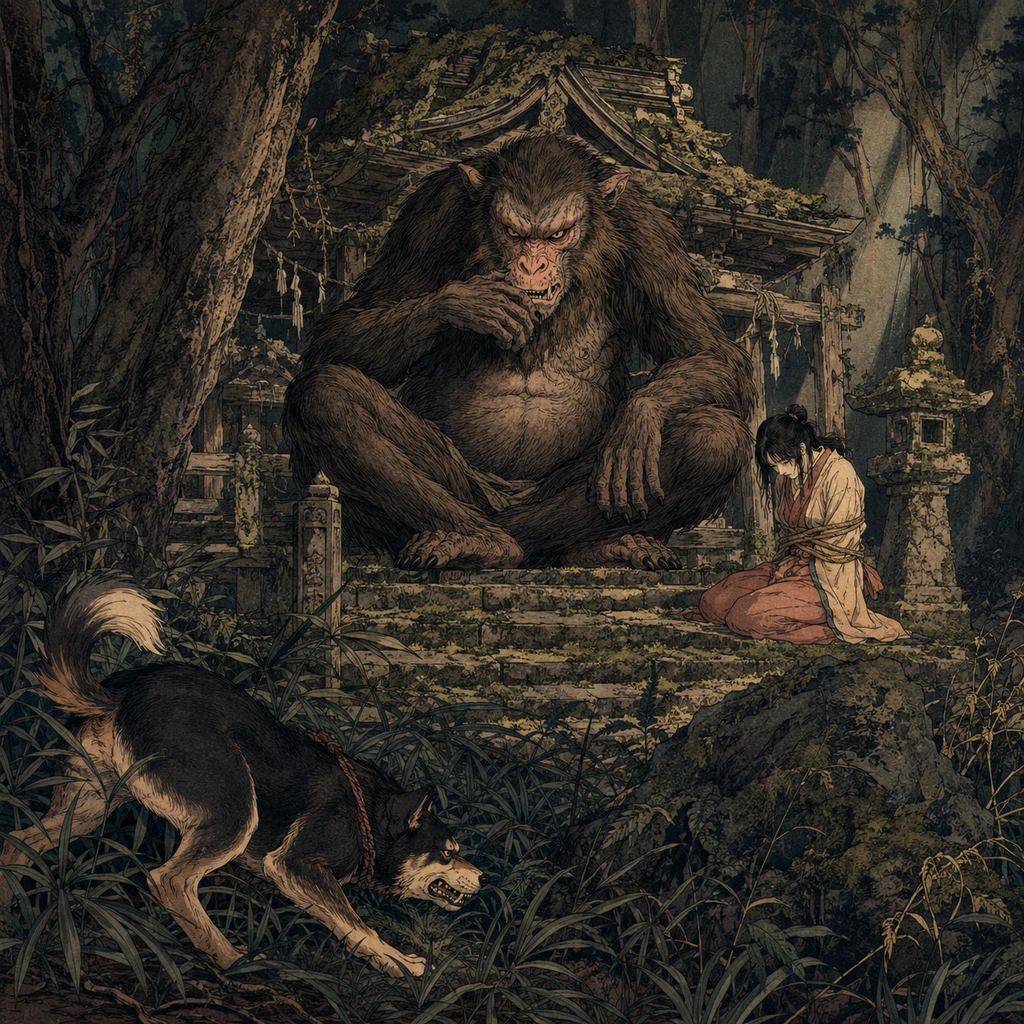
Sarugami (Monkey Deity)
Sarugami is a divine monkey spirit or yokai that appears in the form of a monkey. Historically linked to the monkey messengers of Hiyoshi shrines and revered as lords of the mountains, Sarugami later came to be portrayed in medieval tales as harmful to humans. A well-known motif features a great ape demanding female sacrifices; hunters, monks, and notably dogs often play key roles in its defeat. In some regions Sarugami was feared as a possessing spirit.
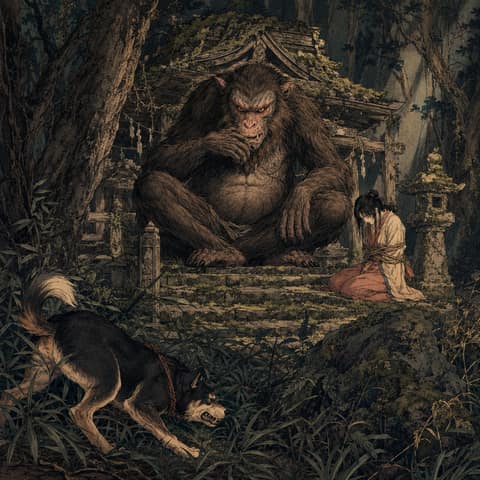
Read moreThe story goes like this: The god of Nakayama in Mimasaka Province was a god in the form of a monkey, and once a year, he demanded a chosen young maiden as a sacrifice. If a maiden was not offered, the god would curse them and ravage the fields. One year, a young hunter from the eastern provinces marries into the family of the maiden chosen for the sacrifice. He offered to take the maiden's place. The hunter took two well-trained dogs and hid in the long chest used to place the sacrifice, instead of the maiden.
On the night of the festival, when the lid of the chest carried into the shrine was opened, a giant monkey standing seven or eight shaku (over two meters) tall appeared, accompanied by about a hundred subordinate monkeys. As soon as the hunter leaped out of the chest, he released the dogs to bite and kill the monkeys one after another, and thrust his sword at the throat of the giant monkey. Then the giant monkey—that is, the god—possessed the head priest to beg for its life, swearing, "I will never demand a sacrifice again." The hunter forgave this, and it is said that human sacrifices ceased in this land thereafter.
The tale of the Sarugami holds weight in Okayama's yokai history because it speaks of the very boundary between "god" and "yokai." While it demands a sacrifice, it is closer to a cursing god (yokai), and after being defeated and making a vow, it reverts to an enshrined god. Divine status and yokai status are not fixed attributes, but fluctuate depending on the relationship with humans—the deep mountain shrines of Mimasaka embody this pendulum even now. Within the precincts of Nakayama Shrine, a Sarugami Shrine still remains as a subordinate shrine, attracting faith for safe childbirth and the granting of children, and a similar sacrifice tale is also passed down at Shiro Shrine in the northern part of Tsuyama City, showing how the echoes of this tale are widely settled throughout the Mimasaka region.
This tale of sacrifice carries a dual meaning: the memory of the ancient custom of human sacrifice, and the community's story of overcoming it. The presence of the hunting dogs that helped the hunter resonates with beliefs in dog gods and sacred dogs found in various regions, which hold that dogs have the spiritual power to exorcise mountain demons. In later generations, variant traditions emerged stating that the dogs that helped were the sacred dog "Shuken" passed down in the Chugoku region. It can be seen how the tale gained embellishments depending on the land as it was handed down. A terrifying mountain god that swallows sacrifices finally makes a pact with humans and ceases its curses—this transformation from "awe to coexistence" is deeply connected to Okayama's spiritual climate, where Ura became the god of the cauldron and the phantom tanuki became a guardian deity.
The mountains of Mimasaka harbor another specter that beguiles humans. It is the Jorogumo.
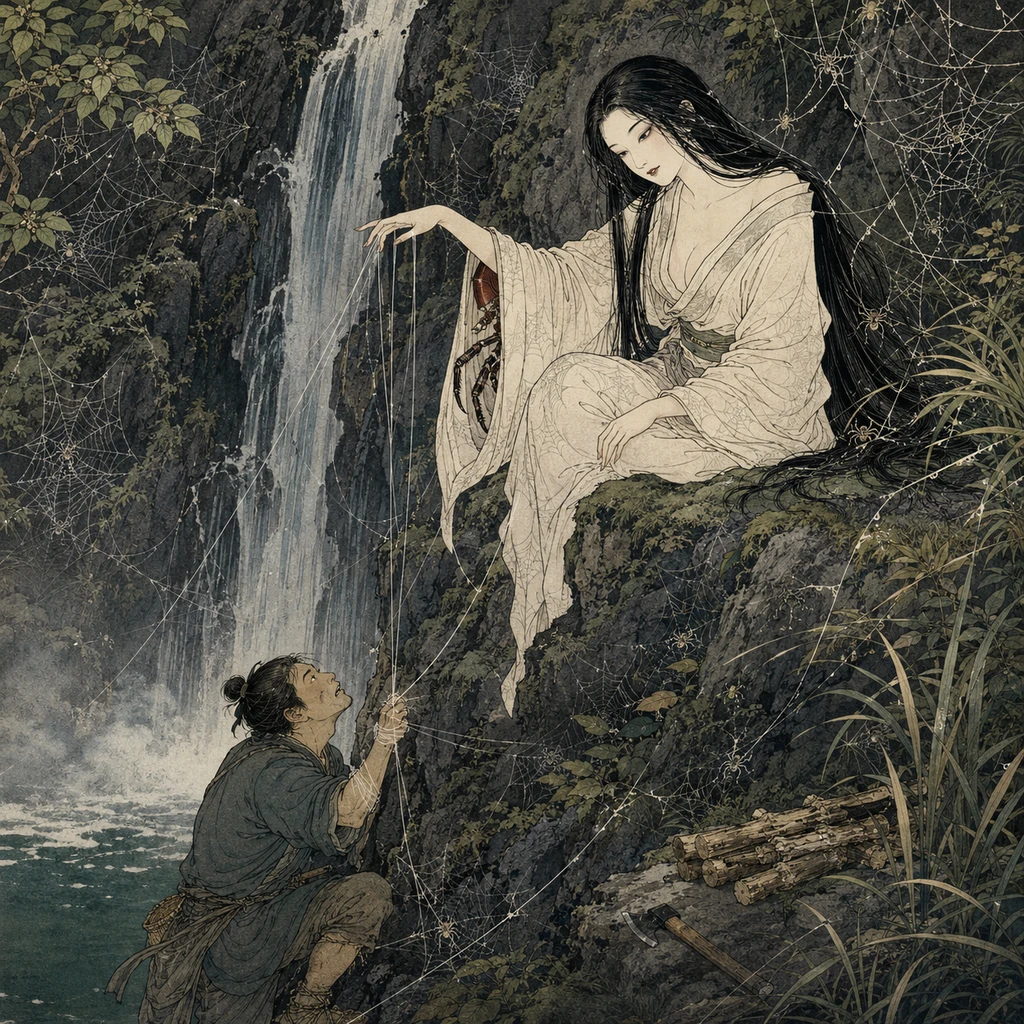
Jorōgumo
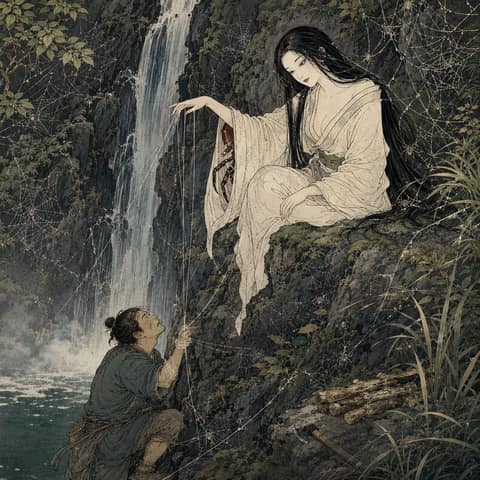
The jorōgumo is a Japanese yokai whose popular image coalesced from several distinct traditions: the name of a living spider species, early modern ghost stories of spiders transforming into women, Toriyama Sekien’s woodblock illustrations, and regional legends of spider pools (*kumobuchi*). Rather than a single beautiful woman dwelling at a specific waterfall, its appearance and behavior vary widely across historical eras and literary records. The written title 絡新婦 was not coined as a literal description meaning "a bride who entangles people." The *Wakan Sansai Zue* glosses the characters 絡新婦 with the reading *chorōkumo* and notes that it is "commonly called *jorōgumo*". The written name represents an intersection between a spider name found in classical Chinese materia medica and the spoken Japanese word *jorōgumo*. Tales of spiders appearing in female form predate Sekien’s art. In the 1677 collection *Tonoigusa*, a samurai grows suspicious of a young woman carrying a child and strikes her with his sword; the following day, he finds a slashed, dead *jorōgumo* alongside numerous human skeletons in the ceiling crawl space. In the 1732 collection *Taihei Hyaku Monogatari*, a man named Magoroku from Sakushū Takada is invited by an older woman into an illusory mansion where a young maiden urges him to marry her; when he flees, he returns to his own veranda, only to discover a tiny *jorōgumo* and an enormous cluster of webs beneath the eaves. Magoroku is not devoured; the narrative centers instead on the hazy boundary between dreams and illusions. In his 1776 work *Gazu Hyakki Yagyō*, Toriyama Sekien gave the title "Jorōgumo" (絡新婦) to an illustration depicting a long-haired woman in flowing robes overlaid with spider legs, surrounded by a swarm of tiny spiders. Wavy lines extending from the spiderlings suggest silk threads, smoke, or fire, but the print includes no explanatory text, nor does it depict a musician seducing a man. A bibliographic investigation conducted by the National Diet Library likewise found no classical literary source that matches the popular modern story of a beautiful woman playing a biwa lute to lure men and ultimately devour them. Waterside traditions of the jorōgumo reflect an entirely separate layer of folklore. Tales of "spider pools" (*kumobuchi*)—in which a spider attaches a thread to a person's foot, only for the individual to shift the silk onto a tree that is then dragged into the water—are distributed throughout Japan. At Jōren Falls, this thread-shifting motif merged with a taboo legend about a woodcutter who retrieves his dropped hatchet from a beautiful woman and dies after breaking his promise of silence, creating the famous Jorōgumo lore known today. Recognizing the differences among these sources reveals the jorōgumo not as a simple seductress, but as a yokai that mirrors human carelessness toward tiny creatures, the boundary between dreams and reality, the hazards of waterside terrain, and the cultural process by which names and images weave disparate legends together.
Read moreThe Jorogumo (literally "entangling bride," also written as "prostitute spider") is a spider yokai that disguises itself as a beautiful woman. "How Magoroku was Deceived by a Jorogumo" from *Taihei Hyaku Monogatari*[4], published in 1732, is set precisely in this Mimasaka. There was a rural samurai named Magoroku in Takata, Sakushu (Mimasaka). One night, an unknown beautiful woman dressed in colorful, gorgeous clothes appeared before Magoroku and approached him coquettishly. However, her true identity was a Jorogumo attempting to suck the man's life force—such is the plot.
The image of the Jorogumo varies greatly by region. While many legends depict a water-dwelling demon spider that lives in waterfall basins or deep pools, throwing its threads to entangle people's feet and drag them into the water, the one in Mimasaka is characterized by sneaking into houses in mountain villages as a bewitching woman, approaching men to steal their life force. The topography of a basin surrounded by deep mountains likely reflected the vigilance against and yearning for glamorous visitors from the outside into the image of this monster. The root of the idea that a spider transforms into a woman lies in observing the ecology of a spider that spins a web, waits for prey, and entangles it with threads, which sublimated into the yokai image of a "beautiful woman who lures and entangles men." The Sarugami that swallows people whole, and the Jorogumo that quietly approaches under the guise of a human—the monsters of Mimasaka both deeply resonate in the single point of being "mountain threats with a friendly face." The blatant violence demanding a sacrifice, and the quiet predation inviting carelessness with beauty. The mountains of Mimasaka harbor the terror of both these extremes.
Sea Monsters of the Bisan Seto:
Umibozu and Nurarihyon
Let us turn our gaze to the sea in the south. The Bisan Seto (Bisan Strait), lying between Okayama and Kagawa Prefectures, is a difficult tidal area separating Honshu and Shikoku, and an archipelago sea dotted with countless islands. For the fishermen and sailors of the Seto Inland Sea, this sea was both a blessing and a place of awe where mysterious things rose and fell.
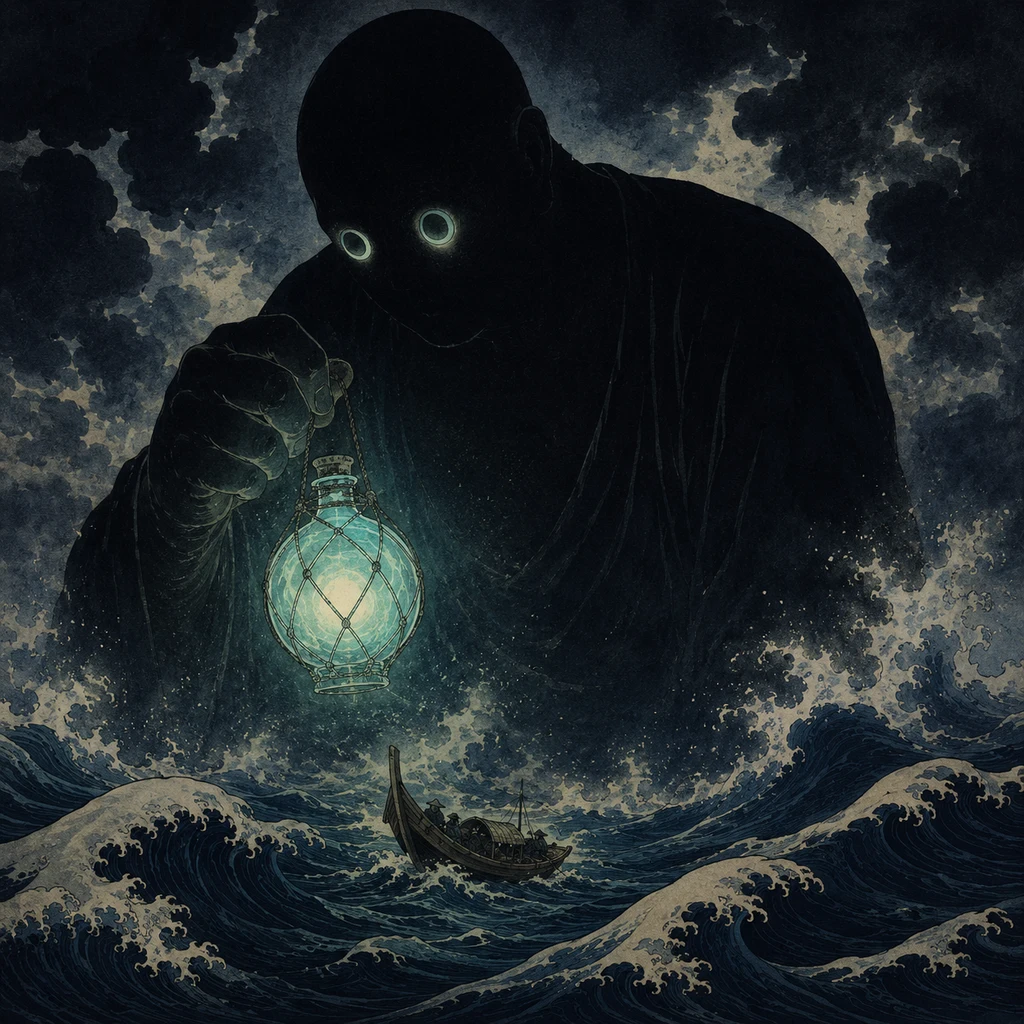
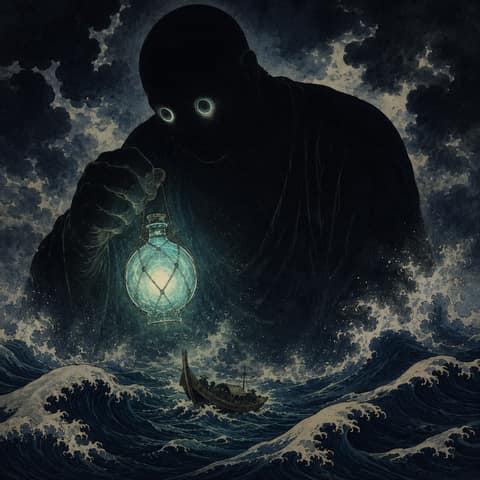
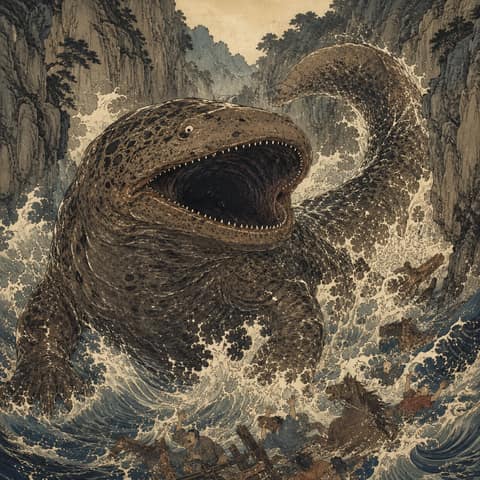
The Umibozu is a massive, black shadow that suddenly appears on the calm night sea. It rises ominously from the water's surface with a round, smooth form like a monk's shaved head, attacking and capsizing ships, or pressing sailors to "lend a ladle." If given a bottomed ladle as requested, the Umibozu uses it to endlessly scoop seawater into the ship to sink it—hence the wisdom for dealing with it passed down in fishing villages across the Seto Inland Sea and elsewhere: always keep a bottomless ladle on the ship, and pass it over to weather the danger when the time comes. With a bottomless ladle, no water accumulates no matter how much is scooped, and the Umibozu gives up and leaves. It is also said that it is more likely to appear on calm nights, and that it whispers "Give me oil," desiring it. It is as if the darkness of the vast, expanding night sea itself has taken form—a pure crystallization of the awe of the sea, and a figure condensing the uncontrollable dangers of the sea, such as storms and shipwrecks, into a single, massive shadow.
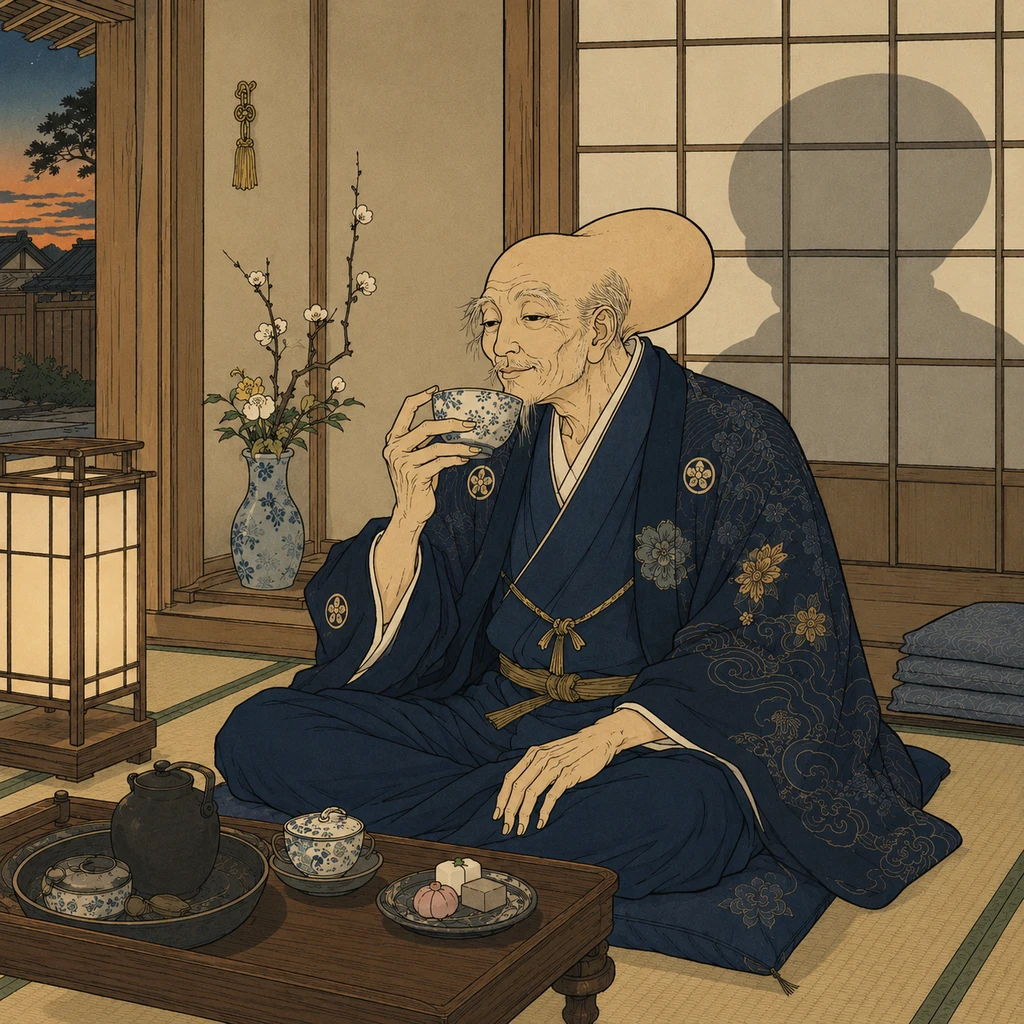
Indispensable in discussing the yokai of the Bisan Seto is the image of the Nurarihyon reported by folklore researcher Hirakawa Rimboku in "Yokai of the Sanyo Road"[5]. Today's Nurarihyon is widely known as the "supreme commander of yokai" or "an old man who slips into houses unnoticed," through the illustration of a long-headed old man in Toriyama Sekien's *Gazu Hyakki Yagyo*[6] and later fictional works.
Nurarihyon
Nurarihyon is a yokai known in Edo-period imagery by his name and the figure of an old man with an enlarged, bald head. The name now often suggests an elusive arch-yokai, yet the earliest sources offer less a detailed history than a striking name and silhouette. The named humanoid figure in Sawaki Sūshi’s Hyakkai Zukan (1737) ranks among the oldest surviving depictions whose date can be established. Toriyama Sekien’s Gazu Hyakki Yagyō, first published in 1776, also helped circulate this image of an old man. These images say little about Nurarihyon’s origins or actions. Their silences invited invention: a “ringleader of monsters” in modern writing, an old man who enters a busy household in a children’s encyclopedia, and a leader of a faction in manga and animation. The journey from a silent image to a story’s central figure is itself one of Nurarihyon’s great fascinations. The history of the name is no simpler. The Seisenban Nihon Kokugo Daijiten cites a 1679 adverbial use of nurarihyon in Saikaku Gohyakuin, and a use as the name of a creature in Rigen Shūran from around 1797. A regional record from Akita names it as a member of a hyakki yagyō procession, while the Bisan Strait has a report of a differently shaped marine apparition. Across images, regional records, and modern reception, the same name has taken on a rich succession of forms.
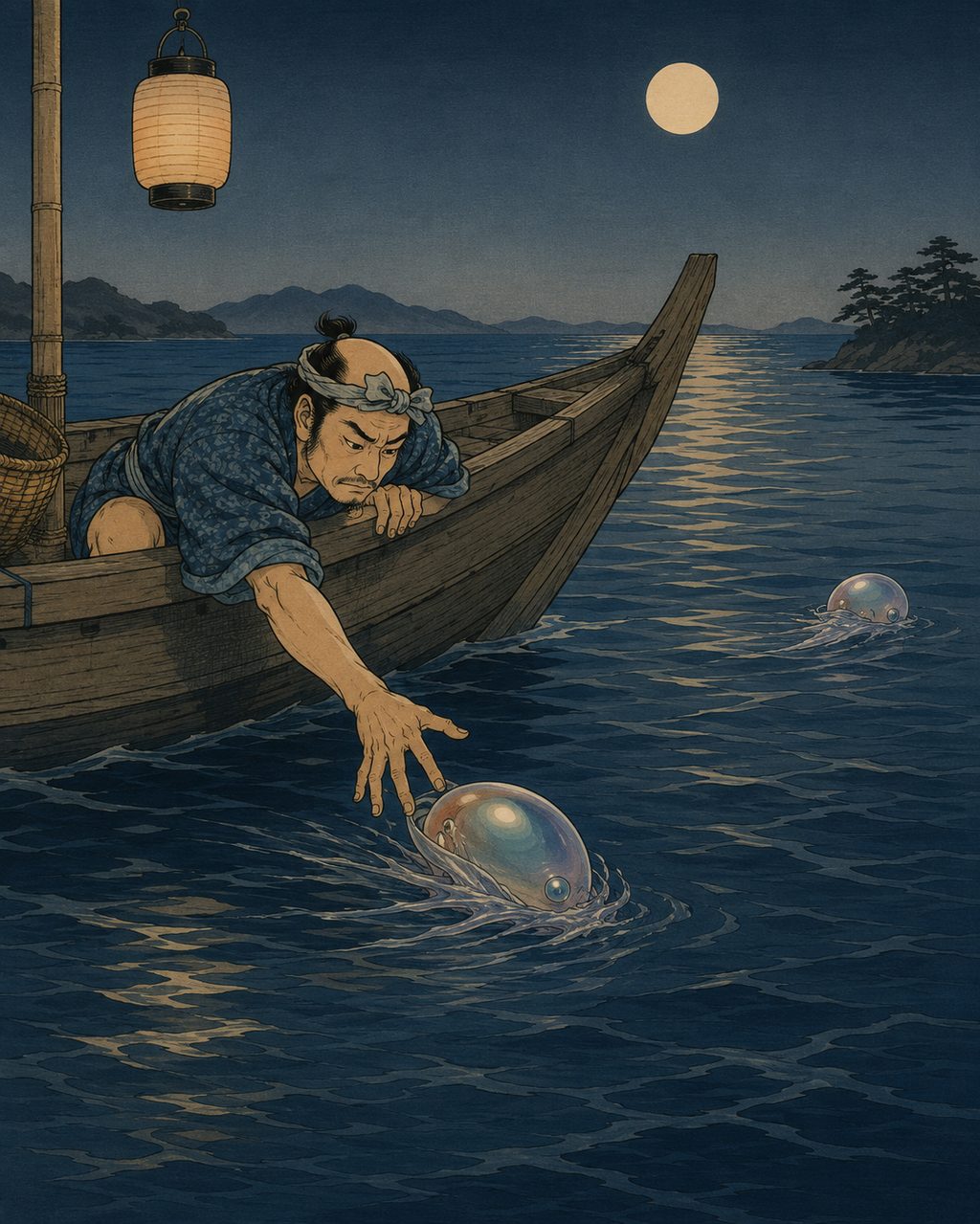
Read moreHowever, according to Hirakawa's report, the original Nurarihyon passed down in Okayama's Bisan Seto was a completely different sea monster. It was like a round ball about the size of a human head, floating on the surface of the sea. When someone brings their boat close and tries to grab it, the ball slips ("nurari") through their hands and sinks, then abruptly pops up ("hyon") a little distance away. No matter how many times one tries to scoop it up, it slips away and pops up, endlessly mocking people. The name itself is said to come from these very actions of "nurari" and "hyon." It is fascinating to consider that the roots of the later image of the supreme commander, whose defining characteristic is evasiveness, lie in this uncatchable ball floating in the Seto Inland Sea. Modern researchers speculate that sightings of large jellyfish or octopuses were perceived as yokai. Both the Umibozu and Nurarihyon are forms taken by the elusive anxieties of the Bisan Seto archipelago.
Monsters of the Village:
Azuki-arai,
Amanojaku,
and the Phantom Tanuki
The plains of Kibi, the mountains of Mimasaka, and the sea of Seto. Finally, let us turn our attention to the smaller specters that breathe within the life of the villages and settlements connecting them.
 Azuki-arai (Bean Washer)ah-ZOO-kee ah-RAH-ee
 Amanojakuah-mah-noh-JAH-koo
 Mahō-sama (Magic Lord)mah-HOH-sah-mah
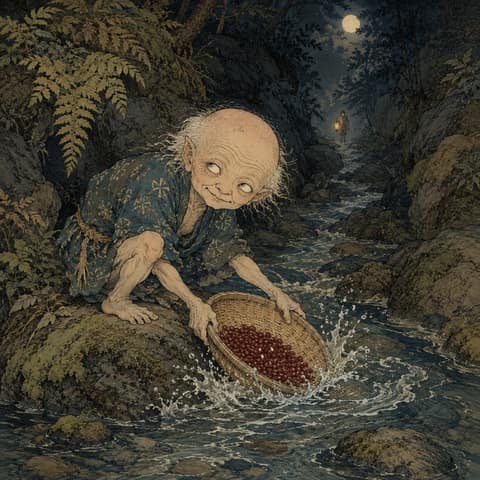
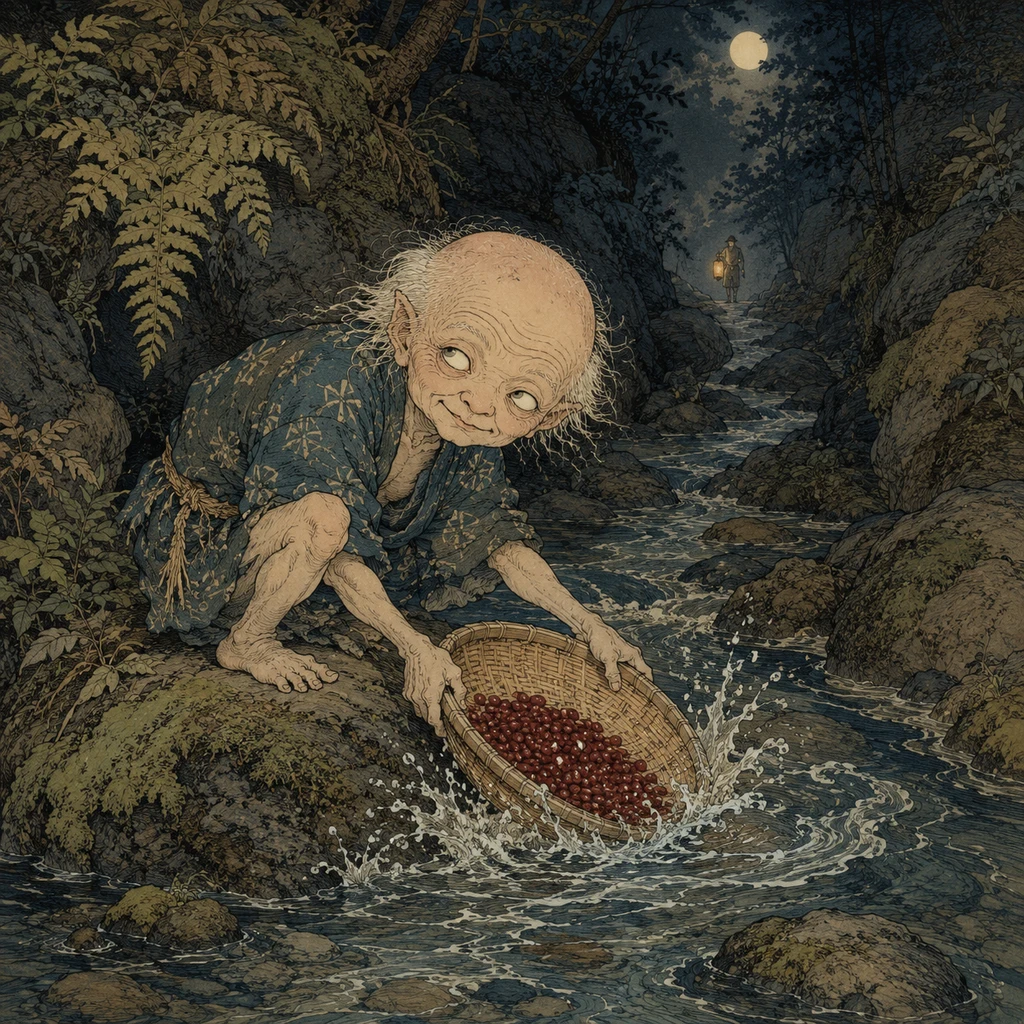
Late at night, by the valley river, from under a deserted bridge, the sound of washing red beans, "shoki-shoki, shoki-shoki," can be heard. When one tries to sneak closer to the direction of the sound, it smoothly moves away, and the figure is never seen—this is the Azuki-arai. Also called Azuki-togi, this monster widely known around watersides in Okayama and nationwide stands out in that "sound" rather than form is its main feature. While many yokai frighten people with their grotesque appearances, the Azuki-arai is a yokai of hearing, asserting its presence strictly through sound alone.
It is also said to hum an eerie song along with the sound, "Shall I wash my red beans, or shall I catch and eat a person? Shoki-shoki," often taking the form of a cautionary tale where someone distracted by the sound peers into the river, slips, and falls into the water. Behind this monster lies the disciplinary wisdom to keep children away from dark watersides. Regarding its true identity, theories have long been told that it is a misinterpretation of the sound of the river's rapids, the noises made by small animals like weasels and badgers, or the calls of insects and birds. The everyday eeriness of the sound of water in a dark valley, something everyone has heard at least once, was directly turned into a monster—the Azuki-arai is a modest yet unforgettable product of the folkloric imagination nurtured by the countless streams flowing through the villages of Okayama.
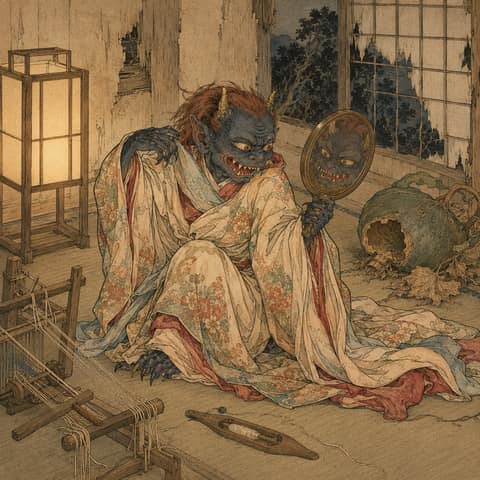
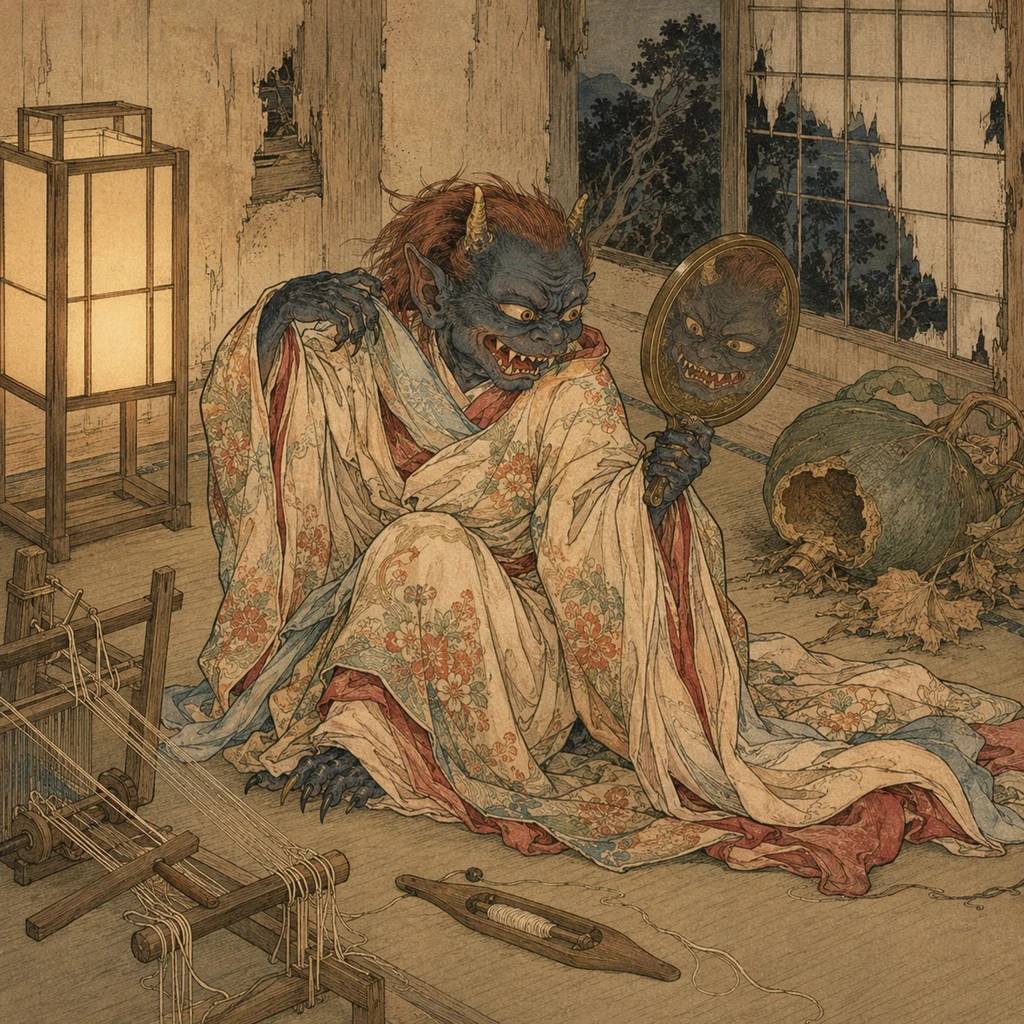
The Amanojaku is a small demon that disobeys everything people say and do, behaving perversely and doing the opposite. Its origin is surprisingly ancient, said to trace back to Ame-no-Sagume, who appears in the *Kojiki* and *Nihon Shoki*[7]. Ame-no-Sagume, a shamanic deity who served Ame-no-Wakahiko and probed and saw through people's hearts, changed into a perverse small demon over a long time—this history, where one who "probes" (saguru) people's hearts turned into "Amanojaku," is also a typical example of a venerable deity falling into a yokai. In Buddhist art, it is widely known as an evil demon trampled by the Four Heavenly Kings such as Vaisravana, representing the subjugation of the wicked by good deities.
The Amanojaku in the world of folktales fully demonstrates its innate perverseness. In the representative "Urikohime," the Amanojaku skillfully deceives the beautiful Urikohime, who is weaving to prepare for her marriage, leads her out of the house, and attempts to take her place. However, its evil deeds are usually exposed with the help of sparrows and other animals, and it is defeated. Imitating people to make them uncomfortable, deliberately doing the opposite to cause confusion—the behavior of the Amanojaku is the personification of the very malice that disrupts the order of the community. In various regions including Okayama, there are examples of calling mountain spirits and echoes (kodama) Amanojaku, and it is thought that phenomena like echoes mimicking and returning human voices were associated with this natural mimic. From the heights of mythology to every corner of the village, the Amanojaku has taken deep root as a familiar malice that rubs people the wrong way.
And a heartwarming, local deity unique to Okayama is Maho-sama.
Mahō-sama (Magic Lord)
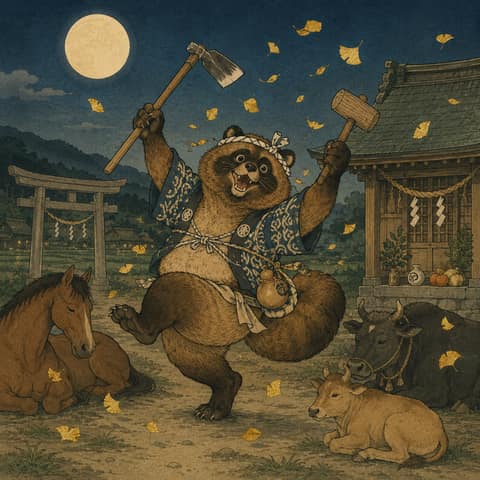
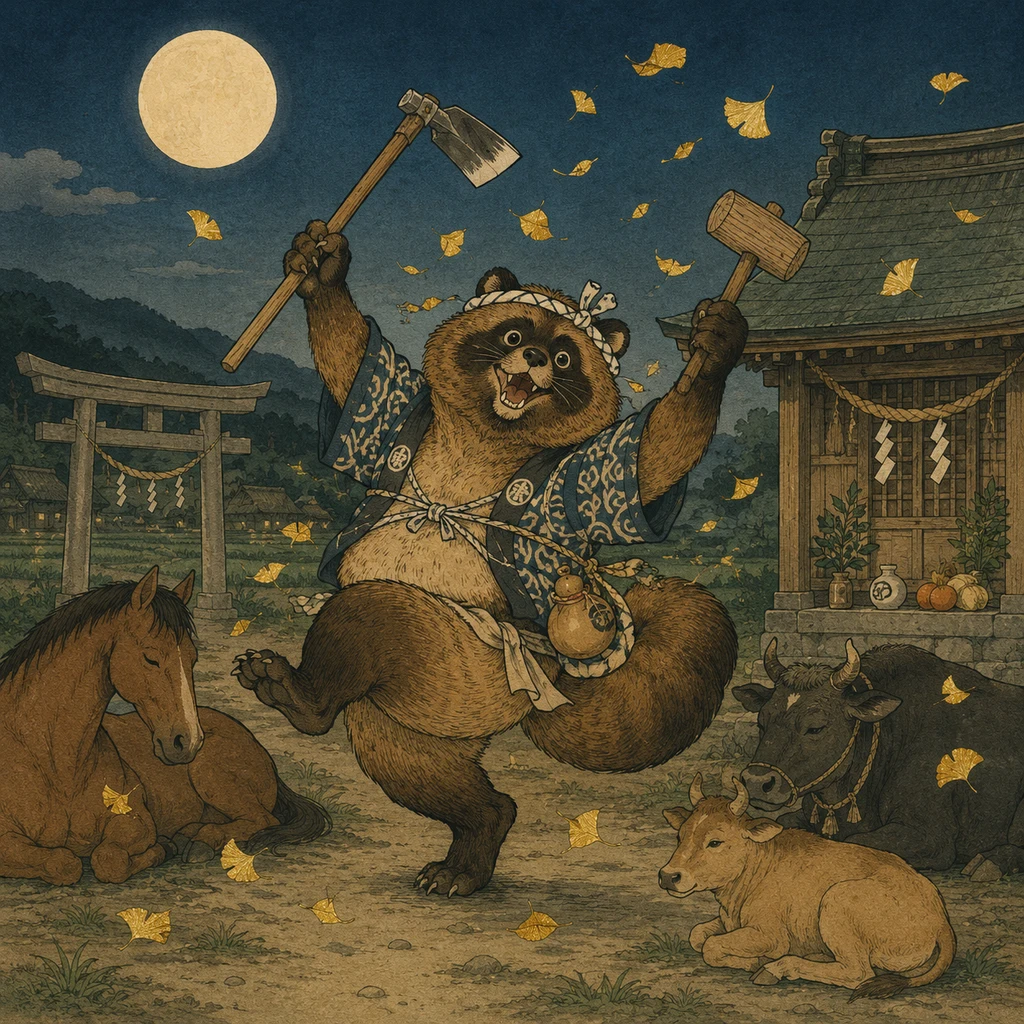
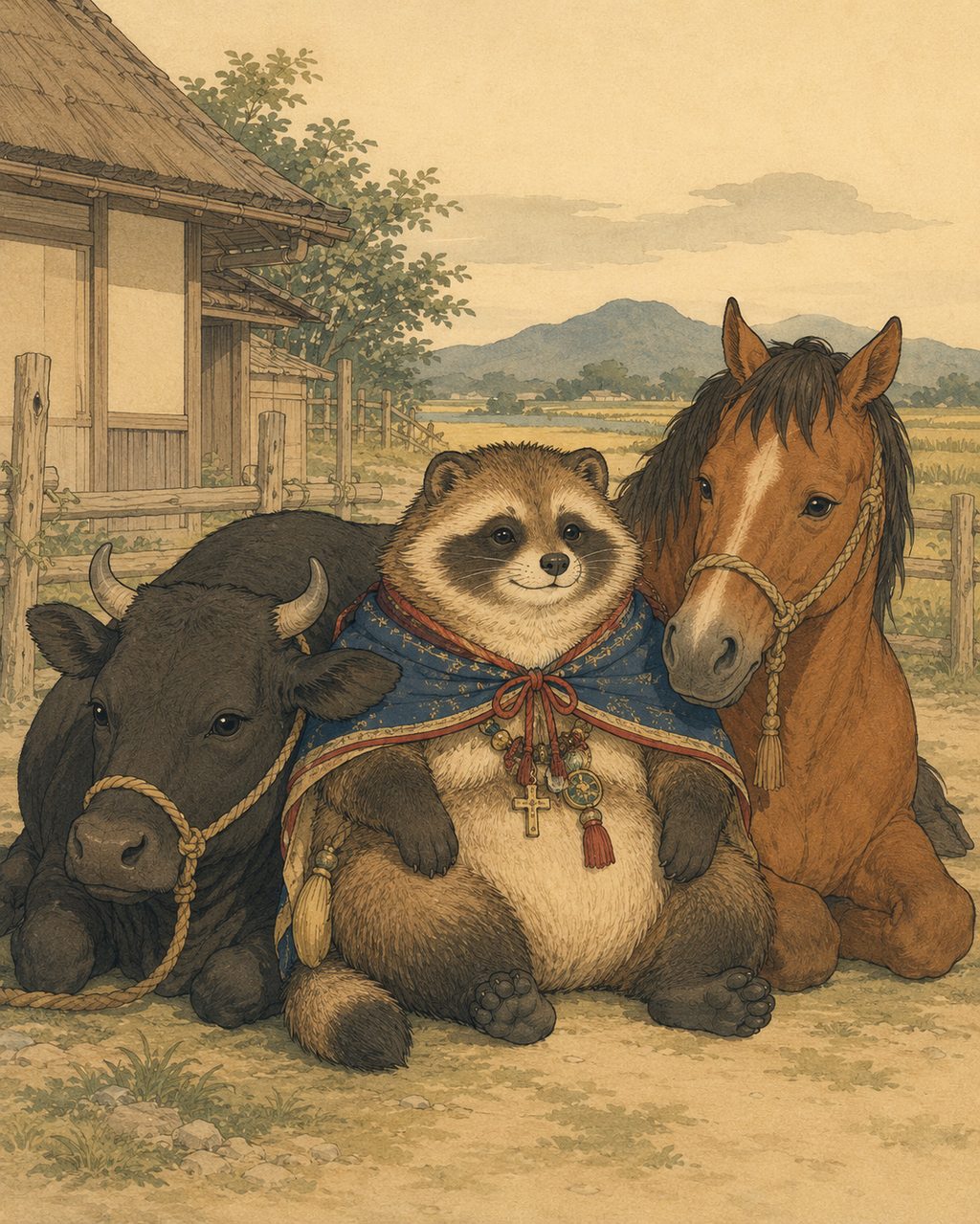
Mahō-sama is the folk name for a guardian deity venerated around Bizen Kamo, originally associated with the shape-shifting tanuki called Kyūmō-danuki and worshiped as a protector of cattle and horses. Shrines in Sōja and Kibichūō also call it Mahō-gū. Explanations of the name include a corruption of “Ma” and “Hō” from Marishiten, and an interpretation that the deity is not the tanuki itself but a household or clan tutelary spirit. Rituals focus on safeguarding livestock and averting fire and theft.
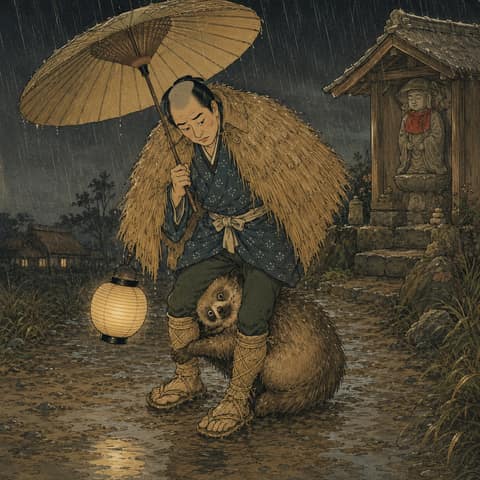
Read moreIn the area stretching from Soja City to Kibichuo Town, there are shrines scattered that enshrine a phantom tanuki called Maho-sama. The most famous among them is Karai Shrine, commonly known as Maho Shrine. According to the *Bizen Kamo Kasho Tanuki Yuraiki*[8] published in 1849, what is enshrined here is a phantom tanuki named Kyumo Tanuki. According to legend, it has a rather unconventional background: it slipped onto a missionary ship preaching Christianity, crossed over to Japan from a distant foreign land, wandered through various provinces, and eventually settled in the land of Kibi.
Although it played some tricks, Kyumo Tanuki was generally accepted by the people, and it is said that in return, it promised to become a god protecting cows and horses. It is a simple and warm faith closely tied to agricultural life, a guardian deity protecting the cows and horses that plow the fields from illness. Around Kibichuo Town, there are several shrines still existing that enshrine this Kyumo Tanuki and its descendants, and they continue to gather the faith of the local people today. Regarding the origin of the unusual name "Maho" (magic), there are theories that it originated from Marishiten worship, and "the law (ho) of Marishiten" was shortened to "Maho," or that the name "Marishiten" itself became corrupted into "Maho" over a long period.
A phantom tanuki does not remain a mischievous yokai, but makes a pact with people to sublimate into a guardian deity of the farming village—here too, the spiritual climate of Kibi, where "a hostile and feared monster is reversed into an enshrined god through a pact," exactly like Ura becoming the god of the cauldron and the Sarugami making a vow to be enshrined, can be clearly seen. However, the origin of Maho-sama relies heavily on local folklore and oral traditions, and there are many parts that are difficult to confirm as historical facts. Here, I would like to modestly note its story as a fascinating example of local faith rooted in the villages of Okayama.
Conclusion:
The Supernatural of Kibi Standing at the Seams
The conquered demon roars beneath the cauldron, the mountain god that swallowed sacrifices makes a vow and is enshrined, and the mischievous tanuki becomes the guardian deity of cows and horses. Looking across the yokai of Okayama, a unique circuit repeatedly emerges: hostile deformations are not simply erased, but through pacts and requiems, they are reversed into faith, divination, and guardian deities. It is no coincidence that Ura, the Sarugami, and Kyumo Tanuki all draw the same arc from "feared monsters to enshrined beings." It is a metaphor for the history of this land itself, where numerous boundaries—Yamato and Kibi, Honshu and Shikoku, human settlements and mountains and seas—have clashed, collided, and eventually come to terms to reach coexistence.
On the other hand, pure terror that is never tamed, like Isora's grudge invited by the silence of the cauldron, the Jorogumo stealing life force with her beauty, and the Azuki-arai bewildering people only with the sound of water without ever showing its form, also remains deeply colored in the mountains, fields, and shores of Okayama. Reconciliation and awe, coexistence and terror—between these two poles, the supernatural of Kibi breathes richly.
The cauldron of Kibitsu Shrine rings today, the mountains of Nakayama Shrine are still deep, and perhaps somewhere tonight in the archipelago sea of the Bisan Seto, an elusive round ball sinks smoothly and pops up abruptly. Beneath the bright folktale of Momotaro sinks such a multi-layered and rich stratum of the supernatural—that is precisely the true depth of the land of Okayama.