
Konjin

konjin

Konjin

Konjin

Their soul is listening — speak, and they will answer.

Basic Description

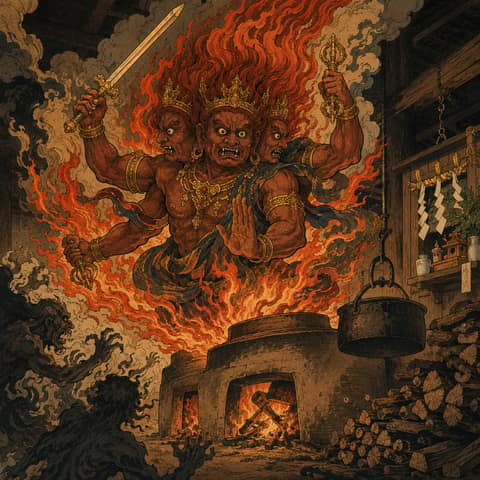
Konjin is an inauspicious god feared in Onmyodo and folk calendar directional beliefs, a deity who bound human lives not as a visible monster, but as an "unviolable direction." According to the calendar, it was taboo to undertake construction, moving, marriage, travel, or earth-moving activities toward Konjin's location; violating this would bring calamity to the household[1]. Although sometimes confused with Kojin—the rough deity of the hearth and homestead—Konjin's core lies not inside the house, but in the taboos of time and direction.

Like the Demon Gate (Kimon), directional avoidance (Katai-gae), and directional warding (Kata-yoke), Konjin belongs to an Onmyodo worldview that interprets space through forces of fortune and misfortune[2]. The terror of this deity lay not in manifesting before one's eyes, but in the fact that illness, fire, and misfortune occurring after a move or construction were interpreted as "because Konjin was violated." In folklore vocabulary, Konjin is recorded as a taboo deity concerning house building and auspicious days[3]. On the other hand, from the end of the early modern period to the modern era, the terrifying Konjin was reinterpreted in the Konkokyo religion as a deity of salvation, Tenchi Kane No Kami[4]. Konjin demonstrates a massive transformation in Japanese religious history: simultaneously a deity of dreaded inauspicious directions to be avoided, and a god of terror inverted into the center of faith.

Folklore & Legends

The practice of Konjin worship functioned as a life technology, judging daily actions against the calendar and directions. Building a house, digging a well, moving earth, traveling far, or moving for marriage—these milestones were considered acts that moved the fate of not just the individual, but the entire household, generating strong fear of violating inauspicious directions[1]. Konjin was the deity who inserted the question, "Is it safe to proceed in that direction now?" into life's major decisions.

The intense phrase "Konjin Seven Kills" (Konjin Shichisatsu) symbolizes the severity of the disasters this deity brings. Rather than a god who literally kills seven people, it functioned as a warning that violating the taboo would bring heavy misfortune to the family. Like the concepts of Kimon and Katai-gae, direction was not mere geography, but carried invisible flows of power[2]. Because of this, while Konjin is difficult to depict visually in a yokai compendium, he was an extremely effective deity in folk society.

The reinterpretation by modern Konkokyo deepens the history of Konjin by another layer. Bunjiro Kawate of Ootani Village, Asakuchi District, Bitchu Province, re-accepted the terrifying Konjin that brings disaster as a deity piercing heaven and earth to give life to humanity[4]. Here, Konjin shifts from an inauspicious god to be avoided to the center of a faith where humans and gods converse. Rather than denying the fear, directly re-enshrining the feared deity turned him toward salvation. This dramatic reversal is precisely why Konjin does not remain a mere directional taboo.

The taboo of Konjin did not merely bind people as a superstition. It also functioned to force people to handle acts that would cause massive damage if failed—like construction or relocation—with caution through calendar judgments. Of course, this also includes the danger of shifting the blame for disasters onto a specific direction. Konjin was a safety mechanism for life, as well as a powerful narrative for explaining misfortune.

He is easily confused with Kojin because both are feared as rough deities connected to household safety. However, while Kojin leans toward beliefs of the hearth, homestead, and fire, Konjin leans toward taboos of direction, time, and days. Grasping this difference makes Konjin's outline quite clear. He is not a god who sits inside the house, but a god who rules which way the house moves, where to dig, and when to depart.

Related Yokai

Yokai deeply tied to this one in legend.

Detailed Analysis

In this version, we read Konjin as the "inauspicious god blocking directions." Konjin does not stand before the gates like an oni. He stops human action in the form of "you must not go in that direction today," "you must not dig there," or "you must not move the house to face that way"[1]. He is not weak because he lacks a physical form; rather, because he has no form, he permeates widely into calendars and directions.

Konjin's power appears at the milestones of life. Construction, relocation, marriage, travel, and public works are acts that change a household's destiny. When the taboos of inauspicious directions overlap there, people postpone the plans themselves, perform directional avoidance (katai-gae), or seek prayers. Konjin is not a one-time ghost story, but a god repeatedly appearing within the calendar of life, wielding sustained power to rule daily judgments.

The relationship with Kimon (Demon Gate) and Kata-yoke (directional warding) is key to understanding Konjin. In the Onmyodo directional worldview, space is not homogeneous; fortune and misfortune dwell in every direction[2]. Among these, Konjin was feared as an entity that invites heavy disaster if violated. If drawn as a yokai, he is not a monster with horns or fangs, but an invisible red line drawn over house blueprints or travel directions. Misfortunes occurring not at the moment of crossing, but *after* crossing, prove the god's existence.

In folk society, Konjin also became a device for explaining disaster. When illness, fire, family death, or business failure occurred, it was said, "That is because they violated Konjin's direction during that construction"[3]. This cannot be dismissed merely as superstition. Faced with inexplicable misfortune, people used the order of time and direction to assign meaning and learn what to avoid next. Konjin was a terror, but simultaneously a framework for interpreting life.

The endpoint of this version is the transformation in Konkokyo. Through the faith experience of Bunjiro Kawate, the feared Konjin was re-accepted as the god of salvation, Tenchi Kane No Kami[4]. Rather than distancing oneself from the inauspicious god, one faces the center of the fear and reconnects the relationship between god and human. Because of this inversion, Konjin does not end as merely a "god of bad directions." The amplitude of shifting from a taboo deity to a deity of salvation is the true depth of Konjin.

Konjin's terror lies in his lack of visibility beforehand, combined with his explanatory power afterward. After something bad happens, people look back on past actions and wonder if they violated that direction at that time. Konjin is a god who stops the future, and at the same time, a god who rereads past misfortunes.

This nature is quite abstract, even among yokai and deities. Oni have shapes; foxes have actions. But Konjin resides within the systems of directions and calendars. That is exactly why his influence is so broad. Every time people move, build, dig, marry, or travel, the possibility of Konjin rises.

The shift to Konkokyo was an attempt to turn this abstract terror into salvation. Instead of continuously avoiding a feared god, that god is re-accepted as the workings of heaven and earth. Here, folk belief possesses the power not just to observe taboos, but to remake the meaning of the god at the very center of the taboo.

Character Profile

This section is our own creative profile for storytelling. It is not historical fact or scholarship.

Yokai Type
Kami
Rarity
Divine
Personality
Does not show his form, stopping people through calendars and directions. Feared for being so closely attached to daily life, he transforms into a god of salvation once re-enshrined.
Compatibility
暦、土地、家の向き、移動の吉凶に敏感な人と相性がよい。見えないルールが生活を動かす感覚を理解できる人に向く。
Abilities
Rule over inauspicious directionsConstruction taboosHalting relocation and marriageInducing directional avoidance (katai-gae)Interpreting disasterTransformation from curse to salvationCalendrical life domination
Weaknesses
Because he lacks a specific form or single mythology, his outline becomes thin if separated from the context of directional beliefs.
Habitat
Folk calendars, house construction sites, places where wells or earth are moved, relocation routes, directional warding prayer sites, and the history of Konkokyo faith.

For more detailed information and diagnosis results about The Inauspicious God Blocking Directions: Konjin, please click here.

Sources & References

4
  1. 暦の中のことば 方位神国立国会図書館(国立国会図書館) [解説資料]暦に現れる方位神と凶方位信仰を概説する資料。金神を陰陽道・民間暦の方位禁忌として位置づけるために用いる。
  2. 鬼門(陰陽道の方位観)(陰陽道の伝承)((民俗・方位信仰), 平安期以降) [reference] Reference北東(丑寅)を鬼の出入りする凶方とする観念。丑(牛)寅(虎)の組合せが、牛の角と虎皮褌という鬼の造形の一因とされる。
  3. 綜合日本民俗語彙 [古典文献] Reference
  4. 金光教の信仰金光教(金光教) [宗教団体公式資料]幕末に恐れられた金神信仰が天地金乃神への信仰へ転じる近代宗教史の文脈を確認するための公式資料。

Interested in this type of yokai?

Discover the yokai most similar to your personality with our yokai diagnosis

Start Yokai Diagnosis

Meet your guardian yokai at the shrine

Draw an omikuji fortune and discover the yokai watching over you today.