Konjin
konjin
The Inauspicious God Blocking Directions: Konjin
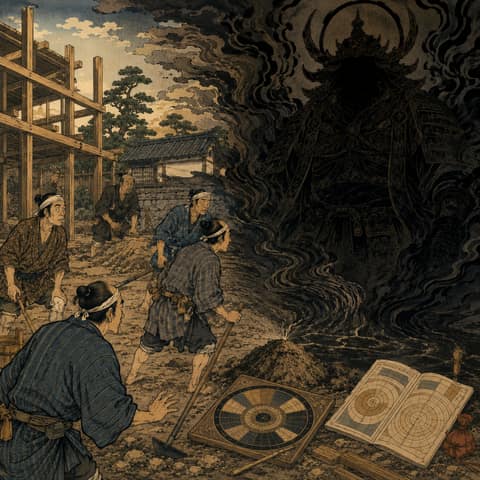
In this version, we read Konjin as the "inauspicious god blocking directions." Konjin does not stand before the gates like an oni. He stops human action in the form of "you must not go in that direction today," "you must not dig there," or "you must not move the house to face that way". He is not weak because he lacks a physical form; rather, because he has no form, he permeates widely into calendars and directions. Konjin's power appears at the milestones of life. Construction, relocation, marriage, travel, and public works are acts that change a household's destiny. When the taboos of inauspicious directions overlap there, people postpone the plans themselves, perform directional avoidance (katai-gae), or seek prayers. Konjin is not a one-time ghost story, but a god repeatedly appearing within the calendar of life, wielding sustained power to rule daily judgments. The relationship with Kimon (Demon Gate) and Kata-yoke (directional warding) is key to understanding Konjin. In the Onmyodo directional worldview, space is not homogeneous; fortune and misfortune dwell in every direction. Among these, Konjin was feared as an entity that invites heavy disaster if violated. If drawn as a yokai, he is not a monster with horns or fangs, but an invisible red line drawn over house blueprints or travel directions. Misfortunes occurring not at the moment of crossing, but *after* crossing, prove the god's existence. In folk society, Konjin also became a device for explaining disaster. When illness, fire, family death, or business failure occurred, it was said, "That is because they violated Konjin's direction during that construction". This cannot be dismissed merely as superstition. Faced with inexplicable misfortune, people used the order of time and direction to assign meaning and learn what to avoid next. Konjin was a terror, but simultaneously a framework for interpreting life. The endpoint of this version is the transformation in Konkokyo. Through the faith experience of Bunjiro Kawate, the feared Konjin was re-accepted as the god of salvation, Tenchi Kane No Kami. Rather than distancing oneself from the inauspicious god, one faces the center of the fear and reconnects the relationship between god and human. Because of this inversion, Konjin does not end as merely a "god of bad directions." The amplitude of shifting from a taboo deity to a deity of salvation is the true depth of Konjin. Konjin's terror lies in his lack of visibility beforehand, combined with his explanatory power afterward. After something bad happens, people look back on past actions and wonder if they violated that direction at that time. Konjin is a god who stops the future, and at the same time, a god who rereads past misfortunes. This nature is quite abstract, even among yokai and deities. Oni have shapes; foxes have actions. But Konjin resides within the systems of directions and calendars. That is exactly why his influence is so broad. Every time people move, build, dig, marry, or travel, the possibility of Konjin rises. The shift to Konkokyo was an attempt to turn this abstract terror into salvation. Instead of continuously avoiding a feared god, that god is re-accepted as the workings of heaven and earth. Here, folk belief possesses the power not just to observe taboos, but to remake the meaning of the god at the very center of the taboo.