YOKAI.JP
Konjaku Gazu Zoku Hyakki

Konjaku Gazu Zoku Hyakki

52 yokai
Thematic

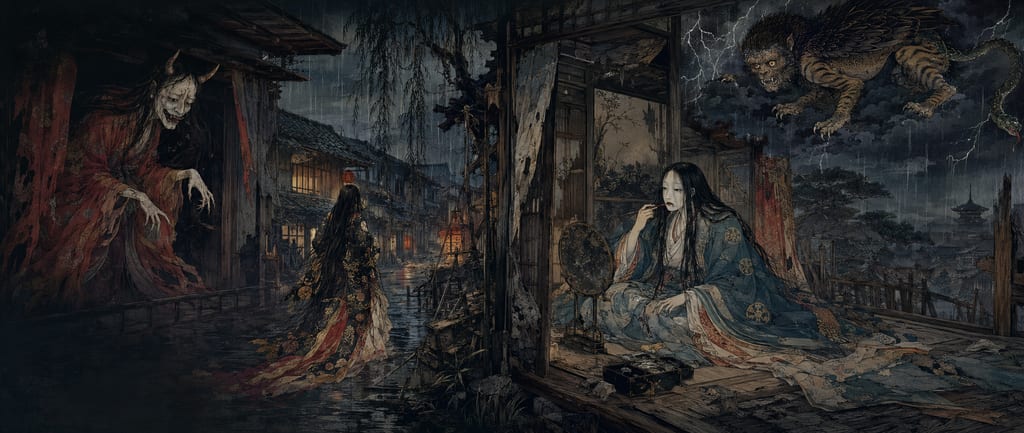
Konjaku Gazu Zoku Hyakki (“Continued Hundred Demons from the Illustrated Past and Present”) is a yokai picture anthology by Toriyama Sekien, published in 1779 (An’ei 8) as a sequel to his Gazu Hyakki Yagyō. While the earlier volume offered names and images alone, this work adds brief notes and verses for each yokai. It is arranged in three books—Rain, Dusk, and Dawn—framed around the passage of time from twilight to sunrise. Alongside famous figures known from the performing arts, such as Shuten Dōji, Hannya, and Nue, Sekien adapts subjects from tale collections and the Wakan Sansai Zue, and includes creatures of Chinese origin. Many entries lack clear sources, showcasing Sekien’s distinctive creativity.

Updated: 1/12/2026
yokai collectionJapanese folkloreToriyama SekienKonjaku Gazu Zoku HyakkiGazu Hyakki YagyoEdo period artJapanese yokaisupernatural creaturesukiyo-emythological monsters

Included Yokai

52 yokai are included

These yokai also have art cards

41 cards — ukiyo-e, modern Japan & more

Ōmagatoki – The Bewitching Hour of Dusk

Ōmagatoki – The Bewitching Hour of Dusk

Uncommon

OHH-mah-gah-TOH-kee

百魅生ずる薄闇刻・逢魔時

Half-Human BeingsVarious regions across Japan

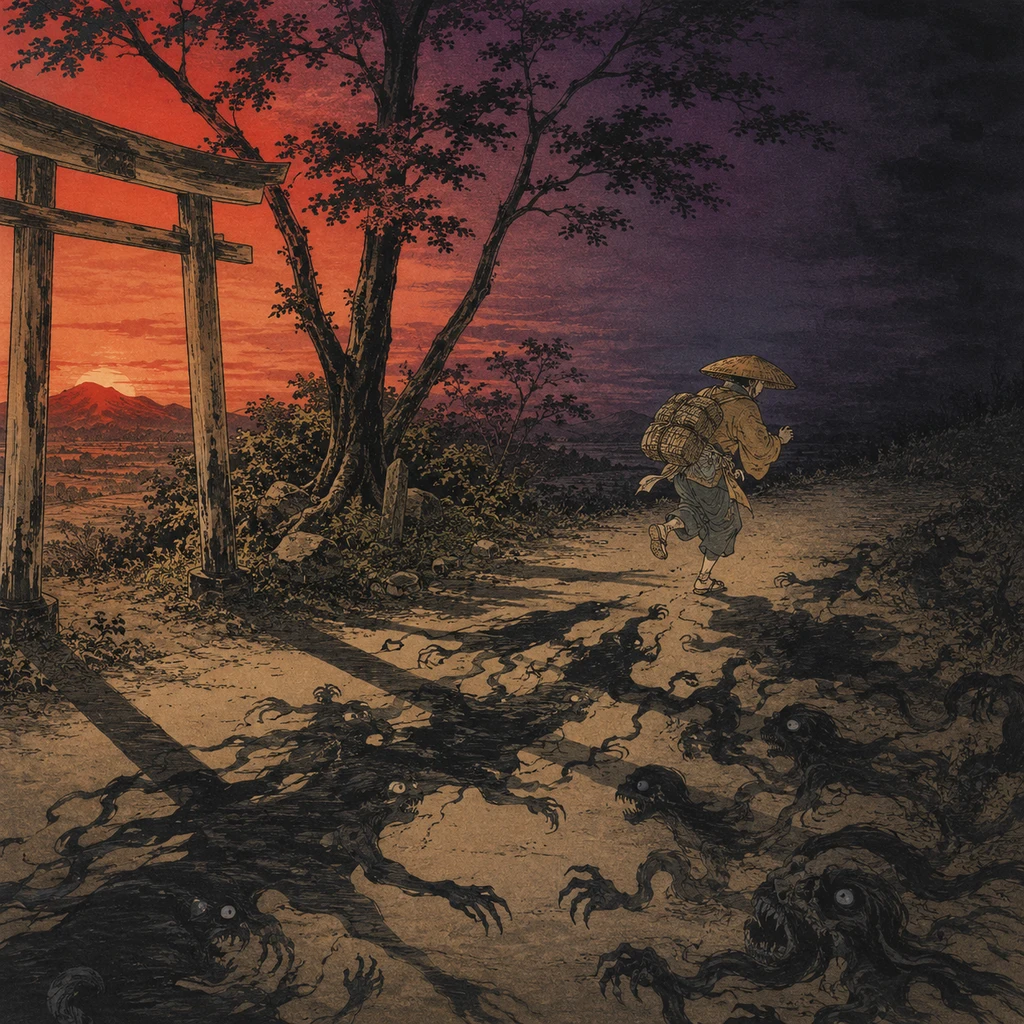
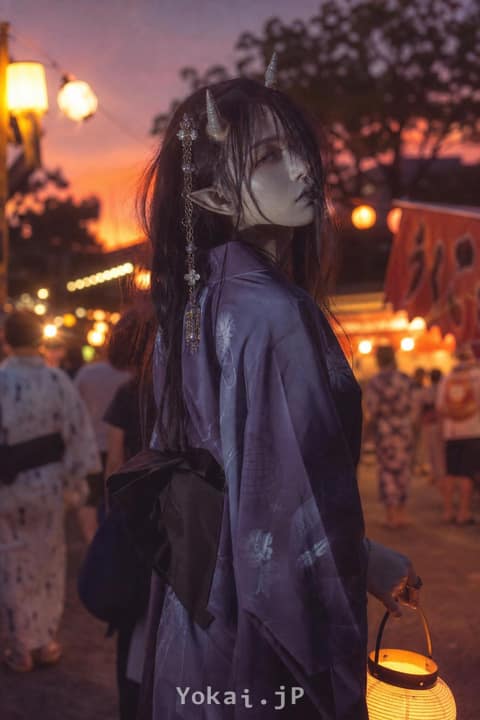
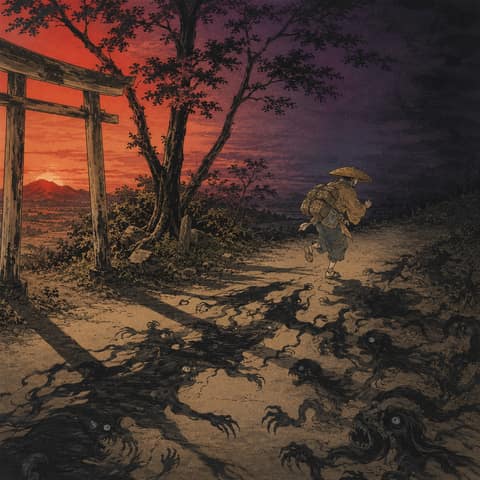
Ōmagatoki refers to the dim hour when day slips into night—the period overlapping with twilight. It’s the in-between time when faces are hard to make out and people are thought to be most likely to encounter demons or yokai. Parents warned children to stay indoors then. The Edo artist Toriyama Sekien glossed it as “the hour when a hundred specters arise,” and folklorist Yanagita Kunio noted older meanings tied to vigilance against shapeshifters. Local dialects preserve related terms with similar nuances.

Oni

Oni

Legendary

OH-nee

角と虎皮褌の鬼

Demons & GiantsKyoto

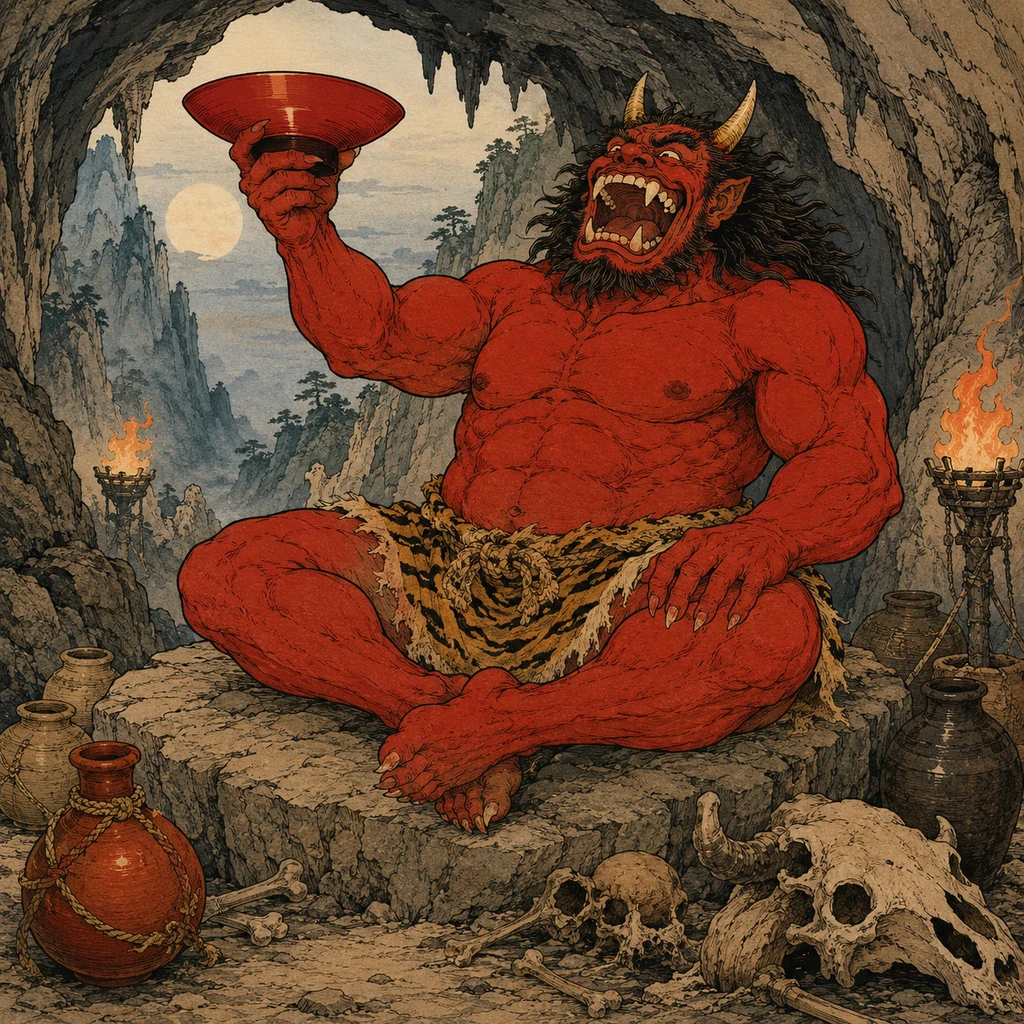
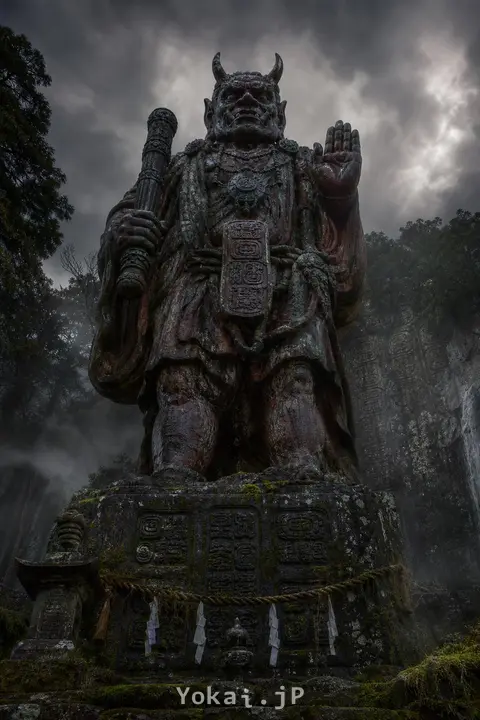
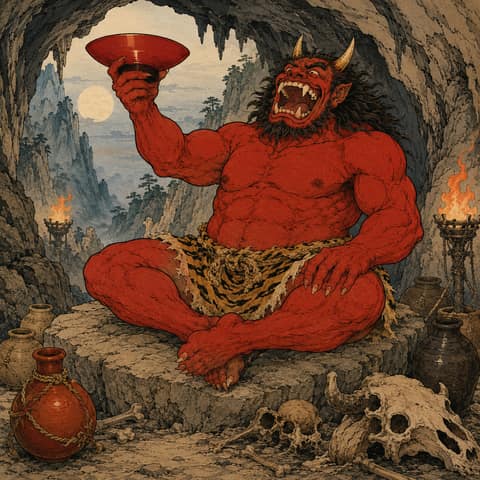
Powerful yokai with horns. Though fearsome in appearance, many are gentle at heart.

Mountain Sprite (Sansei)

Mountain Sprite (Sansei)

Rare

SAHN-say

山中片足の塩盗み・山精

Mountain & Wilderness SpiritsChina – around Anguo County, Hebei Province

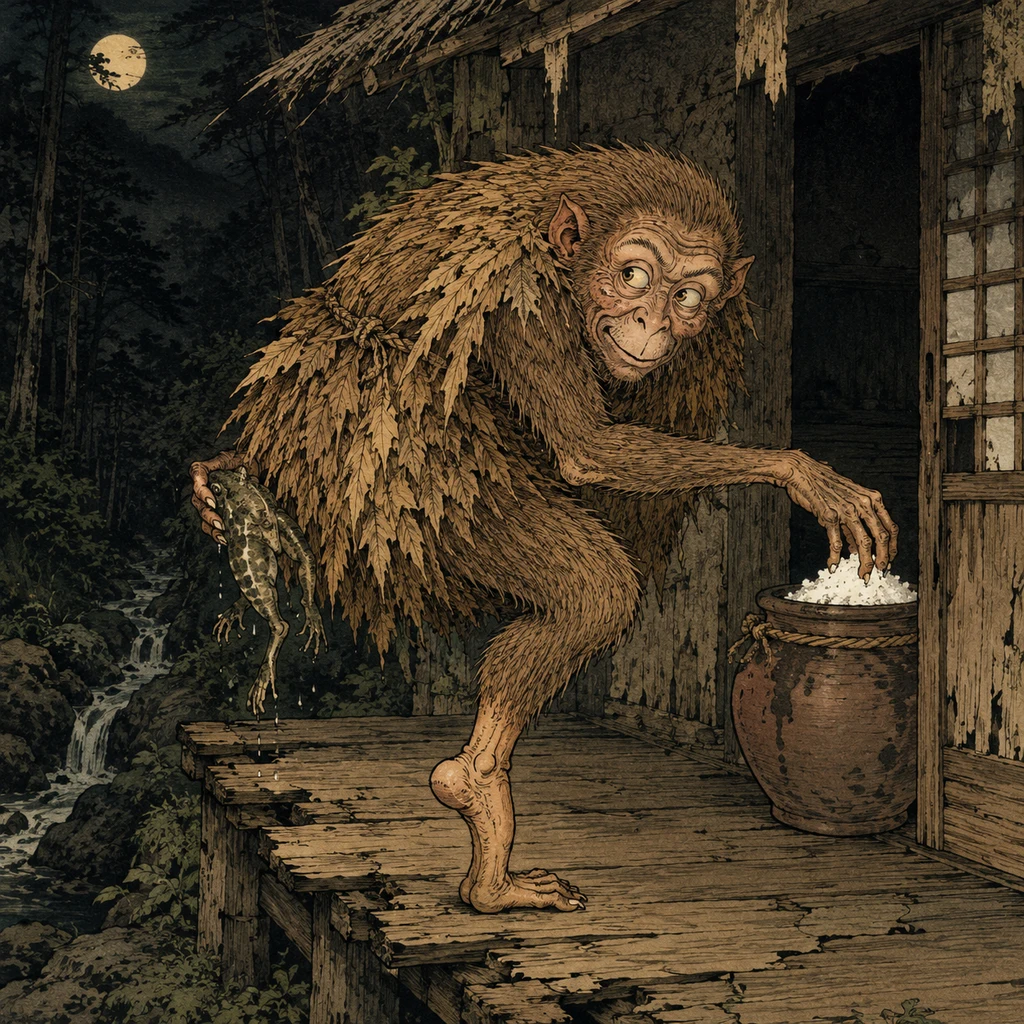
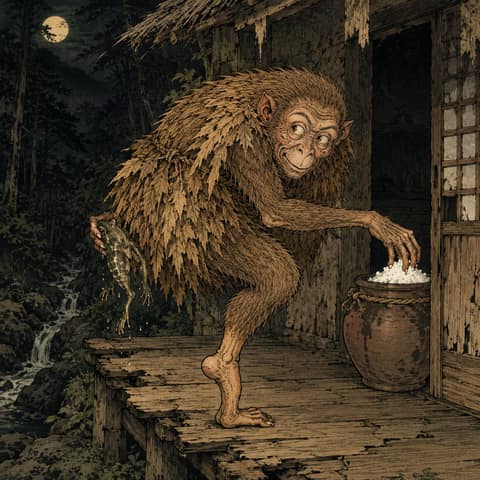
Sansei is a one-legged mountain entity said to inhabit the northern mountains of China, cited in the Japanese compendium Wakan Sansai Zue from earlier Chinese sources. Accounts vary on its height—about one shaku, or three to four shaku—and its single foot’s heel is set backward. It appears at mountain huts to steal salt and favors eating crabs and frogs. It attacks people at night but retreats if the name “Batsu” (the drought demon) is invoked. In Japan, Toriyama Sekien depicted it.

Suiko (Water Tiger)

Suiko (Water Tiger)

Epic

sui-ko

幼児大の鱗甲・水虎

Water SpiritsHubei, China (introduced to Japan through Edo-period texts)

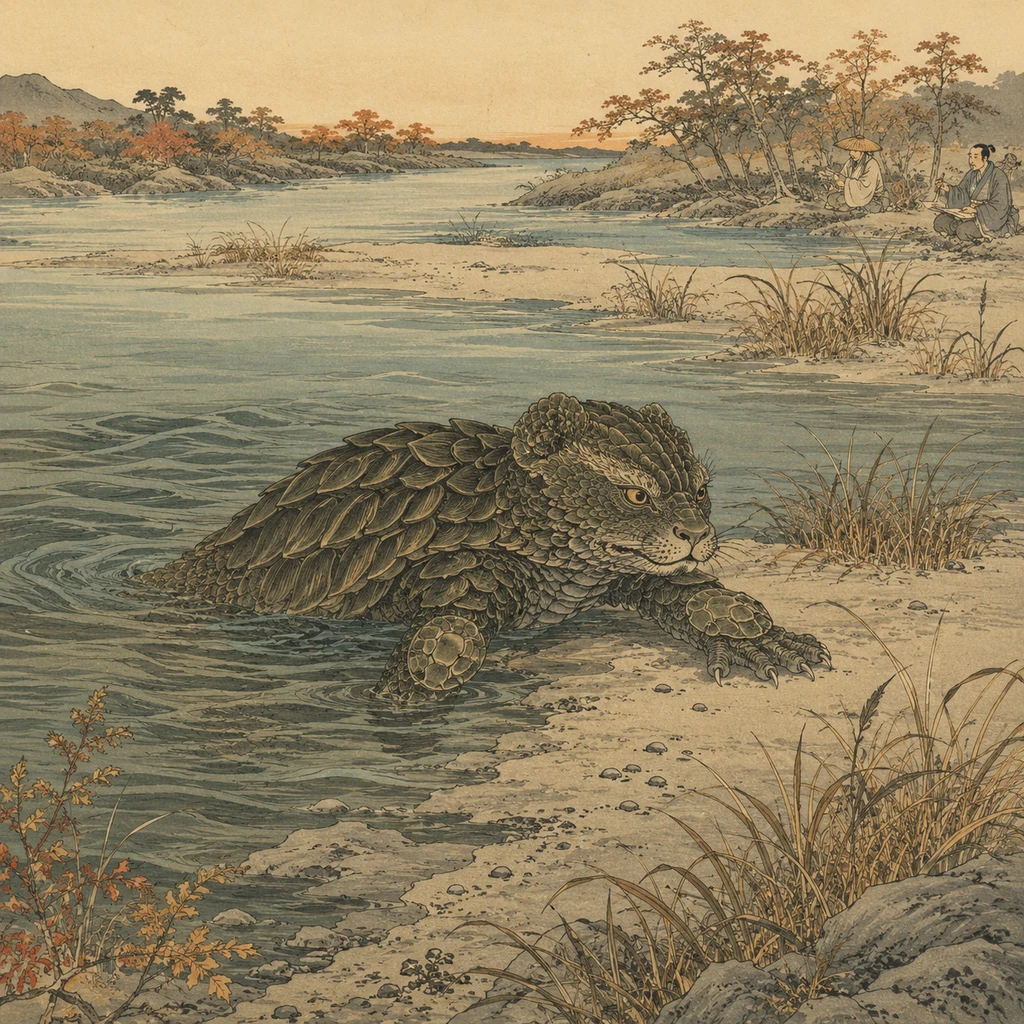
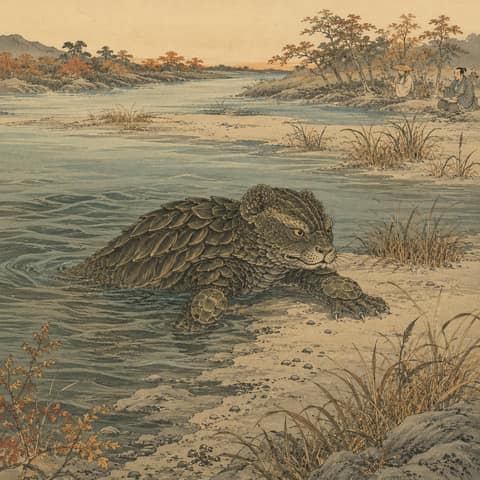
The suiko is a water-dwelling creature first recorded in Chinese materia medica. Roughly the size of a small child, it was said to be clad in hard scales and to bask with its carapace exposed on the sand in autumn. Writers gave it a tiger-like head, distinctive knees, and sharp claws. The Ming-dynasty *Honzō Kōmoku* (Compendium of Materia Medica) did much to spread its image, though the account itself reaches back to an older gazetteer, the *Xiangmian Ji*. The lore travelled to Japan through books during the Edo period, where it was often conflated with the kappa. Scholars, however, insisted that the two were "alike yet not the same" — strikingly similar, but distinct beasts — and recorded them separately.

Satori

Satori

Epic

sah-TOH-ree

心を読む山中の獣・覚

Mountain & Wilderness SpiritsGifu

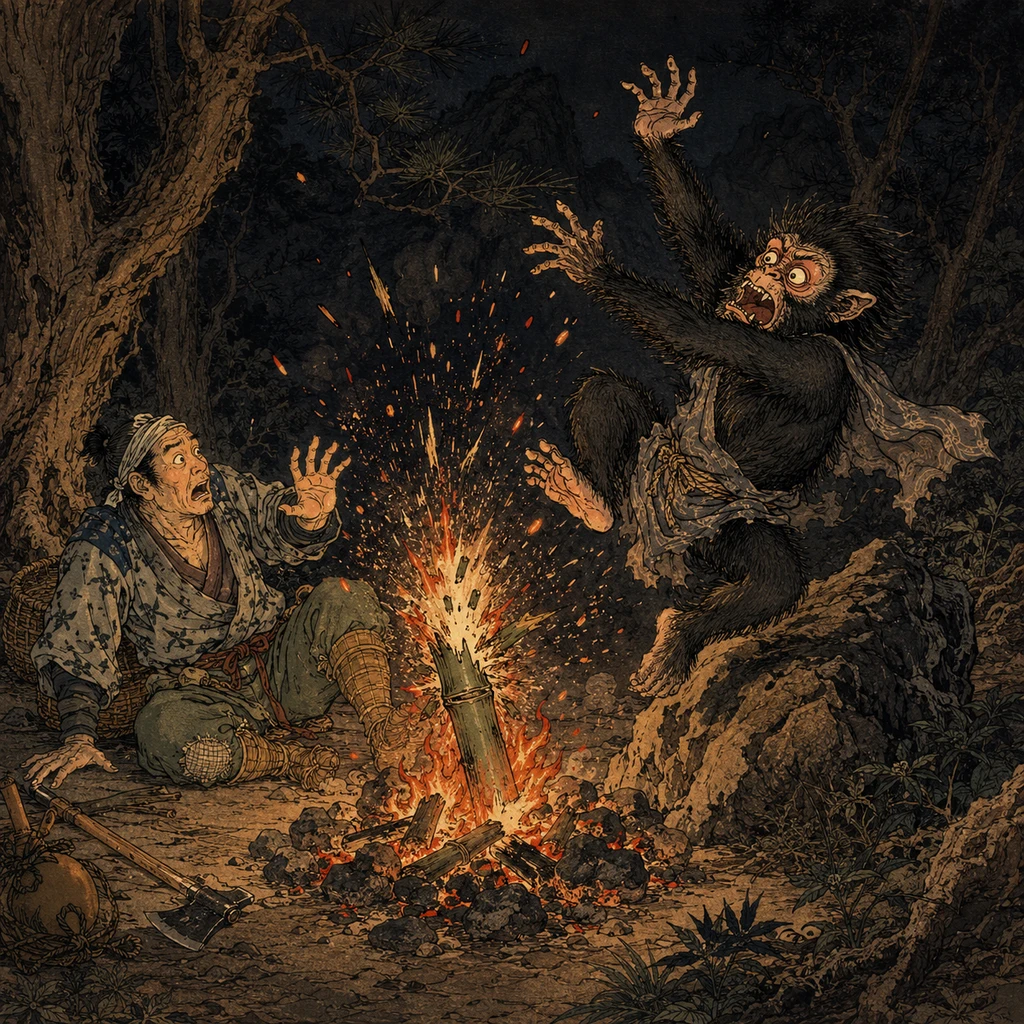
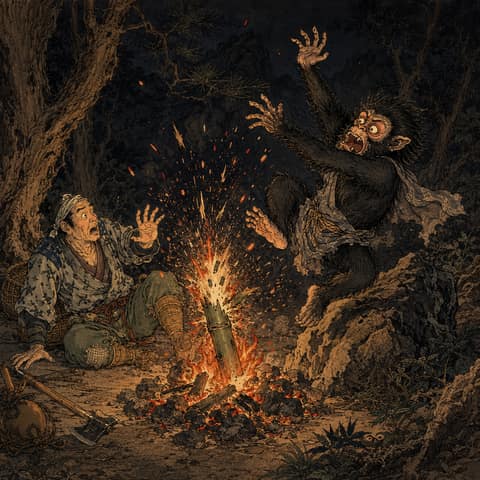
A mind-reading yokai recorded in the Edo-period scroll Konjaku Gazu Zoku Hyakki. Said to dwell in the remote mountains of Hida and Mino, it appears like a dark-skinned, shaggy, ape-like creature that understands human speech and speaks aloud a person’s inner thoughts. It does not wish to harm people, but if threatened with death it flees first. The creature has been linked to the "kaku/jué" (玃) of Chinese lore and to local tales of mind-reading mountain beings.

Shuten-dōji

Shuten-dōji

Legendary

SHOO-ten DOH-jee

大江山の鬼総領・酒呑童子

Half-Human BeingsKyotoShiga

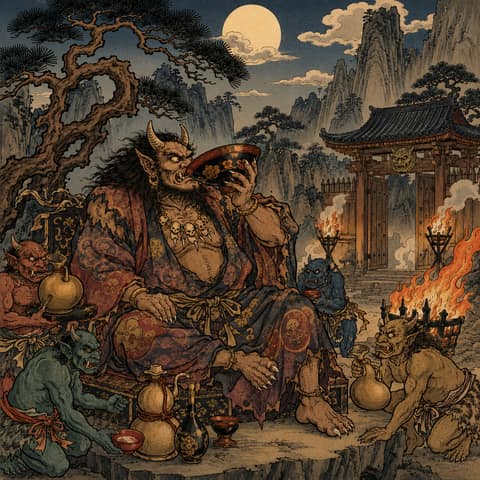
A notorious ogre chieftain who abducted people around the Heian capital. Fond of heavy drinking, he led a band of oni from a mountain stronghold to raid travelers. His name alludes to his love of sake, while dōji refers to a youth or monk-like appearance. Slain by Minamoto no Raikō and his Four Heavenly Kings, his severed head was said to bite even after decapitation. His lair is variously placed at Mt. Ōe, Mt. Ibuki, or Mt. Atago, supposedly located through onmyōji divination.

Hashihime (Bridge Princess)

Hashihime (Bridge Princess)

Epic

HAH-shee-HEE-meh

宇治橋鉄輪の鬼女・橋姫

Half-Human BeingsKyoto

Hashihime is a figure born from ancient water and land deities fused with beliefs in bridge guardians. Revered at old great bridges, she is known as a goddess or ogress. A shrine to her stands at Uji Bridge on the Uji River, with traditions also tied to Nagara Bridge and Karahashi at Seta. Taboos warn against praising other bridges while standing on a bridge, or singing songs of jealousy there. She appears in the Kokin Wakashū, and later lore recasts her as a woman transformed into a demon by jealousy.

Hannya

Hannya

Epic

HAHN-nyah

高貴なる生霊・白般若(六条御息所)

Oni / Giant SpecterNaraKyoto

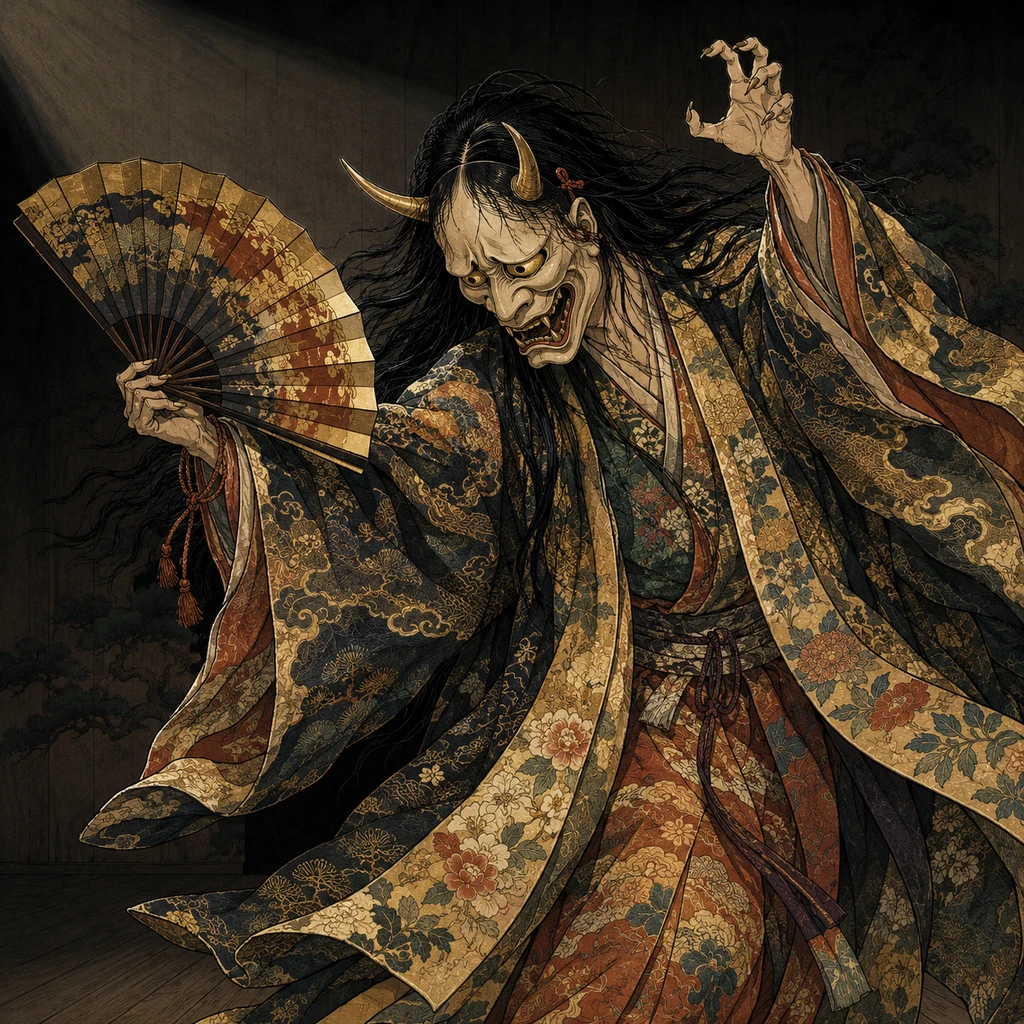
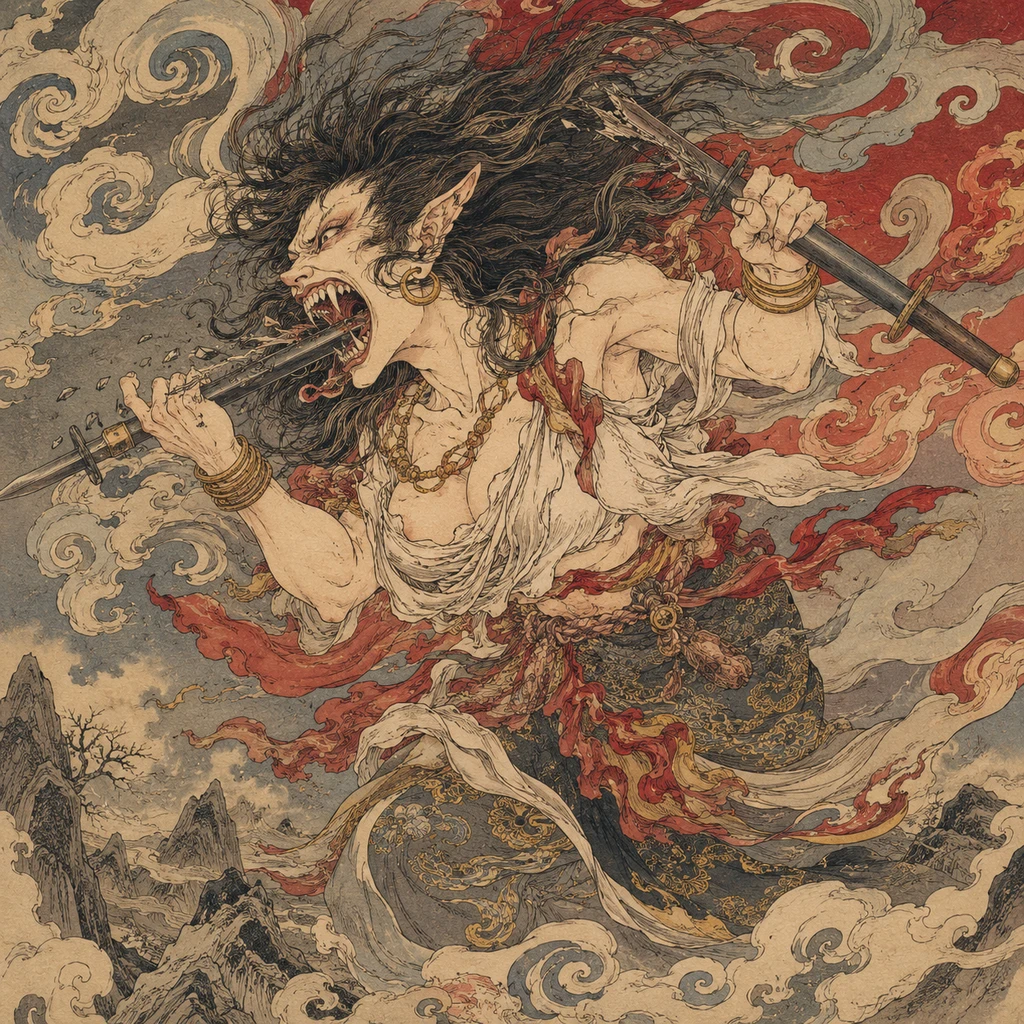
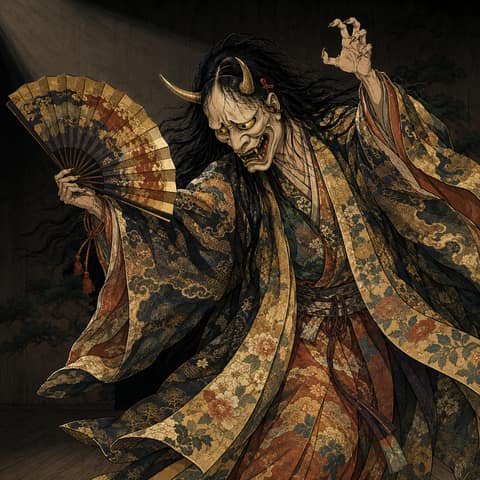
Hannya is not the name of a specific yokai species, but refers to the form of a woman who has transformed into a demon (kijo) out of extreme jealousy and resentment, as well as the 'Noh mask' used to represent her in the traditional Japanese performing art of 'Noh'. Her visual appearance—two golden horns protruding from the forehead, a mouth split to the ears, bared fangs, and disheveled hair—has become globally recognized as the definitive image of a 'female demon' in Japan. The greatest characteristic of this yokai (Noh mask) lies in the 'ultimate duality' hidden within its design. Observing the upper and lower halves of the Noh mask separately reveals its tremendous sculptural beauty. The lower half (the mouth and jaw) expresses pure 'anger and ferocity', intimidating with bared fangs. However, the upper half (especially the outer corners of the eyes and the brow) is etched with profound 'sorrow and despair' over being betrayed by a loved one and falling into the form of a hideous monster. On the Noh stage, the mask is meticulously calculated so that when the actor tilts it slightly upwards ('terasu' - to illuminate), it appears as a terrifying, raging demon, and when tilted slightly downwards ('kumorasu' - to cloud), it looks like a pitiful woman breaking down in tears. Even more fascinating is the strong irony inherent in the name 'Hannya (Prajñā)'. In Buddhism, 'Hannya' is a sacred word meaning the 'highest wisdom (enlightenment)' that severs worldly desires. Why would a female demon who has succumbed to the most secular emotions of 'jealousy' and 'lust' and fallen into evil be called by the name of 'wisdom', its exact opposite? There are various theories, such as that it was created by the genius mask maker 'Hannya-bo' of the Muromachi period, or that reciting the Heart Sutra (Hannya Shingyo) was absolutely necessary to vanquish (exorcise) this female demon. In any case, there is no other yokai that embodies the psychological terror of humans losing their reason and turning into beasts (demons) through such a highly refined artistic expression.

Temple Woodpecker

Temple Woodpecker

Rare

TEHM-puhl WUUD-peh-ker (teh-rah-TSOO-tsoo-kee)
守屋怨念の啄木鳥・寺つつき

Animal ShapeshiftersOsaka

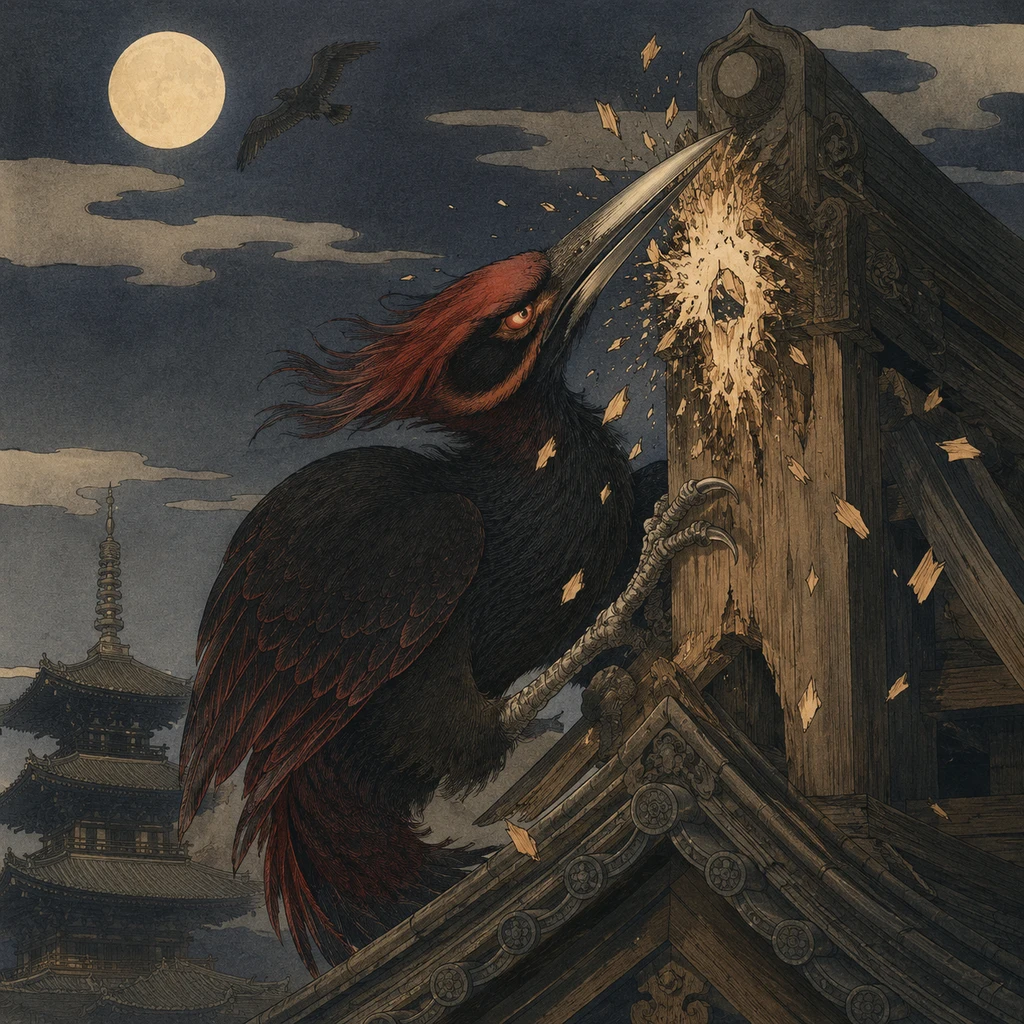
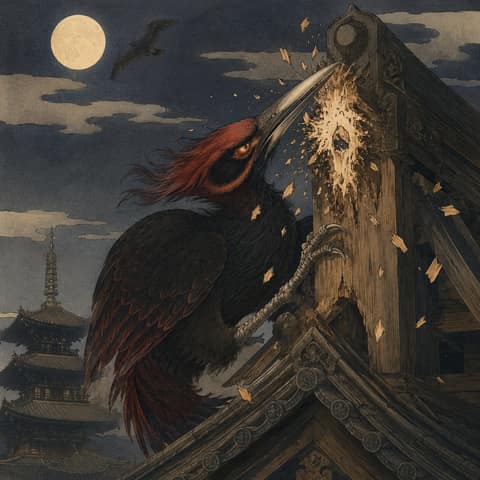
Temple Woodpecker is a sinister bird yokai that takes the form of a woodpecker and pecks at temple beams and doors, damaging sacred buildings. Illustrated by Toriyama Sekien in Konjaku Gazu Zoku Hyakki, it is told as an ill omen that obstructs the Buddhist Law. Some say it is the transformed vengeful spirit of Mononobe no Moriya, targeting temples founded by Prince Shōtoku. Others equate its true form with the great spotted woodpecker; it appears with loud tapping and then vanishes.

Court-Entering Sparrow

Court-Entering Sparrow

Uncommon

NYOO-nai SOO-zoo-meh

清涼殿の供御食い・入内雀

Animal ShapeshiftersKyoto

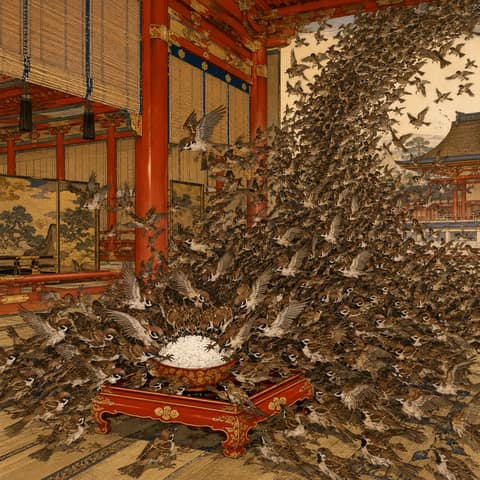
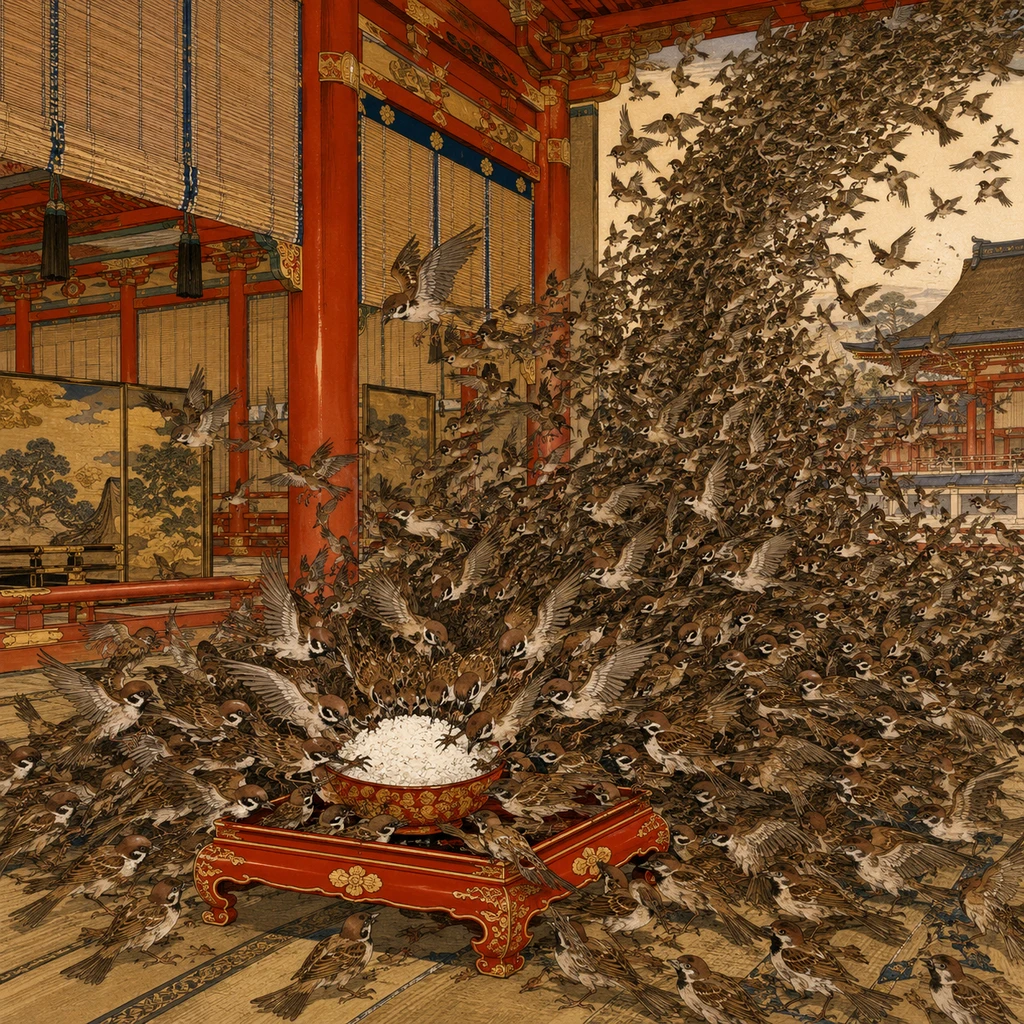
A fearsome bird said to be the transformed spirit—or grudge—of Fujiwara no Sanekata, a mid-Heian poet. After his death, his vengeful spirit became a sparrow that entered the Seiryōden hall of the imperial palace and devoured the rice set on ceremonial trays. Called the “Court-Entering Sparrow” or “Sanekata Sparrow,” it was feared as an ominous intruder into the Inner Palace and blamed for ravaging crops, embodying Sanekata’s fixation on the capital and resentment over his demotion.

Tamamo-no-Mae

Tamamo-no-Mae

Legendary

Tamamo-no-Mae

鳥羽院寵愛の九尾狐・玉藻前

Animal ShapeshiftersKyotoTochigi

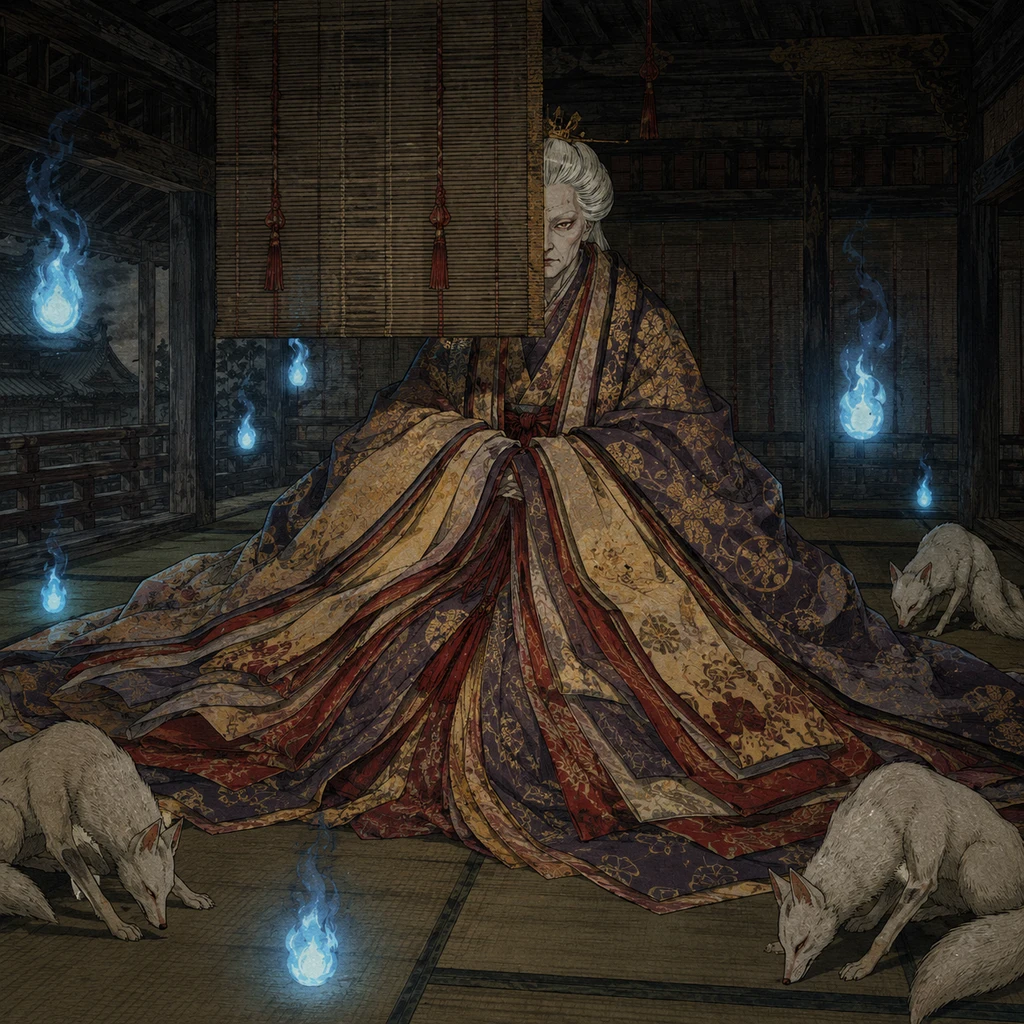
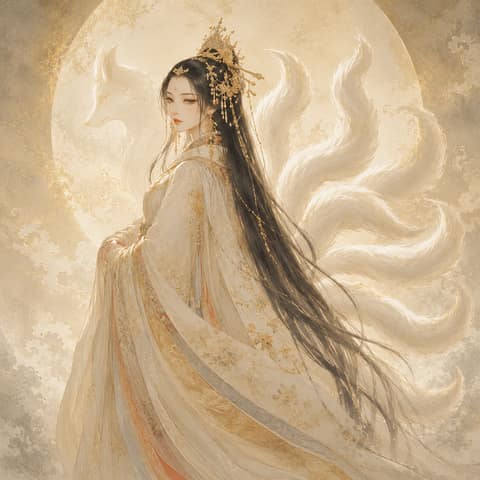
Tamamo-no-Mae is a beauty of unrivaled grace who, in the late Heian period, is said to have served the retired Emperor Toba. Her true form is held to be a nine-tailed fox, yet as a human, Tamamo-no-Mae has above all been remembered as a court lady of rare beauty and deep learning. Poetry and music were a given, but from Buddhist scripture to the old tales of India and China, she answered any question without hesitation, astonishing all at court. The name “Tamamo-no-Mae” carries a story of its own. One night, amid a banquet of poetry and music at the Seiryōden, a gust of wind snuffed out the lamps; in the darkness a dazzling light streamed from her body and lit the hall as bright as day. From this she came to be called “Tamamo-no-Mae,” meaning the lady of the jewel-like, glowing waterweed . Before that, it is said, she had been called Mikuzume. In time she drew all the emperor’s affection to herself, but when he fell ill from an unknown cause, her true nature began to be doubted.

Osakabe-hime

Osakabe-hime

Epic

oh-sah-KAH-beh-hee-meh

姫路天守の城神姫・長壁姫

Half-Human BeingsHyogo

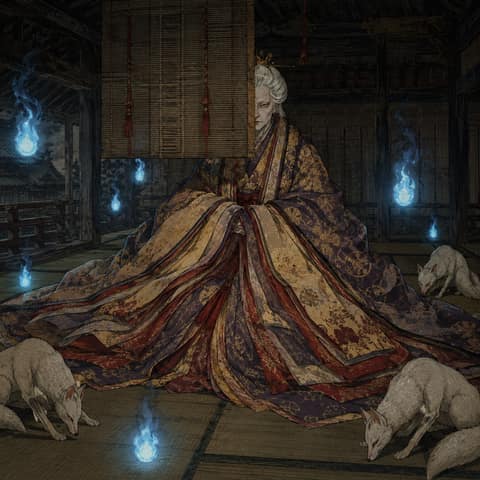
A female yokai and castle deity said to dwell in the main keep of Himeji Castle. Early Edo怪談 depict it as a gender-shifting castle specter; later tradition fixed the image as a “princess.” Revered and feared as both guardian and avenger of the castle, bringing fortune or calamity according to the lord’s conduct. Its true nature varies by tale—an ancient fox, a castle god, a sacrificed woman, or the spirit of a long-departed noble lady. Also called Osakabe.

Ushi-no-koku Mairi (Cursing Rite at the Hour of the Ox)

Ushi-no-koku Mairi (Cursing Rite at the Hour of the Ox)

Epic

OO-shee-noh-KOH-koo MY-ree

丑三つ時の藁人形呪詛

Ghosts & SpiritsKyoto

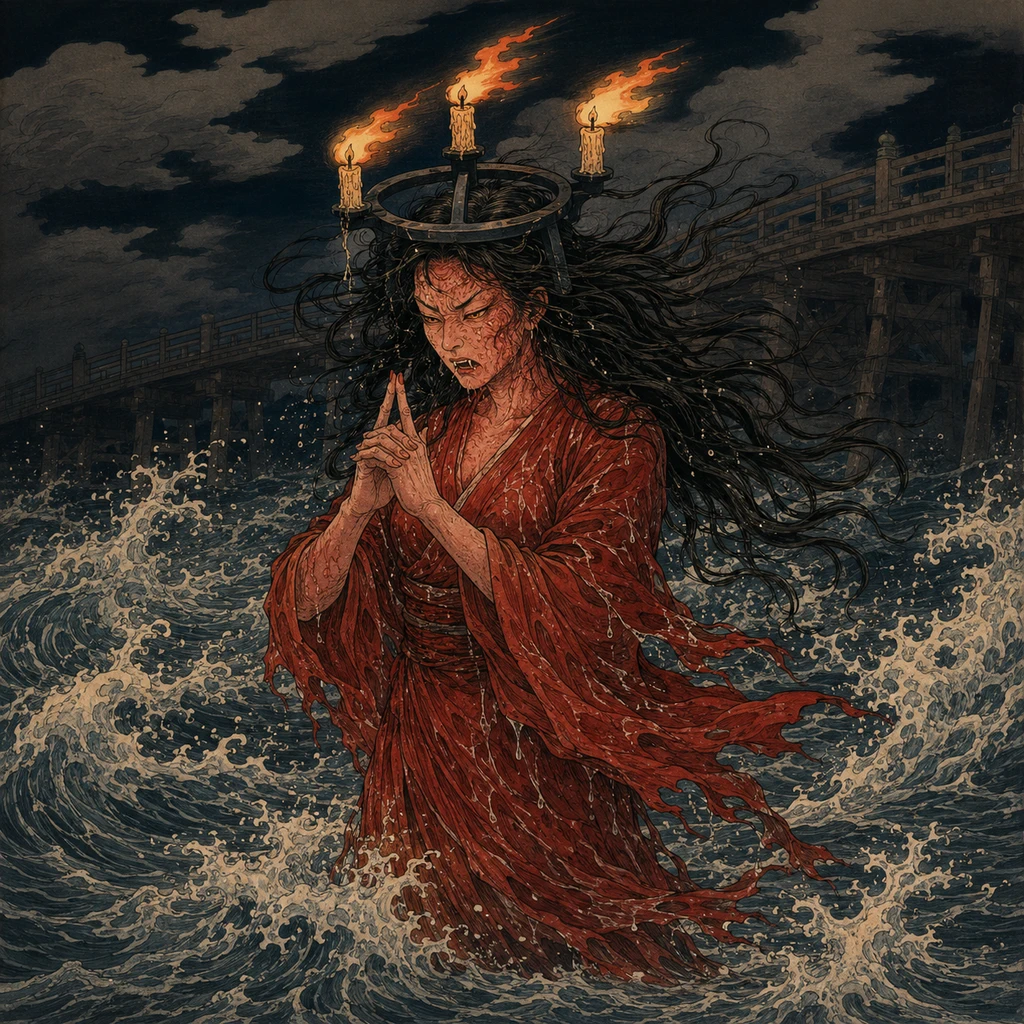
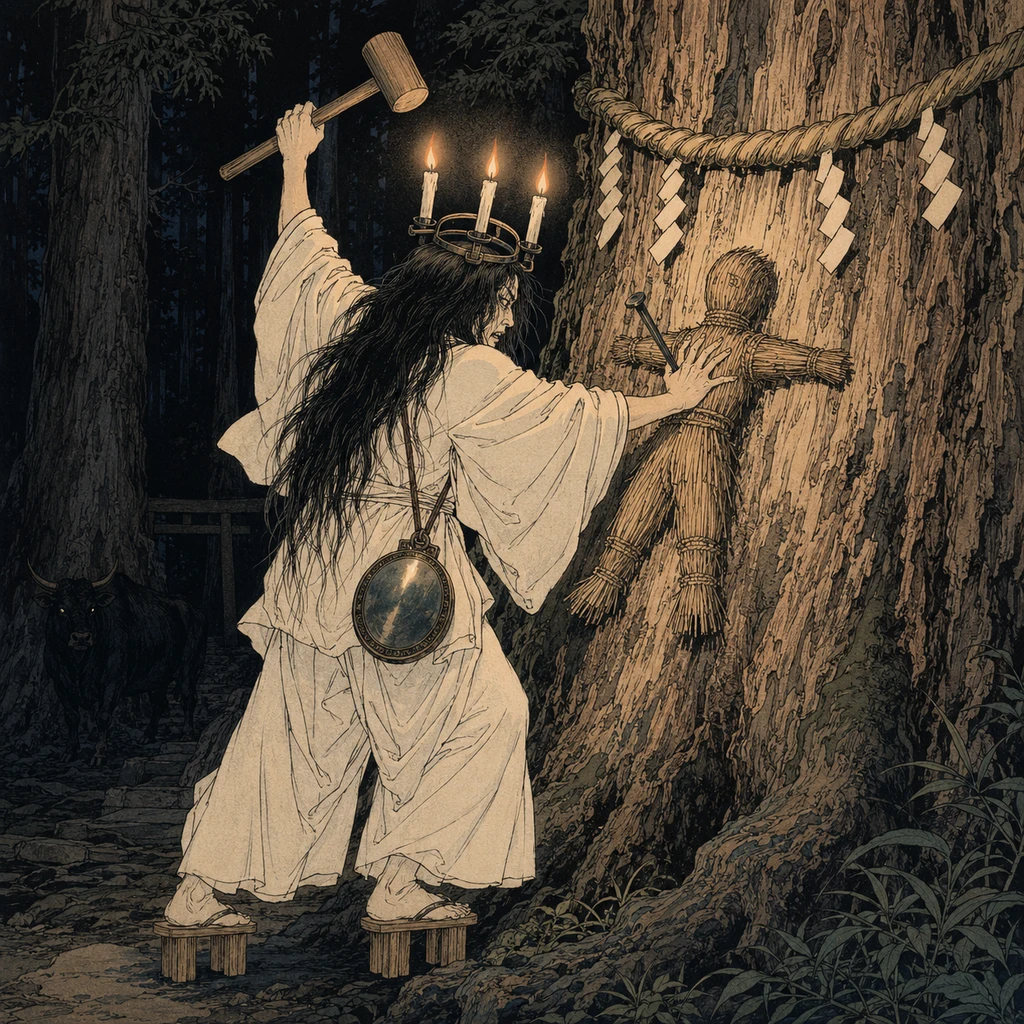
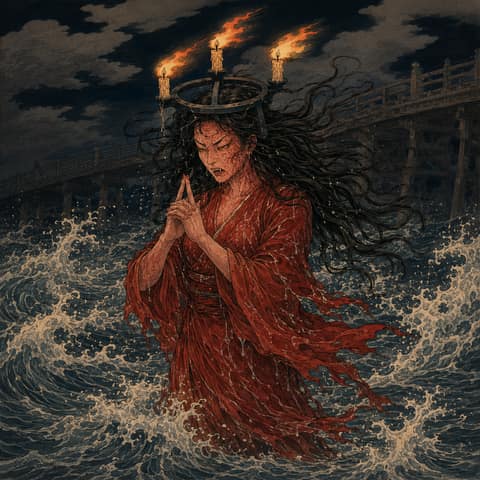
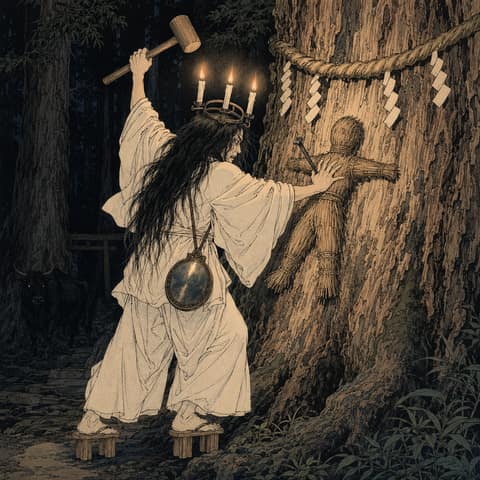
A nocturnal cursing ritual performed at the Hour of the Ox (around 1–3 a.m.). The practitioner nails a straw effigy modeled after the hated target to a shrine’s sacred tree, petitioning for a deadly curse. By the Edo period the rite had a fixed costume and toolkit: white funeral garb, an iron trivet (kanawa) with lit candles worn on the head, one-toothed clogs, a mirror, and five-inch nails. Completing seven consecutive nights was said to fulfill the vow. If witnessed, the spell fails; encountering a black ox promises success—if one mounts it. Scholars trace its roots to ancient doll-substitution curses and Onmyodo katashiro rites.

Shiranui (Mysterious Sea Fires)

Shiranui (Mysterious Sea Fires)

Uncommon

shee-rah-NOO-ee

八朔の沖の親火・不知火

Aquatic SpiritsKumamotoSaga

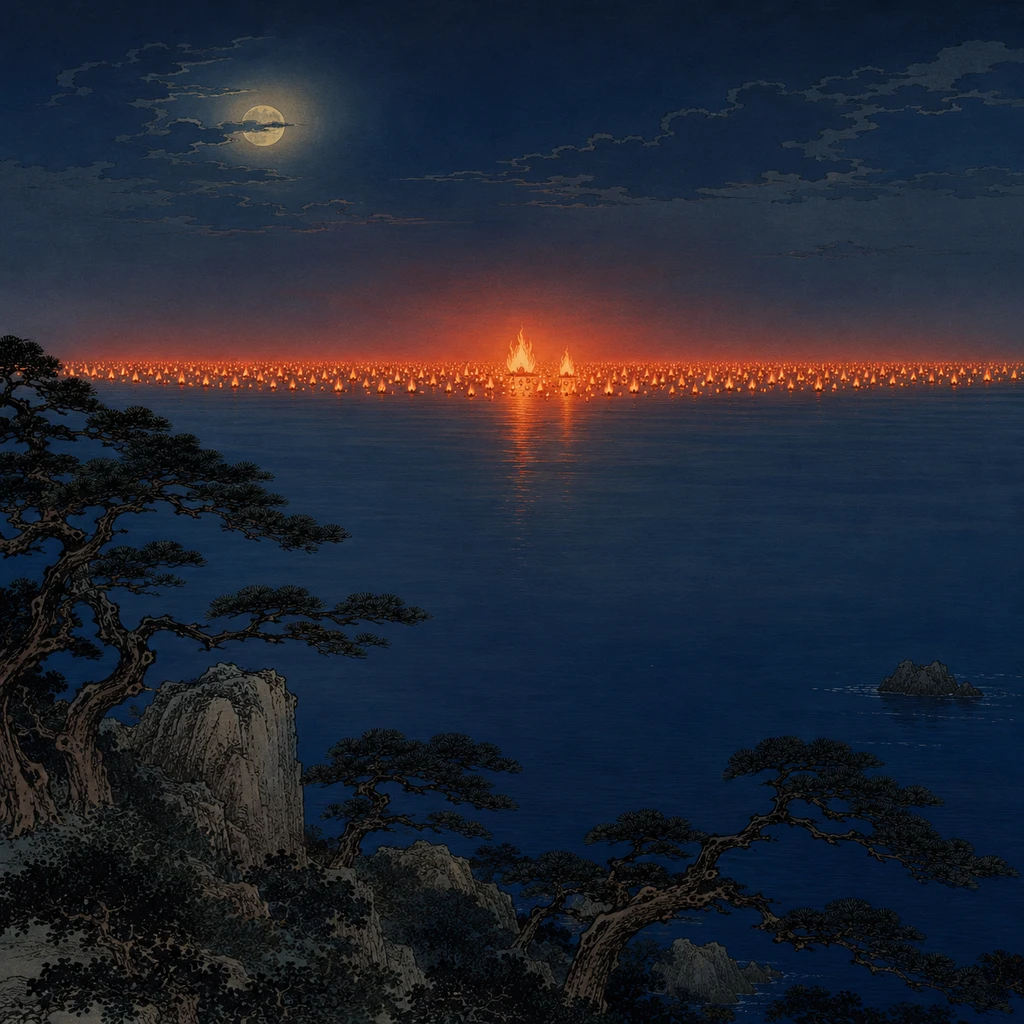
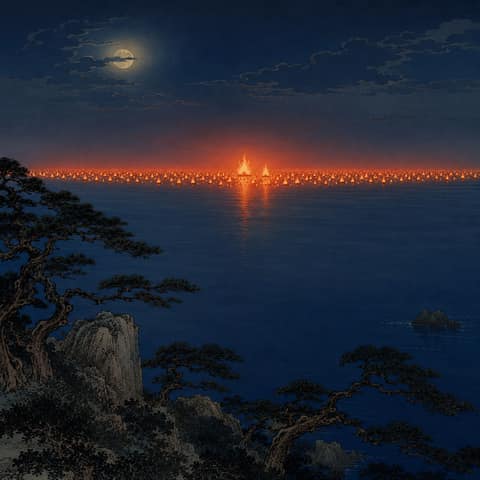
Shiranui are mysterious sea fires said to appear along Kyushu’s shores, especially on the Yatsushiro and Ariake Seas. On a windless new-moon night around the first day of the eighth lunar month, one or two “parent lights” flare up offshore, split left and right, and multiply until hundreds or thousands line the horizon. They are hard to see from sea level but clear from higher ground, and retreat as one approaches. Also called “Thousand Lanterns” and “Dragon Lanterns,” they were feared as bad omens that warned fishers to stay ashore.

Battlefield Will-o'-Wisp

Battlefield Will-o'-Wisp

Uncommon

koh-SEN-joh-bee

血より立つ怨霊火・古戦場火

Demons & GiantsOsaka

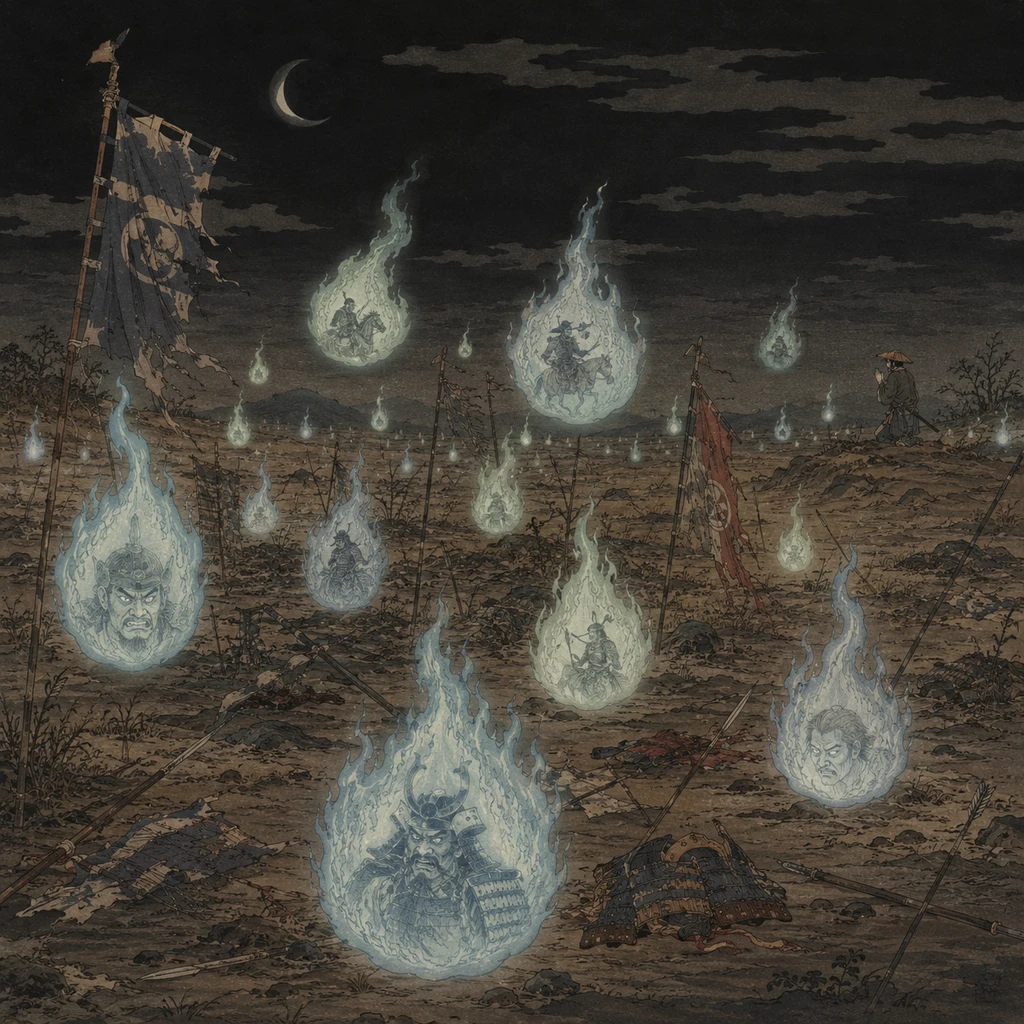
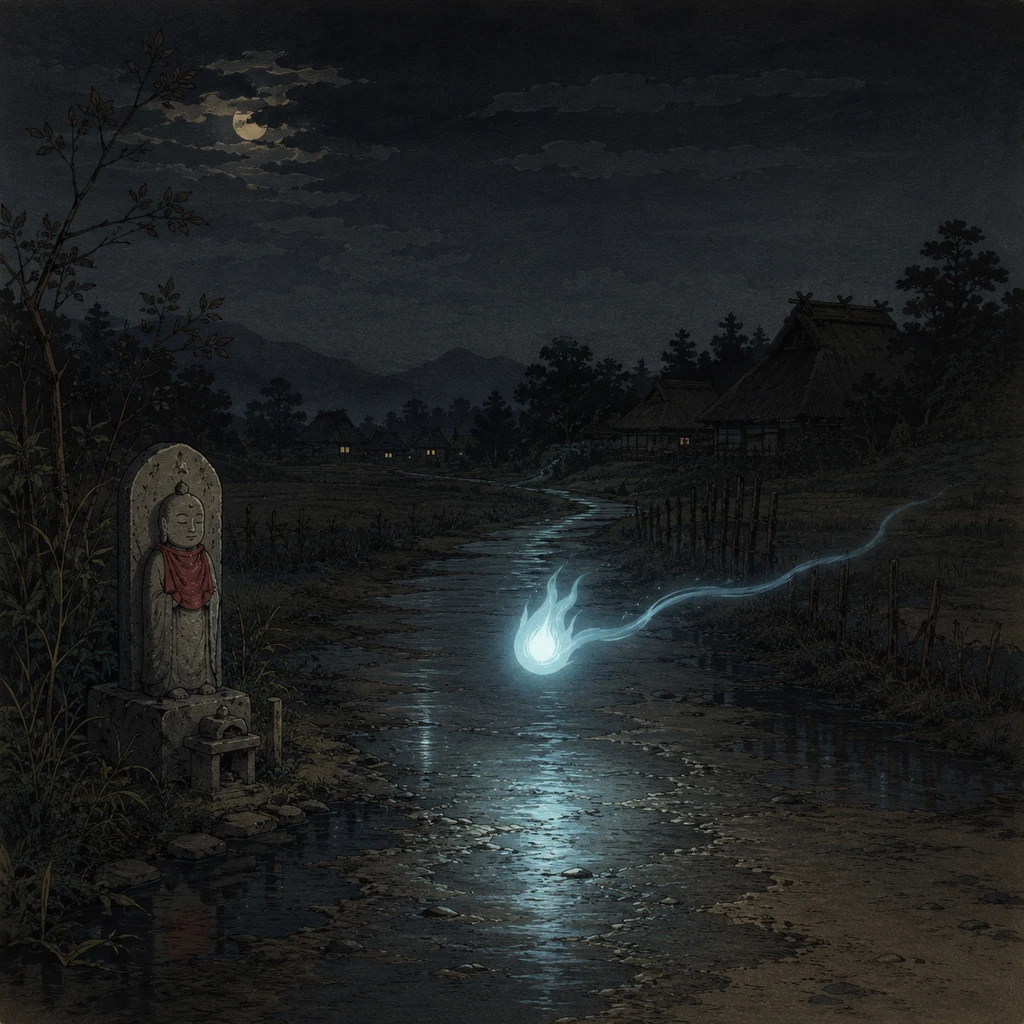
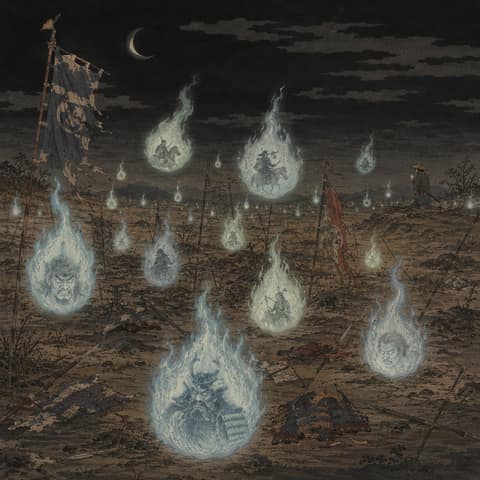
Battlefield Will-o'-Wisp refers to ghost lights that gather over killing grounds where many fell. They drift softly, and in great numbers cast a pale glow across the fields. Said to be fires exuded by the grudges of fallen soldiers and horses, they are depicted in Toriyama Sekien’s Konjaku Gazu Zoku Hyakki as flames rising from blood spilled on the earth. Reliable tales of harm are rare; witnesses are said to recite a Buddhist chant and quietly depart.
Blue Heron Fire

Blue Heron Fire

Epic

ah-oh-SAH-gee-bee

夜光るゴイサギ・青鷺火

Animal ShapeshiftersNaraNiigata

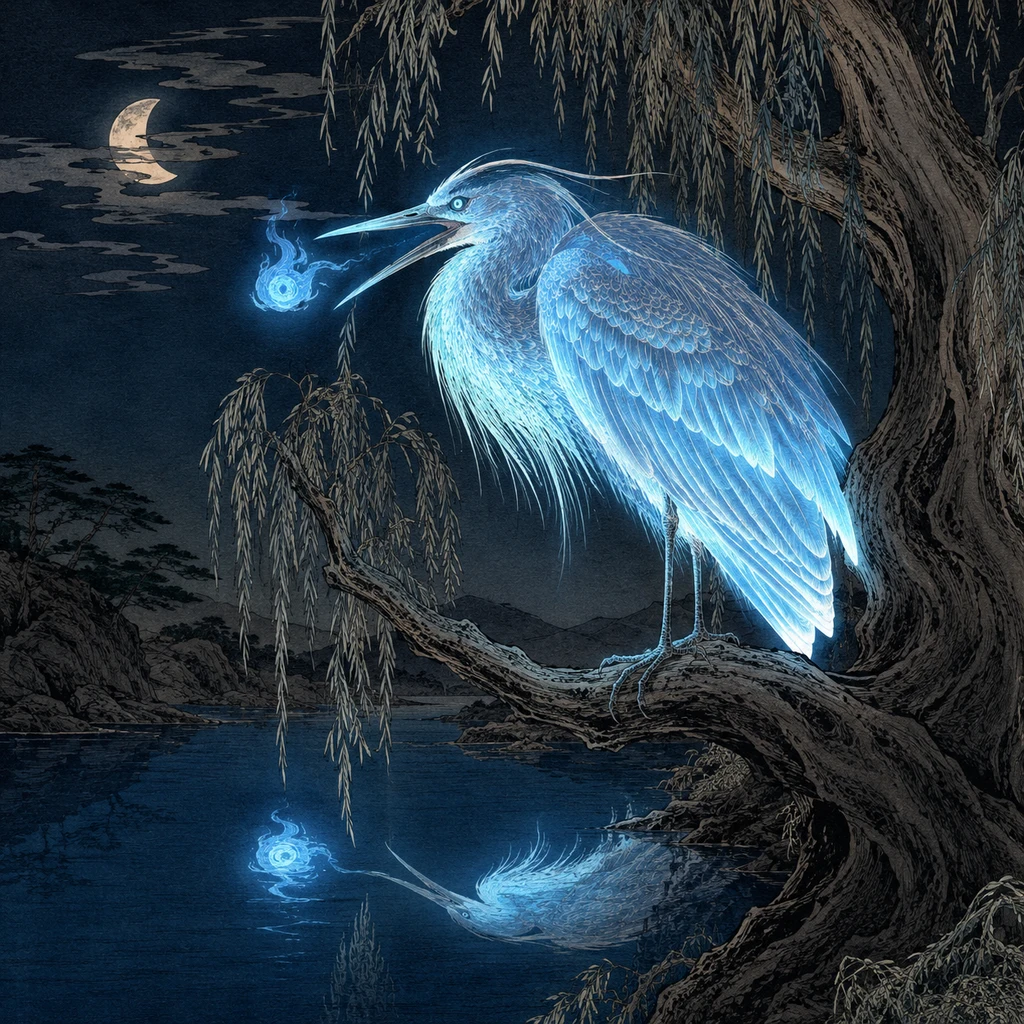
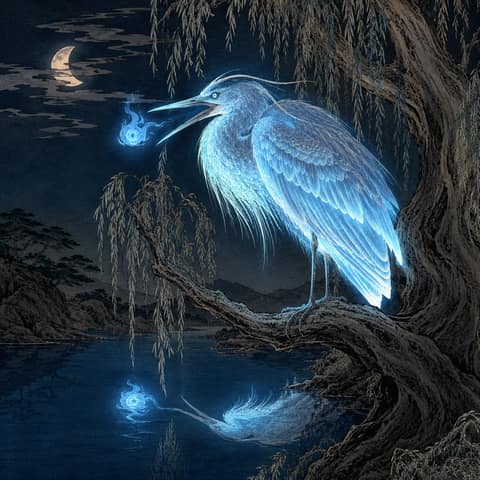
A nocturnal apparition in which a heron’s body appears to glow pale blue. Also called Goi no Hi and Goi no Hikari. Recorded in Edo-period picture books and essays, it was seen on moonlit and rainy nights. Often identified as the black-crowned night heron (goisagi); in flight it looked like blue flames, startling onlookers. Explanations include reflections from wet plumage or substances along the water’s edge, yet many locales remember it as a ghostly fire.

Fire-Quenching Crone

Fire-Quenching Crone

Rare

hee-KEH-shee-bah-bah

灯を吹き消す老女・火消婆

Half-Human BeingsEdo

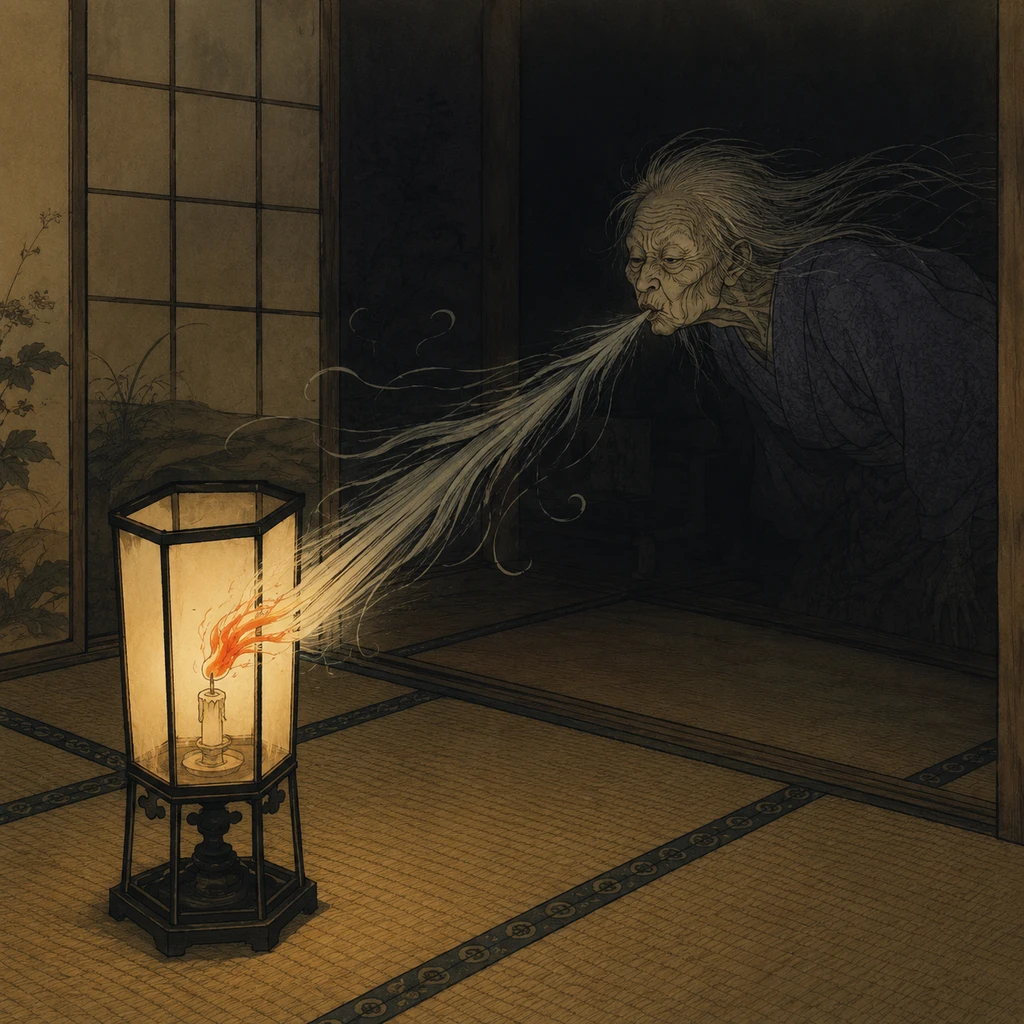
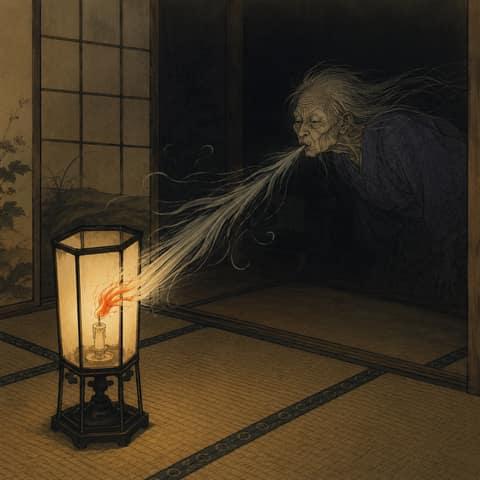
A yokai depicted by Toriyama Sekien in Konjaku Gazu Zoku Hyakki: an old woman who blows out lights. She is said to snuff lanterns, andon lamps, and candle flames from a distance with a single puff, interpreted as an ominous, yin presence that abhors the cheerful, yang nature of fire. Oral accounts are scarce, and scholars often view the figure as largely Sekien’s invention. Later books and picture chapbooks show name variants (“Fukkeshi Baba,” “Fukikeshi Baba”) and link her to tales of lamps going out at parties or on night roads.

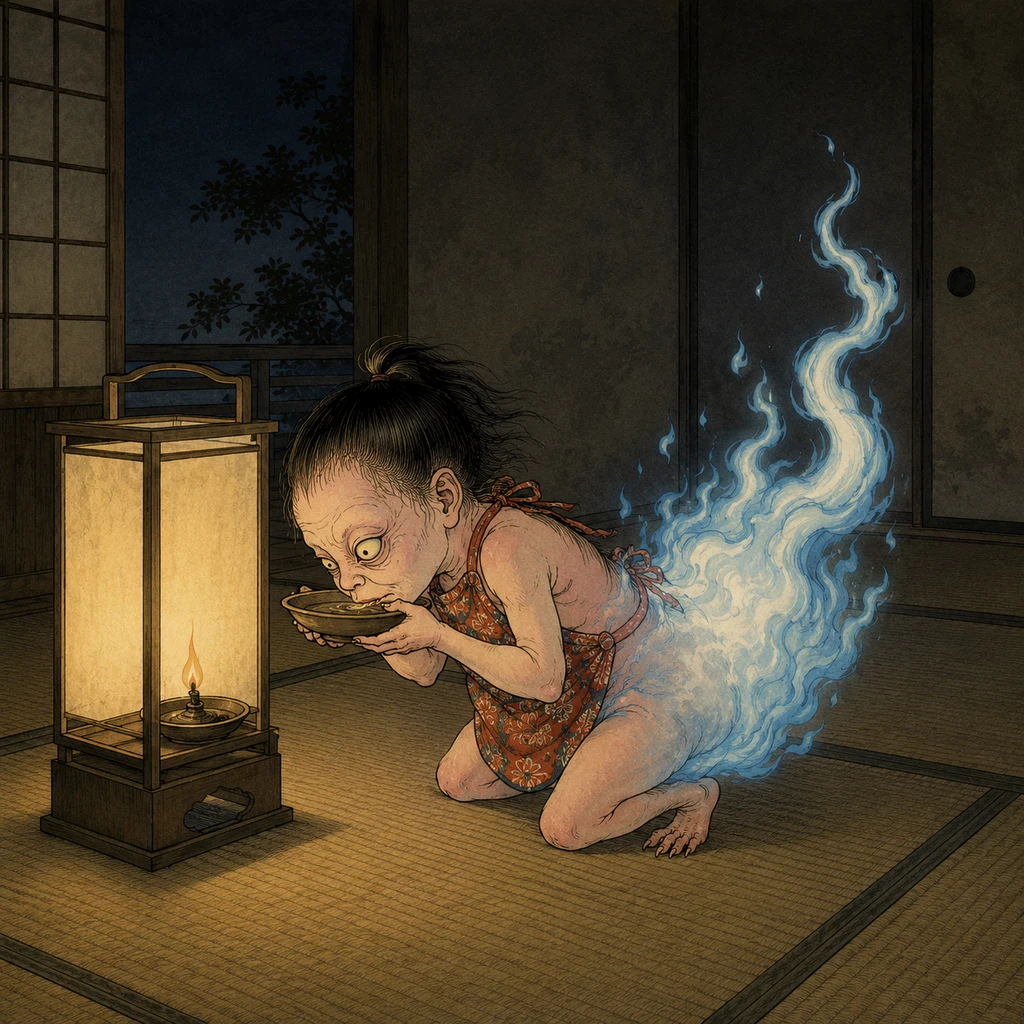
Oil Baby

Oil Baby

Rare

AH-boo-rah AH-kah-go

行灯油を嘗める油赤子

Household SpiritsShiga

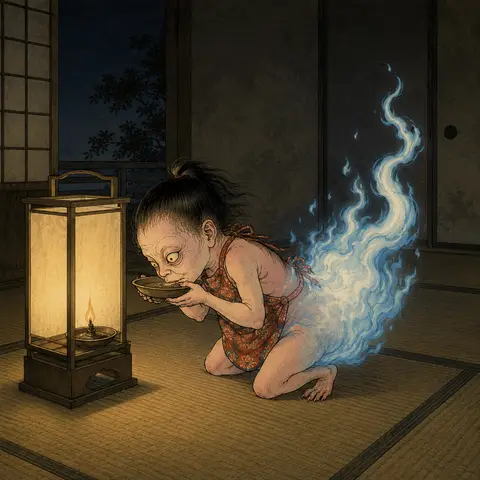
A yokai illustrated in the mid-Edo period by Toriyama Sekien in Konjaku Gazu Zoku Hyakki. It appears as an infant that licks oil from household lamps. The motif draws on a local belief from Ōtsu in Ōmi: an oil seller who stole oil offered to a Jizō statue died and became a wandering fire. Sekien adapted that ghost-fire tale, embodying an obsession with oil in the form of a red baby.

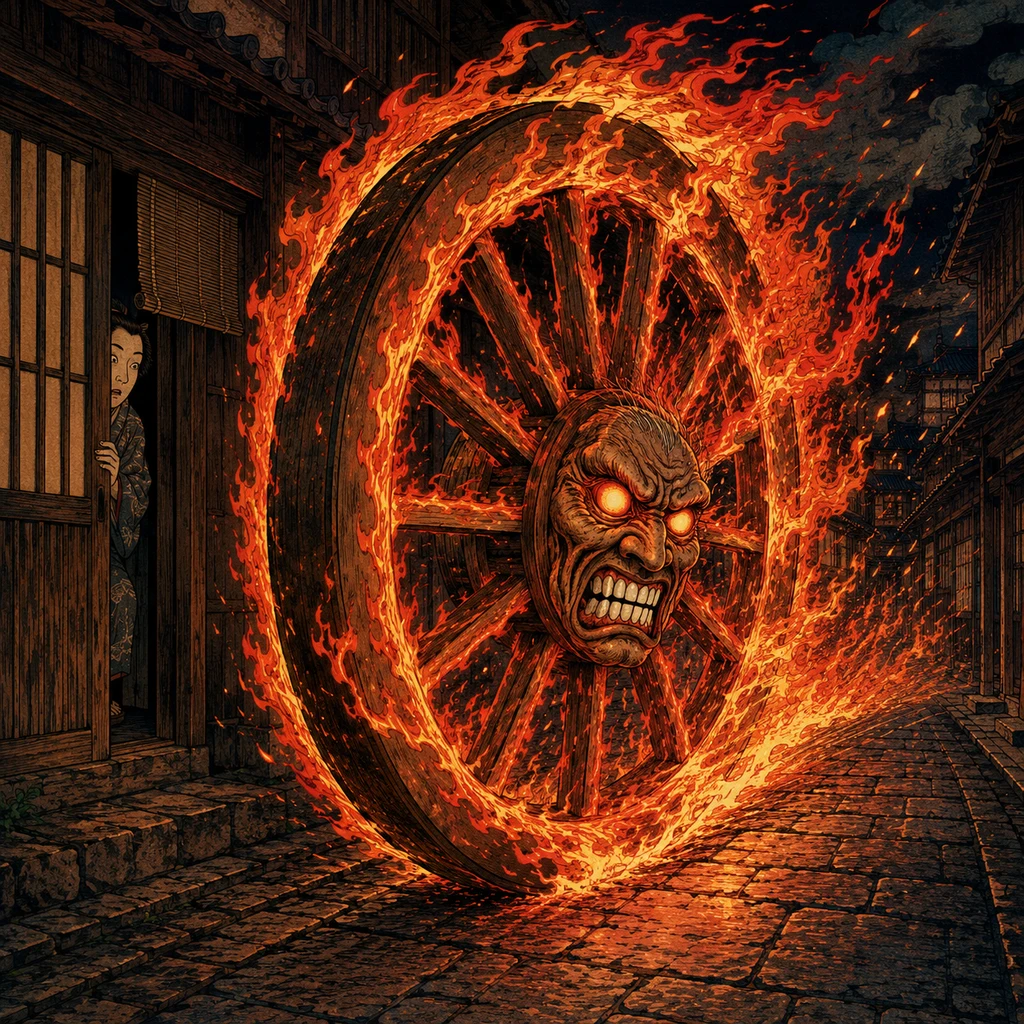
Katawaguruma (One-Wheeled Carriage)

Katawaguruma (One-Wheeled Carriage)

Uncommon

kah-tah-wah-GOO-roo-mah

京東洞院の覗き戒め・片輪車

Household SpiritsKyotoShiga

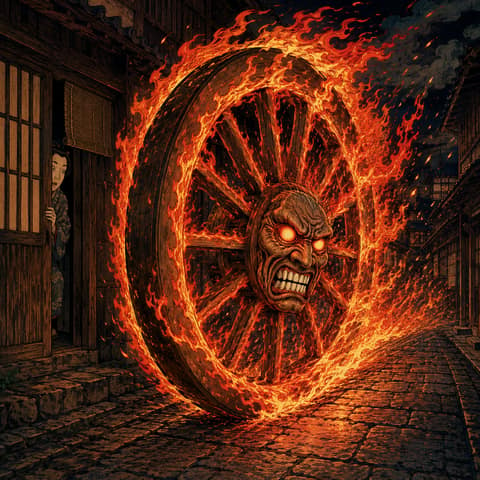
Katawaguruma is a night apparition of a single ox-cart wheel wreathed in flames, racing down dark roads with a human face glaring from its hub. Recorded in early Edo-period kaidan and essays, it was feared to bring misfortune to those who saw it—and even to those who merely gossiped about it. Accounts differ on whether the face is male or female. Sightings are tied to Kyoto and Omi, and the creature appears in contemporary paintings. Scholars often discuss its connection to the wheel-demon Wanyūdō.

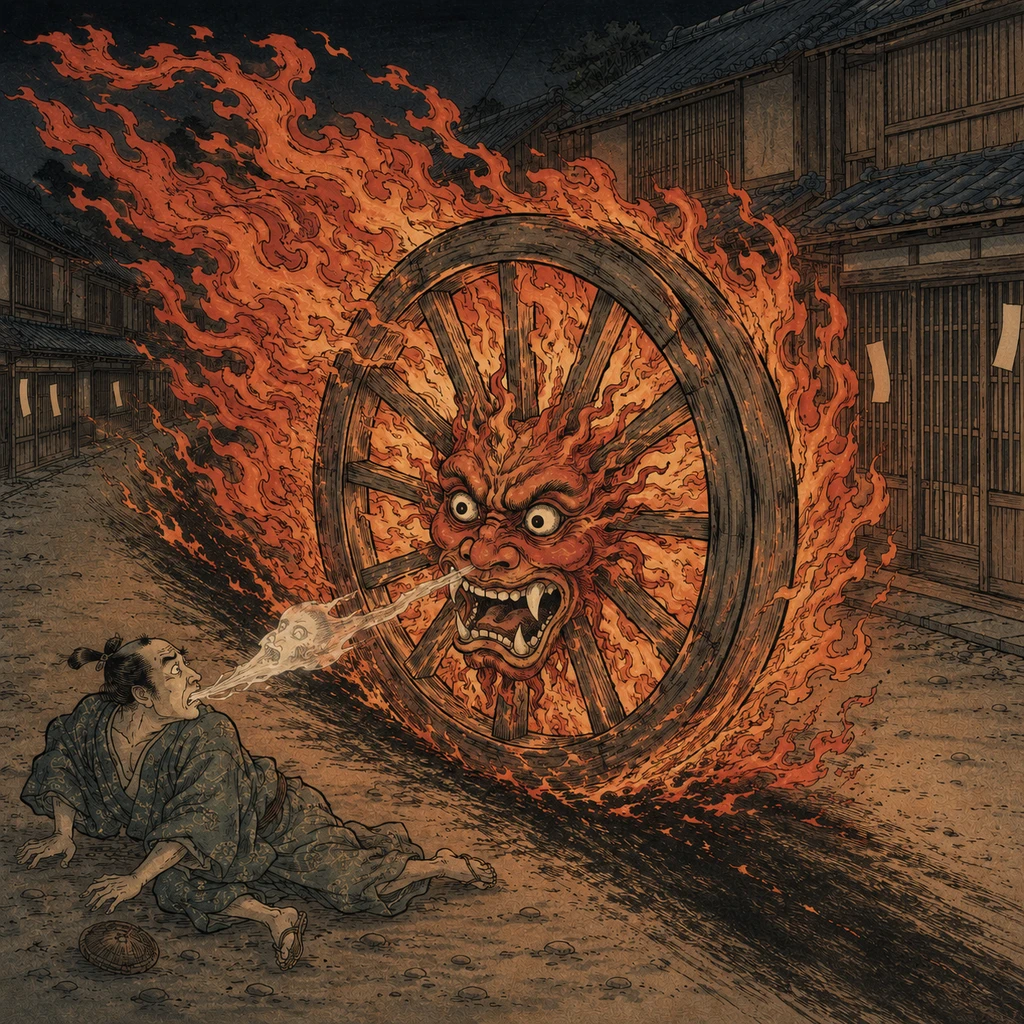
Wanyūdō

Wanyūdō

Epic

wah-nyoo-DOH

燃ゆる車輪の入道顔・輪入道

Household SpiritsKyoto

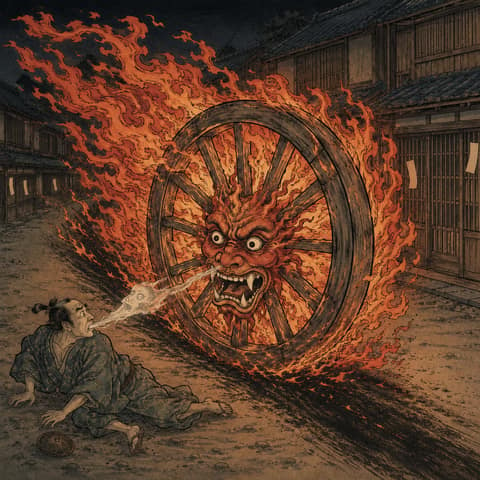
A yokai appearing as a flaming ox-cart wheel with the face of a giant monk-like ogre set in its hub. Said to steal the souls of onlookers. It can be warded off by posting a paper on the doorway reading “This is the village of Katsumo.” Illustrated by Toriyama Sekien in Konjaku Gazu Zoku Hyakki, it is a key example in the lineage of wheel-yokai tales and is often discussed alongside Katawaguruma, with a common origin widely proposed.

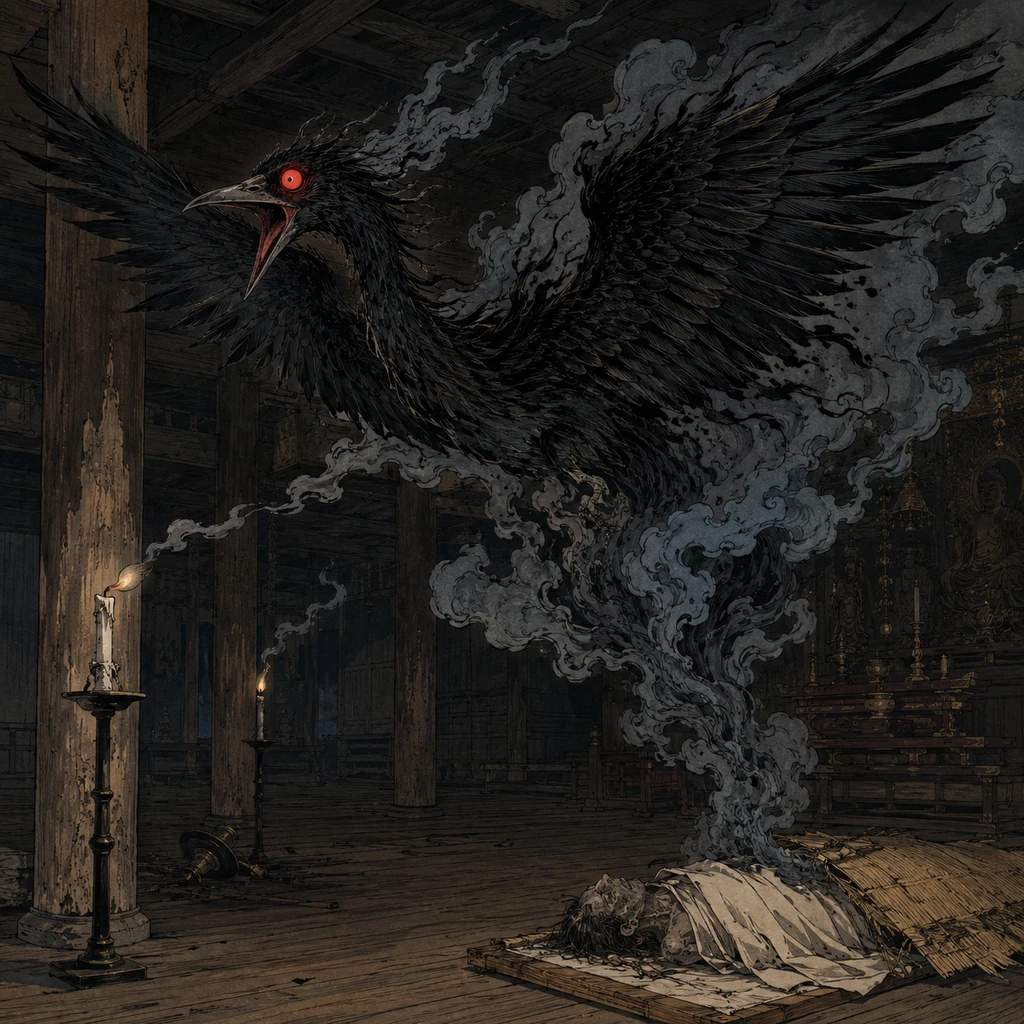
Onmoraki

Onmoraki

Rare

ohn-moh-RAH-kee

屍気より生ずる怪鳥・陰摩羅鬼

Animal ShapeshiftersJapan (tradition derived from Chinese sources)

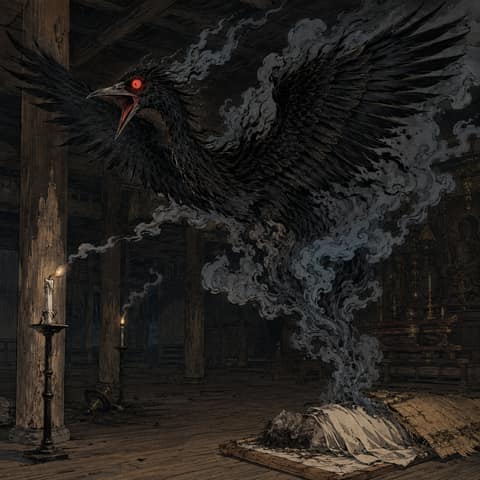
Onmoraki is a monstrous bird found in old Chinese texts, said to arise from the qi that rises off a fresh corpse. It is black like a crane, its eyes gleam like lamplight, and it trembles its feathers while crying in a piercing voice. In Japan it appears in Edo-period picture scrolls and tales, often manifesting before monks who neglect their chanting. It came to be understood as an apparition tied to the unsettled breath of the unoffered dead, a warning emblem against lax funeral rites and monastic negligence.

Funayūrei (Boat Ghosts)

Funayūrei (Boat Ghosts)

Epic

foo-nah-YOO-ray

いなだ貸せの船幽霊

Aquatic SpiritsYamaguchiFukushima

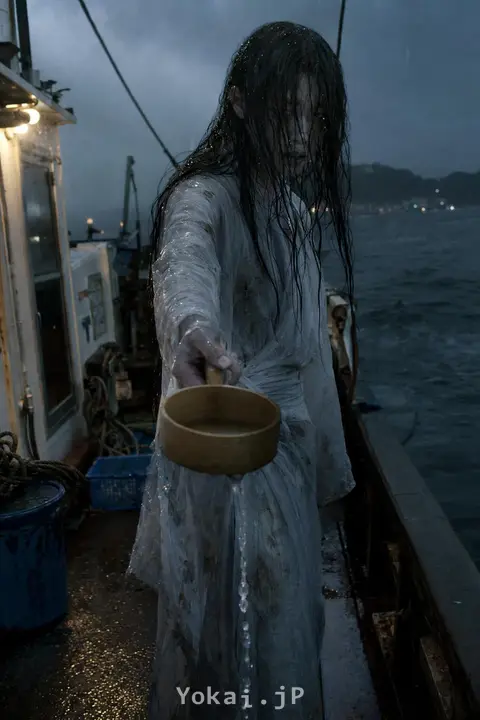
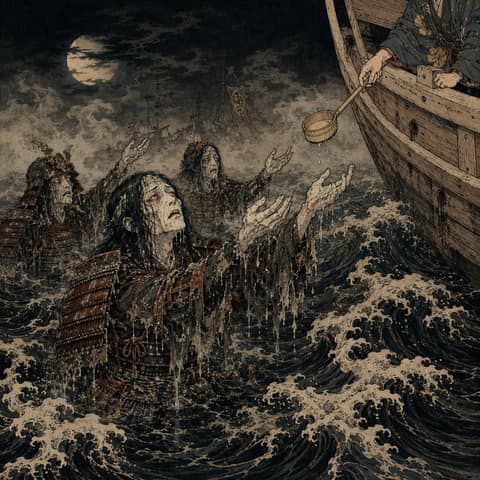
A maritime apparition said to be the spirits of those who died at sea. Accounts vary: they appear as ghostly boats, drowned phantoms, strange fires on the waves, or monk-like sea figures. They commonly emerge on stormy nights or in sea fog, trying to sink passing vessels by ladling seawater aboard, or by bewildering sailors into running aground. Regional countermeasures include handing over a bottomless ladle, throwing rice balls or ash, or fixing them with a stern glare. They are also called “ghost ships” or ayakashi in some traditions.

Gambari Nyūdō

Gambari Nyūdō

Uncommon

GAHN-bah-ree nyoo-DOH

厠の入道・加牟波理入道

Aquatic SpiritsVarious regions (Edo, Kinai, Sanyōdō, etc.)

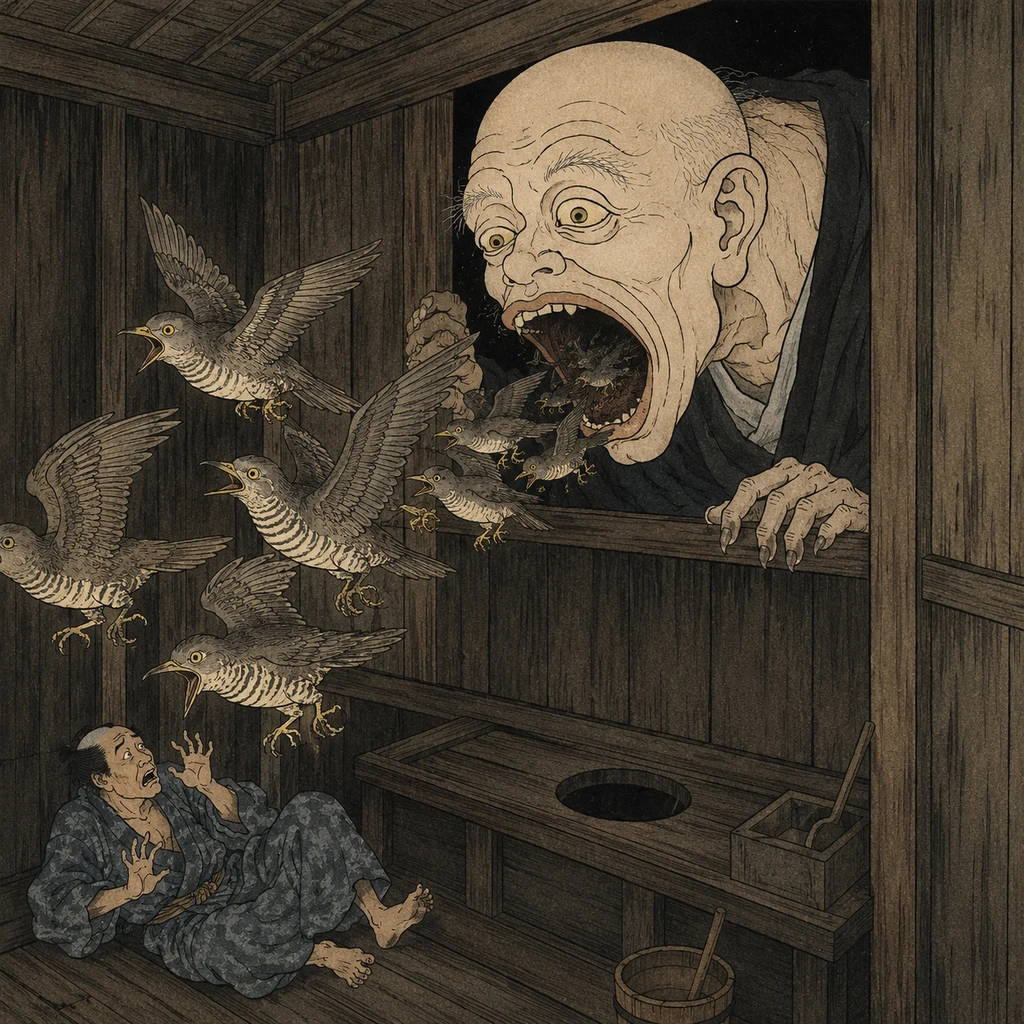
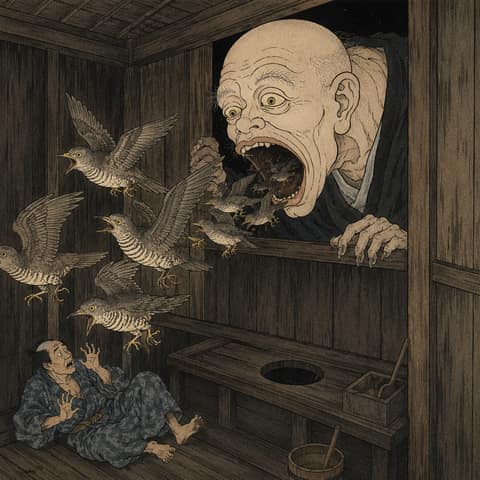
A monk-shaped yokai tied to toilet taboos. In Toriyama Sekien’s Konjaku Gazu Zoku Hyakki it is shown spewing a bird from its mouth, with the note that chanting “Gambari Nyūdō, hototogisu” on New Year’s Eve keeps it away. The belief links ominous cuckoo calls heard in the privy to the characters for kokkō (cuckoo) and the Chinese latrine deity Guo Deng. Local versions vary in name and behavior.

Rainfall Page-Boy

Rainfall Page-Boy

Uncommon

ah-meh-FOO-ree koh-ZOH

雨師に仕う侍童・雨降小僧

Household SpiritsEdo period

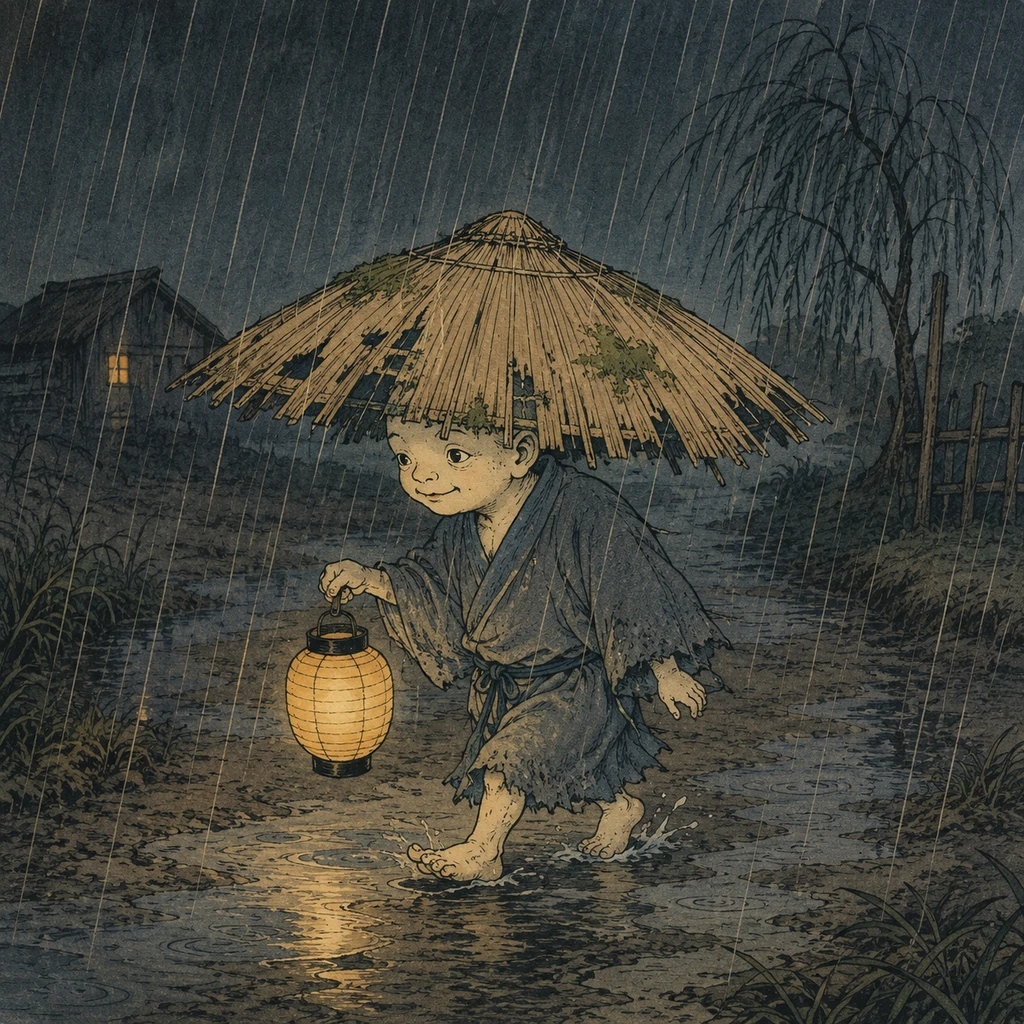
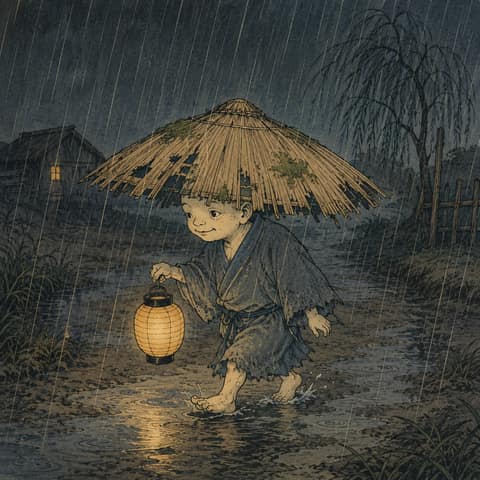
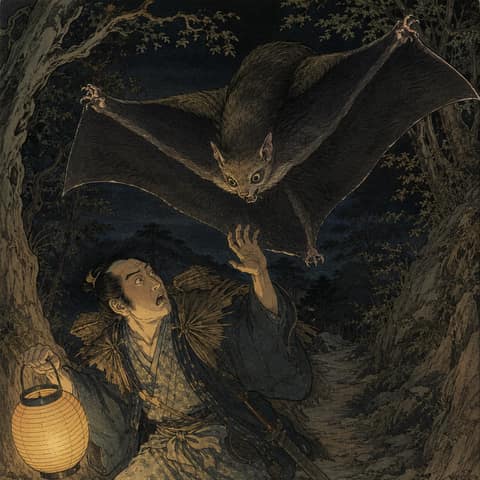
A page-boy–shaped yokai depicted in the Edo-period picture book Konjaku Gazu Zoku Hyakki. He’s shown wearing a Japanese paper umbrella with its main ribs removed over his head and holding a lantern. The notes liken him to a young attendant serving the rain deity (Ushi/Ame-no-shi), with a punning wordplay behind his name. He also appears in kibyōshi (yellow-backed comic books), often in a menial attendant role. He lacks strong ties to local folk traditions and is largely a literary-artistic invention.

Bone Woman

Bone Woman

Rare

HOH-neh-ON-nah

牡丹燈籠の白骨女・骨女

Half-Human BeingsEdo period (print tradition)

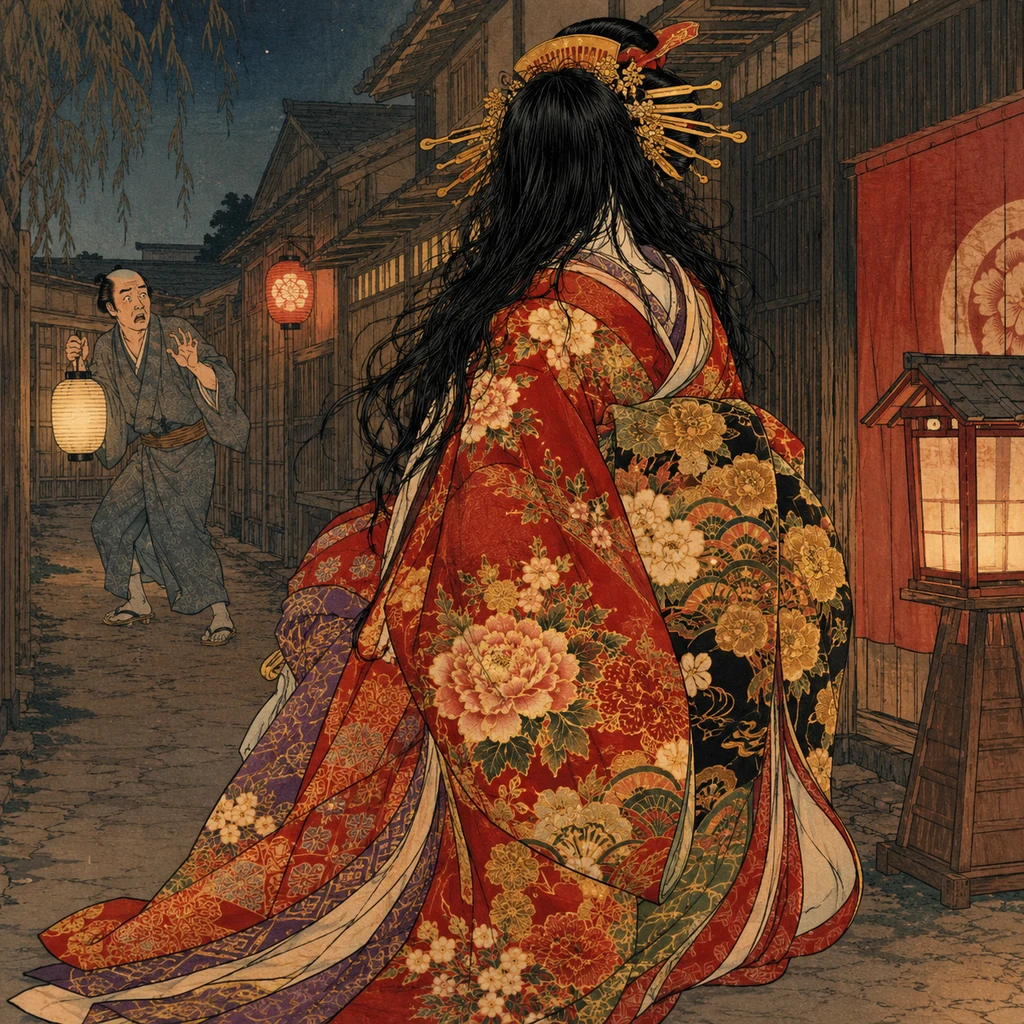
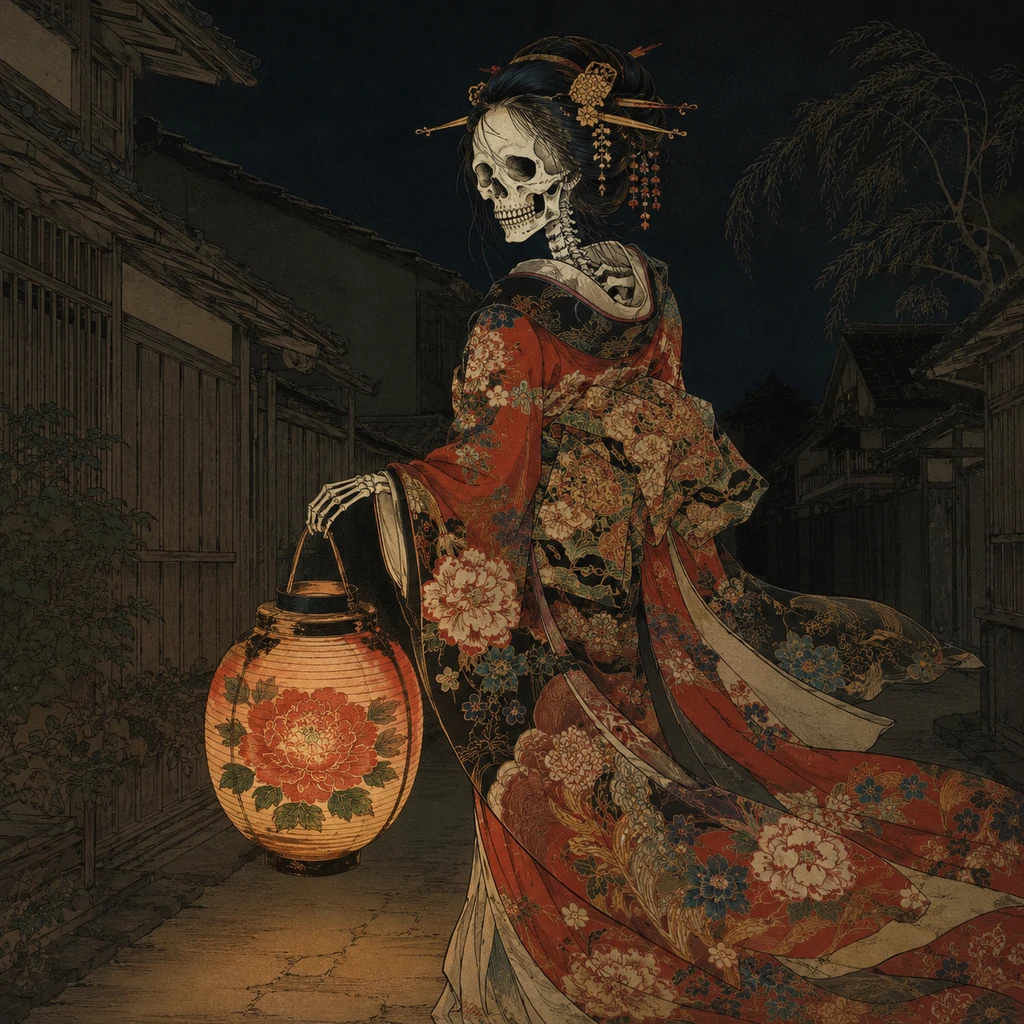
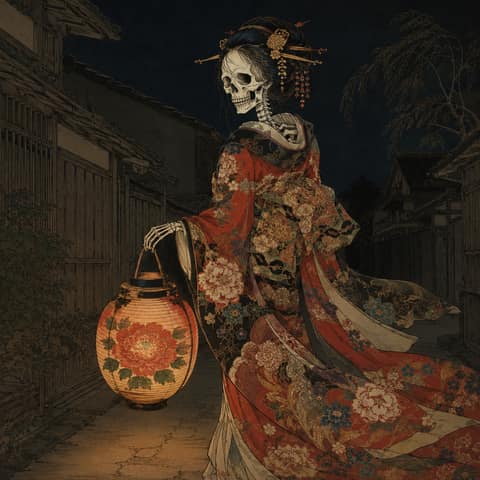
Bone Woman is a skeletal female yokai depicted by Toriyama Sekien in Konjaku Gazu Zoku Hyakki. In his notes, Sekien cites otogizōshi-style ghost tales in which a woman bearing a peony-patterned lantern visits her lover, drawing on the female specter from Asai Ryōi’s Otogibōko story “Botan Dōrō.” The image embodies a beauty who approaches a man but is in truth bare bones—a visualization of the uncanny where desire and death intersect.

Nue

Nue

Legendary

NOO-eh

源頼政の射落とした怪・鵺

Animal ShapeshifterKyotoOsaka

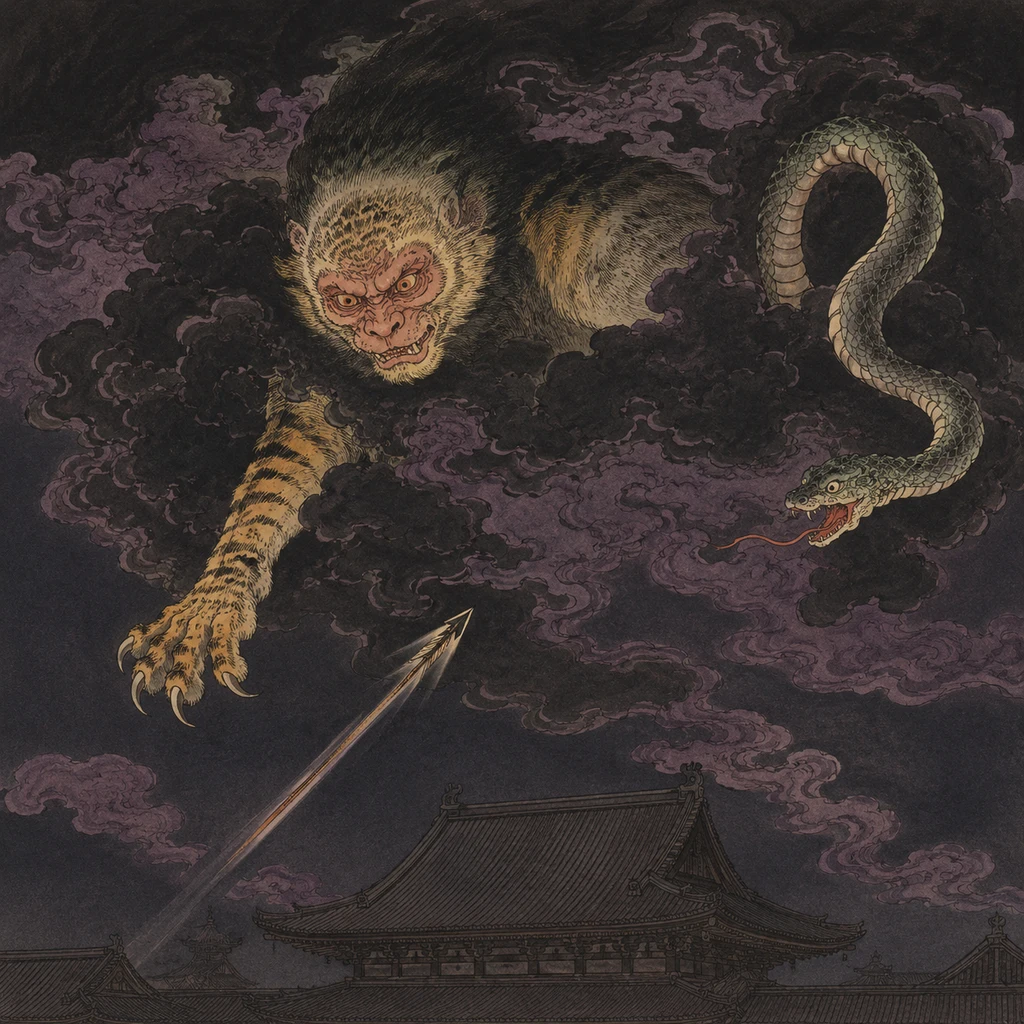
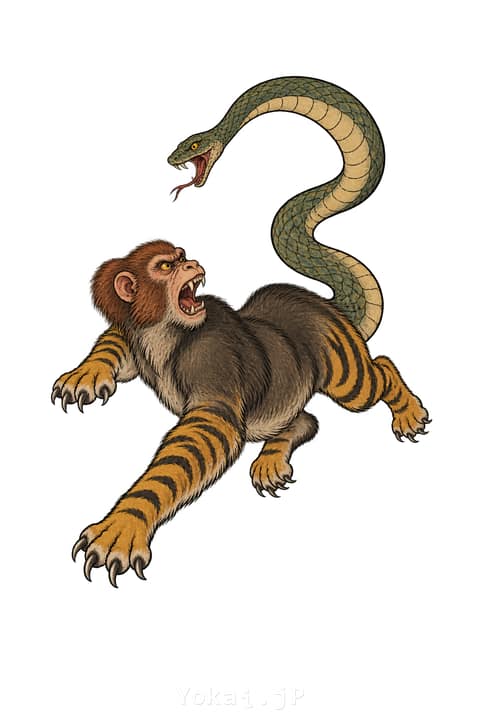
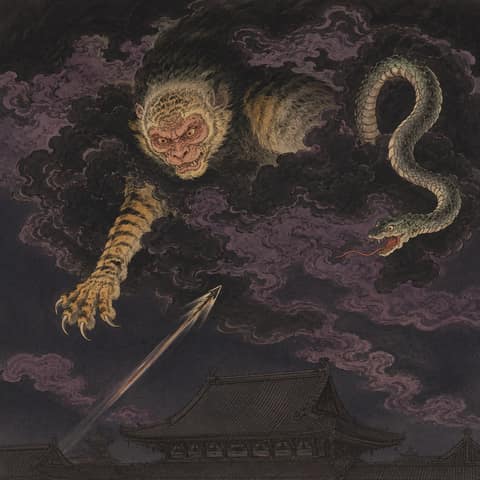
The Nue is one of the most representative yōkai in Japan, famously known as a chimeric aberration composed of a monkey's head, a tanuki's body, a tiger's limbs, and a snake's tail. Originally, "Nue" was the ancient name for a real bird (the White's thrush) that sings a mournful "hyo, hyo" in the night. During the Heian period, its cry was deeply abhorred and considered a "sinister omen." In the *Tale of the Heike*, the monster slain by Minamoto no Yorimasa was inherently a "nameless beast," merely described as "crying eerily like a nue." However, later generations mistakenly applied the name of the bird's cry to the monster itself, thus cementing its identity. It is an extremely unique and important entity in the history of Japanese yōkai, having morphed over the centuries from an invisible "auditory apparition" into a visual "chimera."

Itsumade

Itsumade

Epic

e-tsu-mah-deh

いつまでと鳴く死告・以津真天

Animal YokaiKyotoShiga

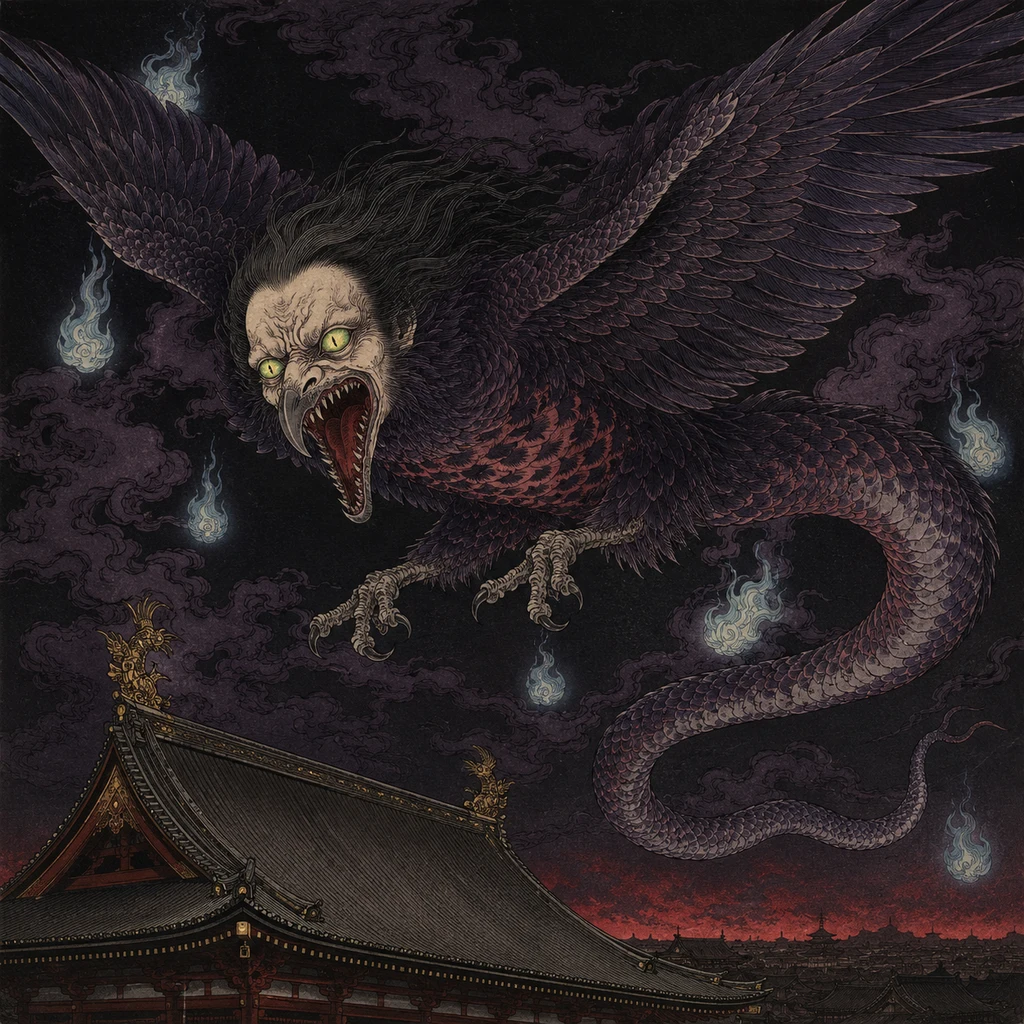
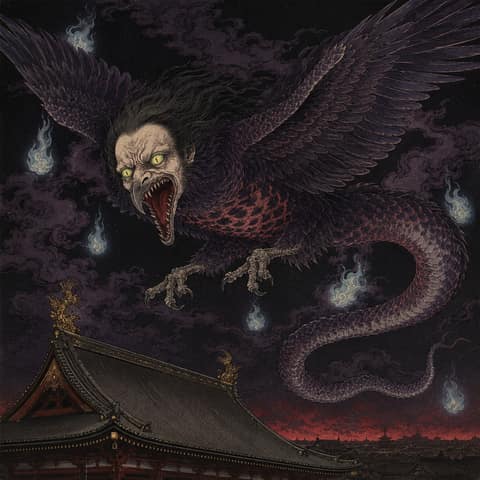
The Itsumade (以津真天) is a gigantic monster bird with a human-like face, a curved beak lined with saw-like teeth, a long serpentine body, and sharp sword-like spurs on its legs. Said to possess a wingspan of up to one *jō* six *shaku* (approximately 4.8 meters), it terrifies people by echoing its eerie cry of "Itsumade, itsumade" ("Until when? Until when?") from the night sky. The primary source of this yokai is an anecdote about an unnamed "monster bird" recorded in Volume 12, "The Matter of Hiroari Shooting the Monster Bird," of the pinnacle of war chronicles, the *Taiheiki* (established in the 14th century). According to the legend, in the autumn of the first year of the Kenmu era (1334), as an epidemic ravaged Heian-kyō (Kyoto) and claimed countless lives, this creature flew above the Shishinden (the Kyoto Imperial Palace) every night, letting out its ominous cry until it was brilliantly shot down by the master archer Oki no Jirōzaemon Hiroari. Crucially, in classical texts, this bird was consistently referred to only as a "monster bird" and lacked a specific proper name. It wasn't until the Edo period that the painter Toriyama Sekien included it in his *Konjaku Gazu Zoku Hyakki* (1779), applying the kanji "以津真天" (Itsumade) to its cry, that it crystallized as a distinct named yokai for the first time. In modern yokai encyclopedias, it is often explained that it "appears beside corpses left abandoned due to war or famine, crying out in protest, 'Until when (will you leave them exposed to the elements)?'" However, this direct connection to "corpses" is absent from medieval and early modern literature; it is a later interpretation added in modern times that logically reinterprets the *Taiheiki*'s backdrop of a rampant epidemic.

Jami (Evil Miasma Spirit)

Jami (Evil Miasma Spirit)

Rare

JAH-mee

山林に満つる魔・邪魅

Half-Human BeingsChina

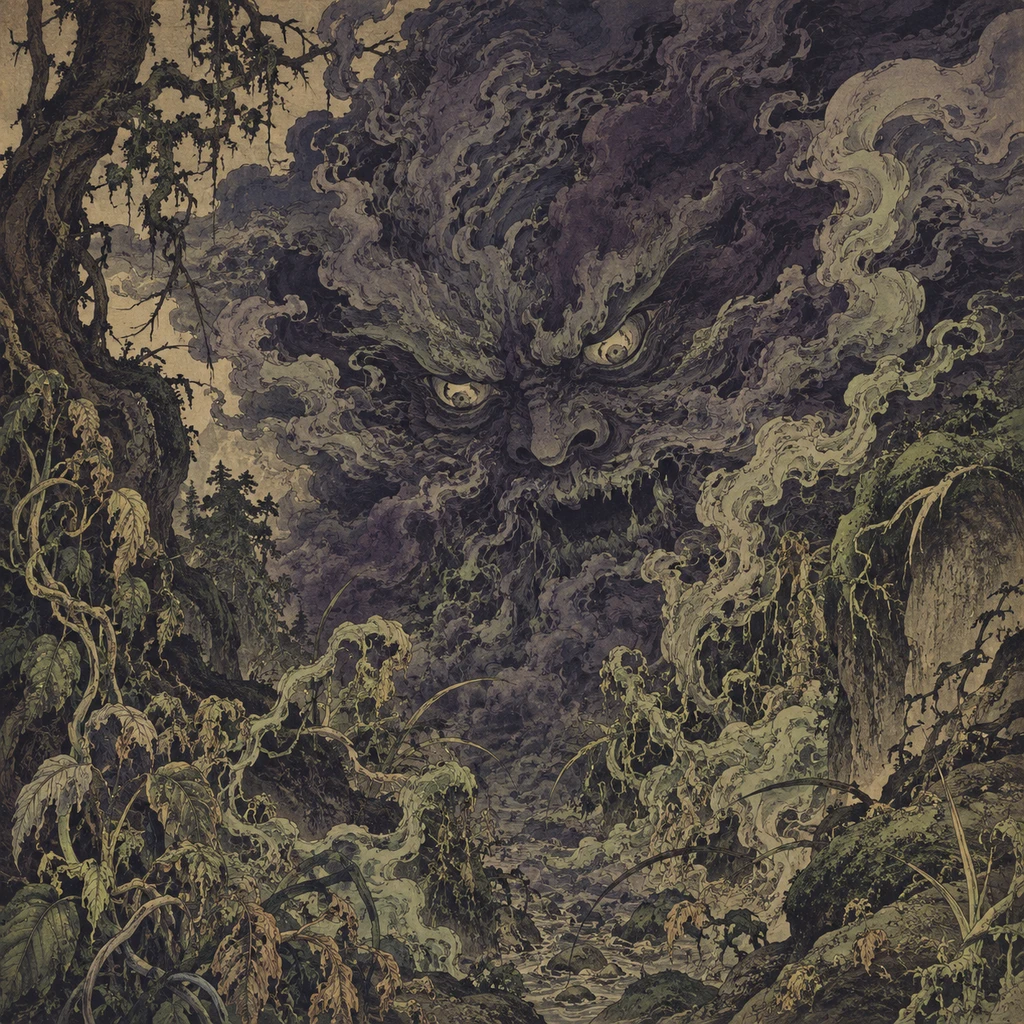
A yokai depicted by Toriyama Sekien in Konjaku Gazu Zoku Hyakki. His note states, “Jami belongs to the class of chimi,” presenting it as the malevolent vapors and wicked forces that pervade mountains and forests, or as a catch‑all for harmful demonic presences. Not a native Japanese creature, it visualizes an abstract malign entity found in Chinese writings. Its form is not fixed; it is linked to noxious airs and curses, bringing illness and delusion to humans.

Mōryō

Mōryō

Epic

MOH-ryoh

水と屍に潜む怪・魍魎

Aquatic SpiritsUncertain (concept from ancient China, adopted in Japan)

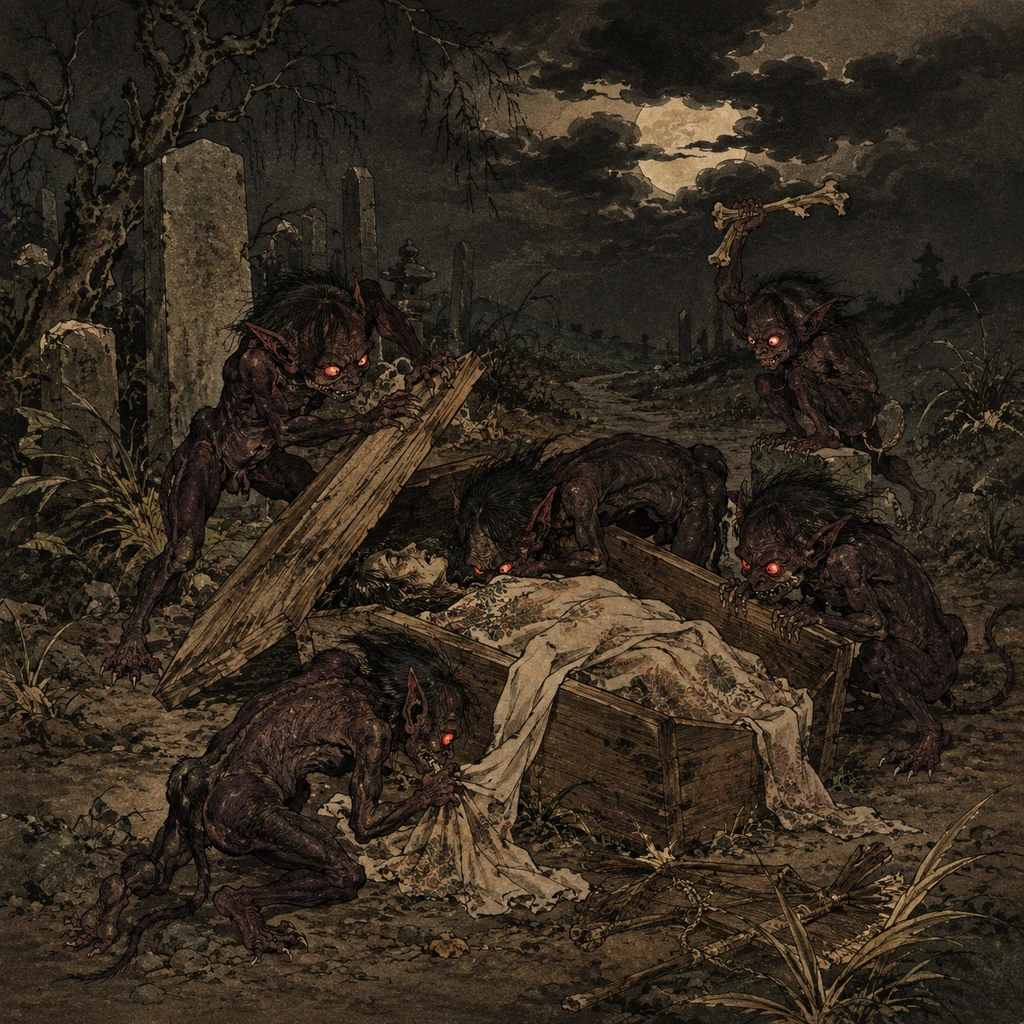
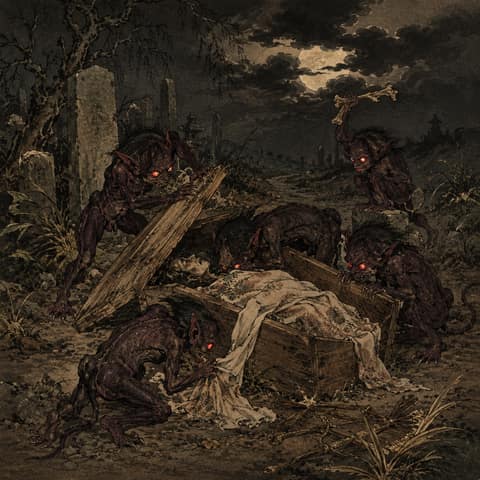
Mōryō is a collective term for malevolent beings that dwell in mountains, rivers, plants, stones, and graveyards, often linked to water-born spirits. In Chinese classics it appears as wangliang or wuxiang, sometimes described as childlike figures with red-black skin, red eyes, and long ears. In Japan it was read as the water deity “mizuha” and later paired with chīmi (chimi) as a set. Mōryō are said to crave the livers of the dead and are associated with funerary disturbances and corpse-snatching apparitions.

Mujina

Mujina

Epic

MOO-jee-nah

夜道で人を惑わす・ムジナ

General ClassificationsFukushimaChiba

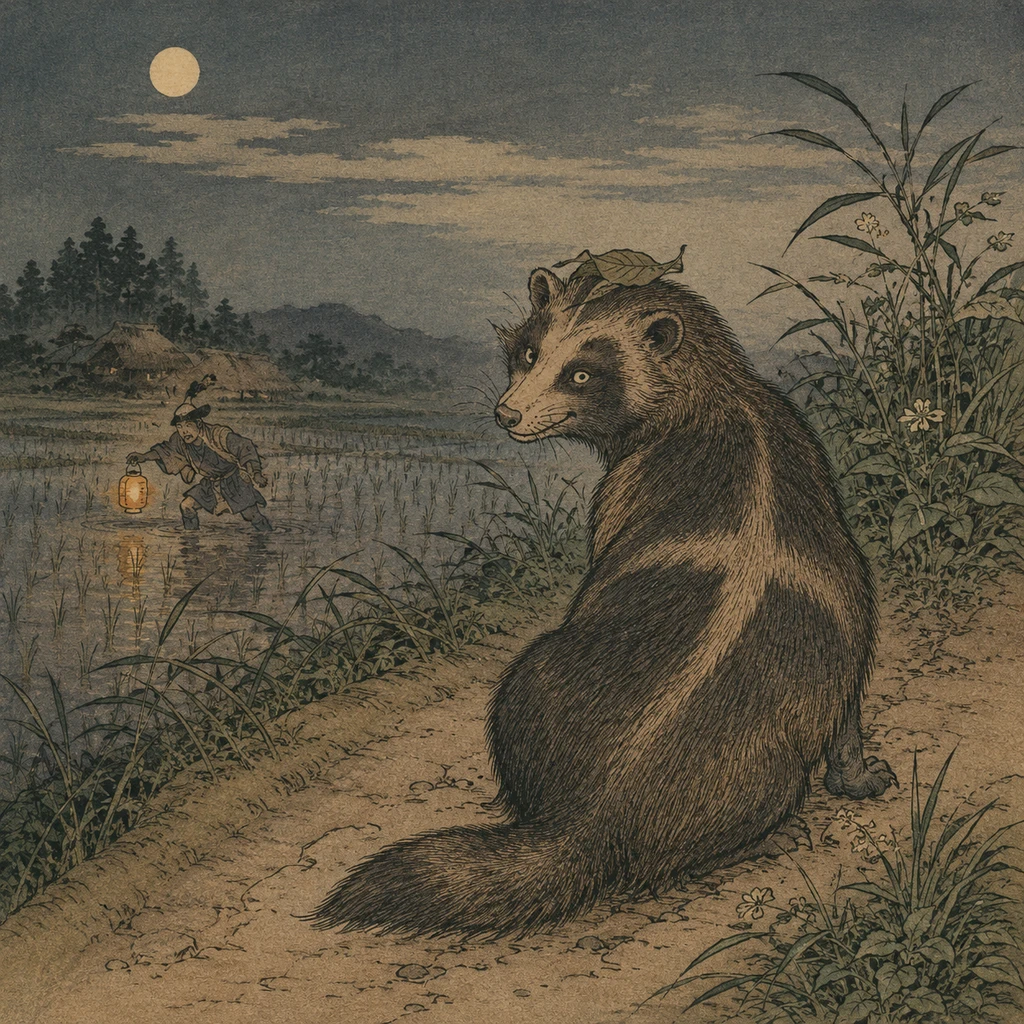
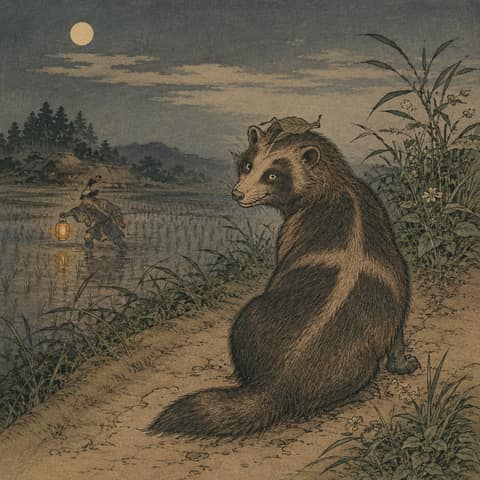
Mujina primarily refers to the Asian badger, though depending on region and era it can be conflated with raccoon dogs (tanuki) or masked palm civets. Since antiquity it’s told as a trickster beast that beguiles travelers at night—making roads or rivers seem different, and altering the appearance of food or places. The Nihon Shoki records a mujina taking human form and singing, and from the Edo period onward it stands beside foxes and tanuki as a leading shapeshifter in art and tales. Scholarly identification varies by region.

Tsuchigumo (Earth Spider)

Tsuchigumo (Earth Spider)

Legendary

TSOO-chee-GOO-moh

葛城山年経の蜘蛛・土蜘蛛

General ClassificationsNaraKyoto

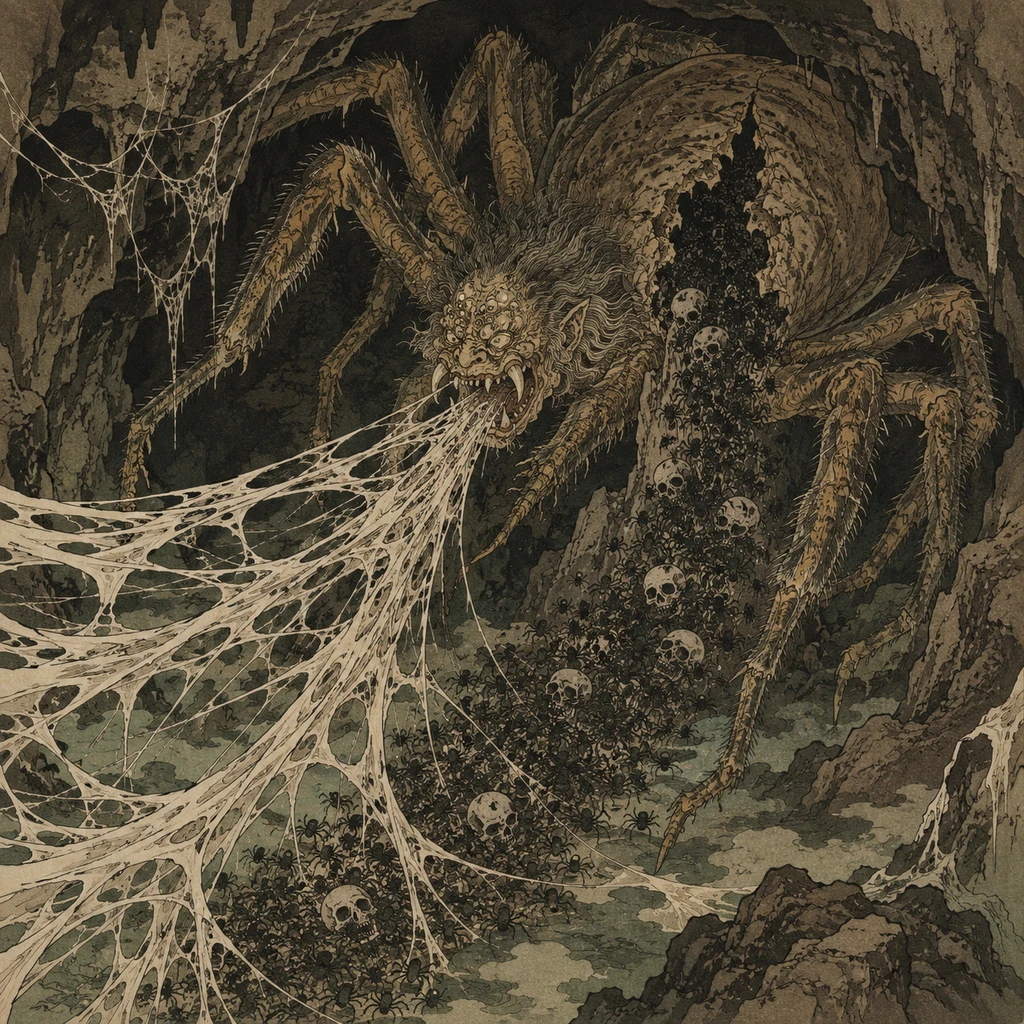
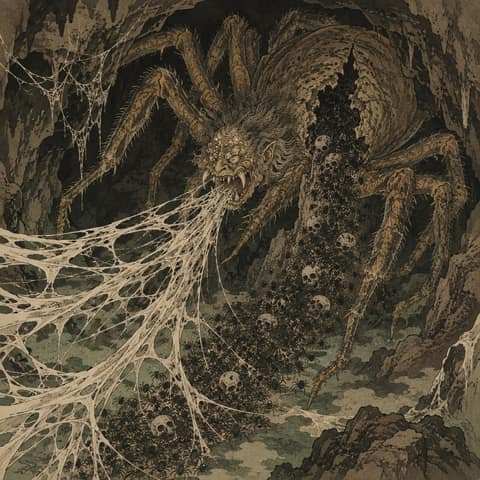
In ancient records, tsuchigumo was a derogatory label for local powers who defied the imperial court—groups who hid in mountains and caves and resisted rule. Their name appears in the Nihon Shoki and various provincial Fudoki. From the medieval period, Noh drama and picture scrolls reimagined them as giant spider yokai, best known in tales where Minamoto no Yorimitsu (Raikō) slays the monster. Despite the image, they are not related to spiders in a biological sense.

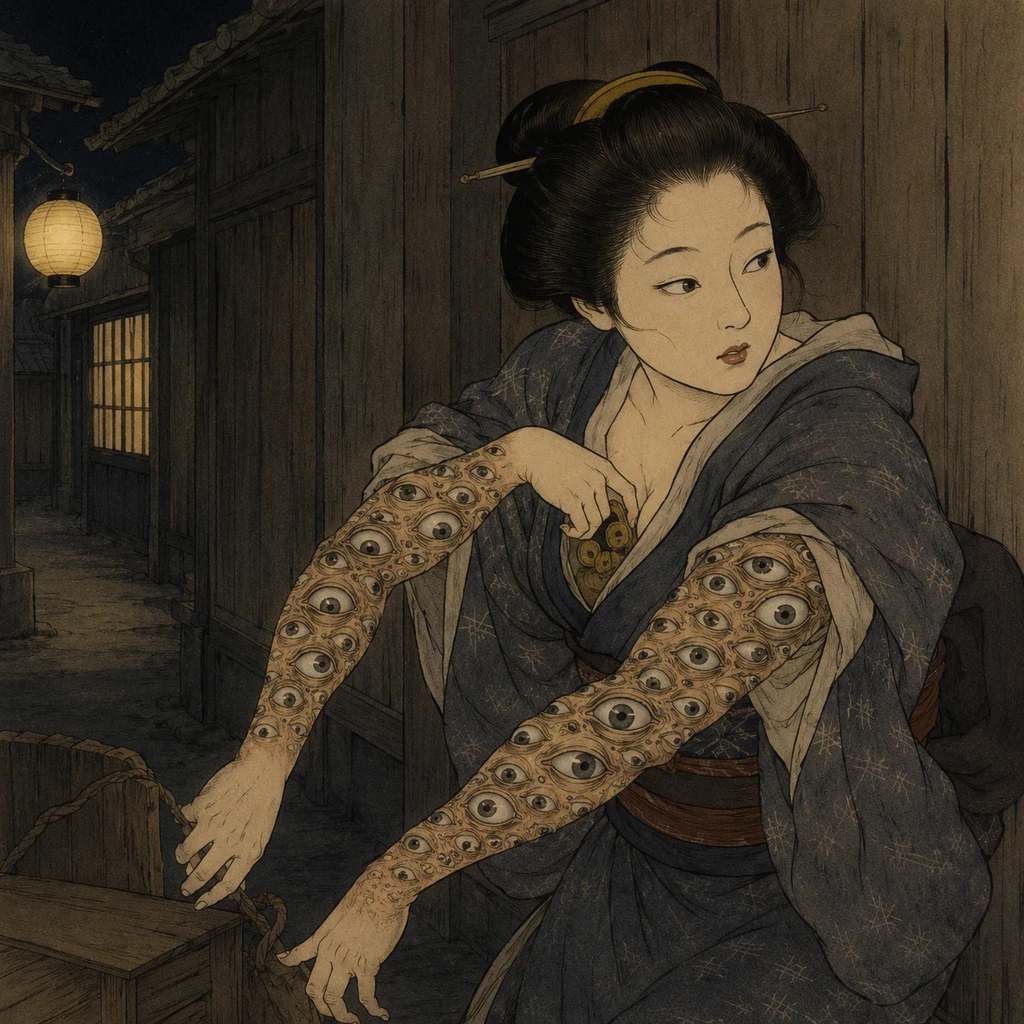
Dodomeki

Dodomeki

Epic

DOH-doh-MEH-kee

銭目の百々目鬼

Half-Human BeingsTokyoTochigi

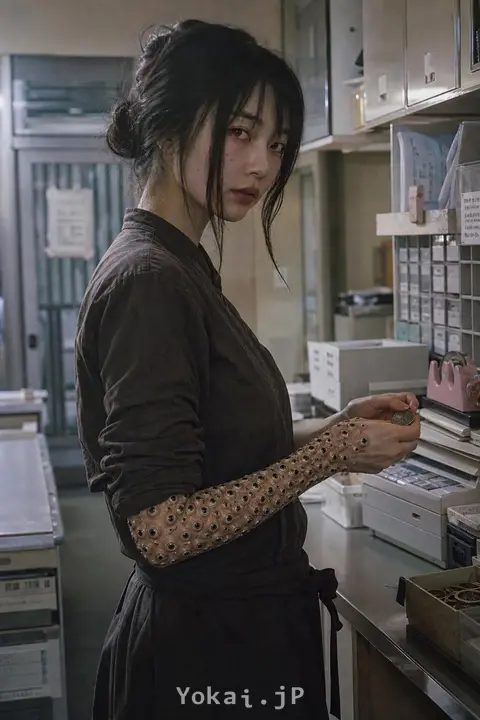
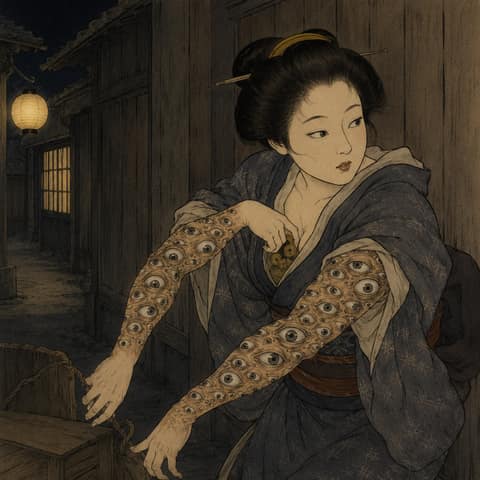
A female yokai illustrated by Toriyama Sekien in Konjaku Gazu Zoku Hyakki, depicted with countless eyes embedded along her arms. She is said to have been a woman with a habit of stealing coins; because she constantly pilfered holed copper cash (torime), the spirits of those coins manifested as eyes on her limbs. Sekien cites a source titled Kankangai-shi, but that work is unverified and likely a playful pseudobibliographic joke. The name Dodomeki may be a wordplay tied to old nicknames for copper coins and to place-name spellings.

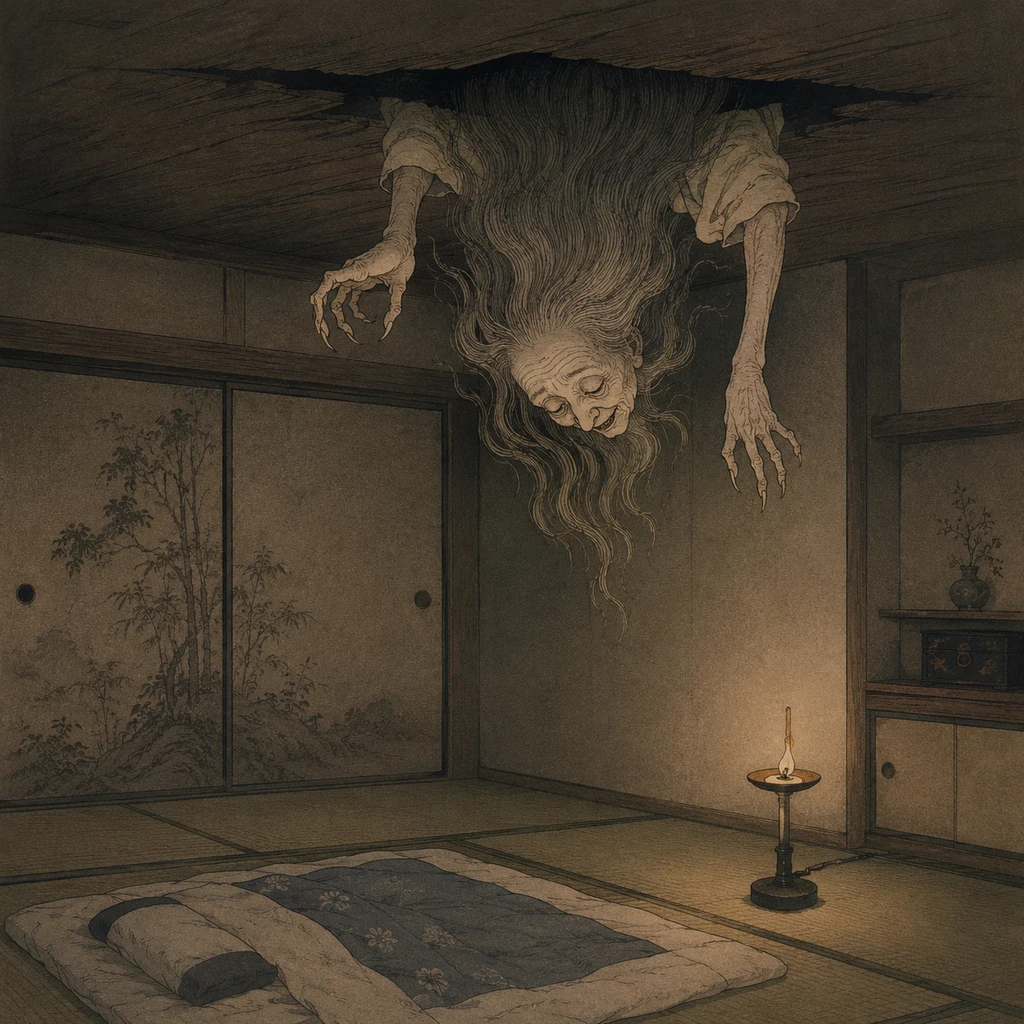
Ceiling-Dropper

Ceiling-Dropper

Rare

TEN-joh-KOO-dah-ree

天井より逆さの老女・天井下り

Household SpiritsEdo period

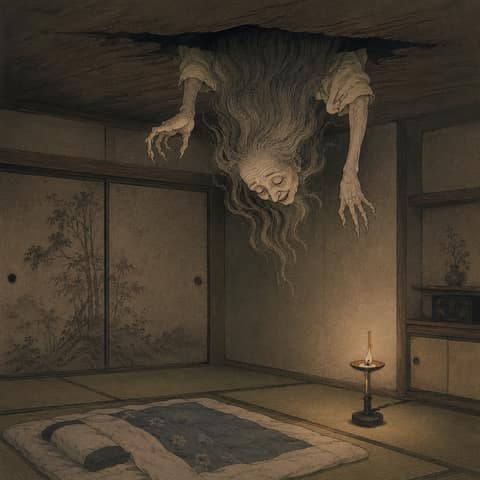
A house-dwelling yokai depicted by Toriyama Sekien in Konjaku Gazu Zoku Hyakki: an ugly old woman with disheveled hair hanging upside down from the ceiling. She appears late at night, startling people but generally causing no direct harm. Some see her as a liminal being moving through the boundary of the ceiling; others view her as Sekien’s wordplay, riffing on the period phrase “to show the ceiling.”

Great Tonsure

Great Tonsure

Rare

OH-kah-BOO-roh

菊文振袖の童形・大禿

General ClassificationsEdo period

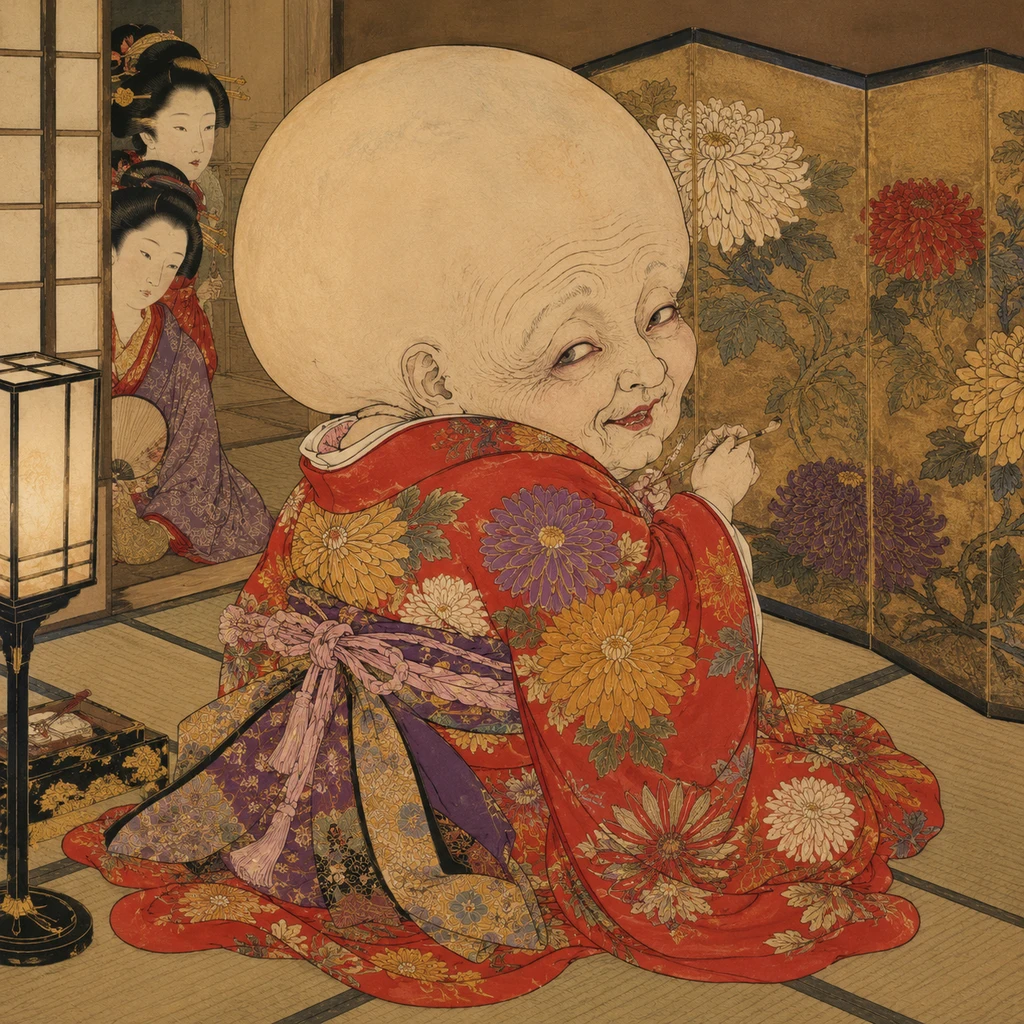
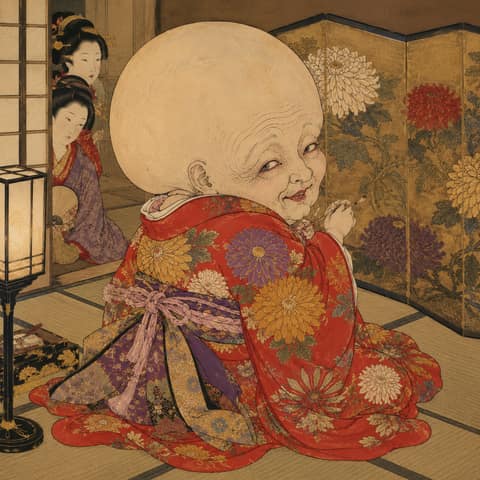
The Great Tonsure is a yokai known only from Toriyama Sekien’s Illustrated One Hundred Demons from the Present and the Past, Continued. It is depicted as taller than a folding screen, wearing a chrysanthemum-patterned long-sleeved kimono, and sporting a smooth, bald head. The caption juxtaposes the youthful longevity of the “Chrysanthemum Boy” with the wizened look of old age, functioning as an allegory that satirizes both the courtesans’ child attendants (kamuro) in the pleasure quarters and elderly monks in mountain temples. It lacks its own folklore episodes and circulated mainly as a pictorial theme and metaphor.

Kinrei (and Kintama)

Kinrei (and Kintama)

Epic

kee-NREH

善行の家に来る・金霊

Ghosts & SpiritsAcross Japan (noted in Edo, the Kanto region, and Suruga)

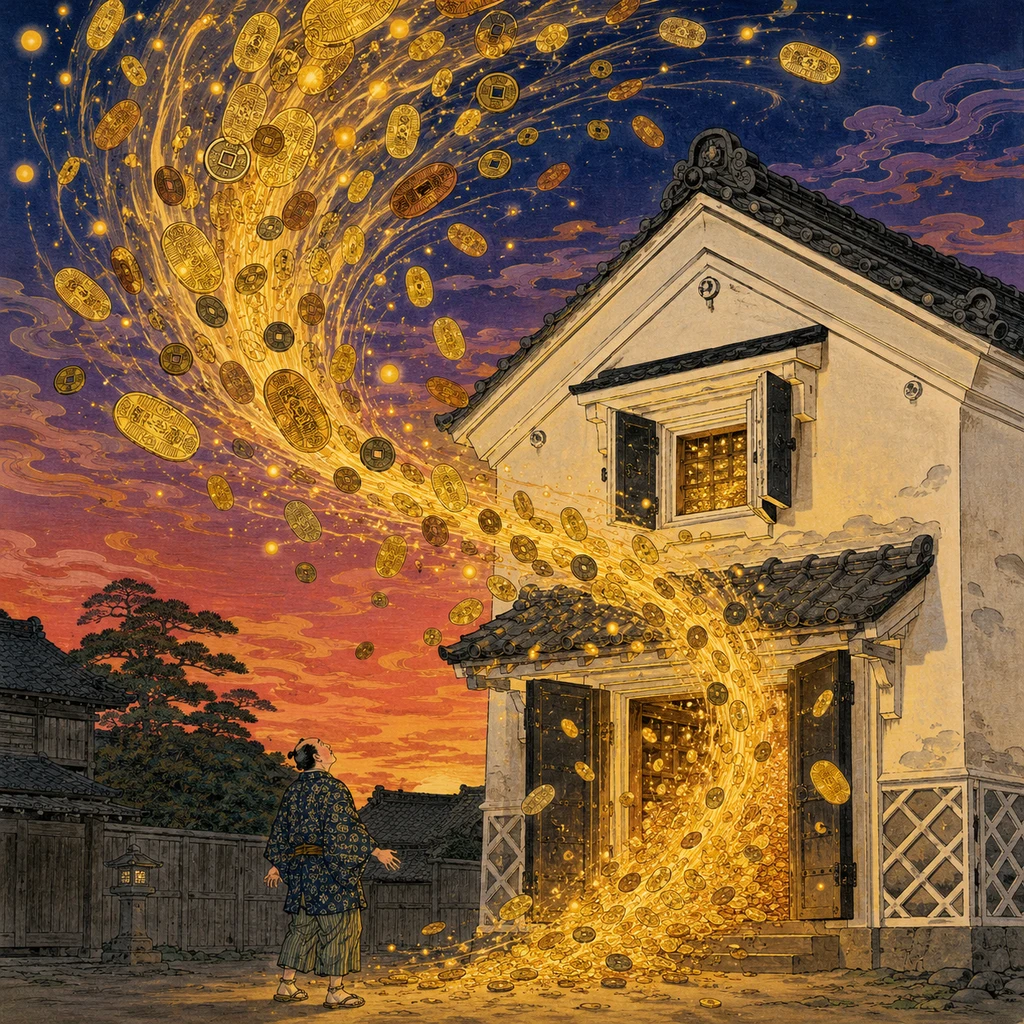
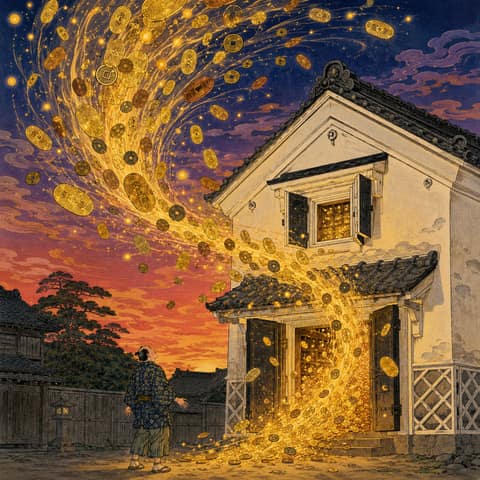
Kinrei is the embodiment of the essence of gold, or a spirit symbolizing fortune and virtue, believed to appear as a sign to households that practice good deeds. Edo-period picture scrolls depict it as storehouses brimming with gold and silver—more an allegory of auspicious news than a tangible monster. Kintama, by contrast, is said to arrive as a glowing sphere or strange fire; welcoming it brings prosperity, but harming it invites decline. The two are sometimes conflated, though their characterizations differ slightly.

Amano-zako (Heaven-Contrary Deity)

Amano-zako (Heaven-Contrary Deity)

Epic

ah-mah-noh-ZAH-koh

素戔嗚の猛気・天逆毎

Deities & Divine SpiritsUncertain (descriptions chiefly in Edo-period encyclopedias)

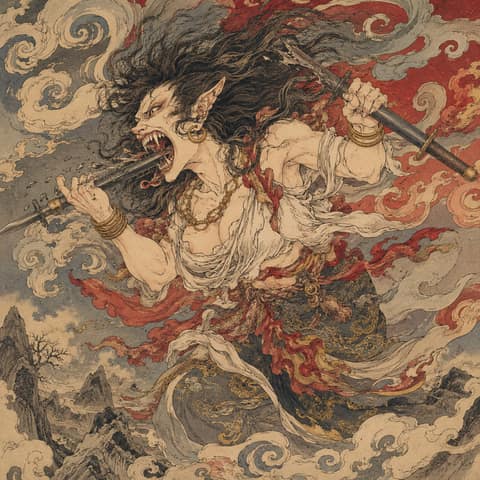
Amano-zako is a monstrous deity cited in an unspecified source quoted by the Edo natural history compendium Wakan Sansai Zue. Said to have taken shape from the fierce breath that Susanoo expelled from his body. Humanoid with beast-like traits, it has a high nose, long ears, and fangs. Its temper is violent; when defied, it rages and can hurl even mighty gods far away. It habitually contradicts things, linking it to the amanojaku, the contrary imp of Japanese lore.

Great Head

Great Head

Epic

OH-oh-KOO-bee

雨夜空に漂うお歯黒・大首

Ghosts & SpiritsVarious provinces (attested in Edo, Kaga, Nagato, and elsewhere)

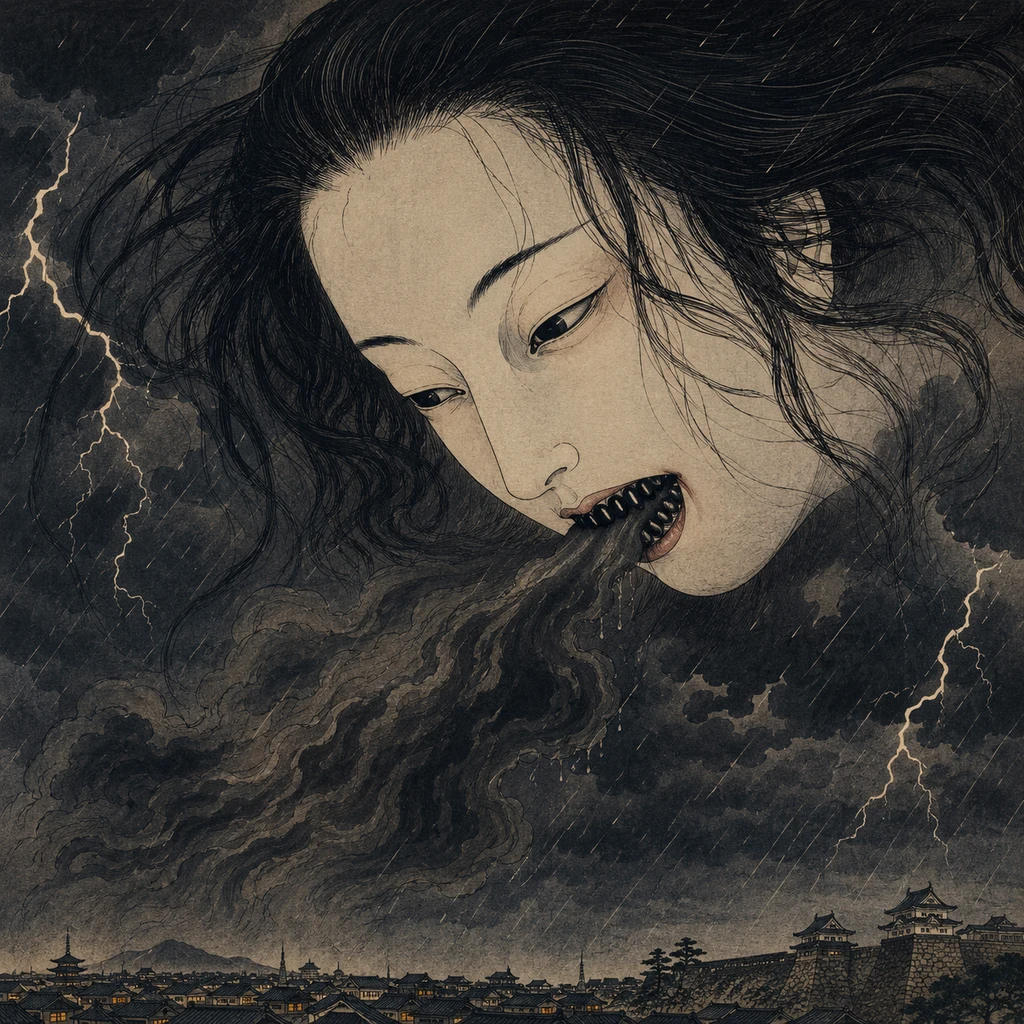
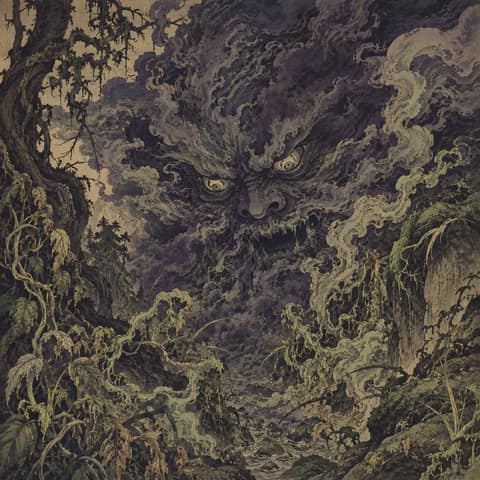
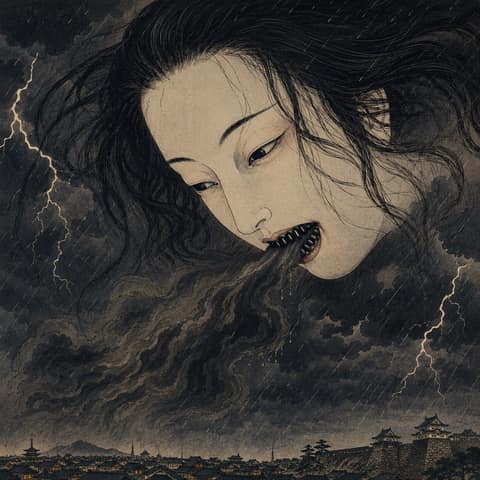
A bizarre apparition in which an enormous woman’s head appears in the sky or at a house’s doorway. It is often shown with ohaguro—blackened teeth—suggesting a married woman. Toriyama Sekien included an image in his mid-Edo Konjaku Gazu Zoku Hyakki, where the head drifts in a rainy night sky. While Sekien’s rendering is considered satirical, anecdotes and essays from many regions report encounters with giant female heads, interpreted as vengeful spirits, lingering grudges, or foxes and badgers in disguise.

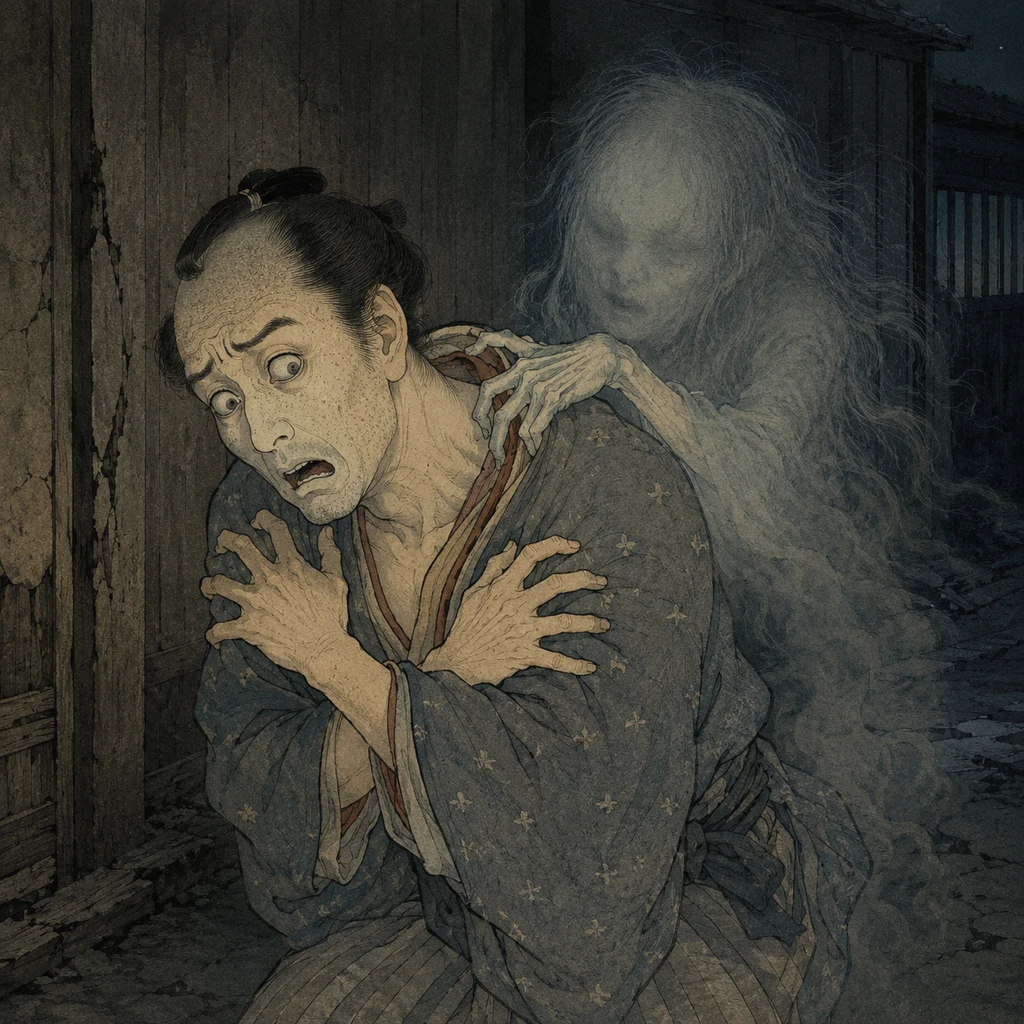
Shibiru-biru (Buru-buru) – The Quiver Spirit

Shibiru-biru (Buru-buru) – The Quiver Spirit

Uncommon

boo-roo-BOO-roo

襟元を凍らす震々

Ghosts & SpiritsJapanese folklore

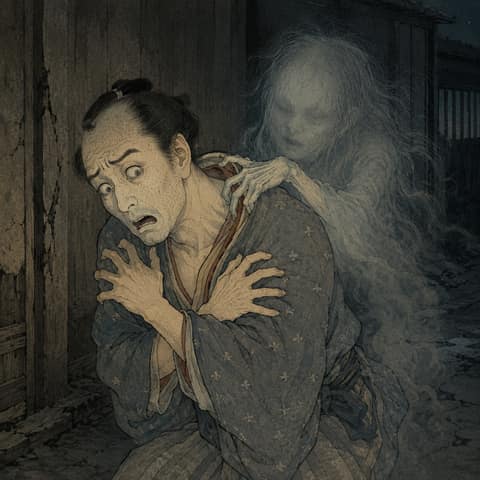
Shibiru-biru, commonly called Buru-buru, is a yokai personifying the omen of fear, depicted by Toriyama Sekien in Konjaku Gazu Zoku Hyakki. When a chill creeps in at the collar and gooseflesh prickles the nape at a sudden fright, it is said this spirit has attached itself. Also known as the Coward God (okubyō-gami) or Zozogami, it symbolizes how fear manifests as bodily sensation. Its form and provenance are undefined, resembling a deified concept of dread.

Momonji (the Hundred-Old Man)

Momonji (the Hundred-Old Man)

Rare

MOH-mohn-jee

原野の病もたらす老爺・百々爺

Mountain & Wilderness SpiritsUncertain; depicted in Edo-period picture scrolls

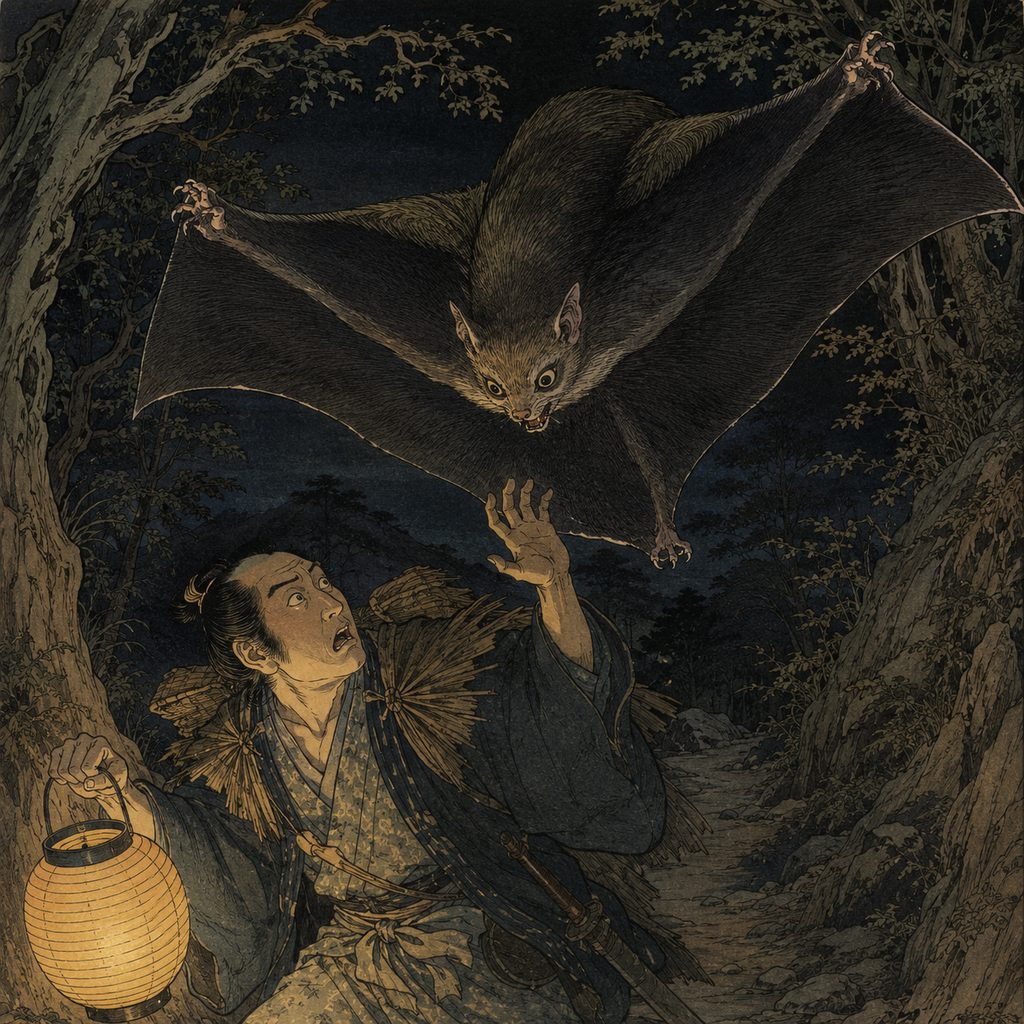
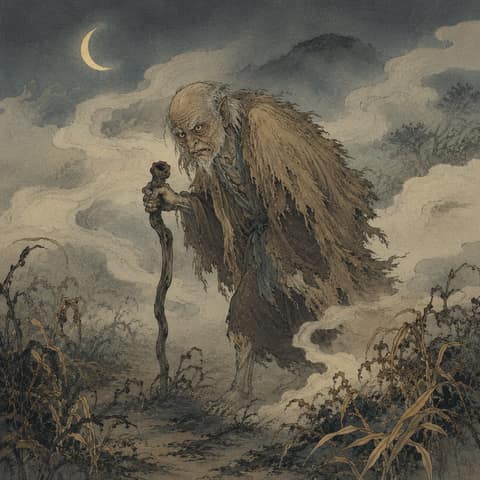
A yokai depicted in Toriyama Sekien’s Konjaku Gazu Zoku Hyakki as an old man with a cane who appears out on the wild plain. Sekien left its true nature “unknown,” but noted it assumes the form of an elderly man in the open fields, approaches travelers, and those who encounter it fall ill. The name likely blends baby-talk terms like “momon-ga” and “gagoji,” and has been discussed in relation to momonji—words for flying squirrels or for wild game/meat. Its abilities and origins remain unclear in folklore.

Grave Fire

Grave Fire

Rare

HAH-kah-noh HEE

五輪塔の燐火・墓の火

Natural Phenomena SpiritsGraveyards across Japan, notably Kyoto Prefecture

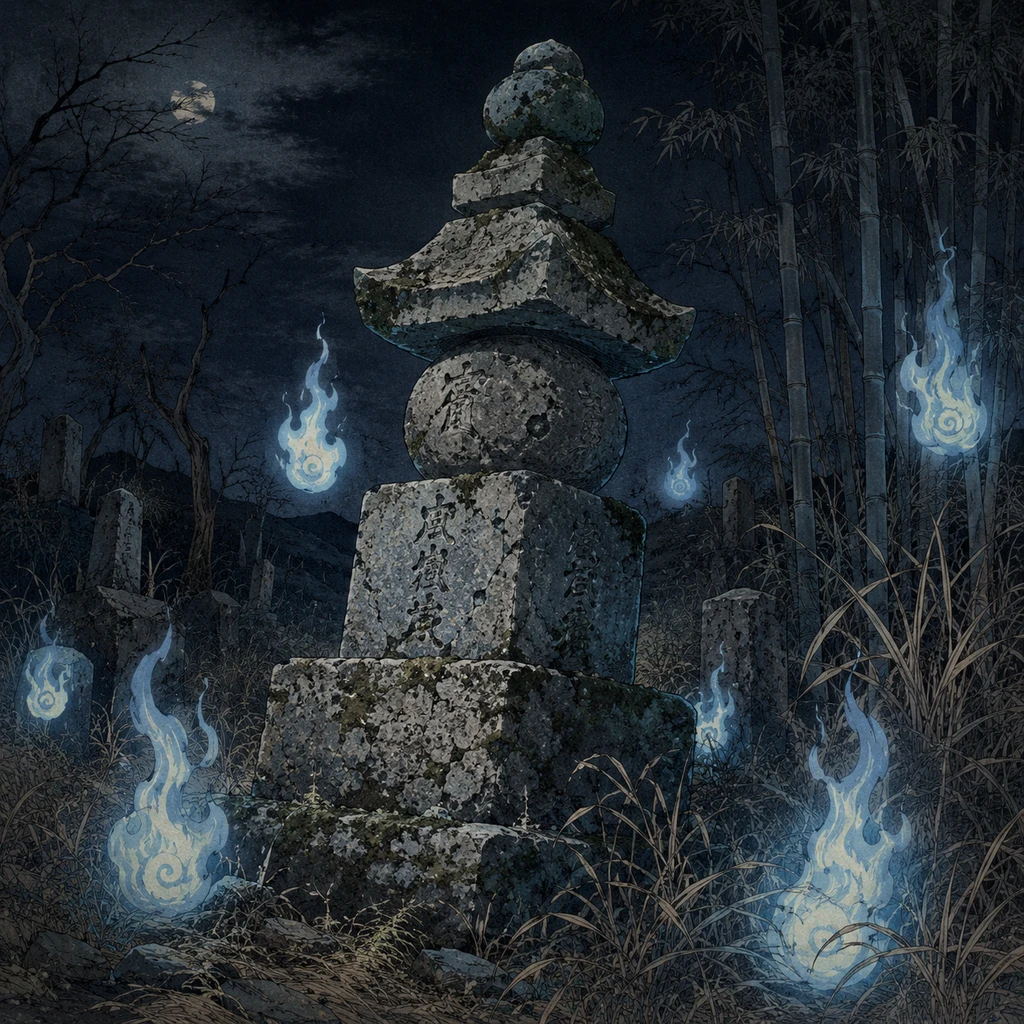
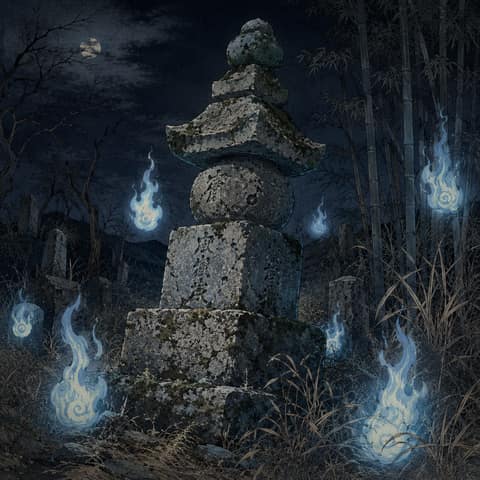
Grave Fire is a type of ghostly flame that appears around cemeteries and old gorintō (five-ring pagoda gravestones). In Toriyama Sekien’s Konjaku Gazu Zoku Hyakki, flames blaze from a timeworn gorintō with damaged Sanskrit seed syllables amid an overgrown burial ground. Some interpret the missing syllables as leaving worldly desires unsevered, which flare up as fire. Early modern ghost tales describe it as a phosphorescent flame arising from blood or fat seeping from corpses or graves, drifting and wavering at night.

Chōchin-bi (Lantern Fire)

Chōchin-bi (Lantern Fire)

Uncommon

CHOH-cheen-bee

田畦に浮かぶ怪火・提灯火

Natural Phenomena SpiritsAcross Japan (notably Shikoku, Yamato, and Ōmi traditions)

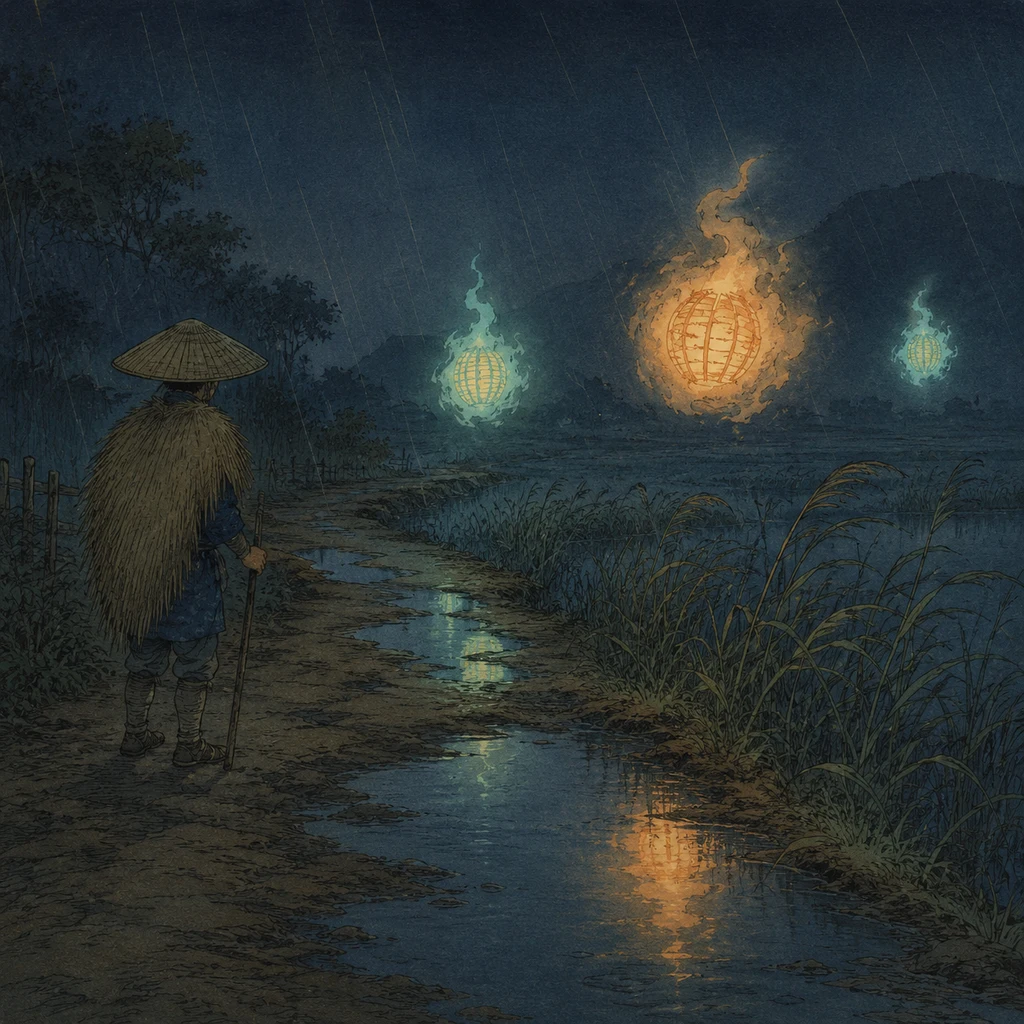
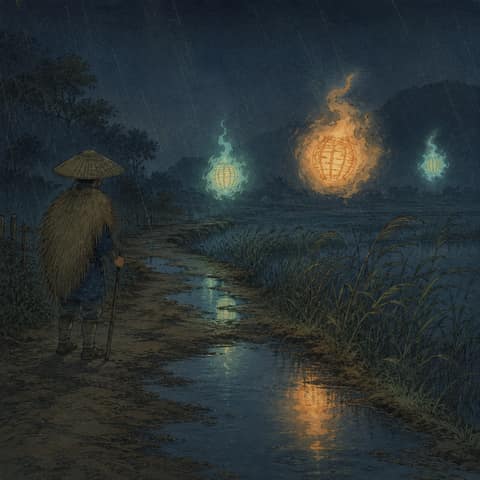
A type of onibi (will-o’-the-wisp) seen near rice field ridges, river embankments, and graveyards. A lantern-sized flame drifts about a meter above the ground and vanishes when approached. In Shikoku it’s often blamed on foxes or tanuki, with names and traits varying by region. Sometimes it appears in strings along night roads and is linked to ominous signs like sudden deaths or fevers, yet its true nature remains unknown.

Hitodama (Human Soul Fire)

Hitodama (Human Soul Fire)

Epic

hee-toh-DAH-mah

夜空に漂う魂火・人魂

Ghosts & SpiritsVarious regions across Japan

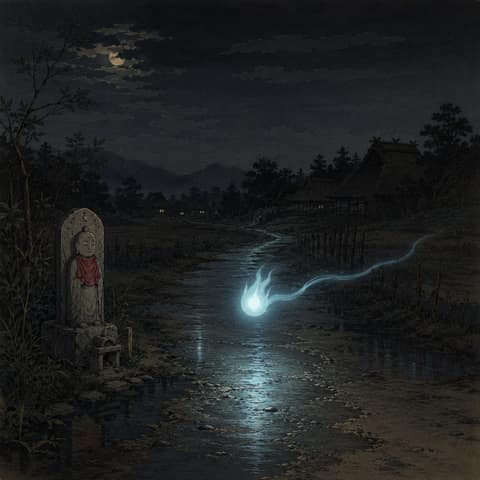
Hitodama are small, floating balls of light seen at night, long interpreted as souls that have left the human body. Reports describe bluish-white, orange, or red hues, often trailing a tail and drifting low to the ground. While often confused with onibi or kitsunebi, hitodama specifically denote the luminous manifestation of a human soul and are linked to death and liminal moments. They appear frequently in classical literature, early modern essays, and regional lore, with sightings continuing into modern times.

Hiyori-bō (Fair-Weather Monk)

Hiyori-bō (Fair-Weather Monk)

Rare

hee-YOH-ree-boh

常陸晴天司る・日和坊

Weather & Calamity SpiritsIbaraki

A yokai depicted by Toriyama Sekien in Konjaku Gazu Zoku Hyakki, said to preside over clear weather. It appears on sunny days and not in the rain. Beyond Sekien’s notes, verified folk reports are scarce and oral traditions remain uncertain. Scholars have linked it to teru-teru bōzu, but no definitive source confirms this origin. Its name is discussed in relation to regional weather-prayer terms like “hiyori-bōzu.”

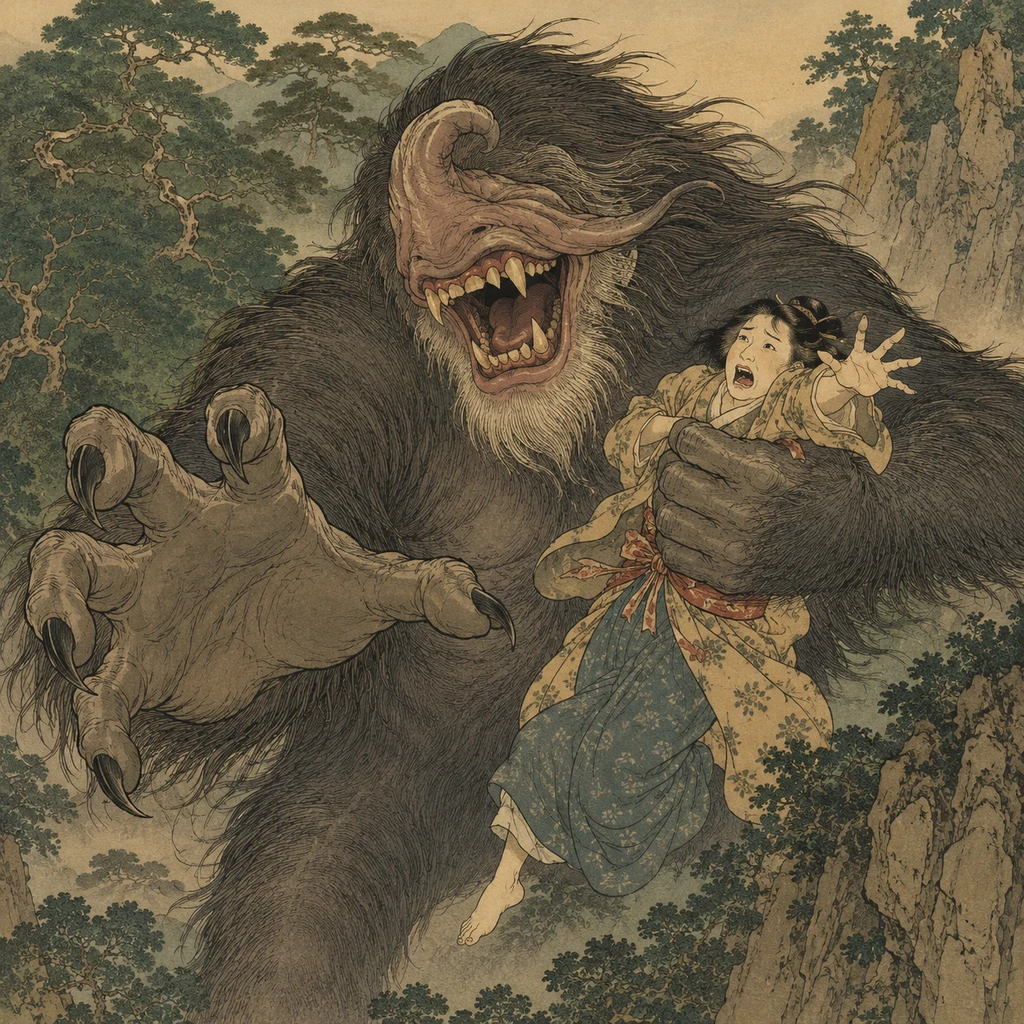
Hihi (Demon Baboon)

Hihi (Demon Baboon)

Epic

HEE-hee

老猿化けの女攫い・狒々

Animal ShapeshiftersNagano

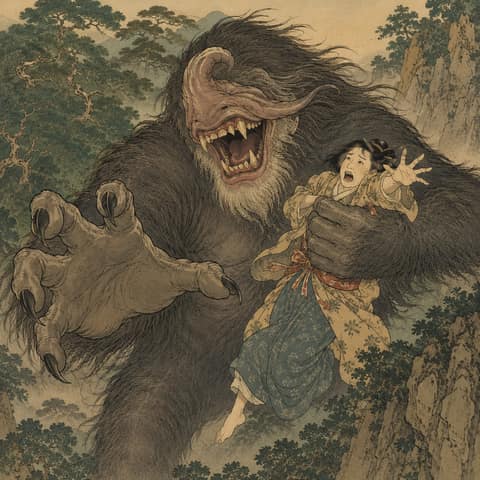
A yokai resembling a large monkey said to appear in the mountains, often described as an aged monkey that has transformed. It possesses formidable strength and is known in many tales to attack people, especially abducting women. Across regions it is said to burst into loud laughter at the sight of humans; its long lips curl upward until they cover its eyes. Edo-period picture scrolls and encyclopedias depict it as big-bodied with black fur. Some explain the name as imitating its laugh, and it is sometimes confused with other mountain beings like yamawaro.

Blue Lady-in-Waiting

Blue Lady-in-Waiting

Rare

AH-oh NYOH-boh

古御所の女官姿・青女房

Half-Human BeingsJapanese folklore

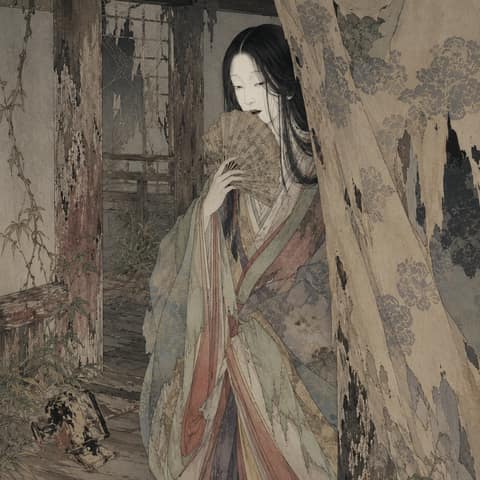
A lady-in-waiting–type yokai seen in Edo-period monster paintings. In Toriyama Sekien’s Konjaku Gazu Zoku Hyakki, she appears as a youthful court woman with ohaguro (toothed blackening), said to haunt a ruined old palace. The term originally referred to low-ranking young attendants serving at court or in aristocratic households, and was not a fixed monster name. Similar court-attendant figures appear across various Hyakki Yagyo picture scrolls; Sekien likely labeled that iconography as “Ao-nyōbō.” Her nature and origins are unknown.

Kejōrō (Hair Courtesan)

Kejōrō (Hair Courtesan)

Epic

keh-JOH-roh

髪に顔覆われる遊女・毛倡妓

Household SpiritsEdo period

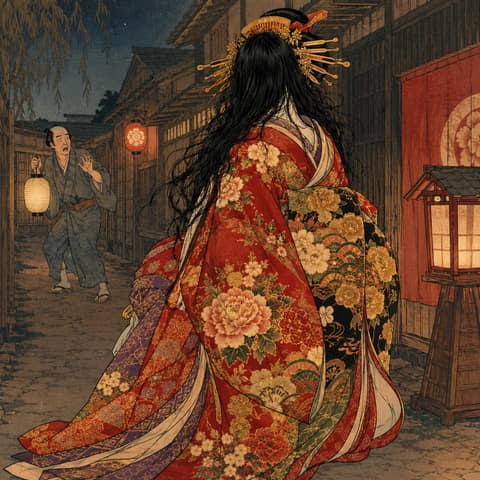
A strongly imaginative yokai depicted in Toriyama Sekien’s Konjaku Gazu Zoku Hyakki and Edo-period kibyōshi. As the name suggests, it appears as a courtesan whose entire body is shrouded in long hair; her face is hidden by hair, or in some readings, absent altogether. Considered a satirical presence in the pleasure quarters, the wordplay links the painted “makeup” of a courtesan with “apparition.” It lacks stable local folklore and is known mainly from printed sources.