YOKAI.JP

Katawaguruma (One-Wheeled Carriage)

kah-tah-wah-GOO-roo-mah

Katawaguruma (One-Wheeled Carriage)

Katawaguruma (One-Wheeled Carriage)

Their soul is listening — speak, and they will answer.

Basic Description

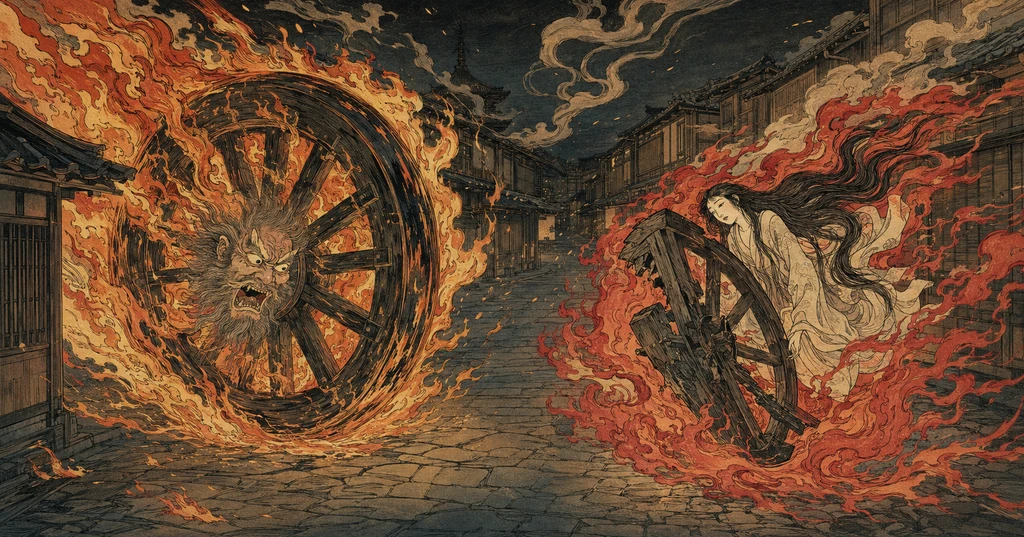
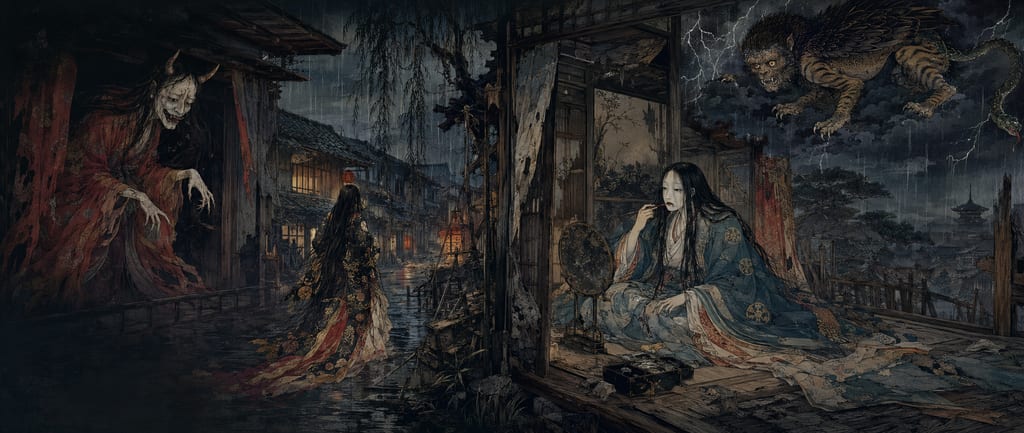
Katawaguruma is a night apparition of a single ox-cart wheel wreathed in flames, racing down dark roads with a human face glaring from its hub. Recorded in early Edo-period kaidan and essays, it was feared to bring misfortune to those who saw it—and even to those who merely gossiped about it. Accounts differ on whether the face is male or female. Sightings are tied to Kyoto and Omi, and the creature appears in contemporary paintings. Scholars often discuss its connection to the wheel-demon Wanyūdō.

Folklore & Legends

In Shokoku Hyakumonogatari, it appears nightly on Kyoto’s Higashi-no-Tōin, a terrible man’s face in the hub clenching a child’s leg, crying, “Look to your own child before you look at me,” after which calamity strikes the household’s children. In Shokoku Rojindan, a katawaguruma carrying a woman roams Omi; when a peeping woman posts a waka on her door, the child is returned. Tsumura Sōan’s Tankai notes a Shinano variant, suggesting cross-influence with the Omi tale.

Detailed Analysis

2 different forms of Katawaguruma (One-Wheeled Carriage) have been confirmed. Each has unique characteristics and personality, with various ways of interacting with people. Details of each form are introduced below.

Kyo’s One-Wheeled Fire Cart

To explain Kyo’s One-Wheeled Fire Cart in detail:

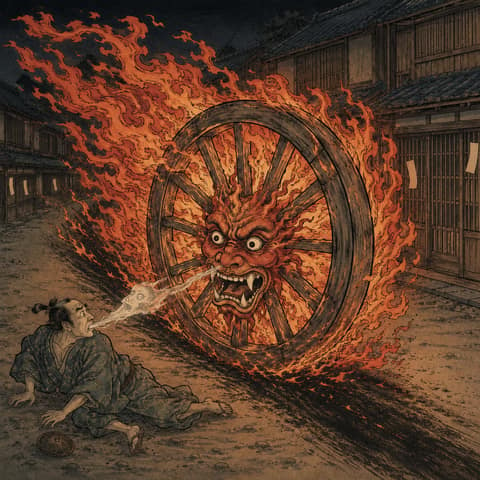
A variant of the Katakuruma said to haunt Kyoto’s Higashi-no-Toin, marked by a strong urge to chasten with words. In the Enpo era, disliking the city’s taste for night roaming and nosy tongues, it rolled through the streets as a single ring of fire. It appears as one lone ox-cart wheel, cypress spokes sooted and red-hot, with a broad-jawed man’s face set in the hub. Its eyes flicker like lantern flames, its teeth gleam like a comb, and it often arrives biting a child’s single foot. Its first cry is always “Look to your child before you look at me,” both a threat and a plain command to tend the home; those who rush inside sometimes avert harm. But peep out of curiosity and, before rumor can spread, calamity befalls the household’s child. The foot it holds is not some stranger’s far away but is bound to the onlooker’s own child—the terror of this type—its fire slipping thinly through the door crack, drawing blood like beriberi in the sleeping room, leaving a tear. This speech-making Katakuruma is often confused with the Wheel Monk, yet it prefers admonition to mockery, and a single line of speech sets both the cause and the end. When a housewife once peered through a slit on Higashi-no-Toin, the wheel halted before the home, pressed its nose to the door, uttered a verse, and left; she ran to the parlor and found the child only lightly harmed, cured by prayer and decoctions. Thereafter, from the bell at sunset, households barred lattices tight, hung dim lamps within, and vowed not to speak of the strange at their lips. Sightings waned, yet during festivals and pilgrimages it returns, rolling as if stepping on the shadows of paper lanterns. It feeds above all on named gossip; if one whispers “katawa-guruma” thrice, its flame licks the eaves and seeks the lattice gap. Elders avoided the name, saying “the one-wheeled fire” or “the wheel’s voice.” Still, a gate warded with waka or votive words can halt it; honoring the power of speech, it eases if the text is orderly and heartfelt for the child. In towns thick with rumor it grows strong, in towns that mind their words and households it wanes, a monster mirroring Kyoto’s temperament.

Character Profile

This section is our own creative profile for storytelling. It is not historical fact or scholarship.

Rarity
Uncommon
Personality
values admonition, unforgiving toward voyeurs and gossips, terse yet each utterance becomes curse or counsel, fierce when angered, never returns if one keeps their word
Compatibility
those who avoid rash acts late at night, those who shut their doors and mind the household, those who honor old etiquette, monks and ritualists who refrain from gossip
Abilities
binding a household to instant misfortune with a single admonishing line, entering as a fire-wheel and thrusting light and heat through narrow gaps, being summoned by following named gossip, discerning the cadence of waka or prayers and easing calamity in answer, far-sensing a child’s sleeping place within a home
Weaknesses
well-ordered waka or votive texts posted at the gate, weakened when people avoid its name and speak of it obliquely, slowed by sealed lattice and shoji gaps with mud plaster or wet paper
Habitat
Yamashiro Province Kyoto along Higashi-no-Toin Street, alleys of townhouses near the Imperial Palace, night roads during pilgrimages and festivals
🔮Yokai Compatibility Test

For more detailed information and diagnosis results about Kyo’s One-Wheeled Fire Cart, please click here.

Katawaguruma of Shiga

To explain Katawaguruma of Shiga in detail:

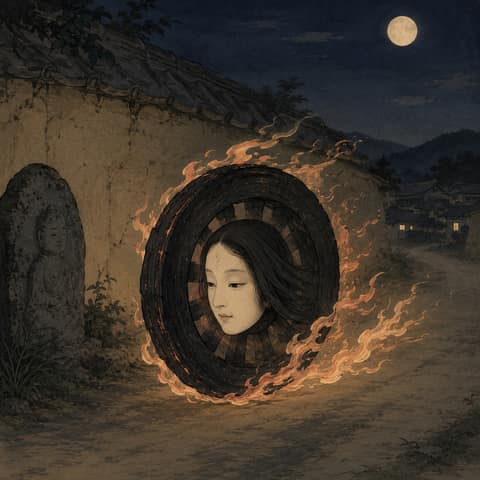
A regional variant of the katawaguruma said to haunt the Koka foothills and the lake winds’ thoroughfares since the Kanbun era. Its flames are steady like a watchfire, and a single scorched ebony wheel skims along nighted earthen walls. A woman’s face floats at its hub, classical and composed, hair unruffled by wind, the mouth faintly smiling yet almost mocking. When it circles a village threshold, lamps shiver and a far voice calls the names of sleeping children. More feared than its form were its “looks” and “rumor”: those who peeked through a door’s crack at midnight, or joked about it next morning, drew misfortune. The calamity was never grand but left a house half wanting—children vanish for a time, a mother’s milk stops, sheaves on the drying rack grow damp on one side. Villagers called this “stealing the half.” Yet it is no lawless fiend; if humans observe propriety, it answers with reason. One tale tells of a woman who repented peeping and pasted a tanka on her door; the katawaguruma sang it back the next night, saying “How gentle you are,” and returned her child. This is its Koka nature: to chide those who break night taboos and mend order through the power of words. When wayside deities and crossroads shrines waned, it appeared like a night watch, staying travelers’ feet and reminding households of latches and silence. Its female visage is said to echo ancient awe of birth goddesses who govern children’s comings and goings, or the many nights in Koka when women kept the home. The wheel is a lone wheel of an old ox cart, scorched axle-grain traced with sigils like Siddham; its fire gives light without heat. If people pierce its guise and spread tales of its traces, it deems its whereabouts too well known and departs. Thus it rarely lingers after a single appearance, blending back into roadside dark once rumors subside. Often confused with Wanyudo, but this kind favors admonition over scorn and prides itself on always returning the children it takes. Sensitive to song, norito, and quiet prayers at the threshold, it favors dignified speech; hence local house codes forbade loud late-night talk, door cracks, and calling children’s names at night. So the katawaguruma came to be seen as Koka’s hidden guardian, teaching courtesy through affliction and undoing affliction through courtesy.

Character Profile

This section is our own creative profile for storytelling. It is not historical fact or scholarship.

Rarity
Uncommon
Personality
modest yet proud, honors vows and responds to waka and proper etiquette, shuns peeping and gossip, stern toward those who break reason, compassionate toward sincere remorse
Compatibility
those who keep their tongue and uphold promises, those versed in poetry and etiquette, those who know the manners of traveling by night
Abilities
half-taking (temporarily removing part of a household’s function or a child’s presence), word-return (responding to poems or prayers at the door to lift misfortune), cold fire (heatless ghostly flame that illuminates without burning), crossroads ward (blocking late-night passage at village boundaries and junctions)
Weaknesses
if peeping is discovered and rumors spread its location is exposed and it must withdraw, when faced with well-formed waka or norito posted at the door it must answer with reason and is easily moved to compassion
Habitat
night roads around village settlements in Koka District of Omi Province, along earthen walls near crossroads and by wayside dosojin

🔮Yokai Compatibility Test

For more detailed information and diagnosis results about Katawaguruma of Shiga, please click here.

Interested in this type of yokai?

Discover the yokai most similar to your personality with our yokai diagnosis

Start Yokai Diagnosis

Meet your guardian yokai at the shrine

Draw an omikuji fortune and discover the yokai watching over you today.