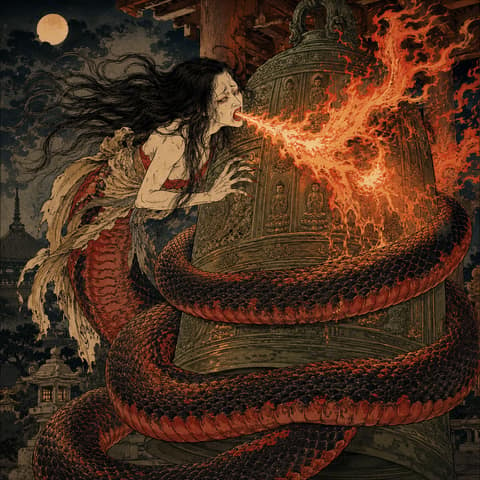
Hashihime is a figure born from ancient water and land deities fused with beliefs in bridge guardians. Revered at old great bridges, she is known as a goddess or ogress. A shrine to her stands at Uji Bridge on the Uji River, with traditions also tied to Nagara Bridge and Karahashi at Seta. Taboos warn against praising other bridges while standing on a bridge, or singing songs of jealousy there. She appears in the Kokin Wakashū, and later lore recasts her as a woman transformed into a demon by jealousy.
Folklore & Legends
In the Kokin Wakashū, the Bridge Princess of Uji appears in love poetry. Later, the “Sword Scroll” section of The Tale of the Heike (Heike Monogatari) recounts a jealous woman who prays at Kibune and soaks in the Uji River for twenty-one days, becoming a demon. The warrior Watanabe no Tsuna famously encounters her at Ichijō Modori-bashi and severs her arm with his famed blade. The Noh play Kanawa follows this lineage, portraying a horned, iron-trivet-wearing demon-woman repelled by Abe no Seimei. Alongside these fearsome aspects, Hashihime also remains a protective bridge deity, enshrined at Uji Bridge.
Yokai Cards4
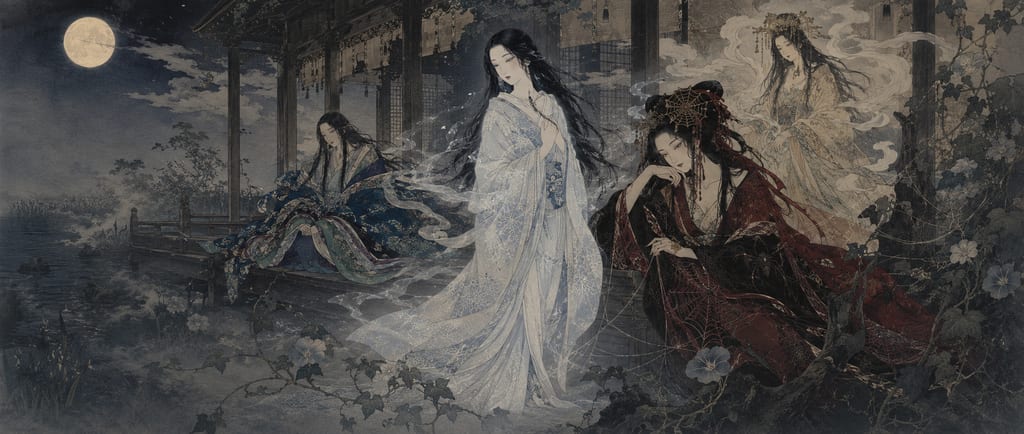
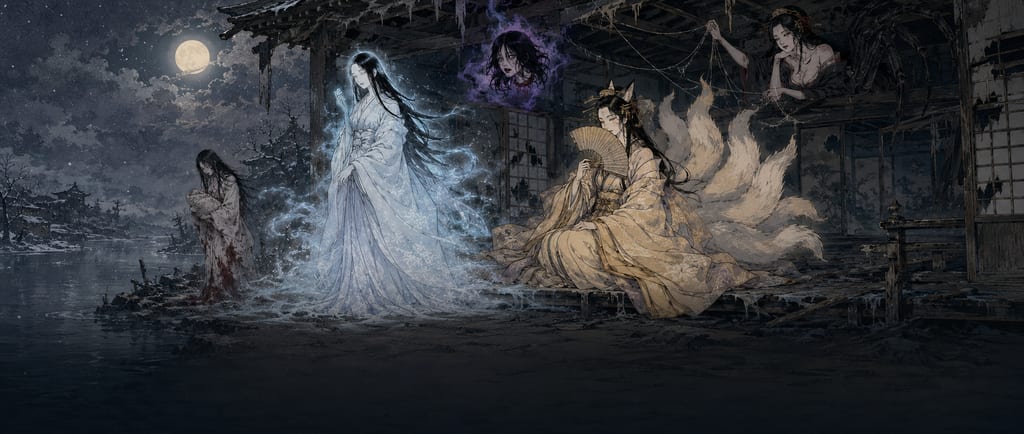
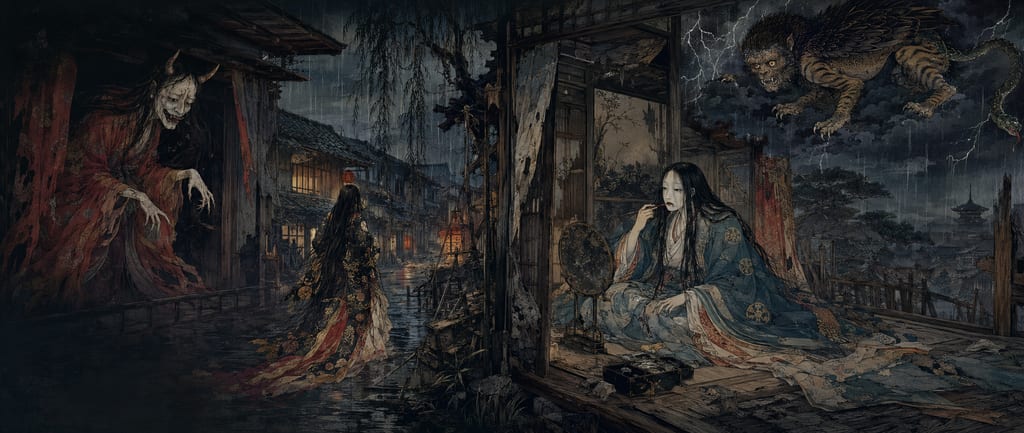
Hashihime (Bridge Princess) across multiple art-style decks
An integrated portrayal of Hashihime as a local divinity of Uji Bridge on the Uji River and as the jealous demon-woman of medieval war tales and Noh. As a local deity she was venerated at the bridgehead as a water and land guardian, protecting crossings and safe passage. Traditions forbid praising other regions or singing lines that stir jealousy upon the bridge, reflecting the belief that local gods dislike talk that exalts elsewhere. In the later tale, a woman visits Kifune, undergoes purificatory austerities in the Uji River, becomes a demon, and encounters a warrior at Ichijō Modori-bashi. Toriyama Sekien noted the shrine at Uji Bridge, and the Noh play Kanawa fixed the image of a demon-woman crowned with an iron trivet. Folklorically, bridges are liminal spaces, linked to water deities, female divinities, and warnings against jealousy, so ritual and storytelling long coexisted. While invented details vary by source, devotion to Uji Bridge, the Modori-bashi encounter, and the dual nature of taboo and protection form the core.
Character Profile
This section is our own creative profile for storytelling. It is not historical fact or scholarship.
quick to harbor resentment, guardian of thresholds, proud, severe yet protective
Compatibility
good with those who keep bridge taboos, at odds with those who slight other places, favorable to respectful travelers, hostile to boastful or envious speech
Abilities
protection over bridges and river crossingswarding intrusion at boundary zonesshapeshifting into a demon-womancurses tied to pollution and jealousy
Weaknesses
pious observance that avoids taboos, pacification through chanting and prayers such as the Benevolent Kings Sutra, offerings and reconciliation rites to the local deity
Habitat
around the Uji River and Uji Bridge, around Nagara Bridge, around the Karahashi at Seta
The diagram below is a diagnostic evaluation chart for Hashihime of Uji (Traditional Form). The higher the value of each item, the stronger that characteristic is expressed.