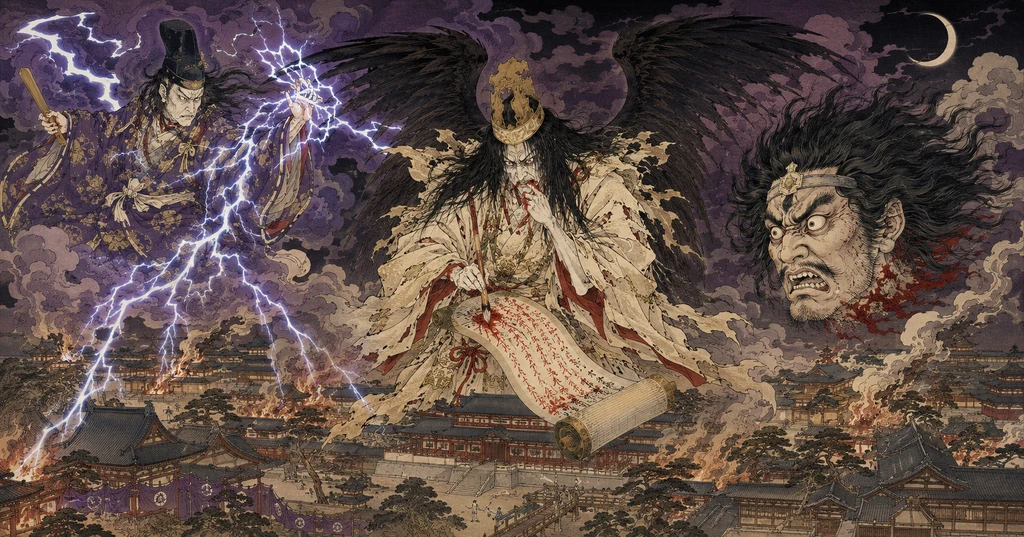
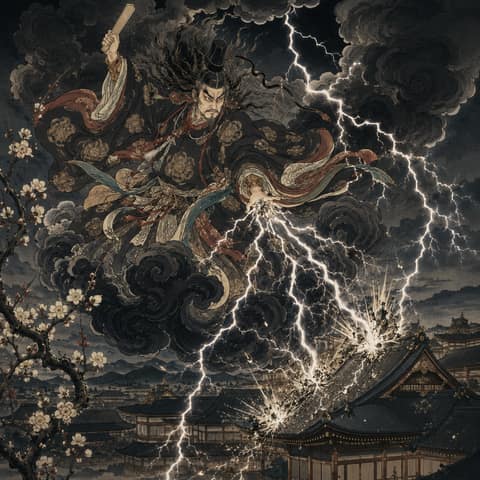
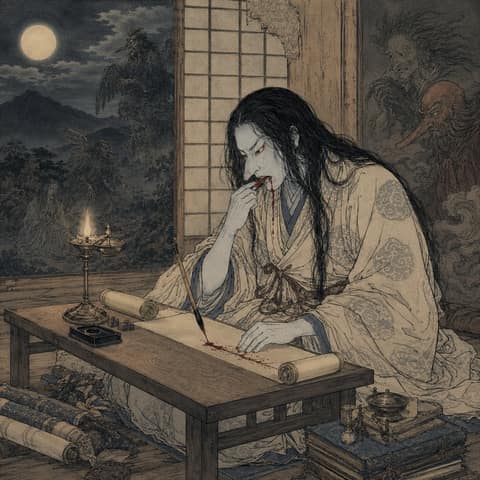
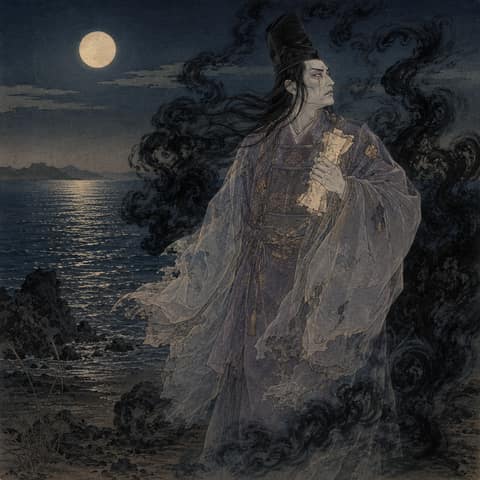
Taira no Masakado was a warrior of the Kanmu-Taira line who held sway over the Bandō region in the mid-Heian period, a man who raised the banner of revolt against the court, styled himself "New Emperor" (Shinnō), and was struck down. After his death, the uncanny tales surrounding his severed head made him one of the most dreaded vengeful spirits in Japan, and in time he was enshrined as a guardian deity of the Kantō and a goryō god at shrines such as Kanda Myōjin.
In the Jōhei and Tengyō years, Masakado rose from private feuds within his own clan, and in the second year of Tengyō (939) he overran the provincial seats of Hitachi and other Kantō provinces to subjugate the eastern lands, proclaiming an oracle of Hachiman Daibosatsu and styling himself New Emperor [1]. But the following year, the third of Tengyō (940), he was shot in the forehead and killed in battle by the punitive army of Taira no Sadamori and Fujiwara no Hidesato (Tawara Tōda). His life is recounted in detail in the contemporary war chronicle Shōmonki[1].
What made Masakado a yokai and a vengeful spirit was less the historical revolt itself than the legend of the head, told in later ages. The story that his head, exposed in the capital, would not rot and cried out night after night before flying off to the east is bound up with the dread of the Masakado Grave-Mound (the "Head Mound") at Ōtemachi in Tokyo, and transmits to this day the belief that to move it brings a curse. At Kanda Myōjin, by contrast, he is fervently revered as the great tutelary of Edo and a god of martial fortune and thriving commerce—embodying the two faces of a goryō god: curse and protection.
Folklore & Legends
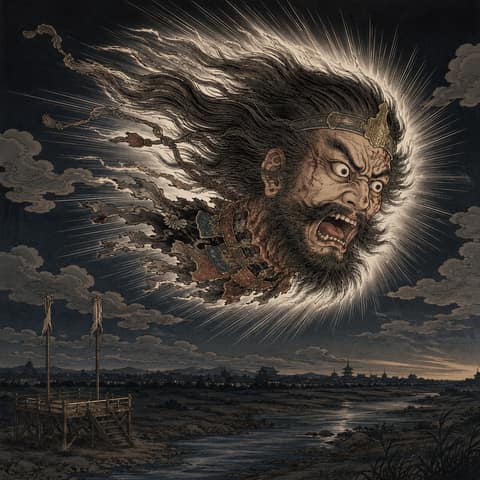
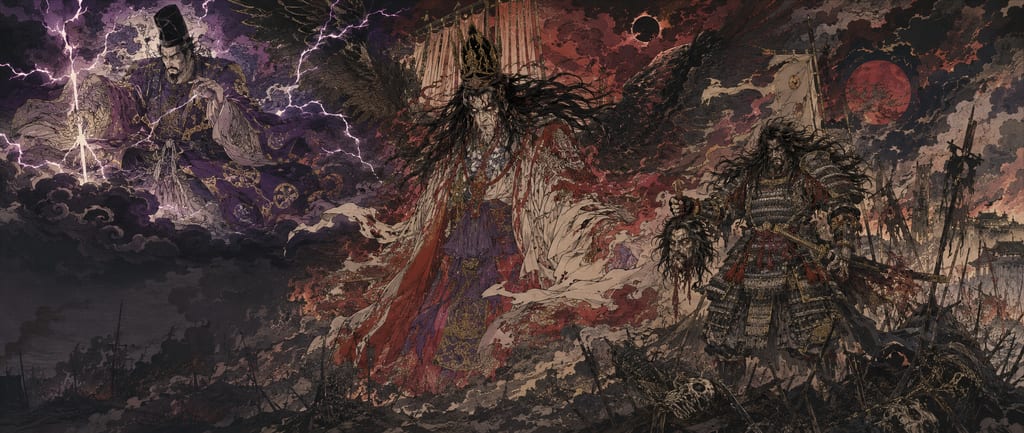
The heart of Masakado's uncanniness lies in the story of the severed head. It does not appear in the contemporary Shōmonki[1] that records the revolt, but is a legend told far later, in works such as the Nanboku-chō-period Taiheiki[2]. According to it, Masakado's head, exposed at the Shichijō riverbed in the capital, did not rot for several months; with eyes wide open it gnashed its teeth, and night after night it cried, "Where is my body? Join it to me and let me fight one more battle." When a man named Tōroku Sakon addressed it with a comic verse—"Masakado was cut down from the temple of his brow, by the stratagem of Tawara Tōda"—the head laughed dryly, and that night, emitting a white light, it flew off toward the eastern lands.
The place where the flying head is said to have fallen is the present-day Masakado Grave-Mound (the Head Mound)[3] at Ōtemachi in Tokyo. This mound has been feared even into modern times, on the belief that attempts to relocate or demolish it bring disaster. When the Ministry of Finance built a temporary office over the mound's site after the Great Kantō Earthquake, the successive deaths of those involved, and the postwar overturning of a bulldozer that killed its driver when the ground was to be leveled, are told as the curse. Yet the deaths of the Finance Ministry officials came several years after construction began and are hard to link causally; these belong largely to modern urban legend. The frog figurines offered at the mound play on the pun that the head "returns" (kaeru) to the east, kaeru also meaning "frog."
Masakado is also a textbook case of a cursing vengeful spirit turned into a protecting god. In the second year of Enkyō (1309), when a plague was attributed to Masakado's curse, the Ji-sect holy man Shinkyō Shōnin is said to have pacified his spirit and enshrined it in the auxiliary hall of Kanda Myōjin[4]. When Tokugawa Hidetada moved the shrine to its present site in the second year of Genna (1616), Kanda Myōjin became the great tutelary of Edo, and the deity Masakado drew reverence as a god of warding off calamity, martial fortune, and thriving commerce. In the Meiji era he was once removed from the main hall's enshrined deities as a traitor, but was restored as an enshrined deity in 1984. The Kokuō Shrine at Bandō, the place of his end, is said to have been founded when his third daughter, the nun Nyozō-ni, carved a seated image on the thirty-third anniversary of her father's death.
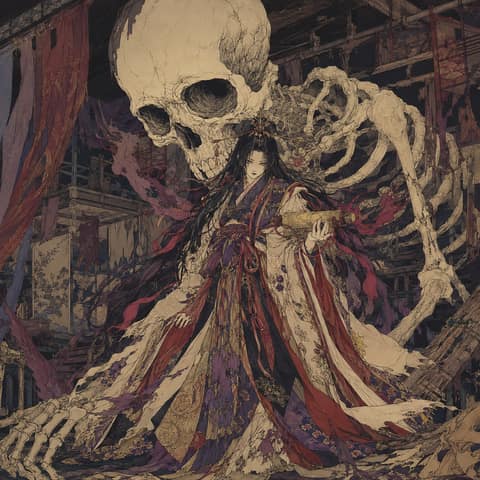
Masakado is counted, together with Sugawara no Michizane and Emperor Sutoku, among the "Three Great Vengeful Spirits of Japan." Yet, as Yamada Yūji and others point out[5] in the study of vengeful spirits, the grouping of these three is an early-modern framework that spread through the popular fiction and kabuki of the Edo period. It should further be noted that the tale of Princess Takiyasha, who commands a giant skeleton, is a later derivative of kabuki and popular fiction with Masakado's daughter as protagonist, and is distinct from the traditions of Masakado himself.
This edition follows in close detail—while fixing the boundary between history and legend—how a single Bandō warrior became the uncanny "flying head" and then turned into a god who guards Edo.
First, history and the uncanny must be separated. The revolt itself is conveyed by the near-contemporary Shōmonki[1], which records in classical Chinese the private feud beginning in 935, the subjugation of the Kantō provincial seats, the proclamation as New Emperor, and the death in battle in 940. But here there is no marvel of a flying head. The supernatural story of a head that would not rot, cried out, and flew appears only centuries later, in the Nanboku-chō-period Taiheiki[2], with anecdotal relays such as the Konjaku Monogatari-shū in between. It is in this later stratum of legend that Masakado is told as a "yokai."
The story of the curse around his head mound is newer still. The dread transmitted at the Masakado Grave-Mound[3] at Ōtemachi—"move it and it curses"—is a modern urban legend, layered onto events that occurred in the heart of the city in the Taishō and Shōwa eras: the deaths of those involved in building the Ministry of Finance's temporary office after the Great Kantō Earthquake, and the bulldozer accident during the Occupation. The factual events and the interpretation that attributes them to Masakado's curse must be carefully separated.
The path of deification, on the other hand, reaches back into the medieval age. In the second year of Enkyō (1309), the Ji-sect holy man Shinkyō Shōnin, who attributed a plague to Masakado's curse, pacified the spirit and added it to the enshrined deities of Kanda Myōjin[4]. This, like Michizane, is the textbook goryō belief of enshrining a raging vengeful spirit and turning it into a protecting god. The ups and downs—drawing the reverence of the people as the great tutelary of Edo, being removed from the enshrined deities as a traitor in the Meiji era, and being restored at the end of Shōwa—also reflect well the duality of the image of Masakado as a hero who rebelled against the throne. In later ages, the story of his daughter Princess Takiyasha commanding a giant skeleton won popularity in kabuki and popular fiction and was depicted in Utagawa Kuniyoshi's "The Old Palace at Sōma"; it should be noted that this is a derivative starring the daughter, not Masakado himself.
Character Profile
This section is our own creative profile for storytelling. It is not historical fact or scholarship.
Valiant and deeply righteous, he aspired to the independence of Bandō. Out of his unfulfilled death he works a curse, but once pacified he guards the land.
Compatibility
Those who hold to independence and self-reliance, those who pray for martial and commercial fortune, those who resist an unjust stigma
Abilities
The marvel of the flying severed headThe curse upon the land and the throneGuardianship of martial fortune, warding off calamity, and thriving commerceThe emblem of independence in styling himself New EmperorProtecting and pacifying the land as a goryō
Weaknesses
The curse softens through reverent pacification and worship
the restoration of honor and deification calm the wrath
it is feared that treating the head mound carelessly brings a curse
Habitat
The Masakado Grave-Mound at Ōtemachi (Tokyo), Kanda Myōjin (great tutelary of Edo), Kokuō Shrine (Bandō City), and old sites and head mounds across the Kantō
The diagram below is a diagnostic evaluation chart for Masakado, Goryō God of the Kantō. The higher the value of each item, the stronger that characteristic is expressed.