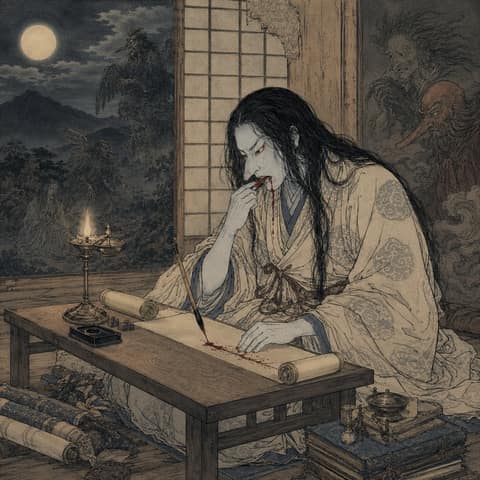
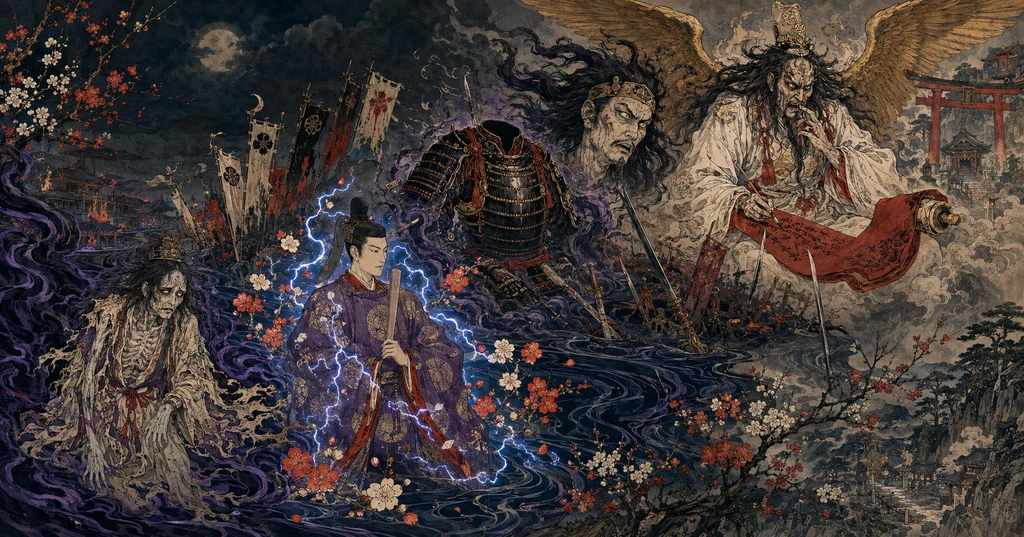
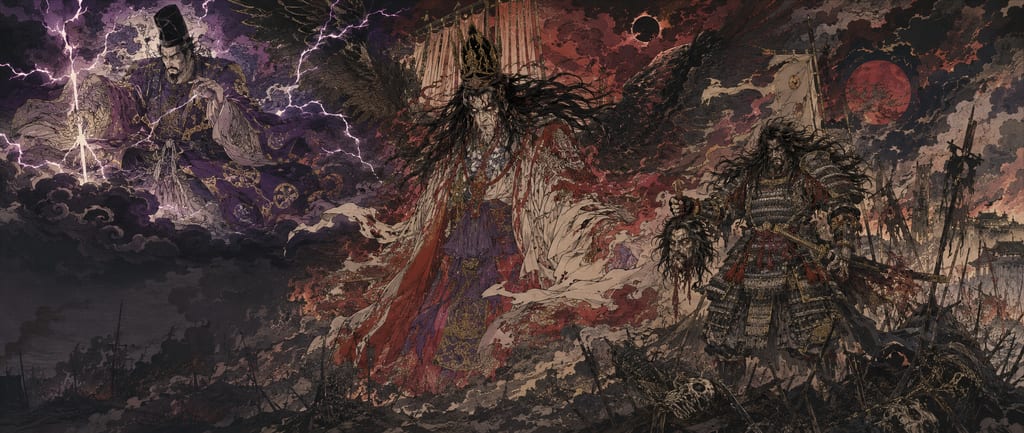
Sugawara no Michizane was a Heian-period scholar and composer of Chinese verse who rose to the office of Minister of the Right; after his death he came to be counted among the most dreaded vengeful spirits in Japan, and was in time enshrined nationwide as Tenman-Tenjin, the god of learning. Born into the scholarly Sugawara house, he was favored under the two reigns of Uda and Daigo, but in the fourth year of Shōtai (901), slandered by the Minister of the Left Fujiwara no Tokihira, he was demoted to Dazaifu, where he died in despair in the third year of Engi (903).
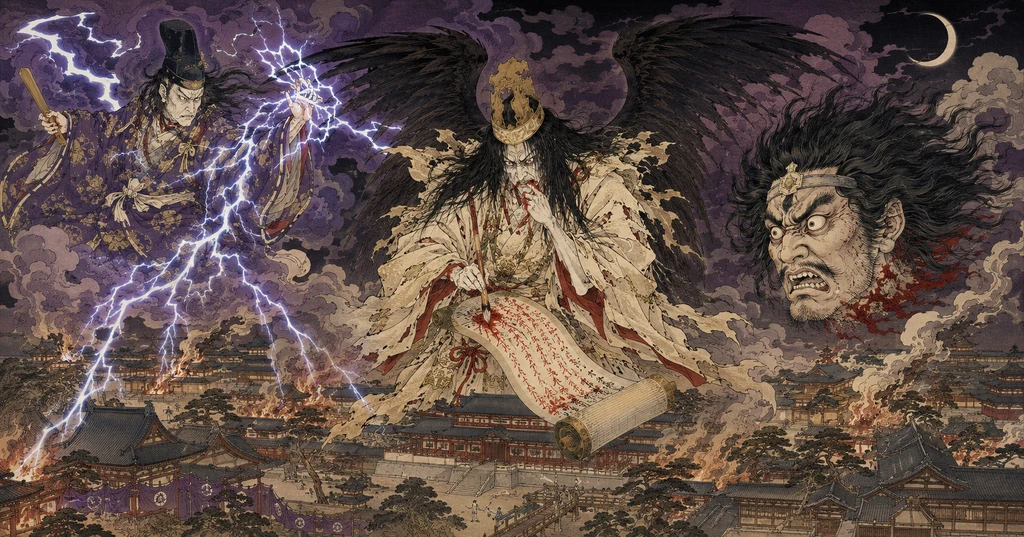
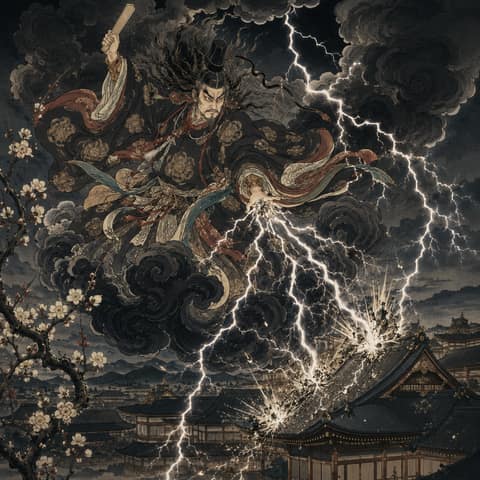
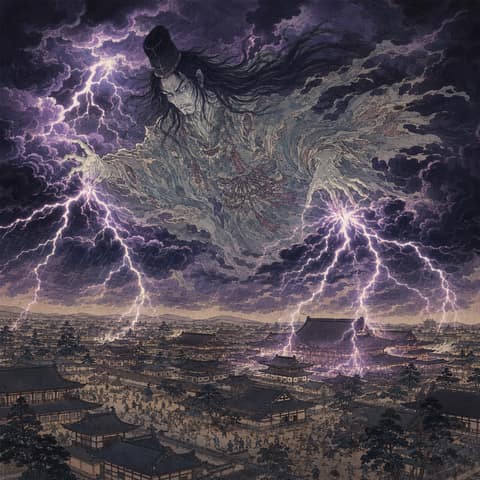
After his death, the capital saw a succession of deaths among his political enemies, beginning with Tokihira, followed by plague and drought, all whispered to be the curse of Michizane, who had been sunk by a false charge. Above all, the [1]lightning strike on the palace's Seiryōden in the eighth year of Enchō (930), which killed and wounded many nobles, fixed the conception of Michizane as Karai-Tenjin, the thunder-wielding "Fire-and-Thunder Heavenly Deity." To pacify that raging spirit, the court enshrined him as a god, and the cult of Tenjin spread outward from Kitano Tenmangū in Kyoto and Dazaifu Tenmangū, built over his grave.
Feared at first as a curse-bringing deity, Tenjin gradually changed in character—on account of Michizane's own outstanding learning in life—into a guardian of scholarship and letters; and in the early-modern era, as terakoya schools spread, he became beloved even among commoners as the god who grants success in study and clears false accusations. The plum he loved so dearly in life, and the thunder he wielded as a vengeful spirit, survive to this day as his emblems.
Folklore & Legends
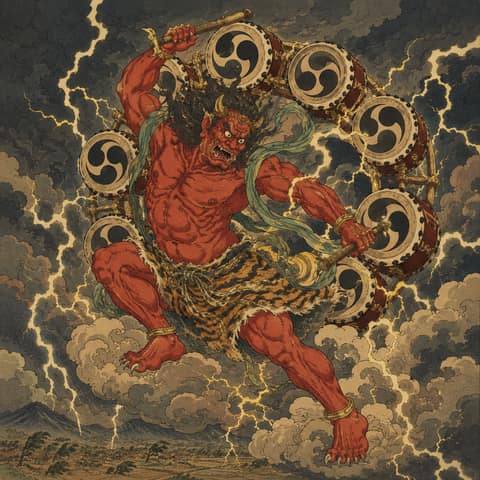
At the heart of the lore surrounding Michizane's curse lies the lightning strike on the Seiryōden in the eighth year of Enchō (930). In the Seiryōden, where Emperor Daigo presided over a council called to pray for rain amid drought, black clouds welled up from the direction of Atago and lightning fell: Major Counselor Fujiwara no Kiyotsura, said to have kept watch over Michizane at Dazaifu, took fire to his robes and was struck dead with his chest torn open, while the Middle Controller of the Right Taira no Mareyo had his face burned and lost his life [1]. Emperor Daigo, having witnessed the carnage, fell ill and passed away within three months. This single event made the belief in Michizane as a thunder god unshakable. The sight of Michizane transformed into a thunder deity, descending upon the capital to strike the Seiryōden, is vividly depicted in the Kamakura-period Kitano Tenjin Engi Emaki[2], and casts its shadow over later paintings of the wind and thunder gods.
At Dazaifu, by contrast, a gentler tradition survives. As Michizane's remains were being borne by ox-cart to burial, the ox sat down before a gate and would not move; that place was chosen as the grave and a shrine was built—this is held to be the origin of Dazaifu Tenmangū. The many images of reclining oxen (sacred oxen, "stroking oxen") in the precincts of Tenjin shrines derive from this story. At Kitano in Kyoto, in the fifth year of Tengyō (942), a young girl of the western capital named Tajihi no Ayako received an oracle to "enshrine me at Kitano," and a shrine hall was raised later, in the first year of Tenryaku (947). Kitano had originally been a land of the thunder god where lightning was frequent, and upon the soil of a belief that to revere a raging thunder god is to turn him into a god who brings rich harvests, Tenjin was at last quieted.
The plum lore is equally famous. As Michizane prepared to leave the capital, he addressed a poem to the plum tree of his residence—"When the east wind blows, send forth your fragrance, blossoms of the plum; though your master be gone, do not forget the spring"—and the plum, longing for its master, is said to have flown in a single night all the way to Dazaifu. This is the sacred tree of Dazaifu Tenmangū, the "Flying Plum" (Tobiume). It should be noted that in its oldest sources, the Shūi Wakashū[3] and the Ōkagami[4], the closing line reads "do not forget the spring" (haru o wasuruna), differing in form from the later-popular "do not, spring, be forgotten" (haru na wasure so).
Michizane is counted, together with Taira no Masakado and Emperor Sutoku, among the "Three Great Vengeful Spirits of Japan." Yet this grouping of the three is not an old classification; the integration of Yamada Yūji and others[5] in the study of vengeful spirits has shown it to be an early-modern framework that spread through the popular fiction and kabuki of the Edo period. A man of letters who wept under a false charge, became a thunder god who shook the throne, and came at last to be revered as the god of learning—Michizane's story has been handed down for over a thousand years as the very archetype of goryō (vengeful-spirit) belief.
Yokai Cards1
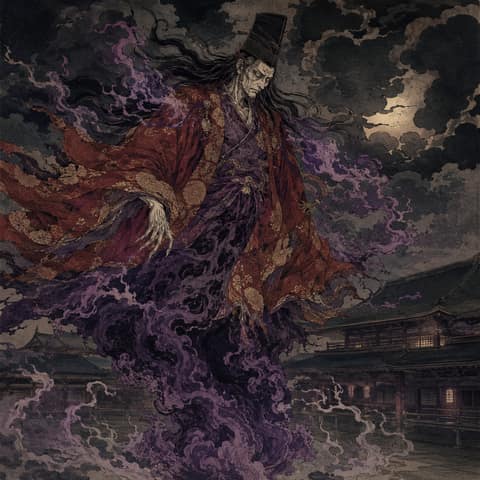
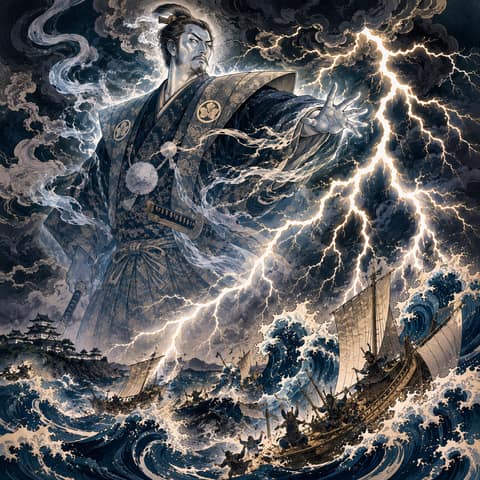
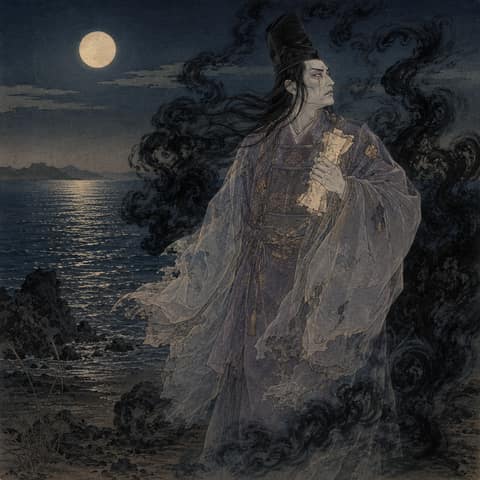
Sugawara no Michizane across multiple art-style decks
This edition follows, in close detail and bound to chronology and iconography, how a single man of letters became a thunder god and then turned into the god of learning—those two transformations.
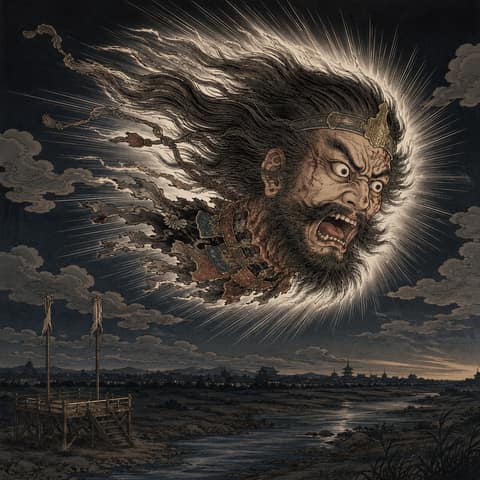
Michizane's becoming a vengeful spirit did not begin immediately upon his death. In the eighth year of Engi (908) his former disciple Fujiwara no Sugane died; the next year, the ninth of Engi (909), the very author of his exile, Fujiwara no Tokihira, died at thirty-nine; and in the twenty-third year of Engi (923) the crown prince Yasuakira passed away. That year the court restored Michizane to Minister of the Right and posthumously granted him the junior first rank, absolving him of guilt—yet the calamities did not cease, and in the third year of Enchō (925) even the next crown prince, Yoshiyori-ō, left the world at only five. The process by which this chain of deaths came to be felt by the people of the capital as the curse of the innocent Michizane is the very genesis of goryō belief.
Its apex was the lightning strike on the Seiryōden in the eighth year of Enchō (930)[1]. The lightning that struck the palace in the midst of a rain-prayer council killed Fujiwara no Kiyotsura, who had watched over Michizane at Dazaifu, instantly, and burned the nobles present one after another. The reading of lightning as Michizane's will became decisive here, and the spirit, surpassing a mere vengeful ghost, was exalted into a dread godhead called Karai-Tenjin, Tenman Daijizai Tenjin, and Nihon Daijō Itoku-ten—a deity who commands the thunder. The Kamakura-period Kitano Tenjin Engi Emaki[2] depicts this scene of becoming a thunder god as the masterpiece of the scroll, and the image of Tenjin driving the thunderclouds cast its shadow even upon the later wind-and-thunder-god paintings of Tawaraya Sōtatsu and others.
The iconography of Tenjin has two contrasting lineages. One is the raging Fire-and-Thunder Deity of the engi scrolls, mounted on thunderclouds and hurling lightning. The other is the composed image of a man of letters and official in court robes holding a baton (shaku), accompanied by a plum at his side—and this became the standard image of the god of learning. The "Tang-crossing Tenjin" (Totō Tenjin), clad in Chinese robes, bearing a sack and holding a sprig of plum, is a variant based on a Zen monastic tale that Michizane crossed in a single night to a Song-dynasty Zen master to receive his teaching.
The shift of weight from vengeful spirit to god of learning advanced gradually. Already in the mid-Heian period he was praised in ritual prayers as a merciful god presiding over letters and honesty, and in the fourth year of Shōryaku (993) the posthumous senior first rank and the office of Chancellor were conferred, fully restoring his honor. But his popular establishment as the god of academic success came far later, in the Edo period, with the spread of terakoya schools. The image of Michizane the outstanding scholar in life was hung in the places of penmanship, and as the guardian of reading, writing, and learning, Tenjin shed the dread of the thunder god and spread to Tenmangū shrines across the land.
Character Profile
This section is our own creative profile for storytelling. It is not historical fact or scholarship.
Upright and impartial. When touched by the resentment of a false charge, fierce as a thunderbolt; once pacified, a merciful god who bestows literary fortune.
Compatibility
Those who aspire to learning, those who endure unjust dishonor, those who love the plum and poetry
Abilities
The divine might of Karai-Tenjin, who summons and brings down thunderProtection over learning, letters, and calligraphyThe judgment that clears false accusationsThe dispelling of plague and calamityThe emblem of Tenjin belief bound with the plum
Weaknesses
The curse softens through reverent pacification and worship
the restoration of honor (posthumous rank) calms the wrath
the vengeful-spirit aspect and the god-of-learning aspect are easily confused
Habitat
Kitano Tenmangū (Yamashiro Province), Dazaifu Tenmangū (Chikuzen Province), Tenmangū and Tenjin shrines nationwide, the Seiryōden (site of the lightning strike)
The diagram below is a diagnostic evaluation chart for Tenman Daijizai Tenjin: Michizane. The higher the value of each item, the stronger that characteristic is expressed.