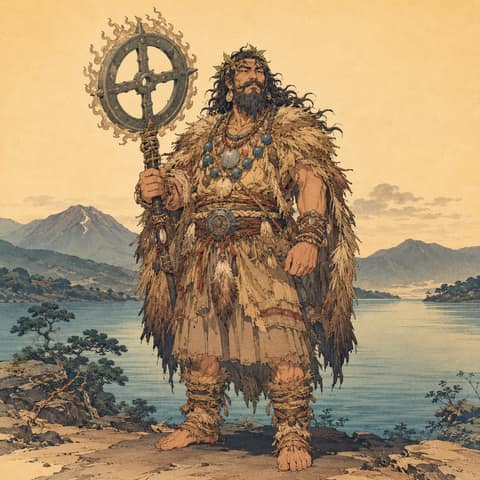
The official history of Suwa Taisha narrates that Takeminakata-no-Kami is the deity who moved from Izumo to Suwa, newly building and ruling Shinano Province[2]. The characteristics of the Suwa faith possess a depth that cannot be explained by a single scene from the central myth. The official explanation of the Suwa faith presents Suwa Taisha as an ancient faith that does not have a main sanctuary (honden), but worships nature itself as the object of reverence (goshintai)[3], and describes Takeminakata-no-Kami as a powerful deity governing wind and rain, and the tutelary god of agriculture, hunting, seafaring, and contests. In other words, Takeminakata-no-Kami is simultaneously the loser of the Izumo myth and the local principal deity who unifies the nature and livelihood of the Suwa basin.
There is also scholarly fluctuation regarding the positioning of this deity. Kokugakuin points out that Takeminakata-no-Kami's name does not appear in the genealogy of Okuninushi-no-Kami in the *Kojiki*, nor does he appear in the *Nihon Shoki*. However, he is confirmed as the enshrined deity of Suwa by the *Sendai Kuji Hongi* and the entry for Minakatatomi Shrine[1] in the *Engishiki* Jinmyocho. Furthermore, the *Suwa Daimyojin Ekotoba* relays that he defeated Moriya-no-Kami, who was originally the god of Suwa, and enshrined himself there. Takeminakata-no-Kami is a deity standing at the intersection where ancient myths, local Suwa rites, the tutelary god of samurai families, and beliefs in dragon and water deities all overlap.
Folklore & Legends
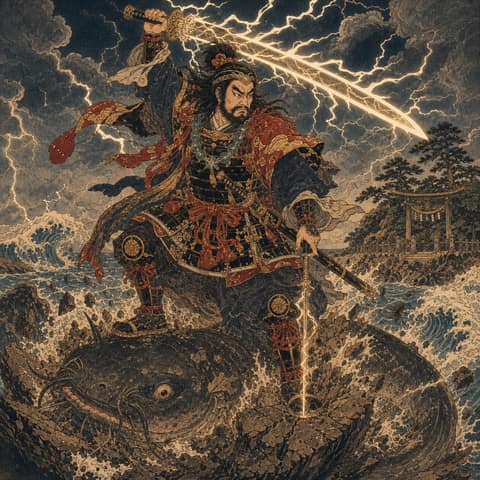
The myth of Takeminakata-no-Kami contrasts submission through words with resistance through strength. In the Kuni-yuzuri segment, Kotoshironushi-no-Kami follows the intention of Okuninushi-no-Kami and agrees to surrender Ashihara-no-Nakatsukuni. On the other hand, Takeminakata-no-Kami challenges Takemikazuchi-no-Kami to a test of strength. He is defeated by his opponent's divine power, which turned his hand into ice and swords, and flees to the Sea of Suwa in Shinano Province. Kokugakuin introduces a theory that views this subjugation as the surrender of political and military ruling power[1]. If Kotoshironushi-no-Kami demonstrates ritualistic submission, Takeminakata-no-Kami bears another aspect of territorial rule through armed resistance and defeat.
However, in Suwa, this defeat is retold not as an end, but as a beginning. The official history of Suwa Taisha states that Takeminakata-no-Kami, who opposed the transfer of the land, moved from Izumo to Suwa, positioning him as the deity who built and ruled Shinano Province—the Suwa nation that began from Kuni-yuzuri[2]. Kokugakuin further shows that the *Suwa Daimyojin Ekotoba* narrates Takeminakata-no-Kami as a god who enshrined himself after defeating Moriya-no-Kami. Here, Takeminakata-no-Kami is not a fugitive, but a foreign god who integrates the region as Suwa Daimyojin while clashing with the old local gods and ritual systems of Suwa.
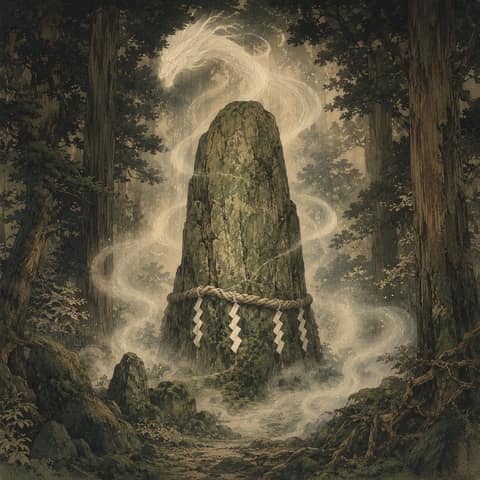
The Suwa faith strongly retains an ancient stratum that reveres nature itself as a divine body. It is officially explained that Suwa Taisha does not have a main sanctuary, transmitting a form of faith where nature is the object of worship—having no honden, nature itself is the goshintai[3]. Therefore, Takeminakata-no-Kami is not so much an anthropomorphic god closed in the depths of a shrine building, but a deity felt in the movements of mountains, lakes, winds, rains, the Onbashira pillars, sacred trees, and ice. The Omiwatari (God's Crossing) of Lake Suwa is a phenomenon where the ice cracks and bulges like a mountain range when the lake freezes over completely. Nagano Prefecture transmits this as the path taken by Takeminakata-no-Mikoto of the Kamisha to visit Yasakatome-no-Mikoto of the Shimosha[4]. This path of ice also becomes a divine ritual to divine the year's crops, social conditions, and climate rainfall.
Beliefs surrounding hunting and meat-eating also make Takeminakata-no-Kami a deity very characteristic of Suwa. Suwa Taisha explains that even in eras when taking life was abhorred, the people of Suwa were granted a divine talisman and permitted to eat venison to survive—permitted to eat venison[3]. This is not a mere indulgence; it is a philosophy where the deity assumes responsibility for the cycle of life between the livelihood of a mountain province and Buddhist taboos. The split-eared deer of the Onto Festival, listed among the Seven Wonders in the official history, and the frog-hunting ritual transmitted by the Suwa City Museum, demonstrate the ancient sacrificial and hunting stratum preserved in the Suwa faith.
His face as a god of war became even stronger after the Middle Ages. Suwa Taisha explains that Suwa-no-Okami was revered as a god of bravery and victory, receiving devotion from figures such as Minamoto no Yoritomo, the Hojo clan, Ashikaga Takauji, Takeda Shingen, and Tokugawa Ieyasu—long-lasting fortunes of war prayed for by successive shoguns[2]. Takeda Shingen in particular revered Suwa Myojin as the tutelary god of his warrior house, donating shrine buildings and territories, and is said to have been involved in the restoration of rituals. The fact that a god defeated in a test of strength in the *Kojiki* was later revered as a god of victory in battle and contests is not a contradiction. The very strength he showed in the scene of his defeat was reinterpreted in Suwa as a fierce divine protection.
The Onbashira Festival is the grandest ritual that displays his fierce power to this day. Suwa Taisha gives its formal name as the Shikinen Zoei Onbashira Taisai[5], explaining that every seventh year—in the years of the Tiger and Monkey—sixteen massive fir trees are hauled and erected at the four corners of the precincts of the four shrines. The pillars are dragged from the mountains to the villages by human power, a sacred *nagikama* (sickle) is struck into them to acknowledge them as sacred trees, and the divine treasure halls and furnishings are newly built. This festival shows Takeminakata-no-Kami not merely as a god of classical literature, but as an ongoing god who cyclically shakes the body of the land.
Furthermore, the Kamisha of Suwa had a unique system known as the Ohori. Suwa City explains the Ohori as the yorishiro (vessel) of Suwa Myojin and the priest who stood at the apex of the Suwa shrines as a living god (arahitogami)[6], noting that the position was hereditary from ancient times until the end of the early modern period. God dwells not only in the shrine buildings, but also in the human body. To understand Takeminakata-no-Kami, one must view the defeat in the Kuni-yuzuri, the ice of Lake Suwa, the massive trees of the Onbashira, hunting and sacrifice, the prayers of warrior families, and the Ohori as a living god, as one continuous sphere of faith.
To read Takeminakata-no-Kami deeply, it is crucial not to treat the defeat in the *Kojiki* and the victory of Suwa Daimyojin as separate stories. In the Kuni-yuzuri myth, Takeminakata-no-Kami challenges Takemikazuchi-no-Kami to a test of strength, is defeated, and pursued to the Sea of Suwa. Kokugakuin cites a theory that interprets this scene as refusing to submit to the words of Takemikazuchi-no-Kami, and provoking another kind of contest through a test of strength[1]. In other words, he is a god who did not obey the command of Heaven with words, but responded with the power of his body. The defeat is not a sign of this god's weakness, but evidence that he touched the order of the world with strength.
Upon entering Suwa, that defeat shifts into a narrative of local integration. Suwa Taisha narrates that Takeminakata-no-Kami moved from Izumo to Suwa, building and ruling Shinano Province—Takeminakata-no-Kami moved from Izumo to Suwa[2]. Kokugakuin introduces that the *Suwa Daimyojin Ekotoba* states he defeated the original god of Suwa, Moriya-no-Kami, and enshrined himself. Here, there is a composition where a god arriving from the central myth overlaps with the old gods and rituals of Suwa. Takeminakata-no-Kami is not merely a god who fled to Suwa. He collided with the land of Suwa itself, settled there, and changed into a god called by the name of the land.
The divine character of Suwa Daimyojin is strong as a god of wind and water. Suwa Taisha explains Takeminakata-no-Kami as a god worshipped since ancient times for governing rain and wind, and as a tutelary god of agriculture, hunting, seafaring, and contests—tutelary god of agriculture, hunting, seafaring, and contests[3]. These four are not disjointed. Rain and wind dictate rice farming; lakes and rivers support transportation and fishing; mountains serve as hunting grounds; and contests relate not only to warriors but to negotiations with nature. Takeminakata-no-Kami was worshipped as a god who reconnects fierce nature to human life.
The Omiwatari makes this reconnection visible. According to Nagano Prefecture's explanation, when Lake Suwa completely freezes over, the ice cracks and forms high, mountain-like ridges of ice. This path is considered to be the trail left by the male god of the Kamisha, Takeminakata-no-Mikoto, visiting the female god of the Shimosha, Yasakatome-no-Mikoto—the path where the male god visited the female god[4]. Furthermore, in the Miwatari ritual, the direction and shape of that path are used to divine crops, social conditions, and climate rainfall. The ice is not just a natural phenomenon; it is the movement of a god, becoming letters that read the future of the land.
In the Onbashira Festival, Takeminakata-no-Kami's power manifests as the movement of trees and people. The explanation of the Onbashira Festival by Suwa Taisha states that it is a festival where sixteen massive fir trees are hauled and erected at the four corners of the four shrines' precincts, and that a sacred *nagikama* harboring a divine spirit is struck into them to recognize them as sacred trees—sacred nagikama said to harbor a divine spirit[5]. The pillars are dragged purely by human strength, without the use of carts or rollers. Here, divine power is not a quiet interiority, but is renewed as a giant tree moving from the mountain to the village, the bodies of parishioners taking on danger, and the pillars standing at the four corners of the shrine. The god of Suwa is periodically re-erected.
Beliefs about hunting and meat-eating also connect the fierceness of this god to daily life. Suwa Taisha recounts that even in eras when taking life was considered a sin, the people of Suwa received the divine talisman of O-Suwa-sama and were permitted to eat venison to survive—eating venison to survive[3]. This is not so much a denial of Buddhist taboos as it is a mechanism where the god assumes the reality of a mountain province. Takeminakata-no-Kami is not a god who grants only clean fertility. He protects the life of the land by embracing hunts involving blood, sacrifices, the winter lake, and the danger of massive trees.
Finally, the system of the Ohori, a living god (arahitogami), is crucial. Suwa City explains the Ohori as the yorishiro of Suwa Myojin, and the priest who stood at the apex of the Suwa shrines as a living god—the yorishiro and living god of Suwa Myojin[6]. In the faith of Takeminakata-no-Kami, god does not solely exist in distant myth, but dwells in the human body, the system of the shrine, and the roles of festivals. The god defeated in the Kuni-yuzuri stands at the center of politics and ritual in Suwa through a living god. This inversion is the deepest allure of Takeminakata-no-Kami.
Character Profile
This section is our own creative profile for storytelling. It is not historical fact or scholarship.
A fierce divine character who tests strength head-on, taking root in the land even if defeated. He consolidates wind, rain, lakes, hunting, agriculture, contests, and rituals, transforming power from the outside into local guardianship.
Compatibility
Highly compatible with those drawn to contests, hunting, agriculture, wind and rain, watersides, regional independence, and ancient rituals. Prefers the sensation of living alongside a nature fraught with danger over abstract tranquility.
Abilities
Divine power of armed force and resistance that challenged Takemikazuchi-no-Kami to a test of strengthReveals good/bad harvests and fortunes through Lake Suwa, wind and rain, and waterAssumes hunting and meat-eating as part of the cycle of lifeRevives the spiritual power of the land through the giant trees of the Onbashira Festival and the renewal of shrine buildingsProtects samurai families in contests, victory in battle, and long-lasting fortunes of warUses the Ohori as a yorishiro to let divine power dwell within a human body
Weaknesses
The layers of his classical origins and the local Suwa faith are complex; reducing him simply to a defeated god, a god of war, or a dragon god loses his essence. His connection to the land of Suwa is immensely strong; stripped of that context, only his roughness remains.
Habitat
Lake Suwa, Suwa Taisha Kamisha and Shimosha, Mount Moriya and the mountains of the Onbashira, Suwa shrines nationwide.
The diagram below is a diagnostic evaluation chart for Takeminakata-no-Kami, the Fierce God of Water and War Residing in Lake Suwa. The higher the value of each item, the stronger that characteristic is expressed.