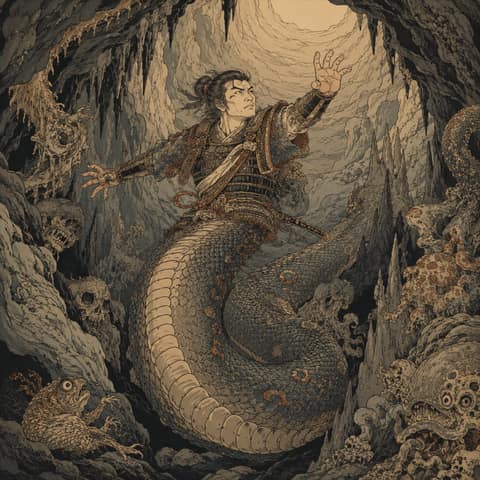
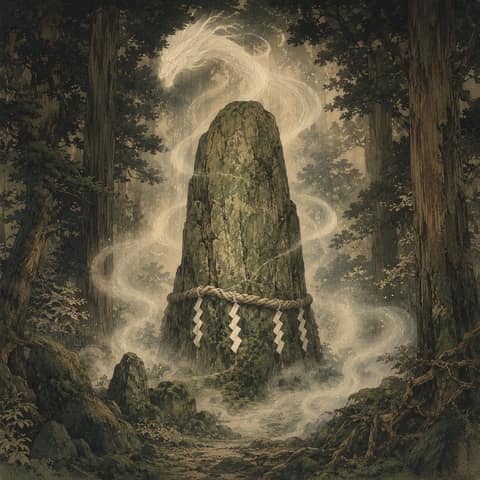
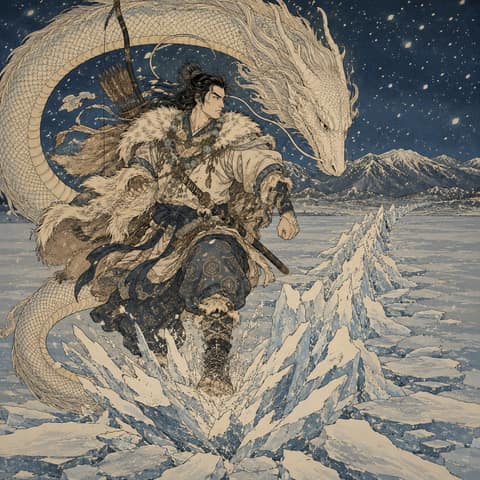
Moriya-no-kami is an indigenous deity and local tutelary god (*jinushigami*) passed down in the Suwa region. He is spoken of as the god who controlled the land before Takeminakata-no-kami, the enshrined deity of Suwa Grand Shrine, entered Suwa. According to the Moriya Shrine, which currently sits in Kawagishi-higashi, Okaya City, Moriya-no-kami confronted Takeminakata-no-kami at the Fujishima Shrine, later reconciled with him, and devoted himself to the Suwa Shrine as the High Priest (*Jinchokan*) of the Suwa Upper Shrine[1]. In the official historical account of Suwa Grand Shrine, Takeminakata-no-kami is said to be the god who, after opposing the yielding of the land (*Kuni-yuzuri*), moved from Izumo to Suwa to build and govern the province of Shinano. Therefore, Moriya-no-kami is positioned as the deity who bears the memory of the land in response to the "arriving Suwa Myojin"[2].
Folklore & Legends
When discussing Moriya-no-kami, it is important not to equate him with Mononobe no Moriya. The official page of Moriya Shrine also explicitly states that he is "a separate existence from Mononobe no Moriya," and the Moriya-no-kami discussed here is the local tutelary and ritual deity of the Suwa region[1]. Furthermore, Moriya-no-kami is spoken of as a deity holding the rights to Mishaguji rituals, closely tied to the ritual memories of the Moriya clan, the High Priests. If Misakuchi-no-kami (Mishaguji) is the tutelary god of the ancient Suwa layer who descends upon stones, trees, pillars, and boundaries, then Moriya-no-kami is the entity that connects that ancient layer to the ritual rights, land control, and memories of the priestly family in human society[3]. Therefore, Moriya-no-kami is not so much a yokai, but rather a key divine figure in the Suwa faith that connects Takeminakata-no-kami, Mishaguji, and the Moriya clan.
The charm of Moriya-no-kami lies in the fact that he is spoken of not as the victor of the central mythology, but as the deity who was there first. Takeminakata-no-kami is the Great God of Suwa standing at the center of the official historical view of Suwa Grand Shrine, but the story of that god entering Suwa requires a god on the receiving end. Moriya-no-kami fulfills that role. He is not a god who fights, loses, and vanishes, but one who, after reconciling, enters into the ritual order as the High Priest. Therein lies a uniquely Suwa-like layering of faith, not merely conquest and replacement. When reading Onbashira, Mishaguji, the Moriya clan, and Suwa Myojin as a single geological stratum, Moriya-no-kami stands precisely at the boundary of those layers.
Character Profile
This section is our own creative profile for storytelling. It is not historical fact or scholarship.
An ancient deity who controlled the land first. Retaining the memory of conflict, he bears a quiet majesty that supports the ritual order after reconciliation.
Compatibility
Strongly tied to Takeminakata-no-kami, Mishaguji, Suwa Grand Shrine, the Moriya clan, Fujishima Shrine, and the dragon/serpent and water god beliefs around Lake Suwa.
Abilities
Demonstrating dominion over the landSupporting the rituals of the ancient Suwa layerConnecting to Mishaguji ritualsBridging the boundary between foreign deities and local land gods
Weaknesses
Not a major deity appearing prominently in the main text of the Kojiki; his outline becomes faint when removed from the context of shrine legends, local folklore, and the Moriya clan's rituals.
Habitat
Moriya Shrine, around Fujishima Shrine, Suwa Grand Shrine Upper Shrine Ritual Sphere, and around Lake Suwa
The diagram below is a diagnostic evaluation chart for Moriya-no-kami, the Local Deity of Suwa Who Confronted Takeminakata-no-kami. The higher the value of each item, the stronger that characteristic is expressed.