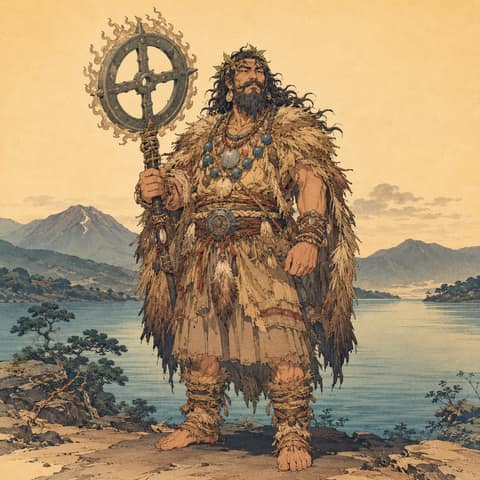
Mishaguji is an indigenous kami and *yorishiro* (object-bound) deity passed down primarily in the Suwa region. Rather than being an anthropomorphic deity with a distinct personality, it is spoken of as a divine spirit that descends into stones, trees, pillars, boundaries, and the land itself. It has been deeply connected with the rituals of the Upper Shrine (Kamisha) of Suwa Grand Shrine and the ceremonial system of the Moriya clan. Research suggests that this Mishaguji worship forms the ancient substratum behind the Suwa Myojin faith centered on Takeminakata, making Mishaguji an important "deity sunken at the bottom of the Suwa faith"[1][2].
Folklore & Legends
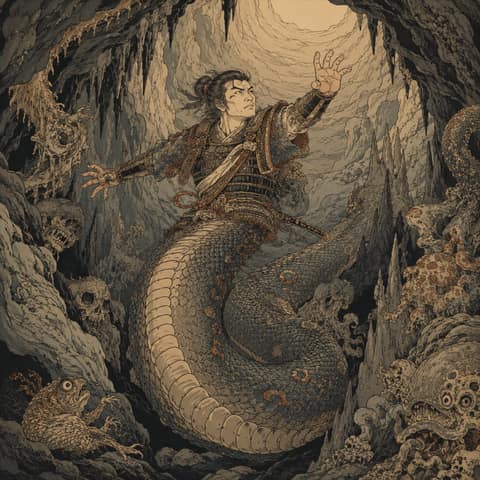
The defining characteristic of Mishaguji is its lack of a fixed form. Though sometimes described as a serpent, stone deity (Ishigami), boundary deity (Dosojin), or tree deity, it is better understood as a formless spirit "brought down" into a *yorishiro* (vessel). In modern folklore studies, its relationship with name variations like Ishigami, Shaguji, Saguji, and Sae-no-kami has been heavily discussed; ever since Kunio Yanagita's *Ishigami Mondo* (Dialogues on Stone Deities), it has been a central subject in debates surrounding spirits dwelling in stones and boundaries[3]. On the other hand, the official Suwa faith explained by the Suwa Grand Shrine revolves around the worship of Suwa Myojin, the Onbashira pillars, and the ritual structure of the Upper and Lower Shrines. Mishaguji is not the primary deity standing on this surface layer, but rather an ancient kami revealed through the memories of the Suwa land, its rituals, and the Moriya clan[4][5].
If one were to treat Mishaguji as a "yokai," it should be viewed not as a terrifying monster, but as a being existing on the border between kami and yokai. Its essence does not lie in folktale tropes like attacking people, shape-shifting, or appearing on dark roads at night, but rather in the spiritual power of stones, trees, pillars, and land invoked through rituals. In Suwa, Takeminakata, Moriya, the Moriya clan, and the Onbashira Festival overlap in complex ways, leaving behind a thick layer of faith that cannot be fully explained by the deities of central mythology alone. Mishaguji is the key to reading this underlying stratum, a presence that transforms Suwa from a mere "stage of myths" into a "place where the land itself harbors the divine."
Character Profile
This section is our own creative profile for storytelling. It is not historical fact or scholarship.
A quiet spiritual presence dwelling in stones, trees, pillars, and boundaries without a fixed form. Not a raging monster, but a deity that descends to the land through ritual.
Compatibility
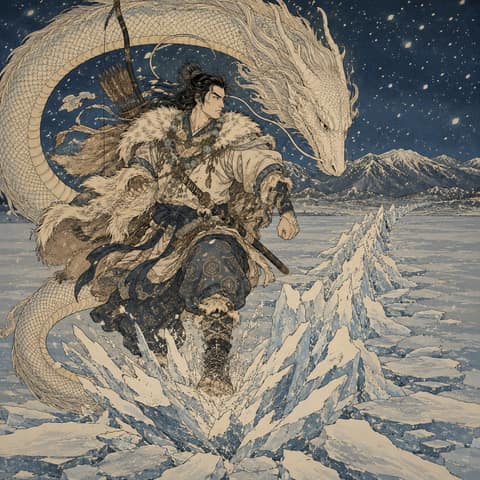
Strongly connected to Takeminakata, Moriya, the Suwa Grand Shrine, the Onbashira Festival, and dragon/serpent deity beliefs.
Abilities
Descends into stones, trees, and pillars as vesselsProtects the land and its boundariesUpholds the spiritual authority of Suwa ritualsStraddles the boundary between kami and nature spirits
Weaknesses
Lacks mythology as an independent, anthropomorphic deity; its outline becomes vague when removed from the context of the Moriya clan rituals and Suwa faith.
Habitat
Around Lake Suwa, the ritual sphere of the Suwa Grand Shrine Upper Shrine, and vessels like stones, trees, pillars, and boundaries.
The diagram below is a diagnostic evaluation chart for Mishaguji, Ancient Suwa Deity Descending into Stones and Trees. The higher the value of each item, the stronger that characteristic is expressed.