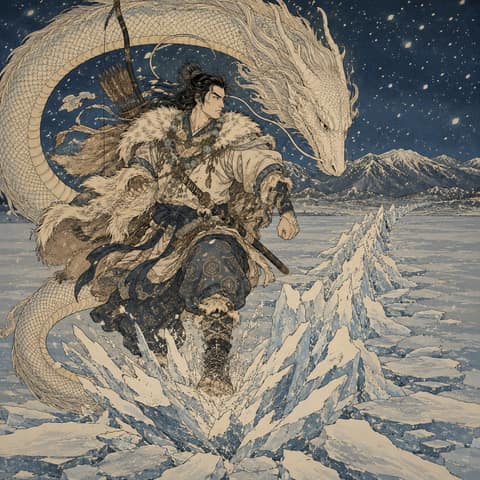
Koga Saburo is the protagonist of a medieval Japanese legend found in the "Origins of Suwa" chapter of the Shintosho, recounting an epic subterranean journey and his transformation into a serpent. Described as the third son of a powerful family in the Koka District of Omi Province, he enters a deep cave in Mount Tateshina in Shinano Province while searching for his missing wife, Princess Kasuga, only to be trapped underground due to his older brother's jealousy. After a long and arduous wandering through the subterranean otherworld, he finally returns to the surface, but his body has transformed into that of a giant serpent or dragon, ultimately linking him to the worship of the Suwa Upper Shrine's deity[1]. Rather than conflating him with Takeminakata-no-Kami from the Kojiki, Koga Saburo is best understood as the product of an alternate medieval Suwa origin myth—an archetypal story of "a warrior who attains godhood by passing through the form of a serpent"[2].
Folklore & Legends
The core of the Koga Saburo legend features elements of a hero's descent into the underworld, fraternal jealousy, the search for a lost wife, transformation into a serpent, and his ultimate deification as the Suwa Myojin. In her study of the source material for the story "Gyofukuki", Kyoko Aoki treats Koga Saburo as a "Koga Saburo turned Dragon" legend linked to giant serpents, Suwa, and the *Tale of the Koga Saburo Cave*[3]. Additionally, Yuko Tagaya categorizes the Koga Saburo legend under the AT301 tale type of the international folktale classification system, focusing on the structural elements of the subterranean realm, the otherworld, adversaries, and the hero's return for comparative research[4]. In the Edo period, the story was adapted into a *joruri* puppet play known as the *Tale of the Koga Saburo Cave*, expanding its influence beyond Suwa mythology into the realms of Koka, Iga, and traditional performing arts[5].
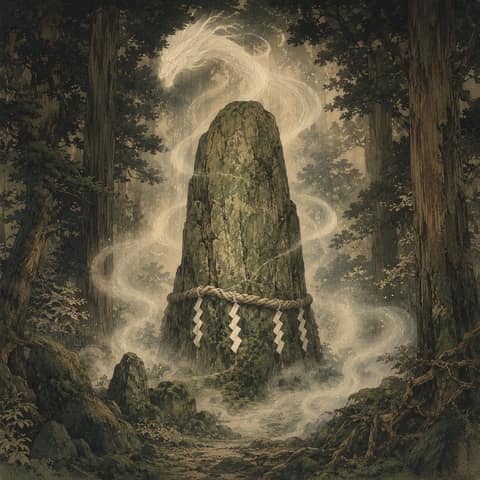
The fascination of the Koga Saburo legend lies not merely in its heroic epic, but in how it explains the origins of Suwa Myojin as "the return of a mortal who fell underground." Unlike Takeminakata-no-Kami from the Kojiki, who retreats to Suwa as the defeated figure in the myth of the transfer of the land, Koga Saburo travels from Omi to Shinano, falls into the underworld through a cave on Mount Tateshina, and returns as a serpent. The deity of Suwa does not simply descend from the heavens, nor does it merely arrive from central mythology; it manifests by passing through mountain caves, subterranean kingdoms, and the body of a snake. This narrative beautifully weaves together the elements of Suwa worship—water, mountains, dragons, serpents, hunting, and the syncretism of Shinto and Buddhism—into a single tale. This is precisely why it is meaningful to establish Koga Saburo as a distinct figure alongside the official enshrined deity Takeminakata.
Character Profile
This section is our own creative profile for storytelling. It is not historical fact or scholarship.
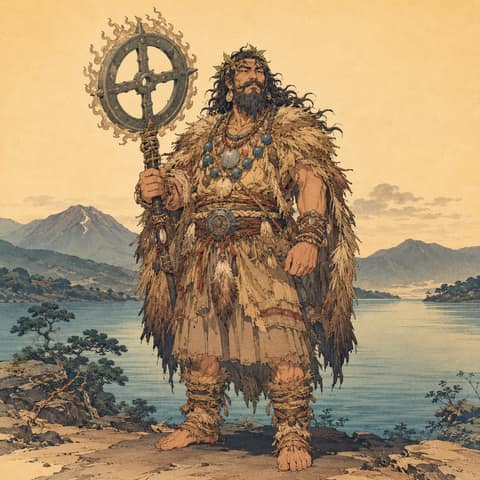
A brave and relentless seeker. Even when cast into the abyss by the jealousy of his own blood, he continues to forge ahead through the underworld, and even after transforming into a serpent, he never loses his resolve to return to Suwa.
Compatibility
He resonates strongly with Takeminakata-no-Kami, Suwa Taisha, Mount Tateshina, the Mishaguji deities, Moriya-no-Kami, dragon and serpent gods, and tales of subterranean otherworlds.
Abilities
The endurance to traverse the subterranean otherworld on footTransformation into the form of a giant serpent or dragonUnification with the deity Suwa MyojinConnecting the husband-and-wife myths of the Upper and Lower Shrines
Weaknesses
As he belongs to a medieval origin myth distinct from the Kojiki's Takeminakata-no-Kami, oversimplifying them as the exact same deity can lead to misunderstandings.
Habitat
Koka District in Omi Province, the caves of Mount Tateshina, Suwa Taisha's Upper and Lower Shrines, and the areas surrounding Lake Suwa.
The diagram below is a diagnostic evaluation chart for Koga Saburo, the Serpent Deity of the Underworld. The higher the value of each item, the stronger that characteristic is expressed.