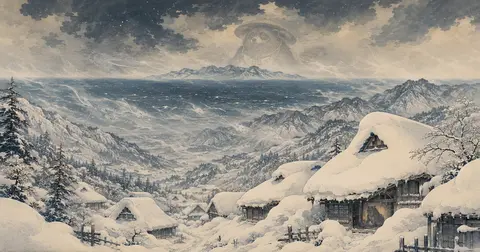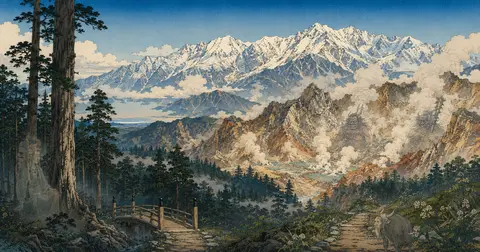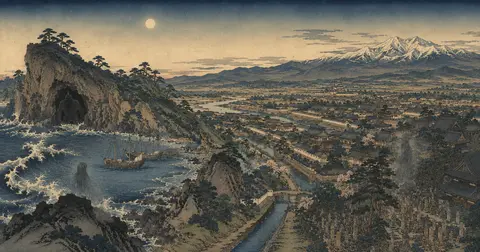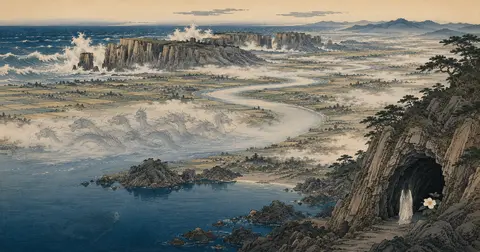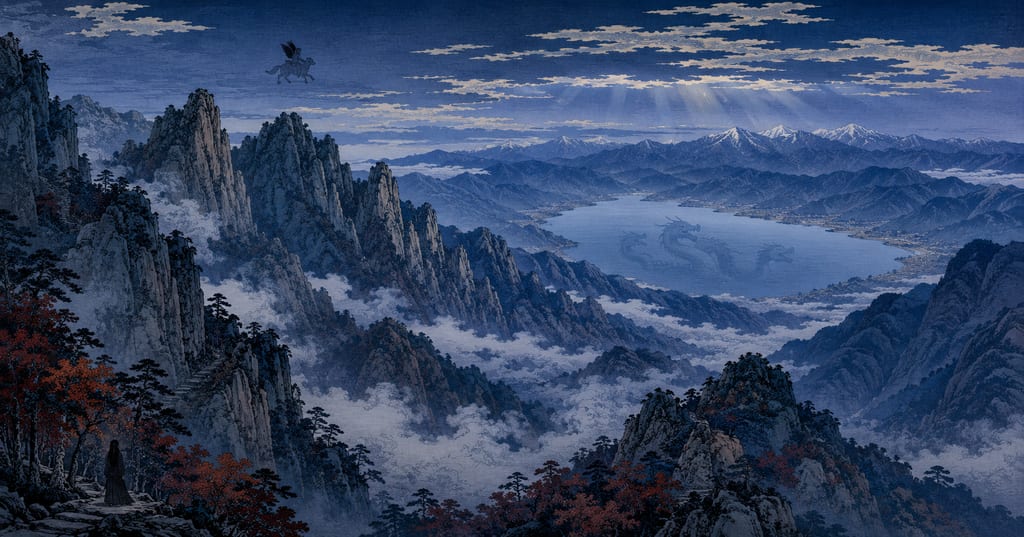
The landlocked mountain province of Shinano (present-day Nagano) is one of the most yokai-dense regions in the Japanese archipelago. The 3,000-meter peaks of the Northern, Central, and Southern Alps, Lake Suwa sinking at the foot of the Yatsushigatake mountains, the rugged sacred peaks of Togakushi and Iizuna, and the deep valleys pierced by the Nakasendo and Kiso roads ── the higher the mountains and the deeper the valleys, the more tales of clashes between gods and demons accumulate.
Among them, Suwa is an exceptionally rare land of "defeated gods" in Japan, where a deity defeated in the myth of the transfer of the land fled, mingled with indigenous gods, and birthed a new faith. Those driven into the mountains became gods, slain demons were etched into place names, and a wind that cuts people without a sound blows through the mountain passes. Lacking the bounties of the sea, this province has instead harbored tales of gods and demons equal to the number of its mountains and valleys. The ancient layer of faith from the Jomon period remains exposed and alive today ── let us trace these yokai of Shinano, moving from Suwa, to Togakushi and Iizuna, to Kiso and the villages.
Suwa ── The God of the Defeated and the Origin Tale of the Underworld
To speak of the yokai of Shinano, one must begin with Suwa. Here lies a stratum of faith unique in the archipelago, where gods from different eras are layered upon a single land. Even when new gods arrived, the old gods were not erased; defeated gods and native gods alike have continued to be enshrined side by side on the shores of the same lake.
Takeminakata-no-Kami
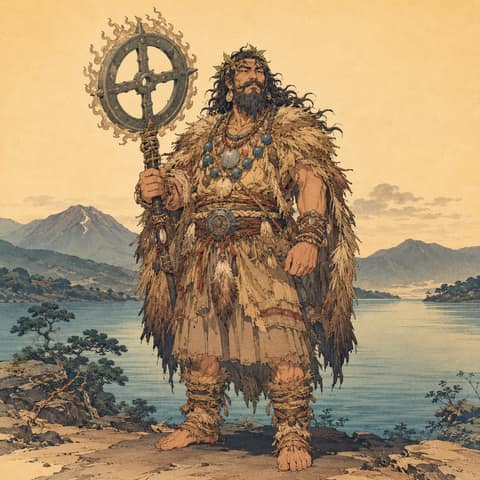
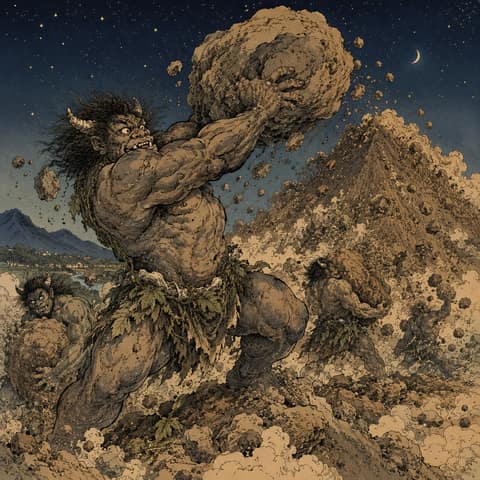
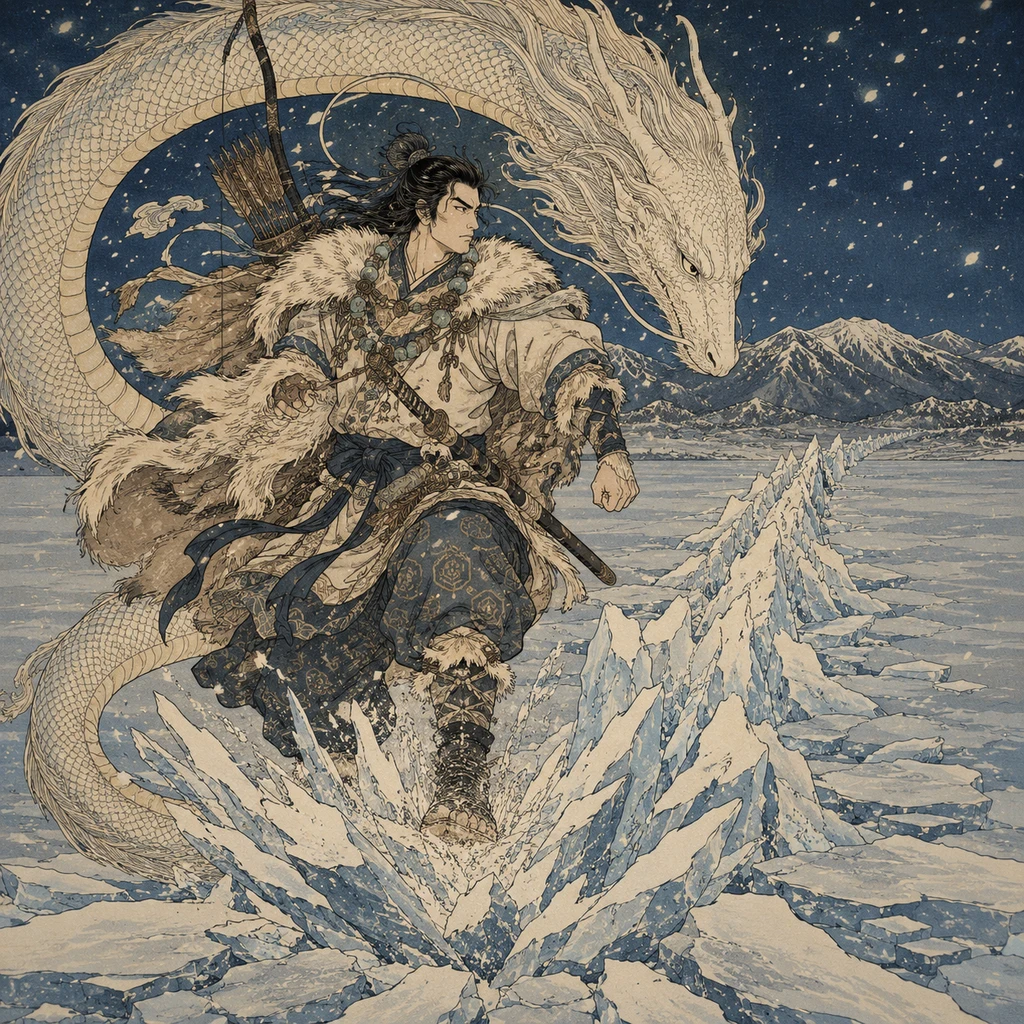
Takeminakata-no-Kami is a son of Okuninushi-no-Kami who appears in the *Kojiki*'s myth of the Transfer of the Land (Kuni-yuzuri). He has been worshipped as Suwa-no-Okami and Suwa-Daimyojin, the deity enshrined at Suwa Taisha. The Kokugakuin University Deity Name Database summarizes that Takeminakata-no-Kami challenged Takemikazuchi-no-Kami to a test of strength, was defeated, pursued to the Sea of Suwa in Shinano Province, and pledged the surrender of Ashihara-no-Nakatsukuni. Reading only this narrative makes him appear as a defeated god of resistance. However, in Suwa, his immense strength and the memories of the frontier were reassembled into a grand divine character governing wind and rain, water, hunting, agriculture, and victory in contests. The official history of Suwa Taisha narrates that Takeminakata-no-Kami is the deity who moved from Izumo to Suwa, newly building and ruling Shinano Province. The characteristics of the Suwa faith possess a depth that cannot be explained by a single scene from the central myth. The official explanation of the Suwa faith presents Suwa Taisha as an ancient faith that does not have a main sanctuary (honden), but worships nature itself as the object of reverence (goshintai), and describes Takeminakata-no-Kami as a powerful deity governing wind and rain, and the tutelary god of agriculture, hunting, seafaring, and contests. In other words, Takeminakata-no-Kami is simultaneously the loser of the Izumo myth and the local principal deity who unifies the nature and livelihood of the Suwa basin. There is also scholarly fluctuation regarding the positioning of this deity. Kokugakuin points out that Takeminakata-no-Kami's name does not appear in the genealogy of Okuninushi-no-Kami in the *Kojiki*, nor does he appear in the *Nihon Shoki*. However, he is confirmed as the enshrined deity of Suwa by the *Sendai Kuji Hongi* and the entry for Minakatatomi Shrine in the *Engishiki* Jinmyocho. Furthermore, the *Suwa Daimyojin Ekotoba* relays that he defeated Moriya-no-Kami, who was originally the god of Suwa, and enshrined himself there. Takeminakata-no-Kami is a deity standing at the intersection where ancient myths, local Suwa rites, the tutelary god of samurai families, and beliefs in dragon and water deities all overlap.
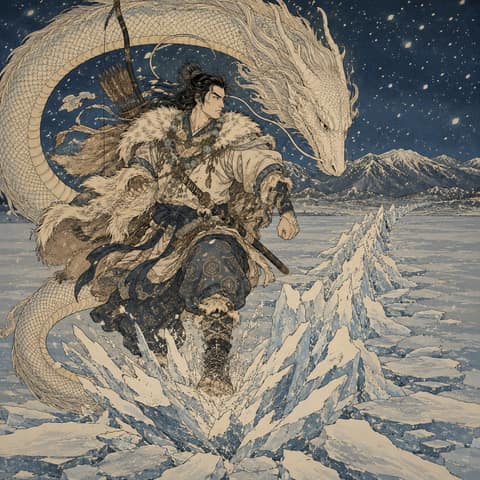
Read moreThe newest layer is Takeminakata-no-Kami, who fled to Suwa after being defeated in the myth of the transfer of the land (Kuni-yuzuri). In the *Kojiki* (Records of Ancient Matters), Takeminakata, a son of Okuninushi, challenges the heavenly messenger Takemikazuchi to a test of strength. However, Takemikazuchi's hand turned into an icicle, then into a sword blade, and he crushed Takeminakata's hand like a reed. The defeated god was pursued all the way to the Sea of Suwa (Lake Suwa) in the province of Shinano, where he surrendered, swearing "I will never leave this land"[1]. Yet, this "loser" of the central mythology was elevated in Suwa to a god of war controlling wind and water, and by the late Heian period, he was pushed to the status of a martial deity rivaling those of Ise and Katori. A god defeated and sealed in the frontier transforms into the strongest god of war precisely in that land[2] ── this reversal is the very gateway to the Suwa faith. Suwa Taisha consists of four shrines: the Kamisha (Upper Shrine) Honmiya and Maemiya, and the Shimosha (Lower Shrine) Akimiya and Harumiya. It lacks a main sanctuary (honden); the Kamisha venerates Mount Moriya as its divine body, while the Shimosha venerates sacred trees. This pre-shrine architecture speaks to the antiquity of the shrines. The Kamisha sits to the south of Lake Suwa, and the Shimosha to the north, forming a pair across the lake ── this structure, treating the lake itself as a sacred precinct, is unseen in other grand shrines.
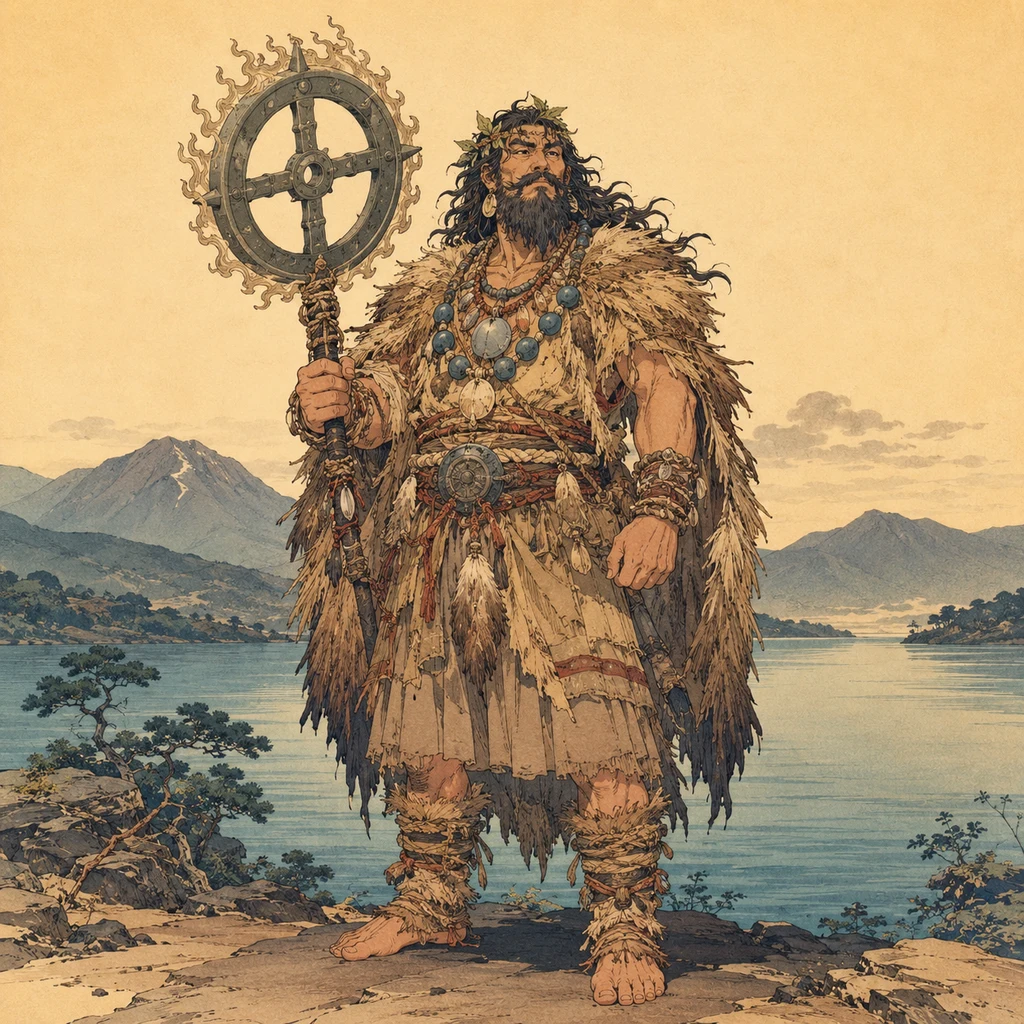
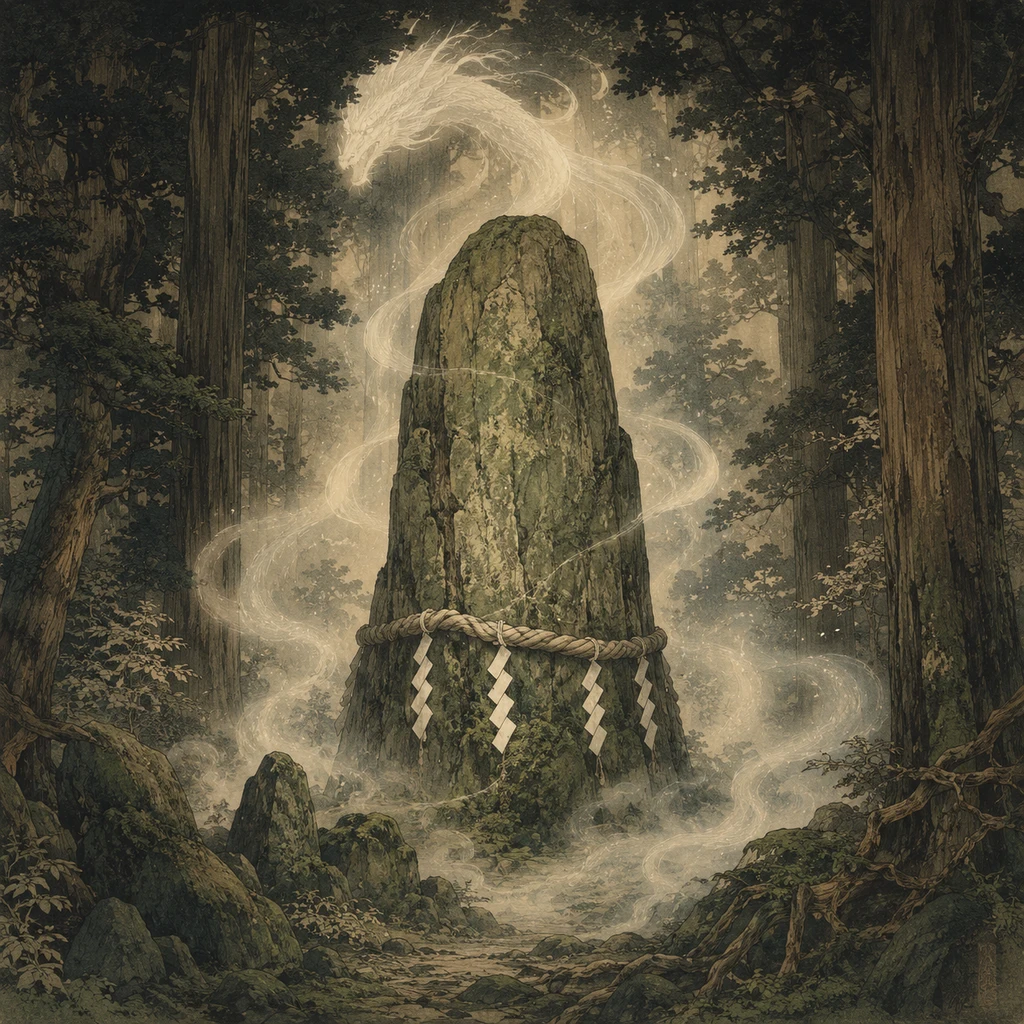
But even before Takeminakata arrived, Suwa had its own native deity: Moriya-no-Kami, the indigenous god who resisted Takeminakata's invasion wielding iron rings. The medieval *Suwa Daimyojin Ekotoba* records that Moriya fought with iron rings while the Suwa deity fought with a wisteria branch, resulting in Moriya's defeat. Though defeated, he was not erased; the Moriya clan, claiming descent from him, held the practical ritual power as the Chief Priests (Jinchokan) of the Kamisha for about 78 generations until the Meiji era. Suwa is a land where the descendants of the defeated god, rather than the victorious one, preside over the festivals. The site of their battle is said to have been across the Tenryu River, and in Okaya today, the Fujishima Shrine venerating Takeminakata and the Moriya Shrine venerating Moriya-no-Kami still stand divided on opposite banks of the river. The Jinchokan Moriya Historical Museum in Chino houses the ancient documents passed down through the Moriya family, preserving to this day the unique layering of Suwa where the victorious god and the defeated god are enshrined together.
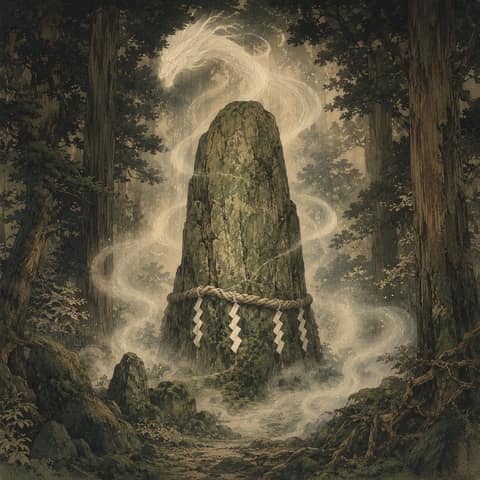
What the Moriya clan manipulated was a spirit said to descend upon stones, trees, and all things in nature ── Mishaguji[3]. The Jinchokan would call Mishaguji down upon a young boy, establishing the child as the "Ohouri" ── a living god serving as the direct vessel for the deity itself. Through an enthronement ritual, the young Ohouri became a living god, treated in the flesh as Suwa Myojin himself. This concept, akin to the *marebito* (sacred guest) faith where a god borrows human form to appear on earth, shows that Suwa is a land that has thinned the boundary between gods and humans to the absolute limit. Faith in Suwa Myojin as a god of war spread nationwide through the samurai class from the medieval to early modern periods, resulting in over ten thousand branch shrines across the archipelago today. During the Sengoku period, Takeda Shingen, who conquered Suwa, took the daughter of the defeated Suwa Yorishige (Suwa Goryonin) as a concubine, passing the blood of Suwa to his son Katsuyori. It is said that Shingen himself revered Suwa Myojin and marched into battle under banners bearing his divine name ── the god supposedly defeated and sealed in Suwa was thus summoned back to the battlefield. Theories viewing Mishaguji as a remnant of nature worship since the Jomon period (such as Kunio Yanagita's *Sai-no-Kami* theory or Shinichi Nakazawa's *Shukujin* theory) are fascinating, but these are modern interpretations; the only certainty is the singular point that "the Moriya clan held the ritual power to call down this spirit."
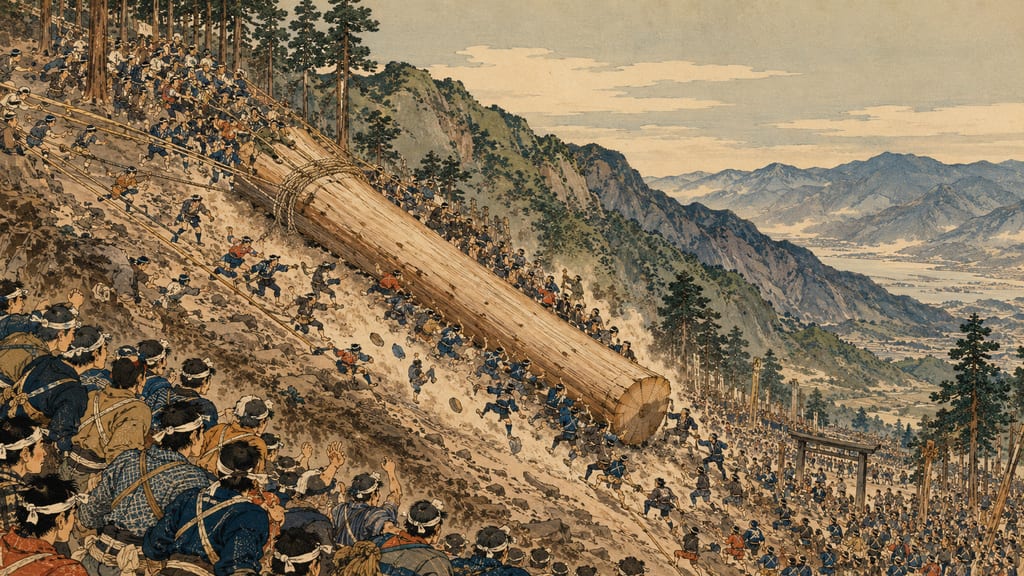
The festivals of Suwa still expose this ancient layer. Once every seven years (by traditional reckoning), in the years of the Tiger and Monkey, giant fir trees are dragged out of the mountains and slid down steep slopes with people riding them in the Onbashira Festival[4] ── a magnificent display of tree worship where gods are called down into the pillars. "Yamadashi" (dragging the giant trees from the mountain to the village), "Kiotoshi" (sliding down the steep hill in one go), and "Tate-onbashira" (erecting the pillars at the four corners of each shrine) ── this series of rituals is so intense it sometimes claims lives, yet the parishioners have repeated it without fail every seven years, turning out in full force. Pillars weighing several tons to over a dozen tons are dragged down the mountain using only human strength and erected around the shrines. The ancient tree worship of calling a god into a tree and welcoming the god from the mountain to the village along with the tree has directly become the festival. In the Kamisha's Ontosai (Head Festival), up to seventy-five deer heads were once offered (now reduced to a few taxidermy heads). It was said that among them, there was always a "split-eared deer of Takano," counted as one of the Seven Wonders of Suwa. Masumi Sugae, a travel writer who visited Suwa in the late Edo period, recorded the bizarre sight of the deer heads lined up at this festival. In an era when Buddhism abhorred the taking of life, the anomaly of Suwa, which continued to offer the heads of beasts to the god of hunting, is evident here. The New Year's *Kawazu-gari Shinji* (Frog Hunting Ritual), where frogs are shot and offered, also preserves an ancient form of animal sacrifice.
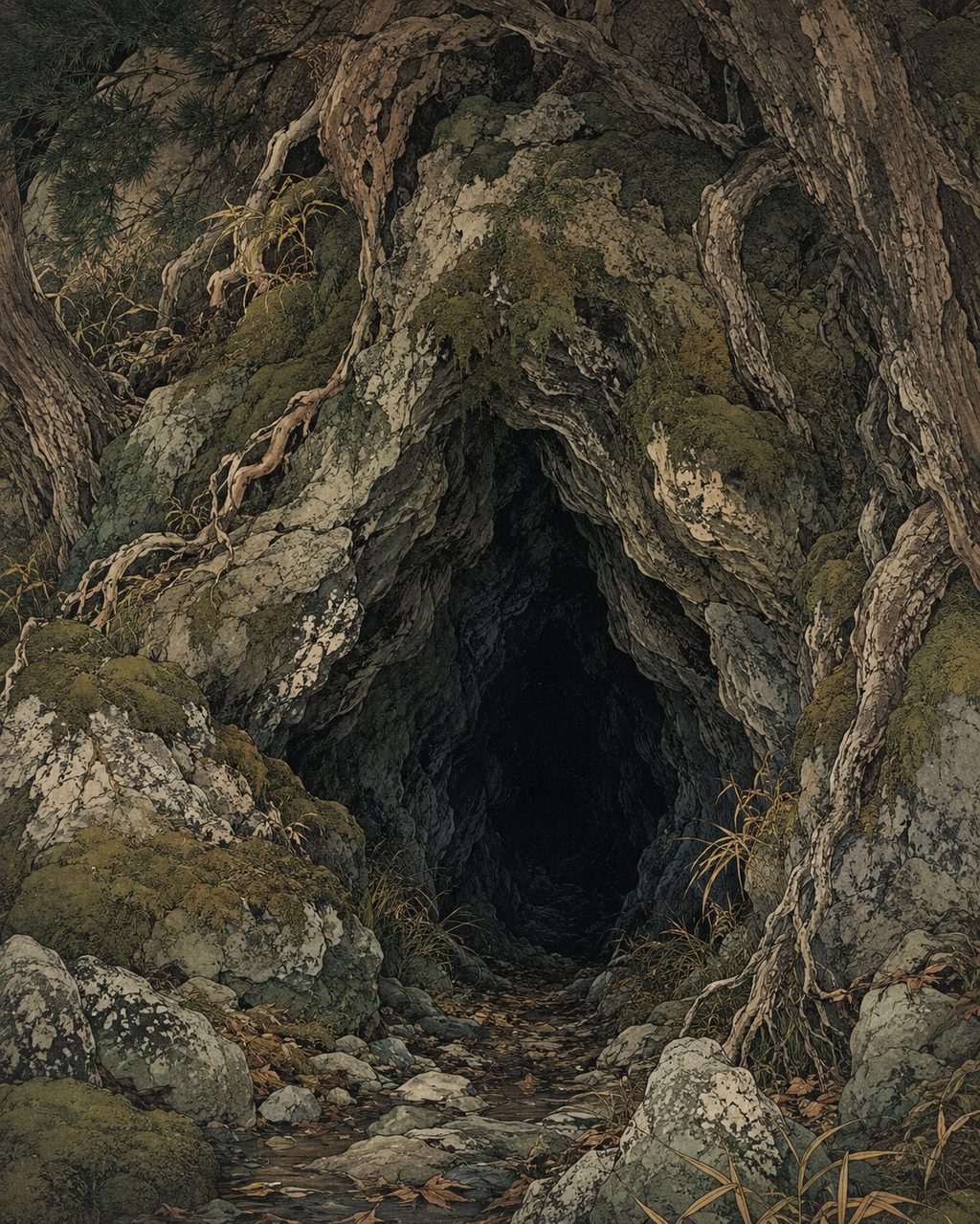
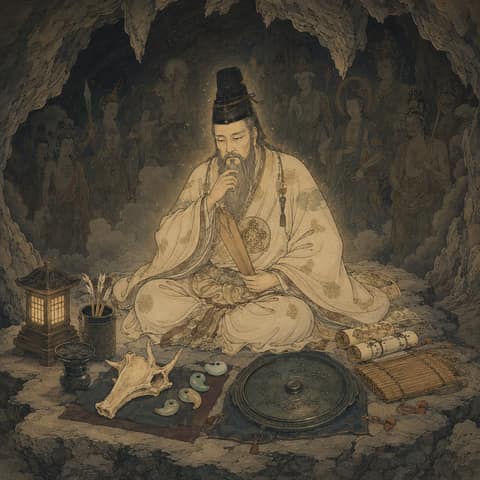
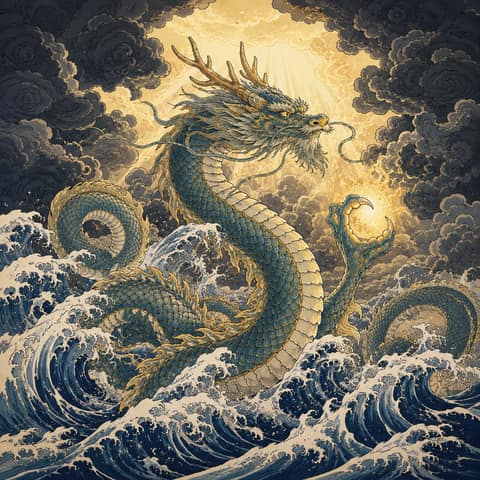
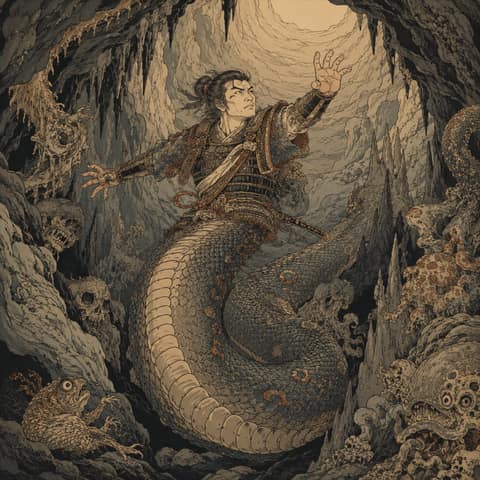
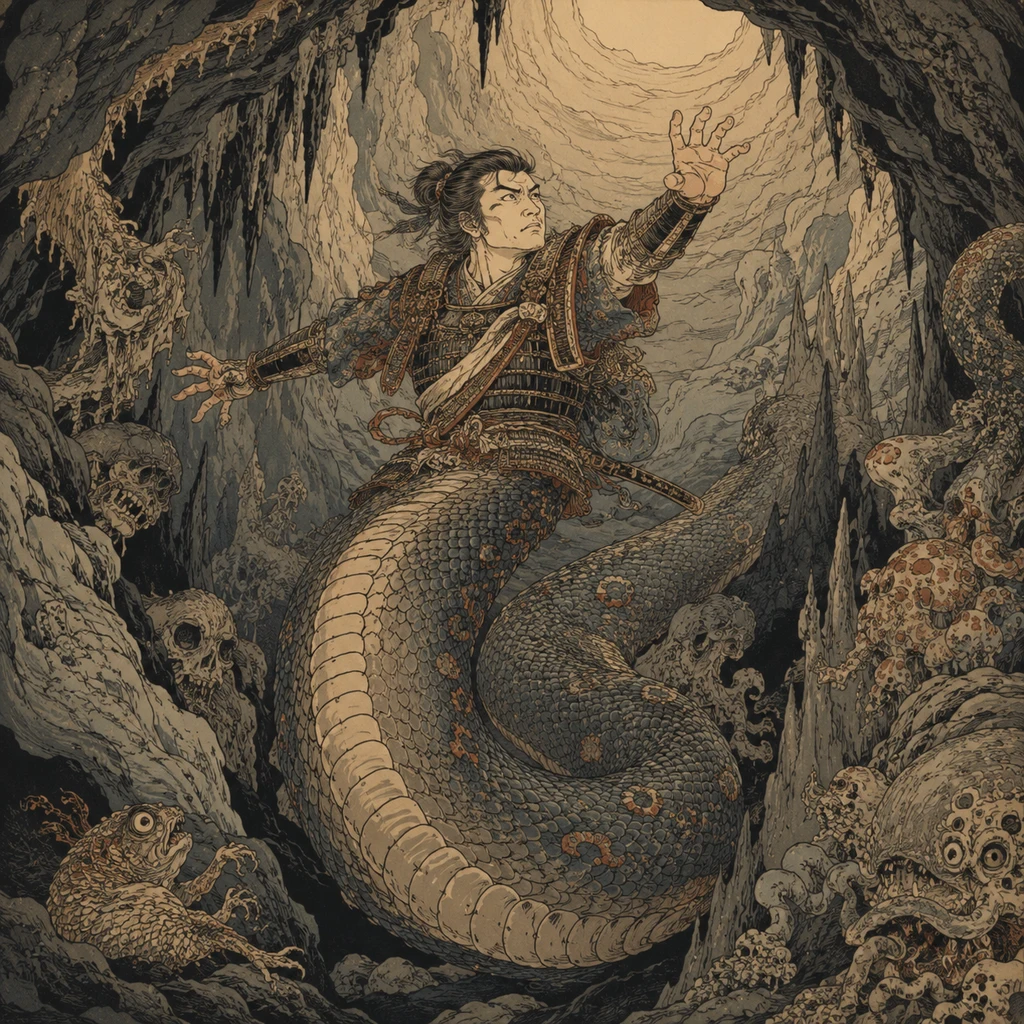
And the god of Suwa also comes from the depths of the earth. According to the origin tale in the Muromachi-period collection of tales, the *Shintoshu*, Koga Saburo of Omi Province, searching for his wife who was abducted by a tengu, descended into a human cave on Mount Tateshina in Shinano, only to be left behind in the underworld due to the betrayal of his older brother who held the rope above ground[5]. Seventy-two countries stretched across the underworld. Saburo wandered through each one, eventually reaching the country of Yuiman, where he spent over thirteen years. When he finally returned to the surface, his body had already transformed into a giant serpent covered in scales due to his long life underground. Saburo, who eventually regained his human form through the teachings of a monk, is said to have become Suwa Daimyojin, and his wife Princess Kasuga became the deity of the Shimosha [6]. At Shinraku-ji Temple in Miyota, the "Pond Where Koga Saburo Emerged" is still passed down today. This story of wandering the underworld to become a serpent and then a god is inextricably linked to the dragon and serpent worship of Suwa.
Why Are There So Many Yokai in Shinano?
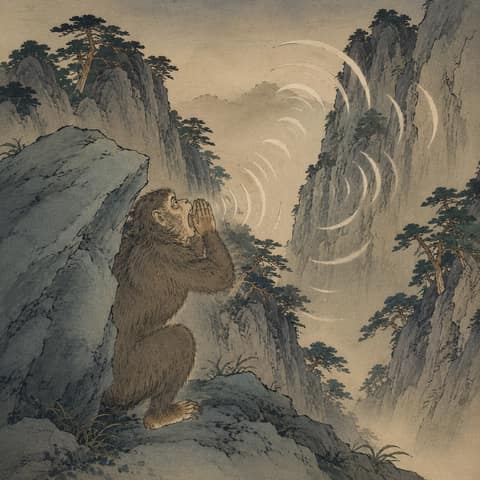
It is no coincidence that so many yokai have accumulated in a single prefecture. Shinano is surrounded by high mountains on all four sides, harboring deep valleys and countless mountain passes within. The "boundaries" separating the domains of humans from the non-human were carved as topography itself between mountains and between villages. Every time a person crossed a pass, traversed a valley, or peered into a deep pool, they stepped upon that boundary. The Kamaitachi that blows, the Yamabiko that echoes, and the Azuki-arai that makes noise are all products of such boundary places.
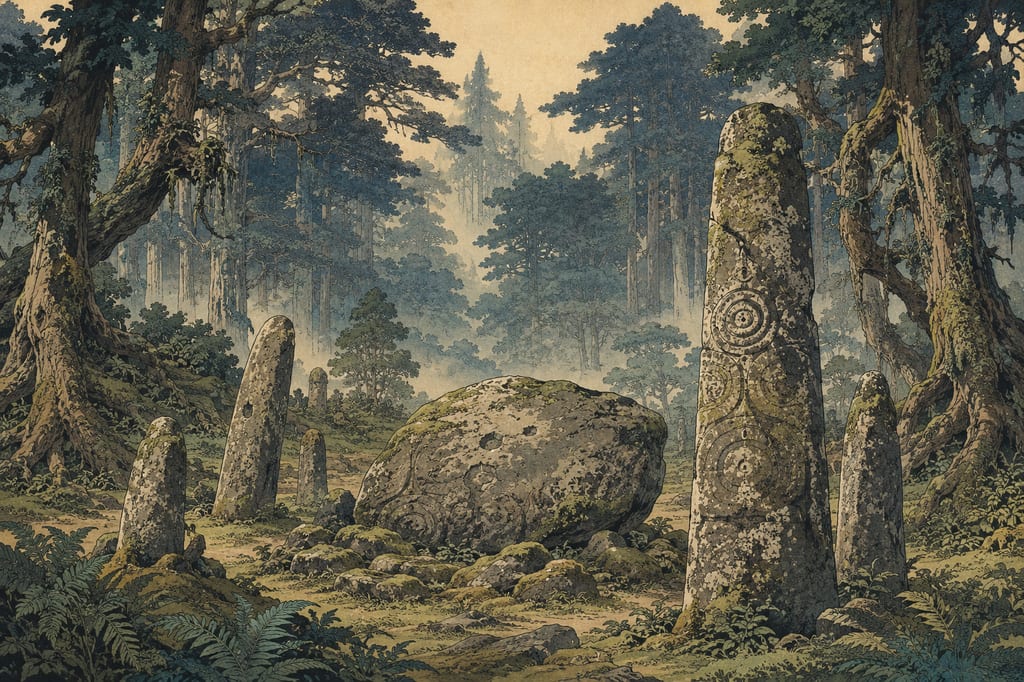
Furthermore, Shinano is a land where ancient time since the Jomon period lies exposed. At the foot of the Yatsushigatake mountains, Jomon sites like Togariishi and Idojiri are densely clustered, and clay figurines (dogu) and stone rods have been unearthed from the ground. Some scholars view the Mishaguji faith of Suwa and the tree rituals of the Onbashira as remnants of this Jomon nature worship ── while this is an interpretation rather than an empirically proven fact, people have viscerally felt that the ancient layer preceding the *Kojiki* and *Nihon Shoki* still breathes in this land. It is because of this antiquity that Kunio Yanagita, Shinobu Orikuchi, and more recently Shinichi Nakazawa have often discussed Shinano as a "land where indigenous faith lies bare."
And Shinano had roads that carried people and stories. The Nakasendo and Kiso roads pierced the rugged valleys, and legends were transported along with travelers from post town to post town. The power of these highways is why Kozenji's Hayataro was known as far away as Enshu. Enclosed by mountains, yet connected to the outside by roads ── the yokai of Shinano have been passed down in this tension. The harshness of mountain life ── raising silkworms, breeding horses, and burning charcoal in the tatara ── casts an even deeper shadow over the strange phenomena.
Togakushi ── The Flying Rock Door and Demoness Momiji
North of Suwa, towering deep behind Nagano City, Mount Togakushi is a sacred site of rock.
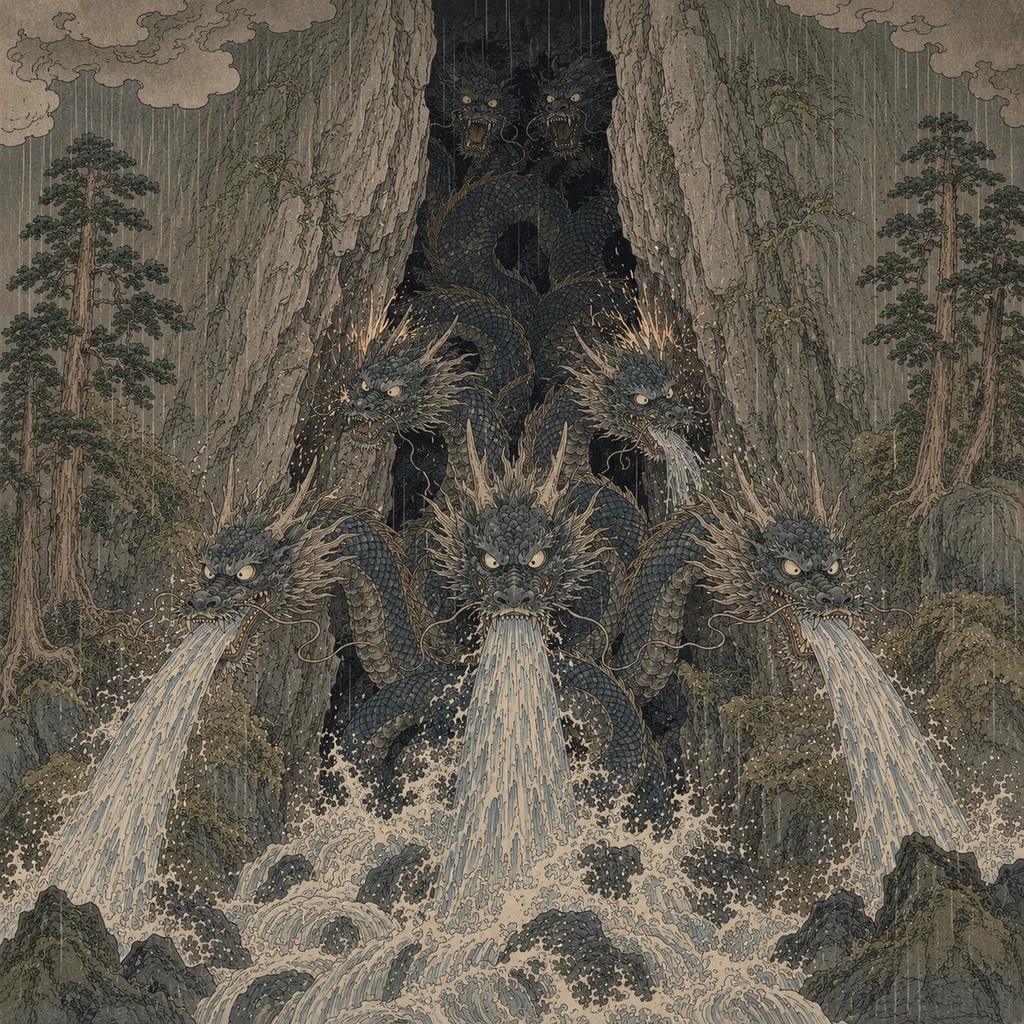
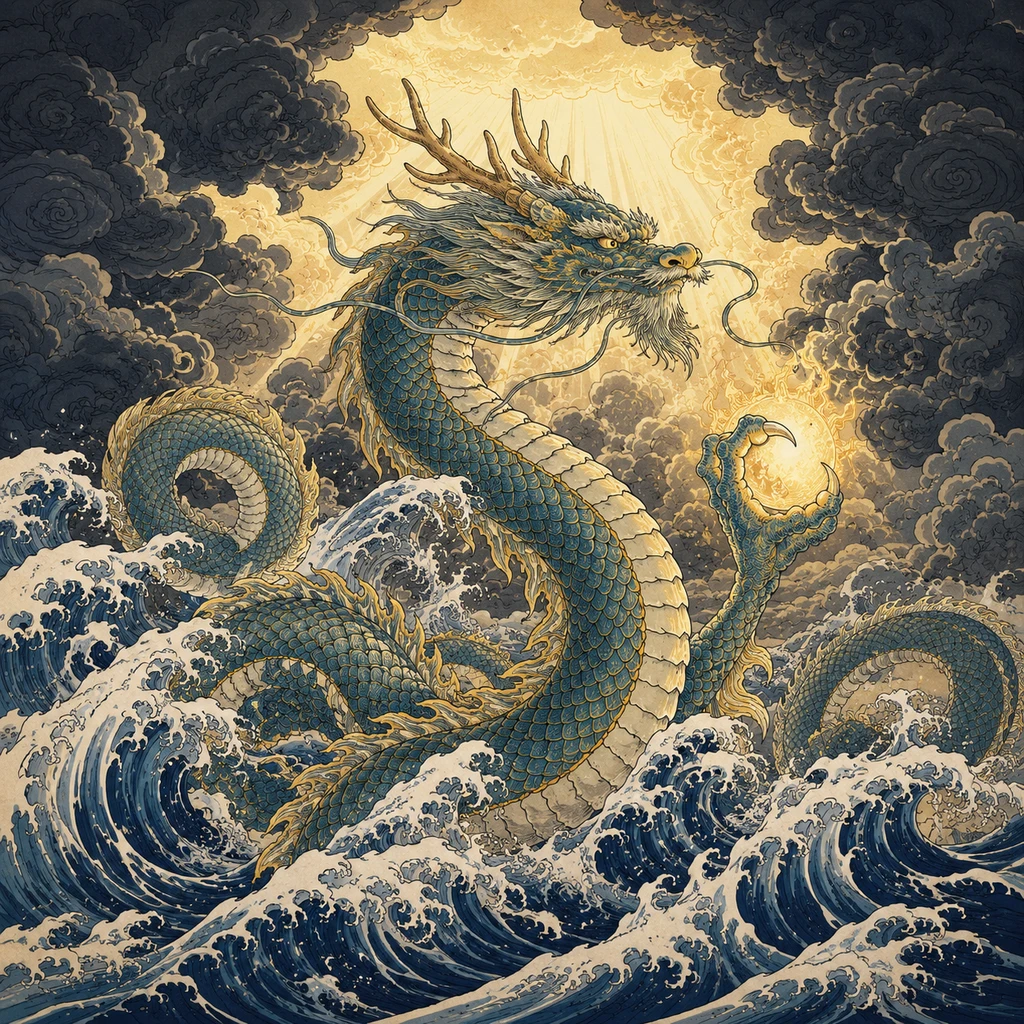
Kuzuryū
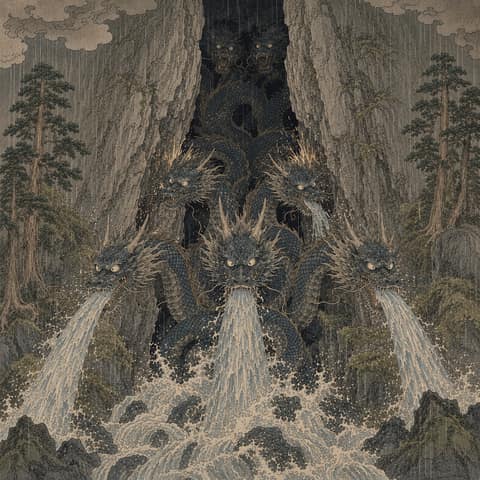
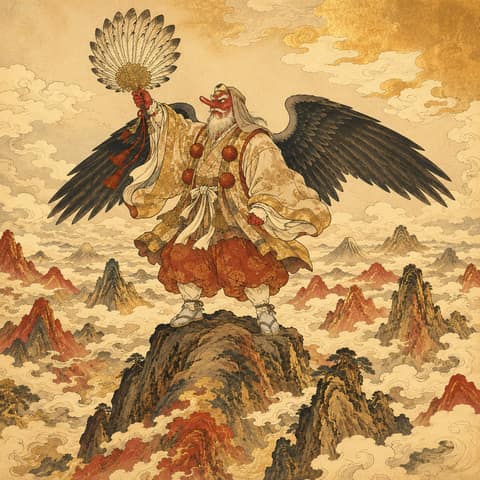
Kuzuryū, also written with the character for 'dragon' in an older form, is a nine-headed dragon worshipped as a water and rain deity and as a guardian of particular landscapes. Many traditions turn on the same transformation: a poisonous or violent dragon that once harmed people is subdued by an ascetic or eminent monk, abandons its demonic nature, and becomes a benevolent god. At Togakushi in Nagano, a nine-headed, dragon-tailed demon is said to have been sealed in a rock chamber through the merit of the Lotus Sutra by the ascetic Gakumon, also known as Gakumon Gyōja. It then settled as the local tutelary deity Kuzuryū Ōgami. At Hakone in Kanagawa, the monk Mangan is said to have subdued the poisonous dragon of Lake Ashi in the Nara period and enshrined it as the lake's guardian. In Echizen, Fukui, a Hakusan Gongen origin story tells of a nine-headed dragon swimming with a sacred image on its head, an episode said to explain the name of the Kuzuryū River. Rainmaking and flood control remain central, but regional worship also seeks relief from toothache, good relationships, and peace for the realm.
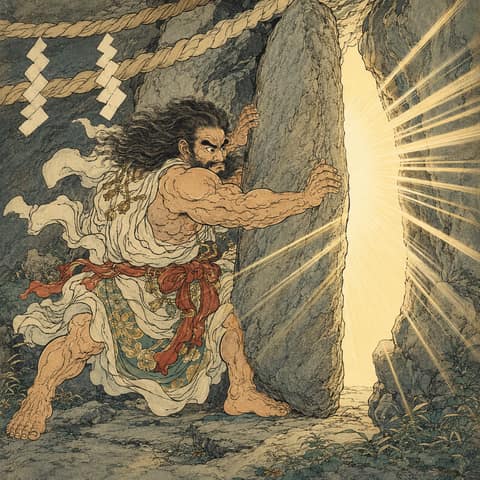
Read moreIt is said that Ame-no-Tajikarao-no-Mikoto threw open the Heavenly Rock Door (Ama-no-Iwato) behind which the sun goddess Amaterasu had hidden, and the door flew all the way to Shinano to become a mountain ── hence the name "Togakushi" (Hidden Door). Deep within the sharp rocky ridges, enshrined next to the Inner Shrine (Okusha) of Togakushi Shrine, is a nine-headed, one-tailed dragon god considered an earth deity older than Ame-no-Tajikarao ── Kuzuryu Okami[7]. As a water god for rainmaking and a deity for sealing toothaches (cavities), he is still offered cooked rice every morning. Since the ascetic Gakumon Gyoja opened this mountain in the second year of Kasho (849), Togakushi developed into a major training ground for Shugendo ascetics encompassing five shrines (Okusha, Chusha, Hokosha, Kuzuryusha, and Hinomikosha), and tales were told of ascetics sealing the nine-headed, one-tailed dragon in a rock cave using spiritual power.
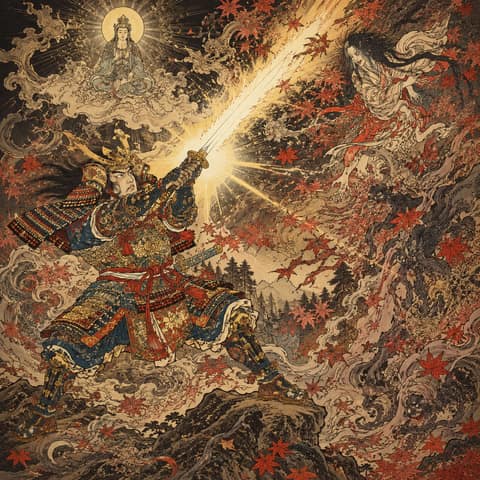
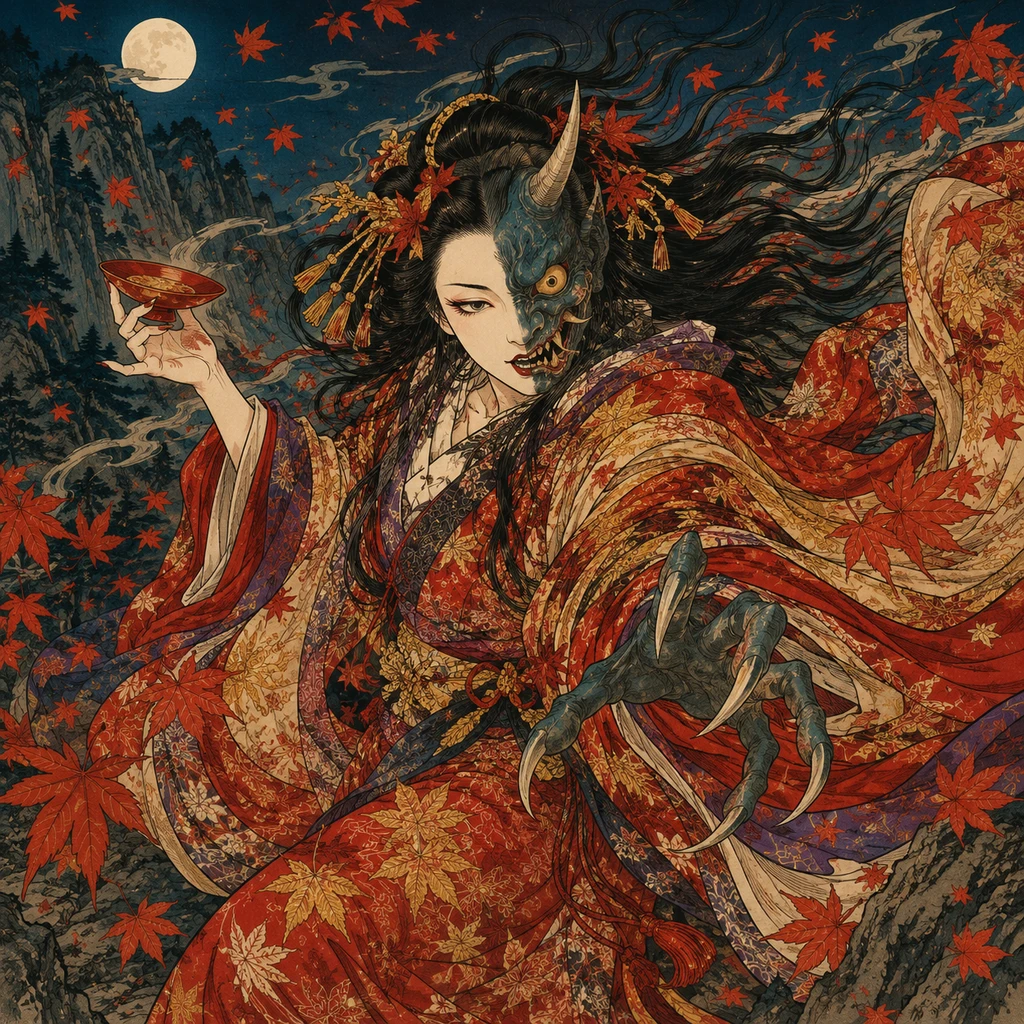 Momijigari (The Demon of the Maple Viewing)moh-MEE-jee-GAH-ree
 Ryūjinryūjin
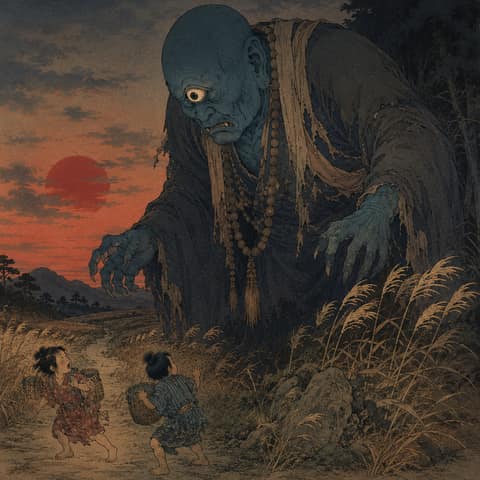
 Aobōzu (Blue Monk)ah-oh-BOH-zoo
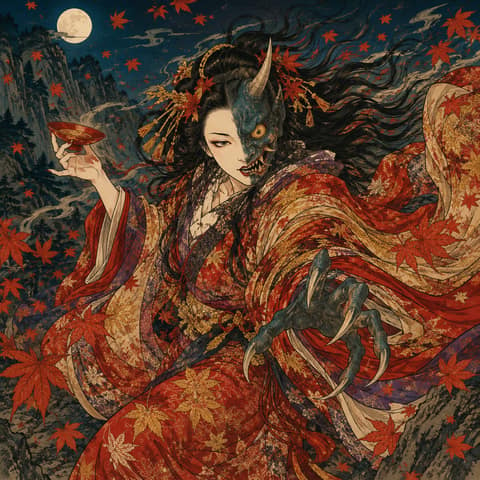
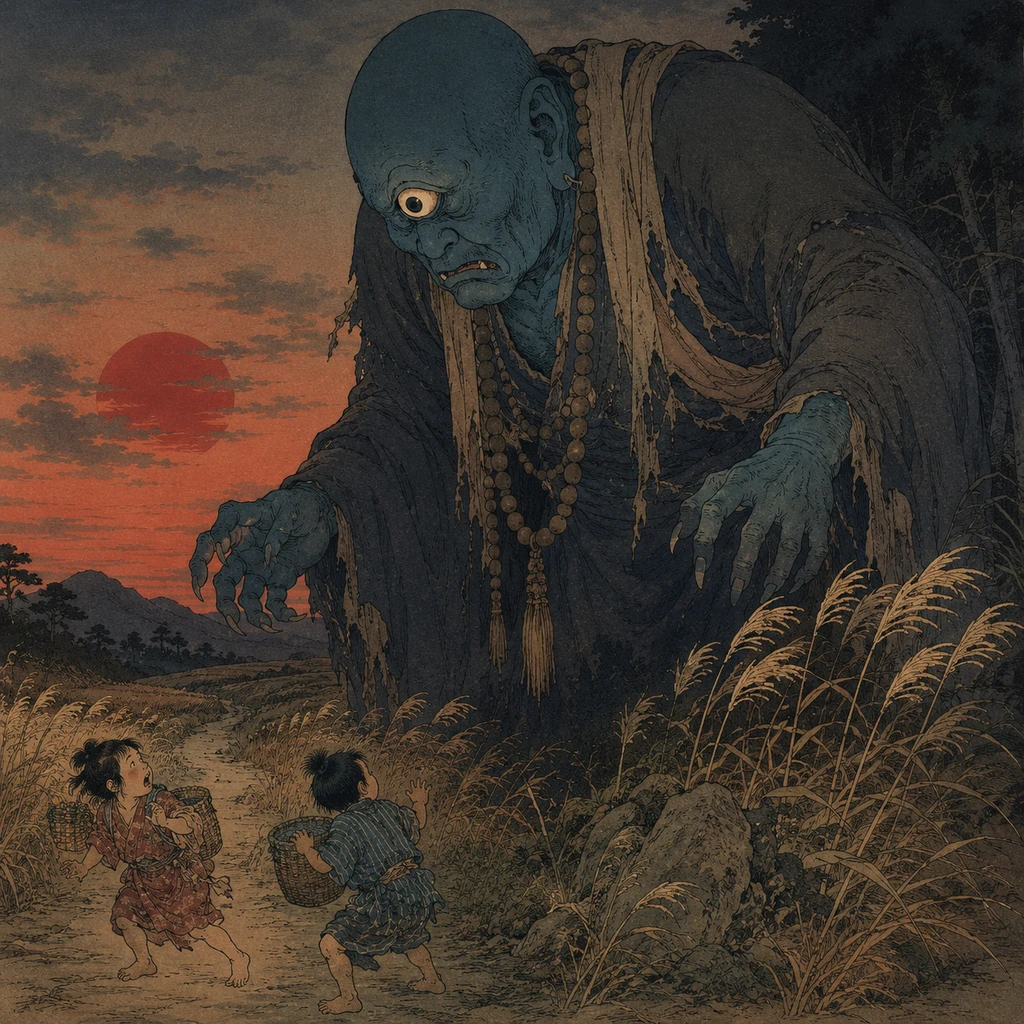
In the heart of the Togakushi mountains lies another darkness. It is the legend of Momiji, a beautiful woman exiled from the capital who turned into a demoness in the mountains of Shinano and ravaged the villages. However, detailed plot points such as "born in Aizu," "concubine of Minamoto no Tsunemoto," or "granted the power of the Demon King of the Sixth Heaven" are mostly relatively new additions depicted in the Meiji-era *Togakushiyama Kijo Momiji Taiji no Den*[8]; in the oldest layer of the tale, it is merely told that an ascetic defeated a demon with nine heads and a dragon's tail. The core story of Taira no Koremochi receiving an imperial command and slaying the demoness is still performed today as the Noh and Kabuki play *Momijigari* (Viewing Autumn Foliage)[9]. The village where the demon was slain and disappeared is said to be "Kinasa" (Demonless Village), and the "Demon's Rock Cave" remains on Mount Arakura, which was said to be her stronghold, while Kitamuki Kannon in Bessho Onsen is spoken of as the place where Koremochi prayed for victory. On the other hand, in Kinasa, there also remains a cultural tradition entirely contrary to the demoness: that the exiled Momiji taught the village the weaving and elegance of the capital ── this narrative, where the defeated leaves something behind in the land, reflects the ambiguity characteristic of Shinano, which enshrines the defeated god Takeminakata. The "Demon's Rock Cave" where Momiji is said to have holed up remains on Mount Arakura, and in Kinasa, a festival commemorating the demoness Momiji is still held in autumn. The nine-headed dragon who is the god of mountains and water, the demoness Momiji who fell to the mountains, and the giant monk Ao-bozu who swells in the twilight ── Togakushi was a mountain where the sacred and the demonic lived back-to-back.
Iizuna ── The Tengu Riding a White Fox and the Magic of Pipe Foxes
Standing to the east of Togakushi, Mount Iizuna is a mountain where ascetics received "magic" (*ho*).
Iizuna Saburō
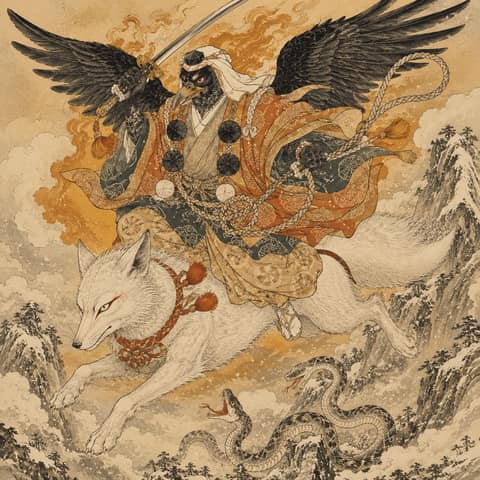
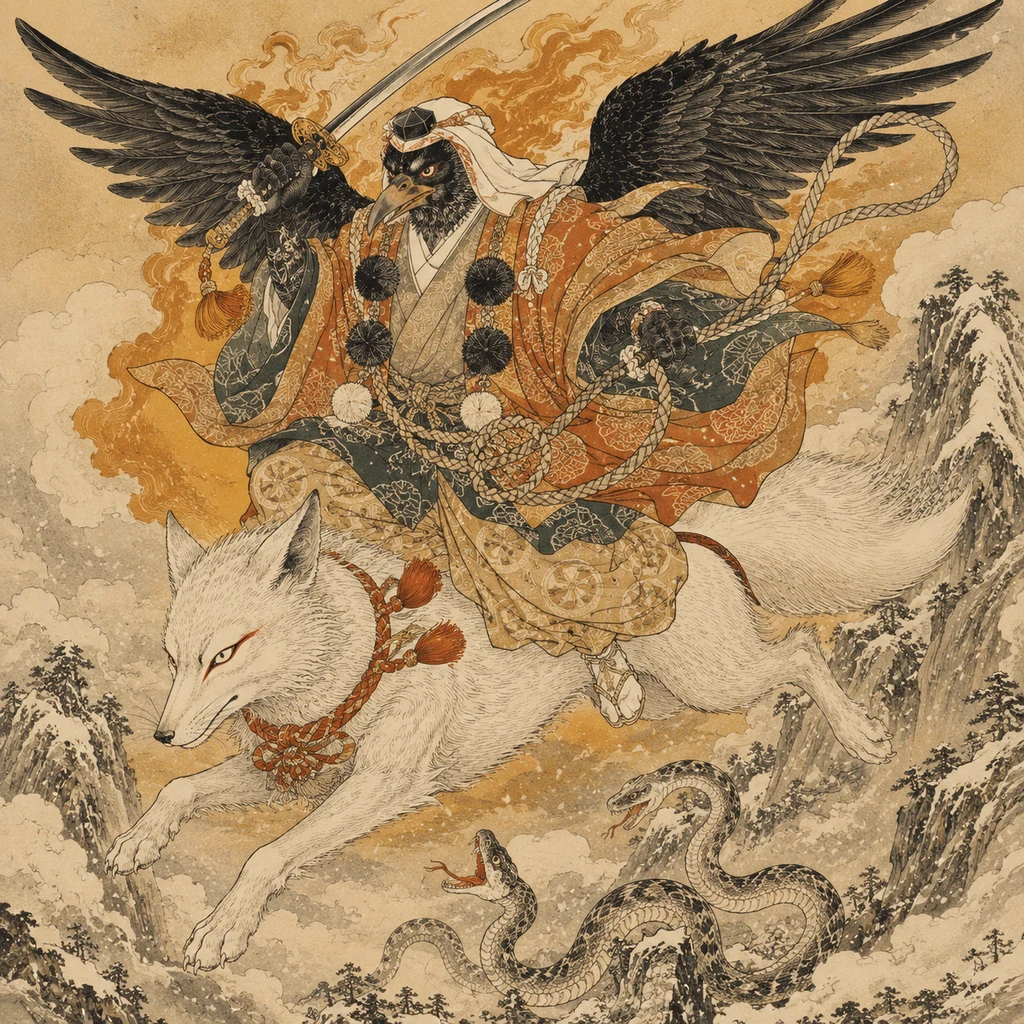
Iizuna Saburō is a great tengu enthroned on Mt. Iizuna in Shinano Province, and the lord of that mountain, who as Izuna Gongen drew a syncretic Shintō-Buddhist devotion. Counted among the Eight Great Tengu, he is said to have styled himself "the third tengu of Japan." He is figured as a crow-tengu bearing a sword and a rope (saku), mounted upon a white fox, and was deeply revered by the warrior houses as a war-god of victory. His name is recorded as "Izuna Saburō" in the medieval Togakushi-san Kenkō-ji Ruki (1458), which transmits that in the first year of Tenpuku (1233) the Izuna Daimyōjin named himself "the third tengu of Japan"—the reason for the "Saburō" (third son), ranking after Atago Tarōbō and Hira Jirōbō. He also stands named as "Izuna no Saburō" in the Muromachi Noh play Kurama Tengu.
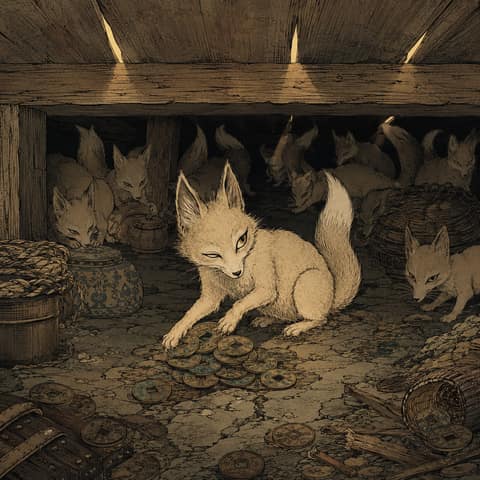
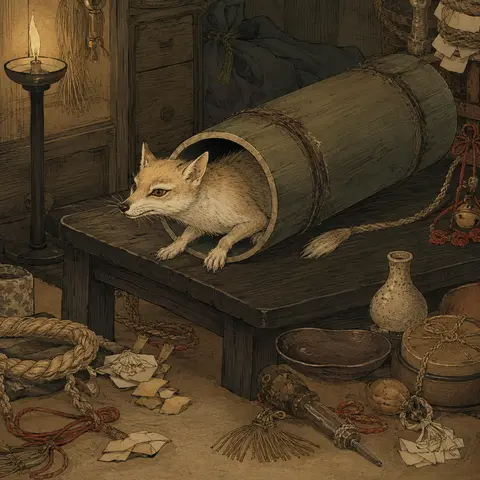
Read moreThe Iizuna Gongen enshrined here is a syncretic god of victory with the face of a crow tengu, riding a white fox, holding a sword and a lasso, bearing flames on his back, with a white snake coiled around the fox. His familiar is Iizuna Saburo[10], a great tengu who calls himself the "Third Tengu of Japan" ── ranking next to Tarobo of Mount Atago and Jirobo of Mount Hira. The "Iizuna-no-ho" (Magic of Iizuna) said to be granted by this mountain is a sorcery that commands *kuda-gitsune* (pipe foxes), fox spirits small enough to fit inside a bamboo tube, and the practitioners were called "Iizuna-tsukai." It is said that the pipe foxes possess people and make them sick, or bring them wealth. It was rumored that by asking an Iizuna-tsukai, one could have a pipe fox possess a hated enemy to make them suffer, or make a ruined family wealthy in a single generation. However, families keeping pipe foxes were sometimes shunned in marriage as "kuda-gitsune-suji" (pipe fox lineages), and the power of the magic was spoken of with both awe and discrimination. From the Chubu region to the mountains of Kanto, faith in these possessing spirits is deeply rooted.
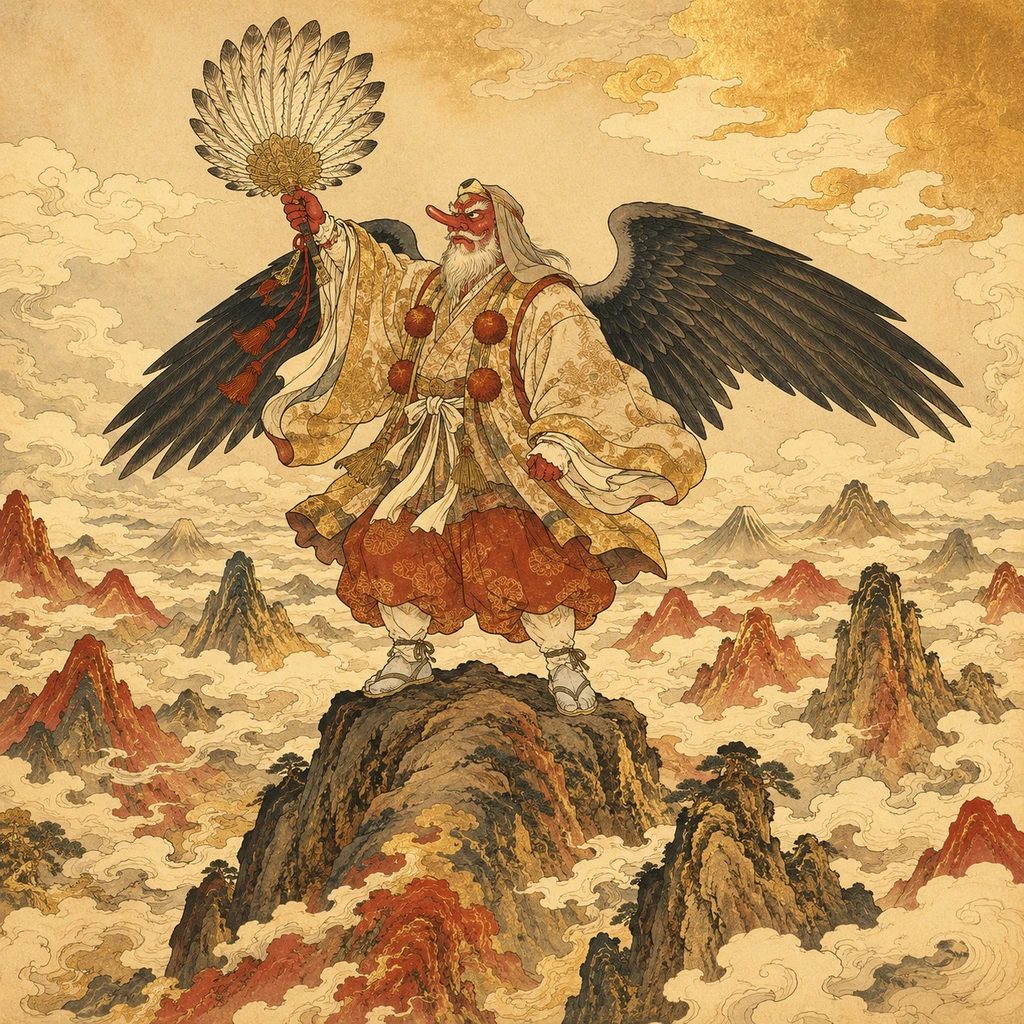
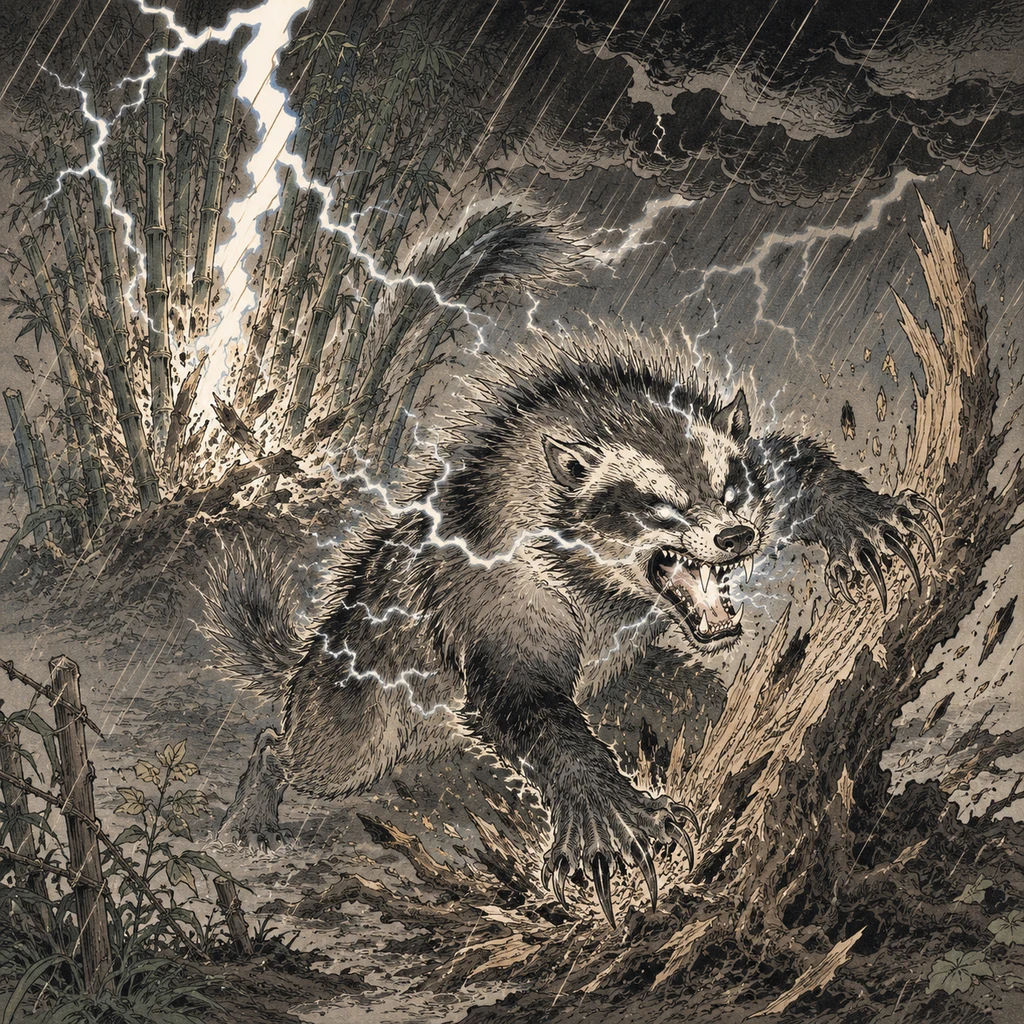

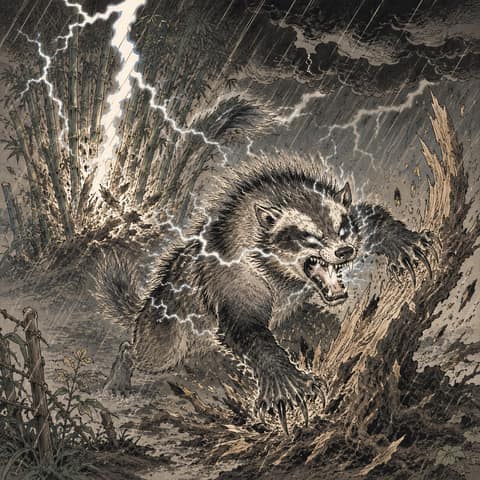
The magical power of Iizuna also attracted the warlords of the Sengoku period. It is said that Uesugi Kenshin placed a statue of Iizuna Gongen on the crest of his helmet, and Takeda Shingen also fervently believed in him [11]. The Deputy Shogun (Kanrei) Hosokawa Masamoto was so absorbed in the magic of Iizuna that he was remembered as a man obsessed with sorcery. The mountain faith of the single province of Shinano eventually spread throughout the Kanto region, and Mount Takao Yakuoin still enshrines Iizuna Daigongen as one of its main deities today. The tengu and fox magic of a single mountain thus took root in the sacred mountains of the eastern provinces. Tengu dwelt in the sacred mountains throughout Shinano; Raiju (thunder beasts), which appeared in the form of beasts alongside thunder, were said to leave sharp claw marks on struck trees; and in deep valleys, Yamabiko (echoes), which returned human voices exactly as spoken, bewildered travelers ── it is said that an "Echo Rock" that returns words remains on Mount Koiwadake in Kita-Azumi. The higher the mountain, the more its peak was the domain of the non-human.
Kiso ── Valley Beasts and the Tale of the Spirit Dog
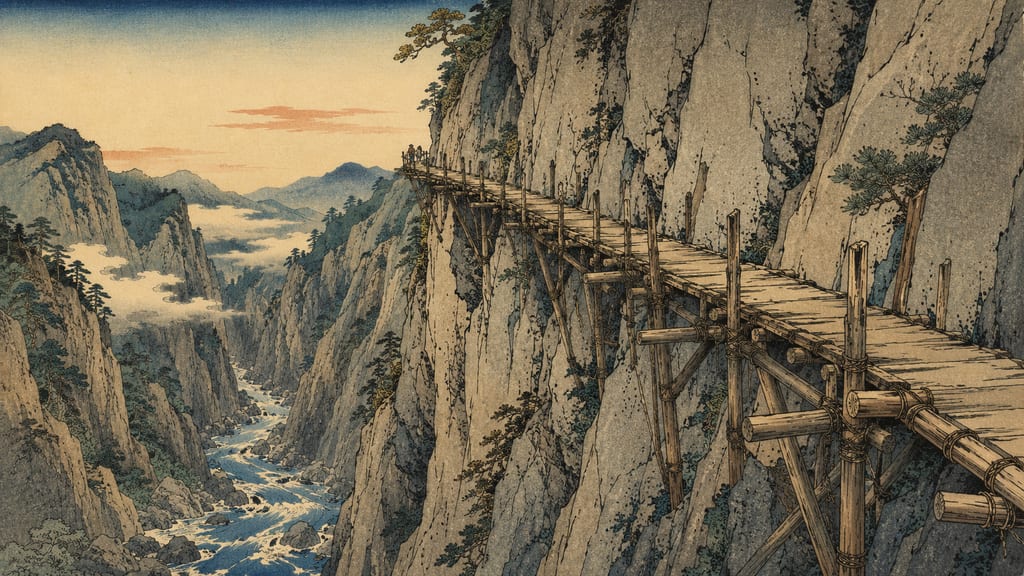
In the deep valleys pierced by the Kiso Road, a difficult section of the Nakasendo, lurk the monsters of mountain beasts. This valley, lined with treacherous spots like "Kiso no Kakehashi" and "Torii Pass," is a rugged path where it was not uncommon for travelers to lose their lives, and it harbored enough darkness to nurture stories of mountain beasts attacking people and gods demanding sacrifices.
Hihi (Demon Baboon)
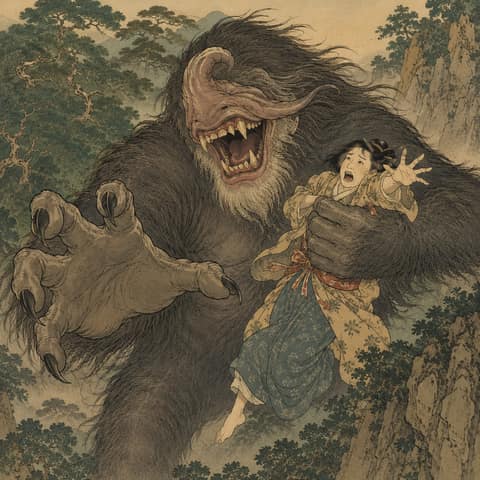
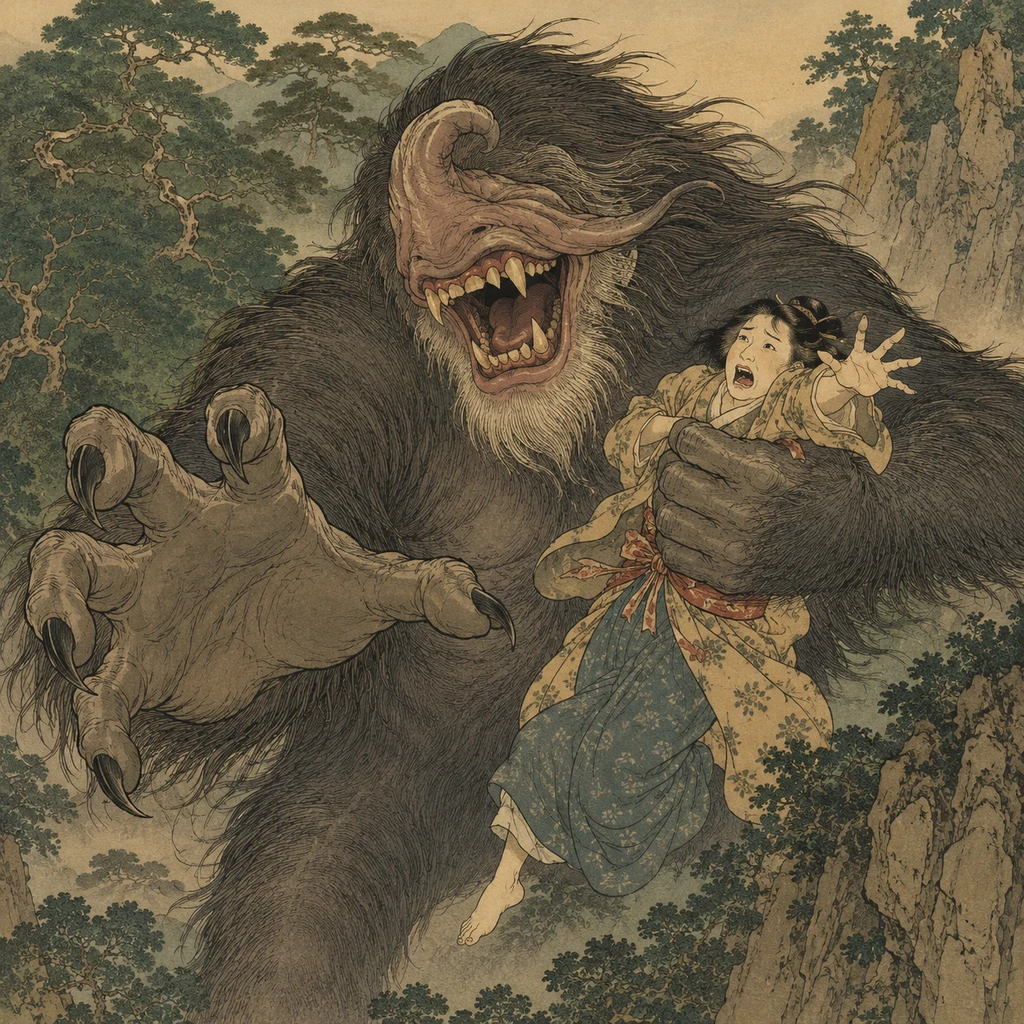
A yokai resembling a large monkey said to appear in the mountains, often described as an aged monkey that has transformed. It possesses formidable strength and is known in many tales to attack people, especially abducting women. Across regions it is said to burst into loud laughter at the sight of humans; its long lips curl upward until they cover its eyes. Edo-period picture scrolls and encyclopedias depict it as big-bodied with black fur. Some explain the name as imitating its laugh, and it is sometimes confused with other mountain beings like yamawaro.
Read moreThe baboon (Hihi) passed down in Kiso is said to be a monstrous transformation of an aged giant monkey that demanded a maiden as a sacrifice every year. It is the spirit dog Hayataro, passed down at Kozenji Temple in Komagane, who defeats it. A traveling monk, hearing that there was a human sacrifice ritual at Mitsuke Tenjin in Enshu (Shizuoka), overheard the monster chanting, "Don't let Hayataro of Shinano know," and traveled all the way to Shinano to borrow the dog ── Hayataro of Shinano and Shippei Taro of Enshu are two sides of the same story[12]. Hiding in a large chest (*nagamochi*) as a substitute for the maiden, Hayataro fiercely bit into the monster when it appeared, and after a fierce death struggle, finally defeated it. However, he himself was deeply wounded, and it is said he struggled back to Kozenji in Shinano before taking his last breath. Hayataro's grave still remains on the temple grounds, and due to this connection with Mitsuke Tenjin in Enshu, a timeless exchange continues between the two locations today. This story pattern of a dog defeating a monkey god demanding maiden sacrifices exists in various places, but the monkey god extermination in the *Konjaku Monogatari-shu* (Anthology of Tales from the Past), considered its prototype, is a story from Mimasaka Province (Okayama)[13], and Hayataro of Shinano is a separate local legend that grew along the post towns of the Nakasendo.
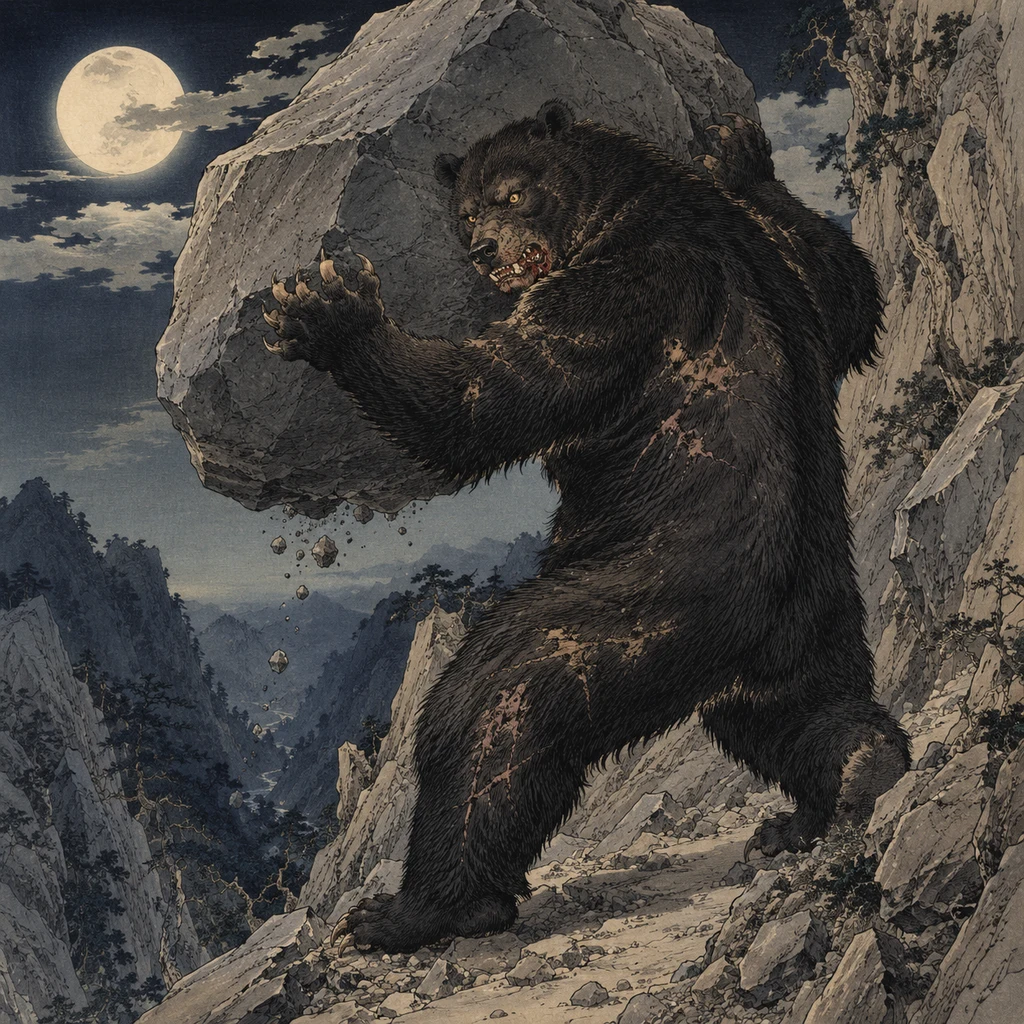
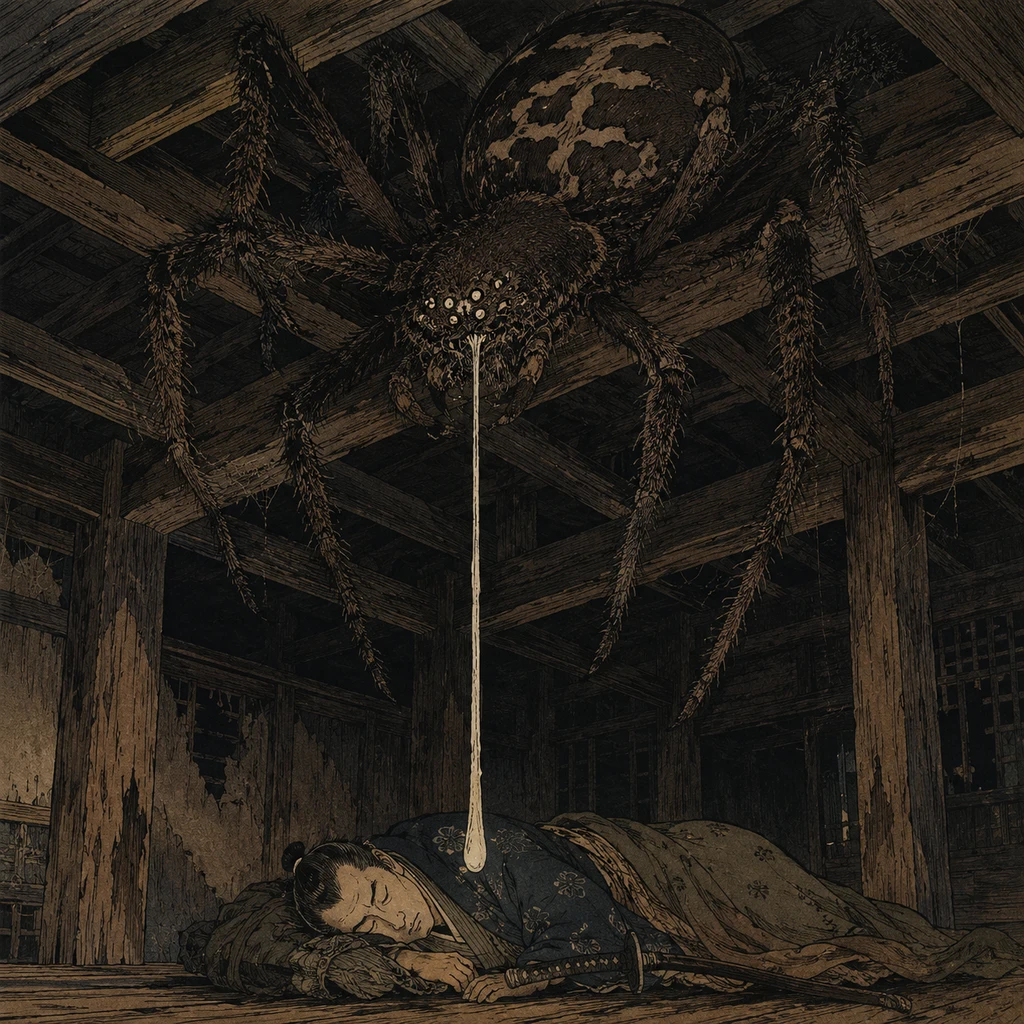
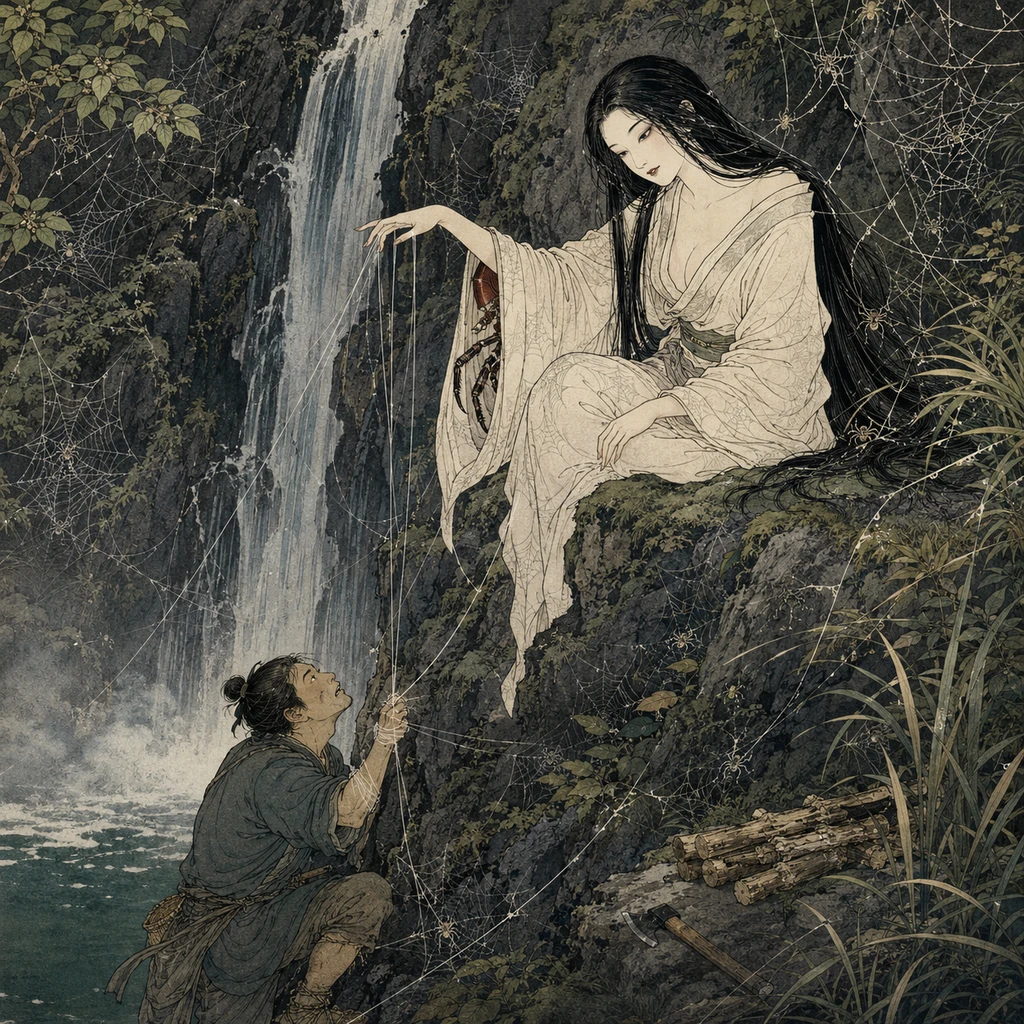
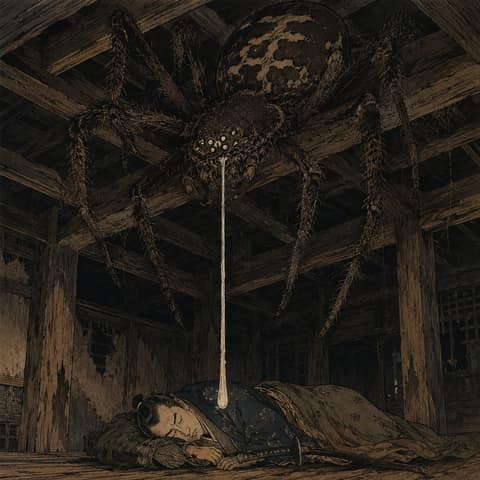
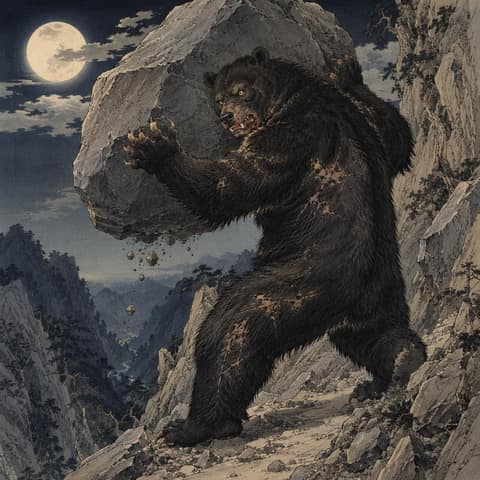
There are other beasts in the valleys. The Edo-period yokai art book *Ehon Hyakumonogatari* depicts the Onikuma (Demon Bear)[14], an old bear of the Kiso Valley turned yokai. At night, it comes down to the villages on two legs, steals horses and cattle, and carries them back to the mountains to eat. It is said that the "Onikuma Rock," a giant boulder pushed into the valley by its monstrous strength, still remains in the mountains of Kiso. In the ceilings of temples and mountain caves lurk giant spiders (Oogumo), aged spiders that have gained demonic power; they were said to stroke people's faces late at night, sucking their vitality and causing illness. When that giant spider takes the form of a beautiful woman to seduce a man, it is the Jorogumo ── the bewitching transformation of a mountain spider that binds its prey with threads. The deep valleys and dense forests harbored a darkness sufficient to make people believe that beasts and insects alike could gain powers surpassing humans if they lived long enough.
Villages and Passes ── Whirlwinds and Nighttime Doorways
Even in the villages and passes descended from the mountains, the bizarre breathed quietly.
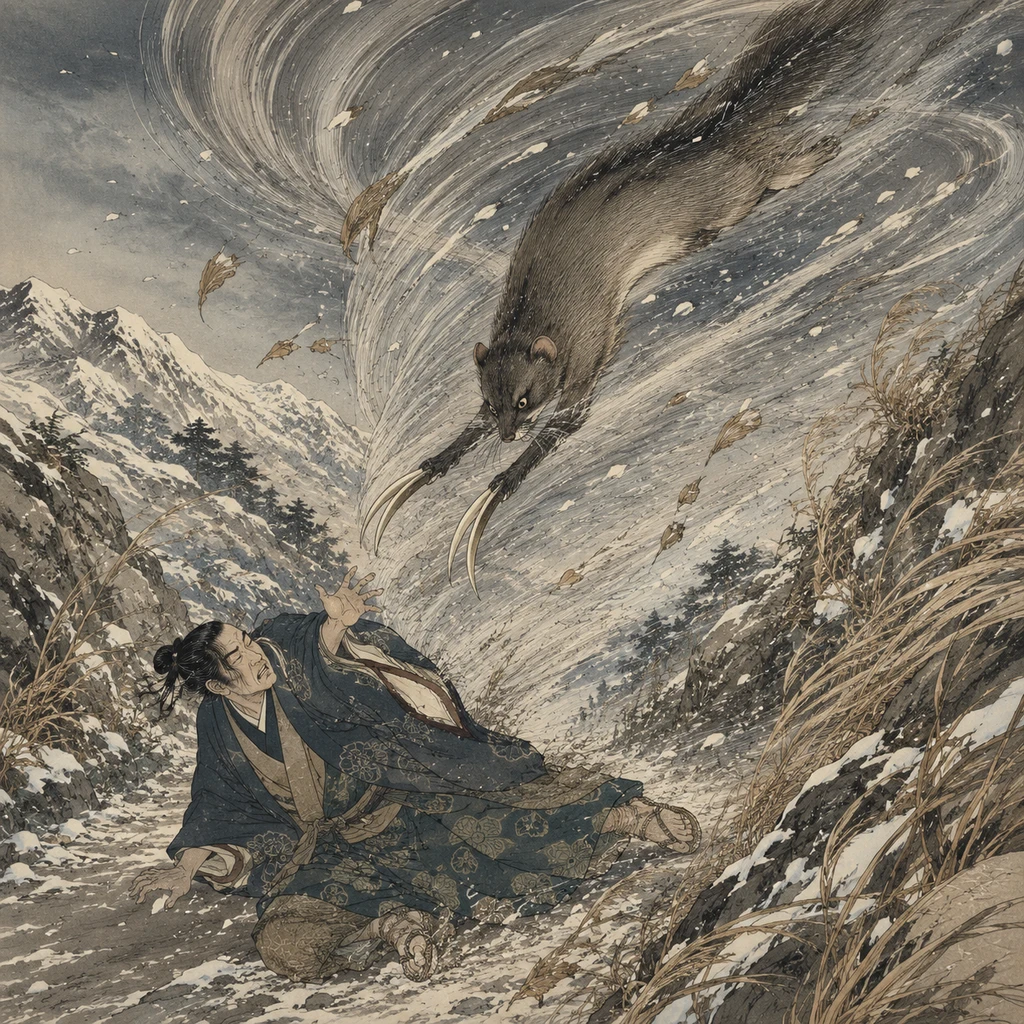 Kama-itachikah-mah-ee-TAH-chee
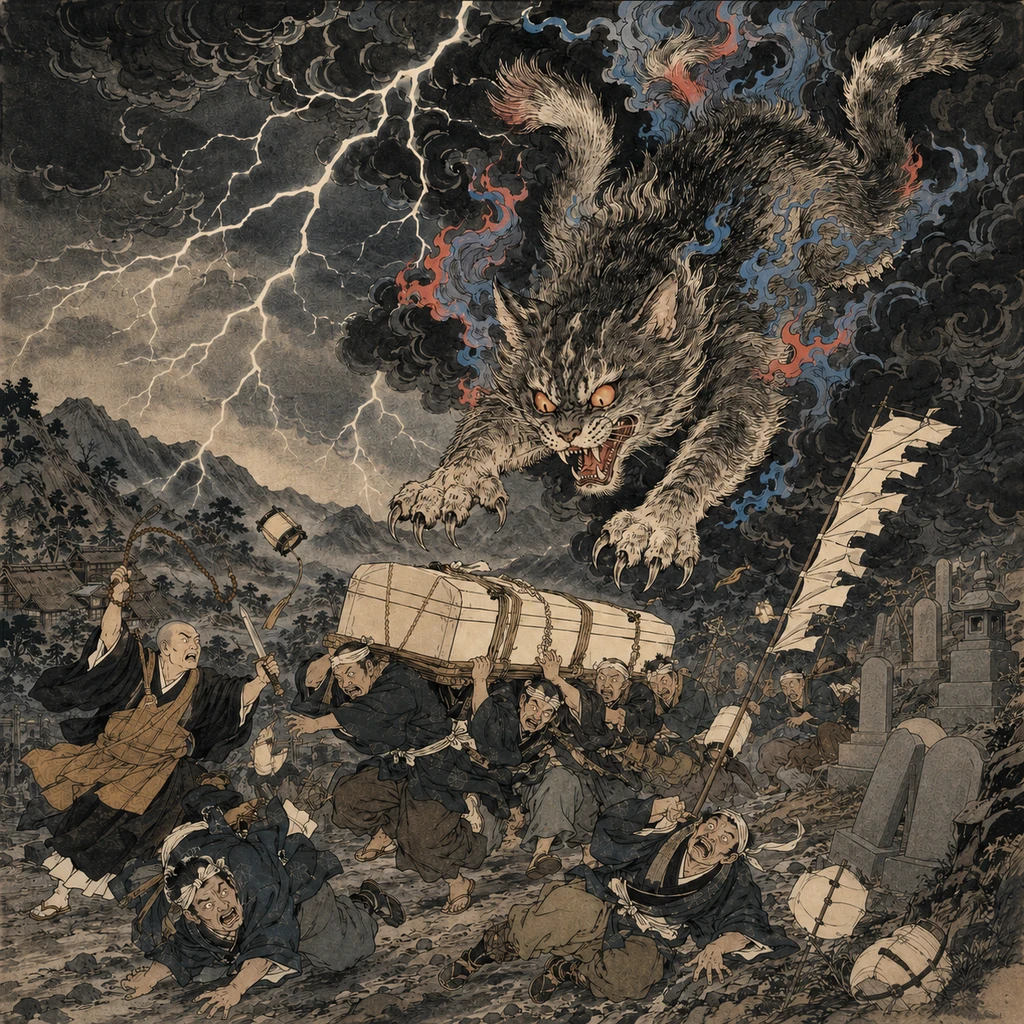 Kasha (Corpse-Dragging Fiend)KAH-shah
 Amazake Hagah-mah-ZAH-keh BAH-bah
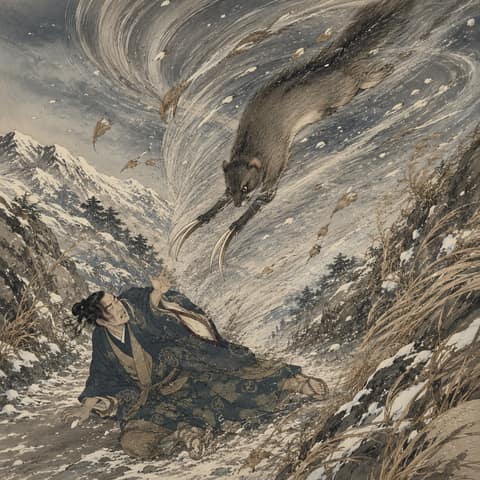
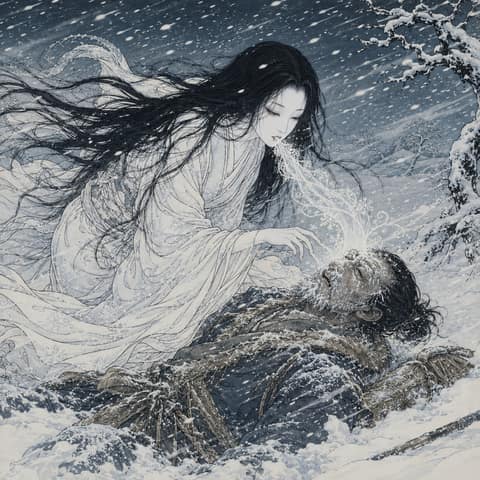
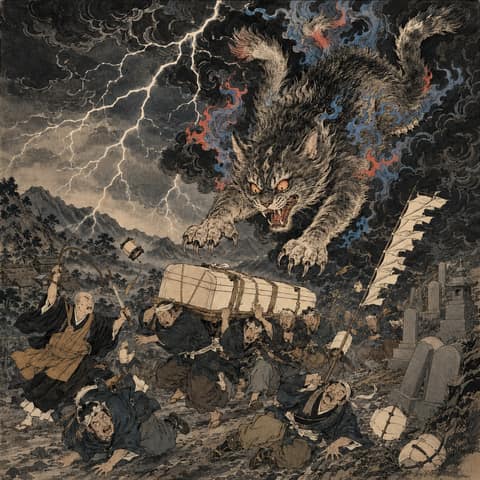
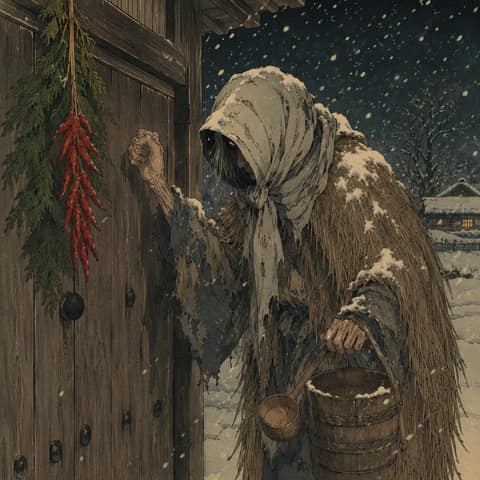
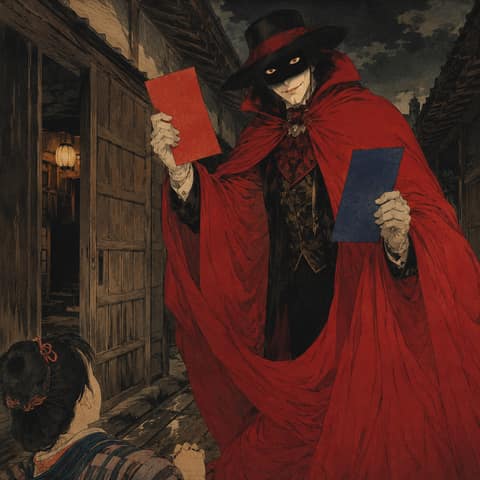
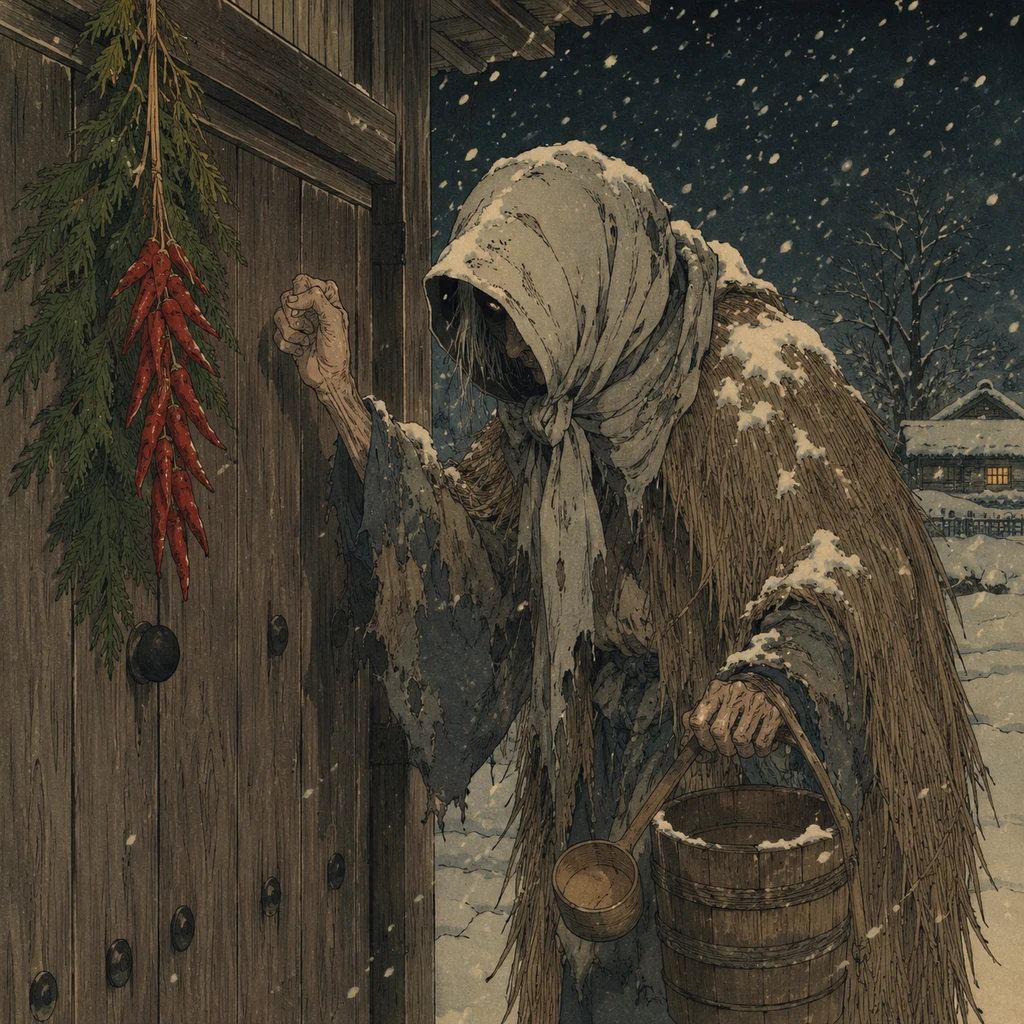
The Kamaitachi is the most characteristic yokai of Shinano and Echigo. Causing sharp cuts without pain or bleeding along with a whirlwind, this monster was spoken of in Hida as the work of a "group of three" ── the first knocks the person down, the second cuts with a blade, and the third applies medicine and leaves. Therefore, it does not hurt or bleed[15]. This is the idea that the dry, cold winter wind of the snow country turns into invisible blades that attack people. When a funeral procession traveled along a mountain path, people feared that black clouds would suddenly well up and the cat demon Kasha (fire chariot), attempting to snatch the corpse, would appear. To prevent the Kasha from stealing the body, precautions such as placing bladed tools on the coffin and keeping sutras continuously chanted during the procession were taken in various places. The Amazake-baba (sweet sake hag), who walks around knocking on doors late at night asking, "Do you have sweet sake?" was associated with epidemics like smallpox, and it was said she would bring illness regardless of the answer. People warded off this old woman yokai by hanging cedar leaves, nandina branches, or chili peppers at their doors.
 Azuki-arai (Bean Washer)ah-ZOO-kee ah-RAH-ee
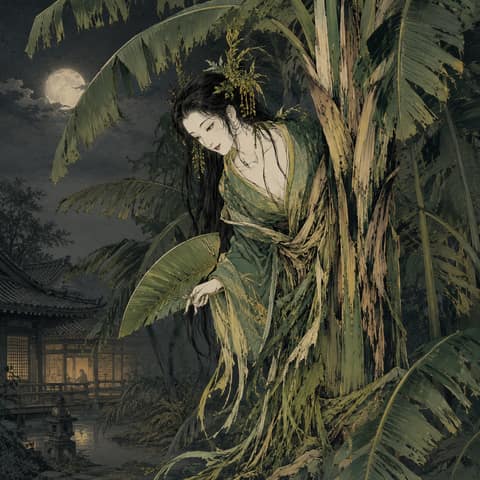
 Banana-Plant Spiritbah-SHOW-noh-SAY
 Smiling Hannyawah-RAH-ee HAHN-nyah
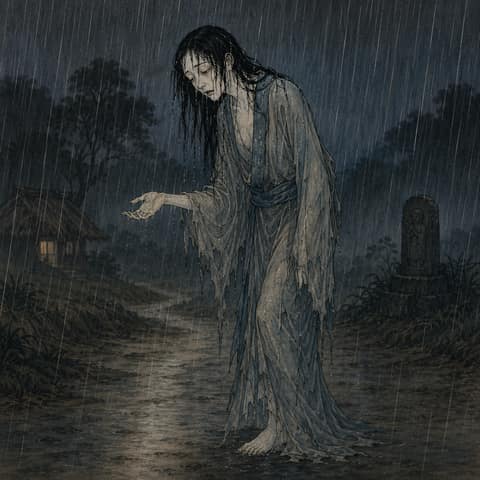
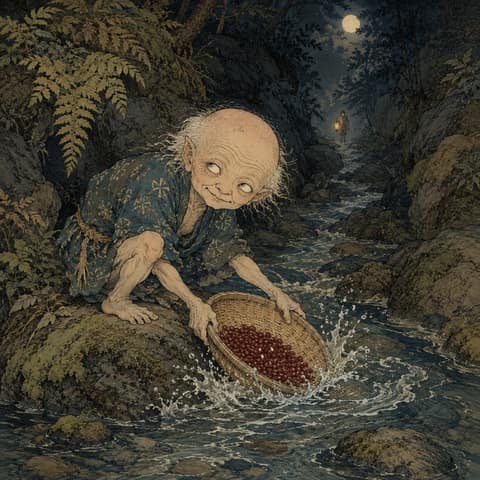
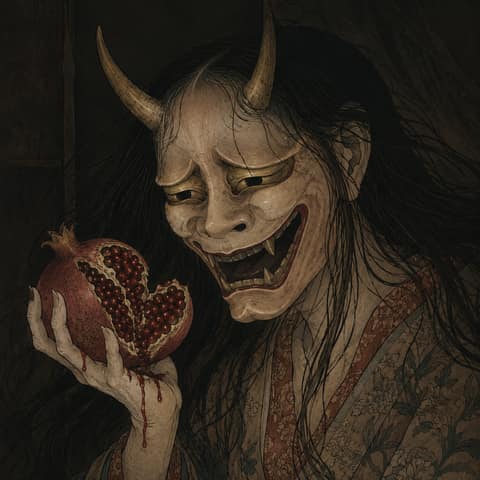
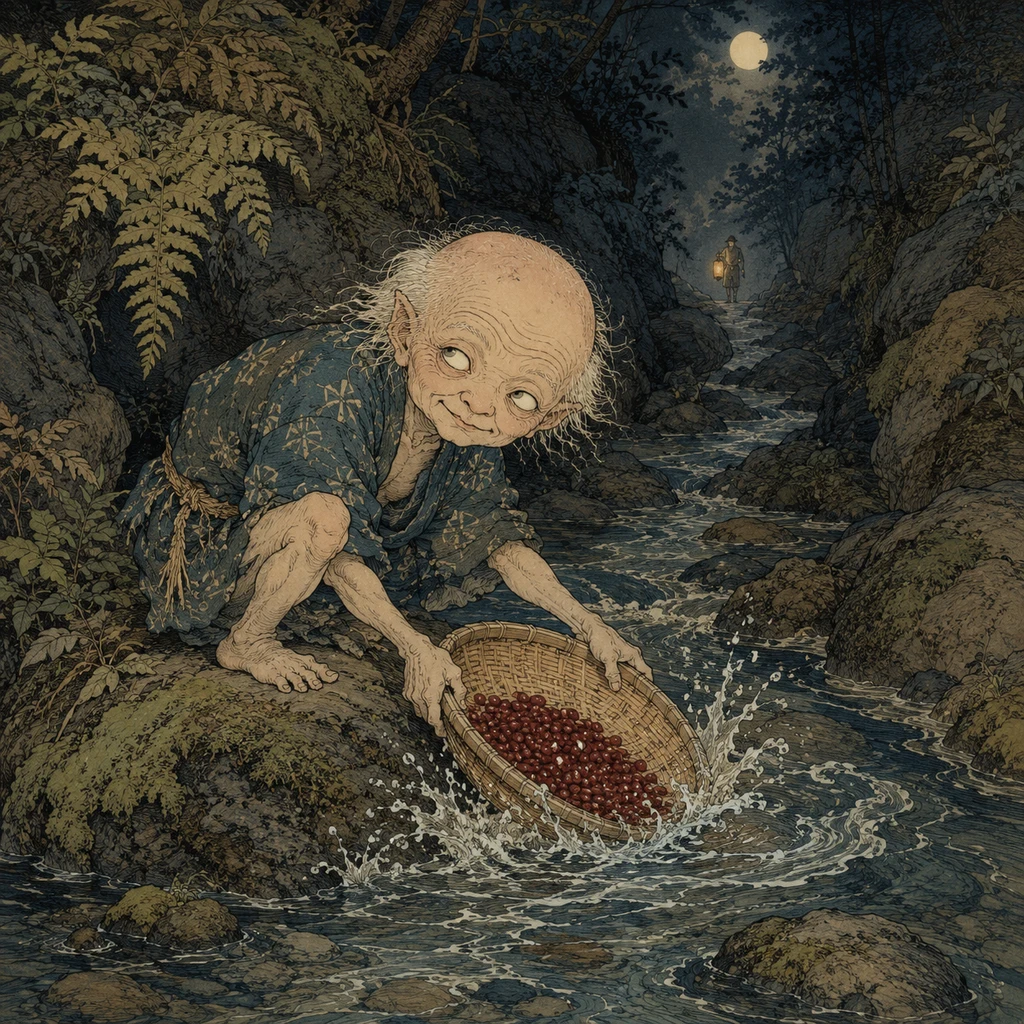
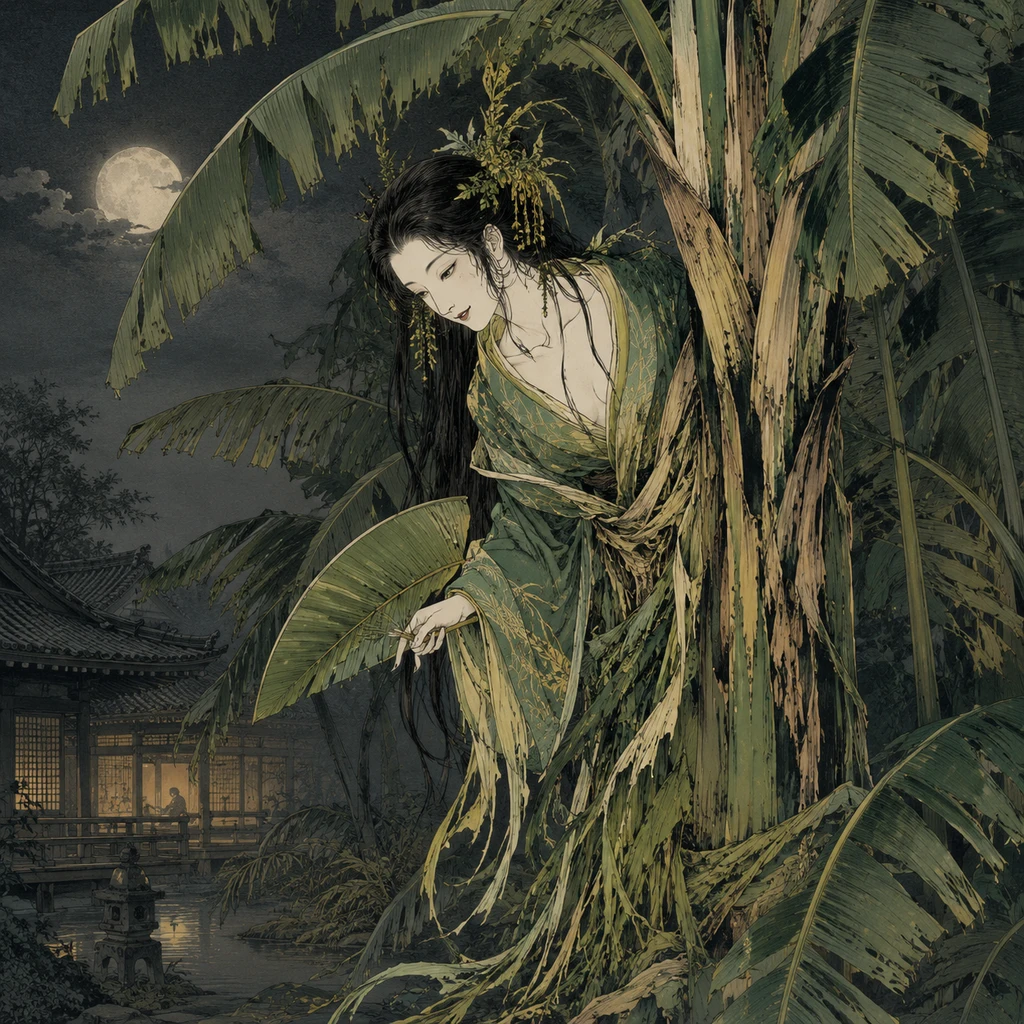
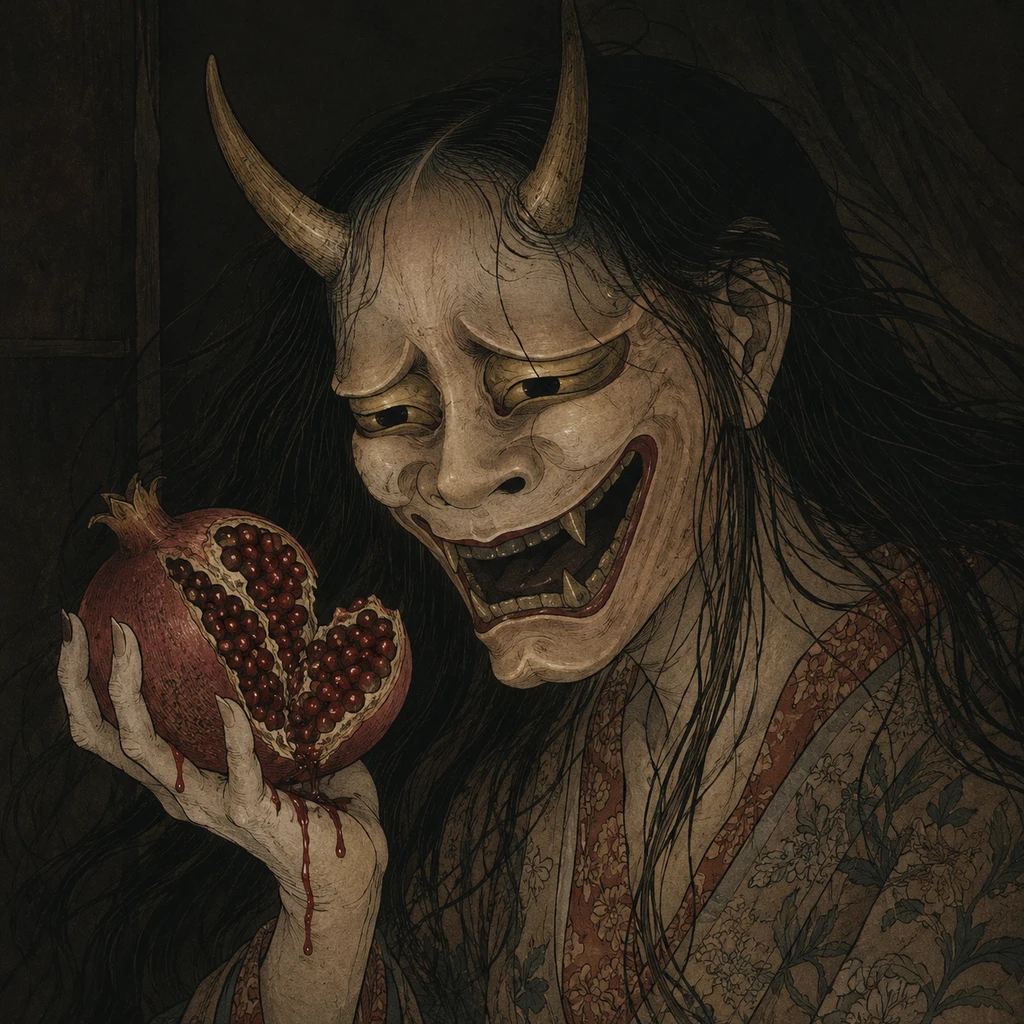
In the riverbank shallows, the Azuki-arai, making the "shoki-shoki" sound of washing adzuki beans every night, terrified travelers without ever showing its form ── the sound itself was the true body of this monster, and it was said that if you followed the sound and got too close, you would fall into the river. The Ame-onna (rain woman) of Shimo-Ina is said to appear on rainy days and abduct children, or simply stand in the rain; the Basho-no-sei (banana plant spirit) dwells in old banana stumps and transforms into a beautiful woman to bewitch monks; and in Higashi-Chikuma, there is the legend of the Warai-hannya (laughing hannya), a woman driven mad by jealousy and passion who turns into a demon, wearing a stiff smile like a mask. Many of these are village monsters spoken of nationwide, not just in Shinano, but the climate of Shinano, which lacks no passes, valleys, or lakes, was an unparalleled land for such monsters to take root. From the Demoness Momiji to the Warai-hannya, the fact that stories of jealousy and passion turning women into demons are so prominent in Shinano is likely not unrelated to the harshness of life enclosed by mountains.
Looking at it this way, one notices a single underlying bass note in the yokai of Shinano. The defeated, the slain, and the hunted are not erased, but are enshrined and passed down in that land as gods or as monsters. Takeminakata, Moriya-no-Kami, Koga Saburo, the Demoness Momiji, and even the beasts of Kiso rather than Kihachi ── it is not the songs of the victors, but the tales of the losers and the boundaries that form the core of imagination in this mountain country.
Lacking the sea, Shinano has harbored tales of gods and demons equal to the number of its mountains and valleys. Enshrining the god defeated in the myth of the transfer of the land as a god of war, carving the slain demon into the name "Kinasa," and elevating Saburo, who wandered the underworld, to a great deity ── the yokai of Shinano are the very memory of this ancient mountain province, wearing the faces of its high mountains and deep valleys.