ame-no-tajikarao
Ame-no-tajikarao, the God of Strength Who Opens the Rock Cave
Deity / Divine SpiritTakamagahara / Sana-no-agata (now Taki, Taki District, Mie Prefecture) / Mount Togakushi (now Togakushi, Nagano City, Nagano Prefecture)
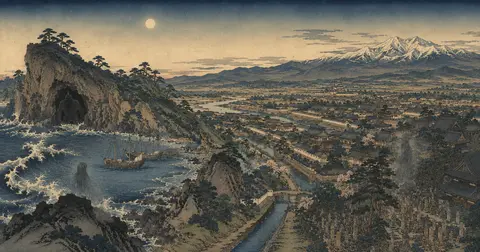
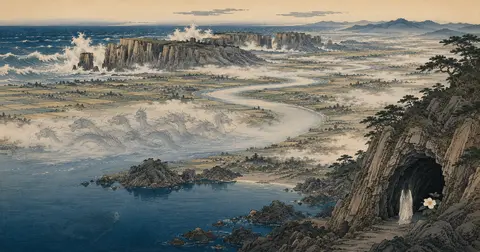
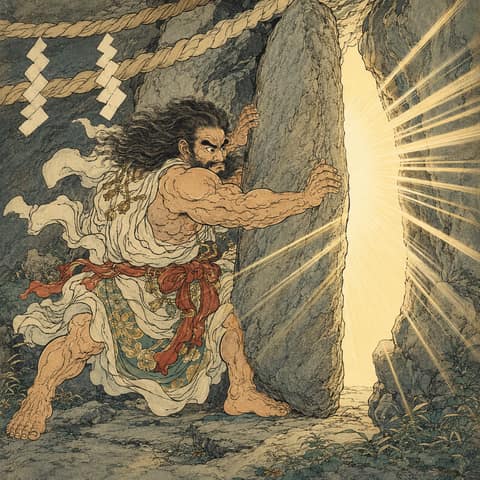
Merely calling Ame-no-tajikarao a "god of strength" fails to capture his true sharpness. In the Kojiki's Heavenly Rock Cave ③, he takes action at the precise moment when the myriads of gods are making noise, Ame-no-uzume is dancing, Ame-no-koyane and Futodama present the mirror, and Amaterasu-Omikami begins to peek out from inside the door. Ame-no-tajikarao is not a director controlling the scene. After the wisdom of Omoikane, the laughter-inducing dance of Ame-no-uzume, and the prayers and mirror of Ame-no-koyane and Futodama have all accumulated, only he, hiding on the sidelines, directly takes the goddess's hand. In mythology, "touching" carries heavy weight. He does not forcibly drag the sun goddess out, but rather seizes the slight movement of her leaning outwards, securing her on the side of the world. His power is both physical brawn and the ability to read the exact right moment.
The resolution of the Heavenly Rock Cave myth is structured as a collaborative effort by multiple gods. As pointed out by Kokugakuin University's Artifact Database, this scene layers elements of ancient rituals such as divination bones, forging, mirrors, jewels, cloth, and sakaki branches. Omoikane thinks, Ishikoridome makes the mirror, Tamanoya makes the magatama, Ame-no-koyane and Futodama handle the ritual and words, and Ame-no-uzume directs Amaterasu's enclosed consciousness to the outside through laughter and dance. Within this entirety, Ame-no-tajikarao bears the shortest and most irreversible action. For prepared rituals to change reality, a physical body to "open" was needed at the very end. Therefore, his divinity lies not in solitary super strength, but in the final point where ritual makes contact with the world.
In the Kojiki, immediately after Ame-no-tajikarao takes Amaterasu's hand and pulls her out, Futodama stretches a shirikumena (shimenawa) behind her and declares, "You may not return further inside than this." This sequence is crucial. Because opening and making return impossible are continuous. The restoration of light cannot be achieved merely by opening the door temporarily. It was necessary to end the state of self-confinement and seal that boundary with a sacred rope so that darkness would not cover the world again. Ame-no-tajikarao is the god who lays his hand on the boundary between the inside and outside of the rock cave, darkness and light, retreat and reappearance, completing the mythological "restoration of light" by pairing with Futodama's rope.
Taking into account the variant traditions in the Nihon Shoki lineage, this god's actions become even more multi-dimensional. Kokugakuin University's annotation on Heavenly Rock Cave ③ introduces that in the main text of the Nihon Shoki's seventh stage, it is depicted as Tajikarao-no-kami catching Amaterasu's hand and pulling her out, while in the first variant (Issho 3), it is depicted as Ame-no-tajikarao-no-kami standing by the rock door and pulling it completely open. If the Kojiki focuses on the "divine hand," the Nihon Shoki variant shifts the focus to the "rock door" itself. In either case, he is the god who breaks the blockage. Whether the object is the hand of a god or a door of stone, Ame-no-tajikarao's action lies in breaking through boundaries. The "hand" included in his name can be read not merely as a symbol of muscular strength, but as an organ that directly intervenes between the divine and the world.
His reappearance in the Descent of the Heavenly Grandson ② reconnects the scene of the Heavenly Rock Cave to the Ise ritual system. In the main text, in addition to the descent of the five attendant deities, the eight-span mirror, magatama, and Kusanagi sword, Tokoyo-no-omoikane-no-kami, Ame-no-tajikarao, and Ame-no-ishikadowake-no-kami are added as accompanying deities. It further notes that the mirror should be worshipped as the spirit of Amaterasu-Omikami, and that Ame-no-tajikarao is enshrined in Sanana-no-agata. Here, he transitions from the hero of the momentary opening of the rock cave to a member of the ritual order that transfers Amaterasu's spirit to the earth. If Omoikane supports ritual and governance, and Ame-no-ishikadowake is stationed as the god of the gates, Ame-no-tajikarao is the power that supports the boundary transition when the sacred treasures descend from heaven to earth. The hand that opened the Heavenly Rock Cave is now added to the procession of sacred treasures descending from Takamagahara to Ashihara-no-nakatsukuni.
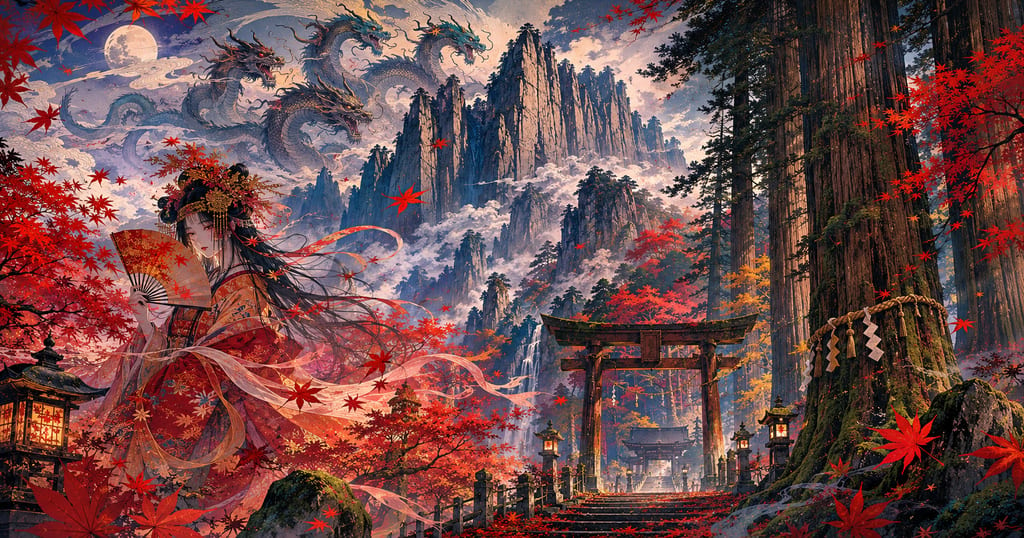
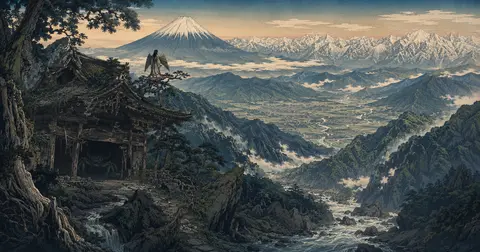
Togakushi Shrine is a sacred site that transformed this mythological role into the shape of a mountain. According to its official history, Togakushi Shrine enshrines deities related to the Heavenly Rock Cave myth from Takamagahara, with Ame-no-tajikarao-no-mikoto enshrined at the Okusha, Ame-no-yagokoro-omoikane-no-mikoto at the Chusha, and Ame-no-uzume-no-mikoto at the Hinomiko-sha. This is a structure where the mythological casting is deployed across the five shrines of Togakushi. Furthermore, the legend that the rock door pushed open by Tajikarao-no-mikoto fell to the lower world and became Mount Togakushi connects the very place name "Togakushi" (hidden door) to the memory of the Heavenly Rock Cave. The door that opened for only an instant in the Kojiki remains as a mountain in Togakushi. Ame-no-tajikarao is also the god who converts unseen events in Takamagahara into a mountain worship practice that people can climb and visit.
In modern times, it is natural, given the meaning of his name, that Ame-no-tajikarao is worshipped as a god of good fortune, fulfillment of wishes, bountiful harvests, and victory in sports. However, the power referred to here is not the power to simply pin down an opponent. In the story of the Heavenly Rock Cave, had he merely destroyed the door with sheer force, Amaterasu likely would not have returned. Only when wisdom, ritual implements, laughter, mirrors, and words are aligned, and Amaterasu herself turns her consciousness outward, does Ame-no-tajikarao's hand change the world. Therefore, praying to this god is not about wishing for a blind breakthrough, but rather praying for the power to take the final step without hesitation after all preparations are complete. There is a closed door. But at the same time, there is a power waiting before the door. Ame-no-tajikarao is the god of that quiet standby and the decisive hand.