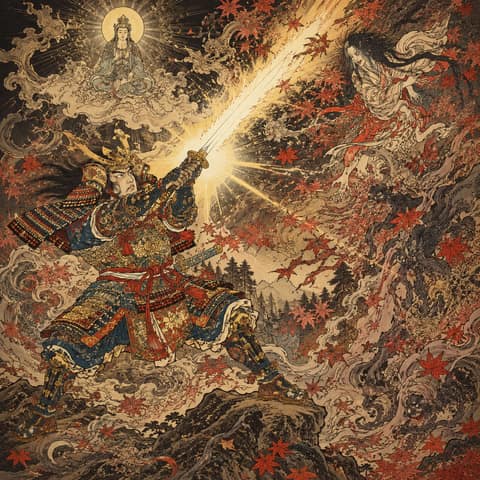
“Momijigari” is the title and theme of a famous tale, widely preserved in medieval and later performing arts and literature, in which the warrior Taira no Koremochi slays a demoness dwelling on Mount Togakushi in Shinano. In Noh, joruri, and kabuki, elegant ladies enjoying the autumn maples are revealed to be the demoness Momiji; aided by divine protection, the warrior sees through the disguise and defeats her. Best known as the title of stage works, the demoness image formed where local legend and the theater tradition intersected.
Folklore & Legends
In the Muromachi-period Noh play Momijigari, Taira no Koremochi is invited by court ladies in Togakushi to a sake banquet and dance. He receives a sacred sword, sees through their deception, and slays the demoness. Early modern joruri and kabuki follow this framework, popularizing the demoness’s name as Momiji. Togakushi-origin legends offer variants: the demon is called Kyūshō Daiō in some versions, or attendant ogres transform into women. Scholars note mutual influence among these performing traditions.
Yokai Cards1
Momijigari (The Demon of the Maple Viewing) across multiple art-style decks
A demoness archetype fixed in Noh, joruri, and kabuki from the Muromachi to Edo periods. She appears under the pretext of autumn leaf viewing as a courtly lady-in-waiting or princess’s attendant, lulling suspicion with music and dance. At the feast she inebriates warriors, but near midnight her nature is exposed by divine protection or a sacred blade, and she reveals her true form in the wilds of Mount Togakushi. Commonly called Momiji, she bears aliases such as Princess Sarashina depending on the work. Her slaying tales extol martial virtue and reflect awe of the mountains, inheriting Togakushi worship and the rhetoric of oni-hunting lore. On stage, the contrast between the elegant disguise of the first act and the ferocious demon visage of the second is emblematic.
Character Profile
This section is our own creative profile for storytelling. It is not historical fact or scholarship.
The diagram below is a diagnostic evaluation chart for Demoness Momiji (Performing Arts Tradition). The higher the value of each item, the stronger that characteristic is expressed.