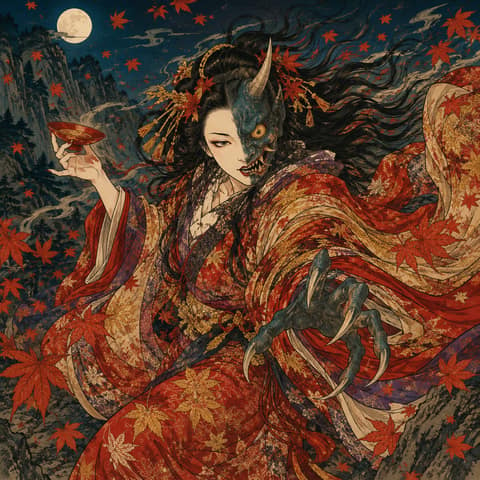
The *Demons of Mt. Ichiya* (*Ichiyazan no Oni*) are demons said to have inhabited Minase in Shinano Province (present-day Kinasa, Nagano City), and are the main figures in a capital relocation legend that explains the origin of the place name *Kinasa* (Village with No Demons). During the Hakuho era, Emperor Tenmu planned to establish a new capital in Shinano, and his envoy, Prince Mino, selected this basin as a candidate site. The indigenous demons, learning of this, feared that 'if a capital is built, we will lose our home', and overnight they built a mountain in the center of the basin to block the flatland, thus thwarting the relocation. The iconic conical mountain of Kinasa that is said to have appeared at this time is Mt. Ichiya[1] (One-Night Mountain).
Enraged that the capital relocation was prevented, Emperor Tenmu dispatched Abe no Hirafu[1] to strike down the demons. Because the demons were exterminated and it became a 'village where demons are no more', it is said that the land formerly called Minase was renamed Kinasa (= Village with No Demons). Alongside the theory of the origin of the place name based on the Momiji Legend—which regards the demoness Momiji as the 'demon'—this is another prominent origin tale. Its distinct feature lies in depicting the demons as a local existence resisting the central capital relocation plan.
Folklore & Legends
This legend has engraved the memory of a capital into a valley village of Shinano. The district names of Higashikyo (Eastern Capital) and Nishikyo (Western Capital)[1] still remain in Kinasa, with smaller place names like 'Tokyo Nijo' and 'Tokyo Sanjo' in Higashikyo, and 'Dairi-yashiki' (Palace Residence) and 'Tatemushi' in both capital districts, evoking thoughts of Kyoto. It is said that Kamo Shrine and Kasuga Shrine were enshrined on the east and west banks sandwiched between the Tenjin and Susobana Rivers as guardian deities of the capital, and foundation stones, obsidian, and 9th to 10th-century pottery and iron slag have been excavated from the ruins of Dairi-yashiki. These Kyoto-derived place names have been passed down as topographic memories corroborating the capital relocation legend.
The story motif of demons building a mountain in a single night is distributed in various places as superhuman mountain-building tales of giants and demons, but the uniqueness of the Mt. Ichiya legend in Kinasa is how firmly it ties this to the origin of the place name and the capital relocation legend. Academic theories suggest that rather than literal monsters, these demons are later retellings of the memories of local forces (those who did not submit) who did not easily obey the centralization of the Ritsuryo state. This resonates with the basin formation tale that Kinasa was once the bottom of a lake, which became a basin when the water dried up, was called Minase Village[1], and was renamed Kinasa around the end of the 7th century. The topography of the valley, the memory of water, the yearning for a capital, and the legend of resistance are all condensed into the single peak of Mt. Ichiya.
Unlike the demoness Momiji, who was refined on the Noh and Kabuki stages, the demons of Mt. Ichiya are indigenous demons who bear the very origin of the place name. Their action is singular—to build a mountain overnight and block the arrival of the capital. The desperation of a local existence refusing to be stripped of its home is condensed into this single point.
While the Momiji legend is a story of descent—'a noblewoman exiled from the capital falls into a demon'—the demons of Mt. Ichiya are depicted as entities that existed in the village from the beginning and resist the capital coming from the outside. The name of the real-life general Abe no Hirafu overlaps with the quasi-historical framework of Emperor Tenmu's capital relocation, giving the legend a strange sense of reality. The conclusion, where the demons are defeated and the name 'Kinasa' is born, is also a story of renaming the land from the perspective of the victor (the center), and the bitter aftertaste of this legend lies in the fact that the defeat of the demons itself was permanently carved as a place name. The cluster of Kyoto-derived place names remaining in Kinasa are scattered in the valley even today, serving as evidence of the victor's memory.
Character Profile
This section is our own creative profile for storytelling. It is not historical fact or scholarship.
A strong indigenous stubbornness to protect their own dwelling, not easily yielding to central authority. Possessing the herculean strength and tenacity to form a mountain in one night, but also combining this with the simplicity of an existence rooted in the village.
Herculean strength to build up a mountain in a single nightTerrain alteration that blocks a basin and thwarts capital relocationVigilance to detect the arrival of the capital
Weaknesses
Defeated and exterminated by the subjugation force of Abe no Hirafu, who received an imperial decree from Emperor Tenmu. The power to build a mountain was no match for the organized military force of the center.
Habitat
The basin of Minase, Shinano Province (present-day Kinasa, Nagano City), and Mt. Ichiya, which they are said to have built in a single night.
The diagram below is a diagnostic evaluation chart for The Demons of Kinasa Who Built a Mountain in One Night. The higher the value of each item, the stronger that characteristic is expressed.