Reading ‘One Body,
Two Faces’ from the Original Text
Ryōmen Sukuna’s body does not begin with a finished portrait. Its starting point is fewer than a hundred characters of classical Chinese in the Nihon Shoki entry for Emperor Nintoku’s sixty-fifth year. The National Archives of Japan’s digital *Nihon Shoki 6* is a surviving copy that transmits ancient entries, not the original completed in Yōrō 4 (720). It nevertheless lets us examine how Sukuna’s name and body were recorded without later summaries.
The passage reads as follows.[1]
In the sixty-fifth year, there was a man in Hida Province named Sukuna. His body bore two faces, each turned away from the other. Their crowns joined, and there was no nape. Each had hands and feet. He had knees but no backs of the knees or heels. His strength was great, and he was agile. He wore swords at his left and right sides and used bow and arrows with four hands. Thus, because he did not obey the imperial command and delighted in plundering the people, Naniwa no Neko Takefurukuma, ancestor of Wani no Omi, was dispatched to put him to death.
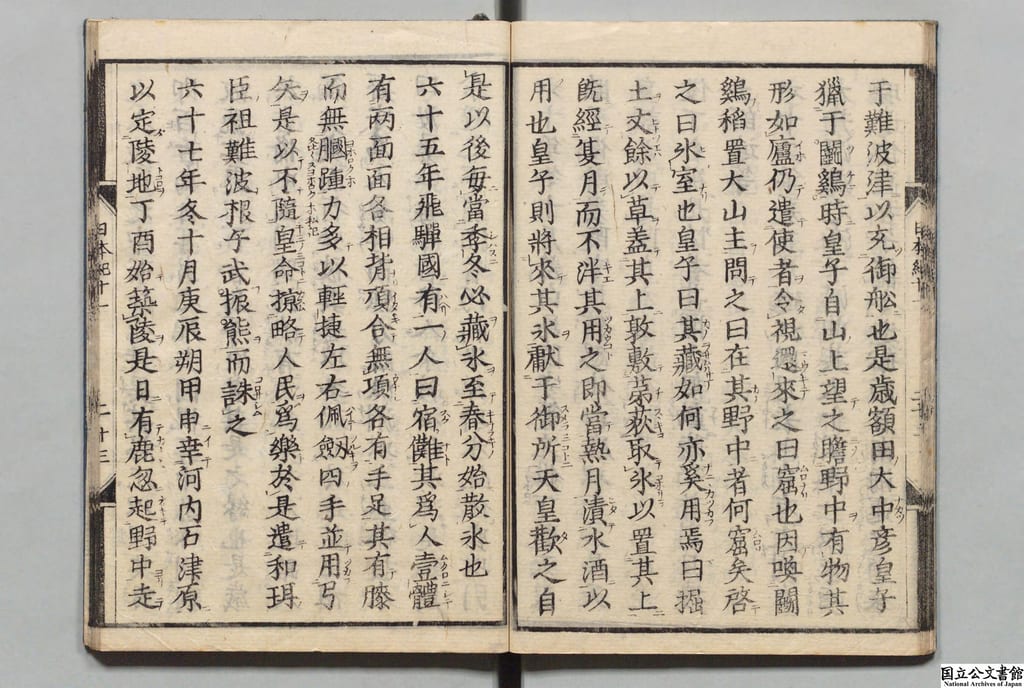
“One body bore two faces” means a single body with two faces. “Each turned away from the other” places them back to back, while “their crowns joined, and there was no nape” means that their tops met without a back of the neck. It describes neither two separate heads nor two bodies, but one body whose faces look in opposite directions. Horns, fangs, skin color, hairstyle, height, and clothing go unrecorded. Without later oni or giant imagery, the earliest Sukuna is an extraordinary form assembled in words.
What Do the Four Hands Do?
The body part whose number is explicit is the “four hands.” Swords were worn at the body’s left and right sides, and four hands worked together with bow and arrows. This supports a heavily armed figure able to use bow and arrows while wearing swords, but not two bows drawn at once, four arrows fired together, or swords and bow wielded simultaneously. Weapon numbers and pose remain open for later makers of pictures and sculpture.
Great strength and agility do not mean supernatural speed, teleportation, or an invulnerable body. Two back-to-back faces might suggest a broad view, but the text grants no freedom from blind spots, foresight, or two minds fighting separately. Sukuna’s martial image is clearest when recorded actions are kept apart from later embellishment.
Does the Text Really Describe Four Legs?
Sukuna’s legs are among the passage’s most disputed details. If “each had hands and feet” corresponds to the two faces or the body’s two sides, four hands and four legs are a natural reading. Yet the text counts only the hands as “four hands”; it never calls the legs “four feet.” Four legs are thus a strong, widespread interpretation, not an attribute whose number the original explicitly states.
“He had knees but no backs of the knees or heels” is harder still. The phrase describes a body that cannot be explained simply by doubling an ordinary human form, but says nothing about how Sukuna stood or walked. Later readings connect it with mountain travelers’ posture, yet this sentence cannot reconstruct an occupation, equipment, or gait. These unresolved lower limbs keep Sukuna from being merely a human with two faces.
Armor,
Axe,
and Four Legs in Temple Tradition
A body once made only of words became a concrete figure in Hida temple traditions. Zenkyūji’s Ryōmen Sukuna Appearance Account has Sukuna emerge from a cave as a six-meter-tall armored giant with two faces, four hands, and four legs, carrying an axe.[5] Here, the number of legs and height—neither given in the Nihon Shoki—are fixed, and an axe replaces bow, arrows, and swords. By forming a mudra and becoming Eleven-Headed Kannon, the extraordinary warrior and Buddhism’s guardian occupy one scene.
This is not an ancient portrait filling a lack in the Nihon Shoki, but a reading of the same name within regional religious tradition. The chronicle’s back-to-back faces, Zenkyūji’s two faces, four hands, and four legs, and later images with two faces, four arms, and two legs are not competing answers with only one correct. Words on the page, a tale of a giant emerging from a cave, and a temple image each called for a different body.
Enkū Turned the Two Faces Toward the Front
Enkū’s seated image does not literally sculpt the two back-to-back faces. Gifu Prefecture records an 88-centimeter, single-block seated image with upright hair, upturned eyes, an axe, a boat-shaped halo with cloud relief, and a rock seat.[7] Its two faces are carved side by side, allowing a viewer standing before it to see both at once. Rather than strictly reproducing front-and-back faces, the composition appears to offer both to the worshipper at once.
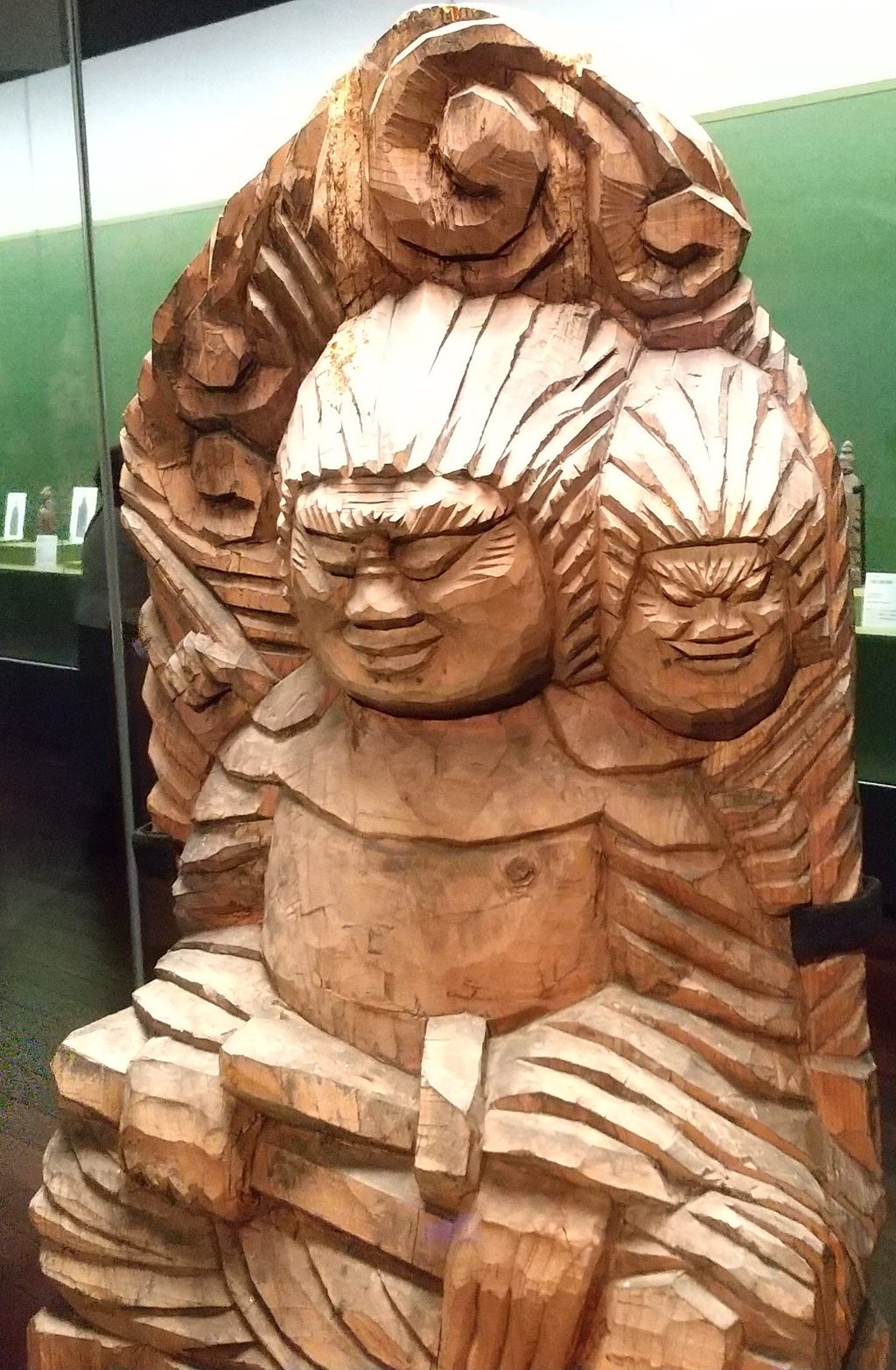
An inscription dated Jōkyō 2 (1685) on a Senkōji shrine confirms Enkū’s stay in Hida around that time.[8] The Sukuna sculpture itself bears no production inscription dated 1685, so it is more prudent to regard it as a work associated with Enkū’s Hida period around that year. Holding an axe rather than the chronicle’s swords and bow, seated on rock rather than standing, and presenting the two faces side by side, it becomes a devotional image approached from the front.
Do Not Assign ‘Anger’ and ‘Compassion’ to the Two Faces
Two faces invite the imagination of two minds, but the Nihon Shoki never says they spoke, thought, or fought separately. It records defiance and plunder, not one face as evil and the other good. Temple founding, guardianship of Buddhism, transformation into Kannon, and dragon-slaying are not tales that explain a “good face”; they are separate accounts passed down by later temples.
Gifu Prefecture’s cultural-property record also does not say that one face in Enkū’s image represents anger and the other compassion. Viewers may perceive differing emotions in the eyes, mouths, or carving, but those impressions cannot be fixed as the sculptor’s intention or Sukuna’s inherent character. The two-faced form is not a sign of moral dualism, but a physical quality never exhausted from one direction.
What the Date in the Senkōji-ki Colophon Shows
Senkōji’s ongoing devotion to Sukuna as its founder remains meaningful today. Connecting it to ancient history, however, requires attention to the documents that transmit it. Okamura Rihei’s *Hida Sansen* reports that one Senkōji-ki scroll ends with November 1621, Genna 7, and Genkai’s name, while judging its form to raise the possibility of later attribution.[4] It confirms a transmitted colophon and a Meiji-era local historian’s critical attention to the document’s formation.
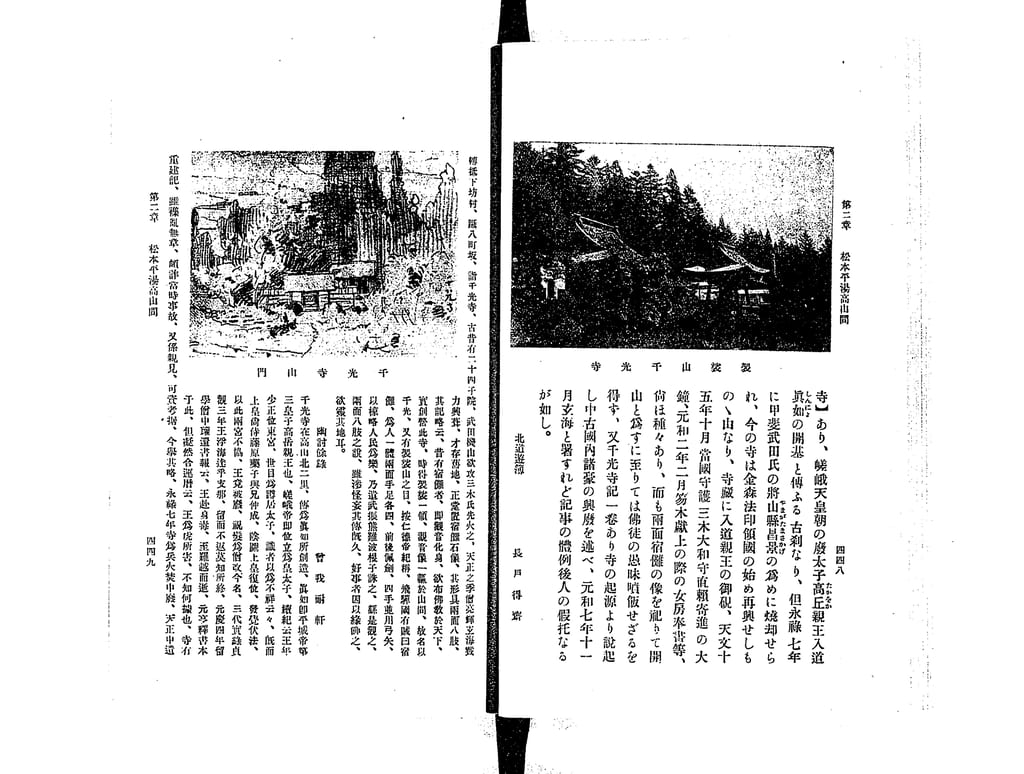
A colophon date is not the date when its story occurred. The number 1621 cannot establish that Sukuna existed in Emperor Nintoku’s reign and founded Senkōji. This does not make later faith valueless: ancient events, an early-modern origin account, modern source criticism, and present worship are facts of different times. A document image can show not only a tradition’s content but when and how it was reread.
The End of the Subjugation and the Weaknesses the Text Does Not Give
The Nihon Shoki ends when Naniwa no Neko Takefurukuma is sent to put Sukuna to death. It gives neither the place nor duration of the fight, and no weapon or strategy. Sukuna’s defeat is certain within the account, but nothing makes Takefurukuma, imperial troops, swords, or bow and arrows a particular weakness. Sealing, pacification rites, memorial rites, and specific spells are likewise absent.
Later temples venerated a Sukuna of the same name as founder, Kannon manifestation, and dragon-defeating outsider—far from a simple tale of an oni defeated by a hero. In written history he is put to death; in temple tradition he is venerated; in sculpture he is worshipped face to face. Rather than compressing these into one personality or powers, we see the two faces more deeply by preserving the periods and media that produced them. The back-to-back faces offer neither a good answer nor an evil one, but receive the different looks cast on the same name across different eras.
Character Profile
This section is our own creative profile for storytelling. It is not historical fact or scholarship.
Yokai Type - Traditional Yokai
Category - Demons & Giants
Rarity - Legendary
Personality - Quiet and dignified, with no haste to decide good and evil. Sukuna keeps distinct the adversary of official history and the guardian of temple traditions, setting different memories beside one another without forcing them together.
Compatibility - A match for someone who enjoys considering the dates and narrators of sources, who mocks neither official history nor local devotion, and who does not rush to flatten contradictions into one answer. Sukuna suits those who listen to the memories accumulated in images and places as well as to strength.
Abilities - A single body with two faces turned away from one anotherUses bow and arrows with four handsWears swords at the left and right sidesGreat strength and agile movementIn Zenkyūji tradition, appears as a giant with two faces, four hands, and four legsIn Zenkyūji tradition, transforms into Eleven-Headed KannonIn Nichiryūbu-ji tradition, drives away a divine dragon
Weaknesses - No distinctive weakness or method of subjugation is known. The Nihon Shoki says that Naniwa no Neko Takefurukuma put Sukuna to death, but it gives no location, weapon, or strategy for the fight; imperial forces or any particular weapon therefore cannot be treated as a general weakness.
Habitat - The Nihon Shoki places Sukuna in Hida Province. Later traditions connect the name with Hida Senkōji, Zenkyūji and the cave at Dewa-ga-hira, and Nichiryūbu-ji in Mino Province. No record identifies an ancient residence or the site of the subjugation.