
Ryōmen SukunaHida's Two-Faced Sukuna: Chronicle and Local Tradition
RYOH-men SKOO-nah
Detailed Description
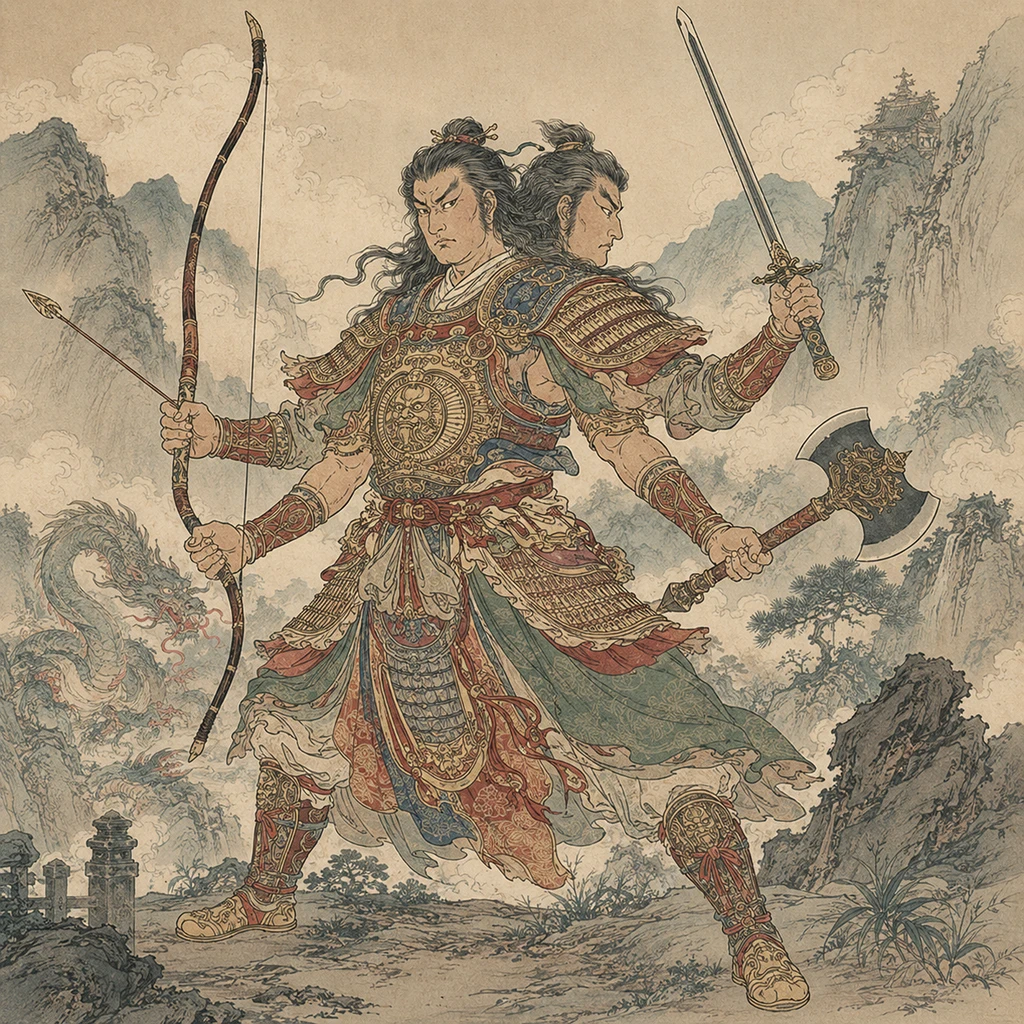
The original text of the Nihon Shoki etches Sukuna's body in remarkable concreteness: "one body with two faces, each turned away from the other; their crowns joined so that there is no nape; limbs on either side; knees, yet no hollows behind them and no heels."[1] One torso, two faces set back to front, no nape where the heads meet, and limbs on each side—read plainly, four hands and four feet alike, an eight-limbed marvel. Yet most of the images that survive locally are carved as "two faces, four arms"—two faces, four arms, two legs. That the Shinsen Mino-shi[2] records the founder of Nichiryūbu-ji as a "two-faced, four-armed stranger" belongs to the same strain, and the discrepancy between the textual description (eight limbs) and the iconographic tradition (four arms, two legs) is not to be overlooked in reading the Sukuna image.
It was Enkū who raised that iconography into art. The seated Ryōmen Sukuna at Senkō-ji[3] sets its two faces side by side rather than front and back, one wearing wrath, the other compassion. This form, salvation glimmering within fury, resonates with the belief that Sukuna was an incarnation of Guze or Senju Kannon.
His historical reality demands caution. Naniwa no Neko Takefurukuma, named as his vanquisher, properly belongs to the section on Empress Jingū, so his placement in the Nintoku chronicle is itself anachronistic. That a Kannon-incarnation tale should attach to Nintoku's reign—supposedly before Buddhism's arrival—is likewise a later construction, and the view that the whole account is a fabrication of the editorial stage carries weight (Nagafuji Yasushi[4]). Nagafuji reads Sukuna as the original deity of Mt. Kurai, a hero hidden away by the central histories, while Hōga Toshio[5] traces him genealogically to the ancestor of the Hida no Miyatsuko. As for the monstrous body, Haga Susumu[6] reads it as the misperceived and exaggerated gear—shin guards and the like—of Hida's mountain folk.
The name, too, invites many theories. From the sound "Sukuna," some traditions argue a tie to Sukunabikona, and Ōbayashi Taryō[7] offered a comparative-mythology framework treating Sukunabikona as Ōkuninushi's "second self." The motif of a god who appears in pairs chimes with the two-faced form of Sukuna. Some also overlay the image of the uncanny Sukuna onto the fact that ancient Hida was a singular "land of craft" that sent its artisans (Hida no Takumi) to the center, though there is no direct documentary link between the two. What is certain is that a single name has been handed down in opposite directions by center and province, and that this very split is what gives the being called Ryōmen Sukuna its shape.
Source Information
種類全体の出典primary
両面宿儺坐像(円空作・千光寺蔵)
著者: 円空
年代: 17世紀
出版社: (飛騨袈裟山千光寺)
種類全体の出典primary
飛騨の英雄両面宿儺(『伝説に歴史を読む』所収)
著者: 八賀晋
年代: 2006
出版社: 大巧社
種類全体の出典primary
両面宿儺と飛騨国造
著者: 宝賀寿男
年代: 2010
出版社: 古樹紀之房間
種類全体の出典primary
『仁徳紀』の両面宿儺について
著者: 永藤靖
年代: 2009
出版社: 文芸研究(明治大学)
種類全体の出典primary
日本書紀
著者: 舎人親王ほか
年代: 720
出版社: (奈良時代の勅撰正史)
種類全体の出典primary
神話の系譜
著者: 大林太良
年代: 2002
出版社: 講談社学術文庫
種類全体の出典primary
千光寺記
著者: 長谷川忠崇(『飛州志』付録)
年代: 1621
出版社: (飛騨袈裟山千光寺の寺院縁起)
種類全体の出典primary
新撰美濃志
著者: 岡田啓(文園)ほか
年代: 1900
出版社: (美濃国地誌)
Personality
In local lore, staunch and proud—a heroic god who subdues dragons and demons and guides the people; in the classical chronicles, a fierce, anti-authoritarian brigand who would not submit to the throne. Opposite temperaments dwell within a single name.
Compatibility
Deeply syncretized with Kannon devotion (Guze and Senju Kannon) and with the mountain worship centered on Mt. Kurai.
Abilities & Skills
Weaknesses
The chronicles' plotline of subjugation by imperial forces (Naniwa no Neko Takefurukuma); the scarcity of sources—a single passage in the Nihon Shoki—that makes any historical identification difficult; and the fact that most local origin-legends date only from the Edo period and cannot be traced into antiquity.
Maya Calendar Guardian KINs
Displaying the Maya calendar KINs that Ryōmen Sukuna (Hida's Two-Faced Sukuna: Chronicle and Local Tradition) protects.
診断評価
妖怪バウンダリー・タイプ指標
いたずら濃度
1.0high: 戯 low: 護
📝 メモ
略奪の凶賊像と在地英雄神が併存し中高に留める
変化適応
1.0high: 化 low: 定
📝 メモ
凶賊と英雄神の二面性を持つが変身ではない
夜話度
0.0high: 夜 low: 昼
📝 メモ
神話史料と縁起が中心で夜性は薄い
情の深さ
0.0high: 縁 low: 境
📝 メモ
民を導く英雄性と反権力性が両面で情は中庸
結界強度
2.0high: 律 low: 流
📝 メモ
飛騨や美濃の寺社縁起に根ざす在地領域性がある
表舞台圧
3.0high: 表 low: 影
📝 メモ
二面四臂の異形武威で正史にも強く現れる
妖怪相性診断
喜び
2.0喜びと楽しさの程度
📝 メモ
歓楽性や愉悦を示す要素はほぼなく、物語は戦闘・祈祷・統治対立が主。
怒り
7.5怒りの激しさの程度
📝 メモ
苛烈・反権力的な性格、戦闘譚が多く、怒りの激しさが強調される。
慈悲深い
3.5慈悲深さの程度
📝 メモ
観音信仰接続や祈祷伝承に慈悲の余韻はあるが、根本は武威中心で高くはない。
憂鬱
4.0憂鬱で思慮深い程度
📝 メモ
失脚・討伐のモチーフや在地での英傑化の落差に陰影はあるが、物語上の中心ではない。
静寂
4.5内なる平静の程度
📝 メモ
祈祷・国家安泰祈念により一定の静謐性はあるが、基本は武断的で高くはない。
いたずら好き
1.0いたずら好きで活発な程度
📝 メモ
戯れや悪戯の性質は伝承に見られない。
やさしい
2.0やさしく親しみやすい程度
📝 メモ
記紀では掠奪・反権力的で親和性は低い。在地でも豪勇型で柔和さは強調されない。
厳格
7.0厳格で真面目な程度
📝 メモ
剛毅・矜持高い性格、山岳修験・寺院縁起との関係から規律的側面が強い。
守護的
6.5他者を守る傾向
📝 メモ
在地伝承では龍退治や寺院守護など守護的。記紀では逆に脅威の側面があるため中高程度に止める。
神秘的
8.0神秘的で不思議な程度
📝 メモ
二面四臂という異形、英雄/鬼神の二面性、寺院縁起や山岳信仰との習合が神秘性を高める。
霊性の深さ
7.5精神的境界の深さ
📝 メモ
観音信仰・山岳信仰との習合、在地祭祀・寺院開基の縁起が示す霊的厚みが大きい。
恋愛妖怪体質診断
執着度
6.2密着型(高)↔自由型(低)
📝 メモ
在地では守護・祈祷・開基と結び地域に深く関わる執着が示唆される一方、山野での機動性・独立性や記紀での無頼性が自由志向も示すため中高程度。
恋愛スタイル
7.8積極型(高)↔受動型(低)
📝 メモ
記紀では反権力的で先制的な行動力が強く、在地でも龍や鬼を討つ英雄性が語られるため、対人関係でも主導しがちな積極性が高いと推定。
感情表現
7.0直球型(高)↔ツンデレ型(低)
📝 メモ
剛毅で武威を示す人物像・像容(武具携行・唐風甲冑)から感情表現は直截的と解しやすい。一方、観音信仰との習合や祈祷縁起が柔性も示すため満点は避ける。
衝突対応
8.5正面突破型(高)↔回避型(低)
📝 メモ
討伐譚・武勇譚が中心で正面からの解決を選ぶ傾向が強い。四臂で武器を操る描写や毒龍退治伝承も正面突破型を裏付ける。
Similar Yokai
Yokai with similar personality and characteristics to Hida's Two-Faced Sukuna: Chronicle and Local Tradition
Opposite Yokai
Yokai with opposite personality and characteristics to Hida's Two-Faced Sukuna: Chronicle and Local Tradition
🔮Test your compatibility with Ryōmen Sukuna now!
Analyze your personality and values to get a detailed compatibility rating with this yokai.
Free, simple, and results in just minutes.