Daikokuten
Daikokuten, Fortune God of Two Thousand Years of Transformation
Deity / divine spiritAncient India, as Mahakala / Hieizan Enryakuji in Otsu, Shiga / Izumo Taisha as a center of syncretism with Okuninushi
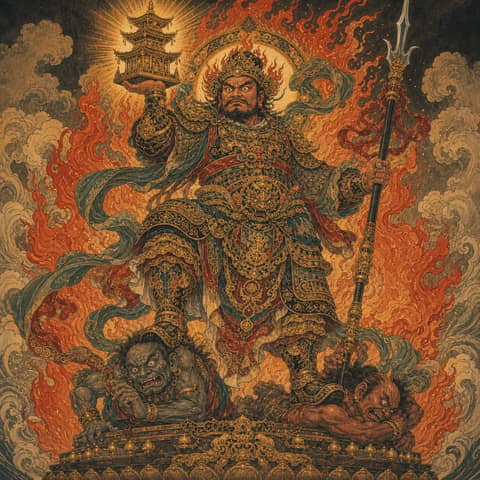
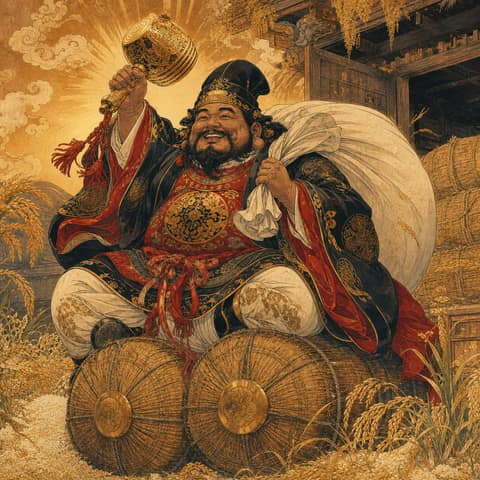
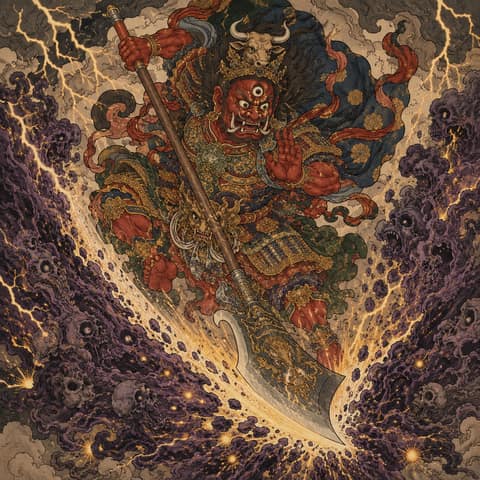
From Mahakala to Daikokuten: two thousand years of cultural transformation. The basic profile introduced Daikokuten's main attributes; the deeper story is the long transformation from ancient Indian Mahakala to modern Japanese Daikokuten. Mahakala is the wrathful, nocturnal, destructive aspect of Shiva, and in ancient Indian society he was associated with war, cemeteries, blackness, and fear. Once received into Buddhism, he became a Dharma guardian and moved through Central Asia, China, Korea, and Japan, taking on new meanings in each cultural sphere. In Japan especially, syncretism with Okuninushi, inclusion among the Seven Lucky Gods, and transformation into a wealth deity created a form so new that it almost amounts to rebirth. Daikokuten is a model case of how a foreign deity can be remade inside Japanese religion.
Sanmen Daikokuten: Hieizan and Saicho's religious design. The Sanmen Daikokuten enshrined by Saicho at Hieizan Enryakuji, combining Daikokuten, Bishamonten, and Benzaiten into one three-faced deity, is one of the distinctive creations of Japanese Buddhist history. All three deities come from Indian Buddhist guardian traditions, but Saicho's placement of the combined figure as guardian of the temple kitchen and economy connected Buddhist ideals of compassion and protection with the practical realities of food, training, and institutional survival. Sanmen Daikokuten later spread through Hieizan, Tendai, Shingon, Zen, and related lineages, becoming an important symbol of Japanese Buddhism's ability to integrate practice and material support.
The logic of syncretism through the sound daikoku. The merging of Daikokuten, the Indian-derived Buddhist deity, and Okuninushi, the Japanese Shinto deity, through their shared reading daikoku is a classic example of medieval Japanese religious syncretism through sound. The written forms, doctrines, and origins were unrelated, but the identical reading of "great black" and "great land" was enough to make them overlap. The new deity was not a simple addition of two figures; it gained new life in popular practice. The case reveals a flexible logic in Japanese religion, where sound, image, folk association, and practical benefit can matter more than strict doctrinal consistency.
The civilizational meaning of the Seven Lucky Gods. The Seven Lucky Gods cult, shaped from the Muromachi and Azuchi-Momoyama periods into the Edo period, gathers Daikokuten, Ebisu, Bishamonten, Benzaiten, Fukurokuju, Jurojin, and Hotei around the shared wish for fortune, wealth, and prosperity. Its origins are deliberately mixed: Ebisu is native Japanese, Daikokuten, Bishamonten, and Benzaiten come from Indian religious worlds, and Fukurokuju, Jurojin, and Hotei come from Chinese Daoist, Buddhist, and popular traditions. Edo commoners did not demand a neat theory. They wanted luck, and that pragmatic wish created one of Japan's most inclusive religious combinations.
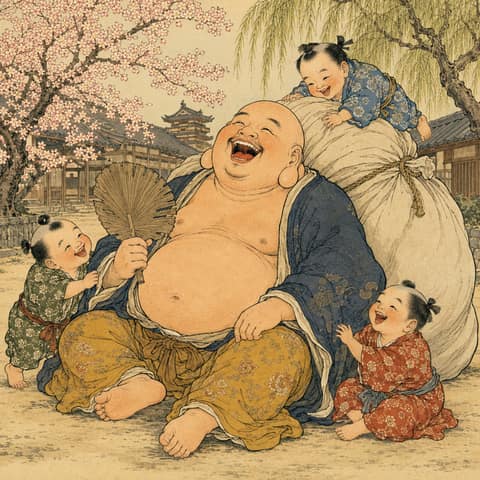
Rice bales, mallet, and sack: medieval Japanese symbolism of fortune. Daikokuten's three main attributes, rice bales, the uchide no kozuchi mallet, and the great sack, compress medieval Japanese ideas of wealth. Rice bales symbolize harvest, food, land, and tax revenue in an agrarian society, entering Daikokuten through Okuninushi's agricultural layer. The mallet appears in classical tales such as the Konjaku Monogatari Shu and Uji Shui Monogatari as a magical tool that produces what one desires, a symbol of inexhaustible resources. The sack combines elements of Mahakala's treasure bag, Hotei's cloth sack, and Japan's seven-treasures imagery, holding gold, silver, lapis lazuli, tridacna shell, agate, pearl, and coral. These objects hold Indian, Chinese, and Japanese symbolism in a single image.
Edo treasure-ship prints and collective wishes for prosperity. Treasure-ship prints became popular in the Edo period, showing the Seven Lucky Gods riding a ship of riches. Placing such a picture under the pillow on the second night of the New Year was believed to bring a lucky first dream. These images circulated widely as New Year charms for townspeople and merchants, and Daikokuten was often drawn near the center because he best embodied wealth, harvest, and thriving business. Through treasure-ship prints, Edo publishing, ukiyo-e, popular religion, and commercial culture converged. Even today, the motif survives in New Year decorations, greeting cards, and shop talismans.
Daikokuten in the twenty-first century: a fortune god in a global age. Daikokuten remains a familiar god of wealth, business, and harvests. His image is used in New Year Seven Lucky Gods pilgrimages, first shrine visits, prayers for business success, and new-shop celebrations; merchants, restaurants, companies, and private homes still place him on altars. Even in an age of globalization, economic anxiety, and individualization, the desire for fortune, wealth, and prosperity remains universal. Daikokuten gathers that desire into one deity through a two-thousand-year chain linking ancient Indian Mahakala, medieval Sanmen Daikokuten, Edo Seven Lucky Gods worship, and the modern Japanese fortune god. He is one of the clearest symbols of cultural transformation in Japanese religion.