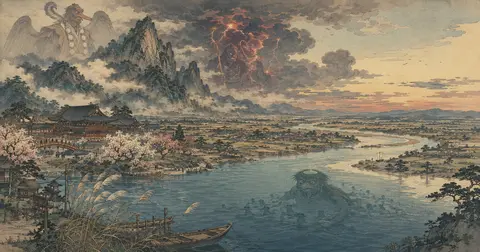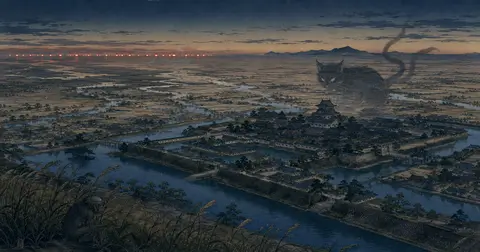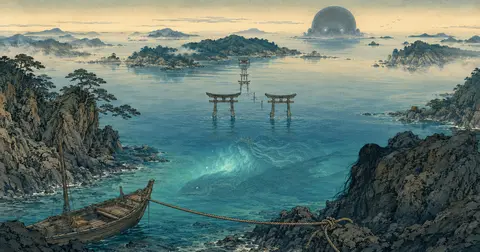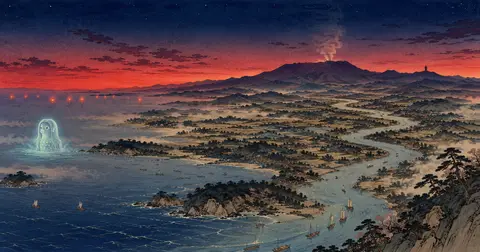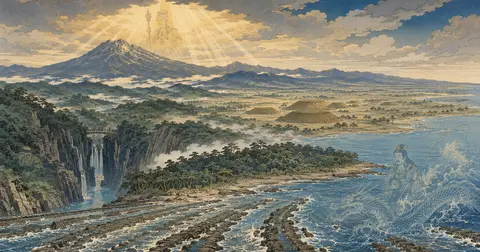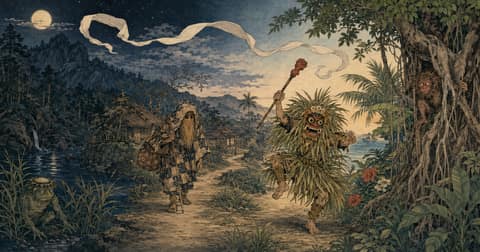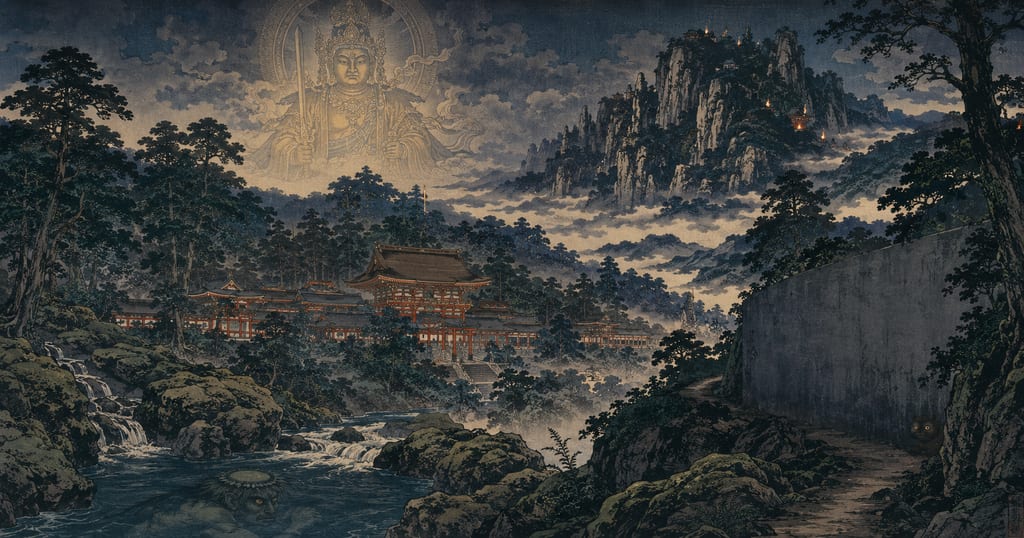
Situated in northeastern Kyushu, boasting both the Kunisaki Peninsula jutting into the Seto Inland Sea and plains nourished by mighty rivers flowing down from Mount Aso, Oita Prefecture was once comprised of the two provinces of Buzen and Bungo, collectively known as the "Toyo Province" (Land of Abundance). When attempting to thread together the supernatural phenomena of this land, the first fact that comes to mind is that this is "the place where gods and buddhas became one."
Usa Jingu, the head shrine of the estimated 40,000 Hachiman shrines across Japan, is enshrined in this land. In the Kunisaki Peninsula rising behind it, a unique mountain ascetic Buddhist culture blossomed known as Rokugo Manzan[1], blending Hachiman worship with Tendai Shugendo practices. Gods became bodhisattvas, and oni were welcomed not as beings to be exorcised, but as ancestral spirits and incarnations of buddhas—this dynamism of syncretism quietly flows beneath the yokai worldview of this region. The supernatural phenomena of the Toyo Province have often been spoken of not as things to be feared and kept at a distance, but as entities to be worshipped, pacified, and drawn into the fold of faith.
On the other hand, kappa (Kawataro) swim in the rivers of Bungo that gather the subterranean waters of Aso, monsters of sound washing azuki beans lurk in the ravines late at night, and invisible walls block the path on dark roads. In the eastern villages, the memory of possessing spirits known as inugami remained deeply rooted until modern times. From the divine Hachiman to the auditory monsters of the riverside, the obstacles of the night roads, and the things that possess family lineages—this article will trace the supernatural phenomena of the Toyo Province in turn, starting with the oracles of Usa, to the oni of Kunisaki, the rivers of Bungo, and the possessions of the villages.
Hachiman:
A Local Deity Becomes a National God,
and a God Becomes a Bodhisattva
When discussing the yokai culture of Oita Prefecture, one cannot avoid Hachiman. Although Hachiman is a divine entity rather than a yokai, the origins and history of this deity serve as the starting point for understanding the Toyo Province's view of the supernatural.
Hachiman
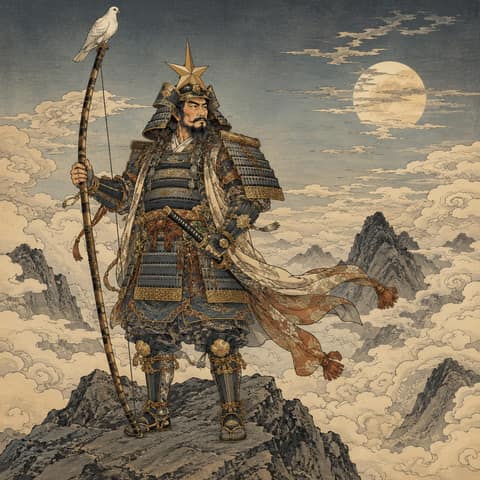
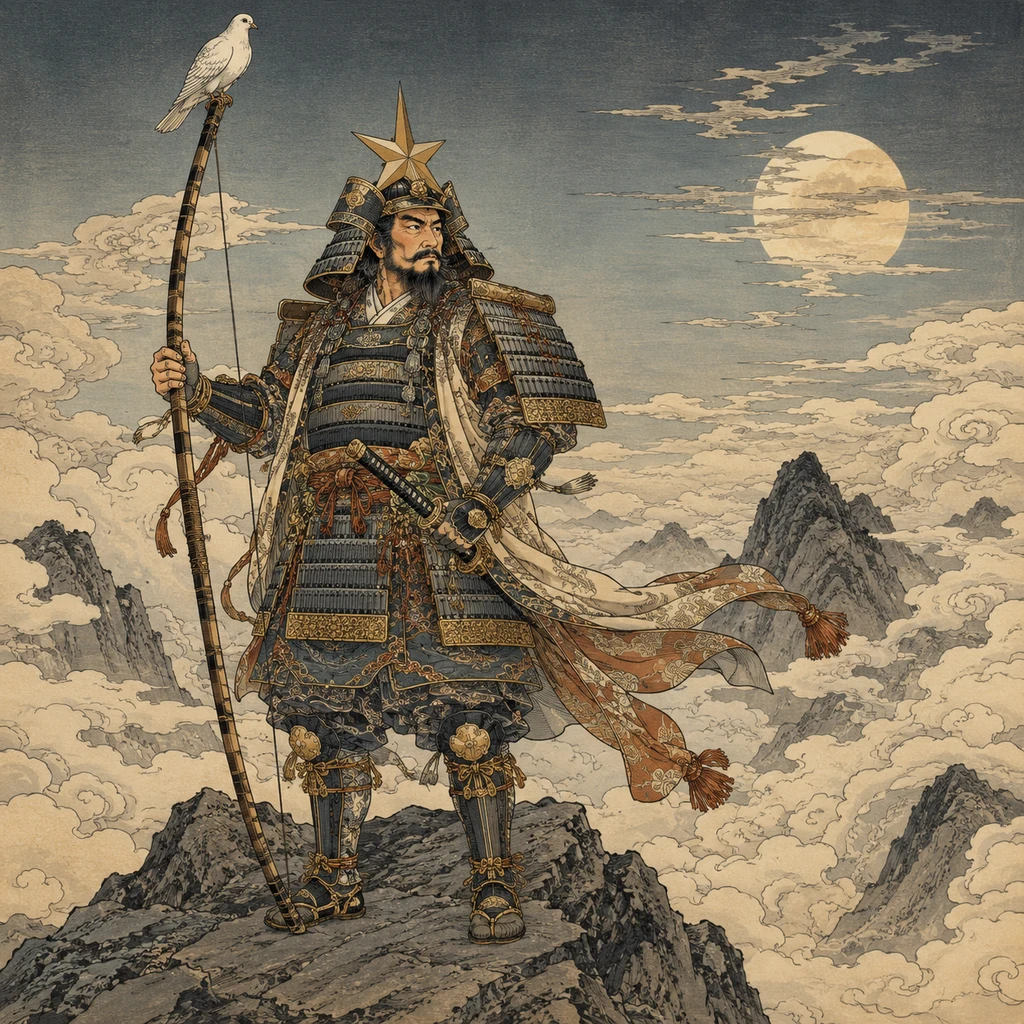
Hachiman (Hachiman-shin or Yahata-no-kami) is one of the most widely worshipped deities in Japan, enshrined as the principal god in approximately 40,000 Hachiman Shrines (Hachimangu) nationwide. His origins are traced to a local indigenous deity worshipped in Usa, Buzen Province (Usa City, Oita Prefecture) in Kyushu. However, he possesses an extremely mysterious background, as he does not appear at all in the classic Japanese mythologies such as the Kojiki or Nihon Shoki. From the Nara to the Heian periods, he came to be identified (syncretized) with the divine spirit of Emperor Ojin (Homudawake-no-mikoto), the 15th emperor, thus establishing his status as an ancestral deity of the imperial family (Kososhin). Furthermore, he was the first Japanese deity to be bestowed with the Buddhist title of "Bodhisattva," becoming "Hachiman Daibosatsu," a god who spearheaded the history of Shinto-Buddhist syncretism. From the Middle Ages onward, he became the tutelary deity (Ujigami) of the Minamoto clan, garnering overwhelming veneration from samurai nationwide as the "God of Lasting Fortunes of War (War God)."
Read moreHachiman is believed to have originally been a local, indigenous deity enshrined in Usa, Buzen Province (modern-day Usa City, Oita Prefecture). He possesses an unusual origin for a god, appearing nowhere in the *Kojiki* or *Nihon Shoki*—despite being a great deity with some 40,000 shrines nationwide, his name is absent from the mythologies of these chronicles. During the Nara period, he came to be identified with the spirit of the 15th emperor, Emperor Ojin, thereby attaining the status of an imperial ancestral god. Furthermore, he became the first Japanese deity to be granted the title of "Bodhisattva," becoming "Hachiman Daibosatsu"[2]. A Shinto god taking on the title of a Buddhist bodhisattva—it was the deity of Usa, no other, that spearheaded this syncretism of Shinto and Buddhism. Placing a god at the beginning of a yokai encyclopedia might seem strange, but the behavior of this deity—who cannot be distinctly categorized as a god, a buddha, a human, or an aberration—is precisely the foundation upon which the supernatural phenomena of the Toyo Province stand.
The catalyst for this was the Hayato Rebellion in Yoro 4 (720). It is said that the great deity Usa Hachiman rode in a portable shrine to southern Kyushu to quell the Hayato people who had rebelled against the Yamato Imperial Court in Osumi and Hyuga. After the rebellion was suppressed, Hachiman returned to Usa, repented for the sin of taking lives, and delivered an oracle declaring, "A hojoe (life-releasing ceremony) must be held every year."
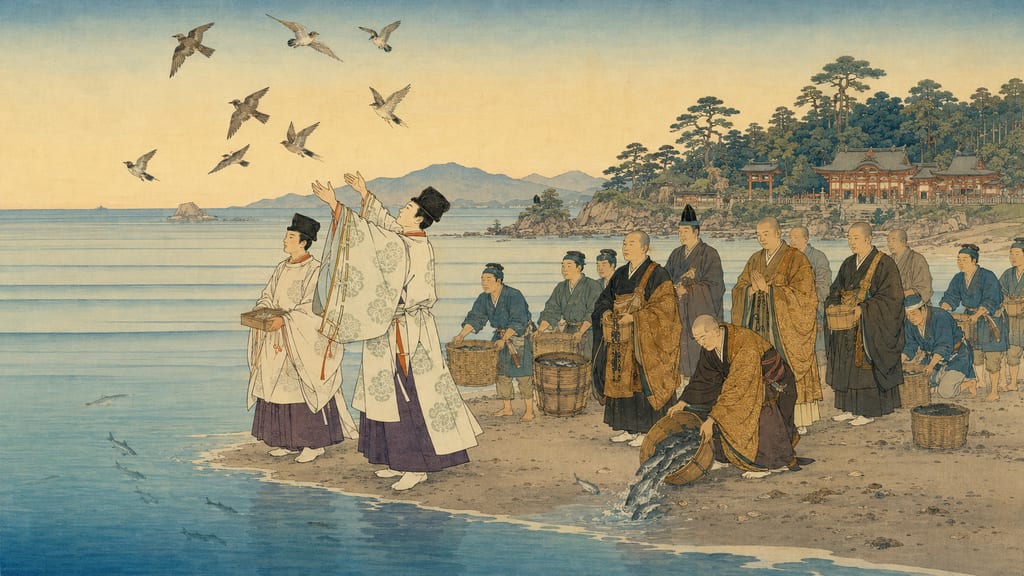
This Hojoe[3] itself is a symbolic festival where a god sought salvation in the Buddhist precept of "no killing," serving as proof that Usa had established syncretism between Shinto and Buddhism at a remarkably early period. This festival, which continues today as the Mid-Autumn Festival, centers on the Shinto ritual of releasing living creatures at Wama beach and bore the significance of pacifying the spirits of the slain Hayato.
Hachiman was also an intensely powerful "god of oracles." During the Nara period, when the construction of the Great Buddha at Todai-ji reached a standstill, Hachiman of Usa delivered an oracle stating, "I will lead the gods of heaven and earth to ensure it is accomplished," and is said to have traveled to the capital to support the project. The greatest oracle that moved history, however, was the Usa Hachiman Shrine Oracle Incident[4] in Jingo Keiun 3 (769). When an oracle was presented claiming, "If Dokyo is placed on the emperor's throne, the realm will be at peace," Empress Shotoku sent Wake no Kiyomaro to Usa to ascertain its truth. The oracle Kiyomaro received was the exact opposite: "In our country, since its creation, the distinction between ruler and subject has been fixed. A subject can never be made a ruler." This report thwarted Dokyo's usurpation of the throne, and Kiyomaro was exiled to Osumi. In the sense that a single divine oracle nearly decided the imperial succession, the weight of Usa Hachiman's oracles stands unrivaled.
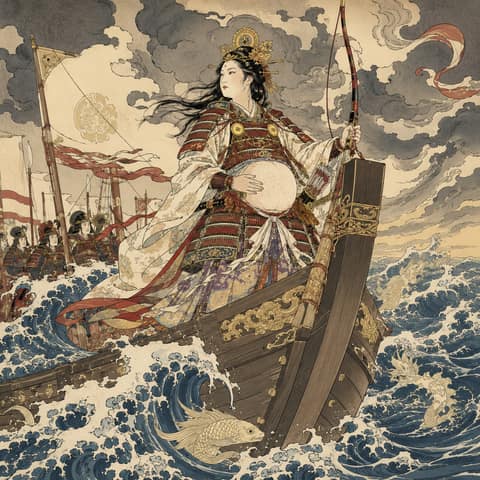
The comprehensive divine nature of this god is also reflected in the enshrinement method known as Hachiman Sanjin (the Three Deities of Hachiman). The main sanctuary of Usa Jingu adopts a structure of Three Deities as One[5], enshrining Hachiman Okami (Emperor Ojin) in the First Shrine, his purported mother Empress Jingu in the Second Shrine, and the Himegami in the Third Shrine. Empress Jingu, in particular, is central to legends where she commanded an expeditionary force while heavily pregnant, wrapping stones around her belly, and safely giving birth to Emperor Ojin upon her return. Consequently, the Hachiman faith strongly harbors not only the strictness of a martial god but also a maternal aspect that protects safe childbirth and child-rearing. The true identity of Himegami is said to be the Three Goddesses of Munakata or a local deity, remaining shrouded in mystery to this day. These three deities, embodying martial prowess, maternity, myth, and mystery all at once, sit quietly within the shrines of Usa.
From the Middle Ages onward, Hachiman was revered as the tutelary deity of the Seiwa Genji clan by Minamoto no Yoriyoshi and Yoritomo, spreading nationwide as a martial god whose name was dyed onto banners reading "Namu Hachiman Daibosatsu." After Minamoto no Yoriyoshi solicited the divine spirit of Iwashimizu Hachimangu to Kamakura, laying the foundation for what would become Tsurugaoka Hachimangu, samurai warriors would utter "Yumiya Hachiman" to swear oaths to their bows and arrows before heading into battle. A single regional deity became a national god, then the guardian deity of the warrior class, and was eventually enshrined in approximately 40,000 branch shrines—the source of this entire progression lies right here in Usa, Buzen. This is why this article on yokai must begin with the story of a god. In the Toyo Province, divine entities, oni, and river monsters all pile up on the same geological layer of syncretism between Shinto and Buddhism.
The Oni of the Kunisaki Peninsula:
Supernatural Entities as Ancestral Spirits and Buddhas
The Kunisaki Peninsula, spreading out to the east of Usa Jingu, was largely a manor of Usa Hachiman during the Nara and Heian periods. It was here that the mountain ascetic Buddhist culture known as Rokugo Manzan was born from the convergence of the Hachiman faith and Tendai Shugendo. Said to have been founded by the Bodhisattva Ninmon in Yoro 2 (718), this land, where stone buddhas, pagodas, and cliff-carved buddhas are etched into the valleys of the peninsula and countless monks' living quarters once lined the mountains, is still called the "birthplace of Shinto-Buddhist syncretism." Bodhisattva Ninmon is frequently described as an incarnation of Hachiman, and the uniqueness of the faith on this peninsula lies in how the god, the buddha, and the founding patriarch are seamlessly fused together.
What commands attention here is the unique character of the "oni" (demons/ogres) of Kunisaki. Generally, oni are targets to be exorcised and slain, but during the Shujo Onie[6] ceremonies held during the lunar New Year on the Kunisaki Peninsula, oni carrying torches are not only not exorcised, but are welcomed as ancestral spirits of the founding masters of Rokugo Manzan or as incarnations of the buddhas.
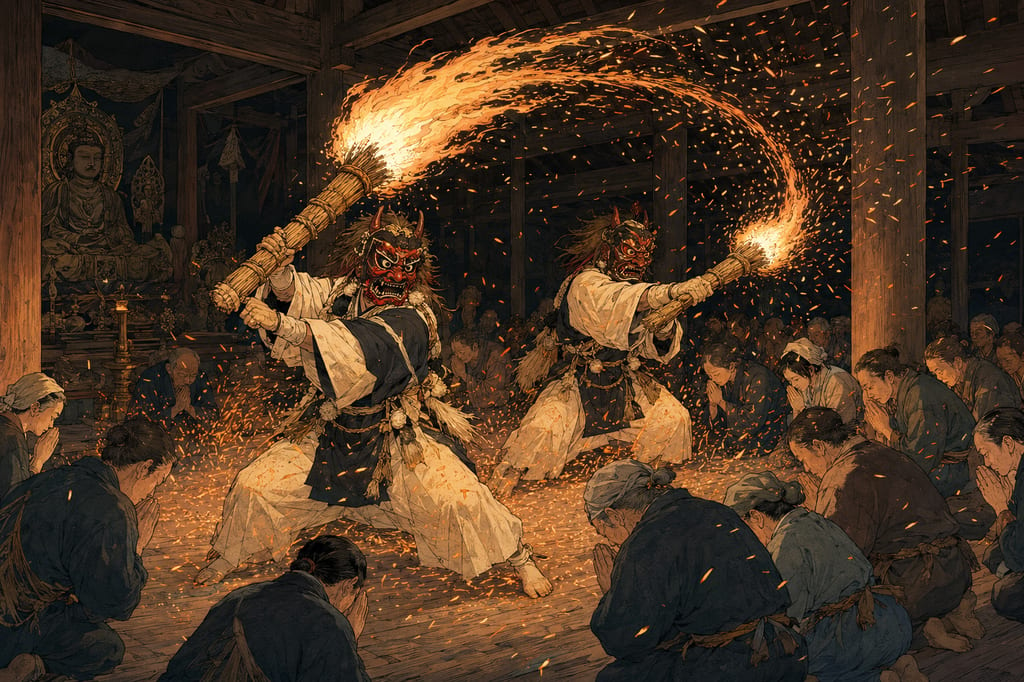
Oni known as Ara-oni and Saibarai-oni run wildly through the halls swinging blazing torches, and people believe that being struck on the back or shoulders, or having their feet stepped on by these oni, will actually bless them with good health and bountiful harvests. Oni bringing salvation rather than disaster—this reversal is an idea completely opposite to the common oni that are chased away by throwing beans during Setsubun. It is an extension of the same logic of Shinto-Buddhist syncretism that saw a local god become a bodhisattva, and the slain Hayato enshrined in a Hojoe. The gaze that sees ancestral spirits and buddhas behind the masks of oni has taken root in this peninsula.
Shujo Onie is believed to have been born from the combination of Heian period New Year events and the Buddhist ascetic practices carried out on the Kunisaki Peninsula, and has been actively held since the early Edo period. It was once held at many temples of Rokugo Manzan, but due to depopulation, the number gradually decreased. Today, having been designated an Important Intangible Folk Cultural Property of Japan in 1977 (Showa 52), it is held annually at Tennen-ji in Bungotakada City, and in alternating years at Jobutsu-ji (even years) and Iwato-ji (odd years) in Kunisaki City. This strange festival of praying to oni while being showered in sparks is the ultimate proof that the Toyo Province drew even oni to the side of the buddhas.
The Rivers of Bungo:
Memories of Kappa (Kawataro) and Sumo
The topography of Bungo is blessed with water. Starting with Hita in the upper basin of the Chikugo River, which gathers the underground streams of the Aso mountain range, rivers such as the Ono River and Oita Prefecture nourish the plains. These rivers and deep pools hold a dense accumulation of folklore regarding the kappa, widely known in Kyushu as "Kawataro."
 Bungo Kawatarōbun-go no kawa-ta-rō
 Shōkichi Kappashō-kichi kappa
 Azuki-arai (Bean Washer)ah-ZOO-kee ah-RAH-ee
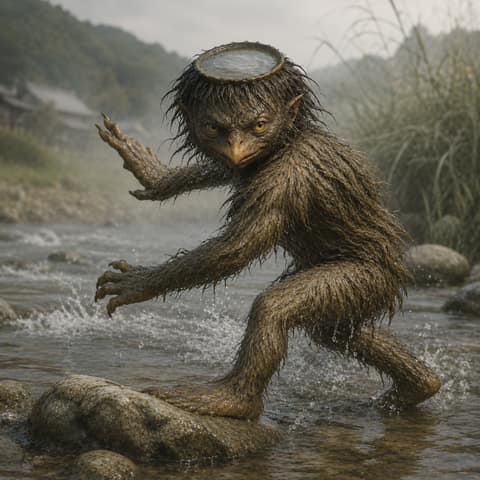
Bungo Kawataro is, true to its name, a kappa that lives in the rivers of Bungo. In Kyushu, kappa are often called Kawataro, while across Satsuma and Osumi they are "Garappa," and in some mountainous areas they are distinguished as "Yamawaro" (mountain children)—even for kappa alone, the terminology in Kyushu is truly diverse. The Bungo Kawataro is said to hold water in the dish on its head and have a body covered in hair resembling a monkey, but it also features a beak-like mouth and a shell. It loves sumo wrestling and underwater mischief, and while it was feared for pulling horses into the water and extracting their innards, it was also said that if one bows politely, the water in its dish spills, making it lose its strength and surrender; if captured, it teaches bone-setting and wound medicines; and if one writes their name on a cucumber and floats it down the river, they can avoid misfortune. Such narrative patterns common across Kyushu were frequently told in Bungo as well.
What should be noted is that observations of these Kawataro were recorded in documents from an early date. The *Kappa Kikiawase* (Inquiries about Kappa)[7], compiled in Hita in Bunka 2 (1805), was recorded by a Confucian scholar at the request of a local official who interviewed nearby eyewitnesses about their kappa encounters. Several tales spanning Buzen and Chikugo were recorded, multiple of which reportedly revolved around sumo wrestling. This suggests that the connection between kappa and sumo was repeatedly spoken of in this region. The fact that Hita was a "Tenryo" (shogunate domain) and a strategic hub of economy and culture in Kyushu, fostering an environment where the intellectual endeavor of transcribing oral accounts could flourish, is likely the background behind the survival of such records.
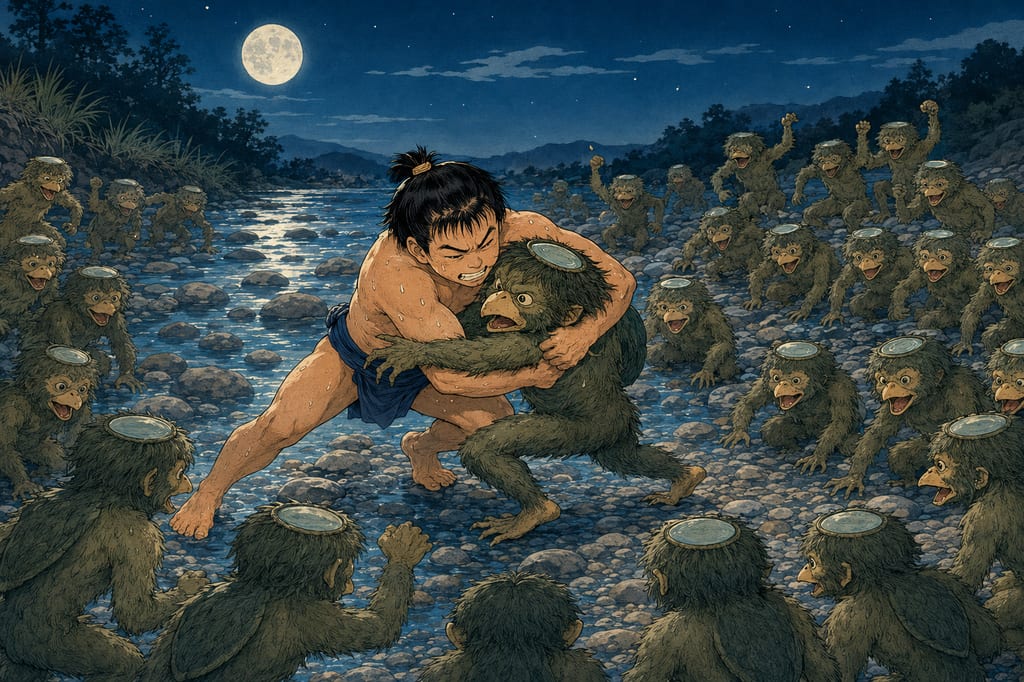
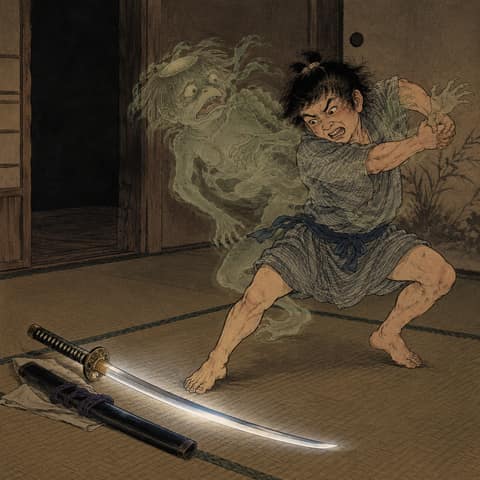
A story that conveys this sumo-loving character as a singular incident is that of the Shokichi Kappa. It is said that when a boy named Shokichi from Takeda Village, Hita District, Bungo Province (modern-day Hita City, Oita Prefecture) punished a troublemaker by the riverbank, he was lured out to the river that night and forced to continuously wrestle against a large number of child kappa. Even when his family brought him back, Shokichi thrashed about as if grappling with an unseen opponent, and was deemed to have been possessed by a kappa. When a short sword (wakizashi) bearing the inscription of Go no Yoshihiro was placed near him, the kappa flinched in fear of the blade's power, but would act up again when the sword was moved away. In the end, the situation was finally quelled through the incantations of a mountain ascetic. The fear of sharp blades and the power of Buddhism or Shugendo is a widespread element common to kappa-slaying tales across Kyushu. This story appears in the *Kawataro-den*[8] from around the Kan'ei era and the *Hita Gunshi*[9] compiled in the Taisho period; while the name "Shokichi Kappa" is from later organizational efforts, its plot is rooted in local legends and old records. That Hita has long been a land rich in kappa folklore can be gleaned from these regional gazetteers as well.
The dual nature of the Kawataro reflects the dual nature of the rivers themselves. The rivers of Bungo were blessings that watered the fields, but at the same time, they were threats that swallowed horses and children. The gruesome legend of horses being pulled into the water and disemboweled is likely the wisdom of folklore, casting the real danger of humans and beasts losing their lives by the river into the form of a kappa as a warning to children. On the other hand, stories of pacifying flood damage by offering tributes, or learning bone-setting and wound medicines from captured kappa, are memories of the villages finding ways to coexist with the rivers. Frightening yet dependable—the Kawataro was the symbol of the precarious contract the people of Bungo forged while living alongside the river.
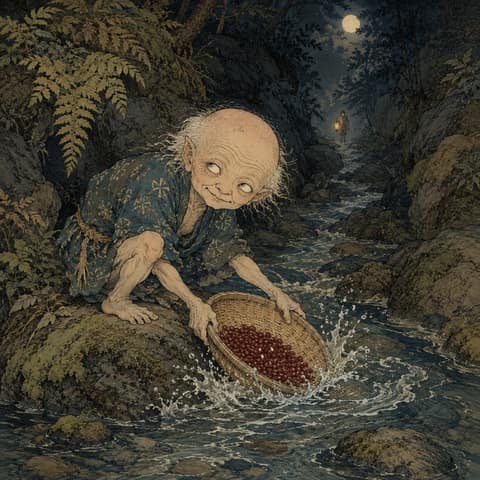
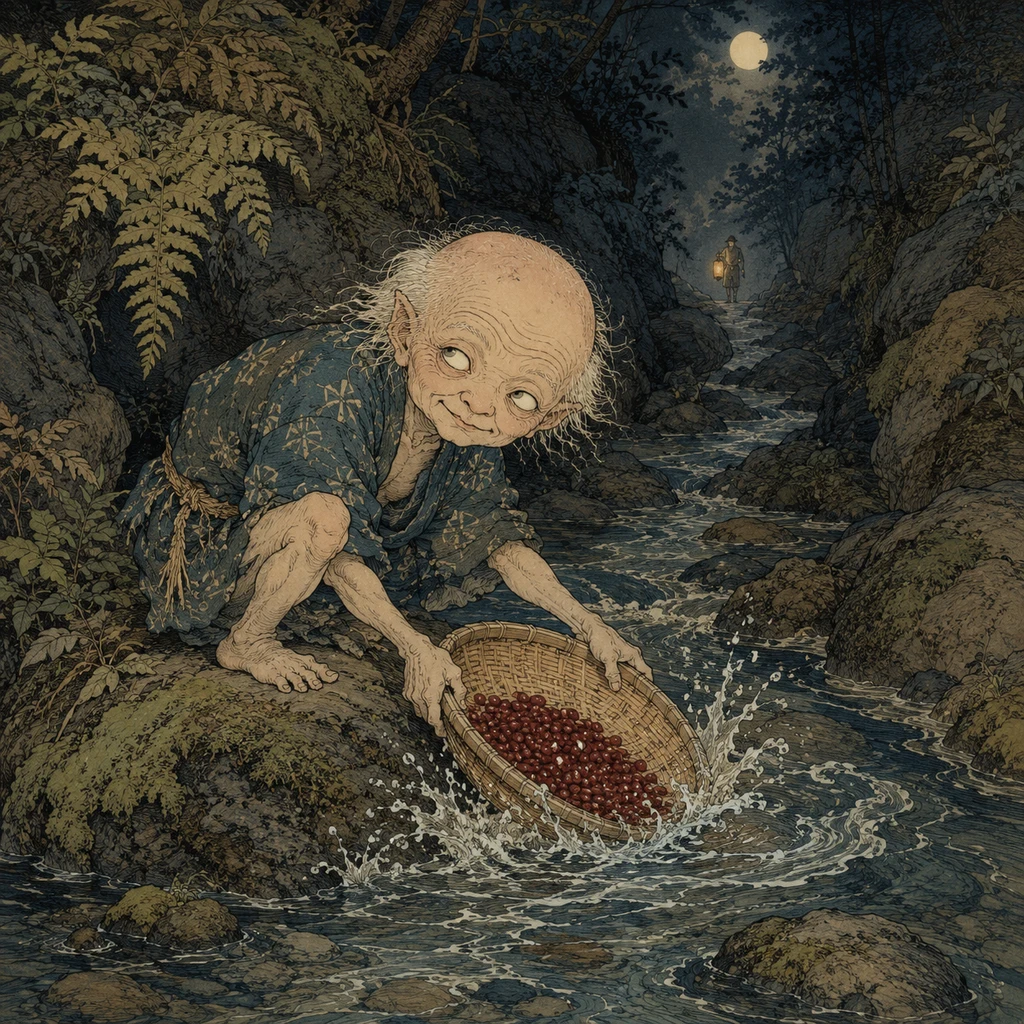
If the kappa is a "visible monster," the riverbanks harbor another kind: an "audible monster." The Azukiarai is a yokai whose true form is sound itself, echoing sounds like "shoki-shoki" and "zaku-zaku" as if washing azuki beans in riversides and ravines late at night. In many legends, its figure never appears; approaching it causes the sound to suddenly cease, and those distracted by the noise were said to slip and fall into the river or valley. While distributed nationwide, in Oita Prefecture, a lyric has been passed down describing it washing azuki while singing, "Shall I wash my azuki, or shall I catch a person and eat them?"[10] This song, housing both innocent behavior and the terror of man-eating in a single phrase, perfectly illustrates the nature of the Azukiarai. In literature, the *Ehon Hyaku Monogatari* (Tenpo 12 [1841])[11] tells of a young monk at a mountain temple who was adept at washing azuki beans but was pushed into a valley river by a jealous wicked monk, and ever since, his spirit has made the sound of washing azuki beans every night. There are also accounts characterizing it by its meticulousness in precisely counting beans from one go to one sho without a single error, retaining traces of the lingering regrets and diligence of the living transforming into a monster of sound. Of course, in the actual realm of folklore, there also coexisted a rational understanding attributing the sounds to natural phenomena like weasels, otters, rustling bamboo leaves, or water noises. With the boundary between the supernatural and nature left ambiguous, people listened closely to the sound of the rivers at night. The rivers of Bungo embraced both the visible monster of the kappa's sumo and the audible monster of the Azukiarai.
Walls on the Night Road:
The Nurikabe of Oita is Painted by "Tanuki"
If rivers breed monsters of the water's edge, night roads breed monsters of the journey.
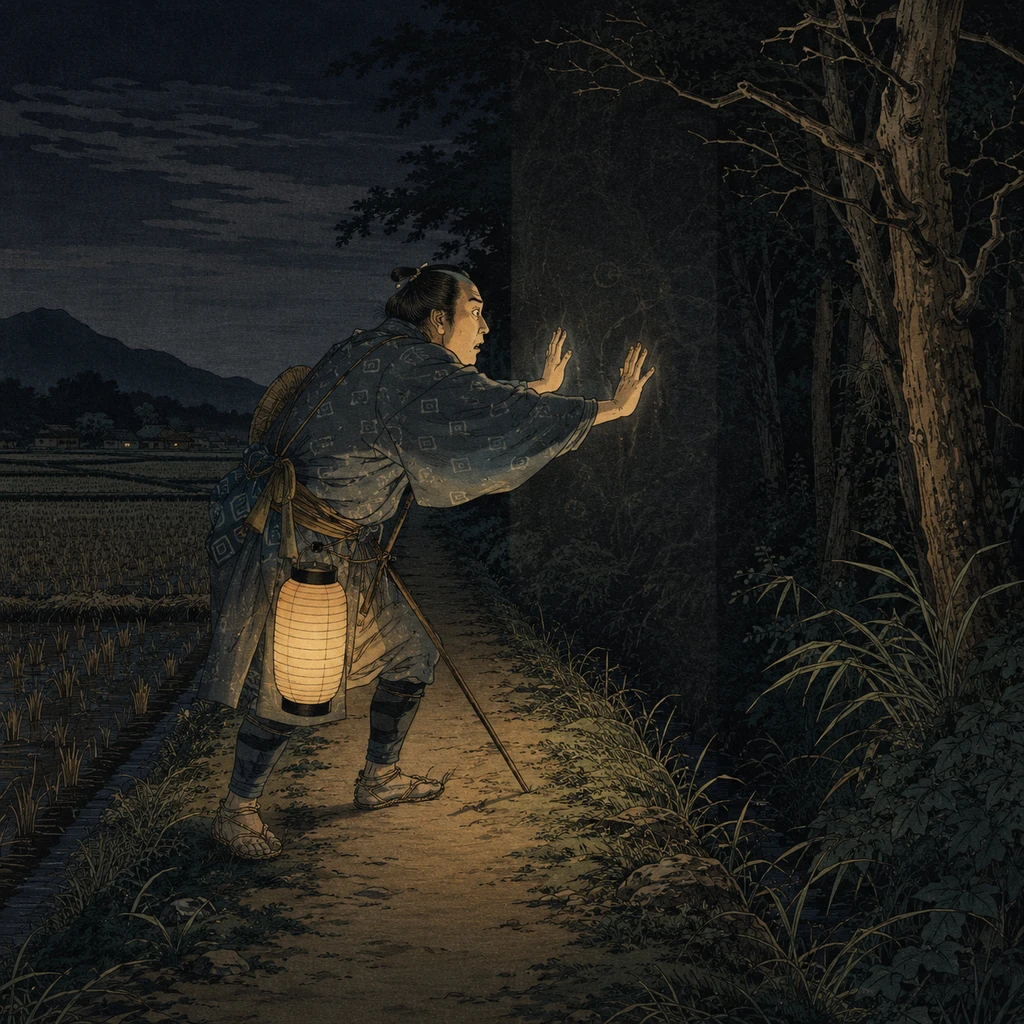
Nurikabe
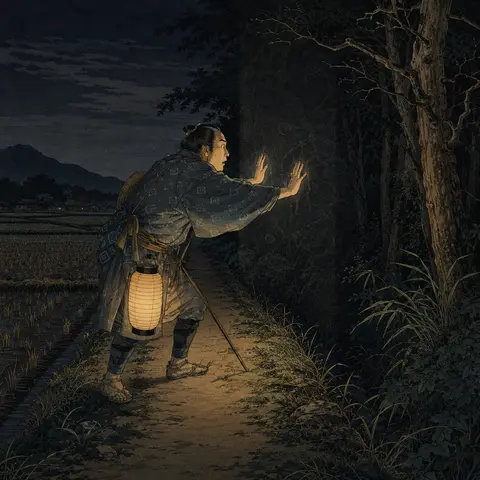
A yokai famed as an invisible wall that blocks travelers on night roads. People suddenly find they can’t move forward, their hands meeting a flat, unyielding surface. The spell is said to break if one waits, sidesteps, or taps the ground with a cane. Its form is unfixed—often described as unseen or like a featureless wall. It rarely harms beyond causing confusion, feared mainly as a nuisance that makes people lose their way.
Read moreThe Nurikabe is an invisible wall yokai that suddenly blocks one's path on a night road. Pedestrians find themselves abruptly unable to move forward, and even if they grope around, they feel obstructed by what seems to be a flat surface. It was generally believed that the spell could be broken by standing still for a moment, stepping to the side, or sweeping a stick around one's feet. As a folkloric vocabulary term, Nurikabe is well-known for being recorded in Kunio Yanagita's *Yokai Dangi* (Discourses on Yokai) under the "Vocabulary of Yokai Names"[12] as an example collected in Onga District, Fukuoka Prefecture, and is considered a yokai centered in northern Kyushu. However, similar supernatural encounters were deeply transmitted in Oita as well, and furthermore, the storytelling in Bungo has a distinct flavor.
In Oita Prefecture, this monster that blocks the path was deemed the work of raccoon dogs (tanuki) and called the "Tanuki's Painted Wall" (Tanuki no Nurikabe). Furthermore, in Kakaji Town (modern-day Bungotakada City), the same monster is referred to as the "Weasel's Painted Wall." Attributing the true identity of an invisible wall not to an abstract "wall yokai," but to familiar beasts known for bewitching humans—such as tanuki and weasels—is an understanding unique to Kyushu, with its rich tradition of bewitchment tales. The Nurikabe here is not so much an intrinsic yokai as it is a type of illusion shown by the bewitchment of animals. Moreover, a folktale from Minamiamabe District (modern-day Saiki City) recounts that on a sloping path called Nanamagari, the Nurikabe appears alongside the previously mentioned azuki-washer (Azukiarai), and the vision of those walking at night suddenly goes pitch black. The auditory monster of the waterside and the wall monster of the night road meet on the very same mountain pass. The endearing figure of a rectangular wall with eyes and a nose, popularized by Shigeru Mizuki's works, is a design established in later generations; the night road walls of Bungo were originally feared as such "invisible hindrances created by the bewitchment of beasts."
Things That Possess the Eastern Villages:
Inugami
Finally, we must touch upon the possessing spirits that took root deep within the village societies of Bungo: the inugami.
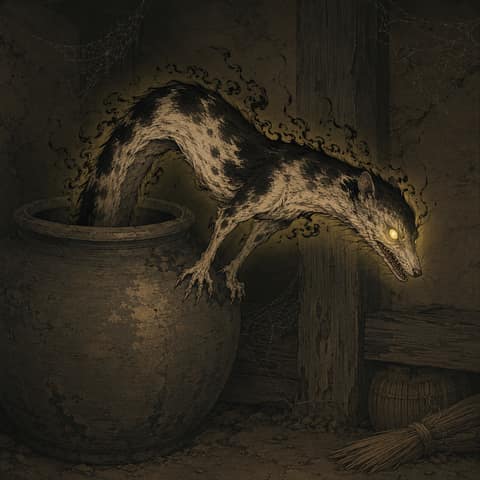
The Inugami is a dog-spirit possession primarily distributed across western Japan. Its heartland is considered to be Tokushima and Kochi in Shikoku, but its presence is also prominent from Shimane and Yamaguchi down to Kyushu. The eastern part of Oita Prefecture, in particular, is counted among the regions where the concept of inugami remained stubbornly persistent until recent years. Its form is mostly described as a small beast about the size of a mouse with mottled patterns. It was believed to be kept in storehouses, under floors, or in water jars, reading its master's intentions to possess other families and bring about illness and domestic turmoil. Those possessed exhibited symptoms such as pain in the chest and limbs, or barking like a dog, and were said to require incantations to purge it, as medical treatment was ineffective.
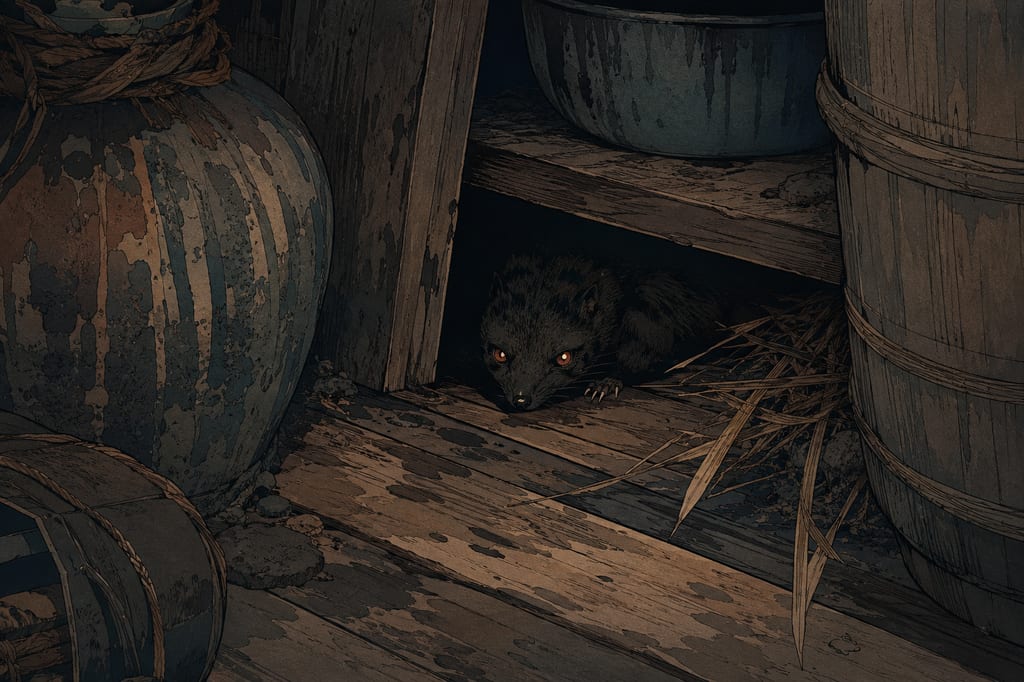
What is particularly grave about the inugami is that it became tied to the concept of family lineages, known as "inugami-suji"[13]. It was thought that inugami possessed specific families generation after generation. When marriages were considered, lineages were investigated, and marriages with families deemed inugami-suji were avoided. This is a negative social history intertwined with discrimination, which trailed off as a serious social problem right up until the modern era. In the background lies the logic of village society trying to explain why one family suddenly prospers while another declines—such maldistribution of wealth and the rise and fall of households were projected into the form of invisible possessing spirits. Jealousy and discord birthed rumors that "that family is an inugami lineage," and the rumors in turn reproduced discrimination. The inugami was the spirit of a beast, but simultaneously a social monster created by the tensions of the community.
Regarding its origins, there are theories that a form of sorcery connected to the "dog venom" (kenko) described in the Chinese *Soushen Ji* (In Search of the Supernatural)[14] was transmitted to Japan, or folk beliefs detailing a creation method involving burying the head of a starved dog at a crossroads to turn its grudge into a cursed object. However, it is pointed out that these are narratives constructed later to explain the inugami's origins rather than historical facts, and they largely functioned as stories to justify discrimination against the families labeled as inugami lineages. Rather than taking the origin tales at face value, questioning why such narratives were needed becomes the key to understanding these possessing spirits. Just as Kenmi Shrine in Tokushima is famous as a shrine for warding off inugami, the people of Bungo also attempted to exorcise these invisible possessions through the power of incantations and deities. The fact that the ultimate destination sought for exorcism was the very power of the gods and buddhas dating back to Usa reveals the unbroken connection between the supernatural and faith in this region, showing its face here as well.
Conclusion:
The Land Where Gods Become Bodhisattvas and Oni Become Buddhas
Looking across the supernatural phenomena of the Toyo Province in this way, a single axis emerges. Usa, where a regional god became a bodhisattva and ascended to a national deity; the Shujo Onie of Kunisaki, where slain Hayato were enshrined through Hojoe and oni, far from being exorcised, are welcomed as ancestral spirits and buddhas—in this land, things that are originally targets of exorcism and fear often flip to the side of faith and salvation. Kappa are subdued by yielding to blades and Shugendo, and upon capture impart medicinal wisdom; the sound of the Azukiarai warns children of the dangers of the waterside; the Nurikabe is understood not as an abstract wall but as the bewitchment of familiar beasts; and even the societal darkness of the inugami was ultimately sought to be purged through prayers. Rather than destroying the terrifying, they are pacified, worshipped, and calmed by the hands of gods and buddhas—the core of the yokai culture nurtured by the "Toyo Province" of Buzen and Bungo is precisely this single geological layer where gods and buddhas, oni and ancestral spirits, and monsters and faith are intricately folded together. While the same yokai are transmitted in other provinces, the narratives in Bungo somehow carry the scent of salvation, a trait undoubtedly linked to the fact that this land was the birthplace of Shinto-Buddhist syncretism.
Regarding the oracles of Usa and the oni of Kunisaki, deeper, land-bound stories sleep within the various temples of Rokugo Manzan[1] and the long shrine history of Usa Jingu itself. The land of Usa that birthed Hachiman Daibosatsu, the valleys of Kunisaki where oni are worshipped amidst showers of sparks, the rivers of Hita where sumo-loving Kawataro swim, and the eastern villages where rumors of inugami were exchanged—the yokai of Oita inevitably lead to specific, concrete locations if one follows them on a map. Using this article as a gateway, we invite you to venture into the world of gods, oni, and kappa of the Toyo Province.