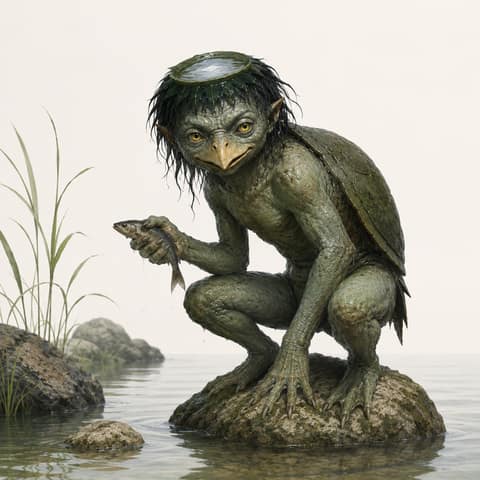
The Shōkichi Kappa is one of the kappa tales of Bungo Province—present-day Ōita Prefecture. It springs from the story of Shōkichi, a boy of Takeda Village in Hita District, who wrestled a kappa and was afflicted by its curse. Closely matching accounts of kappa deeds appear in the Kanei-era Kawatarō-den[1] and the Hita Gunshi[2] (Hita District Gazetteer), among others, vividly reflecting the Kyushu view of the kappa: a love of sumo, possession of human beings, and pacification through prayer. The name "Shōkichi Kappa" itself came into use only in later editorial retellings.
Folklore & Legends
The tale runs as follows. Shōkichi had punished some unseen thing that was making mischief at the river; that very night he was lured to the water and went on wrestling a whole crowd of young kappa. Even after his family brought him home, he kept thrashing about as if grappling with an invisible opponent, and was held to be possessed by a kappa.
So a wakizashi bearing the signature of Gō Yoshihiro was laid at his side; the kappa, fearing the power of the blade, flinched, and when the sword was taken away the uproar began again. In the end, it is said, the prayers of a shugenja (mountain ascetic) finally brought him calm. A dread of keen blades and of the power of Buddhism and the ascetic arts is an element widely shared in kappa-quelling tales, not in Kyushu alone. The local gazetteer Hita Gunshi[2] gathers many other kappa stories besides, showing that this land was rich in kappa lore. In later years the name "Shōkichi Kappa" became widely known through the retellings of Mizuki Shigeru and others, but its core plot rests on local tradition and old records.
This version turns to the phenomenon of "kappa possession" that the Shōkichi tale conveys. Most kappa stories play out at the water’s edge, but here the river sumo is carried right into the home. Brought back by his family, Shōkichi went on raging as if locked in a grapple with an unseen opponent—exactly the work, people said, of a kappa that had possessed a human being. A water-spirit climbing onto dry land by borrowing a human body: there lies the spine-chilling fascination of this tale.
The means of quelling it, too, reflects the faith of the land. What first took effect was the power of Gō Yoshihiro’s signed blade. The belief that the kappa dreads a keen edge is found in many regions, and the detail that it raged again once the sword was removed shows that power plainly. What finally settled the disturbance was the prayer of a shugenja, an ascetic who trains secluded in the mountains. Quelling kappa possession with these two—the power of the blade and the ascetic’s spiritual force—is a hallmark of Kyushu kappa tales. Hita has gathered many kappa stories, the Hita Gunshi[2] foremost among them, and together with the "Bungo Kawatarō" of the same Bungo, they attest to the depth of this region’s kappa beliefs.
Character Profile
This section is our own creative profile for storytelling. It is not historical fact or scholarship.
It lures children to the river to challenge them at sumo and fixates on winning. It possesses people and drives them to wild fits, yet flinches before the power of the blade and of prayer.
Compatibility
People who love sumo and contests and who revere the faith of the land
Abilities
Loves sumo and lures childrenNimble movement underwaterGroup mischief and bewildermentBriefly possesses people and drives them to rage
Weaknesses
Flinches before the power of a keen blade such as Gō Yoshihiro’s signed sword
driven off by the prayers and spiritual power of a shugenja
said to lack endurance on land
Habitat
Rivers and deep pools, irrigation channels and weirs, small streams near rice paddies (around Hita, Ōita Prefecture)
The diagram below is a diagnostic evaluation chart for Shōkichi Kappa, the Sumo-Loving Kappa of Bungo. The higher the value of each item, the stronger that characteristic is expressed.
Yokai Love Persona
The diagram below is a diagnostic evaluation chart for Shōkichi Kappa, the Sumo-Loving Kappa of Bungo. The higher the value of each item, the stronger that characteristic is expressed.