A Shiro-bikuni Appears in Kyoto in 1449
Yao-bikuni first comes into sharp view not in a seaside cave or at a mermaid feast, but in Muromachi-period Kyoto. According to the entry for the twenty-sixth day of the fifth month of Bun’an 6 in *Yasuyoshi-ki*, a Shiro-bikuni claiming to be more than two hundred years old came up to Kyoto from Wakasa and was exhibited at the Great Jizō Hall north of Nijō Higashinotōin[1]. People gathered to glimpse the long-lived nun, while rumors questioning her age spread through the capital.
The diary speculates that the name Shiro-bikuni may refer to white hair. This is a different outline from the beautiful nun who keeps a youthful appearance in later tales. What appears here is an aged nun from Wakasa, city dwellers crowding to see her, and an extraordinary age whose truth cannot be known. Before any supernatural origin, the legend begins with a rumor about a very old woman who stirred the city.
The entry for the twenty-sixth day of the seventh month in *Gaun Nikkenroku* that same year[2] calls the nun from Wakasa an “eight-hundred-year-old nun.” People in Kyoto rushed to see her, and entry through the gate required a payment that varied with social rank. The long-lived nun also occupied the space of a paid public spectacle, where something rare was shown to a crowd.
How Her Age Shifted from Two Hundred to Eight Hundred Years
The two accounts from 1449 alone give the nun two different ages: more than two hundred years and eight hundred years. Early-modern mermaid-flesh stories make her more than four hundred, while some local accounts say she lived for a thousand years. “Eight hundred” is not one precise lifespan calculated from a birth year. It is a number enlarged in storytelling to express a woman who lived beyond ordinary human measure.
That variation is not so much a contradiction as part of the legend’s force. Even two hundred years exceeds a human lifetime beyond imagining. As the number rises to four hundred or eight hundred, the seasons and places she has outlived recede further into the distance. The “eight hundred” in her name makes that immeasurable time felt in a single phrase.
Her appearance varies in the same way. Medieval diaries suggest an old nun with white hair, while an account of early-modern Obama in *Kishi Kikō* introduces an image that appears about eighteen years old[6]. Neither the old nun nor the young woman is the one original form. People imagined a being beyond ordinary age in both white hair and youth.
How Mermaid Flesh Entered the Story
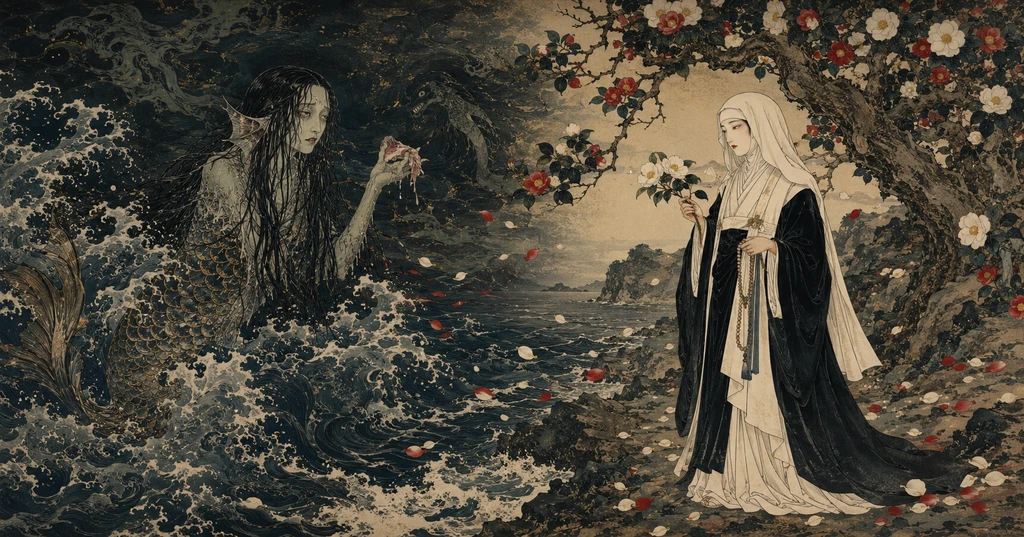
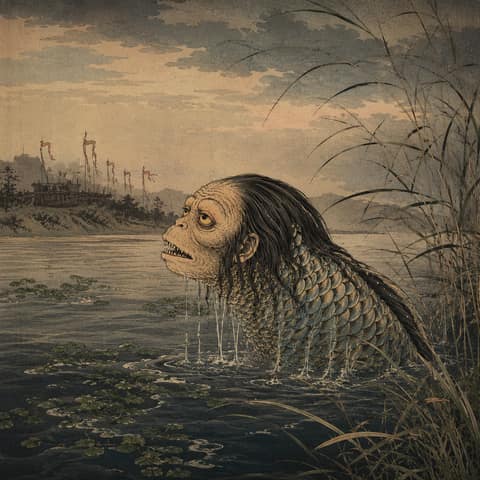
The best-known telling today is the story of a girl who eats mermaid flesh and grows old only very slowly. In Hayashi Razan’s *Honchō Jinja Kō*, in the entry on Miyako no Yoshika, the girl’s father is invited by a stranger in the mountains and obtains a mermaid in a wondrous place[3]. The daughter eats the mermaid he brings home and becomes a Shiro-bikuni more than four hundred years old.
In this account, the girl herself does not journey into the other world. An unknown food, brought home by her father from beyond the boundary, changes her time within the household. Mermaid flesh is not simply a medicine for renewed youth; it is something from another realm brought into the human world. The long years that begin after she eats it can look like either blessing or dread.
Because the tale of mermaid flesh made such a strong impression, Yao-bikuni and mermaids became closely linked. Yet the diaries of 1449 give no reason for her longevity, and local tales offer other causes, such as shellfish or medicine. Mermaid flesh is the best-known early-modern answer among many variants, not the only one.
Traces of a Traveler in Ancient Trees and Temples
Yao-bikuni is also told as an itinerant nun who travelled the provinces, planted trees, and left her name in the origins of temples, shrines, and bridges. At Jigen-ji in Mizuhata Village, Musashi Province, as recorded in *Shokoku Rijindan*, a great Chinese hackberry beside the Niō Gate was said to have been planted by Yao-bikuni of Wakasa[4]. A huge tree looking down on many generations and a nun living beyond a human lifespan become linked as if each explained the other’s age.
Camellias are famous as Yao-bikuni’s emblematic tree, but planting traditions are not limited to camellias. Chinese hackberries, cedars, pines, and other trees that have lived long in a locality can become signs of her journey. There may be no diary recording an itinerary, yet the words “she planted this tree” invite the nun into a place’s past.
In this way, Yao-bikuni became more than the biography of one long-lived woman: her name binds together many local memories. The traces at old trees and temples are not one itinerary across Japan, but a collection of smaller tales in which each place speaks of its own antiquity and wonder.
Obama’s Cave and a Nationwide Tradition
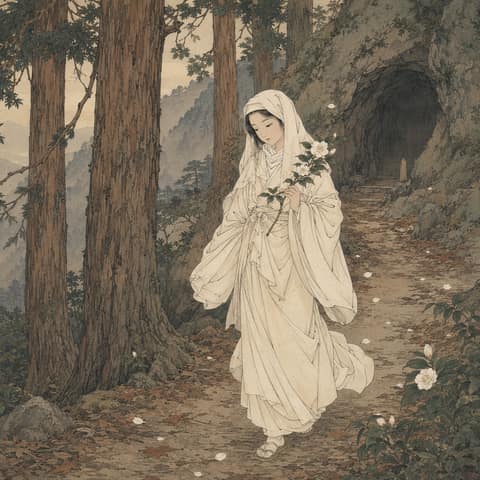
Obama in Wakasa is where the region named as her origin in medieval diaries meets later traditions of her ending. Obama City introduces the cave before Kūin-ji as a sacred cave associated with Yao-bikuni’s entry into meditation[5]. Opening in the mountainside, it became the setting for a story in which the nun returned to Wakasa after a long journey and quietly disappeared.
“Entering meditation” here is the language of the tradition handed down in Obama. The diary of 1449 does not tell of this cave, nor does the city’s account record every detail of fasting or self-mummification. Still, the sacred cave at Kūin-ji has been carefully preserved as a place of return that later local tradition gave to the long-lived nun from Wakasa.
A research bulletin of the Fukui Prefectural Archives, introducing Harumi Takahashi’s 1982 survey, counts 166 Yao-bikuni-related traditions at 121 locations in 89 cities, towns, and villages across 28 prefectures[6]. The figures belong to that survey, but they are large enough to show how widely the legend spread. The Shiro-bikuni displayed in Kyoto, the girl who ate a mermaid, the itinerant nun who planted ancient trees, and the bikuni who entered Obama’s cave: these images overlap as Yao-bikuni continues to speak of both long life and the long memory of place.
Character Profile
This section is our own creative profile for storytelling. It is not historical fact or scholarship.
Yokai Type - Traditional Yokai
Category - Half-Human Beings
Rarity - Rare
Personality - The records do not describe an inner life. They preserve the image of a long-lived nun put on display, the story of mermaid flesh, and a traveler whose name remains with ancient trees and caves across Japan.
Compatibility - For readers who want to enjoy longings for longevity, otherworldly food, and the origins of old trees and temples as different stories from different periods.
Abilities - In different traditions, lives an extraordinary two hundred, four hundred, eight hundred, or more yearsIn the best-known early-modern story, gains long life by eating mermaid fleshAs an itinerant nun, leaves her name in the origins of old trees, temples, shrines, and bridgesIn Obama, Wakasa, is said to have entered meditation in the cave before Kūin-ji
Weaknesses - No shared method of defeating her or weakness of her powers is recorded. Neither an absolute inability to die nor loneliness as her only suffering is a trait shared by every version of the legend.
Habitat - Not a habitat but a landscape of tradition: Wakasa, Kyoto, Kūin-ji in Obama, Jigen-ji in Musashi, and old trees, temples, shrines, and caves across Japan.