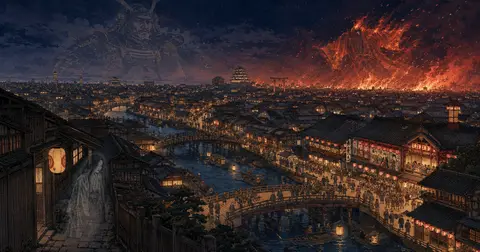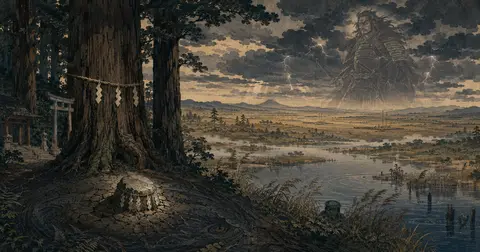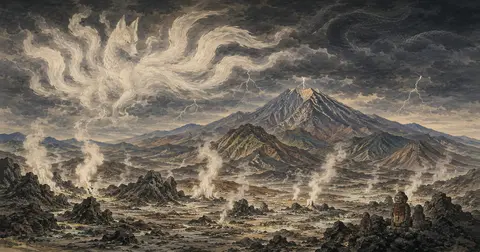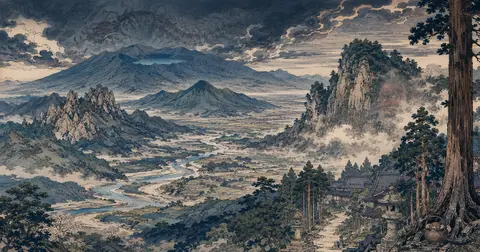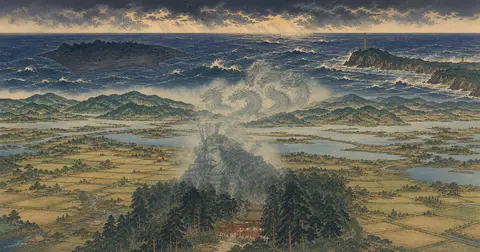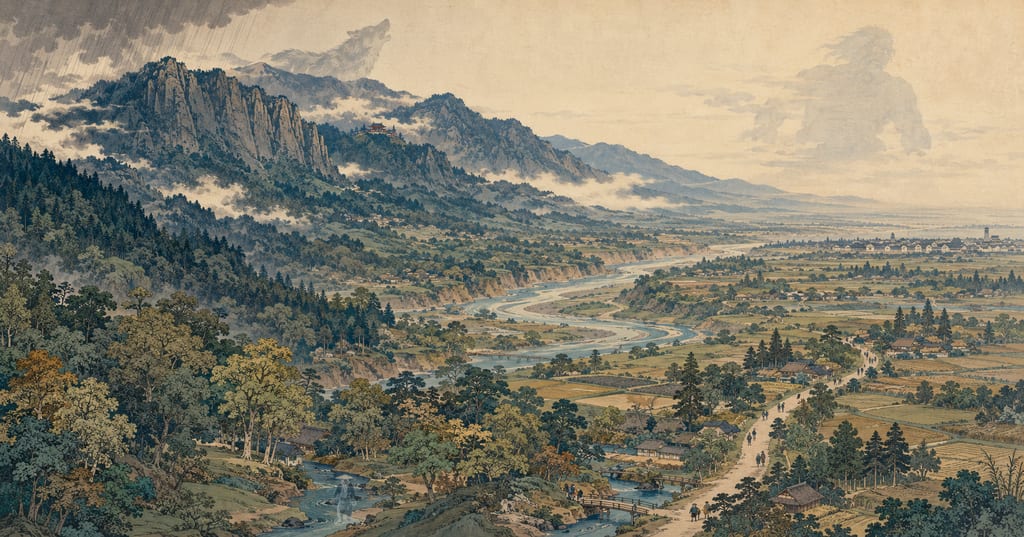
When spreading out Saitama Prefecture as a map, its *yokai* culture stretches between two sharply contrasting terrains. On the western edge rise the massive mountains of Oku-Chichibu, soaring over a thousand meters high, while to the east stretch the vast lowlands carved by the Arakawa and Tone rivers, alongside the endless expanse of the Musashino Plateau covered in the Kanto loam layer. There are mountain gods in the mountains, and plains spirits in the plains—even within the former borders of Musashi Province, it is rare to find a region where "vertical faith" and "horizontal folklore" are so clearly divided.
Standing at the pinnacle of this vertical axis is the mountain dog worship of Chichibu's Mitsumine. Venerated as the divine familiars of Mitsumine Shrine, Oguchi-no-Magami are the deified forms of the extinct Japanese wolf, possessing the spiritual power to ward off fire, prevent theft, and exorcise possessing spirits. On the other hand, scattered across the plateau and lowlands are tales of giant *nyudo* spirits that grow ever taller as you look up at them on night roads, unseen entities washing red beans (*azuki*) by the riverbanks, and the footprints of giants said to have flattened the very terrain of Musashi. This article is an attempt to trace a single, continuous thread—anchored by the mountain worship of Chichibu—all the way to the spirits of the plains nurtured by the climate of Musashino and the castle town of Kawagoe.
When viewing the land of Saitama from the perspective of *yokai*, it becomes clear that it is not merely "Tokyo's neighboring prefecture," but a land that has deeply embedded the memories of the ancient framework of Musashi Province into its western mountains. In this landlocked prefecture without a sea, the focus of faith has been entirely directed toward the mountains and rivers. Mountains that call the rain, mountains that govern the beasts, and rivers that send water to the villages—within this natural cycle, beings that blur the line between god and *yokai* have found their respective habitats.
The Three Shrines of Chichibu and the Gods of the Mountain:
The Pinnacle of the Oinu-sama Faith
To speak of Saitama's *yokai* culture, one must first delve into Chichibu at its western edge. The mountains surrounding the Chichibu Basin have been sacred sites of mountain worship since ancient times, with the Three Shrines of Chichibu—Mitsumine Shrine, Chichibu Shrine, and Hodosan Shrine—forming its core. Among them, Mitsumine Shrine, situated on a ridge over a thousand meters high in the city of Chichibu, is renowned as one of Japan's most prominent holy grounds for wolf worship.
According to the traditions passed down at Mitsumine Shrine, Yamato Takeru, the son of the legendary 12th Emperor Keiko, climbed to these heights from Kai over the Oku-Chichibu mountains on his return from an eastern expedition, and established the shrine for the first time. It is said that mountain dogs acted as his guides on that journey, and due to their loyalty and bravery, they were ordained as divine familiars[1]. Ever since, these mountain dogs have been revered not merely as animals, but as messengers of the gods.
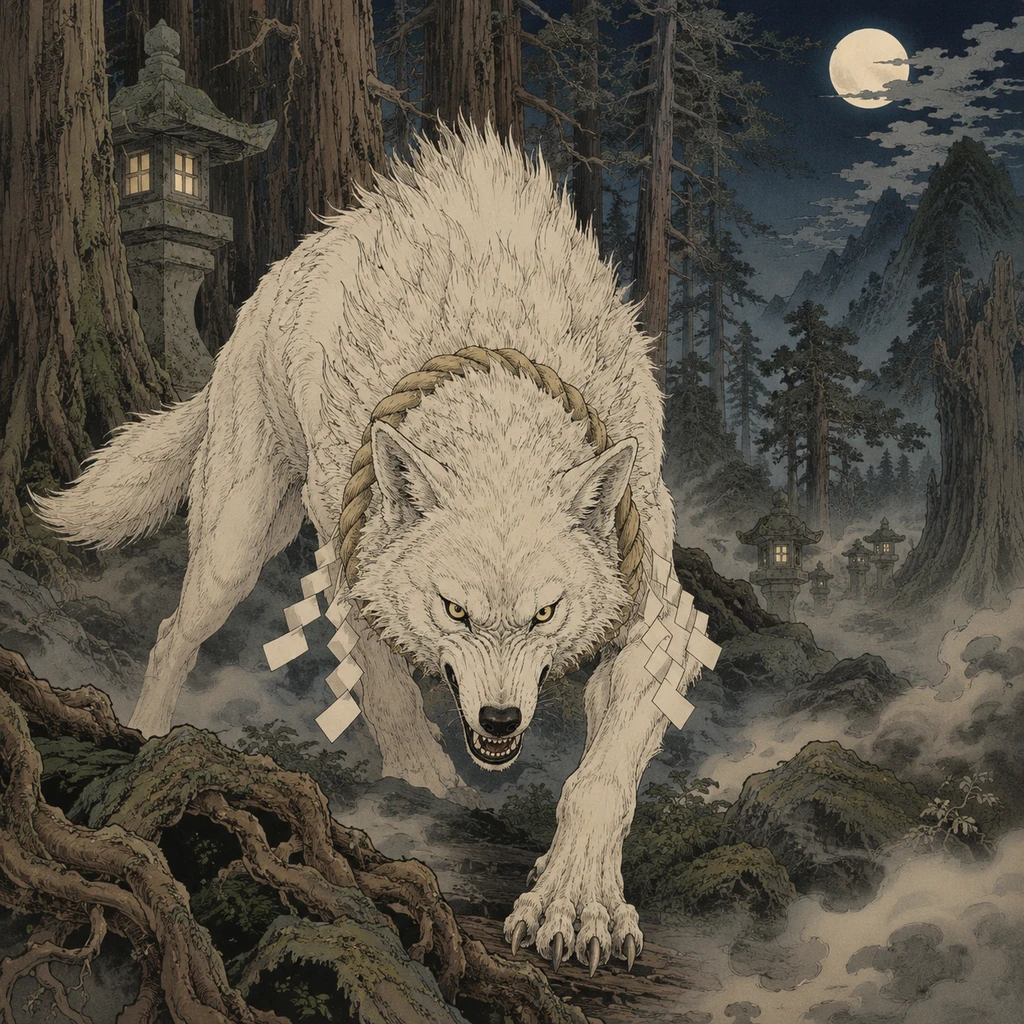
Oguchi-no-magami
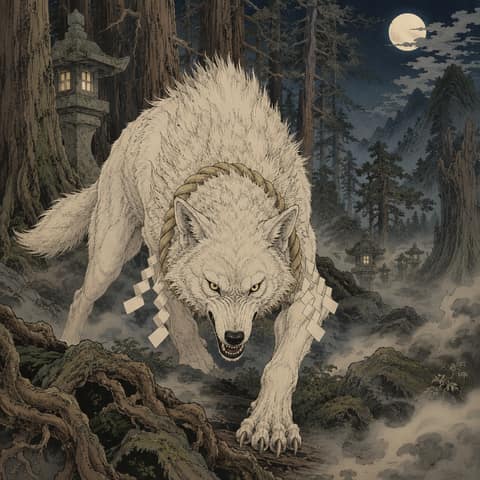
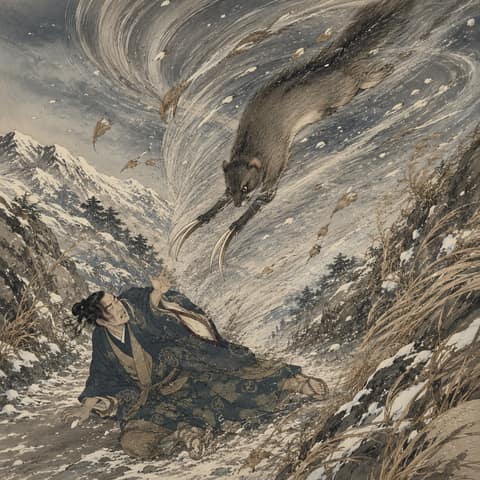
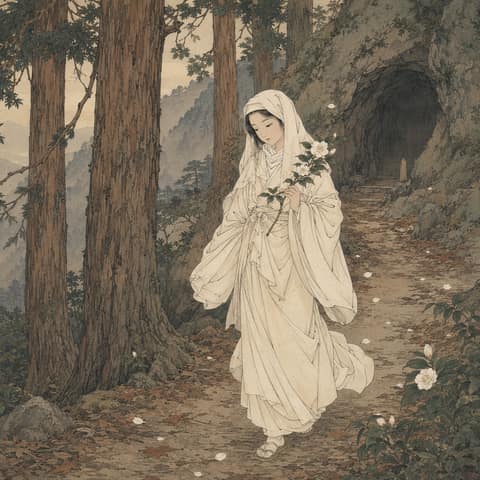
Oguchi-no-magami is a mountain deity born from the deification of the extinct Japanese wolf. It is also respectfully called "Oinu-sama" (Honorable Dog) or "Gokensoku-sama" (Honorable Divine Kin). "Makami" is an ancient name for the wolf, and its history is so old that it was sung of in Volume 8 of the *Man'yoshu* (Collection of Ten Thousand Leaves): "The snow falling on the plains of the great-mouthed true god". In the Asuka region of Yamato Province, there is a legend of the old wolf of the Makamigahara plains; the awe and reverence for a fierce beast that could devour humans was the source of its deification. At Mitsumine Shrine, nestled deep in the Chichibu mountains of Musashi Province, this wolf is worshipped as the divine messenger—or *gokensoku*—of the shrine's main deity, revered as a sacred beast that understands human speech and distinguishes good from evil. Believed to possess the power to ward off fire, theft, monsters, and possessing spirits, the faith in Oguchi-no-magami spread widely throughout the Kanto region from the early modern period onward.
Read moreThe true identity of these divine familiars is Oguchi-no-Magami, or in other words, the deified Japanese wolf. The origins of this name are astonishingly old. In Volume 8 of the *Man'yoshu*, the court lady Toneri no Iratsume composed a poem: "Snow falling on the plains of Makami of the Great Mouth, do not fall so heavily, for I have no house to shelter in." Here, the name "Makami," meaning a deified old wolf, is already associated with the Makami-ga-hara[2] (Plains of Makami) in Asuka, Yamato Province. In essence, the roots of the Oguchi-no-Magami faith are not unique to Chichibu, but rather an ancient, archipelago-wide belief system dating back to Asuka in Nara. The old wolves, once feared for their ferocity, are said to have eventually been elevated to holy beasts that protect crops from wild boars and deer, discern the good and evil of humans, protect the righteous, and punish the wicked[3].
This nationwide faith in the true god survived into the early modern period in Chichibu—the actual habitat of the Japanese wolf—accompanied by the specific practice of *Gokenzoku Haishaku* (borrowing the divine familiars). This is where the uniqueness of Mitsumine lies. The deep mountains of Oku-Chichibu were one of the last strongholds of the Japanese wolf until their confirmed extinction at the end of the Meiji era, and people worshipped the beasts as messengers of the gods while listening to the howls of real wolves echoing in the mountains. In this sense, the mountain dog worship of Mitsumine has a more visceral texture than any other *yokai* faith, as the divine status was not placed upon a mythical holy beast, but upon a real, living creature that howled every night.
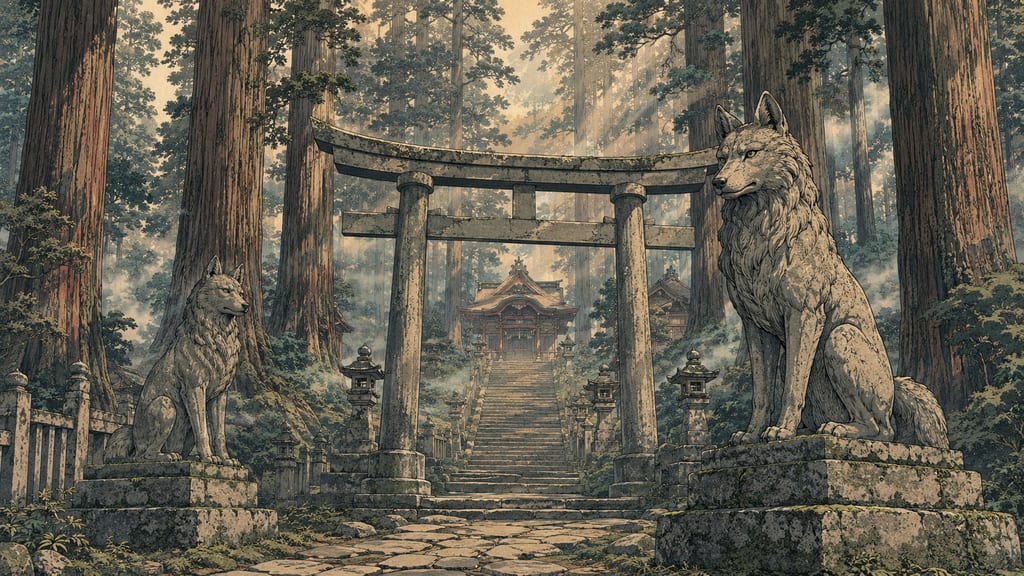
Symbolizing the *Oinu-sama* (Honorable Dog) worship of Mitsumine is the unique ritual known as *Gokenzoku Haishaku*. A divine familiar housed within a sacred talisman is "borrowed" by a household for a year to ward off fire, theft, and other disasters, and is borrowed again the following year—the faith is structured as a borrowing-and-returning transaction between gods and humans. It is said that this practice was initiated by Nikko Hoin, an ascetic who entered the mountains in the fifth year of the Kyoho era (1720). Upon experiencing a divine revelation when numerous mountain dogs appeared before his hermitage in the mountains, he began lending out sacred talismans to believers to protect against boars, deer, fire, and theft[1].
The concept of "borrowing" is remarkably pragmatic even among *yokai* beliefs. The idea of renting a guardian deity for a set term, rather than owning it, reveals the rational mindset of the early modern period, where humans maintained a transactional relationship with the gods even while fearing them. If the borrowed familiar was treated poorly, it was believed a curse would fall upon the household, and once its year of duty was complete, it had to be respectfully returned to the mountain—this tense relationship prevented the faith from becoming a mere formality. The *Oinu-sama*, also referred to as *Goshinken* (Divine Dog) or *Yama-inu-sama*, were known for their miraculous power to drive away vermin that ravaged fields, prevent thieves from sneaking into homes, and even exorcise fox and badger spirits possessing people.
In the Edo period, people from all over the Kanto region ceaselessly formed pilgrim groups (*ko*) to visit Mitsumine because this lending-style protection against theft was believed to yield tangible benefits. For the people of Chichibu and Musashino, whose livelihoods depended on sericulture and farming, the experience of wolves driving away the boars and deer that ravaged their crops was a daily reality; faith and practical benefit were directly connected. The idea of worshipping a wolf as a god is the very worldview of those living in the mountains, born in an era when the boundary between humans and beasts was much thinner than it is today.
Another pillar of the Three Shrines of Chichibu is the Myoken faith visible at Chichibu Shrine, the principal tutelary shrine of the Chichibu city area. Counted as the Fourth Shrine of Musashi Province, this shrine merged with the Myoken Bodhisattva—the deification of the North Star—during the Middle Ages and prospered as the "Chichibu Omiya Myoken-gu." The Chichibu Night Festival, registered as a UNESCO Intangible Cultural Heritage, is said to be deeply connected to Mount Buko, its sacred mountain (*shintaisan*). A legend states that a male god (a serpent deity) residing on Mount Buko and the goddess of Myoken-gu meet once a year. This myth is considered the root of the festival, known for its heroic float music and winter fireworks, acting as a ceremonial performance of a divine marriage connecting the mountain and the village.
Mount Buko, standing 1,304 meters tall, rises like a folding screen to the south of the Chichibu Basin and has been revered as a mountain where gods reside since ancient times. Although its form has been significantly altered today due to limestone mining, its steep northern rock face once exuded an overwhelming divine presence to those looking up from the foothills. Mitsumine, with its mountain dog familiars; Chichibu, which worships Myoken; and Buko, the sacred mountain—where these three overlap lies the depth of Saitama's "vertical faith." In this mountain world where no clear line can be drawn between *yokai* and gods, the objects of awe were not enemies to be exterminated, but neighbors to be borrowed from, worshipped, and lived alongside. The grandeur of Chichibu's *yokai* culture stems from the fact that its source lies in the "faith of worship."
The Night Roads of Musashino:
Mikoshi-Nyudo and Azuki-Arai
Descending eastward from the mountains of Chichibu, the scenery completely changes. The alluvial plains carried by the Arakawa River and the Musashino Plateau covered in volcanic ash unfold, transitioning into a flatland world of mixed forests, fields, and a network of small streams. Here, the stage for supernatural occurrences shifts from the mountain peaks to night roads and watersides. While the mountain gods rise vertically, the spirits of the plains cling to the paths traveled by people and the courses of rivers.
A prime example of this is the *nyudo* (monk-like giant) spirit that looks down on people traversing dark roads.
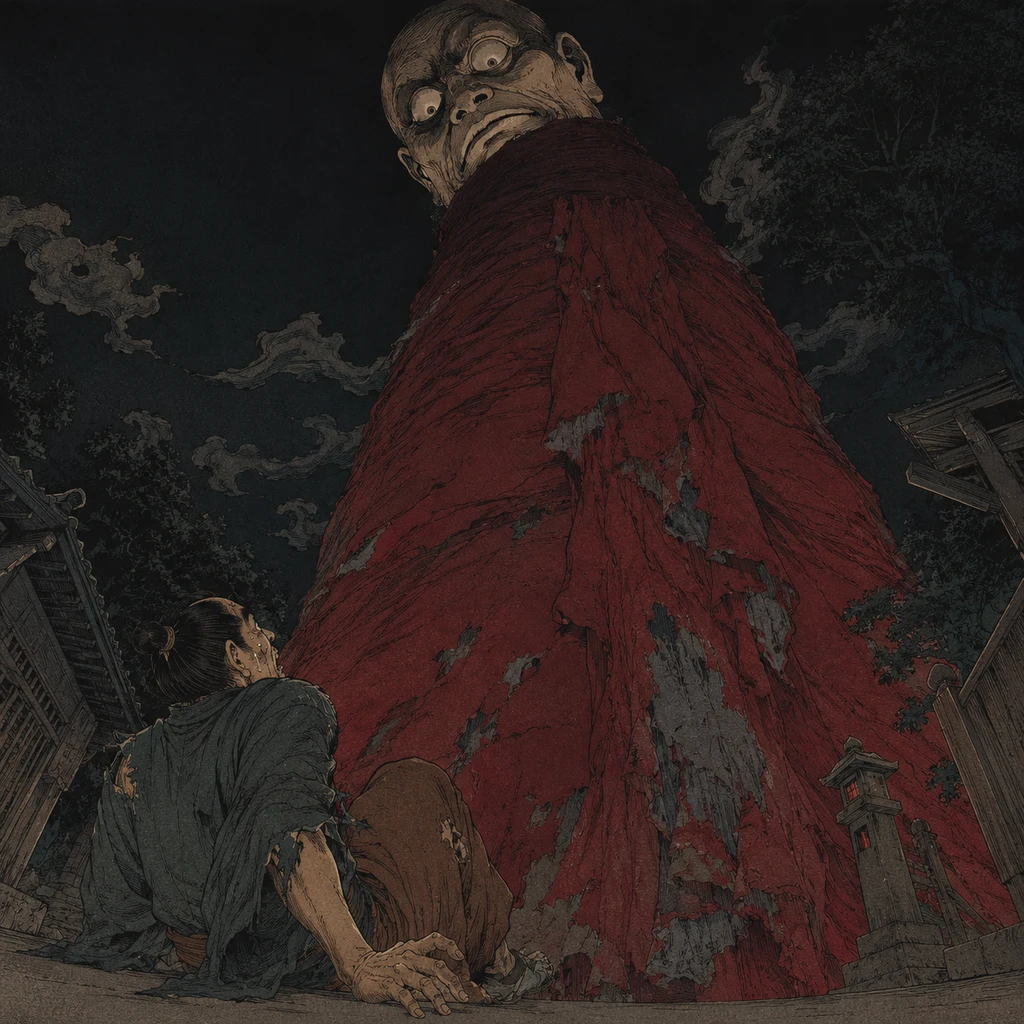
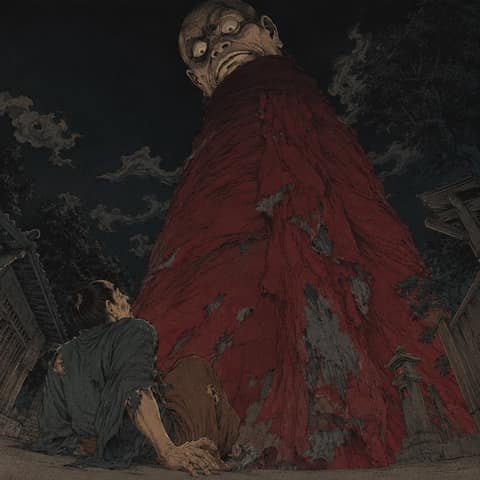
The Mikoshi-Nyudo appears in the form of a monk at the dead ends of night roads or slopes, at crossroads, or at the foot of stone bridges. It is a strange entity that grows endlessly taller the more one looks up at it. It is said that staring at it continuously could cost you your life, but if you quickly call out, "I have seen past you!" (*Mikoshita!*), it will swiftly vanish. Because it is so large that one must look up to see it, it is known by various names across different regions, such as Miage-Nyudo, Taka-Nyudo, Shidai-Taka, and Nobiagari, and stories of it have been widely told on the night roads of the Kanto region, including Saitama. In literature, a story of this spirit appearing before a samurai on a hunt is recorded in the 1677 ghost story collection, *Shukuchoku Gusa*[4], and *nyudo*-type spirits are also featured in the 1686 *Kokon Hyaku Monogatari Hyoban*[5]. Later, Toriyama Sekien illustrated this creature in his *Gazu Hyakki Yagyo* (The Illustrated Night Parade of a Hundred Demons)[6], solidifying its image as a monk with a long neck. The feeling of sensing a presence behind you on a dark, solitary road in Musashino on a moonless night—this very experience was given form as the Mikoshi-Nyudo.
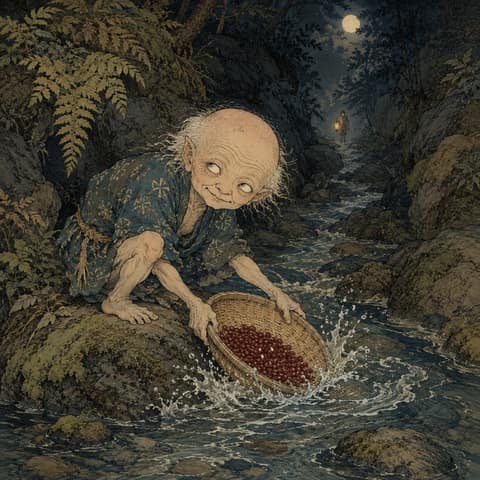
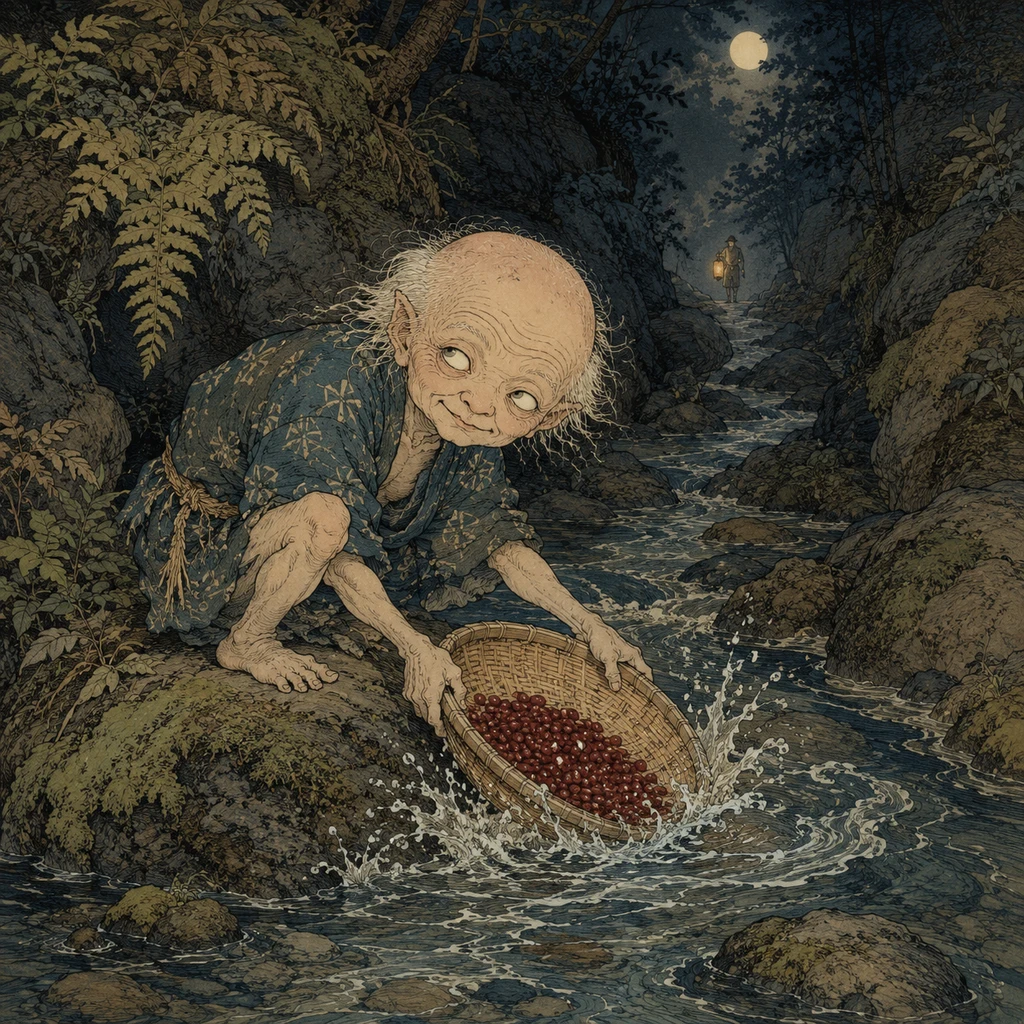
As a spirit clinging to the waterside, there is the Azuki-Arai. This is an entity that makes a "shoki-shoki" sound, like washing red beans, late at night by riverbanks or bridges. It rarely shows its form, instead misleading people entirely through sound. In some regions, it is said to sing, "Shall I wash my red beans, or shall I catch a person to eat?" and those drawn to the water's edge by the sound are said to slip and fall into the river. Also called Azuki-Togi or Azuki-Bakari, it is a nationwide spirit distributed from the Kanto region down to the Chubu and Chugoku regions. However, in places like Saitama with numerous small streams, valley lands, and the constant sound of water at night, the murmur of the stream or the sound of the wind rustling leaves was perceived by human ears as the "sound of washing red beans," crystallizing into a *yokai*.
What is notable is that Azuki-Arai is a "formless *yokai*." While many *yokai* are described as having grotesque forms, the true nature of Azuki-Arai is merely sound, and it exists only as a result of human interpretation of that sound. This can be seen as an example of human perception itself being turned into a *yokai*—where only the sense of hearing is heightened in the dark of night, and the faint sound of water merges with anxiety to transform into a supernatural entity. If Mikoshi-Nyudo is the visual spirit of the night road, Azuki-Arai is the auditory spirit of the night waterside; together, they flank the darkness of Musashino through sight and sound. In stark contrast to the grand divine figures born from mountain worship, the spirits of the plains arise from the very unreliability of human senses.
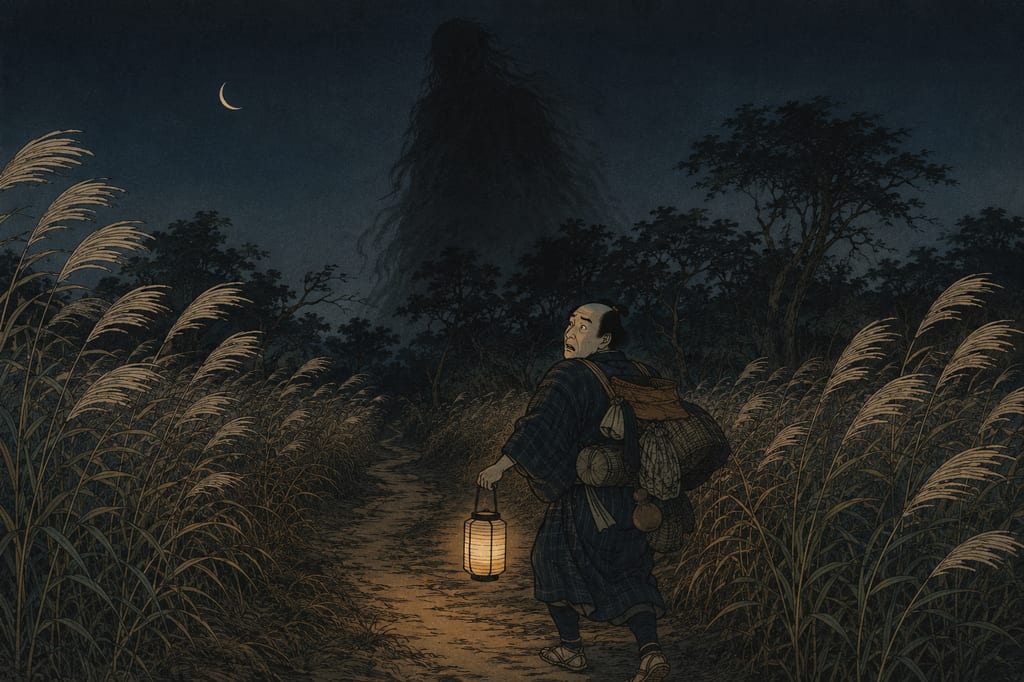
What these spirits share is that they are not demons to be exterminated, but "spirits of presence" that slip into the gaps of human perception. The Musashino Plateau was once covered in endless expanses of mixed forests and miscanthus fields, with narrow, solitary paths connecting the villages. In an age without streetlights, the unease of walking alone on a path through the woods on a moonless night, the sudden feeling of a presence behind you, the swelling anxiety—these physical sensations were passed down in the forms of the *nyudo* and the Azuki-Arai.
While the mountain dogs of Chichibu bear a solemn divinity, the spirits of the night roads in the plains vanish when named. Like the Mikoshi-Nyudo that departs with a single phrase, "I have seen past you," people managed their incomprehensible anxieties by verbalizing the spirits and devising countermeasures against them. Giving the spirit a name and a weakness was in itself a modest human resistance against the dark. Here lies a layer of practical folklore closely tied to daily life, fundamentally different from the worshipful faith of Chichibu.
The Footprints of Giants:
Daidarabotchi and the Terrain of Musashi
Among the folktales of the plains, tales of giants stand out for their massive scale. The footprints of the giant said to have shaped the terrain of Musashino itself—the Daidarabotchi—are etched into the place names of Saitama.
Daidarabotchi
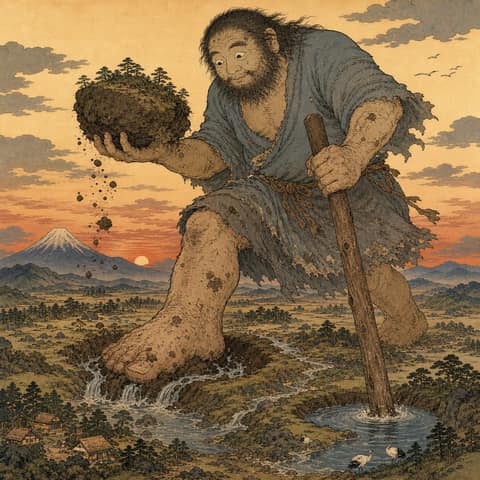
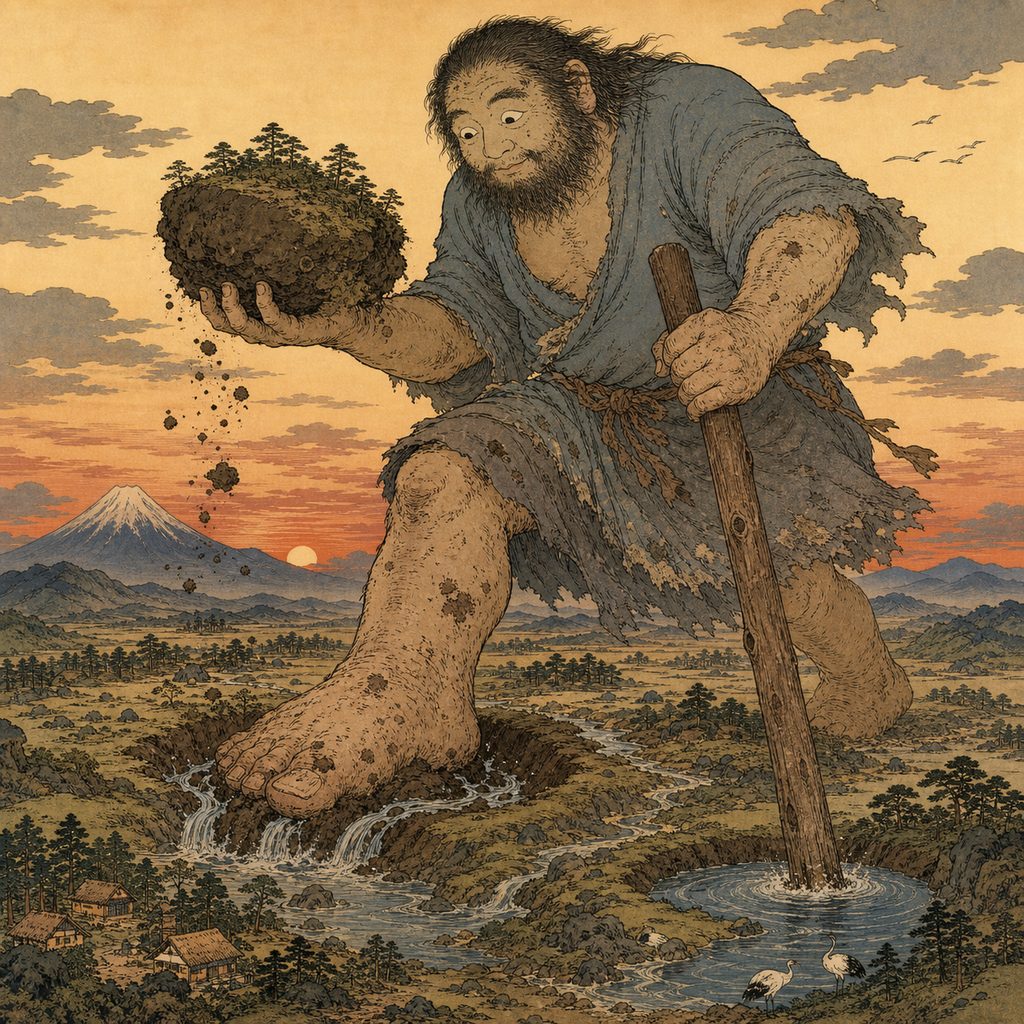
Daidarabotchi is the foremost name in Japanese giant traditions, identifying a widespread body of lore that explains hollows, ponds, marshes, wells, mounds, and mountains as physical traces left by a colossus. Centered primarily in the Kantō and Chūbu regions, the giant is known by appellations that shift across localities—taking forms such as Daidarabō, Daidabotchi, Dairabotchi, and Deedarabotchi—and has historically been transcribed with kanji compounds such as 大太法師 (*Daitabōshi*) and 大多羅法師 (*Daitarahōshi*). Rather than signifying a single mythic individual possessing an identical appearance and life story nationwide, the name functions as an umbrella under which communities grouped analogous regional narratives that interpret local topography through titanic deeds. At the core of these traditions lies not the giant’s facial features or garments, but the physical impression stamped upon the earth in his wake. A single stride caves the ground into a pond or marsh; the point where his foot braces heaves the soil upward; and earth carried or knocked from footwear accumulates into knolls and barrows. Feats such as shouldering mountains, excavating and shifting enormous deposits of earth, planting a walking staff, or excreting connect far-flung peaks, bays, depressions, and natural springs to one colossal frame. These deeds and implements are not attributed uniformly across every district, however, nor does any nationwide consensus define the giant’s moral character, intellect, or attitude toward humans. Classical provincial gazetteers such as the *Hitachi no Kuni Fudoki* and *Harima no Kuni Fudoki* similarly document ancient legends that attribute local landforms to the bodies, footprints, and bodily waste of immense beings referred to as “people of high antiquity” (*jōko no hito*) or “great men” (*ōbito*). While these early accounts share a clear structural framework with later Daidarabotchi traditions, the classical texts never invoke his name. Consequently, they cannot be taken as proof that the same folkloric creature persisted unchanged from classical times; instead, they are comparative evidence for the age of the idea of explaining regional geography through the anatomy of a giant.
Read moreA classic example is "Daitakubo" in Minami Ward, Saitama City. While the characters are typically read as "Ootakubo," it is pronounced "Daitakubo" and is believed to originate from "Daidara-bo," a giant spoken of in various regions. Daidarabotchi legends explain depressions like ponds, hollows, and swamps as the footprints or the marks of the giant stumbling. The nearby Shirahata Swamp in Minami Ward was once called Kobushi-ga-ike (Fist Pond); it was said that the giant slipped in the rain and fell, and the hollow where his fist struck the ground became the swamp. This is a typical etymological tale that interprets the undulations of the terrain as traces of a giant's body.
There is also room for historical investigation into the writing of the place name itself. The former village of Daitakubo should correctly have been written as "Daitakubo" (大田窪村), and according to the *Musashi Kokugunsonshi*[7], the character was mistakenly recorded as "Ta" (太) in a tax catalog created by the magistrate's office in the eighth year of Tenpo (1837), and the spelling was changed thereafter. The trace of using the character "Dai" (大) to represent the sound "Daita" remains here.
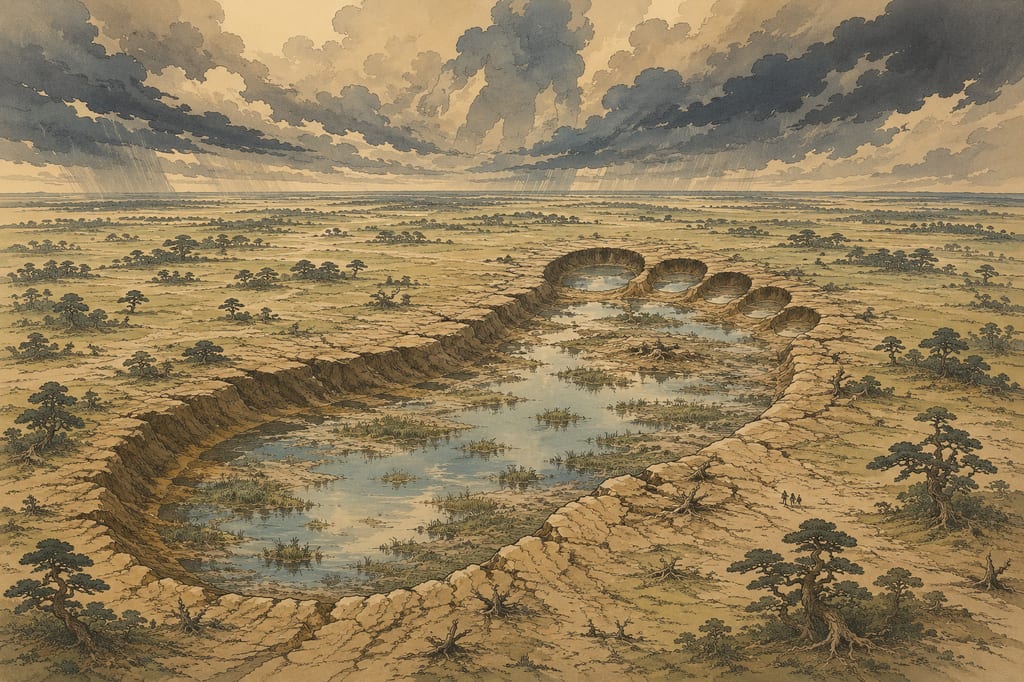
It was Kunio Yanagita who cast academic light on these Daidarabotchi legends. In 1927, Yanagita published "The Footprints of Daidara-bo"[8] in the *Chuo Koron*, examining giant folktales collected from across the country. He opened by stating, "The city of Tokyo can be said to be one of the centers of giant legends in our Japan," explaining that people once imagined a giant walking away, striding north, south, east, and west across the sky. The Kanto Plain, including Musashino, is indeed a region with a dense distribution of such giant legends.
Daidarabotchi is also written as *Daitahoushi* and goes by various names depending on the region, such as Daidarabo or Daidaraboushi. Grand-scale terrain creation myths—such as the giant carrying Mount Fuji or Mount Tsukuba on his back, or the holes left behind from scooping up the soil of the Kanto Plain becoming lakes—are passed down everywhere. However, small-scale place name tales that explain modest hollows and swamps as footprints or signs of a giant tripping, like Saitama's Daitakubo, are also undeniably part of this lore. Yanagita viewed this giant worship as the remnants of an ancient faith in a nation-building god. Just as the god in the land-pulling myth of Izumo hauled land in with ropes, the giants of Musashi also carry the memory of "nation-building" to explain the origins of the terrain—the plateaus and the lowlands.
Here, the overarching structure of Saitama's *yokai* culture emerges once again. Just as the mountain dogs of Chichibu preserved ancient beliefs dating back to the Asuka period within the mountains, the place name of Daitakubo preserves the nation-building giant worship like a fossil within the language of the plains. In the mountains, faith lived on as an "object of worship," while in the plains, faith remained as "place names and words"—though the mediums differ, both remain layers of ancient beliefs piled upon each other. Those who walk through Musashino are, with every place name, treading on the invisible footprints of a giant.
The Castle Town of Kawagoe and the Kappa of the Oppe River
Descending another layer into the folklore of the plains, one arrives at the realm of water *yokai* living right next to human habitation: the *kappa*. The reason *kappa* folklore is so rich in Saitama is because it is a region where rivers like the Arakawa, Iruma, Oppe, and Tone form a dense network, closely tying agriculture and water transport to life by the water.
One of the central areas for this is the region surrounding Kawagoe. Kawagoe developed as a castle town around Kawagoe Castle, built by Ota Doshin and his son Dokan under the orders of the Ogigayatsu Uesugi clan in the first year of Choroku (1457). It was a major strategic point in Musashi, serving as the stage for the Battle of Kawagoe, one of Japan's three great surprise attacks. This battle in the 15th year of Tenbun (1546), in which Hojo Ujiyasu overcame overwhelming odds to defeat the Uesugi-Ashikaga allied forces in a night raid, marked a turning point that shifted the hegemony of Musashi from the Kanto Kanrei family to the Late Hojo clan. In the Edo period, this land, layered with memories of war, prospered as the castle town of the Kawagoe Domain and became a distribution hub for goods connected to Edo via boat transport on the Shingashi River. Today, the streetscape of traditional storehouses known as "Koedo" (Little Edo) remains, and the only surviving Honmaru Goten (Main Keep Palace) in eastern Japan conveys the history of that castle town.
It is precisely at the periphery of the dense human habitation of the castle town, along the edges of the rivers that watered the settlement, that the water spirits lived. Around the Ochiai Bridge on the Oppe River, which flows along the border between Kawagoe City and Kawajima Town in the Hiki District, resides what is said to be the most famous *kappa* in Saitama.
The Kesa-Monk of Igusa
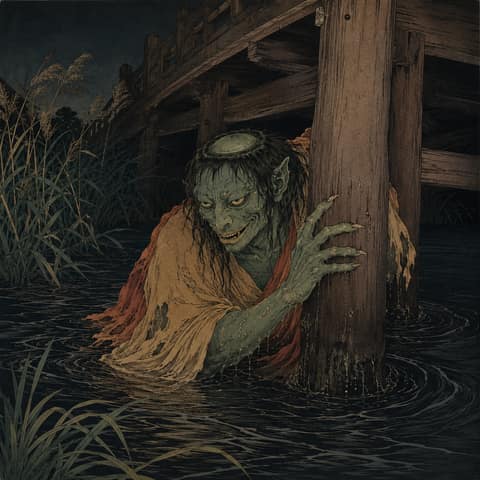
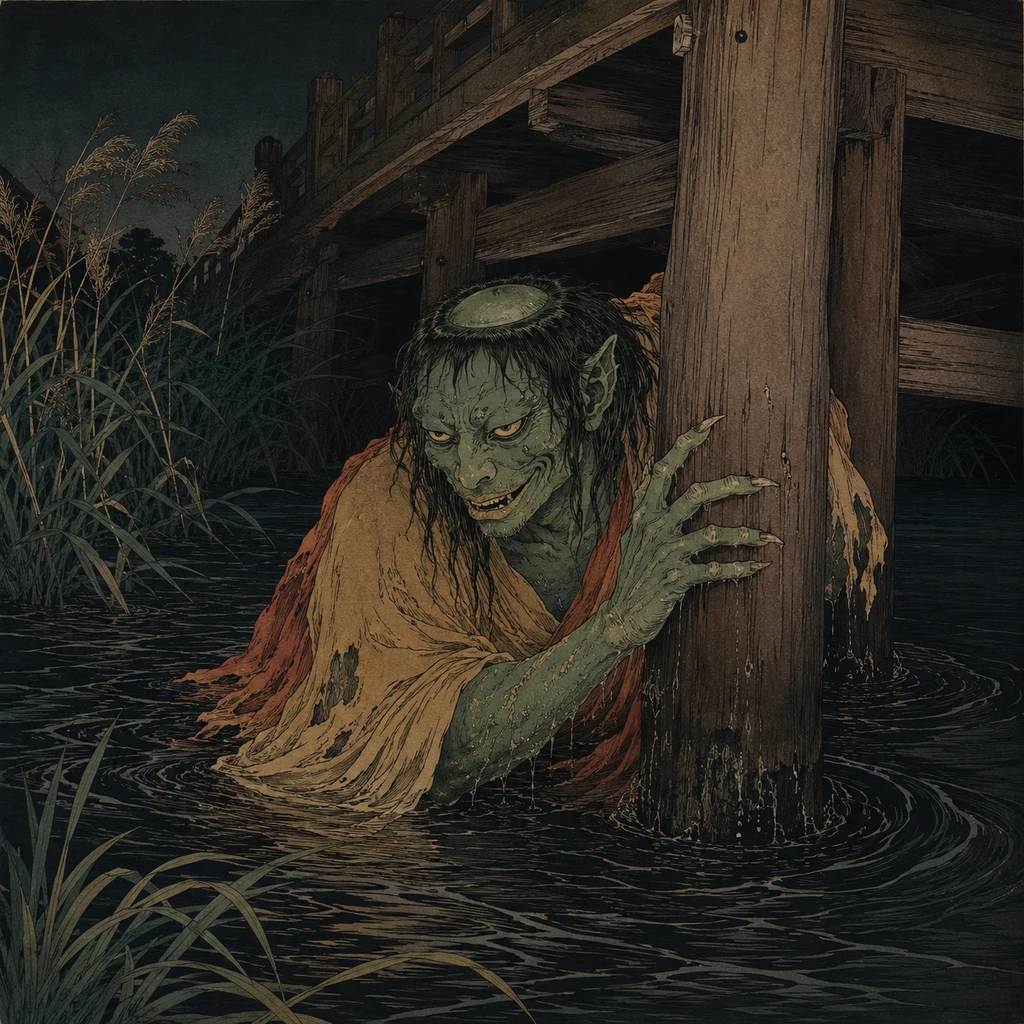
A kappa from Igusa in Kawajima, Saitama. It is said to wear a monk’s kesa robe—hence its name. Late at night near Ochiai Bridge it would call out to passersby, transform into a towering man to block the road, or cling to the back of handcarts to weigh them down. Grim tales say nearby kappa offered it human intestines as a midyear tribute. It is linked in lore to neighboring kappa such as Takebō and Kojirō.
Read moreThe Igusa-no-Kesabou, passed down in Igusa, Kawajima Town, is a *kappa* named for its appearance wearing a *kesa* (Buddhist surplice) like a monk. It is told that if you pass by the Ochiai Bridge late at night, a voice will call out, "Hey," and when you turn around, a large man in a *kesa* will be blocking your path. If you pull a handcart, it will cling to the back and make it heavy—such were the pranks he favored. A gruesome legend also remains stating that neighboring *kappa* would offer human entrails as a mid-year gift to Kesabou once a year, suggesting that he held a kind of boss-like status within *kappa* society.
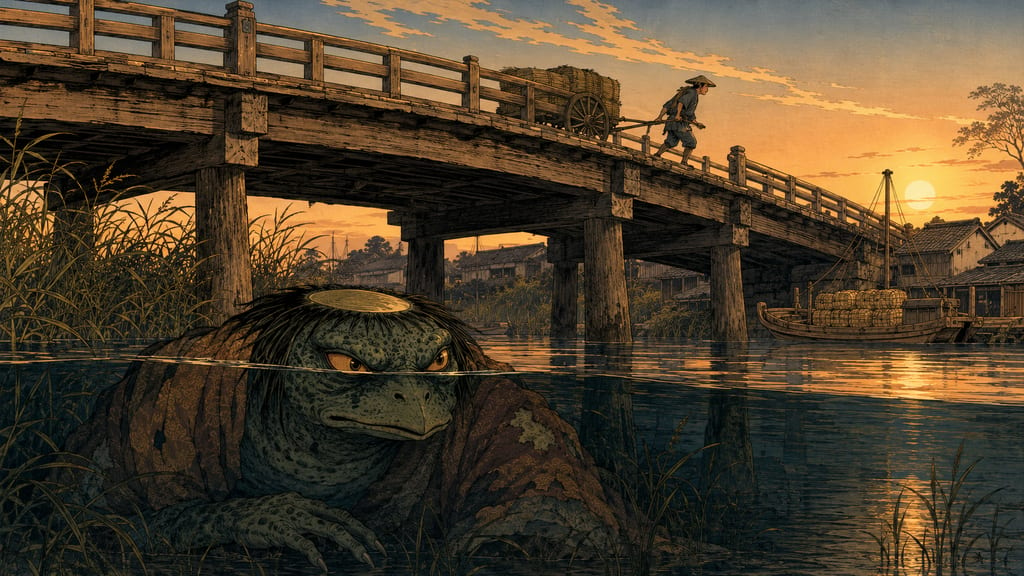
What makes Kesabou interesting is that he is not an isolated spirit, but is positioned within a social network of *kappa*. It is said he was good friends with neighboring *kappa* such as Takebou of Sasai, Kojiro of Koaze (Kon'ya-no-Kojiro), and Kajibou of Konuma. He was also rumored to be married to a *kappa* living in Mandara-buchi at Jimyoin Temple in Tokorozawa City. Furthermore, the *kappa* of Juro-buchi in Ishizaka, the *kappa* of the abyss called Saizo in Oppe, and Kesabou of Igusa were collectively praised as the "Three Great Kappa of the Oppe River"[9]. There is even a tale that the *kappa* of Mandara-buchi in Tokorozawa would offer the entrails of attacked children as gifts to Takebou and Kesabou, revealing that intricate details about the gifting relationships between *kappa* were actively discussed.
With every riverside settlement connected by the thread of the river having its own master *kappa*, tied to one another through marriage, friendship, and the exchange of gifts—this can be seen as a direct projection of the map of the human sphere of life, where people traded and intermarried via the rivers, onto the world of the *kappa*. River courses like the Oppe, Iruma, and Koaze were also the paths of *kappa* society. The *kappa* was the crystallization of the fear of water accidents, but simultaneously, it was a being that narrated the bonds of riverside communities. To attribute a child's drowning to being "pulled in by Kesabou" provided an explanation for tragedy while also serving the role of delivering a practical warning to stay away from the river's edge. *Yokai* were also a language for the community to come to terms with danger.
Connecting the Mountains and the Plains:
The Topography of Saitama's Yokai
The *yokai* of Saitama we have traced thus far may seem disjointed at first glance, but they are in fact connected by a single thread: topography. In the deep mountains of Oku-Chichibu on the western edge, a real beast—the Japanese wolf—took on the divine status of Oguchi-no-Magami, surviving into the early modern period as the lending-style faith of *Gokenzoku Haishaku*. The magnetic field of mountain worship created by the Three Shrines of Chichibu and Mount Buko served as a vertical center that drew worshippers from all across the Kanto region.
Meanwhile, in the Musashino Plateau spreading eastward and the lowlands of the Arakawa and Tone rivers, the supernatural anomalies clung to human life as if crawling along the ground. The Mikoshi-Nyudo of the night roads and the Azuki-Arai of the riversides were spirits of presence that slipped into the gaps of sight and sound; rather than targets for extermination, they were products of everyday wisdom controlled through naming and identification. The Daidarabotchi of Daitakubo is a memory of nation-building that entrusts the very origins of the plateau and lowland terrain to the body of a giant, while Kesabou and the others of Kawagoe and the Oppe River mapped the bonds of river-centric communities onto the social network of the *kappa*.
Gods rise vertically in the mountains, and spirits spread horizontally across the plains. The holy beast faith of Chichibu and the spirits of daily life in Musashino—this difference in elevation is the greatest characteristic that distinguishes Saitama Prefecture's *yokai* culture from the other prefectures of Kanto. While coastal Chiba and Kanagawa have spirits of the sea, and Tokyo, inheriting the urban nature of Edo, fostered urban ghost stories like the Seven Wonders of Honjo, landlocked Saitama has arranged its supernatural anomalies along the vertical axis of nature: mountains and rivers.
And these mountains and plains are never disconnected. The rain that falls on the mountains of Chichibu becomes the Arakawa River, piercing through Musashino, nourishing the lowlands via the Iruma and Oppe rivers, and eventually pouring into the Tone River system. The mountain crops protected by *Oinu-sama*, the plateau fields flattened by Daidarabotchi, and the river water inhabited by Kesabou are all part of a single water cycle. The mountain gods grant rain, the river spirits govern water, and the spirits of the plains cling to the earth and roads—the *yokai* of Saitama are entities that narrate this interconnected cycle of water and land from their respective posts.
Borrowing the talisman of *Oinu-sama* to protect the home, seeing past the *nyudo* on a night road, straining to hear the sound of the Azuki-Arai by the river, and reading the footprints of a giant in place names. The entirety of the perceptions of the people who traveled between the mountains and the plains has drawn the map of this prefecture's supernatural mysteries. That such a rich tapestry of the supernatural breathes within the landlocked province of Musashi is the greatest testament to how people have faced the nature of this land.