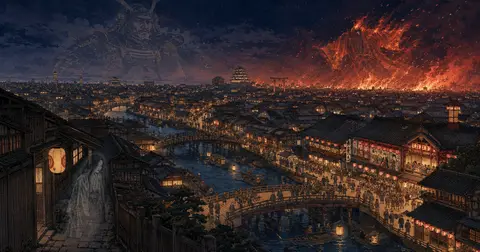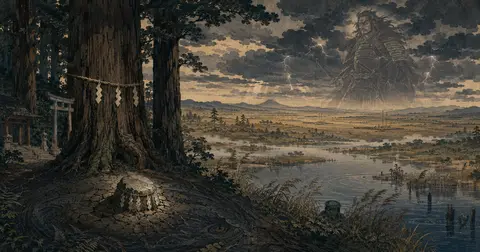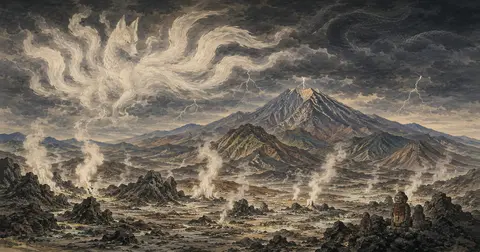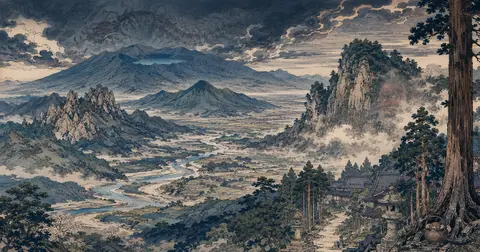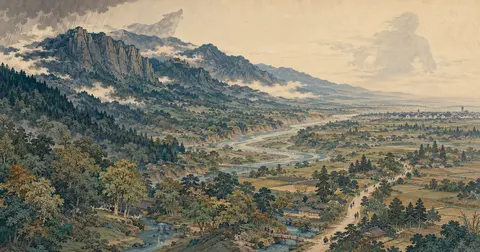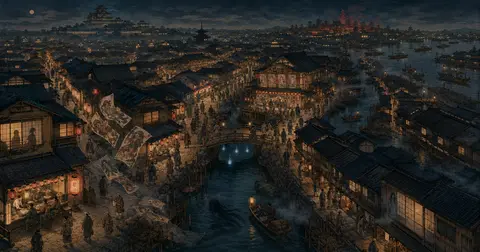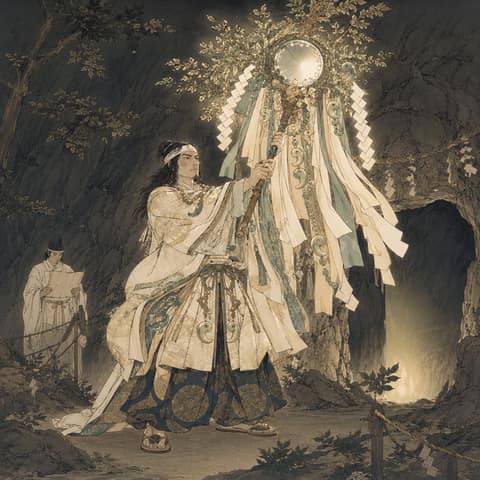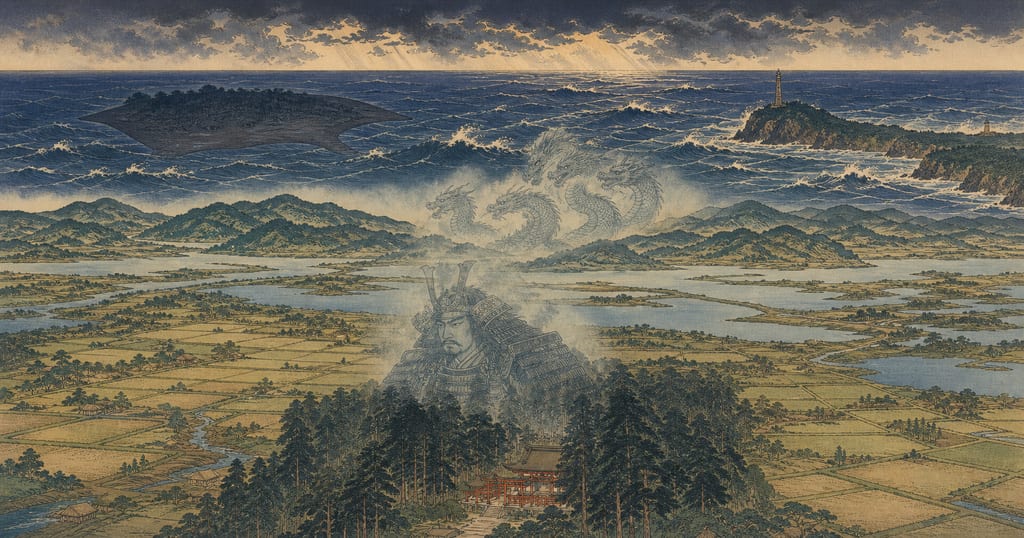
The Boso Peninsula, embraced by the sea on three sides, stands out as a uniquely rich land for yokai even within the Kanto region. Bound by the Tone River to the north, the Pacific Ocean to the east, and Tokyo Bay to the west, this peninsula was divided in ancient times into the three provinces of Shimousa, Kazusa, and Awa[1]. The character for "fusa" (総) originates from the archaic word for hemp, and it is said that Kazusa and Shimousa were originally a single 'hemp province.' The memories of Bando warriors sweeping from the land and the deeply-held fears of fishermen blowing in from the sea both shaped the supernatural folklore of Chiba.
The dominant memory ruling the peninsula from the land is, without a doubt, Taira no Masakado. In the tenth century, this rebellious general swept across the Bando region from his stronghold in Shimousa, ultimately declaring himself the "New Emperor." After his defeat and death, he was elevated to become one of Japan's Three Great Vengeful Spirits. On the seaward side, a gigantic Akaei (red stingray) that could easily be mistaken for an island floats off the coast of Nojimazaki, while Funayurei (boat ghosts) demanding dippers wander through the darkness of the Choshi seas. Meanwhile, tales of shapeshifting Mujina and a woman with a second mouth on the back of her head spread through the villages of Shimousa.
This article explores the yokai culture of Chiba Prefecture through these two axes: the "Masakado of the Land" and the "Monsters of the Sea." A vengeful spirit becomes a god, a giant fish transforms into an island, and the spirits of those lost at sea seek companions — the very geography of the peninsula gave birth to these stories.
A Rebellious General Based in Shimousa — The Vengeful Spirit of Taira no Masakado
When speaking of the yokai of Chiba Prefecture, one cannot leave out Taira no Masakado. Born during the Engi era (early 10th century), Masakado was a powerful Bando chieftain of the Kanmu Heishi lineage, whose sphere of influence covered the lands of Toyota, Sashima, and Soma in Shimousa Province[2]. Through his mother's ties, he had strong connections to Soma District and was also known as "Soma no Kojiro." A clan dispute over the management of Soma Mikuriya, an estate donated to Ise Grand Shrine, cast a long shadow over his life. The outbreak of Masakado's Rebellion was not an initial revolt against the state, but rather a private conflict with his uncles over territory and marriage within the local region of Shimousa. Eventually, this escalated into a massive uprising that engulfed the provincial governments — meaning the land of Chiba itself was the cradle for the colossal tale of Masakado.
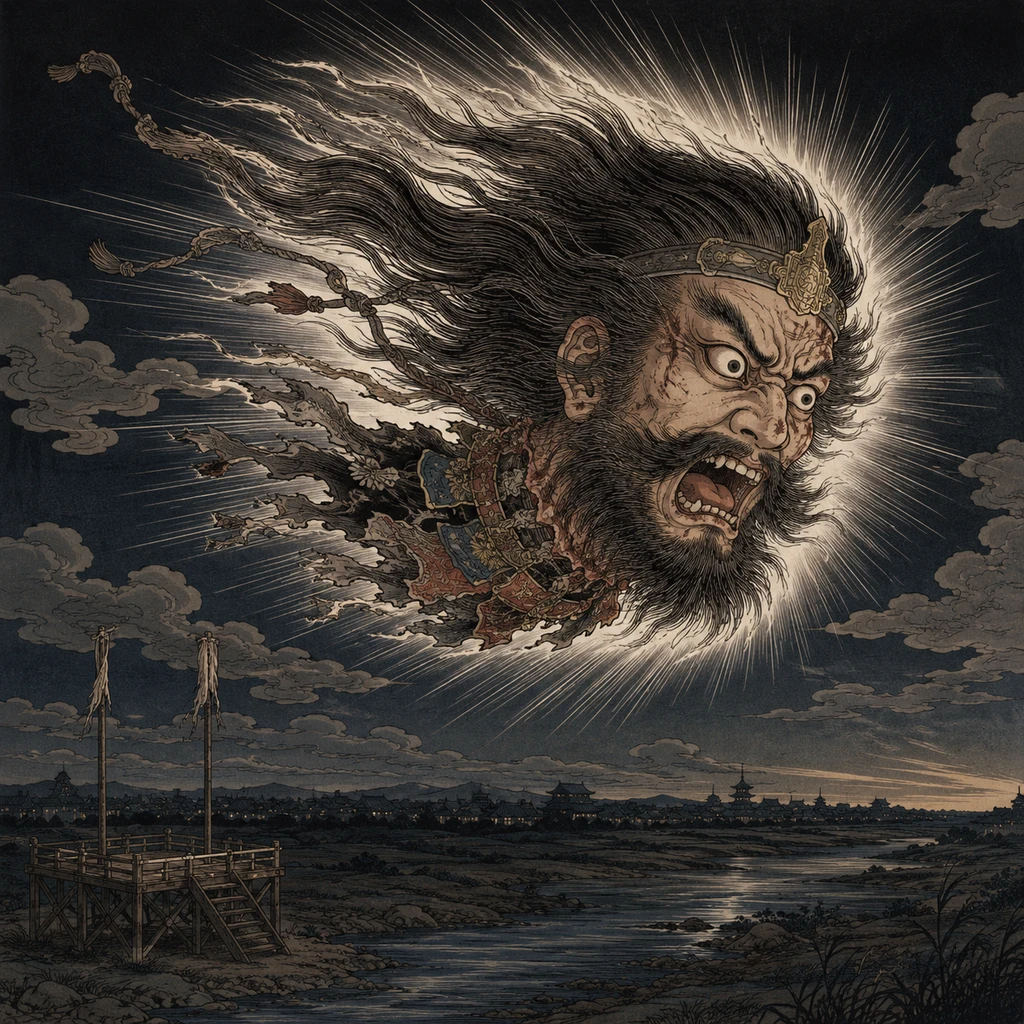
Taira no Masakado
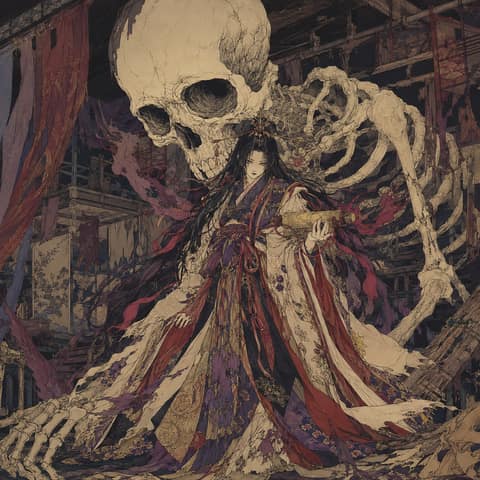
Taira no Masakado was a warrior of the Kanmu-Taira line who held sway over the Bandō region in the mid-Heian period, a man who raised the banner of revolt against the court, styled himself "New Emperor" (Shinnō), and was struck down. After his death, the uncanny tales surrounding his severed head made him one of the most dreaded vengeful spirits in Japan, and in time he was enshrined as a guardian deity of the Kantō and a goryō god at shrines such as Kanda Myōjin. In the Jōhei and Tengyō years, Masakado rose from private feuds within his own clan, and in the second year of Tengyō (939) he overran the provincial seats of Hitachi and other Kantō provinces to subjugate the eastern lands, proclaiming an oracle of Hachiman Daibosatsu and styling himself New Emperor . But the following year, the third of Tengyō (940), he was shot in the forehead and killed in battle by the punitive army of Taira no Sadamori and Fujiwara no Hidesato (Tawara Tōda). His life is recounted in detail in the contemporary war chronicle Shōmonki. What made Masakado a yokai and a vengeful spirit was less the historical revolt itself than the legend of the head, told in later ages. The story that his head, exposed in the capital, would not rot and cried out night after night before flying off to the east is bound up with the dread of the Masakado Grave-Mound (the "Head Mound") at Ōtemachi in Tokyo, and transmits to this day the belief that to move it brings a curse. At Kanda Myōjin, by contrast, he is fervently revered as the great tutelary of Edo and a god of martial fortune and thriving commerce—embodying the two faces of a goryō god: curse and protection.
Read more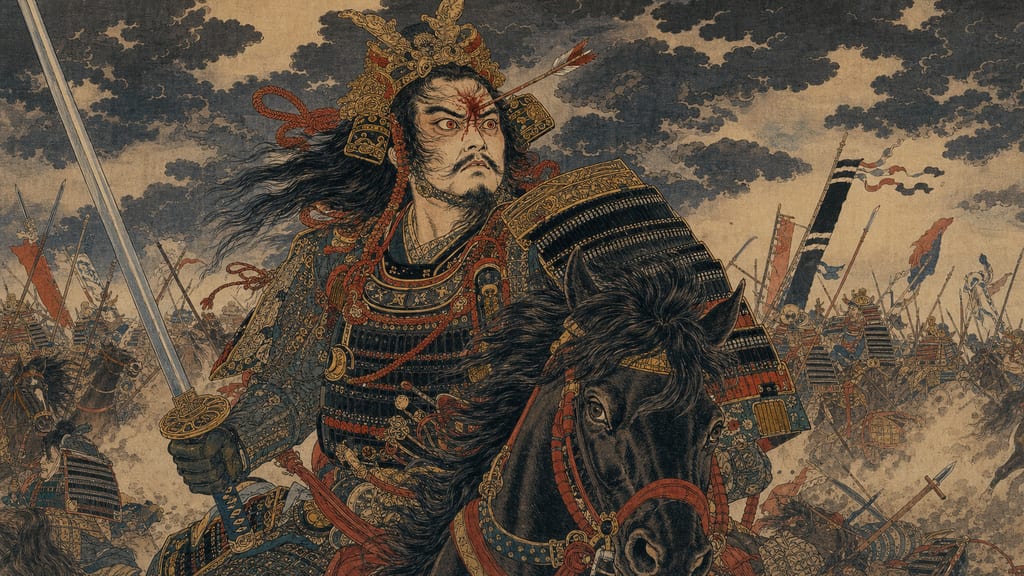
In the second year of Tengyo (939), starting with an attack on the provincial government of Hitachi, Masakado successively conquered the governments of various Kanto provinces, including Shimousa, Shimotsuke, Musashi, and Kozuke, ultimately proclaiming himself the "New Emperor." This was a direct rebellion against the imperial court in Kyoto, declaring the establishment of an independent royal authority in the eastern provinces. Appointing his own provincial governors for the eight Bando provinces, a "second sovereignty" separate from the Emperor in Kyoto became a reality centered in Shimousa, albeit for only a few months. However, his glory was short-lived. In February of the third year of Tengyo, attacked by the allied forces of Fujiwara no Hidesato and Taira no Sadamori, Masakado was struck in the forehead by an arrow and killed in battle on the final battleground of Shimousa Province, according to the *Shomonki*[2]. It was an abrupt end, less than two months after his usurpation as the New Emperor.
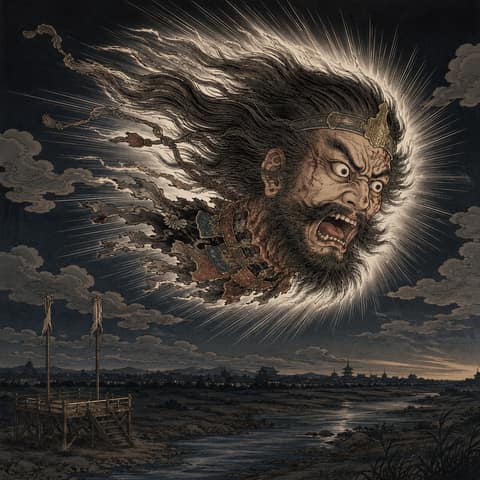
It is after his death that Masakado enters the realm of yokai and the supernatural. His severed head was sent to the capital of Kyoto and put on public display, but it is said that even after several days, it did not rot. Its eyes remained wide open, and night after night, it gnashed its teeth and cried out, "Where is my body? Reattach my head, and I shall fight another battle!" Eventually, the head was said to have emitted a white light and flown away into the eastern sky, landing at various Masakado Mounds[3] across the region. Whenever lightning struck, plagues spread, or natural disasters occurred, Masakado's vengeful grudge was whispered as the cause. He came to be feared as one of Japan's Three Great Vengeful Spirits, alongside Sugawara no Michizane and Emperor Sutoku, and was eventually enshrined as a Goryoshin (vengeful spirit deity) to be pacified. Masakado is not merely a defeated figure in history, but an entity deified as the very spirit of the Bando land.
This deification is shown most quietly at the Kokuou Shrine[4], which stands on the site of his final moments in the former Shimousa Province. According to the shrine's legend, Masakado's third daughter fled to Enichiji Temple in Oshu, took the tonsure, and called herself the nun Nyozo-ni. Thirty-three years after her father's death, she returned to her hometown, carved a statue of Masakado from a sacred tree in the forest while bowing three times for each cut, and enshrined it in a small sanctuary—this is said to be the shrine's origin. The sacred object, a wooden statue of Masakado crafted in the yosegi-zukuri style, is still preserved today as a prefectural cultural property. While feared as a vengeful spirit, he is also quietly mourned through a wooden statue carved by his daughter's hands—the duality of Masakado's existence is condensed here. The most famous grave for his head is currently located in Otemachi, Chiyoda Ward, Tokyo, known for sparking rumors of curses during land readjustments after the Great Kanto Earthquake and post-war redevelopment. The supernatural legacy of Masakado extends from Shimousa to Edo and modern Tokyo, deeply overlapping with Tokyo's own yokai culture (for more details, refer to the histories of the various shrines associated with Masakado).
Among the strange tales surrounding Masakado, the legend of his body doubles is particularly well known. It is said that Masakado had six body doubles, and because seven identical Masakados stood side by side, the enemy could not tell which was the real one. According to one theory, it was his beloved concubine Kikyo who saw through the disguise; she betrayed him to the enemy by revealing that only the true Masakado's temples would move, leading to his downfall. This tale of body doubles and the Kikyo legend are far from historical fact and are traditions that swelled in later eras, but the motif of a single person having multiple bodies and being destroyed by betrayal is an imaginative product perfectly suited to an elusive and vengeful spirit. Across Shimousa, the ruins of castles where Masakado was based still remain, along with village taboos against planting kikyo (bellflowers) because of the name's association with betrayal, showing that the legend lives on today as the memory of the land.
The Chiba Clan and Myoken — The God of War Inheriting Masakado's Memory
Masakado's memory also casts a shadow over a clan that does not claim him as their direct ancestor. The Chiba clan, which took root in Shimousa and became a major power during the Middle Ages, devoutly worshipped Myoken Bosatsu—the deification of the North Star and the Big Dipper—as their guardian deity[5]. The ancestor of the Chiba clan is said to be Taira no Yoshifumi, Masakado's uncle. Later genealogies claim that Yoshifumi fought alongside Masakado or that they shared an adoptive father-son relationship. While the historical reality of their relationship is unclear, the fact that the place name "Chiba" itself is inextricably linked to the same Kanmu Heishi bloodline as Masakado remains undisputed.
While Myoken in other regions is often a gentle deity of agriculture and disaster prevention, Chiba's Myoken takes the form of a god of war clad in armor and wielding a sword. This is an extremely Shimousa-specific aspect of Myoken, revered as the guardian deity of the warrior class throughout the Middle Ages. According to legend, during Masakado's Rebellion, Myoken initially sided with Masakado and brought him a series of victories, but later grew to despise his arrogance and shifted divine protection to Yoshifumi's side, which led to Masakado's defeat. This faith looking up to the unmoving North Star (Hokushin) remains today as Myoken-ji Temple and Chiba Shrine in the city of Chiba, the former stronghold of the Chiba clan, and is carried on through the annual Myoken Grand Festival. A vengeful spirit turned Masakado, and a war god said to have protected his enemies—the land of Shimousa is a place where conflicting spiritual forces are layered in multiple folds.
The Dragon of Inba Numa — The Kuzuryu Torn into Three
If Masakado's tale is the memory of the "land," the other source of Chiba's yokai is "water." Inba Numa, a large marsh spreading across the base of the peninsula, has been the region's largest water source since ancient times, nurturing legends of dragon gods.
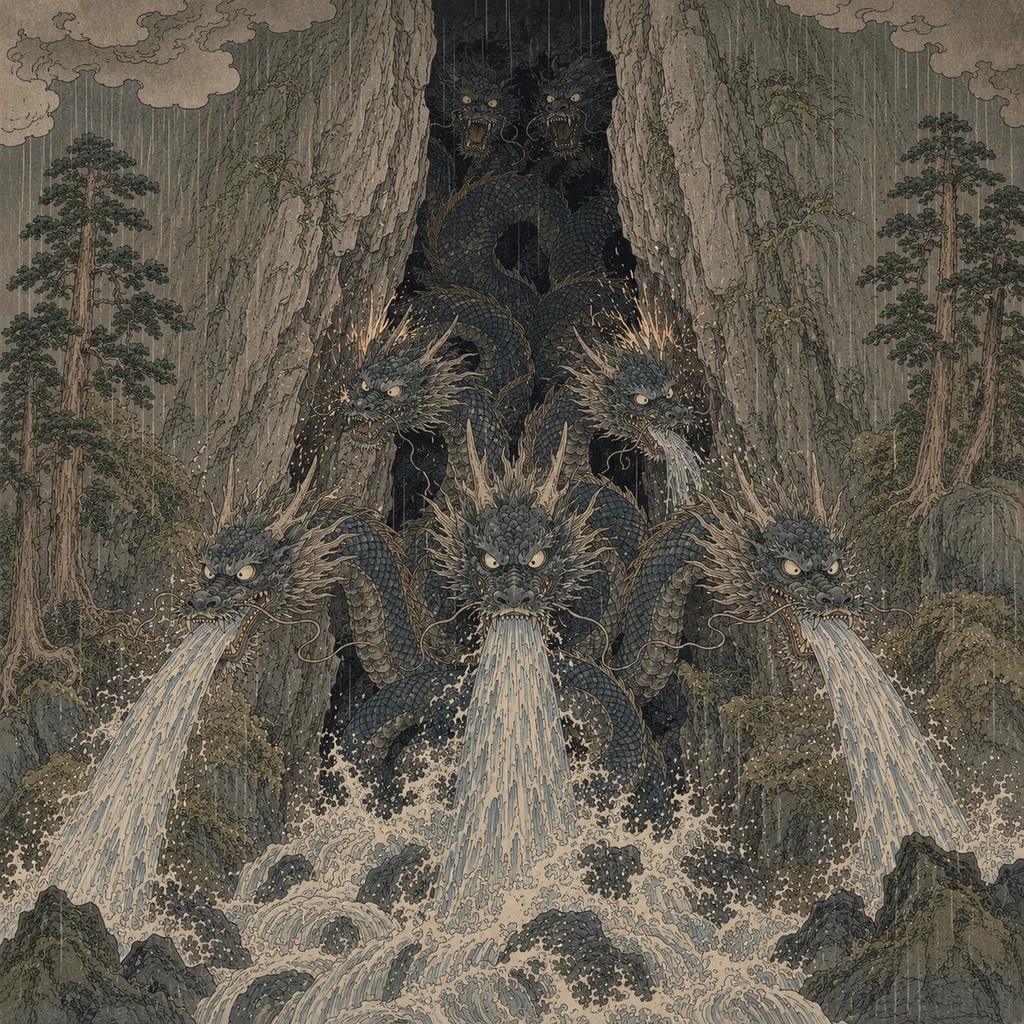
Kuzuryū
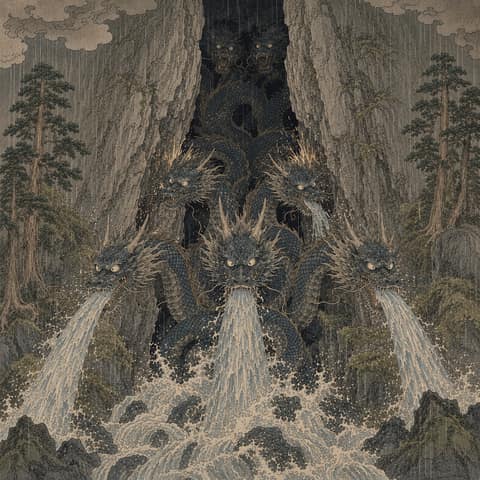
Kuzuryū, also written with the character for 'dragon' in an older form, is a nine-headed dragon worshipped as a water and rain deity and as a guardian of particular landscapes. Many traditions turn on the same transformation: a poisonous or violent dragon that once harmed people is subdued by an ascetic or eminent monk, abandons its demonic nature, and becomes a benevolent god. At Togakushi in Nagano, a nine-headed, dragon-tailed demon is said to have been sealed in a rock chamber through the merit of the Lotus Sutra by the ascetic Gakumon, also known as Gakumon Gyōja. It then settled as the local tutelary deity Kuzuryū Ōgami. At Hakone in Kanagawa, the monk Mangan is said to have subdued the poisonous dragon of Lake Ashi in the Nara period and enshrined it as the lake's guardian. In Echizen, Fukui, a Hakusan Gongen origin story tells of a nine-headed dragon swimming with a sacred image on its head, an episode said to explain the name of the Kuzuryū River. Rainmaking and flood control remain central, but regional worship also seeks relief from toothache, good relationships, and peace for the realm.
Read moreThe Kuzuryu (Nine-Headed Dragon) is a dragon and water deity with nine heads, ruling over rain and water while also being the master of violent floods. This water deity faith, distributed nationwide, was recounted around Inba Numa as a tragic tale distinctly characteristic of Chiba. During a great drought in the third year of Tenpyo (731), under the reign of Emperor Shomu, when both people and crops were withering, a single dragon took pity on the people and made it rain without the permission of the great Dragon King of the Heavens. As punishment for breaking the celestial law, the dragon was torn into three pieces—its head, belly, and tail—which fell onto the fields of Boso[6].
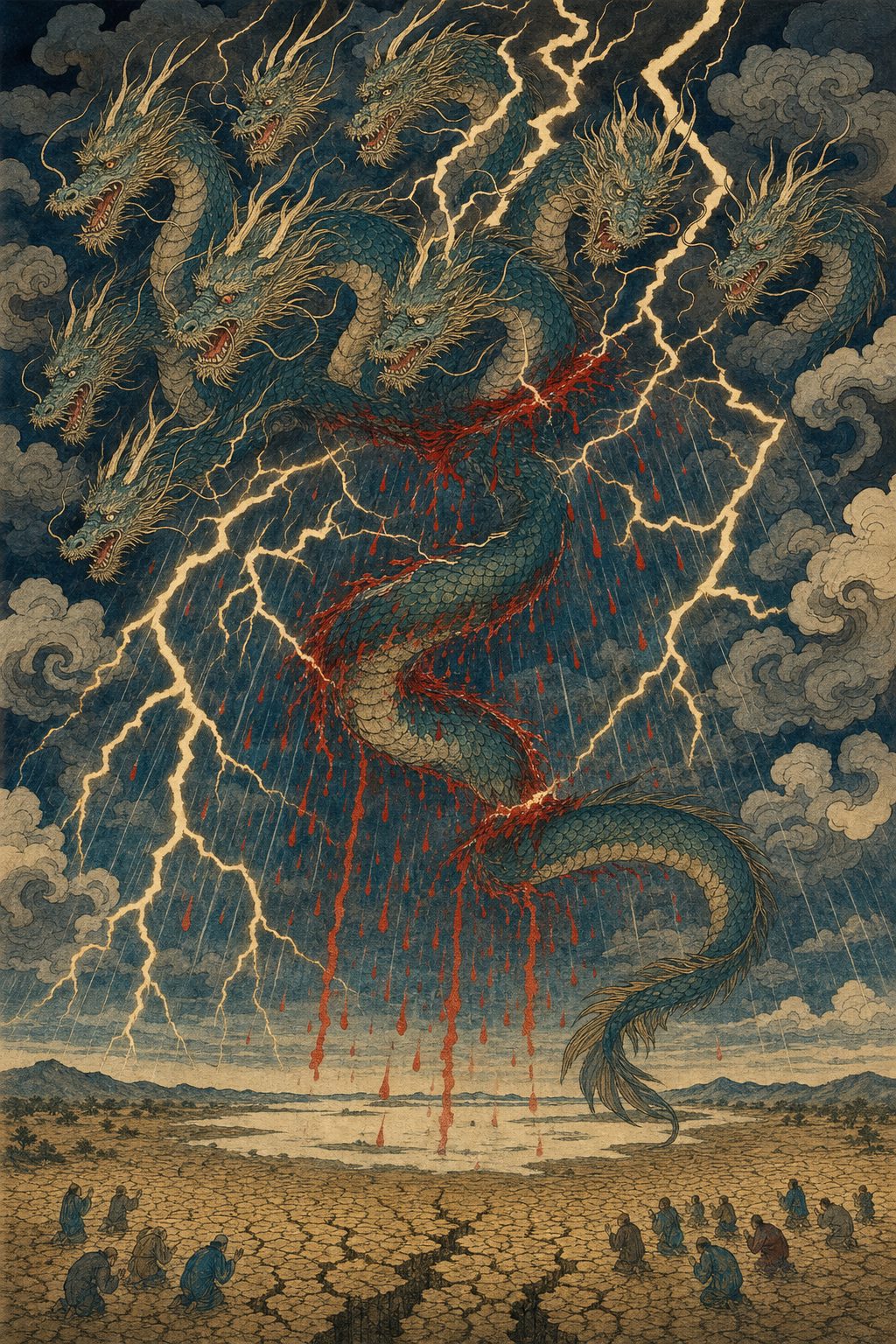
The three fallen parts were enshrined at three temples: Ryukaku-ji (Dragon Horn/Head Temple) in Sakae Town of the Inba District, Ryufuku-ji (Dragon Belly Temple) in Inzai, and Ryubi-ji (Dragon Tail Temple) in Sosa. The fact that the body parts—head, belly, and tail—survive today as the names of separate, distant temples indicates that this legend is not just a folktale, but a story of geography stitched into the real land. In particular, Ryukaku-ji is one of the most prominent ancient temples in Boso, said to have been founded during the Wado era (early 8th century). It holds an origin story claiming a dragon woman built its halls and pagodas overnight, and its surroundings are clustered with countless burial mounds, including the Ryukaku-ji Iwaya Kofun, one of the largest square burial mounds in Japan. The places where the dragon fell were simultaneously ancient cemeteries—this water deity tale took root in locations dense with the atmosphere of death and rebirth.
This dragon legend was widely introduced in the 7th year of Kyoho (1722) in the *Sakura Fudoki* by the Sakura domain samurai Isobe Shogen, and was later included in the *Tonegawa Zushi*[7], a local gazetteer of the Shimousa region. The author of that book, Akamatsu Sotan, was a physician from Fukawa in Shimousa Province who walked the basin of the Tone River, meticulously recording its geography, legends, and supernatural occurrences. The constant struggle with vast inland bodies of water like Inba Numa and Tega Numa, which moistened the fields but occasionally overflowed and swallowed them, was the very foundation of life in this region. The motif of a water god torn apart to save the people was a form of prayer unique to Chiba, born from the lives of lowland people caught in endless cycles of flood and drought. When the story of a nine-headed dragon remaining the master of water even after being torn into three was layered upon the landscape, it perfectly embodied the archetype of Japanese dragon god worship—where a multi-headed water deity is divided and enshrined across multiple locations.
The Sea Monsters of Boso — The Akaei Mistaken for an Island
In contrast to the dragons of the land, massive sea monsters float off the coasts of Sotobo and Awa. Among them, the most representative anomaly of the Boso seas is the Akaei.
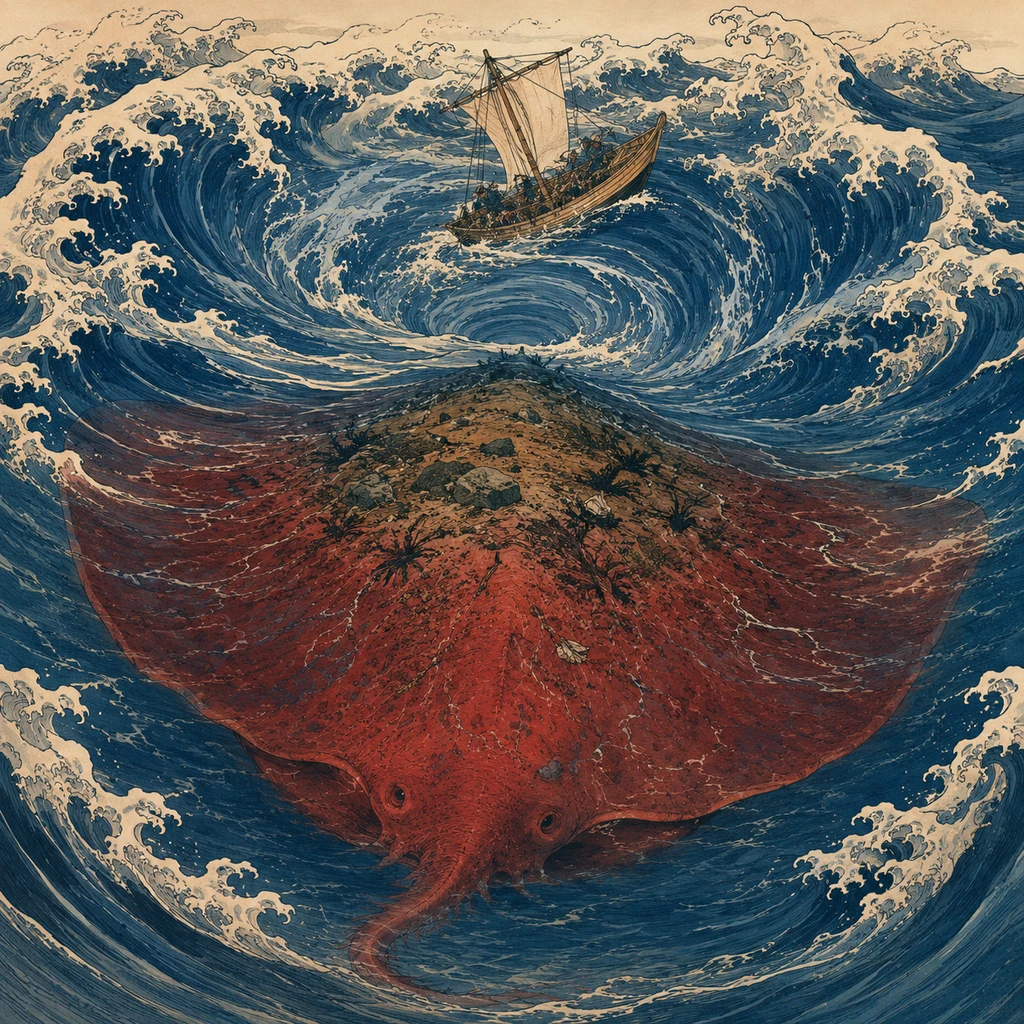
Akaei
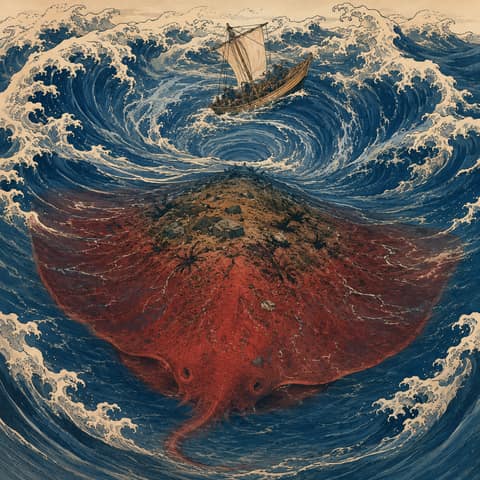
Akaei is a colossal ray recorded as Akaei no Uo, the 'red ray fish,' in the late Edo-period collection Ehon Hyaku Monogatari (1841). Sand accumulates on its back as it floats at the surface, making the creature large enough to be mistaken for an island. Sailors who approach or step ashore find it suddenly sinking beneath them, raising heavy seas that break ships and swallow people. The tale overlaps with mirages and castaway stories, and treats such uncanny encounters as anything but rare on the open ocean.
Read more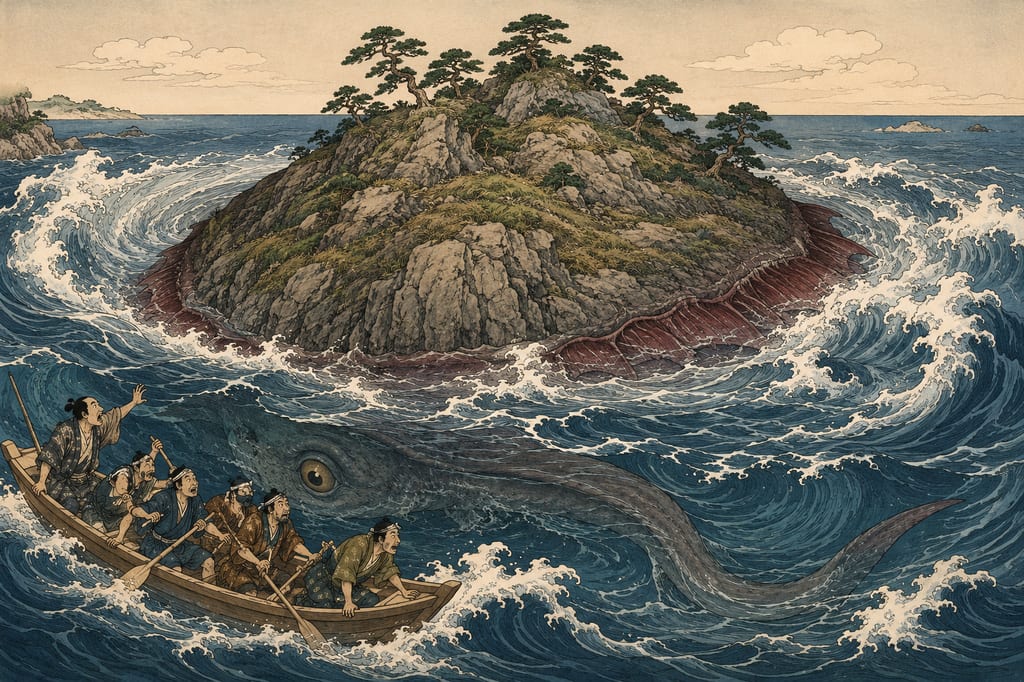
According to the *Ehon Hyaku Monogatari*[8], when a ship departing from Nojimazaki in Awa Province was blown off course by a great storm and left drifting, the crew spotted an island nearby. The sailors joyfully disembarked, only to find unfamiliar vegetation flourishing, with seaweed hanging from the treetops. Though they walked for two or three *ri* (approx. 8–12 km), they found neither people nor houses. Suspicious, they returned to their ship and sailed away, and the moment they did, the island that had certainly been there silently sank into the sea. It was not an island at all, but the back of a colossal Akaei (red stingray) floating on the water's surface[8].
The explanatory text accompanying the illustration records the length of this fish as "exceeding three *ri*"—an absurdly massive size spanning roughly twelve kilometers. Such a gigantic body, large enough to grow vegetation on its back, was told specifically because of the geography of Nojimazaki, located at the southernmost tip of Boso—a place jutting out into the open ocean where the Kuroshio current strikes. Nojimazaki sits at the southern edge of the Boso Peninsula, with the Pacific Ocean stretching endlessly before it. The dread felt by fishermen facing this vast open ocean, far beyond the sensation of land, gave birth to a giant fish indistinguishable from an island. The concept of something floating in the sea that, upon closer inspection, turns out to be the back of a living creature connects to the lineage of "giant whales and giant turtles mistaken for islands" found in legends worldwide. The Akaei is the Japanese version of this archetype, firmly anchored to the place names of Boso.
However, a caveat is necessary. The *Ehon Hyaku Monogatari*[8] is an illustrated collection of strange tales from the Tenpo era (1830s), a publication where the popular author Momosan-jin wrote the text and Takehara Shunsensai provided the multi-colored illustrations. The image of the Akaei is less a pure folk tradition handed down since ancient times in the seas of Awa, and more of an imaginative, early-modern creative monster given shape and popularized through late-Edo publishing culture. Even so, the author's choice of Nojimazaki—a specific, real-world cape—as the setting serves as reverse proof of just how limitlessly terrifying the sea of Sotobo appeared to people of that era.
The Funayurei Appearing in the Seas of Choshi
In the sea stretching from Sotobo to Choshi, there was another supernatural terror that fishermen genuinely feared: the Funayurei (boat ghost).

Funayūrei
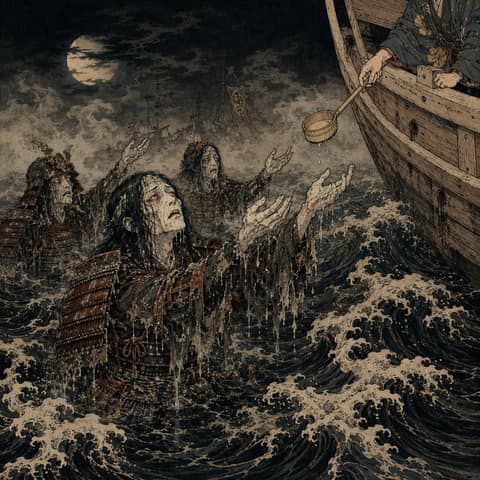
Funayūrei are maritime apparitions formed from the spirits of people who died by drowning or shipwreck. Depending on the region, they may appear as ghosts, phantom boats, eerie lights, or dark figures resembling Umibōzu. They most often emerge on stormy or fogbound nights, when they try to sink a vessel by ladling seawater aboard or confuse its course until it runs aground. Local defenses include offering a ladle with its bottom removed, throwing rice balls or ash, or meeting the ghosts with an unwavering stare. Mōjabune, Bōko, and Ayakashi are among the names applied to such spirits. Toriyama Sekien also depicted Funayūrei in Konjaku Gazu Zoku Hyakki.
Read more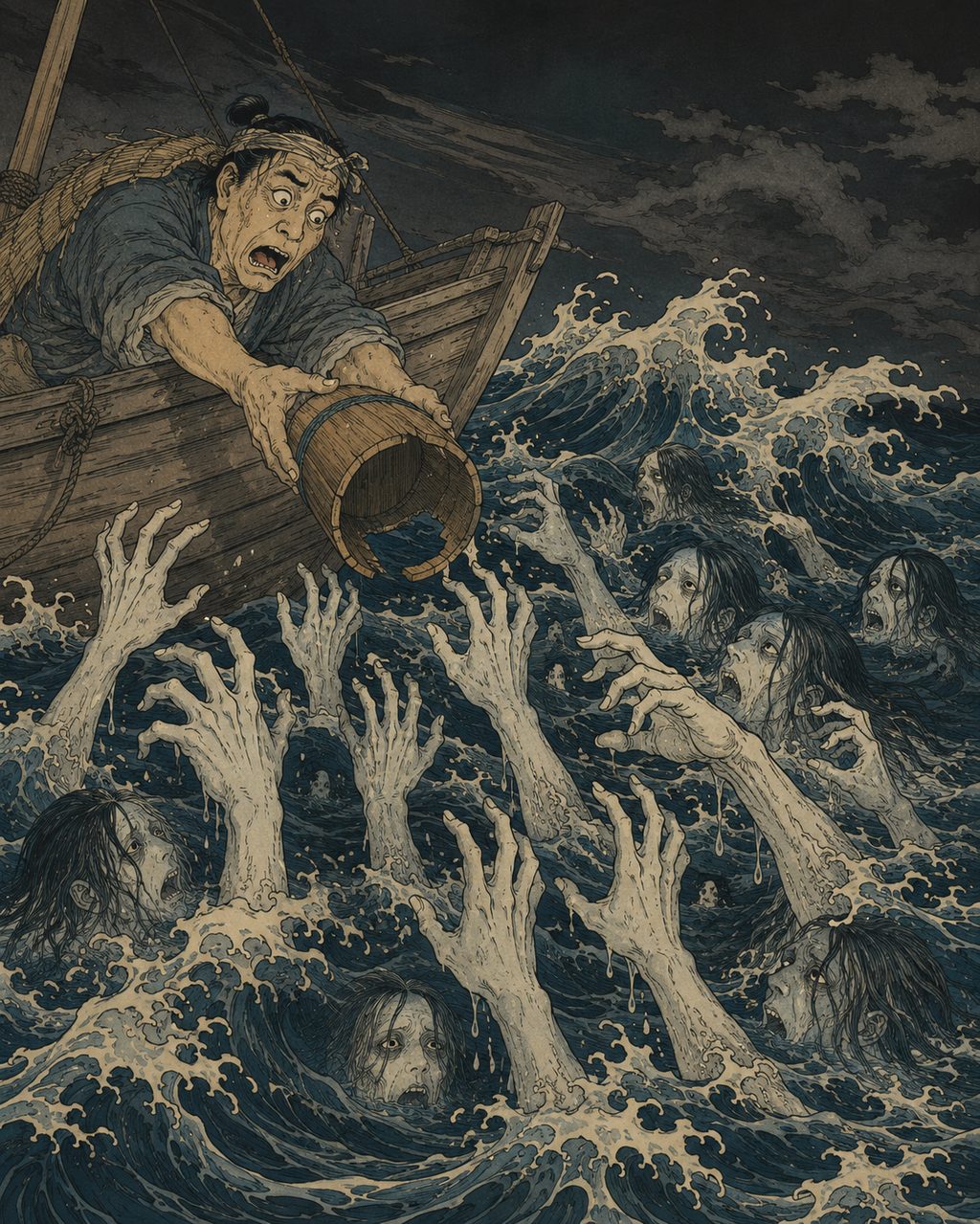
In the legends of Choshi City and the former Unakami District of Chiba Prefecture, on days thick with fog or rough seas, the spirits of those who died in shipwrecks would appear beside boats, trying to drag the living into the sea to increase their numbers[9]. "Mouren, yassa, mouren, yassa, inaga kasee"—"Mouren" means ghosts, "yassa" is the chant used when rowing a boat, and "inaga" means a dipper. Along with these voices, hands reach out from the sea, demanding a dipper. But if one simply hands over a dipper, the ghosts will use it to scoop seawater and sink the boat. Therefore, it is said that fishermen escaped disaster by passing them a dipper with its bottom knocked out[9].
If the Akaei is the awe of the open ocean's absurd scale, the Funayurei is an anomaly rooted in the very real deaths from shipwrecks. The countermeasure of the bottomless dipper was the crystallization of fishermen's urgent wisdom—pretending to grant the opponent's wish while avoiding actual harm. While Funayurei are a nationwide sea monster distributed not only in Sotobo but also throughout western Japan, the fact that they were spoken of in Chiba with the unique moniker "mouren" and tied to the seas of Choshi marks the distinct imprint of this region.
Choshi is a port town at the estuary where the Tone River flows into the Pacific Ocean, a place whose character was drastically altered by the eastward diversion of the Tone River[10] during the early modern period. Previously, the Tone River flowed into Edo Bay (present-day Tokyo Bay), but the Edo shogunate undertook a series of rerouting projects to divert its flow toward Choshi and the Pacific. This transformed Choshi into a major transportation hub where inland water transport—carrying goods from Tohoku down the Tone River to Edo—intersected with open-ocean shipping. However, the waters off Inubosaki are a treacherous bottleneck where the Kuroshio and Oyashio currents clash. As boat traffic increased, so did the number of people swallowed by the sea. The shadows of the dead wandering in search of companions were the very real manifestation of the most urgent fears held by the people of Choshi, who lived by fishing and maritime trade. Geography invites shipping, shipping invites death, and death gives birth to monsters—the Funayurei can also be read as the direct consequence of the civil engineering project that reshaped the geography of Boso, the eastward diversion of the Tone River.
The Shapeshifters in the Darkness of Shimousa — Mujina and Futakuchi-onna
While the monsters of the sea use the open ocean as their stage, more familiar monsters lurked on the night roads and inside the houses of the villages in Shimousa. The most representative of these is the Mujina.
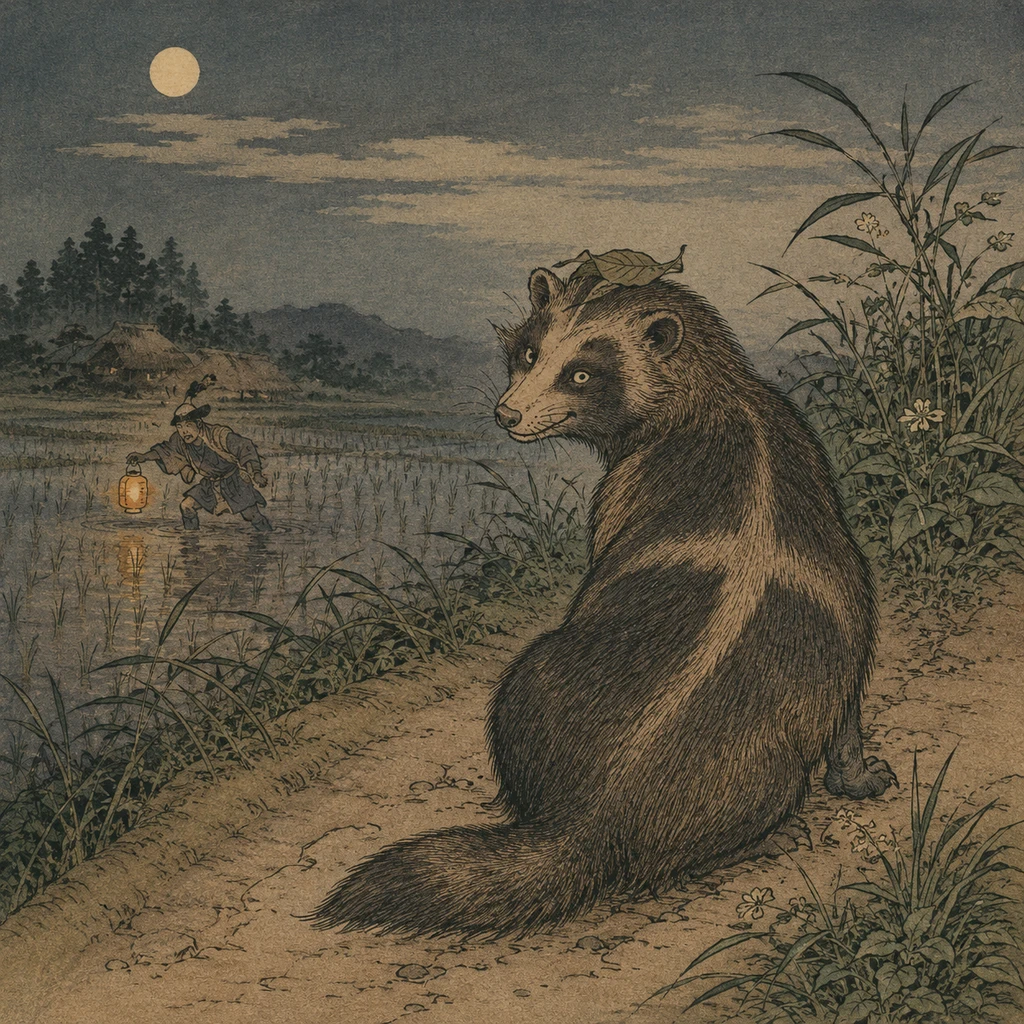
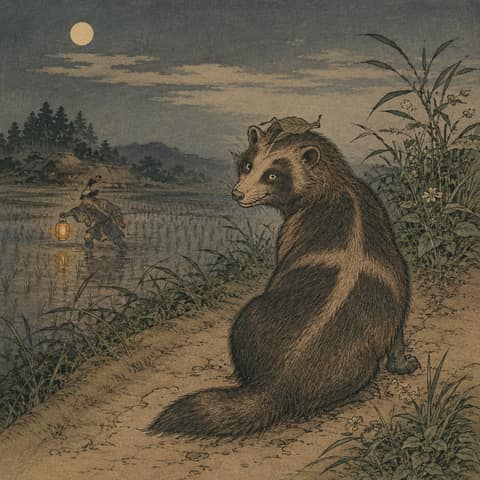
"Mujina" is an old name for badgers or raccoon dogs (tanuki). The specific animal it refers to varies by region, and sometimes the term vaguely lumps together these beasts, including masked palm civets. These animals were believed to bewitch people, giving rise to a wide variety of shapeshifter tales across the country. Particularly in the Shimousa region spanning Chiba and Ibaraki, a Mujina transformed into a young boy with a bobbed haircut and a short kimono was called a "Kabukiri Kozo." This is a somewhat goofy yet eerie monster that calls out to people on deserted night roads or mountain paths, saying, "Drink water, drink tea." One is told never to respond to its voice; this young boy who misleads travelers hurrying through the night has been passed down as a Mujina image unique to the villages of Shimousa.
The most famous of all Mujina shapeshifter tales is likely the story of "Mujina"[11] collected by Lafcadio Hearn in his *Kwaidan*. When a man calls out to a crying woman on a night road, she turns around to reveal a face with no eyes, nose, or mouth—smooth like an egg. He runs away in terror to a soba shop, only for the shop owner to stroke his own face and turn into the exact same faceless creature, a classic double-scare structure. Though this story is set in Akasaka, Tokyo, the origin of the imagination surrounding shapeshifting Mujina lies precisely in rural areas of the eastern Kanto region like Shimousa. The concept of a beast taking human form and erasing the face—the most human part of all—is the very sensation of night in farming villages where the boundary between human and beast remained ambiguous.
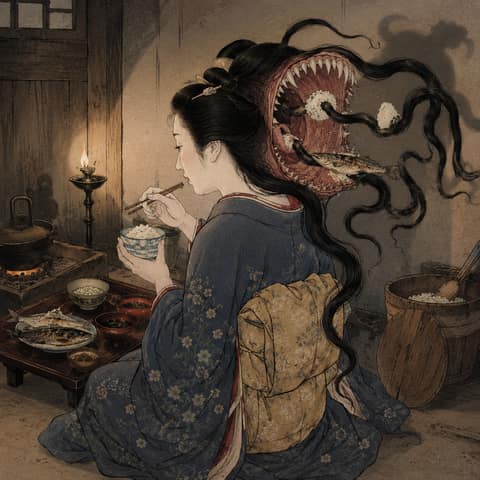
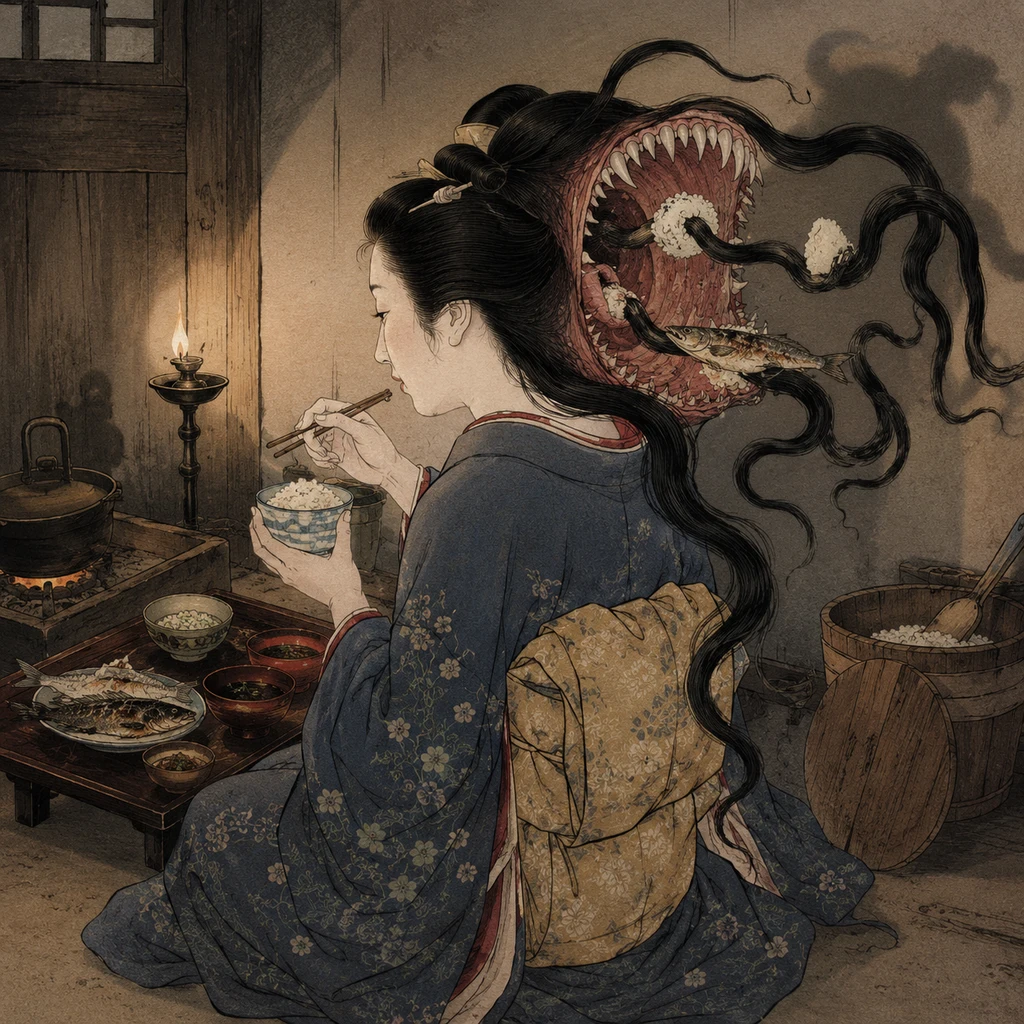
If the Mujina is a monster born from the mischief of beasts, the Futakuchi-onna (Two-Mouthed Woman) is a supernatural anomaly born from a much darker human sin. According to a story set in Shimousa Province recorded in the *Ehon Hyaku Monogatari*[8], a second wife married into a family but hated her predecessor's daughter. She refused to feed the girl properly, eventually starving her to death. Forty-nine days later, the husband was chopping wood when his axe slipped and split the back of his wife's head as she stood behind him. Though the wound initially healed, the split eventually took the shape of lips, a protruding piece of skull became teeth, and the exposed flesh turned into a tongue. At a fixed hour every day, it would ache intensely, and the pain would only subside when food was stuffed into it. Furthermore, the mouth eventually spoke in a human voice, quietly muttering words of repentance for her wicked deed of starving her stepchild to death[8].
The second mouth on the back of the head is the embodiment of karma—a sin overlooked that never vanishes, continuously devouring oneself. No matter how much the front mouth plays the part of a good person, the unseen back mouth speaks the truth. The Futakuchi-onna is a monster that visualizes the Buddhist concept of karmic retribution (that sins cannot be hidden) as a physical deformity on a woman's body. However, we should be cautious about blindly accepting this story as a folktale native to Shimousa. Research points out that the tale of the Futakuchi-onna is not an ancient legend of the region, but carries a strong creative flavor woven by the author, Momosan-jin[8]. Even so, the author's choice to deliberately frame the universal sin of stepchild abuse as a "story of Shimousa Province" clearly demonstrates the skillful technique of early modern weird tales—rooting the supernatural in the geography of the Bando region to make readers feel it was an event occurring in a "neighboring province." The fact that the *Ehon Hyaku Monogatari* favored Boso place names for both the Akaei and the Futakuchi-onna is the flip side of Edo residents' awareness that Shimousa and Awa were still frontiers where the supernatural felt right at home.
The Anomalies of the Three Provinces — Shimousa,
Kazusa,
and Awa
When we rearrange the supernatural entities we have seen so far within the framework of the ancient provinces, the structure of the Boso Peninsula's yokai culture becomes even clearer.
Shimousa Province is the northern side of the peninsula—a low, damp plain bordered by the Tone and Edo rivers. This was Masakado's stronghold, the land of the Chiba clan's Myoken worship, the site of the water deity tales of Inba Numa and Tega Numa, and the villages where the Kabukiri Kozo and Futakuchi-onna were spoken of. In short, the anomalies of Shimousa are concentrated on the memories of the warrior class, inland waters, and the nights of the villages. It is an extremely "land-based" region where history and human sins give birth to monsters.
Kazusa Province occupies the center of the peninsula. Formed in ancient times by the integration of small states like Kami-tsu-Unakami and Kikuma, it is crossed by rivers like the Yoro and Obitsu flowing into Tokyo Bay. While Kazusa does not boast as many prominent yokai names as Shimousa, it plays the role of the geographical spine connecting the anomalies of Shimousa and Awa. The gentle seas of the inner bay and the inland hills—this very intermediacy defines the topology of Kazusa.
And Awa Province is the maritime province at the southernmost tip of the peninsula. Embracing the warm inner bay and the outer Sotobo coast struck by the Kuroshio current, it thrived on fishing and maritime traffic. It was exactly in Awa that the Akaei of Nojimazaki was spoken of—a place where awe of the vastness beyond the sea crystallized most densely. Ancient legends say the Inbe clan crossed the Kuroshio current from Awa (present-day Tokushima) to plant hemp here, meaning the very name "Awa" harbors the memory of travel across the sea. The fact that Awa's anomalies lean heavily toward the enormity of the open ocean and deaths from shipwrecks is simply because this province was, first and foremost, a province of the sea.
Shimousa represents the memories of the land; Kazusa is the spine of the peninsula; Awa holds the dread of the sea. The geographical differences between the three provinces directly manifest as differences in the nature of their supernatural tales.
Yokai Born from the Peninsula
The geography of a peninsula bound by the sea on three sides runs consistently through the yokai of Chiba. On land, Taira no Masakado, struck down after claiming the title of New Emperor, ascended to become a vengeful deity, while in Inba Numa, a dragon that saved the people was torn into three pieces, leaving its name on three temples. At sea, the Akaei, mistakable for an island, floats off Nojimazaki, and the Funayurei begs for a dipper in the darkness of Choshi. And in the nights of the villages, the Mujina shapeshifts, while in the darkness of the home, the Futakuchi-onna murmurs her sins.
A vengeful spirit becomes the guardian deity of Bando, a giant fish shoulders the terror of the open ocean, and the dead of shipwrecks seek companions. These are not unrelated old tales; they are the supernatural phenomena inevitably born in their respective locations upon a single piece of land sandwiched between the Tone River, the Pacific Ocean, and Tokyo Bay.
If we look closely, a single, consistent theme flows through the supernatural folklore of Chiba. It is the imagination of "a body divided, dwelling in various places." Masakado's head detaches from his torso and flies to the eastern provinces; the dragon of Inba Numa is torn into head, belly, and tail, falling upon three temples; the Futakuchi-onna gains a second mouth on the back of her head, bearing two voices in a single body. Bodies splitting, multiplying, and taking root in separate locations—perhaps the very topography of the peninsula itself, bounded by the sea on three sides, divided into three ancient provinces, and carved by countless marshes and river mouths, summoned these tales of "divided bodies."
The memory of the land, the fear of the sea, and bodies torn apart to dwell in the earth—at the intersection of these forces stands the yokai culture of the Boso Peninsula. You can walk to the Masakado Mounds and the three dragon temples, or gaze up at the endless sea of Sotobo. The supernatural tales of Chiba, tied to concrete place names, still quietly breathe on this peninsula today.