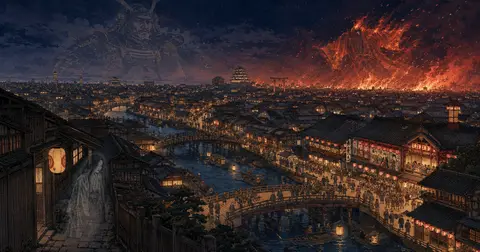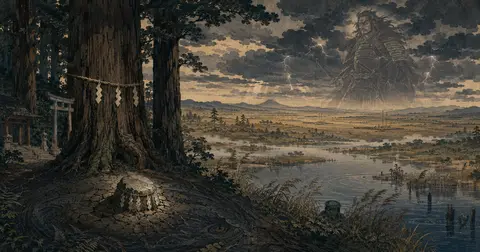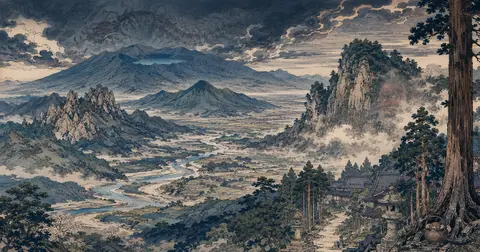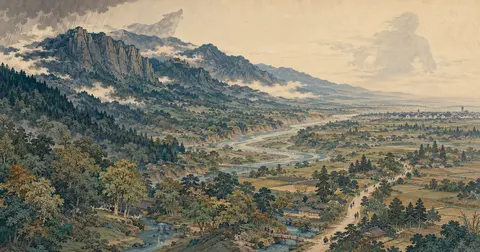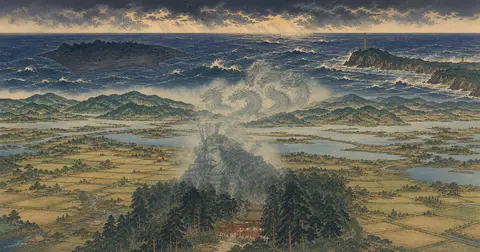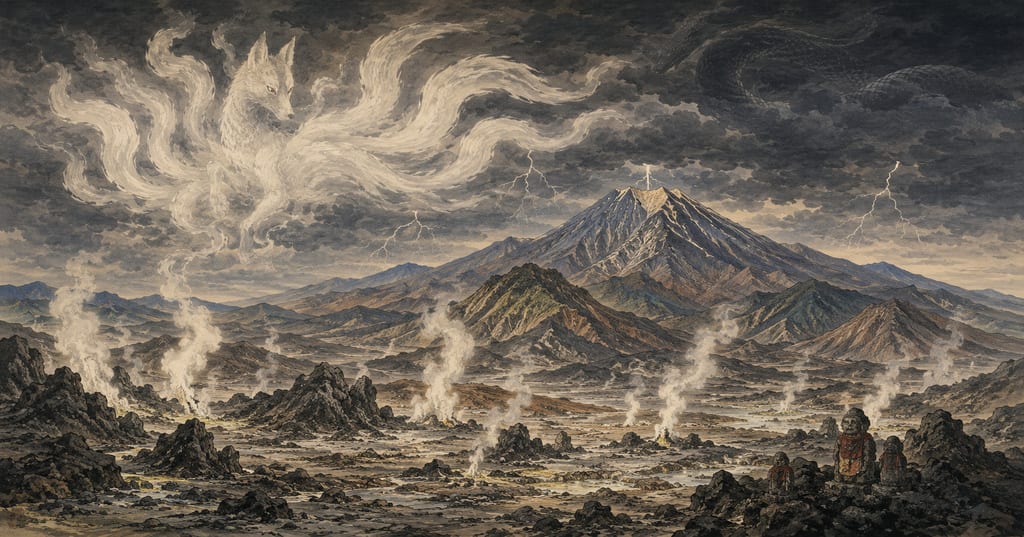
The yōkai of Tochigi Prefecture are born of fire and mountains. To the north, Mount Nasu belches sulfuric smoke, while to the west tower the sacred peaks of Nikkō, with Mount Nantai as their crown. Where the noxious fumes of volcanoes, the prayers of mountain worship, and the drawn bows of the Bandō warriors intersect—that is where Tochigi's supernatural phenomena come to life.
Among them, the tale of the Nine-Tailed Fox passed down in Nasuno stands at the absolute pinnacle of Japanese fox lore. A demonic fox that roamed across three countries takes the form of the beautiful Tamamo-no-Mae, is exposed, flees to Nasuno, and upon being slain, transforms into a rock that spews lethal poison. This epic tale of reincarnation is underpinned by the geological reality of Nasu's volcanoes, whose gases actually kill birds and beasts. Let us explore the yōkai of Shimotsuke—the old name for Tochigi—nurtured by fire and mountains, journeying through Nasu, Oku-Nikkō, Utsunomiya, the deep mountains, and Nikkō.
Nasuno — The Nine-Tailed Fox and Sessho-seki
To speak of the yōkai of Tochigi, one must begin in Nasuno. Here lies an epic tale of reincarnation that represents the pinnacle of Japanese fox folklore.

Tamamo-no-Mae
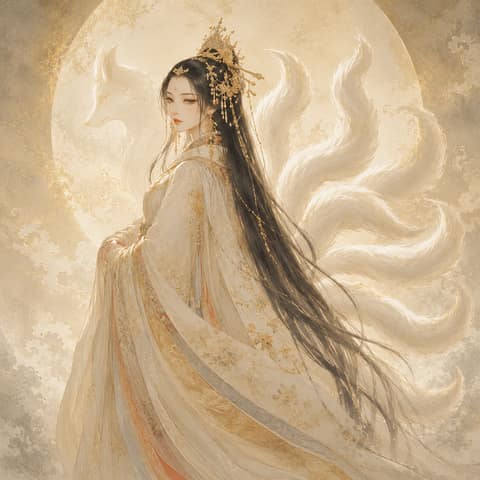
Tamamo-no-Mae is a beauty of unrivaled grace who, in the late Heian period, is said to have served the retired Emperor Toba. Her true form is held to be a nine-tailed fox, yet as a human, Tamamo-no-Mae has above all been remembered as a court lady of rare beauty and deep learning. Poetry and music were a given, but from Buddhist scripture to the old tales of India and China, she answered any question without hesitation, astonishing all at court. The name “Tamamo-no-Mae” carries a story of its own. One night, amid a banquet of poetry and music at the Seiryōden, a gust of wind snuffed out the lamps; in the darkness a dazzling light streamed from her body and lit the hall as bright as day. From this she came to be called “Tamamo-no-Mae,” meaning the lady of the jewel-like, glowing waterweed . Before that, it is said, she had been called Mikuzume. In time she drew all the emperor’s affection to herself, but when he fell ill from an unknown cause, her true nature began to be doubted.
Read moreDuring the reign of Retired Emperor Toba, a woman of peerless beauty named Tamamo-no-Mae appeared at the imperial court and won his deep affection. Well-versed in poetry and music, her intellect was so extraordinary that she could answer any question without hesitation, seeming almost beyond human. The name Tamamo-no-Mae is said to stem from her body emitting a jewel-like radiance, or because when the lamps went out during a moonlit banquet, her glowing form illuminated the entire room. Marveling at her vast knowledge of Japanese and Chinese classics and her ability to instantly solve any riddle, the courtiers praised her as the greatest beauty and intellect in Japan. Yet, this superhuman brilliance was the very proof of her otherworldly nature. When the Retired Emperor suddenly fell gravely ill, the *onmyōji* Abe no Yasunari saw through her disguise—Tamamo-no-Mae was a demonic fox who bewitched humans[1]. Her true form exposed, the fox fled the imperial court, soaring eastward to hide in Nasuno in Shimotsuke Province, where she continued to prey upon the local people and livestock.
The tales memorably recount exactly how Abe no Yasunari uncovered her true identity. He made Tamamo-no-Mae stand before the altar of Taizan Fukun to pray for the Emperor's recovery and forced her to offer purification wands (*nusa*). Unable to suppress her true nature, the fox momentarily revealed her golden-haired, nine-tailed form before vanishing into the sky toward the eastern provinces. The imperial court dispatched a subjugation force led by Miura-no-suke and Kazusa-no-suke. After conducting a massive *makigari* (encirclement hunt) in Nasuno, they finally shot the fox down. This hunt, where warriors honed their archery and horsemanship by using dogs as moving targets, was later told as the origin story for traditional Bandō warrior equestrian arts like *inuōmono* (dog-chasing archery) and *kasagake*. Furthermore, it is said that Sudō Gon-no-kami Sadanobu, who distinguished himself during the Nasuno campaign, was granted this land, settling there to become the progenitor of the Nasu clan—the very clan that would later produce Nasu no Yoichi, the legendary archer who shot the fan target during the Genpei War. The story of slaying the Nine-Tailed Fox was not merely a tale of monsters, but was inextricably linked to the martial traditions of the east and the noble lineage of the clan that ruled Nasu.


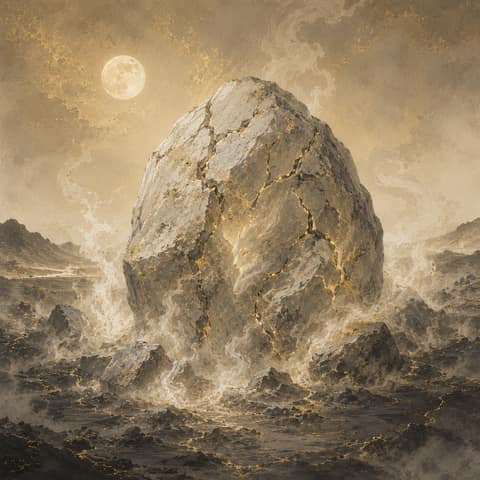
The slain fox transformed into a single boulder that killed any bird or beast that approached with its poisonous vapors, and thus came to be called the Sesshō-seki (Killing Stone)[2]. During the Muromachi period, a high-ranking monk named Priest Gennō is said to have struck and shattered the stone, sending its fragments flying across the country. There is even a popular belief that the heavy hammer used by carpenters, called a *gennō*, derives its name from this very monk. The shards of the Sesshō-seki shattered by Priest Gennō purportedly flew to various regions—such as Aizu, Bingo, and Mimasaka—leaving the name "Sesshō-seki" wherever they landed. This expansive myth, where the nine-tailed poison originating in Nasu scatters across Japan, speaks volumes about how widely the legend of Tamamo-no-Mae was embraced as a narrative of national scale.
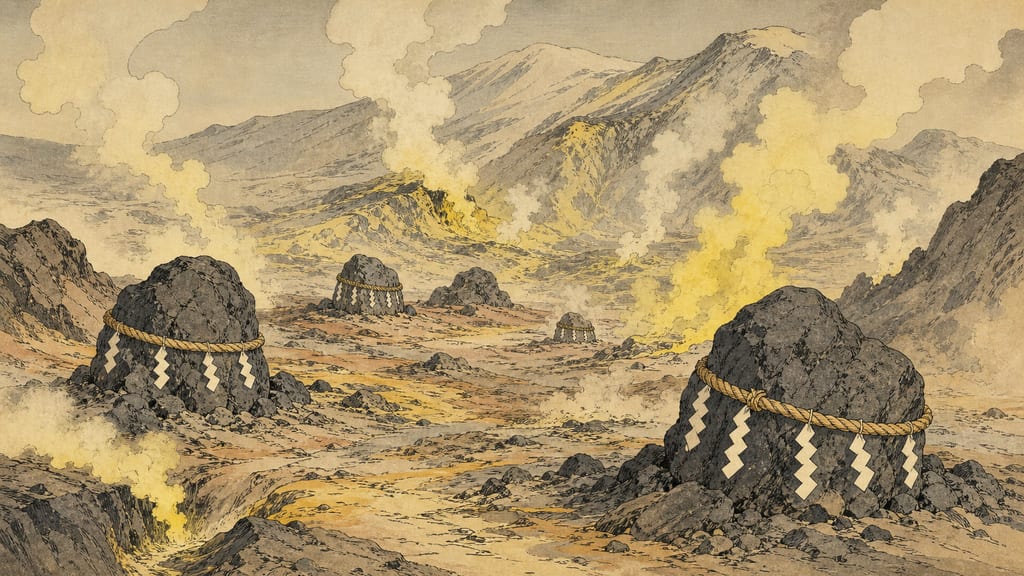
Behind this legend lies the reality of sulfur dioxide gas vented by the volcanoes around Nasu Yumoto and Mount Nasu. In this desolate, purgatory-like terrain devoid of vegetation, birds and animals do indeed perish from the fumes. The name "the stone that kills birds and beasts" is backed by this geological reality. In 1689, when Matsuo Bashō visited this site during his journey for *The Narrow Road to the Deep North* (*Oku no Hosomichi*), he recorded the Sesshō-seki's ghastly scene: "The stone's poisonous vapor is still unextinguished; bees and butterflies lie dead in heaps so thick the color of the sand below cannot be seen." A stone monument bearing his haiku, "The stone's scent / the summer grass red / the dew is hot," stands beside the Sesshō-seki to this day. To Bashō's eyes, Tamamo-no-Mae's poison was a palpable reality. It is still fresh in recent memory when, in March 2022, the actual Sesshō-seki in Nasu was found split completely in two, sparking a viral sensation on social media as people joked that "the sealed nine-tailed fox has been unleashed."
It should be noted that the epic prequel depicting the Nine-Tailed Fox as a "Transnational Menace"—a demonic fox that repeatedly reincarnated as Lady Kayō in India, Daji in China, and finally Tamamo-no-Mae in Japan—is a relatively recent layer of fiction, cemented in works like the late Edo period's *Ehon Sangoku Yōfuden* (1803–05)[3]. These tales recount in vivid detail the atrocities the fox committed in each country. In India, as Lady Kayō, the consort of Crown Prince Hanzoku, she manipulated him into beheading a thousand men; in China, as Daji, the consort of King Zhou of the Shang dynasty, she indulged in the infamous "lake of wine and forest of meat," bringing the kingdom to ruin; and in Japan, as Tamamo-no-Mae, she seduced the Retired Emperor Toba. It is a grand lineage of evil in which a single demon fox led three successive dynasties to their doom. In earlier variations from the Muromachi period, Tamamo-no-Mae's true form was merely an old, two-tailed fox. As the centuries passed, the story expanded—multiplying her tails and moving her origins to the continent.
The Noh play *Sesshō-seki* gave this story a redemptive conclusion. When Priest Gennō confronts the stone in Nasuno, the spirit of the fox emerges from within, repenting for her past sins and finding spiritual salvation through the monk's divine power. This narrative arc—where even a destructive demon fox is ultimately saved by the Buddha—beautifully illustrates the religious depths of Noh theater. In Edo, the story was adapted into Jōruri puppet theater and Kabuki plays, such as *Ehon Zōho Tamamo-no-Mae Asahi no Tamoto*, turning Tamamo-no-Mae into a star of the stage. Through these adaptations, the Nine-Tailed Fox cemented her status as one of Japan's "Three Great Evil Yōkai," alongside the Nue and Shuten-dōji.
Oku-Nikkō — The Great Serpent and Giant Centipede Contesting the Lake
Beyond volcanic poisons, the mountains of Tochigi also harbor memories of a battle between gods.
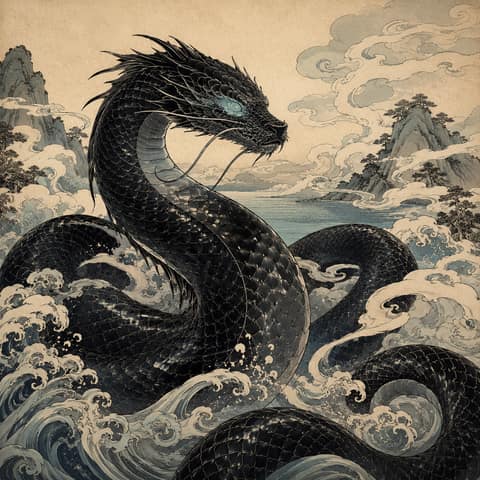
Daija
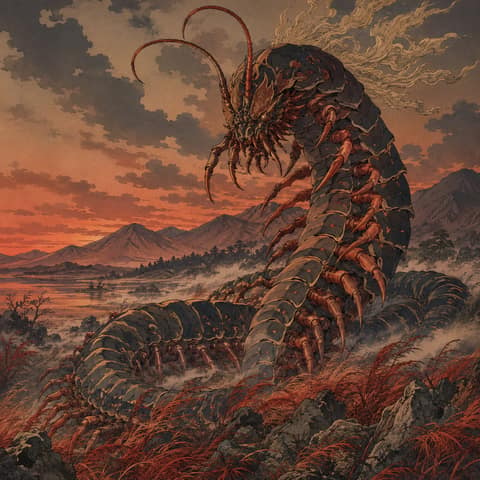
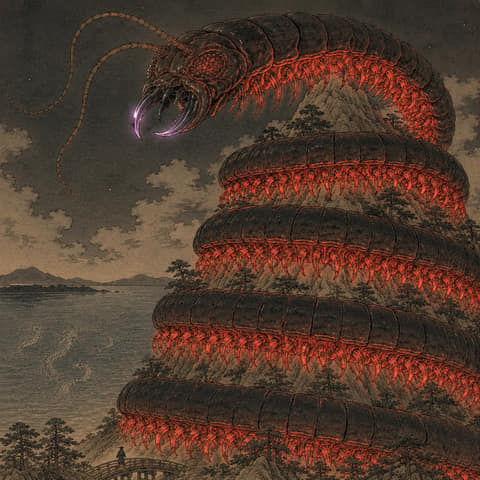
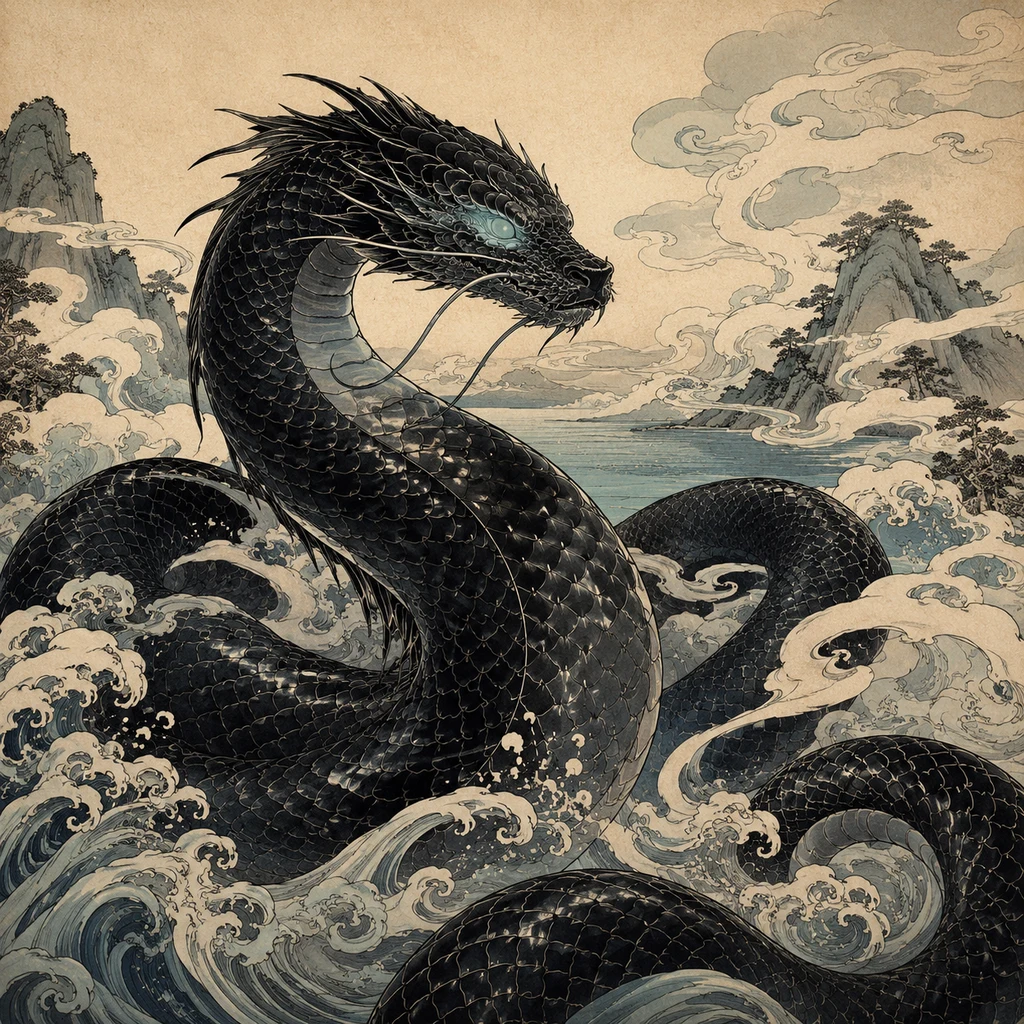
Daija is a general term for giant, divinely imbued serpents, feared and revered across the land as masters of mountains, lakes, and marshes, and as water gods. The epic tale of a divine battle passed down in Senjogahara, Oku-Nikko, is particularly notable. It tells of the god of Shimotsuke Province's Mount Nantai (Futarasan) taking the form of a Daija to fight a giant centipede—the avatar of the god of Kozuke Province's Mount Akagi—over dominion of the beautiful Lake Chuzenji. Serpents symbolize water and rebirth; their immortality, demonstrated by shedding their skin, and the sacred nature of their coiled forms have drawn ancient veneration as avatars of water deities connected to dragons. The concept of mountain gods taking serpentine forms is widespread throughout Japan, with the Daija of Senjogahara being a prime example.
Read moreIn Senjōgahara (literally "the battlefield") of Oku-Nikkō, a legend tells of a divine war fought between the god of Mount Nantai in Shimotsuke and the god of Mount Akagi in Kōzuke (modern-day Gunma) over the dominion of the beautiful Lake Chūzenji. The deity of Mount Nantai transformed into a Great Serpent, while the deity of Mount Akagi took the form of a Giant Centipede. Many place names in Oku-Nikkō are said to trace their roots to this conflict: the moor where the gods clashed became "Senjōgahara," the area where the spilled blood stained the earth red became "Akanuma" (Red Bog), and the shore where they supposedly brokered a truce became "Shōbugahama" (Iris Beach). This tale of divine warfare is recorded in the *Nikkōsan Engi* (Origins of Mount Nikkō) and has formed the spiritual core of the Futarasan worship centered on Mount Nantai. Geologically, the vast marshland known today as Senjōgahara is an alpine wetland formed over millennia as a former lake gradually filled in. Its desolate, sweeping landscape naturally invited legends framing it as the scarred battleground of gods.
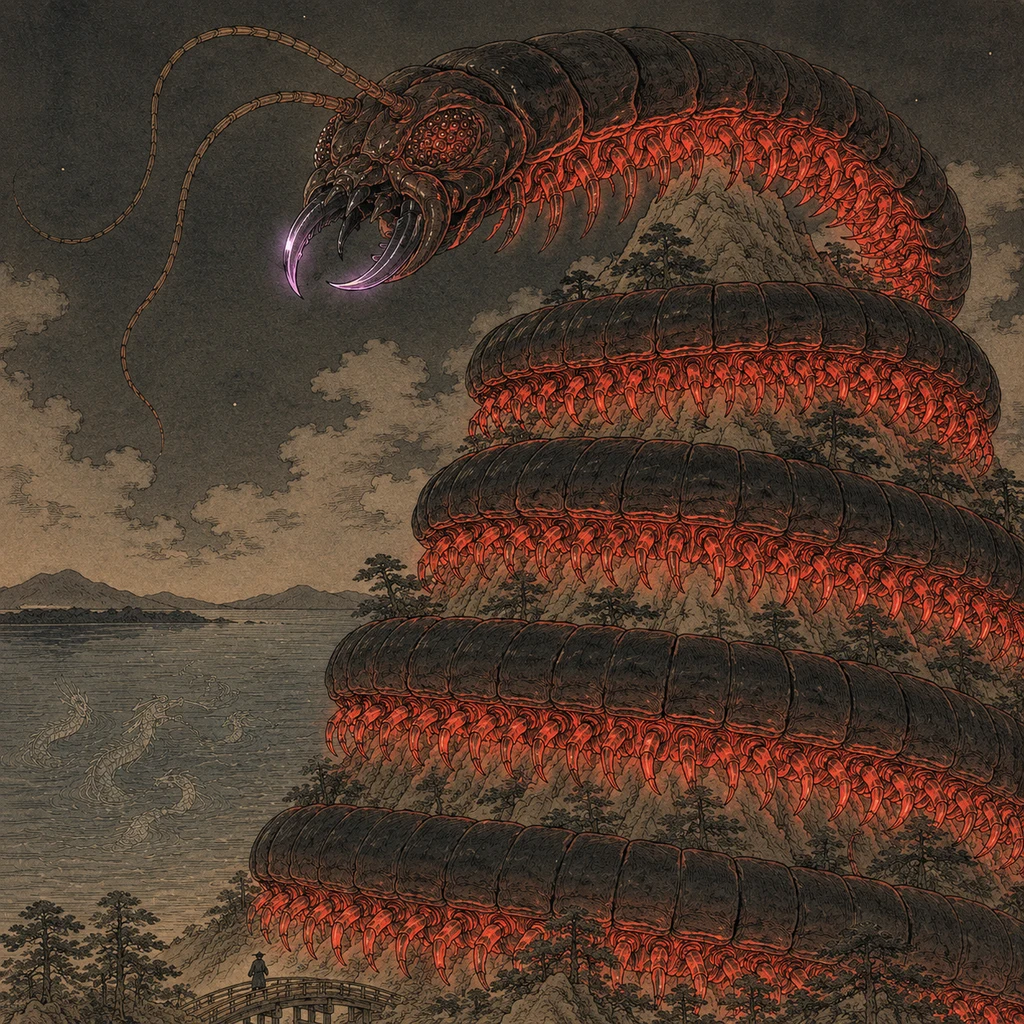
The Great Serpent, initially at a disadvantage, ultimately repelled the Giant Centipede with the aid of a master archer named Sarumaru. This motif of a serpent (a water deity) battling a centipede (a mountain or mining deity) echoes the legend of Tawara Tōda slaying a giant centipede[4] at Mount Mikami in Ōmi Province. Interestingly, the victor is reversed: while a human (Tawara Tōda) defeats the centipede in Ōmi, the serpent vanquishes the centipede in Oku-Nikkō. Surrounding the same centipede motif, an intriguing contrast emerges where a serpent claims victory in the east, and a human claims victory in the west. The archer Sarumaru, who tipped the scales, is often conflated with Sarumaru Dayū, one of the Thirty-Six Immortals of Poetry whose work appears in the *Ogura Hyakunin Isshu*. Today, the deity of Mount Nantai remains enshrined at the Chūgūshi of Futarasan Shrine, looking out over Lake Chūzenji. The memory of the gods' war lives on in the lakeside shrines and local topography.
The portrayal of the Giant Centipede as a mountain deity is deeply linked to mining. The centipede was likened to miners tunneling through the earth, with its multitude of legs symbolizing the power to uncover veins of ore. Considering that Ashio later flourished as one of Japan's premier copper mines, it is perhaps no coincidence that the myth of a centipede god's battle took root in this very mountain range connecting Oku-Nikkō to Ashio.
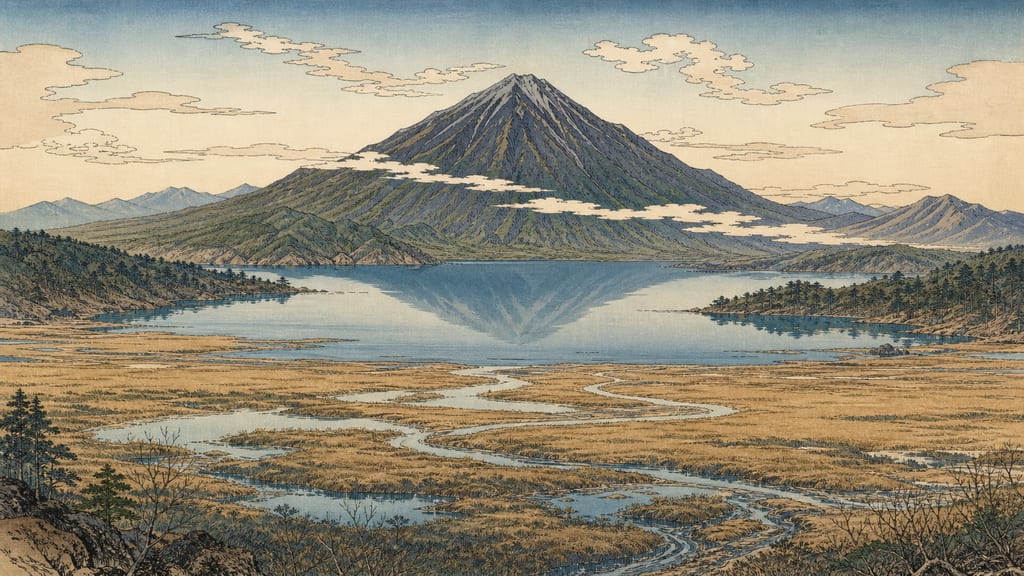
Since ancient times, Mount Nantai has been a peak of ascetic practice where devotees undertake *tōhai* (mountain-climbing pilgrimages). Even today, a long line of pilgrims makes the ascent to the Futarasan Shrine Okumiya at the summit during the summer climbing season. People have continued to climb this mountain—where a god once transformed into a serpent to fight—out of a deep sense of awe. At Mount Nantai, supernatural lore and active religious devotion are seamlessly woven together.
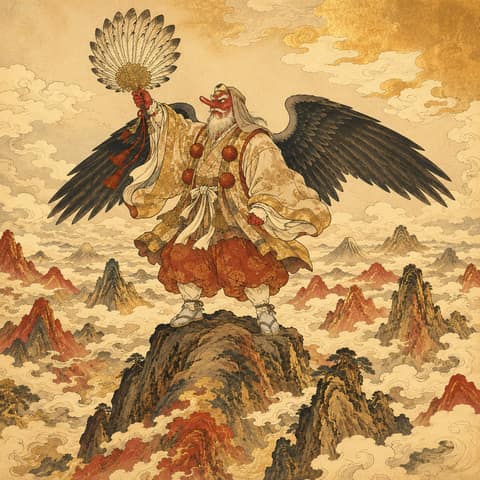
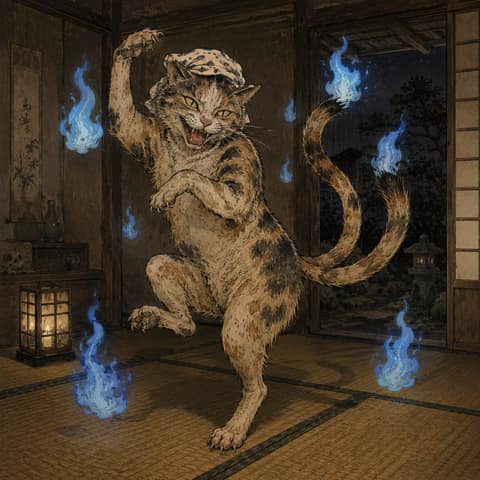
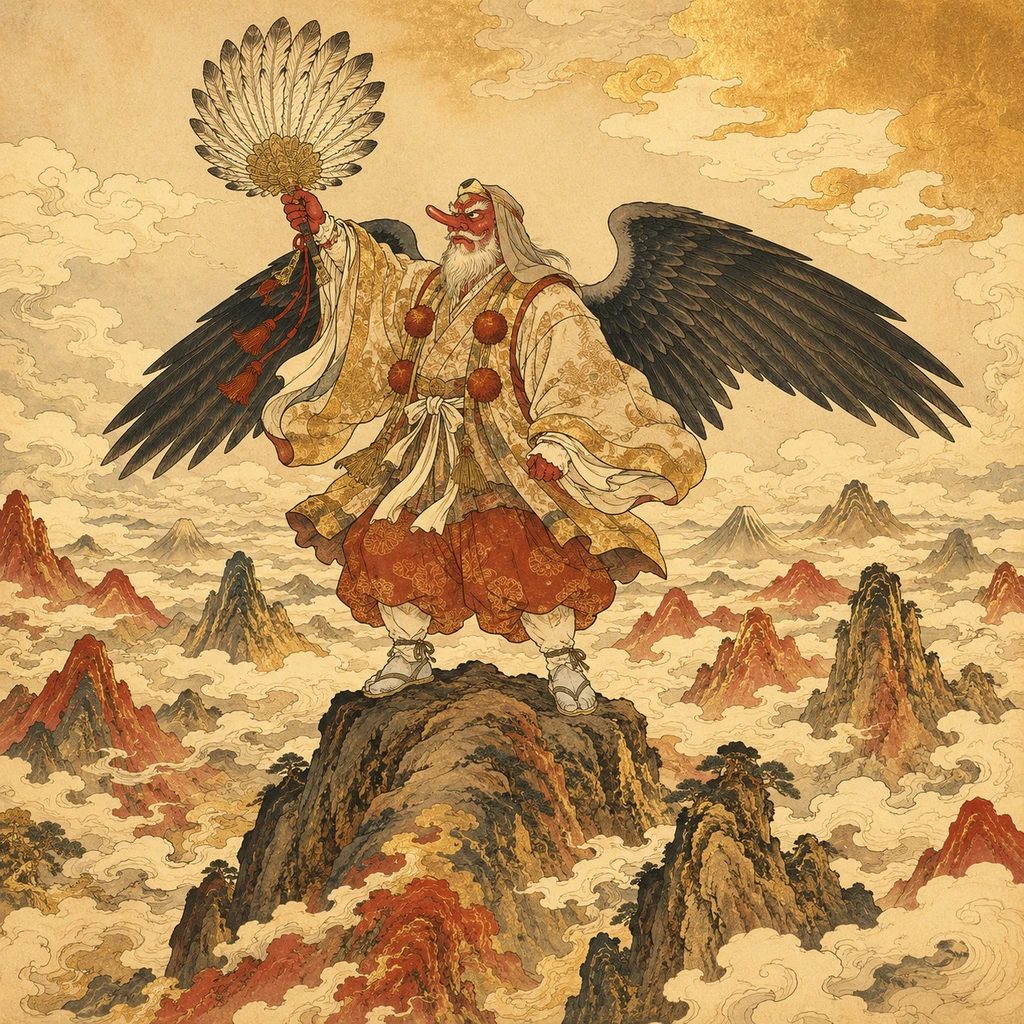
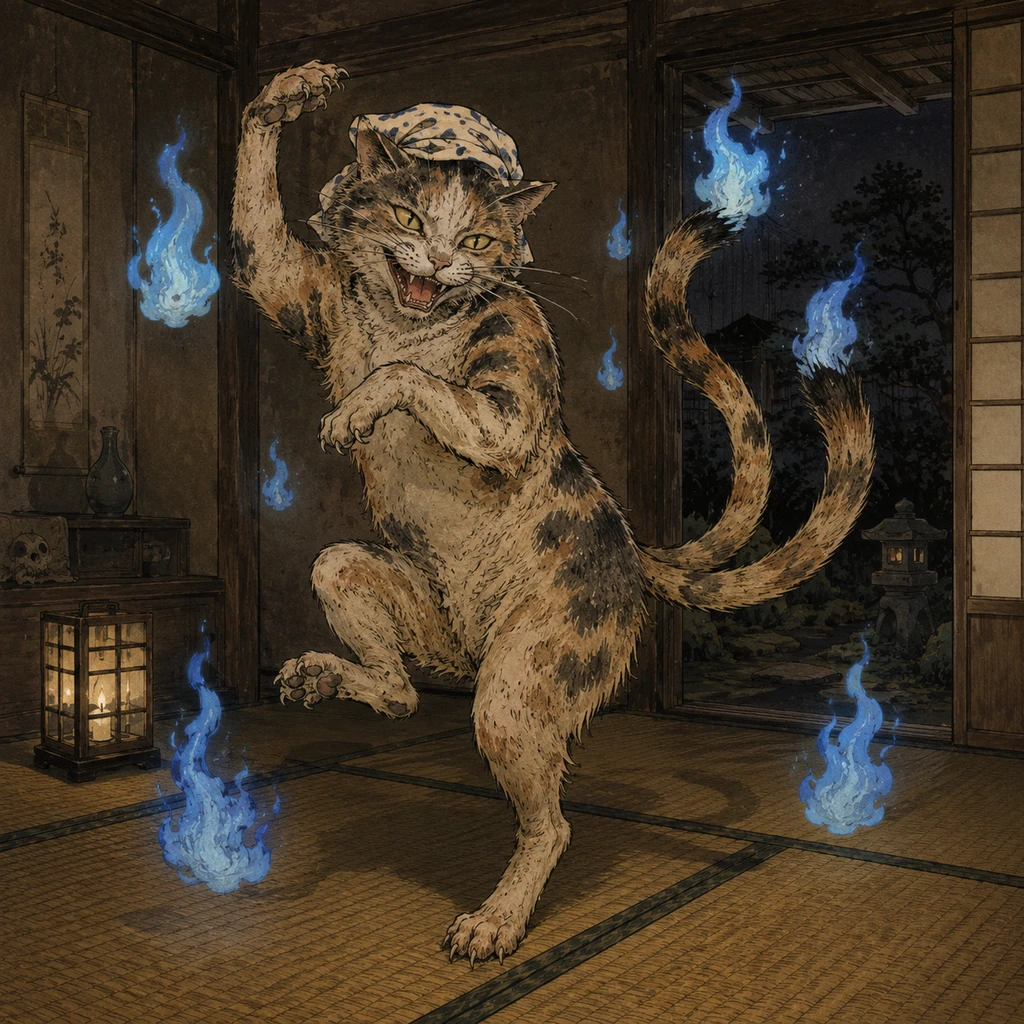
The sacred mountains of Nikkō were not only the battlegrounds of gods but also a major center for mountain worship. Furumine Shrine, nestled in Kobugahara of Kanuma, has served as a heart of Tengu worship, expanding its confraternities (*kō*) across the Kantō region. Enshrining Yamato Takeru no Mikoto, the shrine considers Tengu as his divine messengers who protect worshippers; thus, a great variety of Tengu masks are dedicated there. The "Kobugahara-kō," which prays for protection against fire and disaster, spread from Kantō to the Tōhoku region, and the shrine's talismans are still kept in homes today. Meanwhile, Mount Kōshin in Ashio is a rugged ascetic mountain draped in ancient forests and strange rock formations, where the monk Shōdō Shōnin is said to have enshrined Shōmen Kongō, the principal deity of the Kōshin faith. Kyokutei Bakin's *Nansō Satomi Hakkenden* cast Mount Kōshin as the dramatic stage where Inukai Genpachi slays a gigantic monster cat—a Nekomata—that had grown monstrous over centuries. Bakin chose this mountain for his beast-slaying climax precisely because its forbidding, impenetrable atmosphere made it the perfect lair for a centuries-old phantom feline. The mountains were realms of the gods, but simultaneously they were dark domains inhabited by Tengu and Nekomata.
Utsunomiya — The Dodomeki and Tawara Tōda
The shadow of the warlords who ruled the Bandō region also falls across Tochigi's supernatural lore.
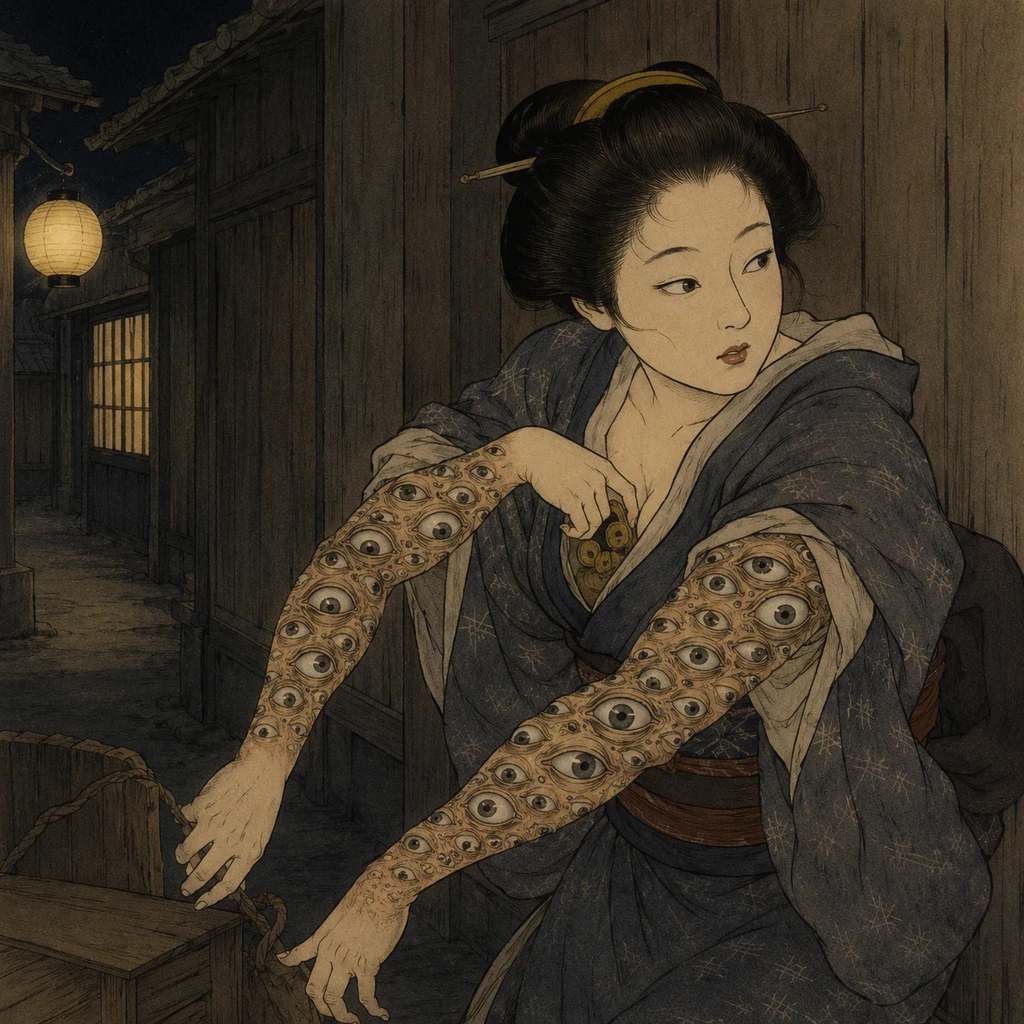
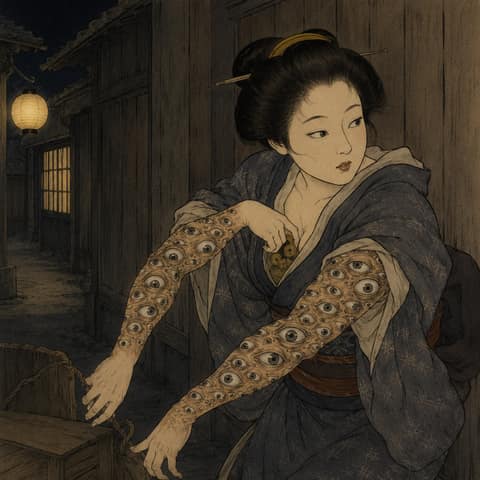
Dodomeki
A female yokai illustrated by Toriyama Sekien in Konjaku Gazu Zoku Hyakki, depicted with countless eyes embedded along her arms. She is said to have been a woman with a habit of stealing coins; because she constantly pilfered holed copper cash (torime), the spirits of those coins manifested as eyes on her limbs. Sekien cites a source titled Kankangai-shi, but that work is unverified and likely a playful pseudobibliographic joke. The name Dodomeki may be a wordplay tied to old nicknames for copper coins and to place-name spellings.
Read moreTawara Tōda, also known as Fujiwara no Hidesato—the legendary hero who defeated the rebel Taira no Masakado—was a warlord with deep ties to this region, having established Karasawayama Castle in Sano, Shimotsuke. Utsunomiya preserves a legend in which Hidesato shot down the Dodomeki, a demon whose arms gleamed with a hundred eyes. When this three-meter-tall ogre appeared at a horse burial ground, its arms glaring with countless eyes, Hidesato supposedly aimed at the brightest eye of them all, piercing its vital spot. The place where the slain demon finally fell is still known today as "Dōmeki Dōri" (Dodomeki Street) in Utsunomiya. The very name Utsunomiya is said to derive from a corruption of "Ichinomiya"—referring to Futarasan Shrine, the chief shrine (ichinomiya) of Shimotsuke Province, heavily venerated by locals. It was right in the temple town sprawling beneath this chief shrine that Hidesato supposedly defeated the Dodomeki. The setting—at the feet of an *ichinomiya* dedicated to a martial god—is perfectly suited for a tale of a Bandō warrior shooting down a demon.
This legend has an epilogue. Four hundred years later, when a virtuous monk arrived at Honganji Temple in Hanawada to deliver sermons, a beautiful young woman appeared every day to listen. This woman was none other than the demon defeated by Hidesato, who had healed her wounds, disguised herself as a maiden, and was once again causing unrest in the village. Yet, moved by the monk's teachings, she repented and disappeared, leaving behind only her demonic claws and horns at the temple. The gentle heart of Utsunomiya's demon legend lies in this conclusion, where a vanquished monster is ultimately saved by the Buddha's teachings. The story of the Dodomeki—slain, yet finding karmic grace before vanishing—reveals a softer undercurrent flowing beneath the martial history of Utsunomiya.
It is worth noting that the "Dodomeki" depicted by the artist Toriyama Sekien in his *Konjaku Gazu Zoku Hyakki*[5] is a completely different creature—a female thief whose arms sprouted a hundred bird's eyes, matching the number of coins she stole. This was a literary pun created by the artist, playing on the word *chōmoku* (bird's eyes), a slang term for copper coins. This creation belongs to an entirely different lineage than Utsunomiya's indigenous demon. Despite sharing the same name, one is a terrifying ogre shot by a Bandō warrior, while the other is an Edo artist's satirical caricature. This single example perfectly illustrates how the mere name of a yōkai can magnetize wildly diverse narratives.
Countless Jizō — The Bake-Jizō of Kanmangafuchi
Deep in the mountains of Nikkō, there exists a mystery that does not harm humans, but quietly bewilders them.
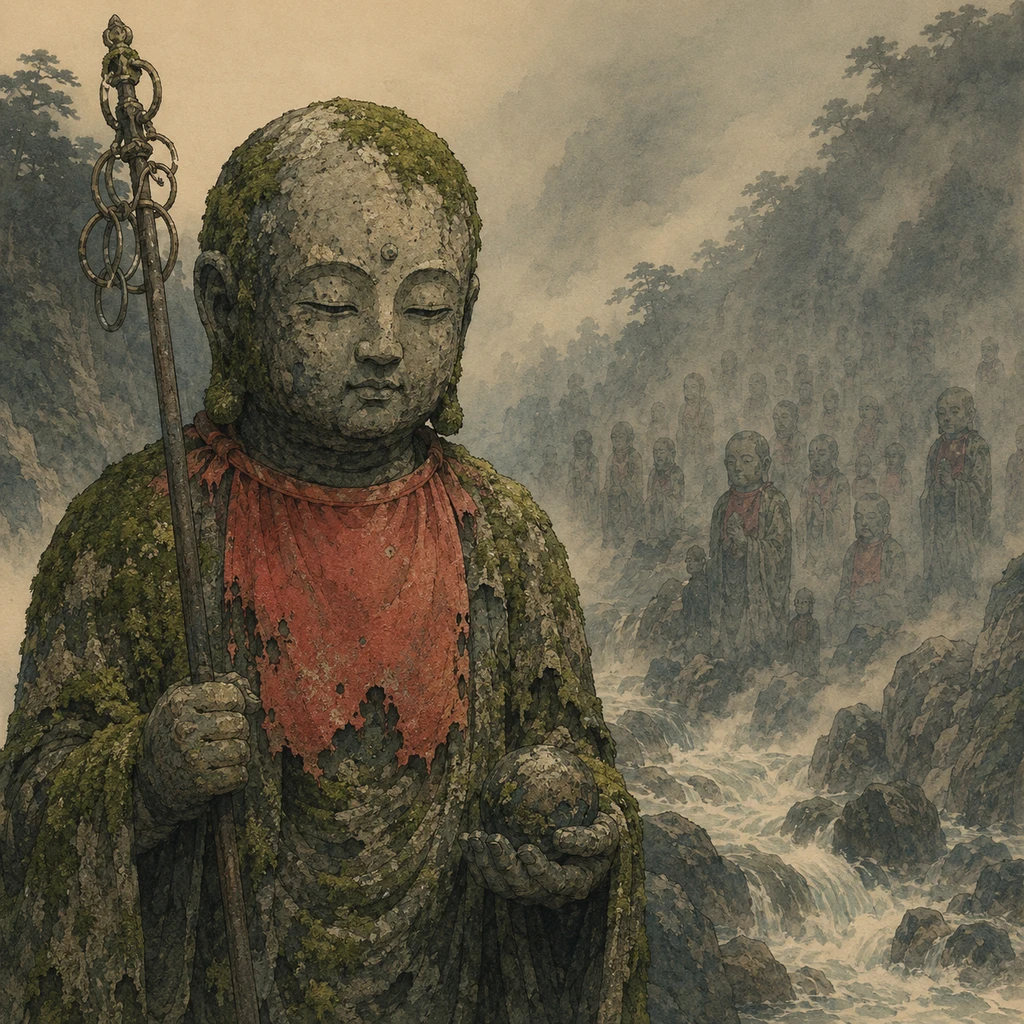
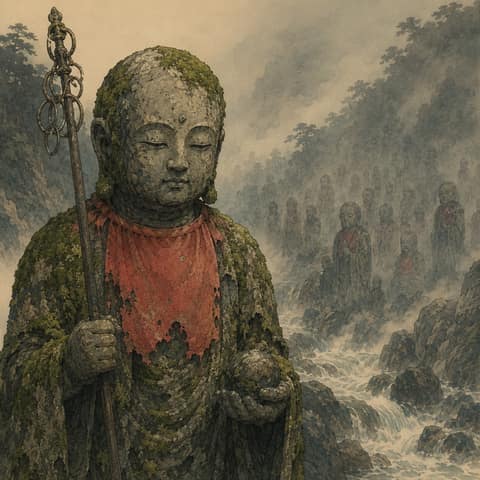
Bake-jizo
Bake-jizo (Ghost Jizo) is a group of Jizo statues lined up along the banks of Kanmangafuchi Abyss in the Daiya River valley of Nikko. Because "the number never matches when counted," they are called Bake-jizo, or Narabi Jizo (Lined-up Jizo). It is said that the count taken on the way there and the count taken on the way back will never match, making it impossible to know the exact number. Rather than being considered a yokai in the traditional sense, it is a "counting mystery" born in a place of faith—the sheer inexplicability of something that is clearly there but cannot be fully grasped by numbers has been spoken of as an anomaly. The group of stone Buddha statues lined up in this scenic spot formed by the lava of Mount Nantai, combined with the tranquility of the sacred ground, causes a dizziness of numbers in those who visit.
Read moreAlong the banks of the Daiya River in Nikkō, in a gorge carved out of Mount Nantai's volcanic rock known as Kanmangafuchi, a row of Jizō statues clad in red bibs stands lined up beside the rushing water. If one walks past them, counting them one by one, and then counts them again on the way back, the numbers mysteriously never match. For this reason, they have been dubbed the "Bake-Jizō" (Phantom Jizō) or "Narabi-Jizō" (Lined-up Jizō). Kanmangafuchi is a gorge of bizarrely shaped rocks and roaring rapids carved by the Daiya River from ancient lava flows. Legend says that these statues were carved and arranged here by disciples of Tenkai, the high-ranking Tendai monk who served three generations of Tokugawa shoguns (Ieyasu, Hidetada, and Iemitsu) and spearheaded the construction of Nikkō Tōshō-gū Shrine. Beside the abyss stands the Jigendō, a hall dedicated to Tenkai himself.
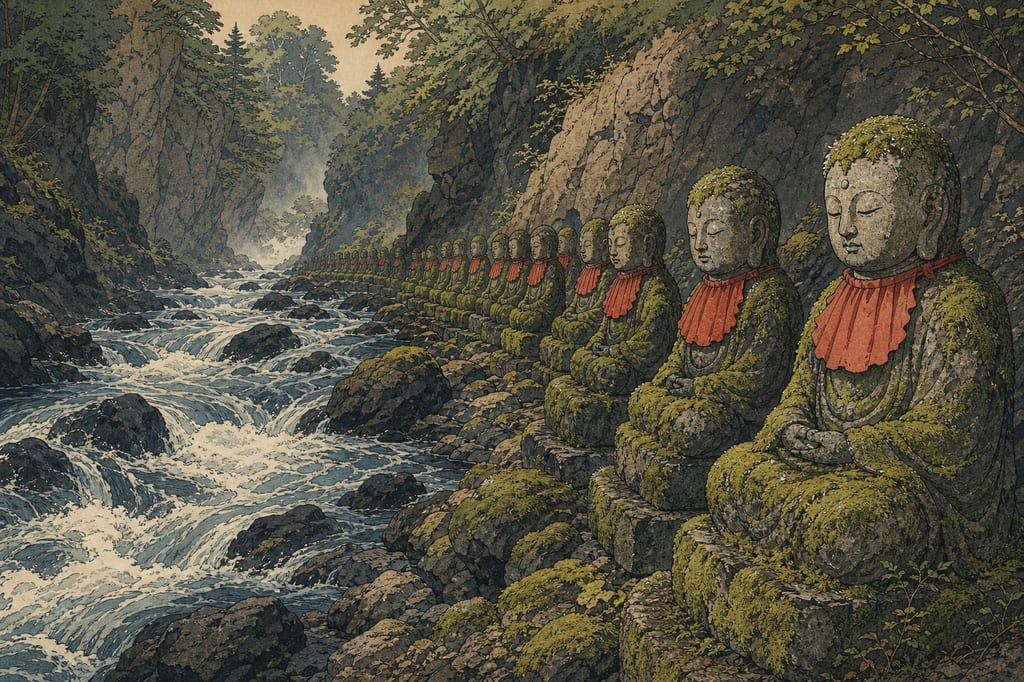
Originally, there were said to be around one hundred of these statues. However, many were washed away during the Daiya River's flooding caused by the Ashio Typhoon of 1902, leaving approximately seventy statues today. The reality behind the "uncountable" anomaly likely stems from the disrupted arrangement caused by this disaster and subsequent restorations. The prominently large statue sitting at the head of the row is called the "Parent Jizō," and local lore playfully suggests that the numbers never match because this parent hides or multiplies its "children." Yet, people saw something far beyond a mere counting error—they perceived the taboo of the sacred site: "You must not count them," and "They cannot be counted." The gorge's name originates from "Kanman," the ending of Fudō Myōō's mantra, and Sanskrit characters supposedly carved by Kōbō Daishi grace the opposite rock wall, signifying that the entire abyss has been a holy sanctuary since ancient times. Causing no harm, enacting no curses, but simply distorting numbers—the Bake-Jizō are the quietest and most enigmatic of Tochigi's supernatural phenomena. The very mystery of being uncountable was the proof of the land's sacred nature.
Volcanoes and Sacred Peaks — Why Is Shimotsuke Filled with Yōkai?
The common thread weaving through Tochigi's yōkai lore is its dual nature of volcanoes and sacred mountains.
Mount Nasu in the north remains an active volcano, its vents still billowing smoke. Reeking of sulfur, the barren expanse around the Sesshō-seki has been compared to hell or the purgatorial banks of the Sanzu River. The visible landscape of death—where volcanic gases literally claim the lives of animals—gave birth to the story of a nine-tailed fox turning into a poison-spewing rock. Conversely, just a stone's throw from this deadly vista lies Shikanoyu (Deer's Bath) in Nasu Yumoto, an ancient hot spring supposedly discovered when a wounded deer was seen soaking in its healing waters. A venomous stone that takes life and a sacred spring that restores it rest side by side. The volcanoes of Nasu are lands embodying the duality of death and rebirth. Explaining the terrifying forces of nature as the vengeful grudge of a slain demon fox reveals an ancient human coping mechanism—using stories to make sense of incomprehensible natural phenomena.
Meanwhile, Nikkō in the western part of the prefecture is a massive center of mountain worship anchored by Mount Nantai and Mount Nyohō. The very name Nikkō is said to derive from Fudaraku (Potalaka), the mythical pure land of the Bodhisattva Kannon. The mountains were originally called "Futara," which was read in its Sino-Japanese pronunciation as "Nikō," and eventually given the auspicious characters for "Nikkō" (sunlight). It is said that Shōdō Shōnin first conquered the summit of Mount Nantai in 782, and ever since, under the syncretism of Shinto and Buddhism, the mountain has flourished as the heart of Futarasan worship—a sacred netherworld where ascetic monks ventured. Gods transforming into serpents and centipedes to war over a lake, Tengu residing in the peaks of Kobugahara, and monster cats lurking in the spiritual heights of Mount Kōshin—these horrors were born from the unfathomable depths of the sacred mountains that ordinary people hesitated to enter. Between the dead volcanic landscapes and the profound sanctity of the holy peaks, the yōkai of Tochigi have found their dwelling.
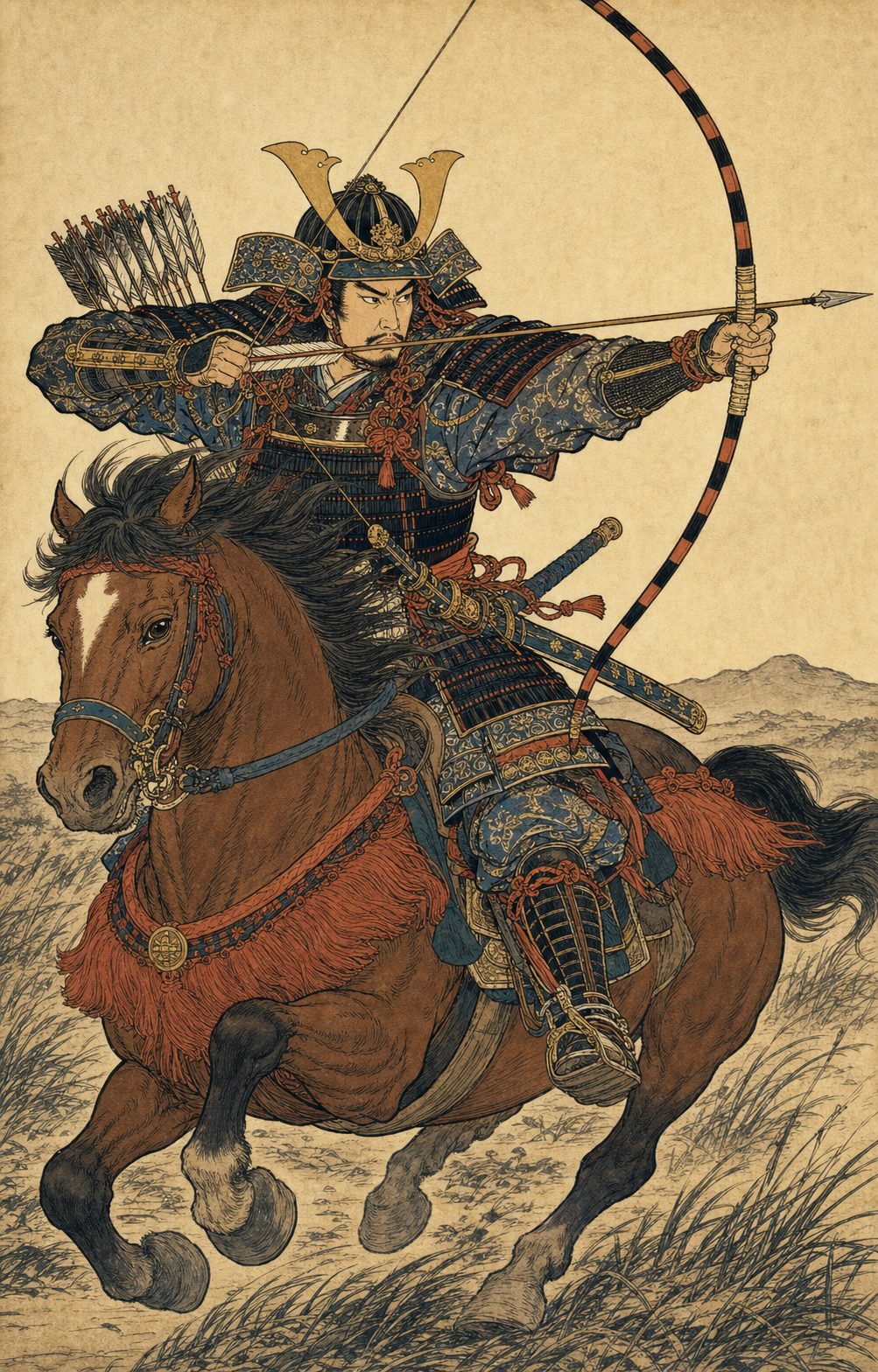
Additionally, Shimotsuke was the homeland of the Bandō warriors. The legends of Tawara Tōda (Fujiwara no Hidesato), who suppressed Taira no Masakado's rebellion, spanned across the eastern provinces—from slaying the Giant Centipede at Mount Mikami in Ōmi to shooting down the Dodomeki in Shimotsuke. Shimotsuke was Hidesato's stronghold and a heartland of Bandō warriors highly skilled in mounted archery. That the encirclement hunts at Nasuno are considered the origin of *inuōmono* archery, and that Hidesato shoots down demons—the recurring motif of the bow and arrow in Tochigi's monster-slaying tales exists entirely because of this martial heritage. Where volcanoes, sacred mountains, and samurai converge, the yōkai culture of Shimotsuke bursts into bloom.
While neighboring Gunma bore the role of the "defeated god" as the centipede of Mount Akagi, and Ōmi had a human hero vanquish the centipede, Shimotsuke exalted the serpent of Mount Nantai as the "victorious god." The same motif of a serpent and a centipede was passed down across provinces, switching the victor and the vanquished depending on the region. Standing at the nexus of these cross-pollinating tales was Shimotsuke, a land blessed with both volcanoes and sacred peaks. Whether it is the Nine-Tailed Fox, the Great Serpent and Giant Centipede, or the Dodomeki—these stories refuse to be confined to a single locality. Instead, they weave threads with nationwide folklore, laying deep roots in the specific topographies of Nasu and Nikkō. To read the yōkai of Tochigi is, in essence, to read the vast tapestry of Japanese yōkai lore itself.
Raijū and Karasuyama — Monsters Descending to the Villages
Alongside the grandiose horrors of sacred mountains and volcanoes, quieter mysteries have been whispered in the villages of Tochigi.
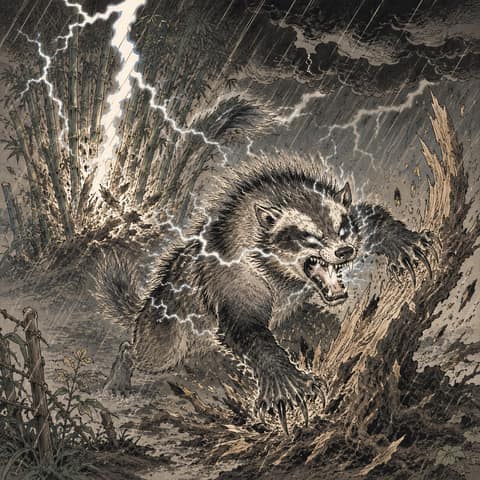
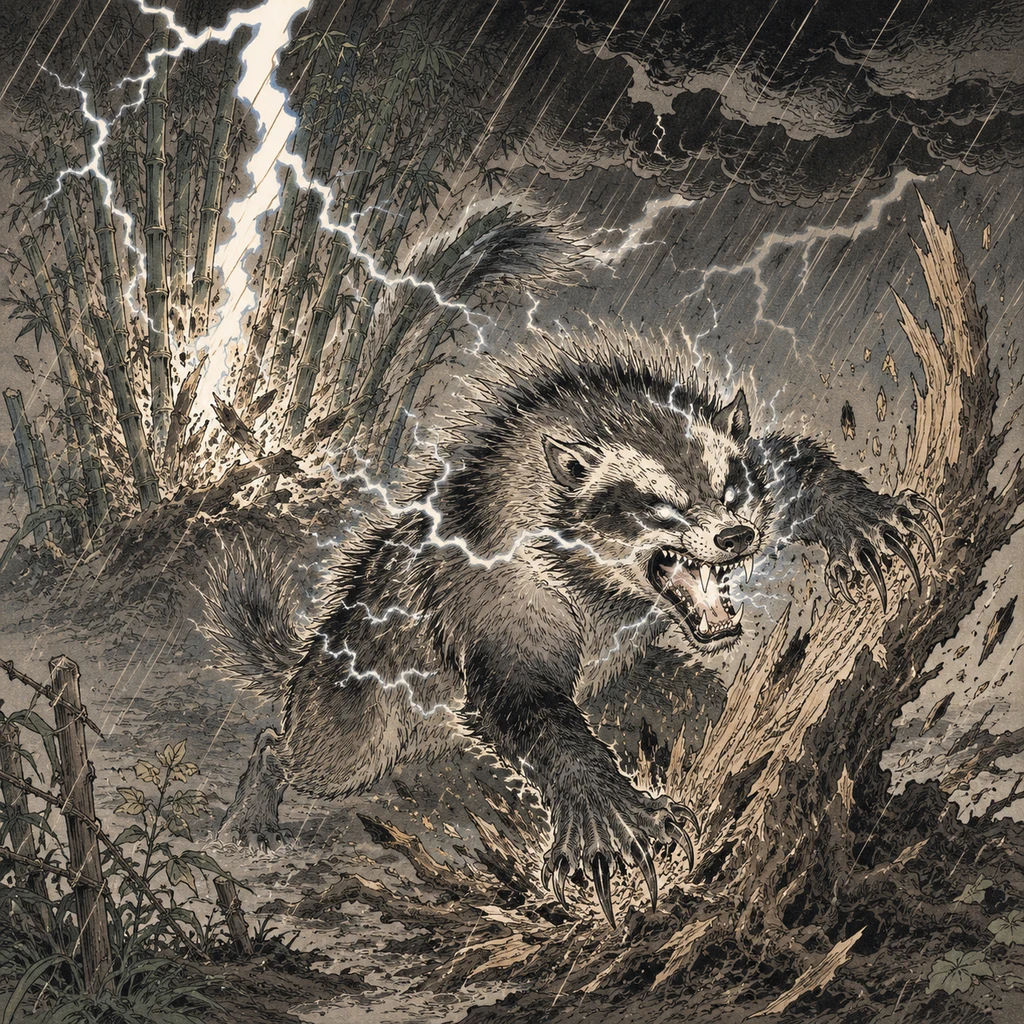
The Raijū (Thunder Beast), a yōkai that plummets from the heavens alongside lightning strikes, is widely documented across eastern Japan, but Tochigi possesses specific sites attached to its lore. The Edo-period essay collection *Hokusō Sadan* contains a description of a Raijū[6] that supposedly appeared in Karasuyama, Shimotsuke Province (modern-day Nasukarasuyama City). It was described as resembling a rat but larger than a weasel, possessing sharp claws and a forked tail, appearing with thunderstorms to leave deep gouges in trees. The belief that thunder is caused by a heavenly beast is ancient; sometimes, rare animals caught near lightning-struck trees were even exhibited in sideshows as "Raijū." Edo-period natural history books and essays depicted it variously as a small beast akin to a marten, raccoon dog, or weasel. The Raijū of Karasuyama was an anomaly spun from tangible evidence—the actual claw marks villagers found on trees after a severe storm. Because Tochigi is a land of towering mountains that beckon storm clouds, tales of beasts falling with the thunder carried a visceral, undeniable weight. While the Raijū is not entirely unique to Tochigi, the fact that its lore is anchored to a specific locale like Karasuyama grants a sense of authenticity to the province's village folklore.
The Nine-Tailed Fox of Nasuno, the Great Serpent and Giant Centipede of Oku-Nikkō, the Dodomeki of Utsunomiya, the Tengu of Kobugahara, the Nekomata of Mount Kōshin, the Bake-Jizō of Kanmangafuchi, and the Raijū of Karasuyama—the yōkai of Tochigi wear the very faces of the nature and history of this land where volcanoes, sacred peaks, and samurai intersect. Envisioning a poisonous stone in a smoking volcano, seeing serpents and centipedes in the clashing of gods over a lake, finding the Buddha's salvation for a slain demon, and reading the taboos of a sacred site in uncountable statues—the countless stories woven by the people of Shimotsuke in their awe and prayers continue to breathe within the mountains and rivers of this prefecture today.