Nekomata
neh-koh-MAH-tah
Split-Tailed Old Cat Nekomata
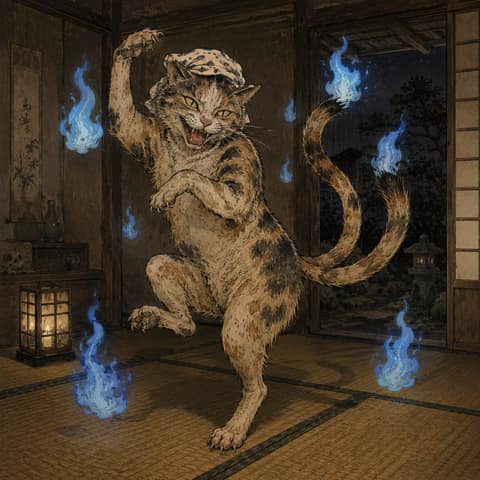
The form of a cat kept in a human home for many years, aging until its tail splits into two, thereby "ascending" to acquire the power to speak and manipulate ghostly flames. Discarding the "mountain beast" aspect spoken of for the species as a whole, this is an interpreted version that maximizes its nature as a "house yokai" (kayou) sharing living space with humans. In this version, the Nekomata is said to stand on its hind legs late at night, place a towel on its head, and dance wildly in the shadows of the hearth. This bizarre dance, originating from the depiction in Toriyama Sekien's "Gazu Hyakki Yagyo", added a somewhat comical and human-like charm to what was originally a terrifying monster cat legend. Furthermore, this Nekomata skillfully mimics the faces and voices of people to deceive family members. It often takes the form of an old woman, which is sometimes interpreted as a projection of the power and underlying intimidation of the matriarch who managed the household for years, superimposed onto the image of an old cat. The folklore presents a clear duality: if the homeowner treats the cat roughly or kills it unreasonably, it becomes a vindictive curse deity, setting ghostly fires (Nekomata fire) in the house and ruining the family lineage. On the other hand, a carefully cherished Nekomata uses its demonic powers to "protect the house." As depicted in works like Sawaki Suushi's "Hyakkai Zukan", there are benevolent tales of them shapeshifting into a shamisen-playing geisha to save a benefactor in a crisis, or using their demonic fire to intimidate and burn away other evil spirits or diseases (impurity) attempting to enter the home. To them, the split tail is not merely a sign of monstrosity; one tail serves as an antenna symbolizing "gratitude (or resentment) toward humans," and the other symbolizes "the demonic nature of a beast."