Nekomata

neh-koh-MAH-tah

Nekomata

Nekomata

This form can walk with you as your companion. Pick a portrait and make it your icon.

Basic Description

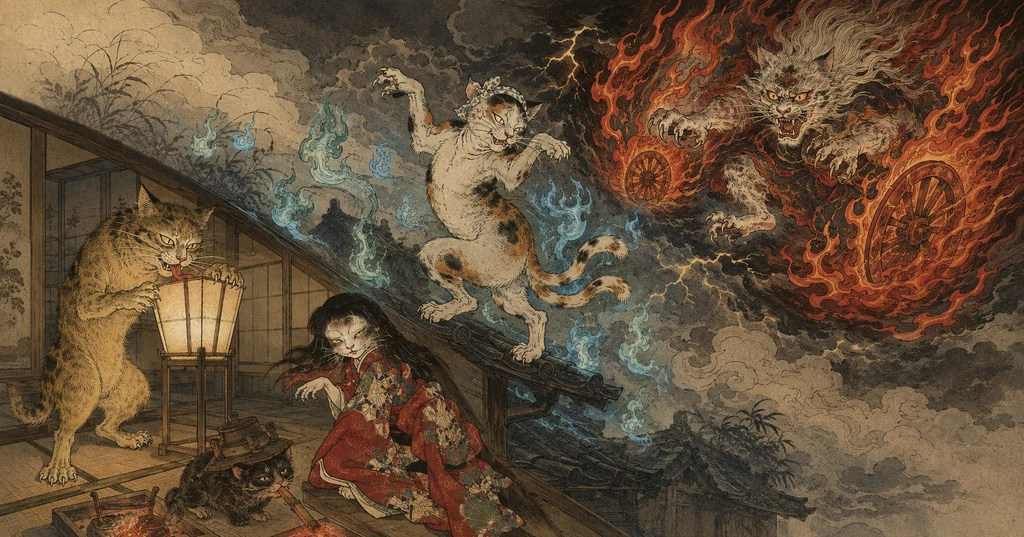
Nekomata is one of the most widely known and complexly evolved supernatural beings in Japanese folklore. Its form is depicted either as a beast that has grown gigantic over the years, or as a monstrous cat with a tail split into two. There are two distinct lineages for the concept of this yokai: one is the "terrifying beast Nekomata living in the mountains," seen in Kamakura period literature, and the other is the "Nekomata as a house yokai, an old cat kept in a home for many years that transforms," which became established from the Edo period onward. In Japanese folk belief, cats are often seen as entities concealing demonic or spiritual powers, and the awe of a creature crossing that boundary crystallized into the image of this two-tailed yokai.

Folklore & Legends

The oldest reliable record of Nekomata is an entry from the first year of Tenpuku (1233) in the diary "Meigetsuki" by the early Kamakura poet Fujiwara no Teika. It notes that "in Nanto (Nara), a wild beast called Nekomata devoured and killed people," describing its appearance as "having eyes like a cat and a body as large as a dog." At that time, the fear of unknown fierce beasts lurking in the mountains (such as rabid animals or wild dogs) was spoken of as the "mountain Nekomata." Later, in Yoshida Kenko's "Tsurezuregusa" (Essays in Idleness) (Section 89), alongside rumors of man-eating Nekomata in the mountains, a popular belief is introduced that "a house cat kept for a long time will transform into a Nekomata." This suggests that the perception of "house cats turning into monsters (yokai)" began to spread around this time.

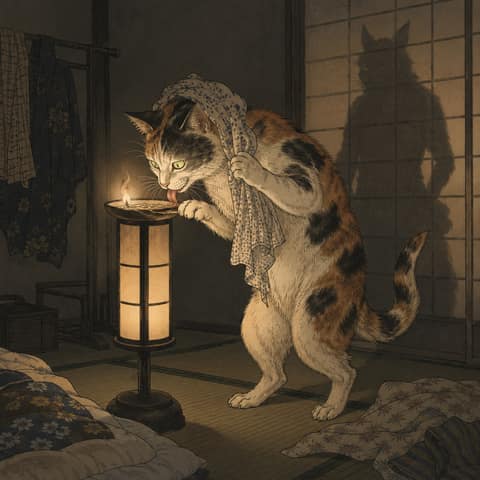
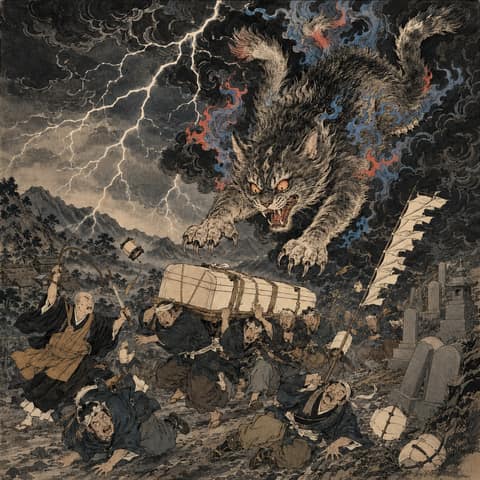
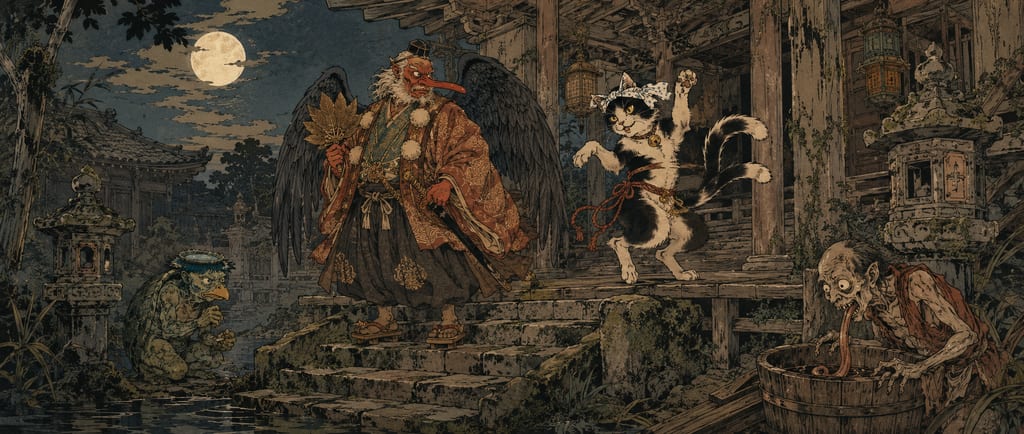
Entering the Edo period, with urbanization, the object of fear shifted from the wilderness to the everyday house, and the Nekomata became fully established as "an old cat kept for a long time whose tail splits into two, causing supernatural phenomena." In collections of strange tales such as the "Yamato Kaiiki", stories of old cats shapeshifting into humans, speaking human words, and manipulating ghostly flames (Nekomata fire) appear frequently. Additionally, they were often confused with the "Kasha" (a messenger of hell in Buddhism), leading to widespread nationwide legends of them appearing at funerals to snatch away the corpses of the dead. Consequently, in some regions, taboos arose saying "do not keep a cat for more than three years," as well as customs of cutting kittens' tails short to prevent them from transforming (one of the origins of the bent-tail cat). Iconographically, Toriyama Sekien's "Gazu Hyakki Yagyo" (1776), which depicted a two-tailed cat standing on its hind legs in front of a shoji screen and dancing with a towel on its head, became the definitive visual representation of the Nekomata that continues to the present day. According to folklorist Kazuhiko Komatsu in his "Basic Knowledge of Yokaiology", the Nekomata projects the fundamental human awe toward the "boundary-crossing" and dual nature of the cat—an animal that is "a tame pet during the day but reverts to a wild predator at night."

Yokai Cards3

Nekomata across multiple art-style decks

Card gallery

Detailed Analysis

2 different forms of Nekomata have been confirmed. Each has unique characteristics and personality, with various ways of interacting with people. Details of each form are introduced below.

Split-Tailed Old Cat Nekomata

To explain Split-Tailed Old Cat Nekomata in detail:

The form of a cat kept in a human home for many years, aging until its tail splits into two, thereby "ascending" to acquire the power to speak and manipulate ghostly flames. Discarding the "mountain beast" aspect spoken of for the species as a whole, this is an interpreted version that maximizes its nature as a "house yokai" (kayou) sharing living space with humans.

In this version, the Nekomata is said to stand on its hind legs late at night, place a towel on its head, and dance wildly in the shadows of the hearth. This bizarre dance, originating from the depiction in Toriyama Sekien's "Gazu Hyakki Yagyo", added a somewhat comical and human-like charm to what was originally a terrifying monster cat legend. Furthermore, this Nekomata skillfully mimics the faces and voices of people to deceive family members. It often takes the form of an old woman, which is sometimes interpreted as a projection of the power and underlying intimidation of the matriarch who managed the household for years, superimposed onto the image of an old cat.

The folklore presents a clear duality: if the homeowner treats the cat roughly or kills it unreasonably, it becomes a vindictive curse deity, setting ghostly fires (Nekomata fire) in the house and ruining the family lineage. On the other hand, a carefully cherished Nekomata uses its demonic powers to "protect the house." As depicted in works like Sawaki Suushi's "Hyakkai Zukan", there are benevolent tales of them shapeshifting into a shamisen-playing geisha to save a benefactor in a crisis, or using their demonic fire to intimidate and burn away other evil spirits or diseases (impurity) attempting to enter the home. To them, the split tail is not merely a sign of monstrosity; one tail serves as an antenna symbolizing "gratitude (or resentment) toward humans," and the other symbolizes "the demonic nature of a beast."

Character Profile

This section is our own creative profile for storytelling. It is not historical fact or scholarship.

Rarity
Legendary
Personality
Fickle and vindictive, yet repays its debts of gratitude
Compatibility
Compatible with those who show modesty and courtesy; loathes those who treat it roughly
Abilities
Ignites ghostly flamesUnderstands human speech and shapeshifts into a humanManipulates shadows and presenceSoothes diseases and impurities
Weaknesses
Weakened by Shinto prayers and Buddhist sutras, loses power if its tail is tied, avoids strong dogs
Habitat
Around the tatami rooms of private houses, barns and hearthsides, alleys and shrines precincts

🔮Yokai Compatibility Test

For more detailed information and diagnosis results about Split-Tailed Old Cat Nekomata, please click here.

Hearth-Guarding Old Nekomata

To explain Hearth-Guarding Old Nekomata in detail:

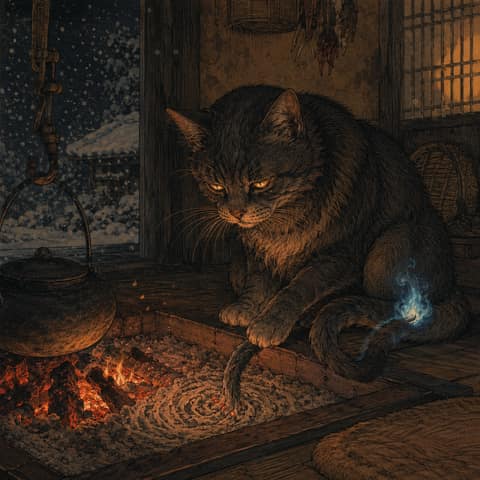
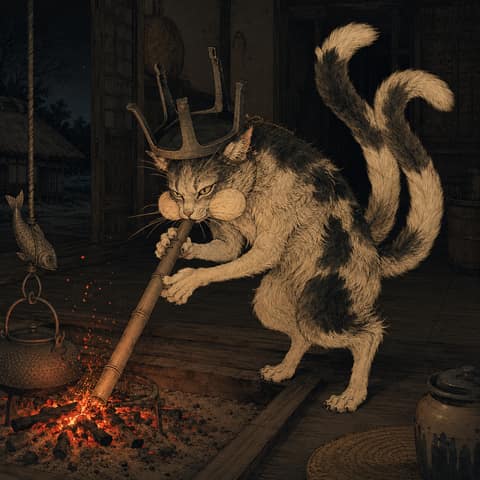
The Hearth-Guarding Old Nekomata is a version of a cat that has been kept in one place for many years, growing old by the hearth stained with soot and ash, until one night it suddenly manifests with a tail split in two. Positioned at the opposite extreme from the violent Nekomata that attacks humans in the mountains (as noted in texts like "Meigetsuki"), this being inhales the breath of the house and its generations of life, absorbing the spirit of fire and cooking smoke, and thus behaves much like a household deity (or Zashiki-warashi). While it is an extension of the folk belief that "a pet cat transforms" cited in "Tsurezuregusa", it carries a much more protective nature. Even without using human words, it signals by clinking the pot lid or drawing patterns in the ash. The pale ghostly fire (Nekomata fire) that darts in the corner of the parlor late at night is not a curse fire to be feared as in "Yamato Kaiiki", but is rather considered a purifying mark where this old Nekomata preemptively licks away the house's fire hazards and burns off evil energies. In some villages, it is believed that one tail connects "the lineage of the family" and the other "the divine spirit of fire," making the split not a mere deformity but a sacred sign holding dual duties.

The Old Nekomata always draws near when the family gathers around a corpse. There is a common fear that cats resurrect the dead, often causing confusion with the Kasha (the monster cat depicted snatching corpses in works like "Gazu Hyakki Yagyo"). However, this version never causes a disturbance; it merely sniffs the ragged breath with its nose and lights a small spark to dispel lingering earthly attachments. Therefore, the proper etiquette is for the family not to brandish blades before the Nekomata, but instead to burn a single stick of incense as a "farewell fire." If a long-kept cat is treated roughly, the stove will burn empty in the dead of night, and overlapping wet footprints will appear on the walls. Conversely, in homes that mourn respectfully, folklore akin to the "urban legends" pointed out by Kunio Yanagita survives: on a snowy morning, only the space under the shoji is warm, and the shadows of mice vanish entirely from the rice bin.

This version is sometimes spoken of as an old cat that once disappeared into the mountains returning out of longing for the house, or as an old indoor cat whose tail split naturally over time. The custom of cutting tails to prevent transformation (the origin of the bent-tail cat) also exists, but in areas protected by the hearth-guard, this is taboo, with strict warnings that "injuring the tail will also split the family's fortunes." In appearance, its back skin droops to look like a cloak, casting a shadow-like figure in dimly lit rooms. This is why it is mistakenly thought to shapeshift into the dead, but the Old Nekomata dislikes unnecessary transformation. When it occasionally borrows the appearance of a grandmother, it is only to lull a child to sleep, making no sound and leaving behind only the scent of soot and ash.

Though it does not show itself to travelers, during milestones of the house—such as taking in a groom or the first night in a newly built home—it taps its claws lightly under the floorboards to foretell fortunes. Three taps mean good luck; two mean beware of fire. If the lamp wick is damp, it smoothes it with its tongue; if the stove fire is too strong, it fans it weaker with its tail. In exchange for taking on these small daily troubles, a custom remains for the family to share the "edges of the meal" with it. Three grains of rice, a pinch of salt, and a little steam. As long as these are observed, the Nekomata will not bewilder humans, and the strange noises at night will be dismissed as mere "house creaks."

Character Profile

This section is our own creative profile for storytelling. It is not historical fact or scholarship.

Rarity
Legendary
Personality
Quiet and dutiful, sensitive to the manners of the family. Highly vigilant at night, gently watches over during the day.
Compatibility
Homeowners who do not waste old tools and cherish fire and food, and those who respect and mourn animals.
Abilities
Controls ghostly fires and erases omens of fire hazardsDivination of people's feelings by drawing patterns in the ashThorough extermination of mice and pestsThins its shadow and melts into floorboards or beamsLights faint farewell fires to soothe lingering attachments at funerals
Weaknesses
Hates households that handle blades recklessly or waste fire, loses affection for the house if its tail is intentionally cut, its power dulls in wastelands lacking moisture
Habitat
Around the hearths of old folk houses from Tohoku to the San'in region, the stoves or earthen floor beams of townhouses, old homes extending from quiet back alleys

🔮Yokai Compatibility Test

For more detailed information and diagnosis results about Hearth-Guarding Old Nekomata, please click here.

Sources & References

6
  1. 明月記藤原定家((鎌倉前期・日記), 1180-1235) [古典文献]藤原定家の日記。天福元年(1233)8月2日条に、南都で人を害したという「猫胯(ねこまた)」の獣の記事が見え、猫又の語の早い用例とされる。
  2. 徒然草(第十九段)吉田兼好((随筆/煙々羅詞書の典拠とされる、近藤瑞木の指摘), 14世紀前半(鎌倉末〜南北朝期)) [古典文献]
  3. 大和怪異記未詳(江戸期の怪談集, 1708) [古典文献]
  4. 画図百鬼夜行鳥山石燕(安永5年(1776年)) [図像資料]
  5. 妖怪学の基礎知識小松和彦(角川学芸出版, 2011) [学術文献]
  6. 百怪図巻佐脇嵩之(元文2年(1737年)) [図像資料]江戸中期(1737年)成立、佐脇嵩之による全30体の妖怪図を収めた標準的妖怪絵巻。後世の妖怪画研究における重要資料。

Interested in this type of yokai?

Discover the yokai most similar to your personality with our yokai diagnosis

Start Yokai Diagnosis

Meet your guardian yokai at the shrine

Draw an omikuji fortune and discover the yokai watching over you today.