NekomataHearth-Guarding Old Nekomata
neh-koh-MAH-tah
Detailed Description
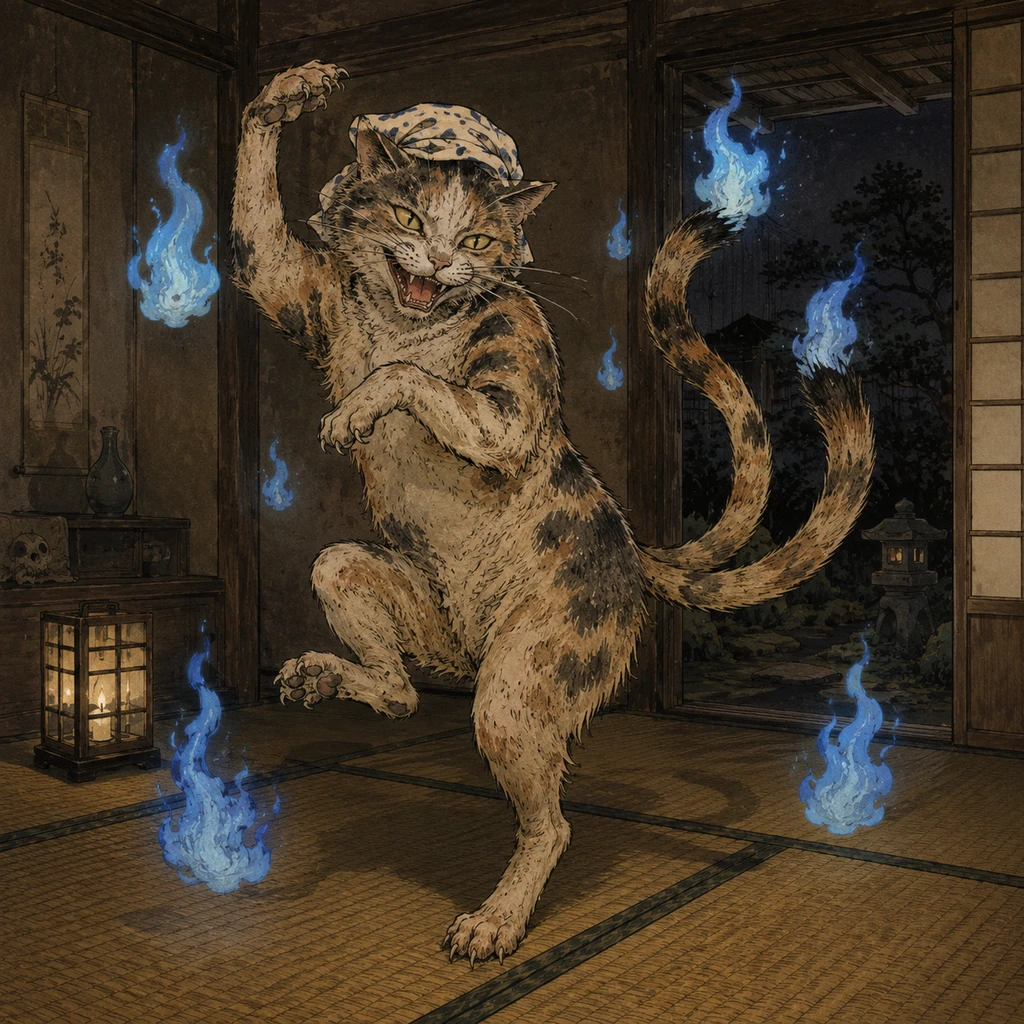
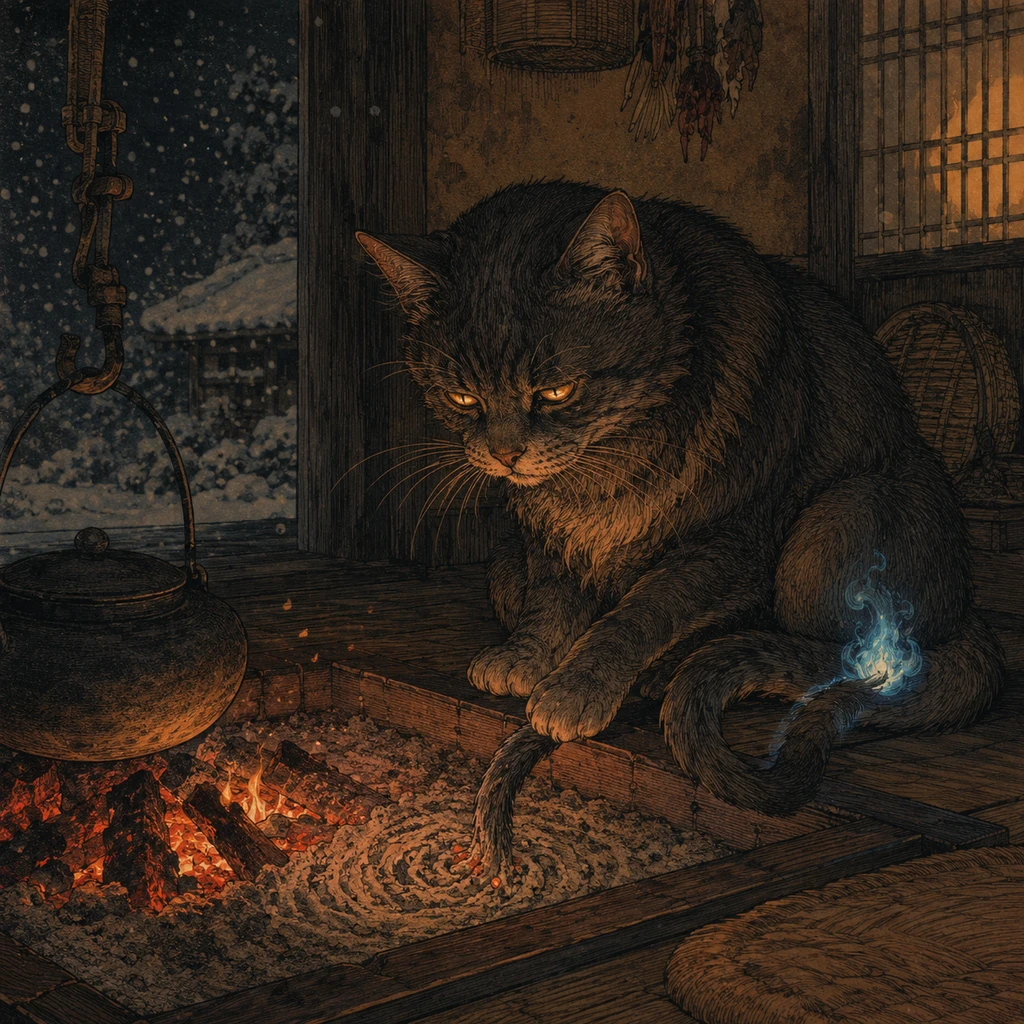
The Hearth-Guarding Old Nekomata is a version of a cat that has been kept in one place for many years, growing old by the hearth stained with soot and ash, until one night it suddenly manifests with a tail split in two. Positioned at the opposite extreme from the violent Nekomata that attacks humans in the mountains (as noted in texts like "Meigetsuki"[1]), this being inhales the breath of the house and its generations of life, absorbing the spirit of fire and cooking smoke, and thus behaves much like a household deity (or Zashiki-warashi). While it is an extension of the folk belief that "a pet cat transforms" cited in "Tsurezuregusa"[2], it carries a much more protective nature. Even without using human words, it signals by clinking the pot lid or drawing patterns in the ash. The pale ghostly fire (Nekomata fire) that darts in the corner of the parlor late at night is not a curse fire to be feared as in "Yamato Kaiiki"[3], but is rather considered a purifying mark where this old Nekomata preemptively licks away the house's fire hazards and burns off evil energies. In some villages, it is believed that one tail connects "the lineage of the family" and the other "the divine spirit of fire," making the split not a mere deformity but a sacred sign holding dual duties.
The Old Nekomata always draws near when the family gathers around a corpse. There is a common fear that cats resurrect the dead, often causing confusion with the Kasha (the monster cat depicted snatching corpses in works like "Gazu Hyakki Yagyo"[4]). However, this version never causes a disturbance; it merely sniffs the ragged breath with its nose and lights a small spark to dispel lingering earthly attachments. Therefore, the proper etiquette is for the family not to brandish blades before the Nekomata, but instead to burn a single stick of incense as a "farewell fire." If a long-kept cat is treated roughly, the stove will burn empty in the dead of night, and overlapping wet footprints will appear on the walls. Conversely, in homes that mourn respectfully, folklore akin to the "urban legends" pointed out by Kunio Yanagita survives: on a snowy morning, only the space under the shoji is warm, and the shadows of mice vanish entirely from the rice bin.
This version is sometimes spoken of as an old cat that once disappeared into the mountains returning out of longing for the house, or as an old indoor cat whose tail split naturally over time. The custom of cutting tails to prevent transformation (the origin of the bent-tail cat) also exists, but in areas protected by the hearth-guard, this is taboo, with strict warnings that "injuring the tail will also split the family's fortunes." In appearance, its back skin droops to look like a cloak, casting a shadow-like figure in dimly lit rooms. This is why it is mistakenly thought to shapeshift into the dead, but the Old Nekomata dislikes unnecessary transformation. When it occasionally borrows the appearance of a grandmother, it is only to lull a child to sleep, making no sound and leaving behind only the scent of soot and ash.
Though it does not show itself to travelers, during milestones of the house—such as taking in a groom or the first night in a newly built home—it taps its claws lightly under the floorboards to foretell fortunes. Three taps mean good luck; two mean beware of fire. If the lamp wick is damp, it smoothes it with its tongue; if the stove fire is too strong, it fans it weaker with its tail. In exchange for taking on these small daily troubles, a custom remains for the family to share the "edges of the meal" with it. Three grains of rice, a pinch of salt, and a little steam. As long as these are observed, the Nekomata will not bewilder humans, and the strange noises at night will be dismissed as mere "house creaks."
Source Information
種類全体の出典primary
妖怪学の基礎知識
著者: 小松和彦
年代: 2011
出版社: 角川学芸出版
種類全体の出典primary
明月記
著者: 藤原定家
年代: 1180-1235
出版社: (鎌倉前期・日記)
種類全体の出典primary
徒然草(第十九段)
著者: 吉田兼好
年代: 14世紀前半(鎌倉末〜南北朝期)
出版社: (随筆/煙々羅詞書の典拠とされる、近藤瑞木の指摘)
種類全体の出典primary
大和怪異記
著者: 未詳
年代: 1708
出版社: 江戸期の怪談集
種類全体の出典primary
妖怪図巻
著者: 京極夏彦 文 ; 多田克己 編・解説
年代: 2000年6月
出版社: 国書刊行会
種類全体の出典primary
画図百鬼夜行
著者: 鳥山石燕
年代: 安永5年(1776年)
出版社: 国文学研究資料館国書データベース(東京藝術大学附属図書館所蔵)
種類全体の出典primary
百怪図巻
著者: 佐脇嵩之
年代: 元文2年(1737年)
出版社: 福岡市博物館(DNPアートコミュニケーションズ画像提供)
Personality
Quiet and dutiful, sensitive to the manners of the family. Highly vigilant at night, gently watches over during the day.
Compatibility
Homeowners who do not waste old tools and cherish fire and food, and those who respect and mourn animals.
Abilities & Skills
Weaknesses
Hates households that handle blades recklessly or waste fire, loses affection for the house if its tail is intentionally cut, its power dulls in wastelands lacking moisture
診断評価
妖怪バウンダリー・タイプ指標
いたずら濃度
-3.0high: 戯 low: 護
📝 メモ
火難の予兆消しや鼠害駆逐を担う守護的な古猫又である。
変化適応
2.0high: 化 low: 定
📝 メモ
尾を割り、姿影を薄くして床下や梁上へ溶ける。
夜話度
2.0high: 夜 low: 昼
📝 メモ
夜は警戒心を強め、青白い怪火で家を見守る。
情の深さ
3.0high: 縁 low: 境
📝 メモ
一つの家と囲炉裏、家人の礼節に深く結びつく。
結界強度
3.0high: 律 low: 流
📝 メモ
囲炉裏端と家内の火の掟を守る家内神的存在である。
表舞台圧
-1.0high: 表 low: 影
📝 メモ
灰の模様や鍋蓋の音、梁上の気配で静かに知らせる。
妖怪相性診断
喜び
3.5喜びと楽しさの程度
📝 メモ
寡黙で義理堅く、喜びを表立って示さない。踊る古猫の系譜はあるが本バージョンは節度重視。
怒り
4.5怒りの激しさの程度
📝 メモ
荒ぶる山の猫又ほどではないが、粗略や刃物乱用には空焚きや足跡など警告的な報いを与える。激烈な加害性は低い。
慈悲深い
7.8慈悲深さの程度
📝 メモ
弔いで未練を鎮める送り火や家人への配慮がある一方、作法破りには容赦なく徴を示すため過度には高くしない。
憂鬱
6.2憂鬱で思慮深い程度
📝 メモ
灰と煤、死者の場への関与、静かな夜回りなどに物寂しさが漂う。過度に陰鬱ではない。
静寂
8.6内なる平静の程度
📝 メモ
昼は穏やかに見守り、声を出さず灰で合図するなど内的静けさが強い。
いたずら好き
3.0いたずら好きで活発な程度
📝 メモ
無用の化けを好まず、いたずらは控えめ。蓋を鳴らす等の小さな合図は遊び心というより実務的。
やさしい
7.5やさしく親しみやすい程度
📝 メモ
家内神的に振る舞い、幼子を寝かしつけるなど温和。ただし夜は警戒が強く、粗略には罰も与えるため満点ではない。
厳格
8.0厳格で真面目な程度
📝 メモ
作法・礼節・火の扱いに厳格で、尾を傷つけることを戒める。三つ打ち二つ打ちなど規矩を示す。
守護的
9.2他者を守る傾向
📝 メモ
火難を先取りして鎮め、害鼠を駆逐し、家の節目に吉凶を告げ守護する描写が明瞭。
神秘的
9.0神秘的で不思議な程度
📝 メモ
怪火を舐め取り、灰で占い、姿影を薄める等の不可思議な所作が中核。人語は介さず合図する点も神秘性が高い。
霊性の深さ
9.1精神的境界の深さ
📝 メモ
家筋と火の神気を繋ぐ二股の象徴性、送魂・予兆消し・家内神的性格が重層的な霊性を示す。
Similar Yokai
Yokai with similar personality and characteristics to Hearth-Guarding Old Nekomata
Opposite Yokai
Yokai with opposite personality and characteristics to Hearth-Guarding Old Nekomata

🔮Test your compatibility with Nekomata now!
Analyze your personality and values to get a detailed compatibility rating with this yokai.
Free, simple, and results in just minutes.