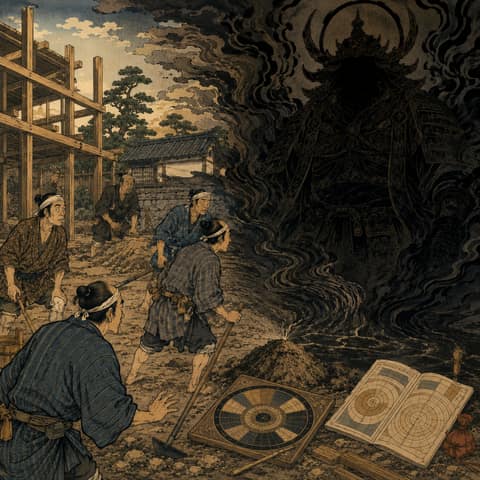
Nationwide (across Japan)ぜんこく
62 yokai rooted in Nationwide (across Japan). Explore the legends tied to this land.

神格 Treasure Ship
TAH-kah-rah-boo-neh
Traditional Version (Treasure Ship Print)
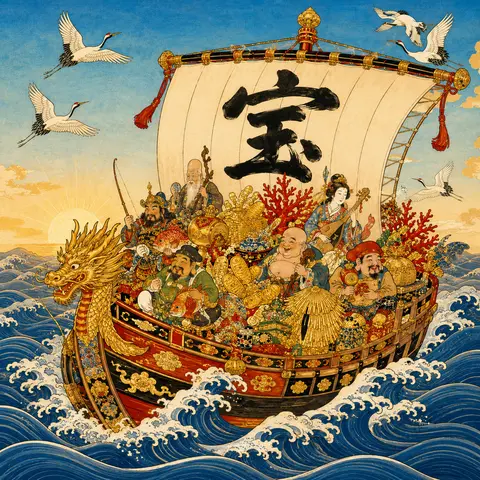
Deities & Divine SpiritsAcross JapanThe Treasure Ship print traces back to boat images used to cast off bad dreams, circulated through urban and temple–shrine annual events. By the early modern period, designs commonly featured the Seven Lucky Gods and heaps of treasures, with auspicious characters on the sail to amplify good omens. Appending a palindrome verse tied it closely to first-dream traditions, preserving the logic of keeping a good dream and consigning a bad one to the river. While designs vary by region and publisher, the print uniquely combines two layers of meaning: inviting fortune and transferring or dispelling impurity. Folklorically, it links to New Year’s purification from year’s end through the first week, backed by its spread as an urban print commodity, ties to temple and shrine origin tales, and the vogue for Seven Lucky Gods as playful stand-ins.

神格 Ryūjin
Ryūjin (the Dragon God)
Ryujin, Water-God Who Stills the Storm
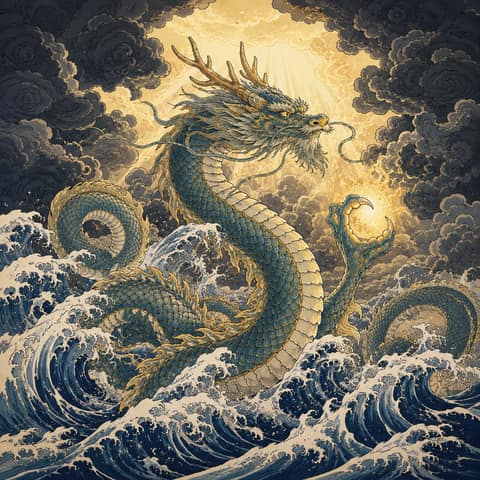
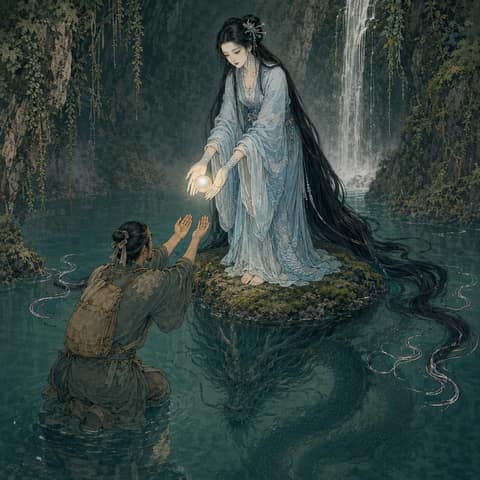
Divine Spirits & DeitiesAll across Japan (the deity who governs the seas, lakes, and great rivers)As the "water-god who stills the storm," Ryujin stands at the border of sea and sky holding the weather in his hands, and it was to him that fishermen, sailors, and the rice-growing folk of the villages prayed most urgently. His power cuts both ways. At times he grants the blessed rain that nourishes the paddies; at times he raises great waves and tempests that shatter ships. For this reason people approached him through many rites, hoping to calm his raging face and draw out his face of blessing. The greatest divine treasures the sea-dragon holds are the tide-flowing and tide-ebbing jewels that command the rise and fall of the tide. Hoori received these two jewels from the sea-god, drowning his elder brother with the flowing jewel and saving him with the ebbing jewel to force his submission. This power to govern the tide at will reveals the very essence of the dragon who rules the sea. At coastal shrines people prayed for storms to subside and for good catches; inland they prayed for rain, offering black horses in drought and sinking offerings into deep pools to court his favor. The legends of human sacrifice handed down at Lake Ashi and at ponds across the land share a single plot — a high priest subdues the raging dragon and turns it into a guardian — telling us that fear and reverence were two sides of one coin. His face as lord of the Dragon Palace is of a piece with this water-divinity. Beyond the sea, on the floor of the waters, the dragon's palace is an otherworld of riches and of time, and one who visits it either gains treasure or, like the one who opened the jeweled box, bears away years that can never be regained. Ryujin is no mere monster but a deity who embodies water itself — the very resource of life and death — and to still the storm was, in the end, to make people keep the fragile covenant drawn between humankind and nature.

伝説 Nurarihyon
Nurarihyon
Supreme Commander Nurarihyon
Half-Human YokaiAcross Japan (Okayama / Supreme Commander)This version represents Nurarihyon as the "Supreme Commander of Yokai," the persona most widely recognized in modern pop culture. The unidentified old man who simply stood silently in the Edo-period *Gazu Hyakki Yagyo* has, through decades of cross-media adaptations, transformed into the absolute mastermind holding the balance of power in the yokai realm. The lore added in the early Showa period—"sneaking into houses unnoticed and acting like the master"—has been sublimated into high-level "abilities" of illusion and mind control, such as "manipulating others' recognition," "completely erasing his presence," or conversely, "dominating the space." The reason he is depicted as so incredibly "strong" in manga, anime, and games is rarely due to mere physical strength or raw demonic power. Instead, his might stems from a charismatic leadership that commands the loyalty of countless yokai, a bottomless cunning that allows him to seamlessly blend into the dark underbelly of human society, and the profound wisdom accumulated over centuries. He is portrayed variously as a cunning arch-nemesis plaguing Kitaro in *Gegege no Kitaro*, a strict and devoted aide supporting Lord Enma in *Yokai Watch*, and an overwhelmingly despair-inducing foe capable of unimaginable transformations (such as a giant female amalgamation or skeleton) in *GANTZ*. The core trait shared across all these works is his elusive, utterly ungraspable nature. Beneath the facade of a mild-mannered old man lies cold, calculating intellect capable of crossing the boundaries between humans and yokai with ease, along with a mysterious charm that ensures his true intentions remain forever hidden. Born from nothingness and grown to colossal proportions by feeding on human imagination, he can truly be called one of the strongest yokai of the modern era.

伝説 Majimun
majimun
The Collective Ryukyuan Demon: Majimun
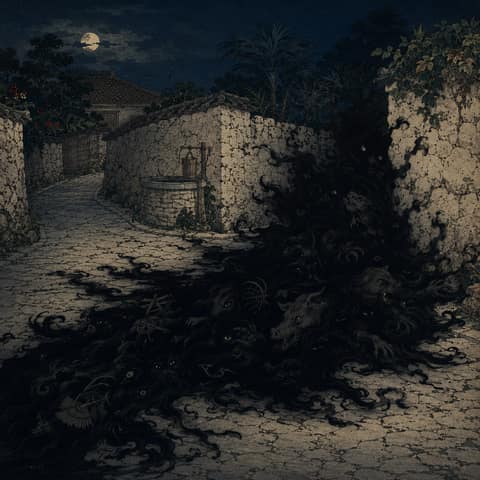
霊・亡霊沖縄·奄美の魔物の総称、特定地点なし(沖縄圏汎存在)"Mamono" vs. "Majimun": Similar Words, Different Worlds. While the basic overview touched upon the shared etymology with the ancient word "Majimono," this deep dive explores how "Majimun," despite sounding akin to the mainland Japanese "Mamono," operates within an entirely different conceptual framework. The mainland "Mamono" is an abstract concept that absorbed the Buddhist and Onmyōdō notion of "Mara" (demons/impediments to enlightenment). In stark contrast, the Ryukyuan Majimun is rooted in the indigenous, pre-Buddhist animism of the southern islands, holistically encompassing nature spirits, ghosts of the dead, localized spirits, and haunted objects. This reflects the historical trajectory of the Ryukyu Kingdom, which received relatively little influence from the centralized Buddhist cultural sphere, thereby preserving its unique religious ecosystem. The Logic of Genesis: "The Generation of Demonic Force". While the mainland Japanese *Tsukumogami* relies on the generative logic that "a tool left for 100 years will have a soul dwell within it," the Ryukyuan object Majimun operates on a more abstract dynamic theory: "demonic force is generated from old objects." This aligns perfectly with the Ryukyuan religious concept of *Seji* (spiritual power), grounded in a worldview where invisible forces inherent in all things manifest under certain conditions. Following Chōei Kinjō's classification, Majimun can be understood as the "photographic negative of Seji"—spiritual power turned malignant. A Structural Analysis of "Crotch-Crawling". The universal Ryukyuan taboo that "you will die if an animal Majimun crawls between your legs" is structurally fascinating. In the schema of the human body, the crotch is a privileged liminal space acting as a "bottom-to-top passageway." For an otherworldly entity to pass through this space signifies an invasion and a violent forced extraction of the soul. While this parallels mainland Japan's spiritual anxieties regarding boundaries like "bridges, crossroads, and borders," Ryukyu is unique in its emphasis on the boundaries of the physical body. In Ryukyuan belief, the *Mabui* (soul) is not fixed to a specific spot but flows in and out; "crotch-crawling" is positioned as a violent connection that forces this extraction. The Epistemological Trait: "Majimun Have No Fixed Form". Surveying the cases in the *Yokai Database*, the greatest characteristic of the Majimun is its "lack of inherent visual form." It is only named by appending "Majimun" to whatever it has possessed or transformed into (a pig, a rice scoop, an infant). There exists no iconographic representation of "Majimun itself." This stands in sharp contrast to mainland Japanese yokai, which, since Sekien Toriyama's *Gazu Hyakki Yagyo* (The Illustrated Night Parade of a Hundred Demons), moved toward solidifying "visual identity as individual characters." Ryukyu retained the Majimun as an abstract concept of "invisible demonic force" until the very end, making it a uniquely challenging subject in comparative yokai studies. Kinjō, Iha, and Orikuchi: The Lineage of Pre-war Okinawan Studies. In the pre-war era, Majimun research blossomed within the broader context of Okinawan Studies. Sparked by Fuyū Iha's *Ko Ryukyu* (Ancient Ryukyu) in 1911, prominent mainland scholars like Shinobu Orikuchi and Kunio Yanagita frequently visited Okinawa, positioning the southern islands' folklore as a vital comparative mirror to the mainland. Chōei Kinjō's yokai treatises were written amid this academic tide, providing a perspective that read the Majimun not merely as a "bizarre Okinawan oddity," but as a "systematic expression of the Ryukyuan concept of the soul." Post-war scholars like Ken'ichi Tanigawa and Kenji Murakami inherited this mantle, shaping the modern discipline of Ryukyuan yokai studies. Systemic Integration with Shisa and Utaki Faith. The Majimun concept does not operate in isolation; it forms a cohesive system with the entirety of Ryukyuan religious culture. Majimun shoulder the "demonic power," while the *Shisa* (guardian lion statues), *Utaki* (sacred groves), *Yuta* (shamans), and *Nuru* (priestesses) shoulder the "sacred power." The symmetry and mutual necessity of these two sides construct the Ryukyuan cosmic order of the sacred and the profane, the pure and the impure, and this world and the next. To study Majimun is directly tied to studying the entire worldview of Okinawan folklore, possessing a cultural anthropological scope far beyond a single monster encyclopedia entry. Modern Legacy: Folkloric Tourism and Entertainment. In post-war Okinawa (and especially after the reversion to Japan), Majimun legends have been adapted into tourism resources, children's books, and manga. They appear in children's literature like *Okinawa no Majimun-zu!* (Border Ink), in exhibits at the Ocean Expo Park's "Native Okinawan Village," and even in mainland exhibitions like the Hyogo Prefectural Museum of History's 2017 showcase on Ryukyuan Yokai. However, because Majimun are inextricably linked to Okinawan living ethics, boundary consciousness, and views on life and death, their consumption in the context of tourism and entertainment demands a respectful attitude toward their profound cultural depths.

伝説 Rokurokubi
ROH-koh-ROH-koo-bee
Hitouban/Nukekubi (Lafcadio Hearn Interpretation)
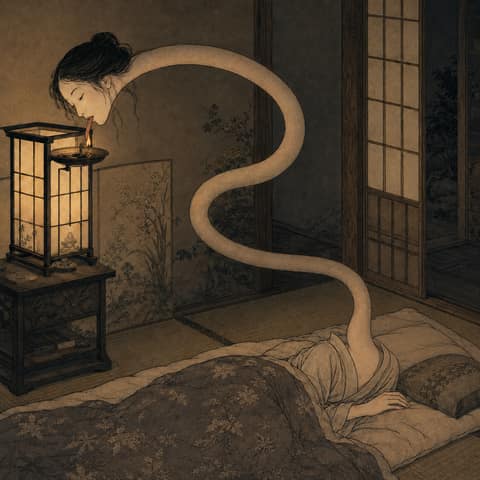
Human-Yokai / Half-Human Half-YokaiAll over Japan -- A human village apparition without a specific locationThis is the interpretation introduced to the world by Lafcadio Hearn, which most strongly inherits the lineage of the Chinese 'Hitouban', presented as a gruesome and ferocious 'nukekubi' (flying head). It completely breaks away from the comical image of the 'neck-stretching ghost' popularized in Edo-period sideshows, positioning it as a terrifying monster that devours human flesh and insects. In this version, the Rokurokubi disguises itself as a perfectly normal human during the day. However, at night, when it falls asleep, only the head detaches from the torso and flies through the air to attack prey. Hidden at the base of the neck are red streaks or eerie scars resembling 'Sanskrit characters' indicating the severance. The body is completely defenseless while the head is away, and if the body is moved to another location during this time, or if the severed surface of the neck is hidden, the returning head will be unable to recombine with the flesh and will fall to the ground and die. Its nature is extremely cruel and deeply vindictive; upon finding prey, it bares its teeth and attacks in swarms. However, at the same time, it possesses the aspect of a pitiful victim burdened with 'deep karma' whose head slips out night after night regardless of their own will. It is the manifestation of magical and psychological horror, where the 'bestiality' and 'uncontrollable repressed passions' lurking within humans escape the cage of the flesh to materialize as physical violence.

伝説 Onryō (Vengeful Spirit)
ohn-RYOH
Goryo Cult
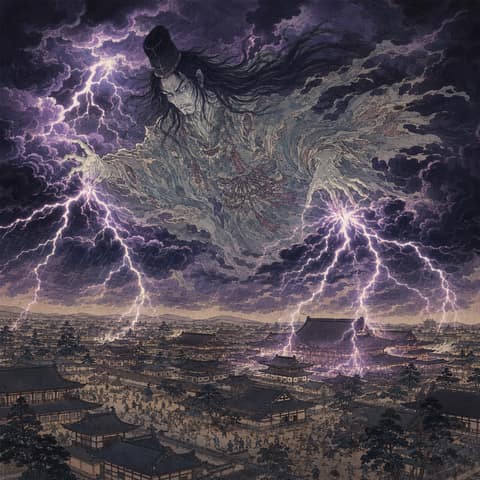
Ghosts & SpiritsAcross JapanA framework that enshrines vengeful spirits as goryo to pacify their curses and turn them into sources of blessing. Epidemics and natural disasters were seen as manifestations of resentment, and reconciliation was sought through founding shrines, conferring divinity, and institutionalizing festivals. Curse deities bear a dual aspect of fear and veneration, and their wild power was believed to transform into communal guardianship through proper requiem rites. Practices ranged from state rituals to village memorials, including era name changes, imperial envoys, Goryo-e, and Hojō-e. For individuals, memorial offerings, sutra copying, nenbutsu, and esoteric prayers were performed, while restoring honor and granting divine ranks were means to ease a spirit’s grievances. Narratives and origin legends explained why resentment arose, giving social memory to causes such as false accusation, untimely death, and broken lineages. A vengeful spirit’s power was not indiscriminate but signaled its intent according to causes, believed to speak through dreams, oracles, thunder and fire, and plague. Pacification was not a one-time act but continued through annual festivals and shrine upkeep, with warnings that neglect would invite resurgence.

伝説 Bakeneko
bah-keh-NEH-koh
Bakeneko
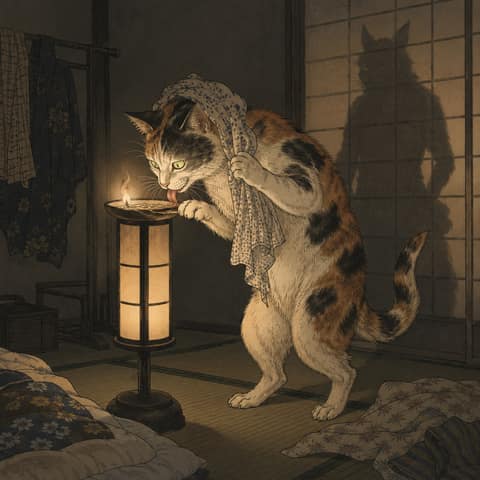
Animal ShapeshiftersVarious regions across JapanA consolidated image of the bakeneko based on Edo-period woodblock prints, printed books, and oral tradition. An aged house cat, or one abused by humans, becomes a yokai imbued with vengeful spirit. Portents include licking lamp oil, standing on two legs, and taking human form to slip into a home. Its curses typically target owners or abusers, manifesting as illness, strange deaths, or household decline. Interfering with funerary rites and desecrating corpses are recurring motifs, and tales often end with pacification by monks or ritual prayers. Early modern folk beliefs feared long-tailed cats as gaining occult power, leading to taboos about tail length. Boundaries with the nekomata are blurry, and when the forked tail is not emphasized, the creature is commonly called bakeneko. Urban entertainment refined the monster-cat image, even linking it with courtesan motifs, yet at its core lies awe of a familiar animal and a worldview of gratitude and retribution.
伝説 Kappa
KAH-pah
The Dish-Headed River Spirit – Kappa
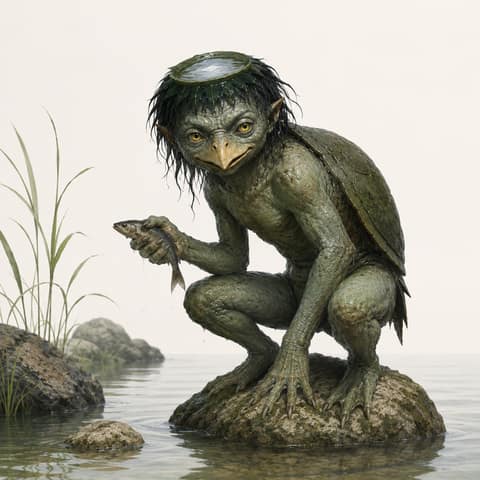
Water SpiritsRivers, ponds, and marshes throughout Japan"Kappa" is not, in truth, the name of any single creature. It is a collective term—the word by which the whole of Japan, each region in its own dialect, has called the water spirits that dwell in rivers and ponds. In southern Kyushu it is the Garappa; in Tōhoku, the Medochi; in Shikoku, the Enko; in Chūbu, the Kawaranbe; in Kinki, the Gataro; in Kyushu again, the Hyosube. From place to place the name and the form shift a little, and the total is said to exceed eighty. Some are close to monkeys, some shaggy with fur, some moving in troops. Yet all share a common core: they live by the water, hold water in the dish on their heads, and drag away people and horses. The kappa, in other words, is the shared name of a vast clan into which all the water spirits of the land have gathered. It is the reading of folklore studies that binds these many variants into one. Yanagita Kunio and Orikuchi Shinobu held that the kappa was originally a god who governed water—a water deity—who declined into a yokai as belief in it faded. The fact that in the komahiki legends the kappa always tries to pull a horse or ox into the water may itself be a memory of festivals in which horses and oxen were offered to a water deity in prayer for a good harvest. In Kappa Komahiki Kō (1948), Ishida Eiichirō compared this bond between horse and water deity with myths from across Eurasia. Precisely because it is a god of water, the kappa draws water to the fields, grants fish, and even hands down bone-setting remedies—while also drowning people and pulling out their shirikodama. Its twin aspects, blessing and curse, are the two sides of a fallen water deity. Traces of the water deity show even in the turning of the seasons. Across western Japan it is widely told that at the autumn equinox the kappa goes up into the mountains to become a yamawaro, and at the spring equinox comes down again to the river to return to being a kappa. The field god who descends from the mountains to the villages in spring, the mountain god who returns to the peaks in autumn—that idea of coming and going maps exactly onto the exchange between kappa and yamawaro. In this way the clan’s variants, too, are bound to one another as a single continuous terrain. The clan even has its legend of a chieftain. On the Kuma River in Kyushu the tale survives of Kusenbō, a kappa general who crossed over from the continent at the head of nine thousand kindred. Having drawn the wrath of Katō Kiyomasa, he was driven from the region, moved to the Chikugo River, and became one of the retainers of the Suitengū shrine in Kurume. That a kappa was imagined not as a lone monster but as a clan linked from river to river is plainly expressed in this tale of a boss. Places tied to the kappa are found all over the country. At Tōno in Iwate there is a "Kappa Pool" (Kappa-buchi) where kappa are said to appear, and at Jōken-ji temple, in honor of a kappa that put out a fire with the water from its head-dish, stand "kappa guardian lions" whose heads are shaped like a dish. At Lake Ushiku in Ibaraki the painter Ogawa Usen, who depicted kappa all his life, was called "Usen of the Kappa," and Tanushimaru in Fukuoka styles itself "the birthplace of the kappa clan." In the Kappabashi district of Tokyo a legend tells of Sumida River kappa who came each night to help a merchant pressing ahead with flood-control works. To this day kappa festivals are held in many places, and the kappa lends its name to sake brands and town mascots alike—remaining the most beloved of all Japan’s water yokai.

伝説 Oni
OH-nee
Oni (Traditional Folklore Form)
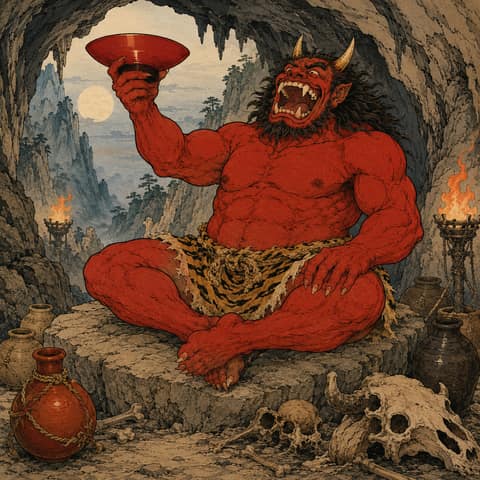
Demons & GiantsNationwide (Japan)A classic oni with red skin, proud horns, and a tiger-skin loincloth. Despite the fearsome look, he carries a warm heart. His booming laughter echoes through the mountains, and he treasures bonds with his comrades above all. Though terrifying when roused to anger, he is usually jovial and a dependable, big-brother figure.

伝説 Kojin
こうじん
The Raging Fire and Boundary Deity, Kojin
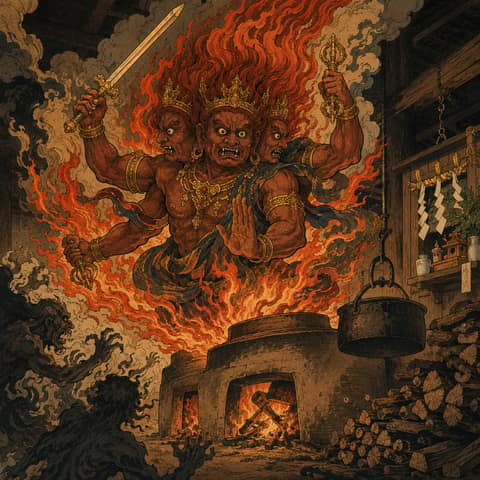
Divine Spirits / DeitiesSeikojin Kiyoshikojin Seicho-ji Temple (Takarazuka, Hyogo Prefecture; head temple of the Sanbo Kojin faith) / Seto Inland Sea cultural sphere of the Chugoku and Shikoku regions (Okayama, Hiroshima, Yamaguchi, Ehime, etc.)Aramitama Ideology and the Duality of Japanese Religion. While the basic description touches upon Kojin's two main systems, this thorough explanation delves deeper into the "Aramitama" (rough spirit) concept and the dualistic structure of Japanese religion. Ancient Shinto understands deities on an axis of "Nigimitama" and "Aramitama," recognizing that a single deity possesses both an aspect of a gentle savior and that of a raging curse-bringer. The Nigimitama gently protects people, while the Aramitama brings curses and disasters; ritually balancing the two is viewed as the religious goal of purification. The Kojin faith represents the extreme realization of this option to "worship the Aramitama independently." It holds a paradoxical structure: by fearing and worshipping a terrifying deity, its violent power is transformed into a protective force for the community. This is a variation of a universal structure in East Asian religious culture, comparable to the City God (Cheng Huang) in China, local deities in Korea, and spirit worship in Southeast Asia. Yaksha Origins and Esoteric Syncretism. Sanbo Kojin is a composite deity that incorporated the form of ancient Indian Yaksha spirits, blending elements of Buddhism, Shinto, mountain asceticism, Esoteric Buddhism, and Onmyodo. In ancient Indian mythology, Yakshas were semi-divine, semi-demonic beings guarding forests, mountains, and treasures; upon entering Buddhism, they were recontextualized as protectors of the Dharma (such as the retinues of Vaisravana). The process by which this merged with Japanese hearth and fire worship to become Sanbo Kojin is a prime example of the dynamism of Buddhism's reception in ancient Japan. The three-faced, six-armed wrathful statue, adorned with flaming hair, fangs, and carrying a bow and arrow, is the result of the fusion between its Yaksha roots and ancient Japanese demon-god imagery. The Religious Economy of Ascetics, Onmyoji, and Monks. The nationwide spread of the Sanbo Kojin faith during the Edo period was driven by the active proselytization of religious groups like Shugendo ascetics, Onmyoji, and lower-ranking monks. Operating outside the institutional structures of major temples and shrines, they made their living by offering prayers, fortune-telling, distributing talismans, and presiding over festivals for local communities. By preaching devotion to Sanbo Kojin, issuing talismans, and organizing rituals, a social system was built that supported the economic foundation of these wandering ascetics. The religious history of medieval and early modern Japan must be understood not just as a history of changing doctrines, but as concrete social history encompassing religious economy, the hierarchy of practitioners, and negotiations with local communities—with the spread of Sanbo Kojin serving as a typical case. The Seto Inland Sea Cultural Sphere and Kagura Theater. Bitchu Kagura in Okayama Prefecture originated as a ritual to "invite Kojin and dance before him," earning the alternative name "Kojin Kagura," and was designated a National Important Intangible Folk Cultural Property on February 24, 1979. In the late Edo period, the scholar Nishibayashi Kokukyo composed mythological plays (Shin-no) such as "The Transfer of the Land by Okuninushi," based on the Nihon Shoki and Kojiki, incorporating them into the rituals and thereby establishing the modern form of Bitchu Kagura. This is a symbolic example of how classical mythology and local Kojin faith heavily intertwine in the Seto Inland Sea cultural sphere. It preserves a unique theatrical culture where national deities (Susanoo, Okuninushi), Kojin, and local gods appear together as an integrated pantheon on the Kagura stage. Since ancient times, the Seto Inland Sea has been a maritime trade route with the continent and the Korean Peninsula, a center of Shingon Esoteric Buddhism, and a vast cultural region where local Shinto traditions—such as those of Izumo, Kibi, and Sanuki—have densely intersected. Ji-Kojin and Village Communities. The outdoor Ji-Kojin possesses a different origin story than the indoor Sanbo Kojin. Worshipped by individual households, kin groups, or small settlements—often using the estate's demon gate, village borders, or mounds beneath large trees as vessels—Ji-Kojin acts as a guardian of community boundaries, land, and ancestors. The dense concentration of Ji-Kojin worship in the mountain villages of the Chugoku region and the islands of the Seto Inland Sea has functioned as a mechanism to religiously reaffirm the hierarchical order of families, small settlements, and villages. The festival dates of the 28th of every month, January, May, and September hold social significance beyond simple religious rituals, acting as social time to confirm the solidarity of community members. Gyuba Kojin: The Industrial Aspect. A third system of Kojin that has garnered folkloric attention is Gyuba Kojin (the Kojin protecting cattle and horses). Tied to the history of using cattle and horses as primary sources of power for farming and transport in the mountain villages of Chugoku and Shikoku, the custom of affixing Kojin talismans in stables and praying for the animals' health during spring and autumn festivals was widespread. This reflects the religious life of pre-modern farming villages, where livestock were not mere economic assets but were religiously positioned as members of the family and community. With the advance of mechanization and modern power sources, Gyuba Kojin worship rapidly declined, but numerous ritual artifacts remain preserved in museums and local history centers across Chugoku and Shikoku. Re-evaluation in the 21st Century. In post-war Japan, folklorists such as Kenichi Tanigawa, Noboru Miyata, and Kazuhiko Komatsu advanced academic re-evaluation of Kojin worship, repositioning it as "the representative of Japan's indigenous local deities." In literature, Miyuki Miyabe's novel *Kojin* (Asahi Shimbun Publications, 2014) explored the deity, becoming a widely read narrative that cross-pollinated Edo-period local Kojin faith with modern societal anxieties. Today, in the 21st century, Kojin festivals and Kagura are inherited as intangible folk cultural properties throughout the Seto Inland Sea, Chugoku, and Shikoku regions. It remains one of the few "active" folk deities living on across academia, literature, and regional folklore. Homes enshrining Sanbo Kojin are still numerous, serving as precious embodiments of folkloric continuity.

伝説 Yamauba
yah-mah-OO-bah
Yamanba (Traditional Folkloric Form)
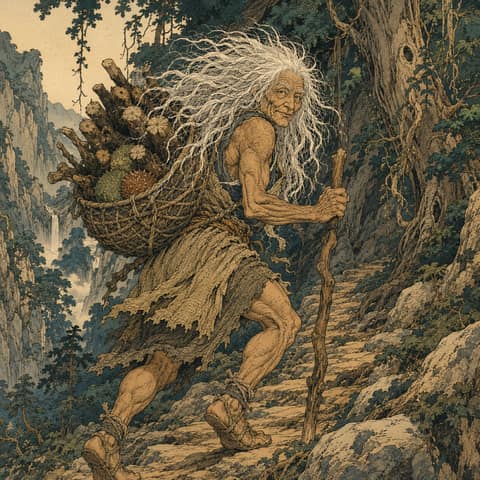
Mountain & Wilderness Spiritsmountain regionsAn elderly woman with white hair and a body hardened by life in the mountains, she is famed as the nurturing figure who raised Kintaro. Her deeply lined face reflects priceless life experience, and she offers precise guidance to the lost. Though she may appear strict, a profound love resides beneath the stern exterior.

伝説 Ikiryō (Living Spirit)
ee-kee-RYOH
Ikiryō
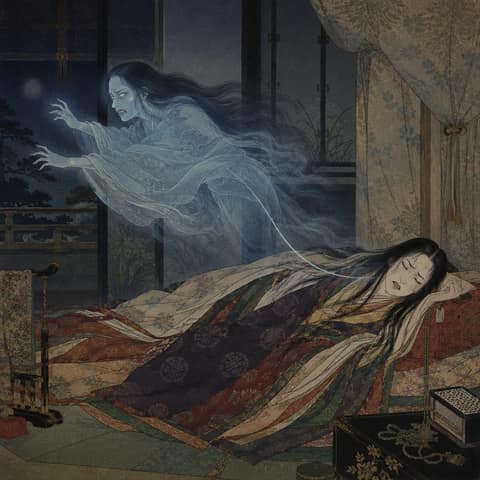
Ghosts & SpiritsAcross JapanThe image of the ikiryō holds two faces: a curse born of resentment, and gentler visitations tied to parting before death or to acts of gratitude. In Heian beliefs, overpowering thought left the body as a “shadow,” appearing at bedchambers, ox-drawn carriages, or gates. In the medieval and early modern eras, scenes witnessed in dreams, will-o’-the-wisps, and flying heads were taken as proof of the soul’s separation. In medical views it was classed as a disorder of the departing soul or of the shadow, with reports of people seeing their own double. The cursing rite of the Hour of the Ox is often linked as a willed sending of intent by the living, though not identical. Regional lore varies in name and form, with some places recording it as a footfall-making human shadow. Overall, it is understood as the coagulation of thought taking shape, a spiritual action of the living set against the dead.

伝説 Yuki-onna
Yuki-onna (the Snow Woman)
The White Apparition of the Snow-Country Night
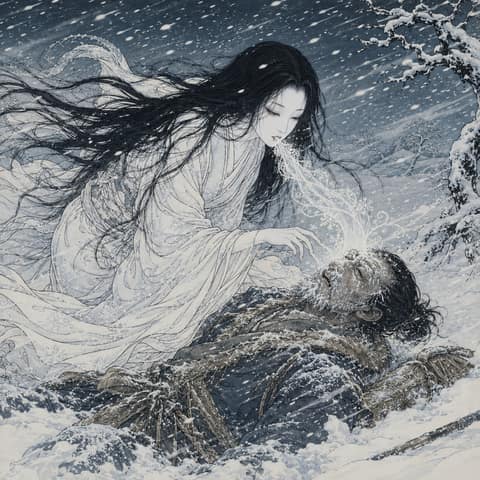
Natural Phenomena & Nature SpiritsThe heavy-snow country of the Sea-of-Japan coast and northern Tōhoku, on HonshūAs a "white apparition," the Yuki-onna is told of as a white figure that suddenly stands in one's path on a blizzard night, leaving no footprints. Before she draws near, the air first turns cold and one's breath freezes white; then, in the glow of the snow, a woman with a long trailing hem floats dimly into view. This sense that "the cold announces her before she comes" is the shared core of encounter-tales across the regions. Her face alone is translucently pale, her eyes glint from within, and she either gives no answer when addressed or asks one's name in a low voice. In many versions the taboo runs thus: answer her question and your life-force is drained; stay silent and you are spared. The tale of Minokichi and O-Yuki that Lafcadio Hearn set down in Kwaidan conveys this white-apparition image most vividly. Having frozen the old woodcutter Mosaku to death in a storm-bound hut, the snow woman leaves the young Minokichi with a single command: tell no one what you have seen tonight. Later Minokichi weds a traveling woman named O-Yuki, fathers children, and lives happily — until one snowy night, watching his wife's pale profile as she sews by lamplight, he sees in her the face of the snow woman of long ago and lets the words slip. O-Yuki reveals herself, declares that she spares him only for the love of their children, and vanishes through the smoke-hole as a white mist. A bond sealed by a single forbidden word comes undone: the sorrow of parting, and the otherworldly woman who longs for a human, crystallize here. In pictorial tradition she is usually painted as a tall woman in white in pale washes, her outline never drawn too firmly, dissolved into a white scarcely distinguishable from the snow. Her feet are blurred into haze and she casts no shadow, lending the air of something not of this world. Less a spirit who sings and dances than a still apparition who stands without sound and vanishes without sound — that is the true nature of the Yuki-onna as a "white apparition."

伝説 Tsuchigumo (Earth Spider)
TSOO-chee-GOO-moh
Tsuchigumo of the Raikō Extermination Tale
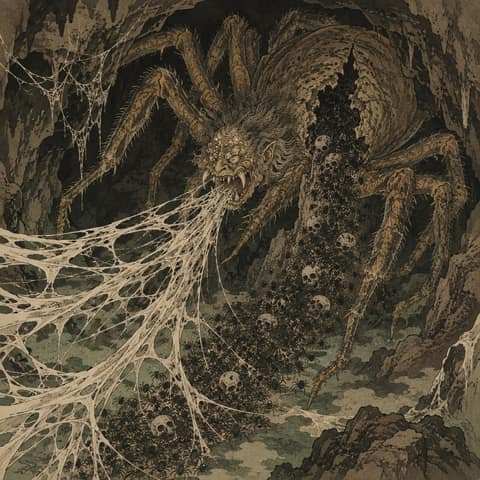
General ClassificationsYamato, Bungo, Hizen, and other regions across JapanA yokai image fixed in medieval narratives: as Minamoto no Raikō lies ill, a monk-like apparition appears at his pillow. When struck, it flees leaving white blood, and following the trail leads to a mound or cave where a giant spider lurks. In Noh it calls itself “the ancient spirit of Mount Katsuragi,” while picture scrolls show it beguiling people with manifold shapeshifts and illusions. Its grotesque form—countless heads and swarms of small spiders bursting from its belly—has been read as a symbol of all manner of demons. Early modern joruri and kabuki inherited this line, tying it to the martial exploits of Raikō’s Four Heavenly Kings. Although the ancient term tsuchigumo once referred to local powers, that lineage diverges from the storybook yokai; only the name was carried over.

伝説 Nekomata
neh-koh-MAH-tah
Split-Tailed Old Cat Nekomata
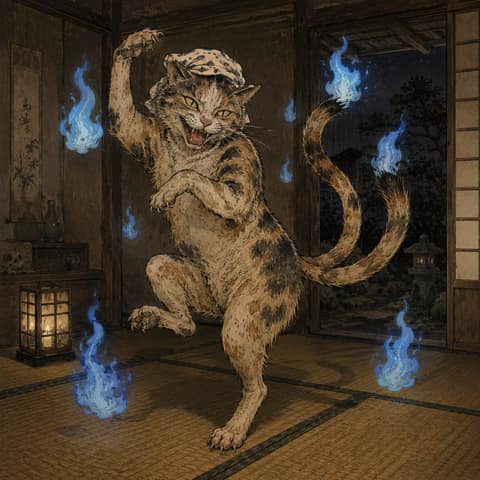
Animal TransformationAll across Japan — Has no specific origin point, told nationwide as transformations of old cats.The form of a cat kept in a human home for many years, aging until its tail splits into two, thereby "ascending" to acquire the power to speak and manipulate ghostly flames. Discarding the "mountain beast" aspect spoken of for the species as a whole, this is an interpreted version that maximizes its nature as a "house yokai" (kayou) sharing living space with humans. In this version, the Nekomata is said to stand on its hind legs late at night, place a towel on its head, and dance wildly in the shadows of the hearth. This bizarre dance, originating from the depiction in Toriyama Sekien's "Gazu Hyakki Yagyo", added a somewhat comical and human-like charm to what was originally a terrifying monster cat legend. Furthermore, this Nekomata skillfully mimics the faces and voices of people to deceive family members. It often takes the form of an old woman, which is sometimes interpreted as a projection of the power and underlying intimidation of the matriarch who managed the household for years, superimposed onto the image of an old cat. The folklore presents a clear duality: if the homeowner treats the cat roughly or kills it unreasonably, it becomes a vindictive curse deity, setting ghostly fires (Nekomata fire) in the house and ruining the family lineage. On the other hand, a carefully cherished Nekomata uses its demonic powers to "protect the house." As depicted in works like Sawaki Suushi's "Hyakkai Zukan", there are benevolent tales of them shapeshifting into a shamisen-playing geisha to save a benefactor in a crisis, or using their demonic fire to intimidate and burn away other evil spirits or diseases (impurity) attempting to enter the home. To them, the split tail is not merely a sign of monstrosity; one tail serves as an antenna symbolizing "gratitude (or resentment) toward humans," and the other symbolizes "the demonic nature of a beast."

伝説 Yūrei (Ghost)
YOO-ray
Toriyama Sekien “Yūrei” (An’ei era)
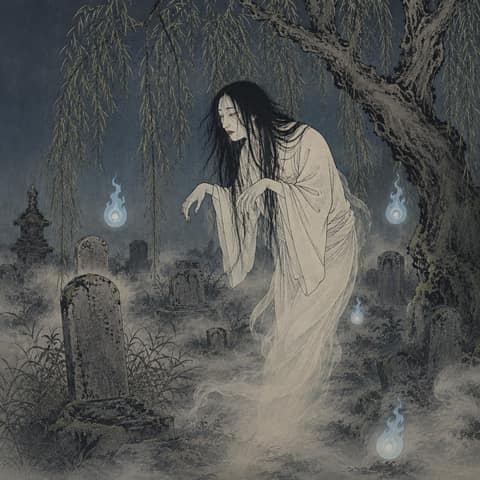
霊・亡霊Across JapanAn image based on the “Yūrei” in Toriyama Sekien’s Gazu Hyakki Yagyō, published around 1776 (An’ei 5). In a nighttime graveyard a woman’s ghost appears between drooping willows, wearing a white burial robe and a forehead cap, raising her arms as if to halt a passerby. It is a transitional depiction from before footless forms and the triangular headcloth became fixed conventions, emphasizing the lifelike force of the arms and the willow and gravestones as symbols of place. Sekien’s plates organized contemporary strange tales, Buddhist views, and funeral customs, profoundly shaping the visual codification of yūrei. While indicating gender and costume, the image leaves the source of attachment unspecified, inviting the viewer to imagine the relationship.

名妖 Ayakashi
ah-yah-KAH-shee
Maritime Ayakashi
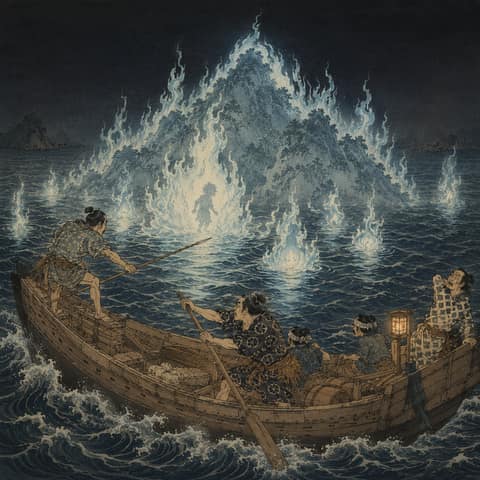
General ClassificationsCoastal regions across Japan, especially Western JapanA consolidated image of ayakashi used as a catchall name for sea-borne anomalies tied to maritime disasters across Japan. Forms vary widely—ghostly fires, phantasms, phantom women, sea serpents—but share behaviors such as leading ships astray, blocking courses, distracting crews, and luring the thirsty. In Tsushima, will-o’-wisps are said to become mountains, and local lore advises boldly pressing ahead to disperse them. In Nagasaki they drift as ghostly lights at sea, in Yamaguchi and Saga they are feared as funayurei, and off Bōsō they are recorded as a well-woman specter. The name is also shared with the real remora in folk belief that it slows a vessel, functioning as a folk explanation for natural phenomena and seafaring anxiety. Toriyama Sekien’s imagery shows a giant sea serpent, tying the idea to ancient notions of sea monsters.

名妖 Mujina
MOO-jee-nah
Traditional Tale Compliant – Trickster Mujina
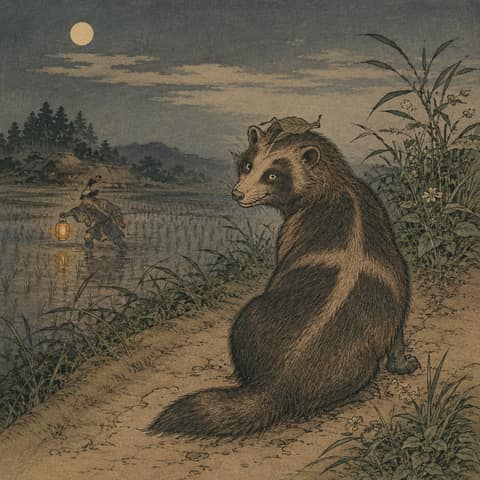
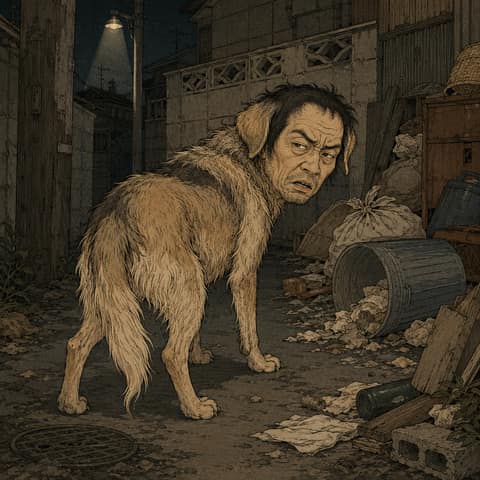
General ClassificationsAcross Japan (many tales in the eastern provinces)A trickster figure based on mujina tales from across Japan. It appears as a beast about the size of a dog with slightly short forelegs; elders are said to show a cross-shaped patch of fur on the back. Skilled at disrupting attention and sense of direction, it makes travelers mistake fields for rivers, ridges for water surfaces, and straw stacks for human figures on night roads. Malicious ones disguise food and latrines as other things, causing shame or misfortune. When taking human form it favors inconspicuous looks such as a boy, a traveler, or a village woman, and may lure with voice alone. In many regions its lore blends with tanuki and fox tales, with the name “mujina” used regardless, but it broadly belongs to the class of beasts that bewitch. Rather than being repelled by martial arts or spells, most stories end with it vanishing once its true nature is seen through, after which it avoids the area. The proverb “mujina of the same hole” means birds of a feather, combining the observation that they share burrows with associations from trickster tales. Traditions are rich in eastern Japan, and Edo-period paintings depict it under the title “Mami” or “Badger.”

名妖 One-Eyed Boy Monk
hee-TOH-tsu-meh koh-ZOH
Traditional Aspect (Hitotsume-bō)
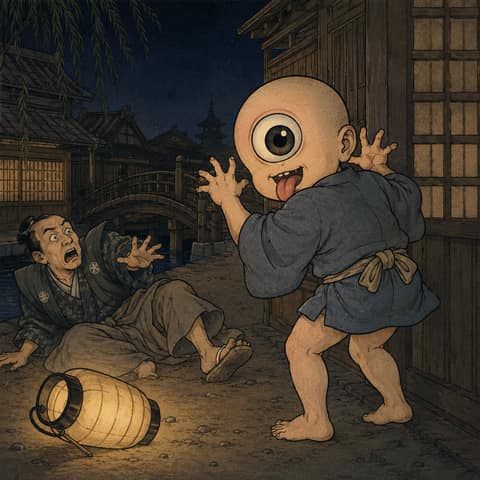
山野の怪Across Japan (Edo, Aizu, Tanba, Bizen, etc.)A整理 based on Edo-period picture scrolls such as Hyakkai Zukan and Bakemono-zukushi depicting the figure known as Hitotsume-bō. It takes the form of a shaven-headed child monk, appearing suddenly in parlors, on bridges, slopes, and crossroads, then vanishing once satisfied with the onlooker’s reaction. Though often associated by inference with the one-eyed, one-legged monk of Mount Hiei, direct identification is avoided. Folklore links it to food by claiming it dislikes beans, and later images show it carrying tofu, yet it rarely intends harm to people or livestock. Its appearances vary by season and weather; in some regions, its single eye is said to glow dimly on rainy nights in late autumn. Names vary by locale, including “Hitotsu-managu” in Ōshū and the widespread “Hitotsume-kozō” and “Hitotsume-bō.”

名妖 Ushi-no-koku Mairi (Cursing Rite at the Hour of the Ox)
OO-shee-noh-KOH-koo MY-ree
Ritual Icon of the Cursing Hour
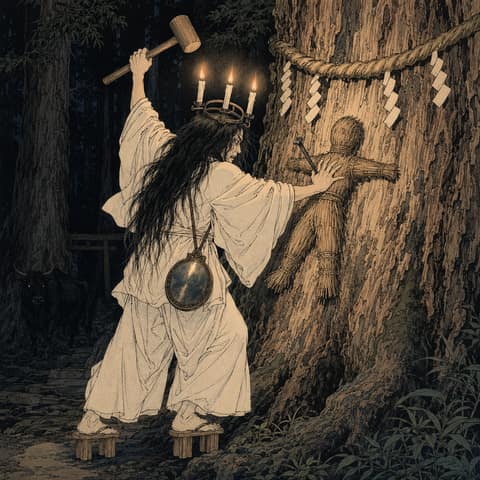
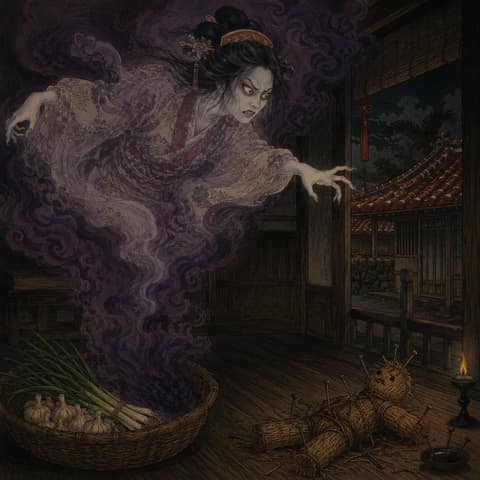
Ghosts & SpiritsKyoto Prefecture (Kifune shrine cult), and areas around shrines across JapanA codified image of the classic Ushi-no-koku mairi centered on Edo-period etiquette. Clad in white burial garb with disheveled long hair, the practitioner inverts an iron trivet as a crown with three candles lit, hangs a mirror on the chest, and moves toward the shrine on single-toothed geta to muffle steps. At the sacred tree, a doll bearing the target’s name is pinned and a five-inch nail is hammered in each night. The witching hour is strictly the third quarter of the Ox Hour, with fulfillment said to come on the seventh night. If witnessed, the rite loses its power, so silence and care to leave no tracks are prescribed. In art, a black ox sometimes accompanies the figure; lore holds that straddling it on the final night brings success, while shrinking back means failure. Straw-doll usage became common in the early modern era, with roots in ancient scapegoat effigy piercings and Onmyodo katashiro rites. Folklore often stops short of asserting curses as real, instead telling that breaking taboos or exposure nullifies the act.

名妖 Epidemic God
yahk-BYOH-gah-mee
Gyōekishin, Plague-Deity
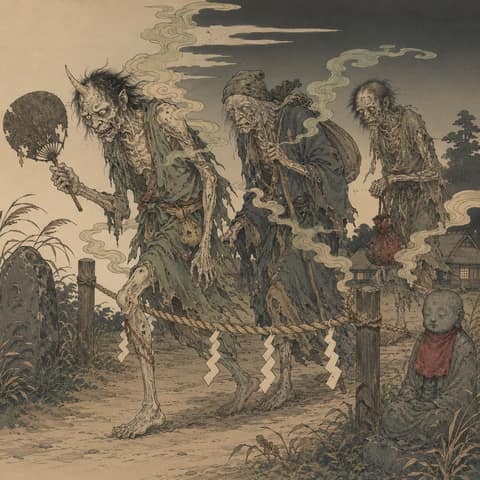
Deities & Divine SpiritsAcross Japan (many records from the Kinai/Kyōki region)An archaic image of the plague deity recognized in both court ritual and folk belief. Usually unseen, it gains force at seasonal turnings and when blossoms fall, entering through village bounds, crossroads, and riverbanks, spreading illness by seizing on household impurity and neglect. In paintings it appears as bands of oni-like or uncanny figures on the move, while tales say it stands at the door as a traveling old man or woman, disliking lapses in almsgiving or proper etiquette. Communal countermeasures include boundary festivals, rites of purification, offerings, displaying talismans, and sending off dolls, with porridge or other set foods prepared on fixed dates to ward it away. Its forms and names are not fixed, appearing in step with local customs and annual rites, so it varies by region, yet it is always told in connection with practices that “set the boundary and purge defilement.”

名妖 Kasha (Corpse-Dragging Fiend)
KAH-shah
Cat-Type Kasha (Early Modern Tale Variant)
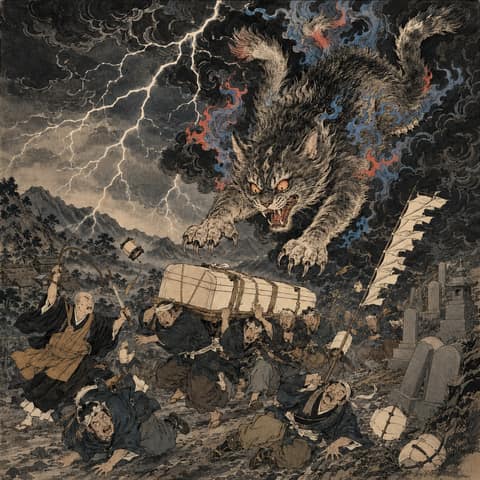
Ghosts & SpiritsAcross JapanA composite form of the bakeneko that solidified in the late 17th century. An aged cat arrives with thunderstorm or dark clouds, seizing the corpse from a coffin by exploiting lapses during funeral processions or wakes. After Toriyama Sekien’s illustrations, the feline form became standard. Regional lore varies: forked tails, attendant will-o’-wisps, or concealment within black clouds. Its targets are not limited to evildoers. Folk countermeasures include night-long vigil at the wake, placing knives or razors atop the coffin, using prayer beads and sutra recitation, and disruptive funeral tactics.

名妖 Amazake Hag
ah-mah-ZAH-keh BAH-bah
Traditional Folklore Aligned
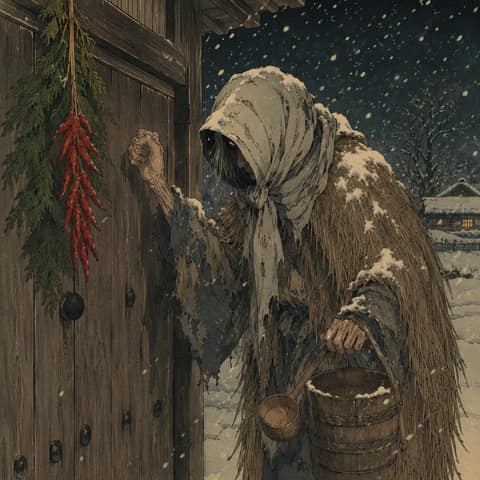
Half-Human BeingsTohoku and Kanto regionsAmazake-babaa was told as a visitor who heralds the arrival of epidemics. She knocks at midnight and asks whether there is sweet sake; the very act is a test of taboo, and answering is understood as a conduit for misfortune. People hung apotropaic symbols—cedar sprigs, nandina, and chili peppers—at their gates and avoided replying. Across Edo, people visited images of an old woman said to calm coughs, linking petitions to folk belief. The tradition overlaps memories of smallpox outbreaks; some view her as a guise of the smallpox deity, while others absorbed the image of a peddler woman on cold nights, creating regional variation. The yokai is transmitted with the taboo structure of “answer and you fall ill,” accompanied by threshold-warding rites, and is positioned as a portent tale that signals the presence of disease.

名妖 Reverse Pillar
sah-kah-BAH-shee-rah
Traditional Kaidan Edition Gyakubashira (Inverted Pillar)
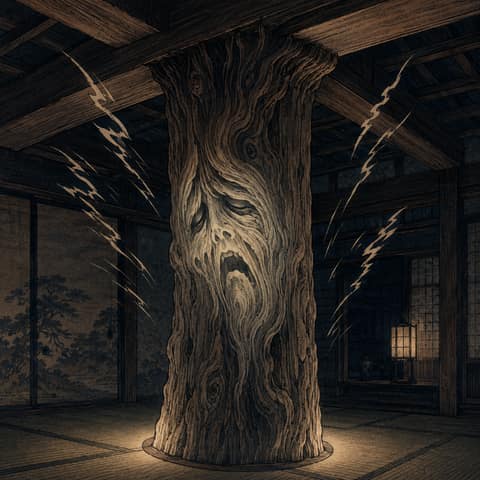
Household SpiritsVarious regions of JapanA post–early modern belief that a pillar installed upside down, defying carpenters’ respect for a tree’s natural root spread, brings mishaps to a house. Persistent midnight house-settling, creaking beams, and uncanny whispers were read as the “curse of the inverted pillar,” prompting reinstallation or prayer. Shigeru Mizuki notes leaves birthing a spirit from the reversed wood, or the pillar itself transforming, yet older records more often treat it as signs of noise, misfortune, and ill omen. Deliberate inverted motifs used as apotropaic design (e.g., Yomeimon) belong to the ritual idea of intentional imperfection and are distinct from this yokai. As a taboo rooted in building folklore, it appears in regional carpenters’ lore, temple and shrine records, and essays.

名妖 Mikoshi-nyūdō (Looming Priest)
mee-KOH-shee nyoo-DOH
Mikoshi-nyūdō (Edo Kaidan Record Type)
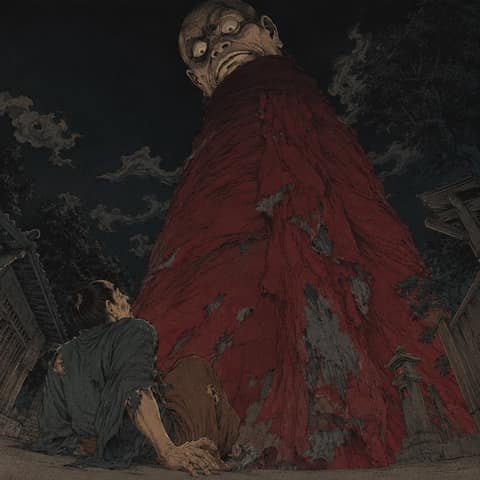
Demons & GiantsVarious regions of Japan (especially Kantō, Tōkai, Shinshū, and Chūgoku)An Edo-period anecdotal and ghost-story variant in which a giant priest-like figure blocks the night road, chilling the heart of anyone who looks up. In some regions it is treated as a plague-bringing deity that can cause fever or sudden death, and is taboo to step over. Its true nature is left unclear, sometimes taken as a disguise of a shape-shifting animal or a haunted object. Methods of banishment emphasize conduct unshaken by fear, such as calling it out by name, looking down on it, or pretending to measure its height.

名妖 Yamabiko
yah-mah-BEE-koh
Traditional Figure (Kodama and Mountain-Deity Retainer Interpretation)
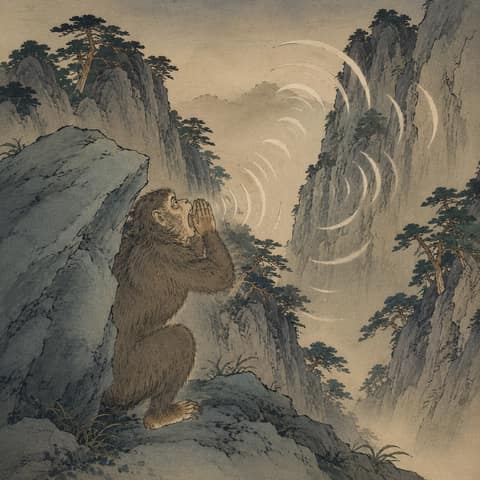
自然現象・自然霊Across Japan (mountains and gorges)Yamabiko is the personification of echoes in the mountains, interpreted as a kodama or a retainer of the mountain deity. Its habit of repeating words back is seen as a boundary-marking reply within the mountain domain, warning against reckless shouting that disrupts the mountain’s vital energy. Early modern images depict it as a small beast akin to a dog or monkey; figures in Hyakkai Zukan and Gazu Hyakki Yagyō have been linked to the yama-ko in Wakan Sansai Zue and to Penghou, said to dwell within trees. Depending on region, intermediaries vary—bird calls like the yobukodori or resonant rocks such as “Yamabiko Rock.” Phenomenon, spirit, and monster imagery overlap in layered tradition.

名妖 Ubume (Ghost of a Dead Mother)
OO-boo-meh
Ubume (Traditional Form)
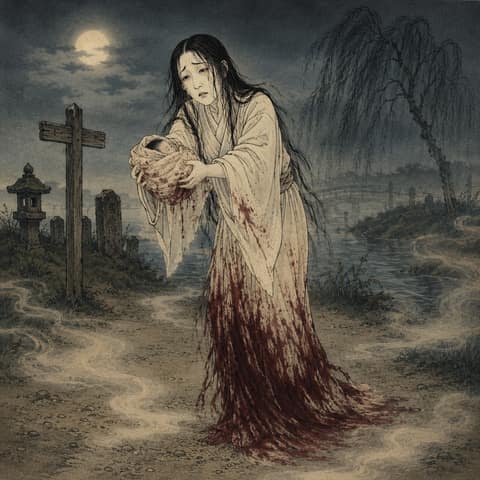
Ghosts & SpiritsVarious regions of Japan (especially Tōhoku, Kantō, and Kyūshū)A spirit formed from the regrets of a woman who died in childbirth, said to appear along night roads, crossroads, and riverbanks. Early modern tales and illustrated books depict her with blood soaking her lower body, cradling a baby and asking passersby to mind the child. Outcomes vary: the helper discovers they held a stone or Jizo statue, receives great strength or wealth as recompense, or suffers misfortune such as being bitten by the infant. Regional variants include Fukushima’s “Obo,” where distracting her with a strip of cloth is advised, and Kyushu’s “Ugume,” whose true nature is revealed at dawn. Edo scholars compared her with nocturnal bird-like portents in Chinese records and reasoned that the qi of those who die in childbirth becomes a yokai. Temple and shrine legends tell of salvation through nembutsu or daimoku, linking her to prayers for childrearing and safe delivery. Ubume is both feared and revered, a spiritual figure embodying a mother’s enduring love.

名妖 Azuki-arai (Bean Washer)
ah-ZOO-kee ah-RAH-ee
Azukiarai of the Mountain Stream
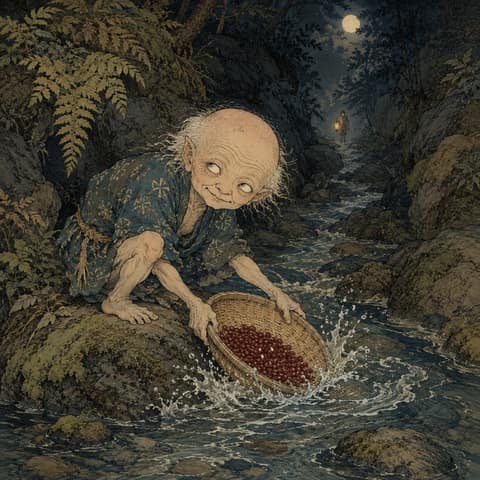
Ghosts & SpiritsVarious regions—especially mountain valleys in Kanto, Chubu, and KinkiRooted in the classic image of the Azukiarai, it blends with the sounds of ravines and flumes, washing red beans through the midnight hours. It lures with sound and tests the curious who peer in. Drawing on early modern notes that it excels at counting and judges vessel measure and bean quantity at a glance, it is not wantonly harmful, but serves as a keeper of taboos along the water’s edge.

名妖 Hitodama (Human Soul Fire)
hee-toh-DAH-mah
Hitodama (Traditional Tale Version)
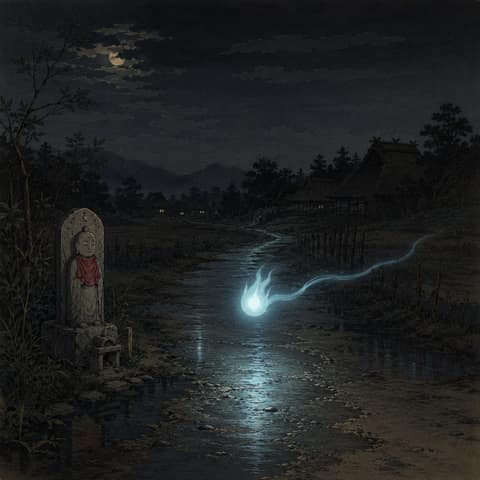
Ghosts & SpiritsVarious regions across JapanA depiction based on the traditional understanding of hitodama. It is a spirit flame that appears in answer to impending death or powerful emotions, said to fly to one’s family line or close relations. It drifts lower than shoulder height with a faint trailing tail. Though it seems to be carried by the wind, it is also said to travel as if toward a destination. Its color is often pale blue, but varies by region, with many reports of orange or red. Sightings cluster near places of passage or boundary—temple and shrine grounds, graveyards, old roads, field ridges, and pond edges. Early modern essays, local gazetteers, and modern folklore collections mention it as a “greeting flame before death” or “parting flame,” and distinguish it from onibi and kitsunebi, which have different origins. Scientific explanations have been attempted, yet tradition regards it as a sign of a soul’s coming and going.

名妖 Blue Heron Fire
ah-oh-SAH-gee-bee
Canonical Folklore Version
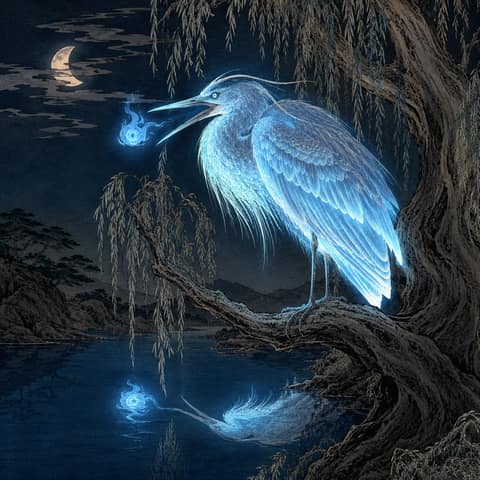
Animal ShapeshiftersVarious regions of Japan (notably Edo, Yamato, and Sado)Aosagibi is told as the pale blue glow seen around night‑active herons such as the black‑crowned night heron, appearing above water or against the night sky. In the Edo period it was depicted by Sekien and recorded widely in essays. Willows and ancient plum trees, river mouths and inlets, and shrine and temple precincts—places where “ki gathers”—were feared as haunts where mysterious fires would linger, and cases are told where a shot “ghost light” proved to be a heron. Explanations noted since early modern times include moonlight and water reflections, the sheen of wet feathers, the glare from white breast plumage, or microorganisms at the waterside, showing how people moved between natural causes and yokai tales. Other strands say old night herons faintly glow by season, turn into fireballs, or breathe fire, letting tales of ghost lights, strange birds, and dragon lamps intersect. Though eerie, many stories end with the creature merely being a bird once brought down, emphasizing its nature as a misperceived apparition.

名妖 Thousand-Wolf Pack
SEHN-bee-kee OH-oh-kah-mee
Senbiki-Ōkami
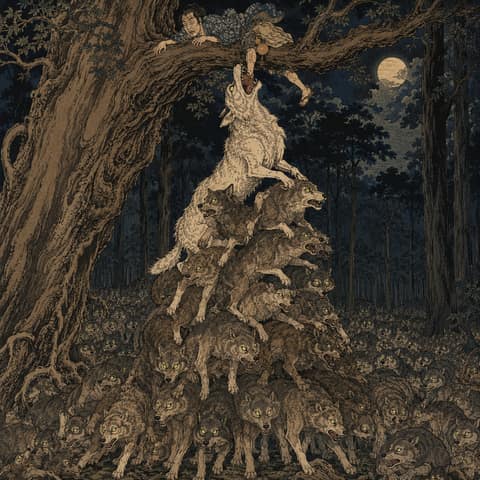
Animal ShapeshiftersAcross Japan (Shikoku, Izumo, Echigo, etc.)The traditional image of the Senbiki-Ōkami portrays not a lone wolf but the terror of a pack moving under command. Tales begin on a nighttime pass where a survivor escapes up a tree. The pack gains height through leaps and coordinated boosts, and when they cannot reach, they summon a chieftain or outside entities such as an old cat, an ogress, or the Blacksmith’s Wife. Those summoned are linked to in-home impostors disguised as family, and by morning the world bears traces—bloodstains, missing household vessels, wounds, or memorial steles—that anchor the tale in reality. Though the wolves’ behavior is exaggerated, older interpretations align it with knowledge of nocturnal habits and pack movement, and prayers, edged tools, and daybreak commonly mark the turning point. Depending on region, the chieftain appears as a white-maned great wolf, an old cat, or an ogress, with names like the Blacksmith’s Wife, Koike Hag, or Yasaburō Hag, yet the core pattern of tree-bound escape and summoning remains. Folklorically, the story links calamity lurking at borders—mountain passes, the hour before dawn—to shapeshifters within the home, often accompanied by memorial towers and place-name lore.

名妖 Funayūrei (Boat Ghosts)
foo-nah-YOO-ray
Beggar of Teigo at Dan-no-ura
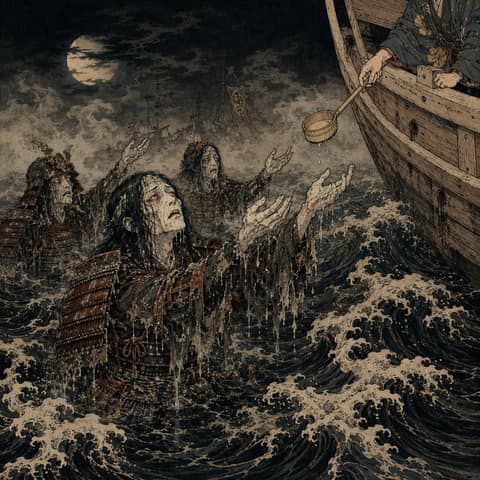
Aquatic SpiritsAcross Japan (coastal and island regions)An uncanny variant of the funayurei said to be the ruined shades of the Taira clan sunk at the Battle of Dan-no-ura. On nights of shifting tides and sea mist in the western straits, they draw alongside a boat, armor dripping, and beg, “Give us a teigo ladle.” Their faces are pale, eyes reddened by salt, voices hoarse yet mannered with samurai courtesy. Keeping the discipline of their former camp, they form ranks even at sea, a herald calls out, and many hands clutch the gunwale. If given a ladle with an intact bottom, they silently bail seawater into the boat until it founders. Those who know the old ways cross the sea with bowls and ladles whose bottoms are pierced, tied ready at the rail. When the ghosts accept them, water runs through and does not stay aboard, and only the weight of their rancor scatters on the tide. Priests sometimes hold services, and then the shadow of war hats melts into the mist, chains of armor return to the sound of waves. They do not drown people at random but approach those ignorant of sea rites or proud souls who scorn the ocean, marking their own downfall upon the world. On the sixteenth of Obon, on equinoctial days, and on battle anniversaries, their tread comes nearest when the sea is unnaturally still, and ghostly fires line the surface like beacons, mirroring the fleets of old. Offerings of ash, rice cakes, incense and flowers, and dumplings soothe their fixation; cast them from the bow and a wave like a shirabyōshi’s sleeve returns once and pushes the boat onward. A hard stare may make them withdraw, not by force of gaze but because the living truly behold the dead and the knotted ki loosens. As Yamaoka Genrin told, their true form is congealed rancor, soot-like grudge given shape upon the current; when winds shift, sutras resound, and offerings sink, the loosened ki disperses into the sea. Thus this version of funayurei can be stilled not only by fear but by memorial rites. Sometimes the outline of a child appears among their ranks, its voice thinner still, never asking for “water,” only hooking small fingers over the rail. If you hear the faint chime of armor bells, correct your helm, take the Hayatomo Rapids on the slant, and let a murmured nembutsu ride the wind. The slayers’ spirits drifting in the western dark yield only to proper forms and compassion.

名妖 Great Nyūdō (Giant Priest Apparition)
oh-oh-nyoo-DOH
Annotated Traditional Edition: Ōnyūdō (Giant Priest)
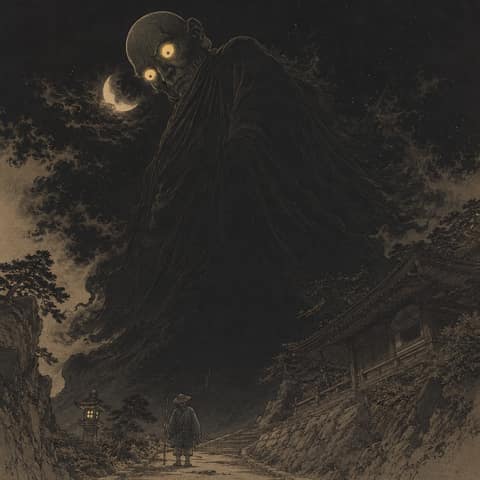
Demons & GiantsVarious regions (Tohoku, Kanto, Shikoku, and elsewhere)The Ōnyūdō is defined by its sheer size and piercing glare. Reports range from a monk-like giant with a topknot to a vague shadowy figure, appearing in liminal places such as night roads, temple and shrine grounds, mountain passes, and lakesides. It draws the gaze of onlookers and, the instant they look up, grows taller to assert its might. Explanations of its nature vary by locale: a transformed animal, the spirit of an old stone pagoda or boulder, or an unclassified anomaly. Harmful cases include people collapsing under its stare or developing fever afterward, yet in places like Awa it is also told as a semi-guardian that helps with labor. Countermeasures follow traditional banishment methods: do not fear or avert your eyes, break its menace with arrows or prayer beads, or expose the true form of the shapeshifter. Historical sources sometimes mix names like Ōbōzu and Ōnyūdō, so it is best understood within local traditions.

名妖 Amanojaku
ah-mah-noh-JAH-koo
Traditional Iconography and Folktale
Demons & GiantsVarious regions of Japan (ancient strands linked to Yamato and Izumo mythic cycles)Amanojaku is understood as a fusion of the trampled demon in Buddhist iconography and the folk image of a small imp fond of mimicry and speaking in reversals. Many temple and shrine statues of the Four Heavenly Kings or Shukongōshin place a small demon underfoot, signifying the subjugation of worldly desires and wicked intent. In stories, Amanojaku habitually reads people’s hidden thoughts, balks at requests, and does the opposite of commands to sow confusion. In mountain lore it is told as a being of tremendous strength, with unfinished stone piles, bridge piers, and toppled boulders on peaks attributed to its failed feats. Interpreting echoes as the voice of Amanojaku is a personification of natural phenomena, overlapping regionally with names like kodama and yamabiko. In fairy tales such as Uriko-hime, it serves as a touchstone-like adversary that preys on carelessness or greed, carrying a moral lesson. Overall, Amanojaku lives across iconography, folktales, and dialect traditions as a mirror of human contrariness and the gaps in the heart.

名妖 Nure-onna
NOO-reh-OHN-nah
Nure-onna (Tradition-Faithful Version)
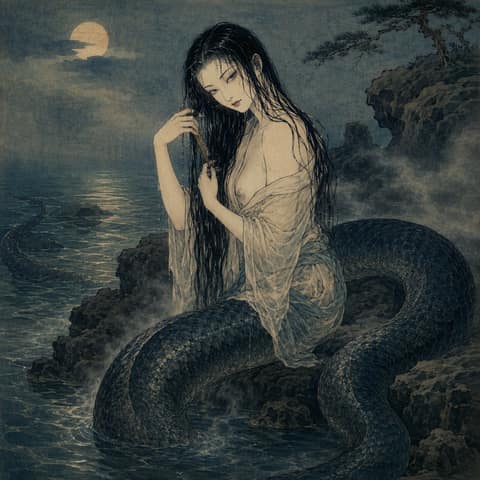
水の怪Various regions (primarily the Sea of Japan coast and San’in area)Seen along seashores and riverbanks as a woman with long wet hair. Depending on the region, she either lures victims by making them hold a baby and then immobilizes them, or appears as a menacing aquatic entity evocative of a serpent’s body and a massive tail. Edo-period yokai art often depicts a serpentine woman, though narrative sources offer scant confirmation. In Iwami she is classed as a water spirit linked to the gyuki, with advice to never hold her burden barehanded. She is sometimes conflated with the iso-onna, and both name and traits vary by locale.

名妖 Kodama (Japanese Tree Spirit)
kodama
Kodama (Ancient Tree and Echo Spirit)
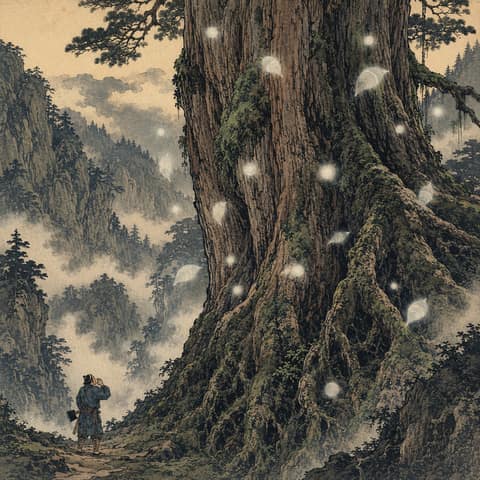
Mountain and Forest SpiritsOld forests and sacred trees across Japan; Aogashima and Okinawa preserve local tree-spirit traditionsThis is the classical kodama: not a mascot-like creature, but the unseen presence of an old tree and the voice that seems to answer from the mountain. It draws on older ideas of tree divinity, on the belief that ancient trunks hold spiritual force, and on the folk reading of yamabiko, the returning mountain echo. The kodama may remain invisible, showing itself only through sound, silence, unease, or the taboo surrounding a tree that should not be cut without ceremony. This version emphasizes the traditional boundary: kodama can be described as a tree spirit, a forest yokai, or a lingering kami-like presence, but its power lies precisely in not fitting only one category.

名妖 Hihi (Demon Baboon)
HEE-hee
Hihi (Traditional Accounts)
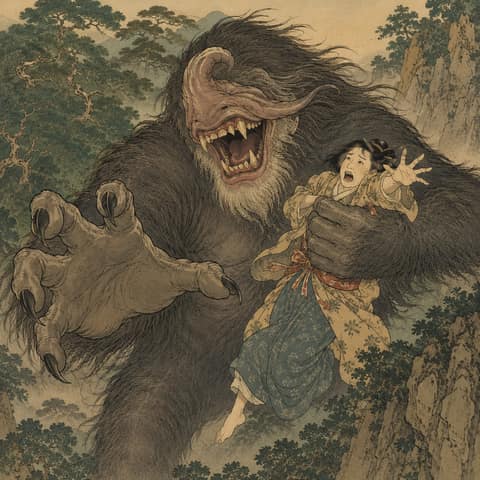
Animal ShapeshiftersVarious regions (mountain areas)A depiction of the hihi based on Edo-period images and folklore. Said to dwell in mountains, it is an aged monkey transformed into a giant, powerfully built being. Many regions tell that it bursts into loud laughter, and when its long upturned lips roll back to cover its eyes, it leaves an opening to strike. Tales include the abduction of women, bouts with woodcutters, and raising wind and storm to hurl people. Natural history compendia such as Wakan Sansai Zue report black hair, large size, and hearsay of human speech, though exact locales and physical evidence remain uncertain. Its name is commonly linked to its laugh. It is sometimes conflated with yama-warawa or monkey deities, but is often distinguished as an ape-shaped mountain monster.

名妖 Broom Spirit (Hōkigami)
HOH-kee-gah-mee
Folk Belief Version – Broom Deity
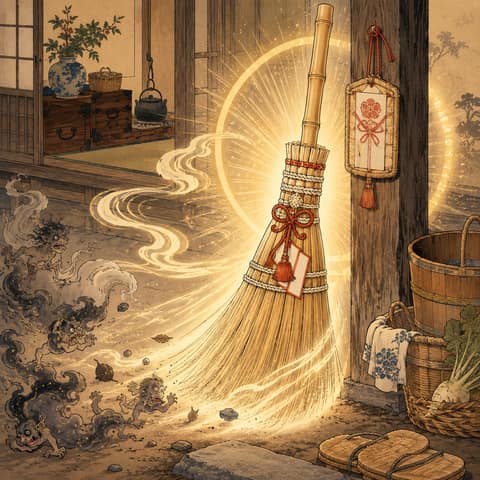
Deities & Divine SpiritsVarious regions across JapanEmphasizing the household cult image of the broom deity, this spirit uses the broom as a sacred vessel to govern domestic purity and the safety of childbirth. Sweeping is seen as a rite of purification that orders boundaries and drives out misfortune and impurity, while the power to gather scattered things back together also symbolizes recalling souls and inviting good fortune. At life’s turning points—New Year, moving house, pregnancy and postpartum—people renew the broom and dispose of the old one with thanks. Mistreating a broom is taboo, and stepping over it, treading on it, or leaving it upside down is inauspicious. Yet the upside-down broom can be used deliberately as a charm to gently send lingering guests home. In art, Toriyama Sekien depicts it as a tsukumogami in Hyakki Tsurezure Bukuro, but in folk practice it is revered as a divine presence dwelling in the tool, a household deity, both practical implement and object of faith. Regional details vary, but it is understood as a local guardian of cleansing and boundaries.

稀少 Momongaa
moh-mohn-GAH-ah
Momongaa (Print-Illustration Variant)
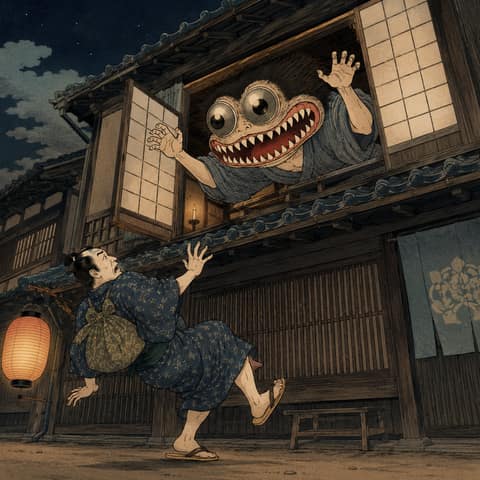
General ClassificationsJapanese folkloreAn image based on what appears in Edo-period prints. It thrusts out huge round eyes and a split mouth from an upstairs doorway or by a paper screen, baring sharp teeth to bluff and frighten, or writhes on all fours as a white lump of flesh with stubby limbs. Its name has the ring of a shouted call, and it is depicted as a specter that turns away nighttime visitors. It claims no personal name or lineage, emphasizing a showy display of monstrous features.

稀少 Hidden Hamlet
kah-koo-reh-ZAH-toh
Sekien Zue Version: Hidden Village
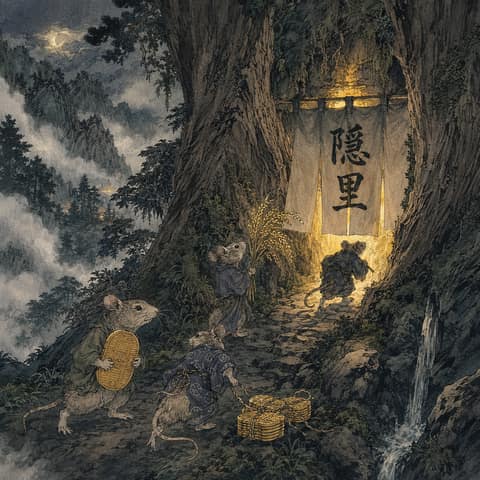
山野の怪Japanese folkloreAn interpretation based on Toriyama Sekien’s Konjaku Hyakki Shūi entry “Kakurezato” (Hidden Village). The mouse and koban coins at the lower right recall tales in which subterranean mice carry wealth (the so‑called Nezumi Jōdo legend), hinting at ties between the village and chthonic or underworld realms. The shop curtain reads “Kakurezato,” expressing a boundary that opens suddenly as an extension of the everyday. The Hidden Village is not a single yokai but a boundary acting as if it has will, repeating wayfinding confusion, temporal slippage, the granting of fortune, and cycles of manifestation and disappearance. Outcomes swing with a visitor’s conduct and greed, from generous hospitality to wealth turning into leaf-litter, resonating with mountain otherworld tales and views of the beyond.

稀少 Aobōzu (Blue Monk)
ah-oh-BOH-zoo
Aobōzu of Traditional Iconography and Provincial Tales
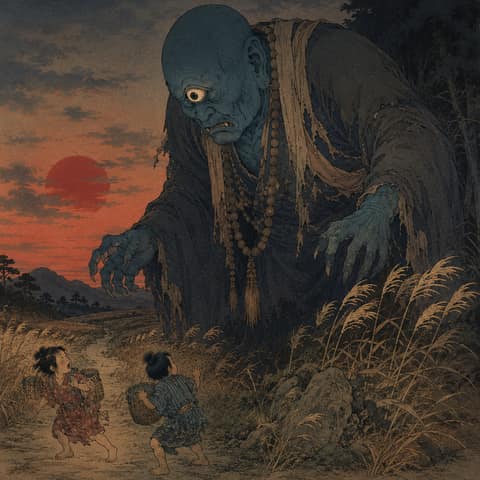
General ClassificationsVarious regions (Wakayama, Fukushima, Gifu, Hiroshima, Shizuoka, Nagano, Okayama, Yamaguchi, Kagawa, etc.)An Aobōzu type based on images in Edo-period picture scrolls and regional field collections. Depicted as a monk with a bluish hue or as a one-eyed priest, it may be told as an animal in disguise, a manifestation of a mountain deity, or an uncanny being of uncertain nature. It serves to warn children against wandering, anchors tales of hauntings in fields, mountains, and vacant houses, and conveys oral taboos. No fixed proper name or origin is agreed upon, and its conditions of appearance and behavior vary by region. Because Sekien’s print lacks commentary, notes from other sources list it alongside the “One-Eyed Monk” or as an allegory for an unseasoned priest, but neither view is definitive. In premodern oral accounts, concrete images coexist under multiple labels such as “Blue Priest,” “Great Monk,” and “Little Monk.”

稀少 Ashinaga Tenaga (Long-Legs and Long-Arms)
ah-shee-NAH-gah teh-NAH-gah
Wakan Zu-e Lineage: Long-Leg and Long-Arm Pair
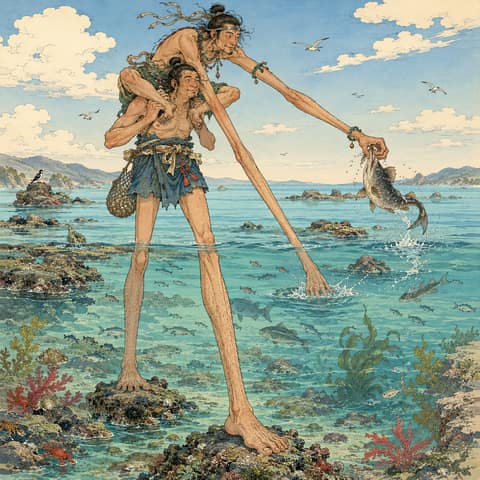
Half-Human BeingsUncertain (ancient foreign lands as reported in early geography)Grounded in the accounts of Sancai Tuhui and the Wakan Sansaizue, this depiction centers on the paired action of the Long-Leg (Ashinaga) and Long-Arm (Tenaga). The Long-Leg wades far into shallow seas, straddling reefs between waves to provide stable footing, while the Long-Arm extends his reach beneath the surface to gather fish and shellfish and to handle nets and baskets. They are recorded as foreign peoples, unattached to specific locales or clans. Dimensions are often given as legs three jo and arms two jo, though sources vary and no single physique is fixed. In Japan they appear in palace screen paintings, caricatures, and kusazoshi, where a set piece of the two cooperating against rough seas became standard. Religiously, they are sometimes placed in Dragon Palace tales as orderly retainers of the sea deity. As folklore, they symbolize otherworldly labor and the extension of reach across distance, and were consumed as images for maritime safety and plentiful catches. Reports of a solitary “Long-Leg” appearing as a weather portent are a separate tradition borrowing the name and should be distinguished from this paired form with Long-Arm.

珍しい Karakasa-kozou
KAH-rah-KAH-sah koh-ZOH
Karakasa-kozou, the Old Umbrella Hopping on Night Roads
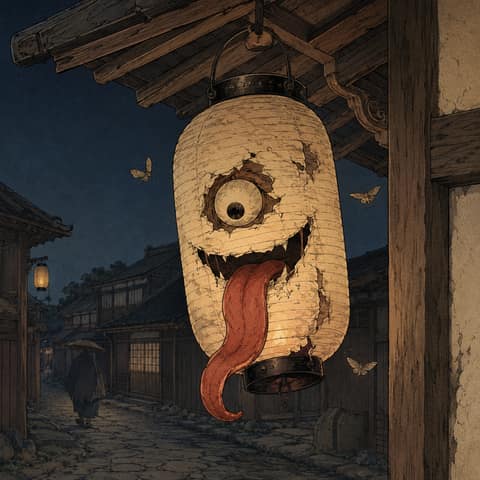
Dwellings & ObjectsAll over Japan ── A tsukumogami of an old umbrella, without a specific origin.This is an interpretation of the one-eyed, one-legged paper umbrella monster, typified by post-Edo period kusazoushi (illustrated entertainment books) and performing arts. In this version, Karakasa-kozou is not a terrifying vengeful spirit that takes human lives, but exhibits an extremely comical and mischievous nature, lurking in the dark to surprise passersby and enjoying their reactions. Although its iconographic roots trace back to the Muromachi period's *Hyakki Yagyo Emaki*, the widely recognized form of "the umbrella handle becoming one leg, with a single eye and long tongue sticking out from the umbrella's fabric" is the result of repetitive production in late Edo "monster playing cards," sideshows, and kabuki trick props. Lined up with visually impactful yokai like the Rokurokubi and Mitsume-kozou, it became a staple star of "toy prints" for children due to the amusement of its design. It appears in alleyways and under eaves at night, hopping on one leg while rustling its frame, causing visual and onomatopoeic strange phenomena, such as licking human faces with its long tongue, but it causes no essential harm. Because it lacks region-specific legends, its haunts and activities are freely adapted depending on the medium, which ironically made it easy to adapt to modern movies and animation. In a sense, it is the ultimate form of Edo townspeople culture completely deodorizing the primal fear of "tsukumogami"—the idea that old objects possess souls—into a "character (toy)" and sublimating it into entertainment.

珍しい Ōmagatoki – The Bewitching Hour of Dusk
OHH-mah-gah-TOH-kee
The Witching Hour (Traditional Narrative)
Half-Human BeingsVarious regions across JapanThough lacking a concrete form, the Witching Hour has long been understood as the effect of dusk’s dimness upon landscape and mind. Households would shut doors, call children inside, and avoid wandering, linking daily rules to this time. Toriyama Sekien depicted a hundred specters gathering at twilight, framing the hour itself as a stage that summons the uncanny. Folklore notes that the difficulty of recognizing faces stirs fear, and mishaps—losing one’s way, waterside accidents, and mountain village straying—were cautioned against as “meeting demons.” Dialects across Japan share this semantic field, often referring to twilight in general without explicit monstrosity. Thus it is not a combative yokai but a sense of peril dwelling in a liminal hour, preserved as a warning tied to the rhythm of daily life.

珍しい Hidden Zato (Kakurezatō)
kah-KOO-reh-zah-TOH
Tradition-Faithful
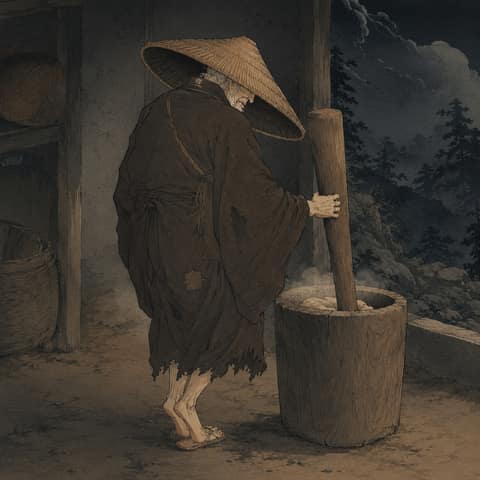
Mountain & Wilderness SpiritsŌu and Kantō regions (Hokkaidō, Akita, Kantō)This version frames the Hidden Zato as a blind minstrel-yokai lurking in the mountains and caverns of Tohoku and Kanto. At midnight it pounds out sounds like a foot-operated mortar or rapid rice polishing, yet the source stays unseen and household tools are said to be “borrowed.” In some tales, peeking reveals the noise coming from a neighbor’s house. Some regions call it a child-snatcher, while others give it a benevolent face as a dispenser of mochi or treasure to the honest, making them prosperous. From early modern times, the idea of hidden villages merged with a mystique around blind guilds, recasting it as an unseen people dwelling in caves. Modern folk explanations liken the racket to insect wingbeats, but as a bearer of the uncanny it endures as a spirit in the form of a zato.

珍しい Gaki Possession (Starving-Ghost Affliction)
GAH-kee TSOO-kee
Traditional Version: Gaki Possession of the Mountain Pass
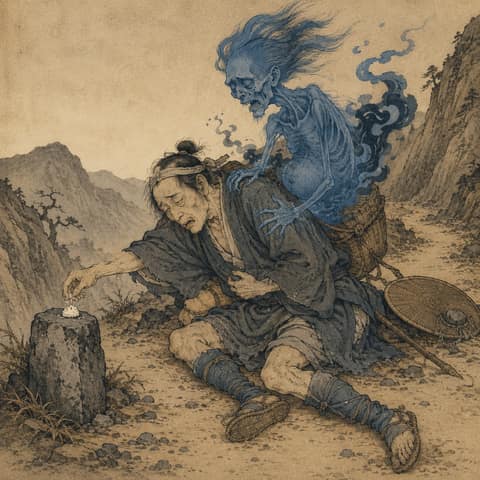
Demons & GiantsVarious regions (Kanagawa, Wakayama, Kochi, Niigata, and elsewhere)A classic image of gaki possession said to occur on mountain passes and in the hills. It is understood to stem from the spirits of those starved to death in battles or as wayfarers, so travelers carried a little food and offered it to the pass before crossing to avert harm. Onset is sudden, marked by fierce hunger, weakness in the limbs, and feet that refuse to move, often leaving one unable to rise in shade or where wind passes through. The remedy is simple: even a single grain of rice, a pinch from a salty rice ball, or a scrap of dried fish in the mouth is said to loosen the grip. As prevention, people scattered a bite of their lunch to the mountain deity or the spirits of the unburied dead, or made offerings at roadside Jizo. One should avoid heavy meals at once, easing the stomach with rice porridge or zosui. Though names vary—Iso-gaki on the coast, Hidarugami in basins and farm villages, Jikitori in Shikoku—the symptoms and remedies are nearly identical and closely tied to local practices of memorial and roadside offerings for the dead.

珍しい Kijo (Demon Woman)
KEE-joh
Canonical Folkloric Type: Kijo (Ogress)
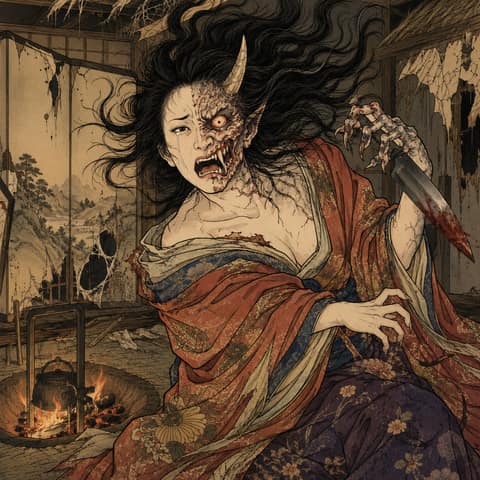
Demons & GiantsVarious regions (notably Tōhoku, Shinano, Ōmi, and around Ise)A standardized profile of the archetypal kijo found across regional tales. She embodies the belief that human passions can ripen into demonic nature, appearing as anything from a beauty to an old woman. By night she lures travelers in mountains or at crossroads, invites them into a lodge or hermitage, then reveals her true form. Many stories end with her being driven off or laid to rest by Buddhist rites, serving as both horror and moral instruction. Depending on locale she may eat humans, target infants, or drink blood, all understood as outcomes of taboo-breaking, suspicion, and obsessive attachment. In Noh, sekkyō, and origin-picture scrolls she is depicted with horns, fangs, and bristling hair, the shock between human guise and oni form being a key dramatic moment.

珍しい Phantom Locomotive
nee-SEH-kee-shah
False Locomotive (Traditional Type)
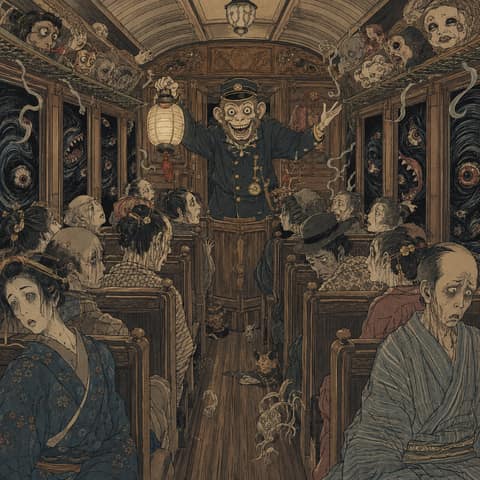
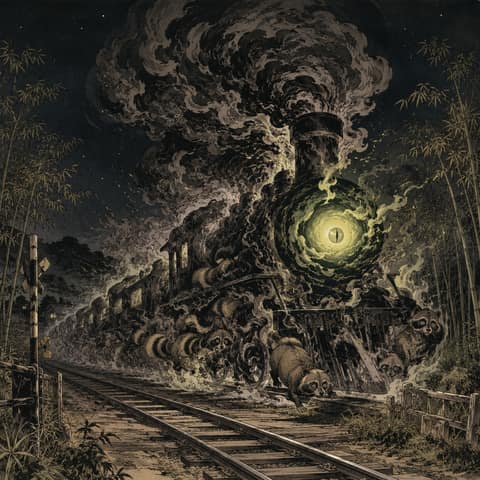
General ClassificationsAcross Japan (especially along railway lines)Accounts of the False Locomotive cluster around the era when the alien sounds and sights of steam engines entered rural life, understood through beliefs in beastly transformations and mimicry. Across regions the plot is similar: at night a whistle and pounding wheels approach from ahead, even lights are seen, but everything vanishes just before impact. Soon after, a dead tanuki or badger is found and given memorial rites. Folklorists place it alongside beings like Azukiarai and Sand-Throwers, extending the idea that uncanny noises are the work of animals. Rumors spread not only by word of mouth but also via newspapers, producing uniform distribution and content. Even when tied to specific locales or temples, the core remains threefold: the match of sound and phantasm, and the tangible animal corpse. It declined as modern transport expanded, yet survives in trackside ghost tales.

珍しい Kūko (Sky Fox)
kū-ko
The Kūko — High Fox Just Below the Tenko
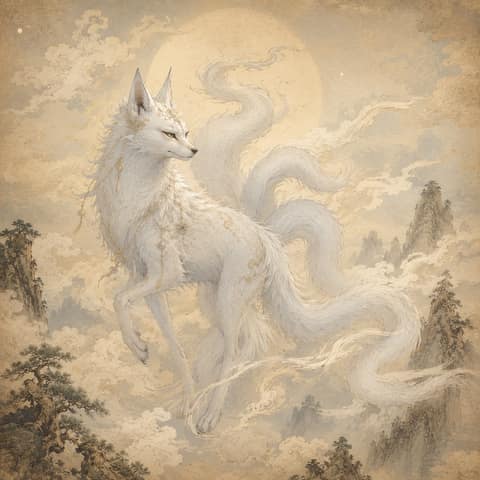
Animal ShapeshiftersThroughout Japan (a high-ranking fox, just below the Tenko)This version looks a little more closely at what kind of being the Kūko actually is. In the Edo-period ranking of foxes, only the lowest, the Yako, was thought to possess a visible body of flesh; from the Kiko upward, foxes were believed to become formless spiritual beings. Because the Kūko ranks just below the Tenko, its shape as an ordinary beast has lost almost all meaning, and it manifests instead as a presence or an influence. By its very nature it differs from the Yako, which stands before people’s eyes to deceive them. A high-ranking fox is closer to one that protects and guides than to one that harms. Overlapping with the lineage of white foxes regarded as messengers of Inari, the Kūko and Tenko were revered in the world of belief as wise foxes that serve the gods. The reason the Kūko so rarely causes any concrete incident is not weakness but that it has long since outgrown the stage of meddling with people out of vanity. Even so, because it wields immense supernatural power, it was thought that to slight it might invite calamity. Gentle toward those who revere it, showing a glimpse of its power only before the arrogant, the Kūko has been spoken of as a mature fox that knows exactly the right distance to keep from human beings.

珍しい Kuro-bōzu (Black Monk)
KOO-roh BOH-zoo
Kuro-bōzu (Traditional Folk Variants)
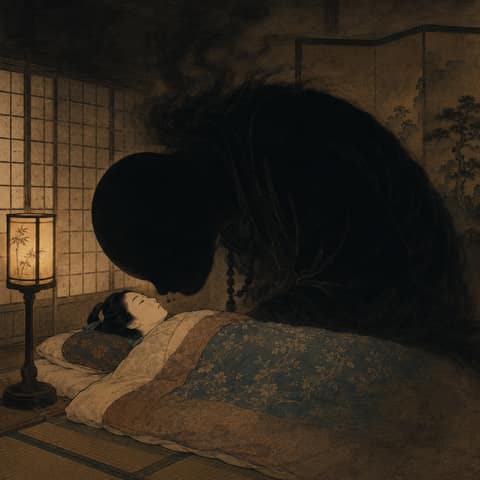
General ClassificationsUncertain; tales recorded in Edo/Tokyo, Kumano (Kii Province), and Nomi District, Kaga ProvinceThe name Kuro-bōzu has long served as a catch-all for regionally varied apparitions. In Edo-Tokyo it was recorded as a bedroom prowler that drew close to women’s mouths to sip their sleeping breath, leaving a fishy odor before departing. Sightings are vague and it is sometimes classed with faceless ghosts. In the Kii Kumano region, meeting it in the mountains causes its height to shoot up, and the more one pursues it the larger it grows before fleeing at great speed. Near the Osada River in Kaga, it appears as a black mass outlined only by its silhouette and escapes into water when struck with a staff, a behavior some locals attribute to an otter spirit. Across Japan the term also substitutes for giants like Ōnyūdō or sea spirits like Umibōzu, sharing one or more traits of black coloration, monk-like appearance, sudden elongation, and affinity with watersides. None of these types show sustained habitation, and reports of appearances typically cease in time.

珍しい Salmon Daisuke
SAH-keh noh OH-oh-skay
Legendary Tale: Daisuke of the Salmon
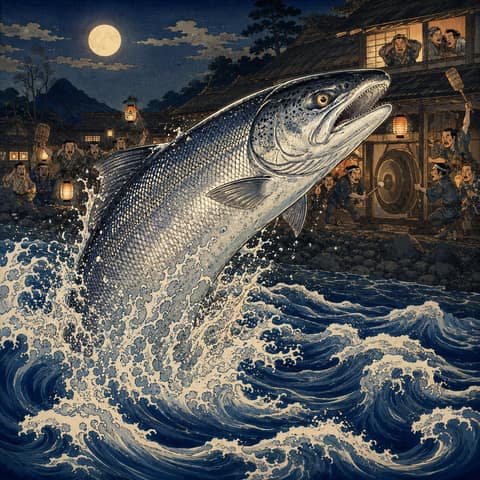
Aquatic SpiritsTohoku region; Shinano River basin (Niigata Prefecture) and across eastern JapanKnown as the King of the River, Daisuke of the Salmon marks forbidden periods and seasonal rites during the salmon run. On set dates—such as the fifteenth of the Frost Month and the twentieth of the Twelfth Month—Daisuke and his consort Kosuke are said to proclaim in loud voices. Anyone who directly hears them dies three days later, so riverside communities kept those days as no-fishing days, ringing gongs, singing, and pounding rice cakes to block out the sound. In tales along the Shinano River, a powerful elder who forces taboo-breaking meets a water authority in the guise of an old woman and dies suddenly with the run’s onset, embodying awe of nature and adherence to proper conduct. The old woman is read as a personified river spirit or Daisuke’s avatar, though never revealed outright. The name varies between “Daisuke of the Salmon” and “Daisuke the Salmon,” and his wife is called Kosuke. Recorded from the early modern period in surveys and folktale collections, this motif spreads across the salmon culture zone of eastern Japan beyond specific locales. Creative variants are few, and the core points—voice, dates, taboo, and fatal retribution—remain consistent.

珍しい Female Tengu
OHN-nah TEN-goo
Annotated Tradition Edition: Female Tengu
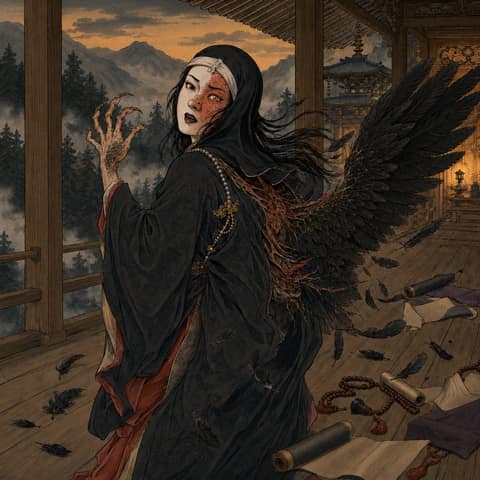
Mountain & Wilderness SpiritsSacred mountains and river valleys across JapanThe Female Tengu is a strand within the broader image of tengu sporadically referenced in texts and oral lore. She is depicted in women’s attire such as kosode, light robes, or scarlet hakama, yet her back-borne wings and supernatural power mark her as a tengu. In The Tale of the Heike and its offshoots, the nun-tengu appears as a metamorphosis born from religious decline, providing a female counterpart to the monk-tengu. Edo-period mountain-encounter tales often stress prohibitions against women, noting the absence of female tengu, while river-tengu lore sporadically mentions married pairs or feminine features. Claims tracing their lineage to the goddess Amanozakoyahime appear in early modern natural-history writings but remain interpretive rather than doctrinal. Regional variation is great and no single image dominates, yet they share the general tengu attributes of might, illusion, and flight. Stripped of creative exaggeration, the Female Tengu is best seen as a projection of womanhood within the tengu world, with specific names and genealogies largely unknown.

珍しい Ikijama (Living Jinx)
EE-chee-JAH-mah
Nama-Jama (Folkloric Sketch)
Ghosts & SpiritsOkinawa PrefectureA strand of Okinawan beliefs about living spirits. When hatred or envy swells, a person’s spirit may slip out while retaining their form and afflict the target with illness or malaise. Reports describe several modes: possession via gifts, attachment through a curse-doll known as the Nama-Jama Buddha, and even obsession achieved by will alone. Harm was said to strike not only people but also livestock and fields. Communities responded with yuta prayers, apotropaic fouling, and even driving it off through scolding and insults. Some accounts say the lineage passes matrilineally, leading to recorded cases of avoided marriages. Early modern records note accusations, lawsuits, and punishments for alleged use.

珍しい Aka-ashi (Red Foot)
AH-kah AH-shee
Aka-ashi
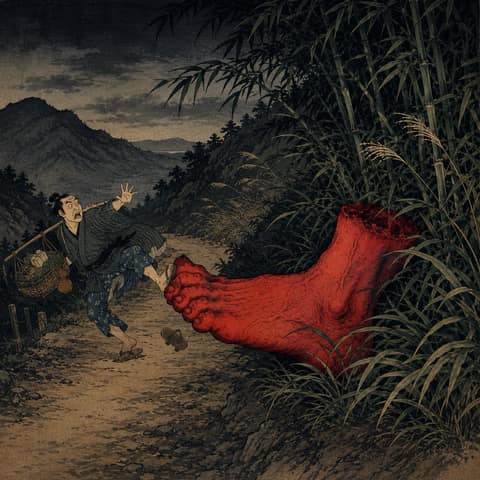
General ClassificationsVarious regions of Japan (Shiwaku Islands in Kagawa, Fukuoka Prefecture, Hachinohe in former Mutsu)Based on records from various regions, in places where it shows itself only a pair of red feet jut from the roadside, startling passersby and throwing off their pace. Where it remains unseen, a dry, cottony or cobweb-like touch clings to the shins, shortening strides and increasing fatigue. It is not lethal, yet it is feared for causing falls and leading people off the road. Its relation to the Red-Hand Child is noted in sources but not assumed to be identical. Encounters are told at crossroads, mountain paths, and brush edges in sparsely peopled spots, most often from dusk to midnight. As remedies, some regions pass down practical measures: breathe deeply and steady your steps, sit to retie sandal thongs, brush aside the roadside grass, though details vary locally and remain uncertain.

珍しい Chōchin-bi (Lantern Fire)
CHOH-cheen-bee
Chochin-bi (Lantern-Flame, regional will-o’-the-wisp type)
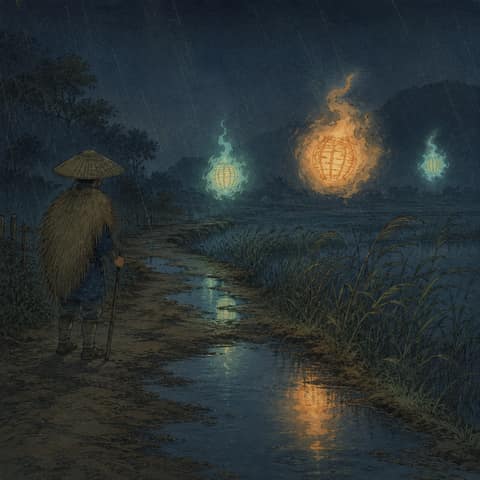
Natural Phenomena SpiritsAcross Japan (notably Shikoku, Yamato, and Ōmi traditions)A regional catch-all name for ghostly lights about the size of a paper lantern. In some areas it is conflated with kitsune-bi and tanuki-bi, its name stemming from the idea of monsters lighting lanterns. It appears on rainy nights along riverbanks, dikes, and graveyards, drifting at a fixed height. Accounts vary by era and locale: vanishing when approached, splitting when struck, or marching in clusters. In folklore it portends untimely death or a curse and marks taboos along the roadside, anchoring tales that warn against pursuit or striking it. It appears in early modern essays and kaidan, sometimes gaining proper names (such as Koemon-bi) and lodging in local memory. Natural ignition and animal-origin theories coexist, and its true nature remains unsettled.

珍しい Tengu Pebble Shower
TEN-goo TSU-boo-teh
Tradition-Faithful Edition
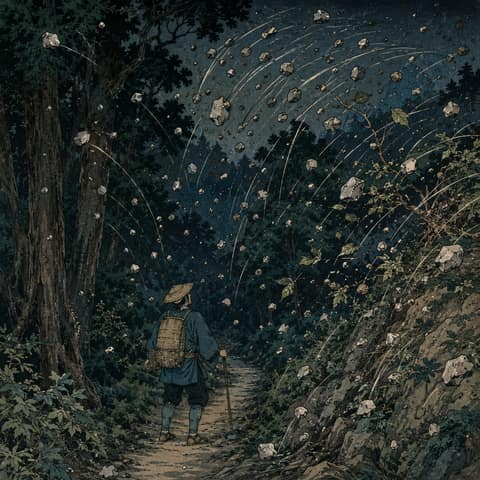
自然現象・自然霊Various regions of Japan (noted in Kaga and Edo records)Tengu-tsubute is told as a formless anomaly whose cause has been variously ascribed to tengu, foxes, or divine intent. Stones fly from all directions though no thrower is seen, impacts and sounds are real yet no stones are found, no marks remain, and the events repeat at set hours. Cases are recorded widely from Kaga, Kanazawa, and Edo in urban quarters to shrine precincts, and some reports note that crowds of onlookers or official patrols led to its quieting. Morally it serves as a warning against misconduct and as an omen of crop failure or illness, and older records link it with thunder as stones cast by Tenjin. Folklore studies connect it conceptually to stone-throwing rites, mass petitions, and indochi stone fights, understanding it as an expression of a supernatural will.

珍しい Horse Possession
OO-mah-TSOO-kee
Tradition-Tale Variant
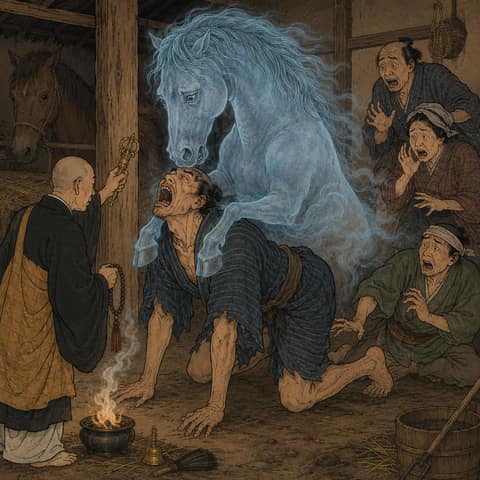
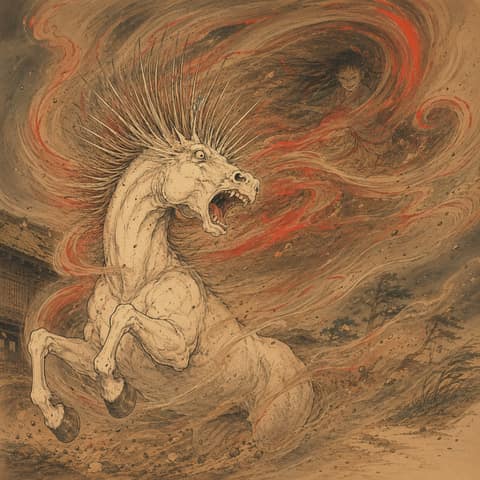
Ghosts & SpiritsAcross Japan (Mikawa, Tōtōmi, Awa, Musashi, and elsewhere)A collective term found in early modern anecdotes and essays for possessions by the vengeful spirits of horses. It warns against violating precepts against killing and neglecting animal care ethics, with triggers including abuse, death from overwork, and callous disposal. Symptoms include neighing, involuntary movements of the limbs, craving foul water, self-biting, reports of seeing as a horse sees, and voicing curses against abusers. The possessing agent may be the spirit of a specific horse or generalized as retribution within the realm of beasts. Recorded remedies include esoteric rites, posthumous memorial services, tending graves and making offerings, though efficacy varies by case. Cases appear in Mikawa, Tōtōmi, Awa, Musashi, and Harima, affecting horse-handlers, samurai, and farmers. While some tales are highly embellished, overall they function as didactic narratives promoting animal memorials and ethics.

珍しい Poverty God
BEEN-boh-gah-mee
Classical Folktale-Concordant
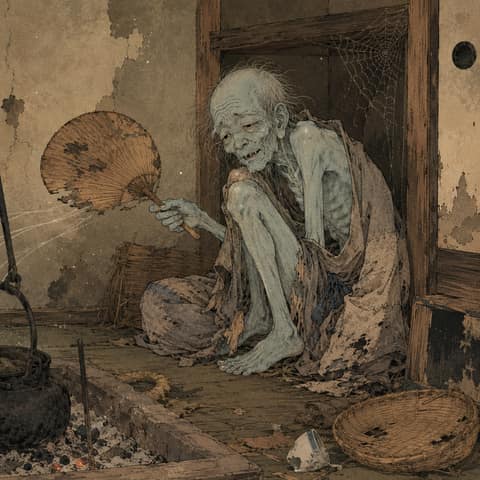
Household SpiritsAcross JapanThe Binbōgami traces its roots to the personification of medieval poverty and began to be named explicitly from the Muromachi period onward. It commonly appears as a gaunt old man carrying a plain paper fan, believed to dwell in closets or the corners of tatami rooms. Banishment is not easy, and ritual sending-off is preferred over force. Saishōshi records guiding it outside the gate with a branch on the last night of the month, Tankai describes setting grilled rice and roasted miso on a wooden tray and letting them drift downriver from the back door, and Nihon Eitaigura tells of honoring it respectfully on the Night of the Seven Herbs so that, appeased, it turns to bring fortune. Numerous folk beliefs link it with fire and household order, as in Niigata’s New Year’s Eve hearth customs and Ehime’s taboos against disturbing the fire. Miso, said to be its favorite, is cited both as an attractant and a taboo, with roasted miso rites preserved in many regions. Though a punitive deity, it is said to grow uncomfortable where diligence, cleanliness, and frugality are observed, and in folk religion it functions as the counter-concept to household gods of fortune, serving as a barometer of family luck.

珍しい Pillow-Flipper
mah-koo-rah-GAH-eh-shee
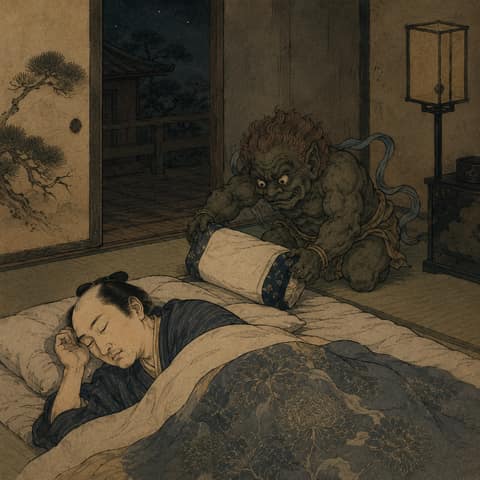
Traditional Type – Temple and Shrine Anomaly Affiliation
Household SpiritsAcross JapanA pillow-flipping subtype rooted in old beliefs that pillows are linked to the movement of the soul and to boundaries. It manifests at thresholds between sacred and secular spaces such as certain parlors, pillars, or Buddhist rooms, turning sleepers’ heads toward a Buddha or principal icon, or simply inverting the pillow to signal a reversal of order. Noted in essays and picture scrolls from the Edo period onward, it often ties into temple Seven Wonders and scroll-haunt tales. In some regions it is read as the play of a zashiki-warashi, the sign of a spirit of someone who died in the house, or a guise of a shapeshifting animal. The fear it inspires has shifted over time: once viewed as a portent of deadly curse, in modern times it tends to be treated as a lighter bedroom haunting and prank.

珍しい Dragon Maiden
RYOO-joh
Dragon Maiden of the Water’s Edge
Aquatic SpiritsJapanese folkloreA folkloric type distilled from tales of a dragon maiden who appears to travelers and fishers near waters. She speaks in human form and asks for offerings or vows. If covenants are kept, she wards off floods and draws shoals of fish; if broken, she chastens with turbid torrents and tempests. She stands not in opposition to deities or Buddhism and is often revered as a rain-bringing dragon god. She shifts between human and dragon shape, with clues to her true nature felt in scales or the damp texture of her garments.

珍しい Taiba, the Horse-Killing Wind
TAI-bah
Taiba (Traditional Record Edition)
Weather & Calamity SpiritsVarious regions across Honshu and ShikokuTaiba is recorded as a sudden apparition arriving with wind and blowing sand. It appears from April to July, especially May to June, and travelers were warned on days that shift between sun and cloud. Accounts vary by region regarding the victim horse’s coat and sex: in Mino white horses were targeted, in Enshu chestnut and bay, while old women and mares were said to be spared. Eyewitnesses tell of each mane hair standing on end, a red gleam shining, and when the horse collapses the wind falls still. The Owari and Mino “Giba” is regarded as a personification of Taiba, a small girl who descends from the sky, ensnares a horse, then vanishes with a smile; the chosen horse spins rightward several times and dies. Folk countermeasures include covering the horse’s neck with cloth, fitting deerfly-proof belly guards or bells, and in emergencies letting a little blood from the ear, needling the center of the tailbone, or cutting the air ahead with a sword while reciting the Komyo Mantra. Temples and shrines fostered prayers for quelling horse-plagues, and talismans to horse deities and belly wraps were used as Taiba wards.

一般 Tanuki
Tanuki
One Step Beyond Seven: The Tanuki's Eight Transformations
Animal shapeshifterAcross Japan, with bake-danuki legends especially concentrated in western JapanWhat "fox seven, tanuki eight" means. "Foxes have seven transformations, tanuki have eight" is a familiar Japanese proverb. It says that tanuki surpass foxes by one degree of shapeshifting. An expanded saying, "fox seven, tanuki eight, otter nine, cat ten," orders animal magic into a ladder. Konjaku Monogatari-shu, volume 27, tale 22, where an aged tanuki becomes a demon, expresses the same idea: long-lived beasts awaken stronger powers. Named old tanuki such as Kincho, Danzaburo, Tasaburo, Shibaemon, and Inugami Gyobu may even become daimyojin. The eight-mat scrotum and Edo humor. The tanuki's scrotum is not biology but urban comedy. Edo goldbeaters were said to wrap a small amount of gold in tanuki skin and hammer it out to the size of eight tatami mats. Utagawa Kuniyoshi turned that joke into images of umbrellas, nets, rooms, shamisen, and sumo rings; Tsukioka Yoshitoshi moved toward the uncanny atmosphere of the Morinji kettle. Low-city caricature and temple ghost story together formed the early modern visual tanuki. Three Famous Tanuki and Three Great Legends. The two sets are often mixed up. Japan's Three Famous Tanuki are Danzaburo, Tasaburo, and Shibaemon. The Three Great Tanuki Legends are Inugami Gyobu, Bunbuku Chagama of Morinji, and the Shojoji tanuki-bayashi tale. The Awa Tanuki War, centered on Kincho and Rokuemon and mediated by Tasaburo, belongs to another stream made famous through kodan storytelling and film. The eight auspicious signs of Shigaraki tanuki. Shigaraki tanuki's eight auspicious signs read the statue's hat, eyes, smile, flask, account book, belly, money bag, and tail as blessings for business: avoiding misfortune, watching carefully, welcoming customers, having food and drink, keeping trust, staying calm, gaining wealth, and finishing well. In effect, postwar merchant ethics were projected onto a round, friendly tanuki body. Pom Poko, with tanuki driven out by development, shows the other side of the same postwar consumer society that put Shigaraki tanuki at shop doors. Why tanuki survive. Pom Poko from 1994 makes tanuki displaced local spirits under Tama New Town development and brings together famous tanuki, including Inugami Gyobu. The Eccentric Family from 2007 imagines Kyoto as a city where tanuki, humans, tengu, and foxes overlap. The tanuki endures because it changes with each period: Edo joke, Meiji image, postwar business charm, modern urban fantasy.